Judges 5:4

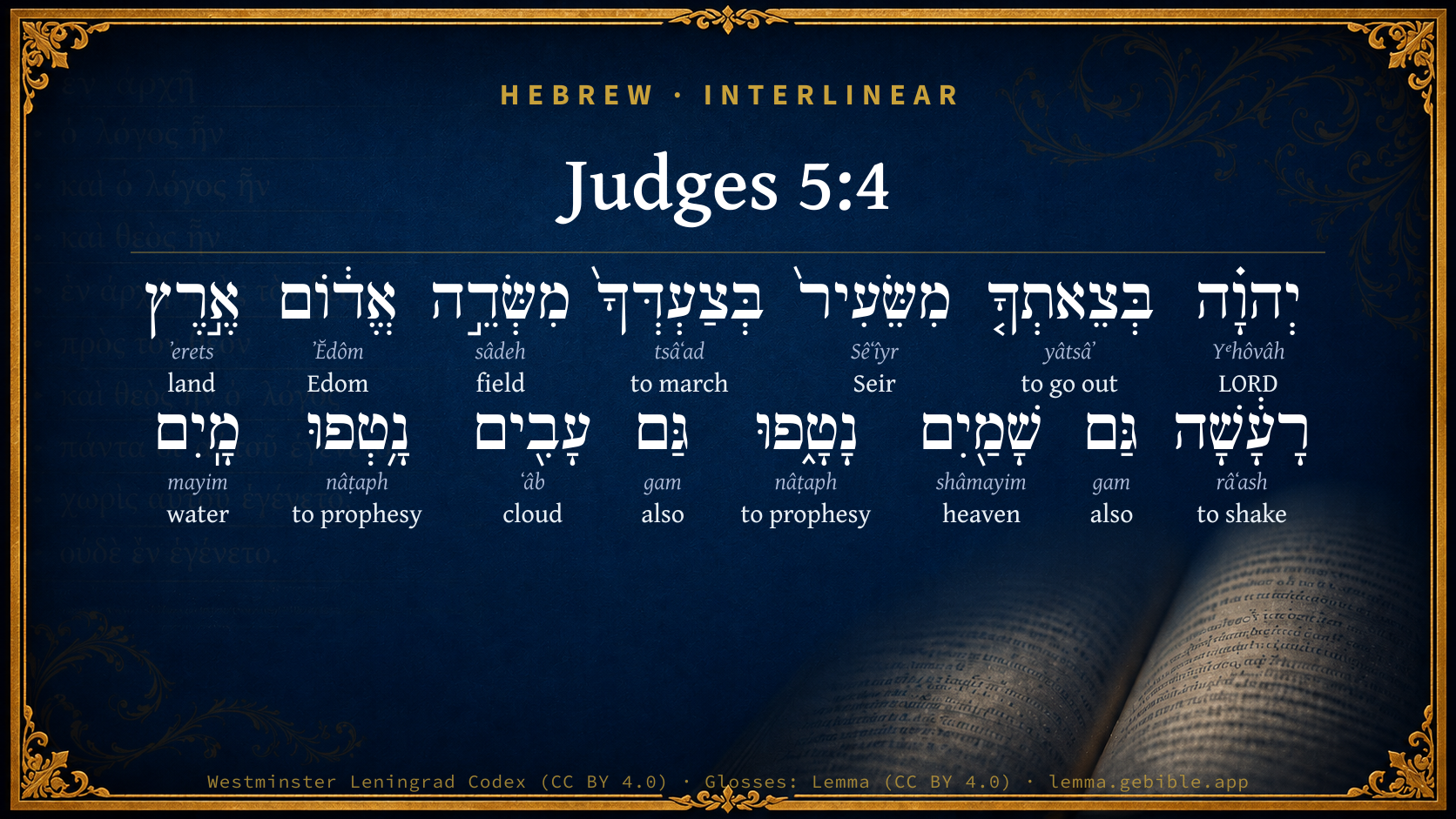
Hebrew (Westminster Leningrad Codex) Judges 5:4 appears in the Hebrew Old Testament. The text above is from the Westminster Leningrad Codex. Each word links to its Strong’s number, a concise gloss, and parsing drawn from the Open Scriptures Hebrew Bible morphology. Click any word for its full Brown-Driver-Briggs (BDB) entry.
Download image
Cite this verse

Judges 5:4 (World English Bible). Public Domain. Lemma interlinear Bible study tool, https://lemma.gebible.app/v/judges/5/4.

Show BibTeX & RIS
BibTeX
RIS
English Translation
Yahweh, when you went forth out of Seir, When you marched out of the field of Edom, The earth trembled, the sky also dropped, Yes, the clouds dropped water.
World English Bible · Public Domain
Highlights
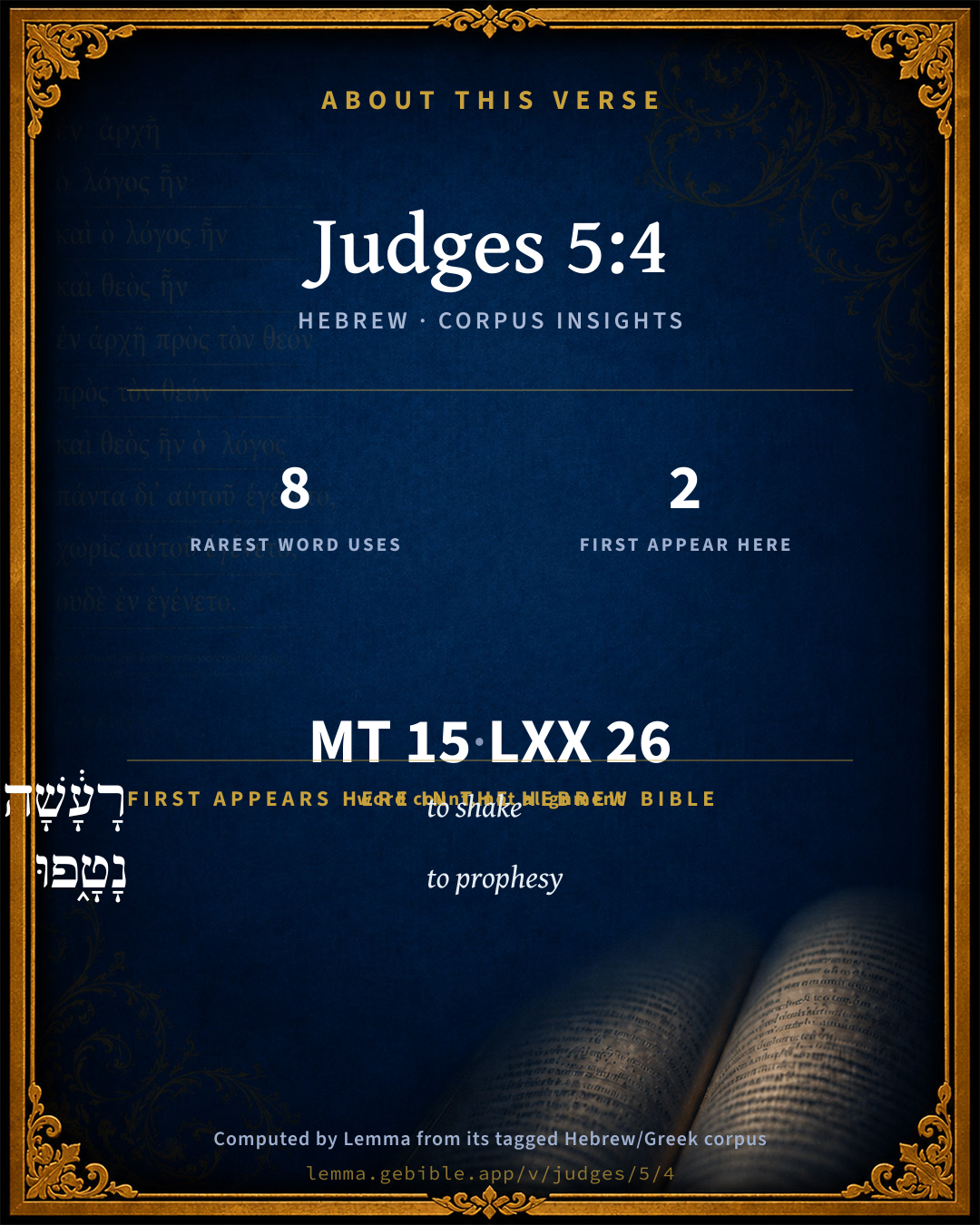
  • 2 first appearances in the Hebrew Bible
Full analysis ↓
Download a study sheet

One document with this verse’s original text, its word-by-word gloss line, the meaning frame, cross-references with their text, attributed commentary, and full source and license credits — printable, and it pastes into notes with its structure intact.

This verse Autodidact and up

Study sheet (.html) Plain text (.txt)

A passage Seminary Student

Up to 50 verses in one chapter. A passage sheet keeps up to 6 commentary sources and 12 cross-references per verse, in the order this page ranks them, and says so on the sheet whenever that leaves anything out. Ask for a single verse and you get the Autodidact verse sheet above.

Everything on this page stays free to read, with no account — the sheet is a download of what is already on screen, not access to it.

Want to remove ads? Support Godless Engineer
Compare translations 3

The same verse in 3 English versions, stacked beneath the original-language interlinear above. Click any original word for its lexicon entry.

Each is an independent rendering of the whole verse — the interlinear is not word-aligned to these translations.

Highlighted words mark where these versions differ — a whole-verse word diff, not a word-by-word alignment.

  • World English Bible Public Domain
    Yahweh, when you went forth out of Seir, When you marched out of the field of Edom, The earth trembled, the sky also dropped, Yes, the clouds dropped water.
  • King James Version Public Domain
    LORD, when thou wentest out of Seir, when thou marchedst out of the field of Edom, the earth trembled, and the heavens dropped, the clouds also dropped water.
  • unfoldingWord Literal Text CC BY-SA 4.0
    Yahweh, at your going forth from Seir, at your marching from the field of Edom, the earth shook, the heavens also dripped, the dark clouds also dripped water.

unfoldingWord Literal Text — © unfoldingWord, licensed CC BY-SA 4.0. Word-aligned USFM3 via Door43 (git.door43.org/unfoldingWord/en_ult).

Versions to compare (up to 4)

3 of 4 selected

Show all 18 translations

Every available English version of this verse, each an independent rendering of the whole verse.

  • World English Bible Public Domain
    Yahweh, when you went forth out of Seir, When you marched out of the field of Edom, The earth trembled, the sky also dropped, Yes, the clouds dropped water.
  • Berean Standard Bible Public Domain
    O LORD, when You went out from Seir, when You marched from the land of Edom, the earth trembled, the heavens poured out rain, and the clouds poured down water.
  • Majority Standard Bible Public Domain
    O LORD, when You went out from Seir, when You marched from the land of Edom, the earth trembled, the heavens poured out rain, and the clouds poured down water.
  • King James Version Public Domain
    LORD, when thou wentest out of Seir, when thou marchedst out of the field of Edom, the earth trembled, and the heavens dropped, the clouds also dropped water.
  • American Standard Version (1901) Public Domain
    Jehovah, when thou wentest forth out of Seir, When thou marchedst out of the field of Edom, The earth trembled, the heavens also dropped, Yea, the clouds dropped water.
  • Revised Version (1885) Public Domain
    LORD, when thou wentest forth out of Seir, when thou marchedst out of the field of Edom, the earth trembled, the heavens also dropped, yea, the clouds dropped water.
  • Geneva Bible (1599) Public Domain
    Lord, when thou wentest out of Seir, when thou departedst out of the field of Edom, the earth trembled, and the heauens rained, the cloudes also dropped water.
  • Douay-Rheims (1899) Public Domain
    O Lord, when thou wentest out of Seir, and passedst by the regions of Edom, the earth trembled, and the heavens dropped water.
  • Young's Literal Translation Public Domain
    Jehovah, in Thy going forth out of Seir, In Thy stepping out of the field of Edom, Earth trembled, also the heavens dropped, Also thick clouds dropped water.
  • Literal Standard Version CC BY-SA 4.0
    YHWH, in Your going forth out of Seir, || In Your stepping out of the field of Edom, || The earth trembled and the heavens dropped, || And thick clouds dropped water.
  • Unlocked Literal Bible CC BY-SA 4.0
    Yahweh, when you went out from Seir, when you marched from Edom, the earth shook, and the skies also trembled; also the clouds poured down water.
  • unfoldingWord Literal Text CC BY-SA 4.0
    Yahweh, at your going forth from Seir, at your marching from the field of Edom, the earth shook, the heavens also dripped, the dark clouds also dripped water.
  • Darby Bible Public Domain
    "LORD, when thou didst go forth from Se'ir, when thou didst march from the region of Edom, the earth trembled, and the heavens dropped, yea, the clouds dropped water.
  • World Messianic Bible Public Domain
    “LORD, when you went out of Seir, when you marched out of the field of Edom, the earth trembled, the sky also dropped. Yes, the clouds dropped water.
  • Webster's Bible Public Domain
    LORD, when thou wentest out of Seir, when thou marchedst out of the field of Edom, the earth trembled, and the heavens dropped, the clouds also dropped water.
  • Free Bible Version CC BY-SA 4.0
    Lord, when you set off from Seir, when you marched from the land of Edom, the earth shook, rain fell from the skies, the clouds poured down water.
  • Bible in Basic English Public Domain
    Lord, when you went out from Seir, moving like an army from the field of Edom, the earth was shaking and the heavens were troubled, and the clouds were dropping water.
  • JPS Tanakh (1917) Public Domain
    LORD, when Thou didst go forth out of Seir, when Thou didst march out of the field of Edom, the earth trembled, the heavens also dropped, yea, the clouds dropped water.

Literal Standard Version (2020), Covenant Press — licensed CC BY-SA 4.0. Text via the HelloAO Bible API (eBible.org). Unlocked Literal Bible (unfoldingWord) — licensed CC BY-SA 4.0. Text via the HelloAO Bible API (eBible.org). unfoldingWord Literal Text — © unfoldingWord, licensed CC BY-SA 4.0. Word-aligned USFM3 via Door43 (git.door43.org/unfoldingWord/en_ult). Free Bible Version, Dr. Jonathan Gallagher — licensed CC BY-SA 4.0. Text via the HelloAO Bible API (eBible.org).

Word by word

More ways to search: Search by grammar → Find every occurrence → Compare this word →

Practice this passage: Drill this verse → Learn its vocabulary →

בְּצַעְדְּךָ֙
tsâʻad
H6805
“in/at · to march · you”
Preposition + Verb, Qal, Infinitive Construct + Suffix, Personal, 2nd Person, Masculine, Singular
Part of Speech
Preposition + Verb
Stem
Qal
Form
Infinitive Construct
Full BDB Definition

Origin: a primitive root

TWOT: 1943

to step, march, stride - (Qal) to step, march - (Hiphil) to cause to march
  1. יְהוָ֗ה Yᵉhôvâh H3068 “LORD” Noun, Proper
  2. בְּצֵאתְךָ֤ yâtsâʼ H3318 “in/at · to go out · you” Preposition + Verb, Qal, Infinitive Construct + Suffix, Personal, 2nd Person, Masculine, Singular
  3. מִשֵּׂעִיר֙ Sêʻîyr H8165 “from · Seir” Preposition + Noun, Proper
  4. מִשְּׂדֵ֣ה sâdeh H7704 “from · field of” Preposition + Noun, Common, Masculine, Singular, Construct
  5. אֱד֔וֹם ʼĔdôm H123 “Edom” Noun, Proper
  6. אֶ֣רֶץ ʼerets H776 “land” Noun, Common, Both, Singular, Absolute
  7. רָעָ֔שָׁה râʻash H7493 “to shake” Verb, Qal, Perfect, 3rd Person, Feminine, Singular
  8. גַּם gam H1571 “also” Particle, Accusative
  9. שָׁמַ֖יִם shâmayim H8064 “heaven(s)” Noun, Common, Masculine, Plural, Absolute
  10. נָטָ֑פוּ nâṭaph H5197 “to prophesy” Verb, Qal, Perfect, 3rd Person, Common, Plural
  11. גַּם gam H1571 “also” Particle, Accusative
  12. עָבִ֖ים ʻâb H5645 “clouds” Noun, Common, Both, Plural, Absolute
  13. נָ֥טְפוּ nâṭaph H5197 “to prophesy” Verb, Qal, Perfect, 3rd Person, Common, Plural
  14. מָֽיִם mayim H4325 “water(s)” Noun, Common, Masculine, Plural, Absolute

About this verse

These counts appear in no published source. They are computed here, from the morphology-tagged text and Lemma’s own curated glosses. What Lemma adds →

15
words
13
distinct lemmas
Historical
section

Notable vocabulary

The rarest word here is בְּצַעְדְּךָ֙ to march H6805 — appearing just 8 times in the whole Hebrew Bible.

First appearance in Scripture

These words make their first canonical appearance in the Hebrew Bible here:

  • רָעָ֔שָׁה to shake H7493
  • נָטָ֑פוּ to prophesy H5197

Shared distinctive vocabulary

בְּצַעְדְּךָ֙ to march H6805 occurs in 8 verses of the Hebrew Bible. Also found in:

Grammatical profile

  • 5 verbs
  • 8 nouns
  • 2 particles

Verb forms

  • בְּצֵאתְךָ֤ Qal · Infinitive Construct
  • בְּצַעְדְּךָ֙ Qal · Infinitive Construct
  • רָעָ֔שָׁה Qal · Perfect
  • נָטָ֑פוּ Qal · Perfect
  • נָ֥טְפוּ Qal · Perfect

Repetition

Words recur within this verse — often emphatic in Hebrew:

  • גַּם also H1571 ×2
  • נָטָ֑פוּ to prophesy H5197 ×2

Hebrew & Septuagint length

In English translation the verse runs 29 words from the Hebrew and 31 from the Septuagint (LXX English) — closely comparable.

A rough comparison of the two English renderings, which tokenize alike — not a word-level alignment.

Word counts can differ between the Hebrew and the Greek without any difference in meaning — e.g. the Hebrew direct-object marker אֵת has no separate Greek word, and Greek often adds the article ὁ.

In the original languages it is 15 Hebrew tokens and 26 Greek tokens — but the two are counted differently (Hebrew bundles its prefixes and suffixes into one token; the Greek is in lemma form), so that isn’t a like-for-like length.

Cross-references

7

Topical passages linked to Judges 5:4 in the Treasury of Scripture Knowledge — connected by theme and wording, ordered by reader-vote popularity; previews shown in the World English Bible.

  • Deuteronomy 33:2 He said, Yahweh came from Sinai, Rose from Seir to them; He shined forth from Mount Paran, He came from the ten thousands of holy ones: At his right hand was a fiery law for them.
  • Psalms 68:7–8 God, when you went forth before your people, When you marched through the wilderness... Selah.
  • Psalms 77:17 The clouds poured out water. The skies resounded with thunder. Your arrows also flashed around.
  • 2 Samuel 22:8 Then the earth shook and trembled, The foundations of heaven quaked Were shaken, because he was angry.
  • Job 9:6 Who shakes the earth out of its place; The pillars of it tremble;
  • Psalms 18:7–15 Then the earth shook and trembled. The foundations also of the mountains quaked and were shaken, Because he was angry.
  • Habakkuk 3:3–6 God came from Teman, The Holy One from Mount Paran. Selah. His glory covered the heavens, And his praise filled the earth.

Cross-references courtesy of OpenBible.info (CC BY 4.0).

Hebrew and Greek witnesses Masoretic Hebrew ↔ Greek Septuagint

The same verse in the two great witnesses to the Old Testament, shown verse-for-verse.

These are two independent witnesses, not word-aligned to each other, and the Septuagint is shown in lemma (dictionary) form.

Hebrew Judges 5:4 Masoretic · Westminster Leningrad Codex

יְהוָ֗ה בְּצֵאתְךָ֤ מִשֵּׂעִיר֙ בְּצַעְדְּךָ֙ מִשְּׂדֵ֣ה אֱד֔וֹם אֶ֣רֶץ רָעָ֔שָׁה גַּם שָׁמַ֖יִם נָטָ֑פוּ גַּם עָבִ֖ים נָ֥טְפוּ מָֽיִם

Yahweh, when you went forth out of Seir, When you marched out of the field of Edom, The earth trembled, the sky also dropped, Yes, the clouds dropped water.

World English Bible · Public Domain

Greek LXX Judges 5:4 Septuagint · lemma form

κύριος ἐν ὁ ἔξοδος σύ ἐν σηιρ ἐν ὁ ἀποαἴρω σύ ἐκ ἀγρός εδωμ γῆ σείω καί ὁ οὐρανός στάζω δρόσος καί ὁ νεφέλη στάζω ὕδωρ

O Lord, in your going forth on Seir, when you went forth out of the land of Edom, the earth quaked and the heaven dropped dews, and the clouds dropped water.

LXX2012 (modern English Septuagint) · Public Domain

On this verse, The Cambridge Bible for Schools and Colleges discusses the Septuagint’s reading. Read the note in Commentary ↓

Hebrew: Westminster Leningrad Codex (CC BY 4.0). Greek: Septuagint (public domain); English from LXX2012 (modern English Septuagint) (Public Domain). How the Septuagint differs from the Hebrew →

Targum (Aramaic paraphrase)

1

The Targum is the ancient Jewish Aramaic paraphrase of the Hebrew Scriptures — an interpretive translation, not the Hebrew text itself. Onkelos (literal) and Pseudo-Jonathan (expansive) render the Torah, and Jonathan the Prophets. Coverage is partial: where no permissively-licensed English translation exists for a verse, only the Aramaic is shown. This is verse-level text, not a word-by-word alignment to the Hebrew.

  1. Targum Jonathan Prophets (Joshua–Malachi)
    יְיָ אוֹרַיְתָךְ דִיהַבְתָּא לְיִשְׂרָאֵל כַּד עָבְרִין עֲלָהּ הֲוָה שַׁלְטִין בְּהוֹן עַמְמַיָא וְכַד תַּיְבִין לָהּ מִתְגַבְּרִין אִנוּן עַל בַּעֲלֵי דְבָבֵיהוֹן יְיָ בְּיוֹם אִתְגַלֵיתָךְ לְמִתְּנָהּ לְהוֹן מִשֵׂעִיר בְּהוֹן אִתְגַלֵיתָא בְּהוֹפָעוֹת יְקָרָךְ עַל תְּחוּמֵי אֱדוֹם אַרְעָא זָעַת אַף שְׁמַיָא מָכוּ אַף עֲנָנַיָא נְגִידוּ מִטְרָא:

    (no public-domain English translation for this verse)

    Targum Jonathan — Aramaic: “Mikraot Gedolot” (public domain). English: “Sefaria Community Translation” (CC0 1.0 (public-domain dedication)); “London "Chaldee Paraphrase," 1871” (public domain). Text via Sefaria.

Commentary

Notes on Judges 5:4 from classic Christian and Jewish commentators (each source and its license shown beneath its notes). The classic Christian expositions comment on the surrounding passage and are grouped to its opening verse, so a note may address several verses; the Jewish commentaries on the Tanakh (Rashi and others) are per-verse, so they appear only where the commentator wrote on this verse.

Lemma curates 59 commentaries, every one of them public domain or Creative Commons licensed, each selected and text-cleaned for this edition rather than reprinted as found. About our sources →

Trapp's Complete Commentary

John Trapp

Jdg 5:4 LORD, when thou wentest out of Seir, when thou marchedst out of the field of Edom, the earth trembled, and the heavens dropped, the clouds also dropped water.

Ver. 4. Lord, when thou wentest out of Seir.] When thou marchedst before thy people through the wilderness. Thus this good woman recogniseth mercies long since received, that she may the better praise God for the present deliverance. A worthy pattern for us to imitate, with whom, as with children, eaten bread is soon forgotten. It is good to begin our thanksgivings high enough: and as shopkeepers, by turning over their books to look up one debt, take notice of many more: so should it be with us in revising and celebrating God’s favours.

John Trapp, A Commentary or Exposition upon All the Books of the Old and New Testament (1647–1656) — public domain. Text from a community e-Sword module.

Joseph Benson's Commentary

Jdg 5:4. Lord, when thou wentest out of Seir — Thus the prophetess, by a sudden apostrophe, addresses him, not as their present deliverer, but as the God who had formerly exerted his miraculous power to bring them into the promised land; leaving her hearers to recollect, that it was the same power which had now subdued the Canaanites, that at first expelled them; the same power which had now restored to the Israelites the free enjoyment of their country, that at first put them in possession of it. In other words, being to praise God for the present mercies, she takes her rise higher, and begins her song with the commemoration of the ancient deliverances afforded by God to his people; and the rather, because of the great resemblance this had to them, in the miraculous manner of them. Seir and Edom are the same place, and these two expressions mean the same thing, even God’s marching at the head of his people, from Seir or Edom, toward the land of Canaan. The earth trembled — God prepared the way for his people, and struck a dread into their enemies, by earthquakes, as well as by other terrible signs. The heavens dropped — That is, thou didst send storms and tempests, thunder and lightning, and other tokens of thy displeasure upon thine enemies. The books of Moses, indeed, do not mention any earthquake as happening during their march from Seir in Edom, to war against Sihon and Og, and take possession of their land; but it is highly probable, from what is repeatedly spoken of the terror occasioned by their march, and the universal fear that was spread round because of them, that it was attended with such commotions of nature. See Psa 68:7-8; Isa 64:3; Hab 3:6; Deu 1:19-20.

Joseph Benson's Commentary on the Old and New Testaments (1811–1818) — public domain. Text from a community e-Sword module.

Whedon's Commentary on the Bible

Daniel D. Whedon

4. Thy going out from Seir — What going out from Seir is here meant? There is an allusion to the desert-journey of Israel, and the theophanies connected with it, especially the theophany at Sinai; and the same occurs in substance again in Psa_68:7-8, and Hab_3:3-4. That sublime theophany was the grand independence day of Israel, always fresh, and to be celebrated in the greatest of national hymns; but to explain this verse and the following as a reference exclusively to that ancient time, and as having no other application, is to meet insuperable difficulty in bringing the passage into any sort of harmony with the context. We, therefore, reject such an explanation of these words. The trembling earth, the dropping heavens, the quaking mountains, together with the statements of Jdg_5:20-21 that the heavens fought, and the Kishon swept the hosts of Sisera away, all point to a terrible thunder storm which God sent on that occasion to discomfit the enemies of his people. See note on Jdg_4:15. The inspired poetess saw in that tempest a sublime theophany, which reminded her of the ancient scenes at Sinai, and she very naturally passes from her address to the heathen kings (Jdg_5:3) to speak of this miraculous interposition of Jehovah. She clothes her description in imagery drawn from the theophany at Sinai. Compare the use of similar imagery in Psa_18:7-15. The going out from Seir, and through the fields of Edom, is, therefore, to be explained as the approach, from that southern quarter of the heavens, of the tremendous tempest in which Jehovah moved forth from his seat on Sinai, and marched to the rescue of his people. See note on next verse. This view, which is that of Robinson and some of the best scholars, seems to us much more tenable than that of most expositors, which makes Jdg_5:4-5 the description of a scene which had no connexion at all with the subject matter of this song.

Heavens did drop — Poured down floods of water, that speedily swelled the Kishon and other streams so as to sweep multitudes of the warring host away. Compare Jdg_5:21.

Daniel D. Whedon (gen. ed.), Commentary on the Old and New Testaments (1874–1909) — public domain. Text from a community e-Sword module.

Jamieson, Fausset & Brown

Robert Jamieson, A. R. Fausset & David Brown

Allusion is here made, in general terms, to God's interposition on behalf of His people.

Seir . . . the field of Edom--represent the mountain range and plain extending along the south from the Dead Sea to the Elanitic Gulf.

thou wentest out--indicates the storm to have proceeded from the south or southeast.

Jamieson, Fausset & Brown — Commentary Critical and Explanatory on the Whole Bible (1871) — public domain (CC PDM 1.0). Text via the HelloAO Bible API.

Adam Clarke's Commentary

Verse 4. When thou wentest out of Seir] Here is an allusion to the giving of the law, and the manifestation of God's power and glory at that time; and as this was the most signal display of his majesty and mercy in behalf of their forefathers, Deborah very properly begins her song with a commemoration of this transaction.

Adam Clarke's Commentary on the Bible (1810–1826) — public domain. Text from a community e-Sword/MySword module.

Ellicott's Commentary for English Readers

(4) Lord, when thou wentest out of Seir.—See Psa_68:7-9; Hab_3:3-12. The majority of commentators, both ancient and modern, suppose that the reference is to the promulgation of the law on Sinai, as described in Exo_19:16-18, Deu_33:3. But the mention of Seir and Edom seems to show that this is not the case, and, indeed, the imagery is different, and the context requires a more pertinent allusion. It the thunders and lightnings of the fiery law are alluded to, we can only suppose that a contrast is intended between the glory which Israel derived from that revelation and their recent abject condition; but the train of thought is clearer if we explain the allusion of the march of Israel from Kadesh Barnea to their first great conquest on the east of the Jordan. This march seems to have been signalised, and the battles of Israel aided, by the same majestic natural phenomena as those which had helped them to defeat Sisera, as though Jehovah Himself were the leader of their vanguard. Though the earthquakes and rains which made so deep an impression upon them are not recorded in the Pentateuch, the memory of the circumstances is preserved in these three passages.

A Bible Commentary for English Readers, edited by Charles John Ellicott (1878–1897) — public domain. Text from a community e-Sword module.

The Cambridge Bible for Schools and Colleges

gen. ed. J. J. S. Perowne

4, 5. Jehovah’s advent. These verses describe the awful coming of Jehovah to help His people in the battle: the Godhead approaches in storm and thunder, in the very storm which brought disaster upon Sisera’s army, Jdg_5:20 f. Similar accompaniments of Jehovah’s presence are alluded to in Mic_1:3-4; Isa_64:1; Psa_18:7-15; Psa_50:3; Psa_97:2-6. The ancient dwelling-place of Jehovah, before the establishment of the sanctuary on Zion, was not in Canaan but at Sinai (J’s name, and P’s) or Horeb (E and D) Exo_3:1, 1Ki_19:8, situated at a distance, of ‘eleven days by the Mt Seir road from Kadesh-Barnea’ (Deu_1:2), probably in Midian, E. of the Gulf of ‘Aḳãbah; from thence He issued across the field i.e. region of Edom into Canaan for the deliverance of His people. Cf. Deu_33:2; Hab_3:3; Zec_9:14.

wentest forth … marchedst] Cf. Hab_3:12 f., and Psa_68:7 (imitated from here).

Seir] the mountain range E. of the ‘Arâbah, from the S. of the Dead Sea to the Gulf of ‘Aḳãbah, in which the field of Edom lay, Gen_32:3; Gen_36:8. Seir was the home of Esau, Deu_2:5; Jos_24:4.

the heavens also dropped] The object water is suspended till the next line, an instance of the parallelism noted above (1). But instead of dropped the LXX. A gives were in commotion, which perhaps implies the Hebr. word for swayed; this correction is adopted by some scholars. The last two lines of this v. and the second of Jdg_5:5 are copied in Psa_68:8.

The Cambridge Bible for Schools and Colleges (gen. ed. J. J. S. Perowne; Cambridge University Press, 1878–1918) — public domain. Text from a community e-Sword module.

John Gill's Exposition

Lord, when thou wentest out of Seir, when thou marchedst out of the fields of Edom,.... Here properly begins the song, what goes before being but a preface to it; and it begins with an apostrophe to the Lord, taking notice of some ancient appearances of God for his people, which were always matter of praise and thankfulness; and the rather are they taken notice of here, because of some likeness between them and what God had now wrought; and this passage refers either to the giving of the law on Sinai, as the Targum and Jarchi; see Deu 33:2; or rather, as Aben Ezra, Kimchi, and others, to the Lord's going before Israel, after they had encompassed the land of Edom, and marched from thence towards the land of Canaan, when they fought with Sihon and Og, kings of the Amorites, and conquered them; which struck terror into all the nations round about them, and the prophecies of Moses in his song began to be fulfilled, Exo 15:14; and which dread and terror are expressed in the following figurative phrases:

the earth trembled; and the like figure Homer (a) uses at the approach of Neptune, whom he calls the shaker of the earth, perhaps borrowed from hence; it may design the inhabitants of it, the Amorites, Moabites, Edomites, Philistines, Canaanites, and others:

and the heavens dropped, the clouds also dropped water; which, as it may literally refer to the storm and tempest of rain that might be then as now, see Jdg 4:15, so may figuratively express the panic great personages, comparable to the heavens and the clouds in them were thrown into, when their hearts melted like water, or were like clouds dissolved into it.

(a) ' , Iliad. 13. v. 18, 34, 44.

John Gill's Exposition of the Whole Bible (1746–1763) — public domain (CC PDM 1.0). Text via the HelloAO Bible API.

Albert Barnes' Notes on the Bible

Compare Psa 68:7-9, and Hab 3:3-16. The three passages relate to the same events, and mutually explain each other. The subject of them is the triumphant march of Israel, with the Lord at their head, to take possession of Canaan, and the overthrow of Sihon, Og, and the Midianites. This march commenced from Kadesh, in the immediate neighborhood of Self, and the victories which followed were an exact parallel to the victory of Deborah and Barak, accompanied as it had been with the storm which made Kishon to overflow his banks.

Albert Barnes' Notes on the Bible (1834–1885) — public domain. Text from a community e-Sword/MySword module.

Haydock's Catholic Bible Commentary

Edom. Sinai, where God gave his law amid thunder and lightning, was situated in Idumea. (Calmet) --- God displayed his glory on this mountain, and also on Mount Seir, Deuteronomy xxxiii. 2. Some believe that Debbora compares the wonders which attended the late victory, with those which God wrought when he led his victorious bands though the desert, and conquered the countries of Sehon, &c. (Haydock) --- He provided for the wants of his people, even in the most desolate regions, giving them water out of the hard (Calmet) rock of Horeb or Sinai, (Haydock) and causing all nature to change her appearance at his approach, Psalm lxvii. 8., and Exodus xix. 18. (Calmet)

George Leo Haydock (1774–1849), Haydock's Catholic Family Bible and Commentary, 1859 edition — public domain. Excludes Psalms (Douay-Rheims chapter numbering differs from Protestant) and Deuterocanonical books (Catholic canon only).

Matthew Poole's English Annotations

Seir and

Edom are the same place; and these two expressions note the same thing, even God’s marching in the head of his people from Seir or Edom towards the land of Canaan. Whilst the Israelites were encompassing Mount Seir, there were none of the following effects; but when once they had done that, and got Edom on their backs, then they marched directly forwards towards the land of Canaan. The prophetess being to praise God for the present mercy, takes her rise higher, and begins her song with the commemoration of the former and ancient deliverances afforded by God to his people, the rather because of the great resemblance this had with them, in the extraordinary and miraculous manner of them.

The earth; either,

1. The inhabitants of the earth or land; or,

2. The earth, properly taken, as the following passages are; God prepared the way for his people, and struck a dread into their enemies by earthquakes, as well as by other terrible signs.

The clouds also dropped water, i.e. thou didst send most dreadful showers of rain, storms and tempests, thunder and lightning, and other tokens of thy displeasure, upon thine enemies; as may appear by comparing this with other parallel texts.

Matthew Poole's English Annotations on the Holy Bible (1683–1685) — public domain. Text from a community e-Sword/MySword module.

The Pulpit Commentary

Vers. 4, 5. The recent victory recalled the glories of those days when God brought up Israel from Egypt into Canaan. She specifies the march from Seir or Her, and the day when Mount Sinai was altogether on a smoke, and the whole mount quaked greatly.

The Pulpit Commentary (1880–1919), ed. H.D.M. Spence-Jones & Joseph S. Exell — public domain. Text from a community e-Sword module.

John Wesley's Explanatory Notes

Edom - Seir and Edom are the same place; and these two expressions note the same thing, even God's marching in the head of his people, from Seir or Edom, towards the land of Canaan: while the Israelites were encompassing mount Seir, there were none of the following effects; but when once they had done that, and got Edom on their backs, then they marched directly forward towards the land of Canaan. The prophetess being to praise God for the present mercies, takes her rise higher, and begins her song with the commemoration of the ancient deliverances afforded by God to his people, the rather because of the great resemblance this had with them, in the miraculous manner of them. The earth trembled - God prepared the way for his people, and struck a dread into their enemies, by earth-quakes as well as by other terrible signs. Dropped water - That is, thou didst send storms and tempests, thunder and lightning, and other tokens of thy displeasure upon thine enemies.

John Wesley, Explanatory Notes Upon the Whole Bible (1754–1765) — public domain. Text via the GEBible commentary corpus.

Keil & Delitzsch

C. F. Keil & F. Delitzsch

To give the Lord the glory for the victory which had been gained through His omnipotent help over the powerful army of Sisera, and to fill the heathen with fear of Jehovah, and the Israelites with love and confidence towards Him, the singer reverts to the terribly glorious manifestation of Jehovah in the olden time, when Israel was accepted as the nation of God (Ex 19). Just as Moses in his blessing (Deu 33:2) referred the tribes of Israel to this mighty act, as the source of all salvation and blessing for Israel, so the prophetess Deborah makes the praise of this glorious manifestation of God the starting-point of her praise of the great grace, which Jehovah as the faithful covenant God had displayed to His people in her own days. The tacit allusion to Moses' blessing is very unmistakeable. But whereas Moses describes the descent of the Lord upon Sinai (Ex 19), according to its gracious significance in relation to the tribes of Israel, as an objective fact (Jehovah came from Sinai, Deu 33:2), Deborah clothes the remembrance of it in the form of an address to God, to bring out the thought that the help which Israel had just experienced was a renewal of the coming of the Lord to His people. Jehovah's going out of Seir, and marching out of the fields of Edom, is to be interpreted in the same sense as His rising up from Seir (Deu 33:2). As the descent of the Lord upon Sinai is depicted there as a rising of the sun from the east, so the same descent in a black cloud amidst thunder, lightning, fire, and vapour of smoke (Exo 19:16, Exo 19:18), is represented here with direct allusion to these phenomena as a storm rising up from Seir in the east, in which the Lord advanced to meet His people as they came from the west to Sinai. Before the Lord, who came down upon Sinai in the storm and darkness of the cloud, the earth shook and the heaven dropped, or, as it is afterwards more definitely explained, the clouds dropped with water, emptied themselves of their abundance of water as they do in the case of a storm. The mountains shook (נזלוּ, Niphal of זלל, dropping the reduplication of the ל = נזלּוּ, Isa 63:19; Isa 64:2), even the strong rocky mountain of Sinai, which stood out so distinctly before the eyes of the singer, that she speaks of it as "this Sinai," pointing to it as though it were locally near. David's description of the miraculous guidance of Israel through the desert in Psa 68:8-9, is evidently founded upon this passage, though it by no means follows from this that the passage before us also treats of the journey through the desert, as Clericus supposes, or even of the presence of the Lord in the battle with Sisera, and the victory which it secured. But greatly as Israel had been exalted at Sinai by the Lord its God, it had fallen just as deeply into bondage to its oppressors through its own sins, until Deborah arose to help it (Jdg 5:6-8).

Keil & Delitzsch — Biblical Commentary on the Old Testament (1861–1891) — public domain (CC PDM 1.0). Text via the HelloAO Bible API. (Old Testament only.)

Rashi

Rabbi Shlomo Yitzchaki (Rashi)

Adonoy, when You went forth from Seir, This refers to the giving of Torah, as it is said, "…and shone forth from Seir to them." Why is this relevant here? This is what Devorah said: "The Torah is severe when forsaken, but rewarding when adhered to, as it was given in awesomeness and power. Thus, the Yisroelites were handed over to their enemies for forsaking it; and, when they offered to engross themselves in it, they were saved." All this we learn from Targum Yonasan's rendition.

Dripped. They dripped dew of revival.

Rashi on the Tanakh — English translations: “The Judaica Press complete Tanach with Rashi, translated by A. J. Rosenberg” (CC BY 4.0); “Pentateuch with Rashi's commentary by M. Rosenbaum and A.M. Silbermann, 1929-1934” (public domain); “The Metsudah Tanach series, Lakewood, N.J” (CC BY 4.0); and “The Book of Joshua, Metsudah Publications, 1997” (CC BY 4.0). Text via Sefaria.

Radak

Rabbi David Kimhi (Radak)

O Lord, when You came forth from Seir: Most of the commentators explained this matter to be about the giving of the Torah, since the mountains trembled and dripped with water. And likewise did they explain, "this Sinai" (verse 5) - that it trembled, as it is stated (Exodus 19:18), "and the entire mountain trembled greatly." Likewise did the other mountains tremble - like Mount Seir and Mount Paran - even though it is only written, "and the entire mountain trembled." And this is also the opinion of the translator (Targum Yonatan). But the sage, Rabbi Avraham Ibn Ezra, explained that it is a hint to the wars that the Holy One, blessed be He, fought for Israel. And likewise (Deuteronomy 33:2), "He radiated forth to them from Seir"; as well as (Habakuk 3:3), "God is coming from Teman, the Holy One from Mount Paran"; and also (Psalms 68:8), "O God, when You went at the head of Your army, when You marched through the desert, Selah."

The earth quaked: And likewise (II Samuel 22:8), "Then the earth rocked and quaked" - it is all a hint to the wars. And the explanation of, "when You came forth from Seir; when you marched out from the field of Edom," is because it was there that Israel started to fight with the nations - when they passed Mount Seir and fought with Sichon and Og. And God, may He be blessed, came forth before them and defeated [their enemies]. And it is with His power that they prevailed in all of those wars. And likewise, "the heavens dripped, also the clouds dripped water."

Radak on the Tanakh — English translations: “Sefaria Community Translation” (CC0 1.0 (public-domain dedication)); “Eliyahu Munk, HaChut Hameshulash” (CC BY 4.0); “Rabbi Mike Feuer, Jerusalem Anthology” (CC BY 4.0); and “R. David Kimhi on the first book of Psalms, Translated by R.G. Finch, London, 1919” (public domain). Text via Sefaria.

Lesson kit

Teaching starters — assembled from the data on this page, not authored interpretation. Every prompt links to the verse data it draws on. Edit before teaching.

Judges, in the Historical, opens this verse with 15 words (13 distinct Hebrew lemmas). Its most distinctive word is tsâʻad (“to march”). A historical commentator’s framing appears above. Read the whole chapter for the surrounding context.

Discussion questions

  1. How does “to march” (tsâʻad) shape what this verse is saying?
  2. 2 words make their first appearance in Scripture here. What does this debut establish?
  3. How does Genesis 49:22, which shares the word «to march», read alongside this verse?
  4. What does the repetition of “also” (2× in this one verse) do in this verse?
  5. These translations render this verse differently. What is at stake in choosing one wording over another?
  6. «בְּצֵאתְךָ֤» is a Qal Infinitive Construct verb. How does that grammatical form shape the action described?
  7. Compare how Trapp's Complete Commentary and Joseph Benson's Commentary read this verse. Where do they agree or differ?

Things to notice

Reading settings

Reading text

Shown beneath each verse's original-language words.

Old Testament
Old Testament edition

Read the OT as the Masoretic Hebrew (MT) or the Greek Septuagint (LXX).

English shown for the Greek Septuagint (in the Hebrew ↔ Greek comparison).

Comparing translations? Open the Compare panel on any verse page to stack up to four side by side.