
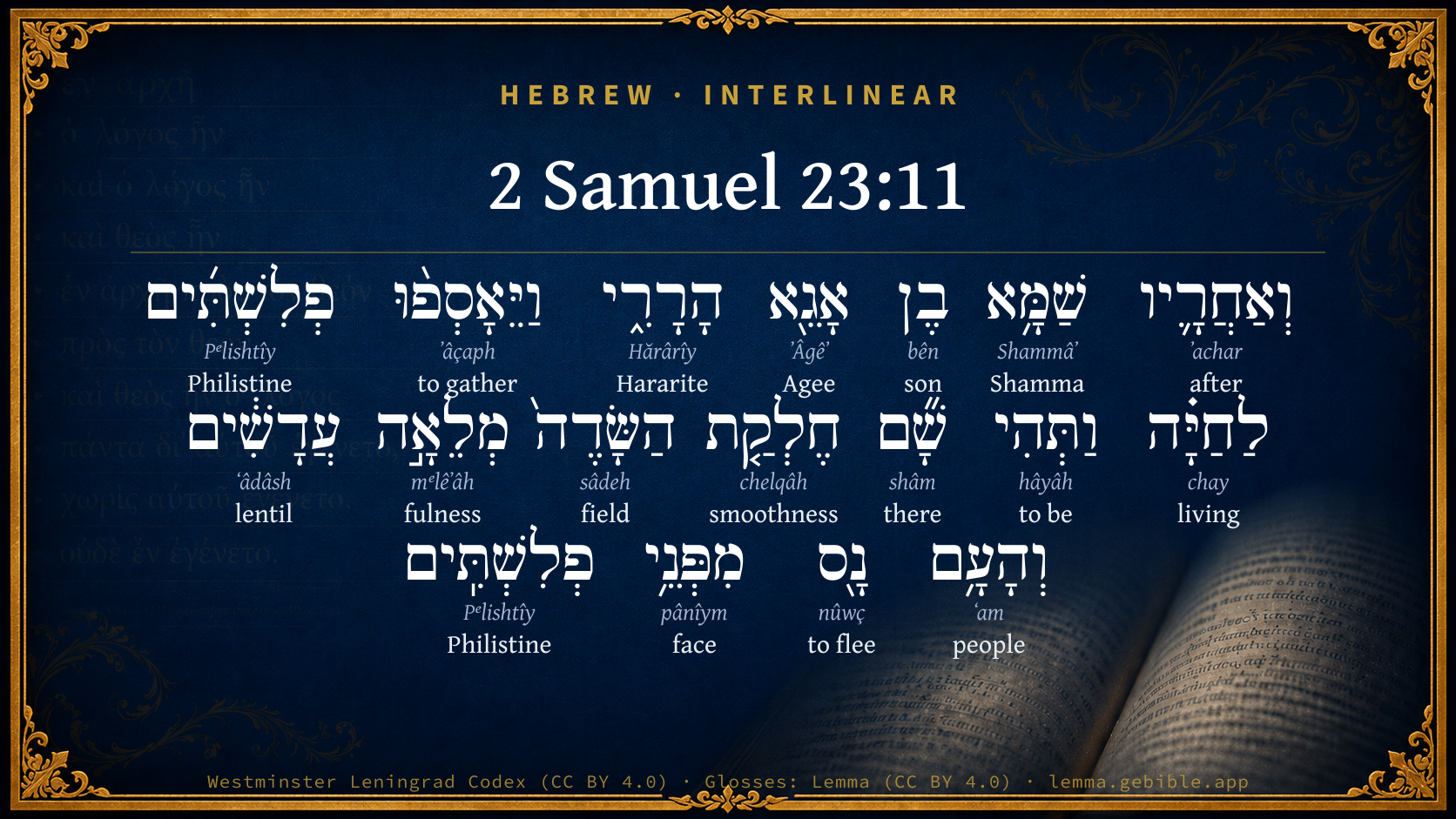
2 Samuel 23:11

Hebrew (Westminster Leningrad Codex) 2 Samuel 23:11 appears in the Hebrew Old Testament. The text above is from the Westminster Leningrad Codex. Each word links to its Strong’s number, a concise gloss, and parsing drawn from the Open Scriptures Hebrew Bible morphology. Click any word for its full Brown-Driver-Briggs (BDB) entry.
Download image
Cite this verse

2 Samuel 23:11 (World English Bible). Public Domain. Lemma interlinear Bible study tool, https://lemma.gebible.app/v/2-samuel/23/11.

Show BibTeX & RIS
BibTeX
RIS
English Translation
After him was Shammah the son of Agee a Hararite. The Philistines were gathered together into a troop, where was a plot of ground full of lentils; and the people fled from the Philistines.
World English Bible · Public Domain
Highlights
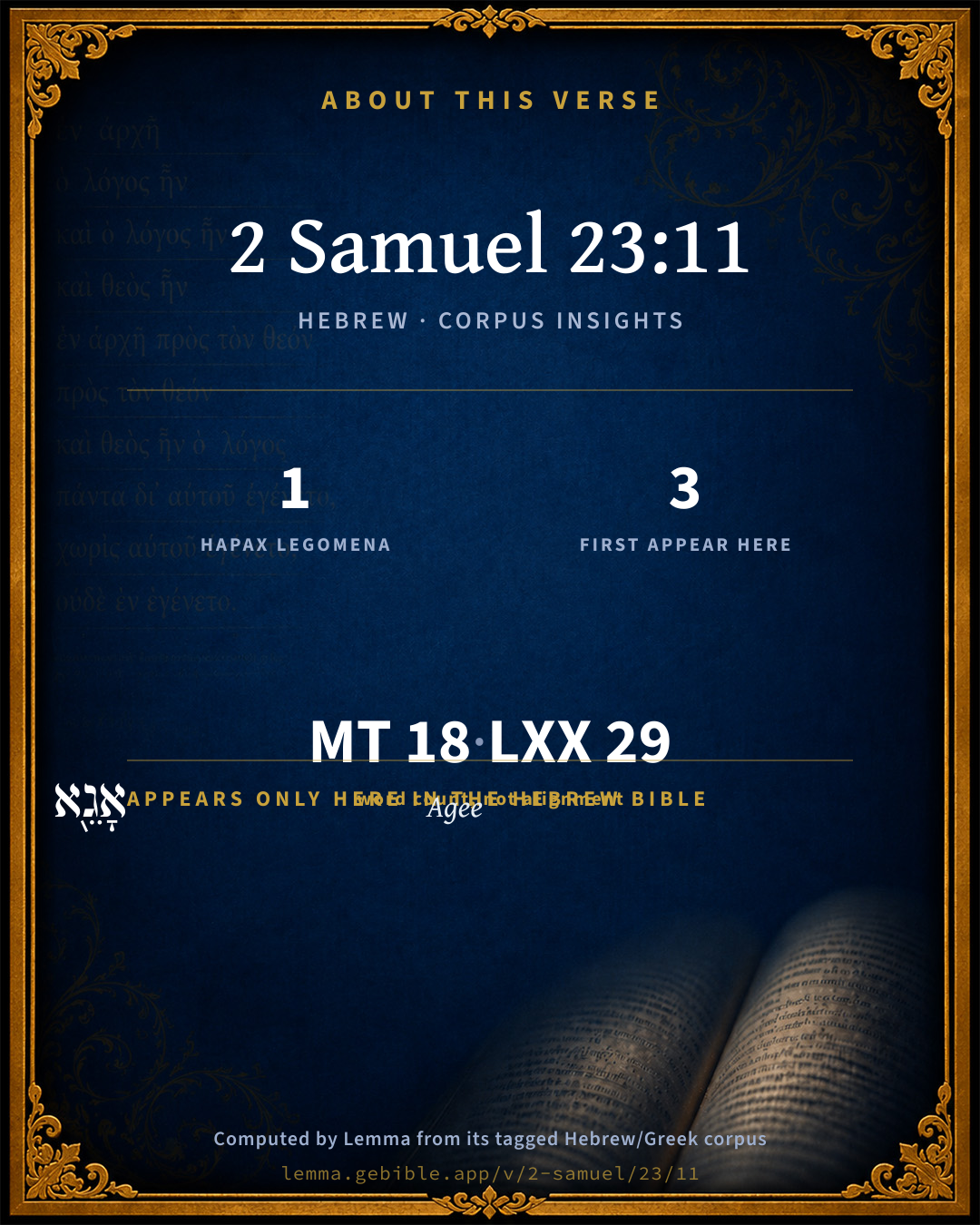
  • 1 hapax legomenon — only here in the Hebrew Bible
  • 3 first appearances in the Hebrew Bible
Full analysis ↓
Download a study sheet

One document with this verse’s original text, its word-by-word gloss line, the meaning frame, cross-references with their text, attributed commentary, and full source and license credits — printable, and it pastes into notes with its structure intact.

This verse Autodidact and up

Study sheet (.html) Plain text (.txt)

A passage Seminary Student

Up to 50 verses in one chapter. A passage sheet keeps up to 6 commentary sources and 12 cross-references per verse, in the order this page ranks them, and says so on the sheet whenever that leaves anything out. Ask for a single verse and you get the Autodidact verse sheet above.

Everything on this page stays free to read, with no account — the sheet is a download of what is already on screen, not access to it.

Want to remove ads? Support Godless Engineer
Compare translations 3

The same verse in 3 English versions, stacked beneath the original-language interlinear above. Click any original word for its lexicon entry.

Each is an independent rendering of the whole verse — the interlinear is not word-aligned to these translations.

Highlighted words mark where these versions differ — a whole-verse word diff, not a word-by-word alignment.

  • World English Bible Public Domain
    After him was Shammah the son of Agee a Hararite. The Philistines were gathered together into a troop, where was a plot of ground full of lentils; and the people fled from the Philistines.
  • King James Version Public Domain
    And after him was Shammah the son of Agee the Hararite. And the Philistines were gathered together into a troop, where was a piece of ground full of lentils: and the people fled from the Philistines.
  • unfoldingWord Literal Text CC BY-SA 4.0
    And after him Shammah, the son of Agee the Hararite. Now the Philistines gathered themselves to Lehi, and a portion of the field there was full lentils, and the people fled from the face of the Philistines.

unfoldingWord Literal Text — © unfoldingWord, licensed CC BY-SA 4.0. Word-aligned USFM3 via Door43 (git.door43.org/unfoldingWord/en_ult).

Versions to compare (up to 4)

3 of 4 selected

Show all 18 translations

Every available English version of this verse, each an independent rendering of the whole verse.

  • World English Bible Public Domain
    After him was Shammah the son of Agee a Hararite. The Philistines were gathered together into a troop, where was a plot of ground full of lentils; and the people fled from the Philistines.
  • Berean Standard Bible Public Domain
    And after him was Shammah son of Agee the Hararite. When the Philistines had banded together near a field full of lentils, Israel’s troops fled from them.
  • Majority Standard Bible Public Domain
    And after him was Shammah son of Agee the Hararite. When the Philistines had banded together near a field full of lentils, Israel’s troops fled from them.
  • King James Version Public Domain
    And after him was Shammah the son of Agee the Hararite. And the Philistines were gathered together into a troop, where was a piece of ground full of lentils: and the people fled from the Philistines.
  • American Standard Version (1901) Public Domain
    And after him was Shammah the son of Agee a Hararite. And the Philistines were gathered together into a troop, where was a plot of ground full of lentils; and the people fled from the Philistines.
  • Revised Version (1885) Public Domain
    And after him was Shammah the son of Agce a Hararite. And the Philistines were gathered together into a troop, where was a plot of ground full of lentils; and the people fled from the Philistines.
  • Geneva Bible (1599) Public Domain
    After him was Shammah the sonne of Age the Hararite: for the Philistims assembled at a towne, where was a piece of a fielde full of lentils, and the people fled from the Philistims.
  • Douay-Rheims (1899) Public Domain
    And after him was Semma the son of Age of Arari. And the Philistines were gathered together in a troop: for there was a field full of lentils. And when the people were fled from the face of the Philistines,
  • Young's Literal Translation Public Domain
    And after him `is' Shammah son of Agee the Hararite, and the Philistines are gathered into a company, and there is there a portion of the field full of lentiles, and the people hath fled from the presence of the Philistines,
  • Literal Standard Version CC BY-SA 4.0
    And after him [is] Shammah son of Agee the Hararite, and the Philistines are gathered into a company, and there is a portion of the field full of lentils there, and the people have fled from the presence of the Philistines,
  • Unlocked Literal Bible CC BY-SA 4.0
    After him was Shammah son of Agee, a Hararite. The Philistines gathered together where there was a field of lentils, and the army fled from them.
  • unfoldingWord Literal Text CC BY-SA 4.0
    And after him Shammah, the son of Agee the Hararite. Now the Philistines gathered themselves to Lehi, and a portion of the field there was full lentils, and the people fled from the face of the Philistines.
  • Darby Bible Public Domain
    And after him, Shammah the son of Agee the Hararite: the Philistines were gathered into a troop, and there was there a plot of ground full of lentils, and the people had fled before the Philistines;
  • World Messianic Bible Public Domain
    After him was Shammah the son of Agee a Hararite. The Philistines had gathered together into a troop where there was a plot of ground full of lentils; and the people fled from the Philistines.
  • Webster's Bible Public Domain
    And after him was Shammah the son of Agee the Hararite. And the Philistines were collected into a troop, where was a piece of ground full of lentils: and the people fled from the Philistines.
  • Free Bible Version CC BY-SA 4.0
    After him came Shammah, son of Agee, the Hararite. When the Philistines gathered at Lehi, in a field full of lentils, the Israelite army ran away from them,
  • Bible in Basic English Public Domain
    After him was Shammah, the son of Ela the Hararite. And the Philistines came together in Lehi, where there was a bit of land full of seed; and the people went in flight from the Philistines.
  • JPS Tanakh (1917) Public Domain
    And after him was Shammah the son of Age the Ararite. And the Philistines were gathered together into a troop, where was a plot of ground full of lentils; and the people fled from the Philistines.

Literal Standard Version (2020), Covenant Press — licensed CC BY-SA 4.0. Text via the HelloAO Bible API (eBible.org). Unlocked Literal Bible (unfoldingWord) — licensed CC BY-SA 4.0. Text via the HelloAO Bible API (eBible.org). unfoldingWord Literal Text — © unfoldingWord, licensed CC BY-SA 4.0. Word-aligned USFM3 via Door43 (git.door43.org/unfoldingWord/en_ult). Free Bible Version, Dr. Jonathan Gallagher — licensed CC BY-SA 4.0. Text via the HelloAO Bible API (eBible.org).

Word by word

More ways to search: Search by grammar → Find every occurrence → Compare this word →

Practice this passage: Drill this verse → Learn its vocabulary →

אָגֵ֖א
ʼÂgêʼ
H89
“Agee”
Noun, Proper
Part of Speech
Noun
Type
Proper
Full BDB Definition

Origin: of uncertain derivation, compare with H90

TWOT: None

Agee = "I shall increase" - father of a warrior of David
  1. וְאַחֲרָ֛יו ʼachar H310 “and · after · him” Conjunction + Preposition + Suffix, Personal, 3rd Person, Masculine, Singular
  2. שַׁמָּ֥א Shammâʼ H8037 “Shamma” Noun, Proper
  3. בֶן bên H1121 “son of” Noun, Common, Masculine, Singular, Construct
  4. הָרָרִ֑י Hărârîy H2043 “Hararite” Noun, Gentilic, Masculine, Singular, Absolute
  5. וַיֵּאָסְפ֨וּ ʼâçaph H622 “and · to gather” Conjunction + Verb, Niphal, Sequential Imperfect, 3rd Person, Masculine, Plural
  6. פְלִשְׁתִּ֜ים Pᵉlishtîy H6430 “Philistines” Noun, Gentilic, Masculine, Plural, Absolute
  7. לַחַיָּ֗ה chay H2416 “to/for the · living” Preposition, Determined + Noun, Common, Feminine, Singular, Absolute
  8. וַתְּהִי hâyâh H1961 “and · to be” Conjunction + Verb, Qal, Sequential Imperfect, 3rd Person, Feminine, Singular
  9. שָׁ֞ם shâm H8033 “there” Adverb
  10. חֶלְקַ֤ת chelqâh H2513 “smoothness of” Noun, Common, Feminine, Singular, Construct
  11. הַשָּׂדֶה֙ sâdeh H7704 “the · field” Particle, Definite Article + Noun, Common, Masculine, Singular, Absolute
  12. מְלֵאָ֣ה mᵉlêʼâh H4395 “fulness” Adjective, Adjective, Feminine, Singular, Absolute
  13. עֲדָשִׁ֔ים ʻâdâsh H5742 “lentils” Noun, Common, Feminine, Plural, Absolute
  14. וְהָעָ֥ם ʻam H5971 “and · the · people” Conjunction + Particle, Definite Article + Noun, Common, Masculine, Singular, Absolute
  15. נָ֖ס nûwç H5127 “to flee” Verb, Qal, Perfect, 3rd Person, Masculine, Singular
  16. מִפְּנֵ֥י pânîym H6440 “from · face(s) of” Preposition + Noun, Common, Both, Plural, Construct
  17. פְלִשְׁתִּֽים Pᵉlishtîy H6430 “Philistines” Noun, Gentilic, Masculine, Plural, Absolute

About this verse

These counts appear in no published source. They are computed here, from the morphology-tagged text and Lemma’s own curated glosses. What Lemma adds →

18
words
17
distinct lemmas
Historical
section

Notable vocabulary

1 hapax legomenon — a word that appears only here in the entire Hebrew Bible:

  • אָגֵ֖א Agee H89

First appearance in Scripture

These words make their first canonical appearance in the Hebrew Bible here:

  • שַׁמָּ֥א Shamma H8037
  • אָגֵ֖א Agee H89
  • הָרָרִ֑י Hararite H2043

Shared distinctive vocabulary

שַׁמָּ֥א Shamma H8037 occurs in 2 verses of the Hebrew Bible. Also found in:

Grammatical profile

  • 3 verbs
  • 12 nouns
  • 1 adjective
  • 1 preposition
  • 1 adverb

Verb forms

  • וַיֵּאָסְפ֨וּ Niphal · Sequential Imperfect
  • וַתְּהִי Qal · Sequential Imperfect
  • נָ֖ס Qal · Perfect

Repetition

A word recurs within this verse — often emphatic in Hebrew:

  • פְלִשְׁתִּ֜ים Philistine H6430 ×2

Hebrew & Septuagint length

In English translation the verse runs 34 words from the Hebrew and 35 from the Septuagint (LXX English) — closely comparable.

A rough comparison of the two English renderings, which tokenize alike — not a word-level alignment.

Word counts can differ between the Hebrew and the Greek without any difference in meaning — e.g. the Hebrew direct-object marker אֵת has no separate Greek word, and Greek often adds the article ὁ.

In the original languages it is 18 Hebrew tokens and 29 Greek tokens — but the two are counted differently (Hebrew bundles its prefixes and suffixes into one token; the Greek is in lemma form), so that isn’t a like-for-like length.

Cross-references

3

Topical passages linked to 2 Samuel 23:11 in the Treasury of Scripture Knowledge — connected by theme and wording, ordered by reader-vote popularity; previews shown in the World English Bible.

  • 1 Chronicles 11:13–14 He was with David at Pasdammim, and there the Philistines were gathered together to battle, where was a plot of ground full of barley; and the people fled from before the Philistines.
  • 1 Chronicles 11:27 Shammoth the Harorite, Helez the Pelonite,
  • 2 Samuel 23:33 Shammah the Hararite, Ahiam the son of Sharar the Ararite,

Cross-references courtesy of OpenBible.info (CC BY 4.0).

Hebrew and Greek witnesses Masoretic Hebrew ↔ Greek Septuagint

The same verse in the two great witnesses to the Old Testament, shown verse-for-verse.

These are two independent witnesses, not word-aligned to each other, and the Septuagint is shown in lemma (dictionary) form.

Hebrew 2 Samuel 23:11 Masoretic · Westminster Leningrad Codex

וְאַחֲרָ֛יו שַׁמָּ֥א בֶן אָגֵ֖א הָרָרִ֑י וַיֵּאָסְפ֨וּ פְלִשְׁתִּ֜ים לַחַיָּ֗ה וַתְּהִי שָׁ֞ם חֶלְקַ֤ת הַשָּׂדֶה֙ מְלֵאָ֣ה עֲדָשִׁ֔ים וְהָעָ֥ם נָ֖ס מִפְּנֵ֥י פְלִשְׁתִּֽים

After him was Shammah the son of Agee a Hararite. The Philistines were gathered together into a troop, where was a plot of ground full of lentils; and the people fled from the Philistines.

World English Bible · Public Domain

Greek LXX 2 Samuel 23:11 Septuagint · lemma form

καί μετά αὐτός σαμαια υἱός ασα ὁ αρουχαῖος καί συνἄγω ὁ ἀλλόφυλος εἰς θηρία καί εἰμί ἐκεῖ μερίς ὁ ἀγρός πλήρης φακός καί ὁ λαός φεύγω ἐκ πρόσωπον ἀλλόφυλος

And after him Samaia the son of Asa the Arachite: and the Philistines were gathered to Theria; and there was there a portion of ground full of lentiles; and the people fled before the Philistines.

LXX2012 (modern English Septuagint) · Public Domain

On this verse, Haydock's Catholic Bible Commentary discusses the Septuagint’s reading. Read the note in Commentary ↓

Hebrew: Westminster Leningrad Codex (CC BY 4.0). Greek: Septuagint (public domain); English from LXX2012 (modern English Septuagint) (Public Domain). How the Septuagint differs from the Hebrew →

Targum (Aramaic paraphrase)

1

The Targum is the ancient Jewish Aramaic paraphrase of the Hebrew Scriptures — an interpretive translation, not the Hebrew text itself. Onkelos (literal) and Pseudo-Jonathan (expansive) render the Torah, and Jonathan the Prophets. Coverage is partial: where no permissively-licensed English translation exists for a verse, only the Aramaic is shown. This is verse-level text, not a word-by-word alignment to the Hebrew.

  1. Targum Jonathan Prophets (Joshua–Malachi)
    וּבַתְרוֹהִי שַׁמָה בַר אָגֵא דְמִן הָרָר טוּרָאָה וְאִתְכְּנִישׁוּ פְלִשְׁתָּאֵי לְחַיָתָא וַהֲוַת תַּמָן אַחֲסָנַת חַקְלָא מַלְיָא טְלוֹפְחִין וְעַמָא אַפֵּךְ מִן קֳדָם פְּלִשְׁתָּאֵי:

    (no public-domain English translation for this verse)

    Targum Jonathan — Aramaic: “Mikraot Gedolot” (public domain). English: “Sefaria Community Translation” (CC0 1.0 (public-domain dedication)); “London "Chaldee Paraphrase," 1871” (public domain). Text via Sefaria.

Commentary

Notes on 2 Samuel 23:11 from classic Christian and Jewish commentators (each source and its license shown beneath its notes). The classic Christian expositions comment on the surrounding passage and are grouped to its opening verse, so a note may address several verses; the Jewish commentaries on the Tanakh (Rashi and others) are per-verse, so they appear only where the commentator wrote on this verse.

Lemma curates 59 commentaries, every one of them public domain or Creative Commons licensed, each selected and text-cleaned for this edition rather than reprinted as found. About our sources →

Trapp's Complete Commentary

John Trapp

2Sa 23:11 And after him [was] Shammah the son of Agee the Hararite. And the Philistines were gathered together into a troop, where was a piece of ground full of lentiles: and the people fled from the Philistines.

Ver. 11. Into a troop.] Or, For foraging.

And the people fled.] As 2Sa 23:9, for it seemeth that this exploit was achieved jointly by these two worthies at the same time. {1Ch 11:14}

John Trapp, A Commentary or Exposition upon All the Books of the Old and New Testament (1647–1656) — public domain. Text from a community e-Sword module.

The Biblical Illustrator

Joseph S. Exell

2Sa_23:11

Shammah the son of Agee the Hararite.

Shammah

I wish you to look at the deed of this man Shammah, who stood in the midst of the plot of lentils and defended it, and slew the Philistines. The one idea that leaps up from this narrative is that which you often find through Scripture, that in the clay of defeat and disaster all God wants is one whole-hearted man. If the Lord can only get a beginning made, if He can, amidst all the disgraceful stampede and rout, get but one man to stop running, one to stop flying, one soul to cease from unbelief and panic and fear, and begin to trust in Him, there and then the tide of battle shall be turned. Shammah did, that is to say, the unexpected. Fleeing had been the order of the day for Israel, and pursuing;had been the order of the day for Philistia. A very pretty game, truly! We shout and you run. We appear, and you disappear. You sow in the spring--it was very kind of you, Israelites--and we step in in the autumn and take the harvest. It is a wonderfully nicely arranged system for Philistia, whatever it may be for Israel. And, just so; dont we seem to make nothing of our Christianity (meaning by that, Christ), as against the powers of Philistia? Look at them in London to-day. What are we doing? Where are we gaining? Speaking broadly, it is invisible. Where are we defeated? Everywhere. The world laughing at us, scandal upon scandal, tale upon tale, wreck upon wreck, ruin upon ruin. Drink, lust, uncleanness, commercial dishonour, everything that belongs to the Devil, strong and vigorous, successful and sweeping; and everything that belongs to Jesus Christ, like those dispirited Israelites, weak and scattering as a flock of sheep. It is bad enough. But just as then, so I believe still, if here and there some man would only understand that in all this there is a trumpet being blown for rallying, times for the individual and for the community might be mightily changed. There is Shammah, and what seems to be sweeping through the breast of--I was going to say the poor man, the noble man--was this: This is too bad! I am sick and tired of this. Are we for ever to sow in the spring, and are these Philistines to reap our crop in the autumn? Are we for ever to be at their mercy? Are we for ever to be trodden underfoot and scattered like sheep? Death is preferable to this running and running and running; and in Gods great name I stand to-day--Death or Victory! If some of us would do that we would be big Christians before night. Just where you have always yielded, my hardly beset brother or sister, try how it will work to stand to-day. Resist this onset that always before has made a clean sweep of you, and what will happen? It will be what always happens: Resist the devil, and he will flee from you--he is a bigger coward than you are. Whom resist steadfast in the faith. Then, it was a big fight for very little. He defended a plot of lentils. Not much to fight for, a plot of lentils! But, coarse horse-feed after all, as I believe it was, it was Israels lentils, and Philistia had no right to them. It was Gods, and not theirs; and little as it seemed to be to make a fight for, Shammah stepped into the middle of the plot, like one who would say, It is mine, it is my countrymens, it is my Gods, and ye shall not have it if one man can prevent it. I wish come one here, young or old man, would, like Shammah, stand in the middle of the wreck that is left, and have one fight for it. Although what is left may have no more proportion to what used to be or what might have been than a patch of lentils has to a broad-acred farm, yet in Gods name stand in the middle of the wreck, and see what will happen. That is all God asks: Stand, stand in the midst, and then see! If the Church of Christ would only get possessed of Shammahs spirit, and in all the howling wreck that is at home and abroad, if she would stand and fight, there would be such a central victory as would tell to the furthermost circumference. I think I see him. He is a sight for dispirited Christians, a sight for all poor backsliders. You are defeated, overcome, overborne. Old sins, like Philistines, have come back on you; redeemed though you call yourself, old sins have come back fore the last month or year and more, and they have been driving you before them pitiably, somewhat contemptuously--secret sins, or open sins, or both combined. You have lost heart, the roaring flood in its strength has swept you away, especially the weakest thing that ever dared to call itself Christian man, believing man, redeemed man. Now, what are you to do? In Gods name let us all try it, let us all do what Shammah did--stand in the middle of what is left. What shall you do? My brother, late in the day as it is, and although night is coming near, although you are not now the man you used to be, and a hundred voices in your ear say to you, It is too late to retrieve the past, those hundred voices are a hundred lies and liars. It is not too late: stand in the middle of the wreck left, in Gods great name. Stand, stand! you might die more than conqueror yet. Over you, there may yet be heard in Heaven the shout of victory: Stand! Shammah stood in the midst of it, and though it wee not worth two half-crowns of any mans money, he defended it, and slew the Philistines, and God came down from heaven to win a patch of lentils! For the Lord loves victory, and the Lord hates defeat, and the only thing He wants is to get at His adversary through some faithful, upright, believing soul. (John McNeill.)

The Biblical Illustrator, edited by Joseph S. Exell (c. 1880s–1900s) — public domain. Text from a community e-Sword module.

Joseph Benson's Commentary

2Sa 23:11. After him was Shammah — Who, although not expressly mentioned in the parallel place, 1Ch 11:14, yet is plainly implied to have been engaged in this great action. For it is said, that they set themselves, &c., that is, Shammah and Eleazar, who joined in this enterprise. But this place, in Samuel, teaches us that Shammah had the chief hand in it, and therefore it is ascribed to him. Ground full of lentils — In 1Ch 11:13 it is, full of barley: in which there is no difficulty, one part of the field having probably been sown with lentils and the other with barley. The people fled from the Philistines — Fearing to defend the place.

Joseph Benson's Commentary on the Old and New Testaments (1811–1818) — public domain. Text from a community e-Sword module.

Adam Clarke's Commentary

Verse 11. A piece of ground full of lentiles] In 1Ch 11:13 it is a parcel of ground full of barley. There is probably a mistake of עדשים adashim, lentiles, for שעורים seorim, barley, or vice versa. Some think there were both lentiles and barley in the field, and that a marauding party of the Philistines came to destroy or carry them off, and these worthies defeated the whole, and saved the produce of the field. This is not unlikely.

Adam Clarke's Commentary on the Bible (1810–1826) — public domain. Text from a community e-Sword/MySword module.

Ellicott's Commentary for English Readers

(11) Into a troop.—Josephus, using different vowels, read “to Lehi,” the scene of Samson’s exploit (Jdg_15:9; Jdg_15:19); but as the same word recurs in 2Sa_23:13, clearly in the sense of “troop,” the English reading should be retained.

Lentiles.—Chronicles has “barley.” The two words might easily be confounded in the Hebrew, and it is quite immaterial which is correct; the point is that the Philistines had made a foray to gather the ripe crops, the Israelites were terrified and fled, while Shammah, by his courage and valour, turned the tide of battle, and won a great victory.

A Bible Commentary for English Readers, edited by Charles John Ellicott (1878–1897) — public domain. Text from a community e-Sword module.

The Cambridge Bible for Schools and Colleges

gen. ed. J. J. S. Perowne

11. into a troop] Probably the consonants should be read with different vowels to Lehi, the scene of Samson’s victory over the Philistines (Jdg_15:9; Jdg_15:14; Jdg_15:19).

lentiles] Chr. reads barley. The two words might easily be confused in Hebrew. The Philistines came up to carry off the ripe crops. Cp. 1Sa_23:1.

The Cambridge Bible for Schools and Colleges (gen. ed. J. J. S. Perowne; Cambridge University Press, 1878–1918) — public domain. Text from a community e-Sword module.

John Gill's Exposition

And after him was Shammah the son of Agee the Hararite,.... One who was of the mountainous country, as the Targum, the hill country of Judea, of Hebron, or the parts adjacent; this was the third of the first three; there was one of this name among the thirty, Sa2 23:33,

and the Philistines were gathered together into a troop; but so they were no doubt at first; R. Isaiah takes it to be the name of a place called Chiyah; as the Targum, Chayatha; and which Kimchi says was a village, an unwalled town; and Ben Melech observes, that it is said in the Arabic language, a collection of houses is called Alchai: it may be the same with Lehi, where Samson slew a thousand with the jawbone of an ass, Jdg 15:17, whence it had its name; and Josephus (u) says, the place where the Philistines were gathered together was called "the Jawbone": but perhaps the sense of Ben Gersom may be best of all, that they gathered together in this place for provision, for food and forage, to support the life of them and their cattle: since it follows:

where was a piece of ground full of lentiles; a sort of pulse, which was eaten in those countries, and the pottage of which was delicious food, see Gen 25:30,

and the people fled from the Philistines; as they did before under Eleazar, Sa2 23:9.

(u) Antiqu. l. 7. c. 12. sect. 4.

John Gill's Exposition of the Whole Bible (1746–1763) — public domain (CC PDM 1.0). Text via the HelloAO Bible API.

Albert Barnes' Notes on the Bible

Hararite - Interpreted to mean “mountaineer,” one from the hill country of Judah or Ephraim.

Albert Barnes' Notes on the Bible (1834–1885) — public domain. Text from a community e-Sword/MySword module.

Haydock's Catholic Bible Commentary

Troop. Hebrew Lachaya, has been much controverted: but it appears to be the name of Lechi, or Lehi, "the jaw-bone," (Josephus and Complutensian Septuagint) so memorable for the exploit of Samson. (Bochart, Anim. p. 1. B. ii. 15.) --- Vulgate literally, in statione, "in a station." Some copies of the Septuagint, "against wild beasts;" "To hunt wild beasts," Syriac and Arabic. But it is most probably the name of a place. (Calmet) --- Lentils. (1 Paralipomenon) Barley seems more correct, as the field could not be full of both at the same time; (Haydock) and barley is of more general utility. (Kennicott) --- Yet some would assert, that there was barley in one part and lentils in the other. (Buxtorf, &c.)

George Leo Haydock (1774–1849), Haydock's Catholic Family Bible and Commentary, 1859 edition — public domain. Excludes Psalms (Douay-Rheims chapter numbering differs from Protestant) and Deuterocanonical books (Catholic canon only).

Matthew Poole's English Annotations

Full of lentiles, or barley, as it is 1Ch 11:13; for both might very well grow in the same field, in divers parts of it. And this fact is ascribed to Eleazar, 1Ch 11:12, but so as it is implied that he had some partner or partners in it: for it is there said, 1Ch 11:14, They set themselves, &c. So Eleazar might stand and fight in that part where the barley was, and Shammah there where the lentiles were.

Matthew Poole's English Annotations on the Holy Bible (1683–1685) — public domain. Text from a community e-Sword/MySword module.

Whedon's Commentary on the Bible

Daniel D. Whedon

11. Into a troop — That is, in a great crowd. Through the error of some copyist several lines are omitted in the parallel place in Chronicles, so that what is here ascribed to Shammah is there attributed to David and Eleazar.

Lentiles — עדשׁים Chronicles has שׂעורים, barley. But the Hebrew words are so similar that one might easily have been mistaken for the other. Barley is probably the better reading, as it is more likely that the Philistines would attack and the Israelites defend a field of barley than a field of lentiles.

Daniel D. Whedon (gen. ed.), Commentary on the Old and New Testaments (1874–1909) — public domain. Text from a community e-Sword module.

The Pulpit Commentary

Into a troop. Josephus renders it "to Lehi," the scene of Samson"s exploit. The word is rare, but occurs again in ver. 13, where, however, we find in Chronicles the ordinary name for a host substituted for it. The Revisers have retained in the margin, "or, for foraging:" but its occurrence in Psa_68:10, where it is tendered "thy congregation," and in the margin of the Revised Version," troop" makes it probable that" troop" is the right rendering here. Lentiles . In 1Ch_11:13, "barley." The difference is probably caused by a transposition of letters. The Philistines seem to have made this incursion in order to carry off or destroy the crops of the Israelites.

The Pulpit Commentary (1880–1919), ed. H.D.M. Spence-Jones & Joseph S. Exell — public domain. Text from a community e-Sword module.

John Wesley's Explanatory Notes

Lentiles - Or barley, as it is 1 Chron. xi, 13. For both might grow in the same field, in divers parts of it. And this fact is ascribed to Eleazar,

1 Chron. xi, 12, but it is implied, that he had some partner or partners in it; for it is there said, 1 Chron. xi, 14 they set themselves, &c. So Eleazar might fight in that part where the barley was and Shammah where the lentiles were.

John Wesley, Explanatory Notes Upon the Whole Bible (1754–1765) — public domain. Text via the GEBible commentary corpus.

unfoldingWord translationNotes

Door43 World Missions Community

General Information:

This continues the list of David's greatest soldiers. (See: How to Translate Names)

a field of lentils

"a field where someone had planted lentils"

lentils

a flat seed, eaten like beans (See: Translate Unknowns)

the army fled

"the Israelite army ran away"

translationWords

Philistines

Yahweh

unfoldingWord translationNotes — © Distant Shores Media and the Door43 World Missions Community, licensed CC BY-SA 4.0. Source: git.door43.org/Door43/en_tn.

Rashi

Rabbi Shlomo Yitzchaki (Rashi)

From the mountain. From the mountain.

For [war like] beast in the wild. [Gathering] to become troops like the beasts gather in the wild.

Rashi on the Tanakh — English translations: “The Judaica Press complete Tanach with Rashi, translated by A. J. Rosenberg” (CC BY 4.0); “Pentateuch with Rashi's commentary by M. Rosenbaum and A.M. Silbermann, 1929-1934” (public domain); “The Metsudah Tanach series, Lakewood, N.J” (CC BY 4.0); and “The Book of Joshua, Metsudah Publications, 1997” (CC BY 4.0). Text via Sefaria.

Lesson kit

Teaching starters — assembled from the data on this page, not authored interpretation. Every prompt links to the verse data it draws on. Edit before teaching.

2 Samuel, in the Historical, opens this verse with 18 words (17 distinct Hebrew lemmas). Its most distinctive word is ʼÂgêʼ (“Agee”). A historical commentator’s framing appears above. Read the whole chapter for the surrounding context.

Discussion questions

  1. How does “Agee” (ʼÂgêʼ) shape what this verse is saying?
  2. This verse holds 1 word here found nowhere else in the Hebrew Bible. What might the rare word draw attention to?
  3. 3 words here appear for the first time in Scripture. What is being introduced at this debut?
  4. 1 Chronicles 7:37 shares the word «Shamma» with this verse. How do the two illuminate each other?
  5. “Philistine” occurs 2× in this one verse. What is the effect of the repetition?
  6. The translations on this page render this verse differently — a whole-verse word diff, not a word-by-word alignment. What might account for the different wordings?
  7. The verb «וַיֵּאָסְפ֨וּ» is Niphal Sequential Imperfect. How does its form color the action?
  8. Reading how Trapp's Complete Commentary and The Biblical Illustrator read this verse, where do the two commentators agree and where do they part?

Things to notice

  • 1 word in this verse appears nowhere else in the Hebrew Bible.
  • 3 words make their first canonical appearance in Scripture here.
  • This verse counts 18 Hebrew ↔ 29 Greek words.
  • These translations choose different wording for 14 words in this verse.
  • “Philistine” occurs 2× in this single verse.

Reading settings

Reading text

Shown beneath each verse's original-language words.

Old Testament
Old Testament edition

Read the OT as the Masoretic Hebrew (MT) or the Greek Septuagint (LXX).

English shown for the Greek Septuagint (in the Hebrew ↔ Greek comparison).

Comparing translations? Open the Compare panel on any verse page to stack up to four side by side.