1 Kings 14:11

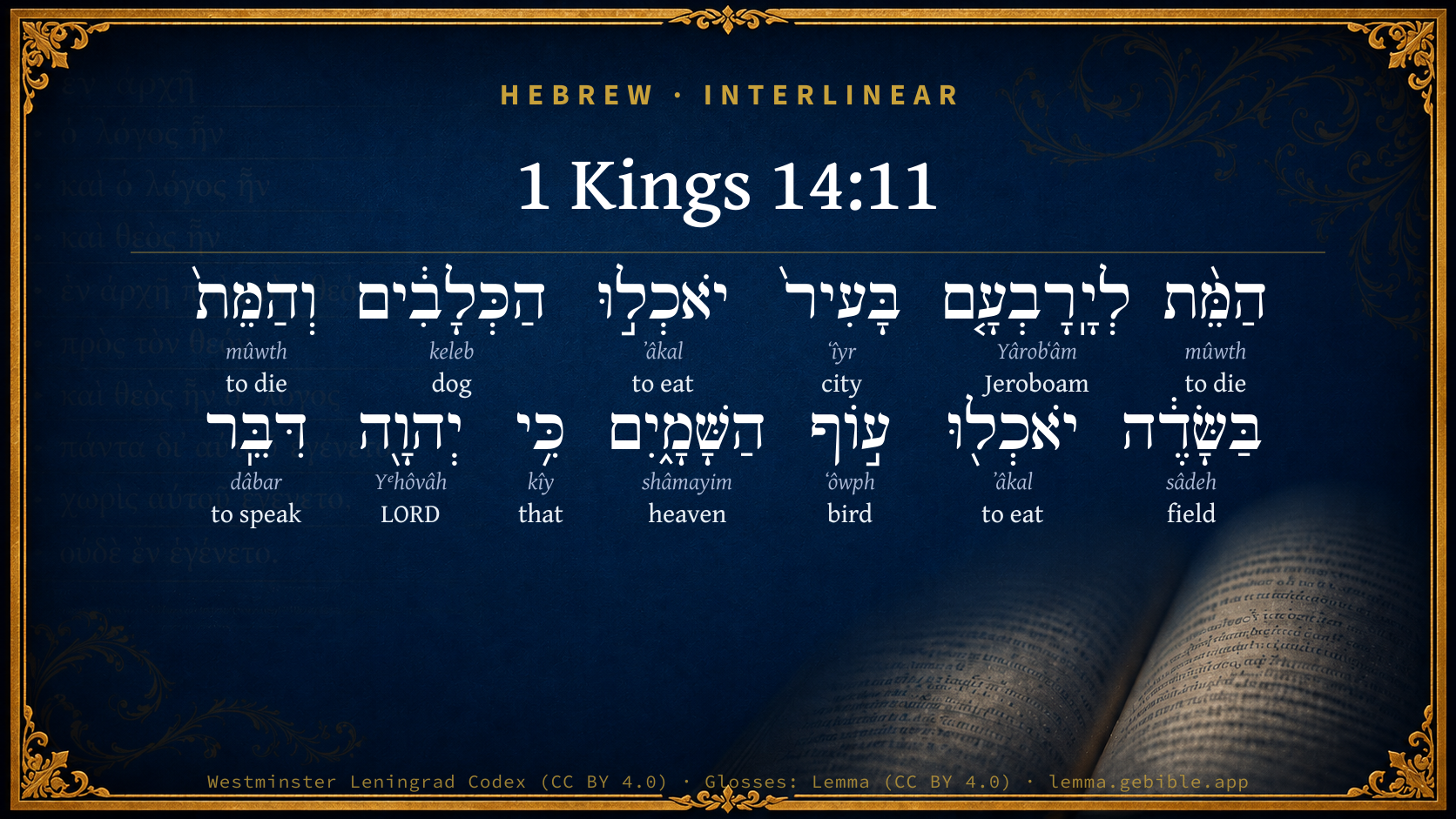
Hebrew (Westminster Leningrad Codex) 1 Kings 14:11 appears in the Hebrew Old Testament. The text above is from the Westminster Leningrad Codex. Each word links to its Strong’s number, a concise gloss, and parsing drawn from the Open Scriptures Hebrew Bible morphology. Click any word for its full Brown-Driver-Briggs (BDB) entry.
Download image
Cite this verse

1 Kings 14:11 (World English Bible). Public Domain. Lemma interlinear Bible study tool, https://lemma.gebible.app/v/1-kings/14/11.

Show BibTeX & RIS
BibTeX
RIS
English Translation
Him who dies of Jeroboam in the city shall the dogs eat; and him who dies in the field shall the birds of the sky eat: for Yahweh has spoken it.
World English Bible · Public Domain
Download a study sheet

One document with this verse’s original text, its word-by-word gloss line, the meaning frame, cross-references with their text, attributed commentary, and full source and license credits — printable, and it pastes into notes with its structure intact.

This verse Autodidact and up

Study sheet (.html) Plain text (.txt)

A passage Seminary Student

Up to 50 verses in one chapter. A passage sheet keeps up to 6 commentary sources and 12 cross-references per verse, in the order this page ranks them, and says so on the sheet whenever that leaves anything out. Ask for a single verse and you get the Autodidact verse sheet above.

Everything on this page stays free to read, with no account — the sheet is a download of what is already on screen, not access to it.

Want to remove ads? Support Godless Engineer
Compare translations 3

The same verse in 3 English versions, stacked beneath the original-language interlinear above. Click any original word for its lexicon entry.

Each is an independent rendering of the whole verse — the interlinear is not word-aligned to these translations.

Highlighted words mark where these versions differ — a whole-verse word diff, not a word-by-word alignment.

  • World English Bible Public Domain
    Him who dies of Jeroboam in the city shall the dogs eat; and him who dies in the field shall the birds of the sky eat: for Yahweh has spoken it.
  • King James Version Public Domain
    Him that dieth of Jeroboam in the city shall the dogs eat; and him that dieth in the field shall the fowls of the air eat: for the LORD hath spoken it.
  • unfoldingWord Literal Text CC BY-SA 4.0
    The one to Jeroboam dying in the city, dogs will eat, and the one dying in the field, birds of the sky will eat.” For Yahweh has spoken.’

unfoldingWord Literal Text — © unfoldingWord, licensed CC BY-SA 4.0. Word-aligned USFM3 via Door43 (git.door43.org/unfoldingWord/en_ult).

Versions to compare (up to 4)

3 of 4 selected

Show all 18 translations

Every available English version of this verse, each an independent rendering of the whole verse.

  • World English Bible Public Domain
    Him who dies of Jeroboam in the city shall the dogs eat; and him who dies in the field shall the birds of the sky eat: for Yahweh has spoken it.
  • Berean Standard Bible Public Domain
    Anyone belonging to Jeroboam who dies in the city will be eaten by dogs, and anyone who dies in the field will be eaten by the birds of the air.’ For the LORD has spoken.
  • Majority Standard Bible Public Domain
    Anyone belonging to Jeroboam who dies in the city will be eaten by dogs, and anyone who dies in the field will be eaten by the birds of the air.’ For the LORD has spoken.
  • King James Version Public Domain
    Him that dieth of Jeroboam in the city shall the dogs eat; and him that dieth in the field shall the fowls of the air eat: for the LORD hath spoken it.
  • American Standard Version (1901) Public Domain
    Him that dieth of Jeroboam in the city shall the dogs eat; and him that dieth in the field shall the birds of the heavens eat: for Jehovah hath spoken it.
  • Revised Version (1885) Public Domain
    Him that dieth of Jeroboam in the city shall the dogs eat; and him that dieth in the field shall the fowls of the air eat: for the LORD hath spoken it.
  • Geneva Bible (1599) Public Domain
    The dogges shall eate him of Ieroboams stocke that dyeth in the citie, and the foules of the aire shall eate him that dyeth in the fielde: for the Lord hath said it.
  • Douay-Rheims (1899) Public Domain
    Them that shall die of Jeroboam in the city, the dogs shall eat: and them that shall die in the field, the birds of the air shall devour: for the Lord hath spoken it.
  • Young's Literal Translation Public Domain
    him who dieth of Jeroboam in a city do the dogs eat, and him who dieth in a field do fowl of the heavens eat, for Jehovah hath spoken.
  • Literal Standard Version CC BY-SA 4.0
    the dogs eat him who dies of Jeroboam in a city, and birds of the heavens eat him who dies in a field, for YHWH has spoken.
  • Unlocked Literal Bible CC BY-SA 4.0
    Anyone who belongs to your family who dies in the city will be eaten by dogs, and anyone who dies in the field will be eaten by the birds of the heavens, for I, Yahweh, have said it.'
  • unfoldingWord Literal Text CC BY-SA 4.0
    The one to Jeroboam dying in the city, dogs will eat, and the one dying in the field, birds of the sky will eat.” For Yahweh has spoken.’
  • Darby Bible Public Domain
    Him that dieth of Jeroboam in the city shall the dogs eat, and him that dieth in the field shall the fowl of the heavens eat; for Jehovah hath spoken.
  • World Messianic Bible Public Domain
    The dogs will eat he who belongs to Jeroboam who dies in the city; and the birds of the sky will eat he who dies in the field, for the LORD has spoken it.”’
  • Webster's Bible Public Domain
    Him that dieth of Jeroboam in the city shall the dogs eat; and him that dieth in the field shall the fowls of the air eat: for the LORD hath spoken it.
  • Free Bible Version CC BY-SA 4.0
    Those of Jeroboam's family who die in the town will be eaten by dogs, and those who die in the countryside will be eaten by birds. For the Lord has spoken.
  • Bible in Basic English Public Domain
    Those of the family of Jeroboam who come to death in the town, will become food for the dogs; and those on whom death comes in the open country, will be food for the birds of the air; for the Lord has said it.
  • JPS Tanakh (1917) Public Domain
    Him that dieth of Jeroboam in the city shall the dogs eat; and him that dieth in the field shall the fowls of the air eat; for the LORD hath spoken it.

Literal Standard Version (2020), Covenant Press — licensed CC BY-SA 4.0. Text via the HelloAO Bible API (eBible.org). Unlocked Literal Bible (unfoldingWord) — licensed CC BY-SA 4.0. Text via the HelloAO Bible API (eBible.org). unfoldingWord Literal Text — © unfoldingWord, licensed CC BY-SA 4.0. Word-aligned USFM3 via Door43 (git.door43.org/unfoldingWord/en_ult). Free Bible Version, Dr. Jonathan Gallagher — licensed CC BY-SA 4.0. Text via the HelloAO Bible API (eBible.org).

Word by word

More ways to search: Search by grammar → Find every occurrence → Compare this word →

Practice this passage: Drill this verse → Learn its vocabulary →

הַכְּלָבִ֔ים
keleb
H3611
“the · dogs”
Particle, Definite Article + Noun, Common, Masculine, Plural, Absolute
Part of Speech
Particle + Noun
Type
Common
Gender
Masculine
Number
Plural
State
Absolute
Full BDB Definition

Origin: from an unused root means. to yelp, or else to attack

TWOT: 981a

dog - dog (literal) - contempt or abasement (figuratively) - of pagan sacrifice - of male cult prostitute (figuratively)
  1. הַמֵּ֨ת mûwth H4191 “the · dying” Particle, Definite Article + Verb, Qal, Participle Active, Masculine, Singular, Absolute
  2. לְיָֽרָבְעָ֤ם Yârobʻâm H3379 “to/for · Jeroboam” Preposition + Noun, Proper
  3. בָּעִיר֙ ʻîyr H5892 “in/at the · city” Preposition, Determined + Noun, Common, Feminine, Singular, Absolute
  4. יֹאכְל֣וּ ʼâkal H398 “to eat” Verb, Qal, Imperfect, 3rd Person, Masculine, Plural
  5. וְהַמֵּת֙ mûwth H4191 “and · the · dying” Conjunction + Particle, Definite Article + Verb, Qal, Participle Active, Masculine, Singular, Absolute
  6. בַּשָּׂדֶ֔ה sâdeh H7704 “in/at the · field” Preposition, Determined + Noun, Common, Masculine, Singular, Absolute
  7. יֹאכְל֖וּ ʼâkal H398 “to eat” Verb, Qal, Imperfect, 3rd Person, Masculine, Plural
  8. ע֣וֹף ʻôwph H5775 “bird of” Noun, Common, Masculine, Singular, Construct
  9. הַשָּׁמָ֑יִם shâmayim H8064 “the · heaven(s)” Particle, Definite Article + Noun, Common, Masculine, Plural, Absolute
  10. כִּ֥י kîy H3588 “that” Conjunction
  11. יְהוָ֖ה Yᵉhôvâh H3068 “LORD” Noun, Proper
  12. דִּבֵּֽר dâbar H1696 “to speak” Verb, Piel, Perfect, 3rd Person, Masculine, Singular

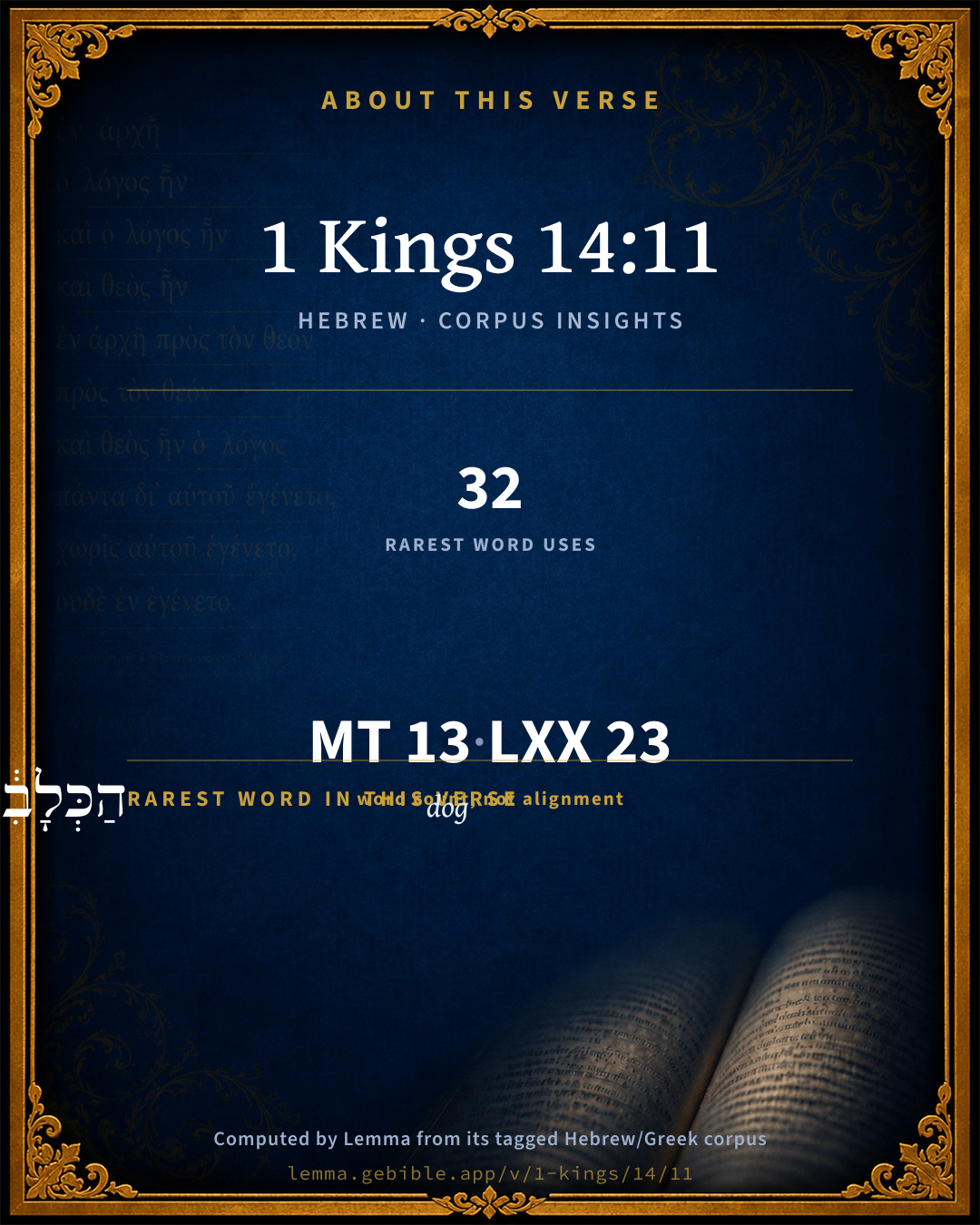
About this verse

These counts appear in no published source. They are computed here, from the morphology-tagged text and Lemma’s own curated glosses. What Lemma adds →

13
words
11
distinct lemmas
Historical
section

Shared distinctive vocabulary

הַכְּלָבִ֔ים dog H3611 occurs in 31 verses of the Hebrew Bible. Also found in:

Grammatical profile

  • 5 verbs
  • 7 nouns
  • 1 conjunction

Verb forms

  • הַמֵּ֨ת Qal · Participle Active
  • יֹאכְל֣וּ Qal · Imperfect
  • וְהַמֵּת֙ Qal · Participle Active
  • יֹאכְל֖וּ Qal · Imperfect
  • דִּבֵּֽר Piel · Perfect

Repetition

Words recur within this verse — often emphatic in Hebrew:

  • הַמֵּ֨ת to die H4191 ×2
  • יֹאכְל֣וּ to eat H398 ×2

Hebrew & Septuagint length

In the original languages it is 13 Hebrew tokens and 23 Greek tokens — but the two are counted differently (Hebrew bundles its prefixes and suffixes into one token; the Greek is in lemma form), so that isn’t a like-for-like length.

Cross-references

7

Topical passages linked to 1 Kings 14:11 in the Treasury of Scripture Knowledge — connected by theme and wording, ordered by reader-vote popularity; previews shown in the World English Bible.

  • 1 Kings 16:4 Him who dies of Baasha in the city shall the dogs eat; and him who dies of his in the field shall the birds of the sky eat.
  • 1 Kings 21:23–24 Of Jezebel also spoke Yahweh, saying, The dogs shall eat Jezebel by the rampart of Jezreel.
  • Jeremiah 15:3 I will appoint over them four kinds, says Yahweh: the sword to kill, and the dogs to tear, and the birds of the sky, and the animals of the earth, to devour and to destroy.
  • Revelation 19:17–18 I saw an angel standing in the sun. He cried with a loud voice, saying to all the birds that fly in the sky, "Come! Be gathered together to the great supper of God,
  • 1 Kings 21:19 You shall speak to him, saying, Thus says Yahweh, Have you killed and also taken possession? You shall speak to him, saying, Thus says Yahweh, In the place where dogs licked the blood of Naboth shall dogs lick your blood, even yours.
  • Isaiah 66:24 They shall go forth, and look on the dead bodies of the men who have transgressed against me: for their worm shall not die, neither shall their fire be quenched; and they shall be an abhorring to all flesh.
  • Ezekiel 39:17–19 You, son of man, thus says the Lord Yahweh: Speak to the birds of every sort, and to every animal of the field, Assemble yourselves, and come; gather yourselves on every side to my sacrifice that I do sacrifice for you, even a great sacrifice on the mountains of Israel, that you may eat flesh and drink blood.

Cross-references courtesy of OpenBible.info (CC BY 4.0).

Hebrew and Greek witnesses Masoretic Hebrew ↔ Greek Septuagint

The same verse in the two great witnesses to the Old Testament, shown verse-for-verse.

These are two independent witnesses, not word-aligned to each other, and the Septuagint is shown in lemma (dictionary) form.

Hebrew 1 Kings 14:11 Masoretic · Westminster Leningrad Codex

הַמֵּ֨ת לְיָֽרָבְעָ֤ם בָּעִיר֙ יֹאכְל֣וּ הַכְּלָבִ֔ים וְהַמֵּת֙ בַּשָּׂדֶ֔ה יֹאכְל֖וּ ע֣וֹף הַשָּׁמָ֑יִם כִּ֥י יְהוָ֖ה דִּבֵּֽר

Him who dies of Jeroboam in the city shall the dogs eat; and him who dies in the field shall the birds of the sky eat: for Yahweh has spoken it.

World English Bible · Public Domain

Greek LXX 1 Kings 14:11 Septuagint · lemma form

καί κοιμάω ροβοαμ μετά ὁ πατήρ αὐτός καί θάπτω μετά ὁ πατήρ αὐτός ἐν πόλις δαυίδ καί βασιλεύω αβιου υἱός αὐτός ἀντί αὐτός

No English rendering of this Greek verse — the small residue in the structurally divergent books.

Hebrew: Westminster Leningrad Codex (CC BY 4.0). Greek: Septuagint (public domain); English from a public-domain English Septuagint. How the Septuagint differs from the Hebrew →

Targum (Aramaic paraphrase)

1

The Targum is the ancient Jewish Aramaic paraphrase of the Hebrew Scriptures — an interpretive translation, not the Hebrew text itself. Onkelos (literal) and Pseudo-Jonathan (expansive) render the Torah, and Jonathan the Prophets. Coverage is partial: where no permissively-licensed English translation exists for a verse, only the Aramaic is shown. This is verse-level text, not a word-by-word alignment to the Hebrew.

  1. Targum Jonathan Prophets (Joshua–Malachi)
    דִימוּת לְיָרְבְעָם בְּקַרְתָּא יֵיכְלוּן כַּלְבַיָא וְדִימוּת בְּחַקְלָא יֵיכְלוּן עוֹפָא דִשְׁמַיָא אֲרֵי מֵימְרָא דַייָ גְזַר כֵּן:

    (no public-domain English translation for this verse)

    Targum Jonathan — Aramaic: “Mikraot Gedolot” (public domain). English: “Sefaria Community Translation” (CC0 1.0 (public-domain dedication)); “London "Chaldee Paraphrase," 1871” (public domain). Text via Sefaria.

Commentary

Notes on 1 Kings 14:11 from classic Christian and Jewish commentators (each source and its license shown beneath its notes). The classic Christian expositions comment on the surrounding passage and are grouped to its opening verse, so a note may address several verses; the Jewish commentaries on the Tanakh (Rashi and others) are per-verse, so they appear only where the commentator wrote on this verse.

Lemma curates 59 commentaries, every one of them public domain or Creative Commons licensed, each selected and text-cleaned for this edition rather than reprinted as found. About our sources →

Trapp's Complete Commentary

John Trapp

1Ki 14:11 Him that dieth of Jeroboam in the city shall the dogs eat; and him that dieth in the field shall the fowls of the air eat: for the LORD hath spoken [it].

Ver. 11. Shall the dogs eat.] A fearful judgment, such as befell Euripides the poet, and Lucian the atheist, eaten alive by dogs, as it is storied.

John Trapp, A Commentary or Exposition upon All the Books of the Old and New Testament (1647–1656) — public domain. Text from a community e-Sword module.

Tyndale Open Study Notes

Tyndale Open Resources

14:11 eaten by dogs: This message of judgment for Jeroboam’s family followed the legal curses pronounced for unfaithfulness (Deut 28:26; see 1 Kgs 16:4; 21:23; 2 Kgs 9:35-37).

Tyndale Open Study Notes — © Tyndale Open Resources, licensed CC BY-SA 4.0. Text via the HelloAO Bible API.

Geneva Bible (1599)

Geneva Bible translators

They shall lack the honor of burial in token of God’s malediction.

Geneva Bible (1599) marginal notes — public domain. Text via Bolls.life.

Adam Clarke's Commentary

Verse 11. Shall the dogs eat] They shall not have an honourable burial: and shall not come into the sepulchres of their fathers.

Adam Clarke's Commentary on the Bible (1810–1826) — public domain. Text from a community e-Sword/MySword module.

Ellicott's Commentary for English Readers

(11) Him that dieth.—The same judgment is repeated in 1Ki_16:4; 1Ki_21:24. (Comp. also Jer_36:30.) The “dogs” are the half-wild’ dogs, the scavengers of every Eastern city; the “fowls of the air” the vultures and other birds of prey. In ancient times the natural horror of insult to the remains of the dead was often intensified by the idea, that in some way the denial of the rites of burial would inflict suffering or privation on the departed soul. Whether such ideas may have lingered in the minds of the Israelites we have no means of knowing. But certainly their whole system of law and ritual was calculated to give due honour to the body in life, as consecrated to God; and this would naturally tend to teach them that the body was a part of the true man, and therefore to deepen the repugnance, with which all reverent feeling regards outrage on the dead.

A Bible Commentary for English Readers, edited by Charles John Ellicott (1878–1897) — public domain. Text from a community e-Sword module.

The Cambridge Bible for Schools and Colleges

gen. ed. J. J. S. Perowne

11. shall the dogs eat] It was this circumstance which rendered it so horrible to the Oriental mind to be cast out unburied. The dogs of an Eastern city were many and devoured all they found.

The Cambridge Bible for Schools and Colleges (gen. ed. J. J. S. Perowne; Cambridge University Press, 1878–1918) — public domain. Text from a community e-Sword module.

John Gill's Exposition

Arise thou therefore, get thee to thine own house,.... With all haste, as soon as she could:

and when thy feet enter the city; the city of Tirzah, very probably the king's palace stood at the entry of it, see Kg1 14:17,

the child shall die; this is an answer to the question she was to ask, and at the same time a token of the sure and certain fulfilment of all the prophet had spoken in the name of the Lord.

John Gill's Exposition of the Whole Bible (1746–1763) — public domain (CC PDM 1.0). Text via the HelloAO Bible API.

Albert Barnes' Notes on the Bible

The dogs are the chief scavengers of Oriental cities (compare Psa 59:6, Psa 59:14). And the vulture is the chief scavenger in the country districts, assisted sometimes by kites and crows (see Job 39:27-30, where the vulture, not the eagle, is intended). Vultures are very abundant in Palestine.

Albert Barnes' Notes on the Bible (1834–1885) — public domain. Text from a community e-Sword/MySword module.

Haydock's Catholic Bible Commentary

Devour. They shall have the burial of asses, Jeremias xxii. 19.

George Leo Haydock (1774–1849), Haydock's Catholic Family Bible and Commentary, 1859 edition — public domain. Excludes Psalms (Douay-Rheims chapter numbering differs from Protestant) and Deuterocanonical books (Catholic canon only).

Matthew Poole's English Annotations

So both sorts shall die unburied.

Matthew Poole's English Annotations on the Holy Bible (1683–1685) — public domain. Text from a community e-Sword/MySword module.

Whedon's Commentary on the Bible

Daniel D. Whedon

11. Dogs eat… fowls of the air eat — The horrible punishment threatened in the law to the impious transgressor, (Deu_28:26,) and the foulest indignity that a conquered and slaughtered foe could be exposed to. Compare marginal reference and 1Sa_17:46. “Dogs are the chief scavengers of Oriental cities. Troops of dogs, more than half wild, scour the streets by night, clearing away all the offal and carrion that they can find. The vulture in the country districts, assisted sometimes by kites and crows, does the work of the dog in towns.” — Rawlinson.

Daniel D. Whedon (gen. ed.), Commentary on the Old and New Testaments (1874–1909) — public domain. Text from a community e-Sword module.

The Pulpit Commentary

Him that dieth of Jeroboam Heb. to Jeroboam, i.e., belonging to, of the house of. Of Jeroboam," conveys the idea of his seed. It is possible that his wife shared in the general doom, in the city shall the dogs eat; and him that dieth in the field shall the fowls of the air (Heb. heavens, as in Gen_1:26 Gen_2:19 Gen_7:23, etc.) eat This was a terrible threat to a Jew that the dead body should fall a prey to dogs and wild beasts. Cf. Psa_79:2; Jer_7:33 Jer_16:4 Jer_34:20; Eze_29:5, etc. For him it had a factitious horror, because of the threatening of Deu_28:26; cf. Rev_19:17, Rev_19:18. It was, therefore, the climax of disgrace and misfortune; the greatest dishonour that could be offered to the dust and to the memory. Hence the threat of David (1Sa_17:46; cf. ver. 44); hence the devotion of Rizpah, (2Sa_21:10) and the complaint of the Psalmist. (Psa_79:2) Cf. Homer, Iliad 1:4, 5.

Whose limbs, unburied on the naked shore, Devouring dogs and hungry vultures tore.

Dogs, it is well known, are the scavengers of Eastern cities. They exist there in great numbers, and in a semi-savage state, and the carcases of animals and carrion of all sorts are left for them to consume, which they do most effectually, roaming the streets all night (Psa_59:6, Psa_59:14) in search of garbage. Vultures and other birds of prey perform a similar office in the open country: (Job_39:29, Job_39:30; Mat_24:28) for the Lord hath spoken it.

The Pulpit Commentary (1880–1919), ed. H.D.M. Spence-Jones & Joseph S. Exell — public domain. Text from a community e-Sword module.

John Wesley's Explanatory Notes

Eat - So both sorts shall die unburied.

John Wesley, Explanatory Notes Upon the Whole Bible (1754–1765) — public domain. Text via the GEBible commentary corpus.

unfoldingWord translationNotes

Door43 World Missions Community

Anyone who belongs to your family who dies in the city will be eaten by dogs

This can be stated in active form. AT: "Dogs will eat anyone who belongs to your family and who dies in the city" (See: Active or Passive)

anyone who dies in the field will be eaten by the birds of the heavens

This can be stated in active form. AT: "the birds of the heavens will eat anyone who dies in the field" (See: Active or Passive)

when your feet enter the city

The word "feet" here is a synecdoche for the whole person. AT: "when you enter the city" (See: Synecdoche)

All Israel

This is a generalization that means the people of the northern kingdom of Israel. AT: "The Israelite people" (See: Hyperbole and Generalization)

go into a grave

"be buried in a grave"

out of Jeroboam's house

The word "house" here is a metonym for "family." AT: "in all of Jeroboam's family" (See: Metonymy)

was anything good found in the sight of Yahweh, the God of Israel

The sight of Yahweh represents Yahweh's judgment or evaluation. This can be stated in active form. AT: "did Yahweh, the God of Israel, find anything he judged to be good" (See: Metaphor and Active or Passive)

translationWords

die

heaven

Yahweh

Jeroboam

Abijah

mourn

bury

grave

house

good

unfoldingWord translationNotes — © Distant Shores Media and the Door43 World Missions Community, licensed CC BY-SA 4.0. Source: git.door43.org/Door43/en_tn.

Lesson kit

Teaching starters — assembled from the data on this page, not authored interpretation. Every prompt links to the verse data it draws on. Edit before teaching.

1 Kings, in the Historical, opens this verse with 13 words (11 distinct Hebrew lemmas). Its most distinctive word is keleb (“dog”). A historical commentator’s framing appears above. Read the whole chapter for the surrounding context.

Discussion questions

  1. What does “dog” (keleb) contribute to the verse as a whole?
  2. Exodus 11:7 shares the word «dog» with this verse. How do the two illuminate each other?
  3. “to die” occurs 2× in this one verse. What is the effect of the repetition?
  4. The translations on this page render this verse differently — a whole-verse word diff, not a word-by-word alignment. What might account for the different wordings?
  5. The verb «הַמֵּ֨ת» is Qal Participle Active. How does its form color the action?
  6. Reading how Trapp's Complete Commentary and Tyndale Open Study Notes read this verse, where do the two commentators agree and where do they part?

Things to notice

Reading settings

Reading text

Shown beneath each verse's original-language words.

Old Testament
Old Testament edition

Read the OT as the Masoretic Hebrew (MT) or the Greek Septuagint (LXX).

English shown for the Greek Septuagint (in the Hebrew ↔ Greek comparison).

Comparing translations? Open the Compare panel on any verse page to stack up to four side by side.