
Ruth 2:3

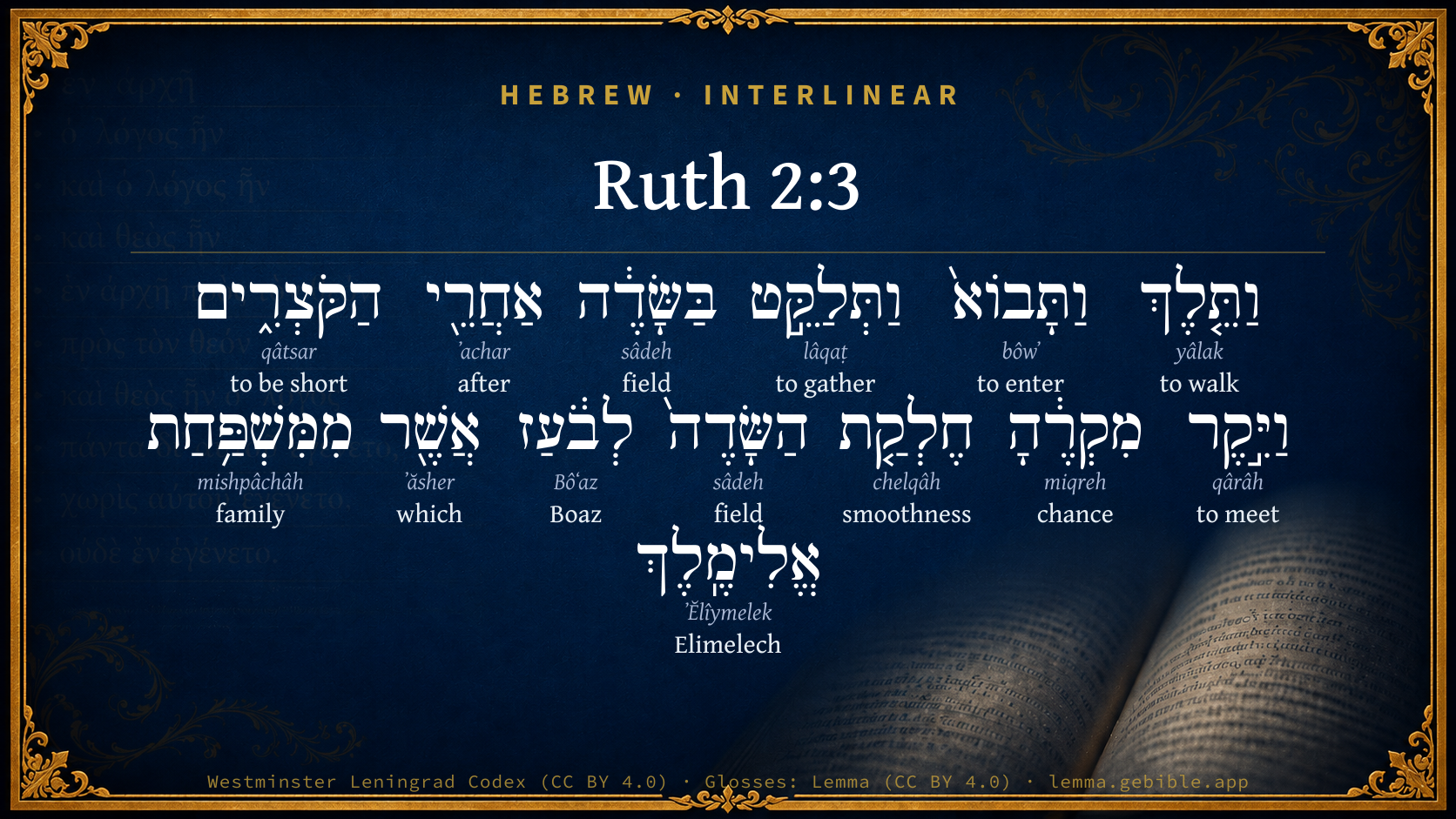
Hebrew (Westminster Leningrad Codex) Ruth 2:3 appears in the Hebrew Old Testament. The text above is from the Westminster Leningrad Codex. Each word links to its Strong’s number, a concise gloss, and parsing drawn from the Open Scriptures Hebrew Bible morphology. Click any word for its full Brown-Driver-Briggs (BDB) entry.
Download image
Cite this verse

Ruth 2:3 (World English Bible). Public Domain. Lemma interlinear Bible study tool, https://lemma.gebible.app/v/ruth/2/3.

Show BibTeX & RIS
BibTeX
RIS
English Translation
She went, and came and gleaned in the field after the reapers: and she happened to come to the portion of the field belonging to Boaz, who was of the family of Elimelech.
World English Bible · Public Domain
Highlights
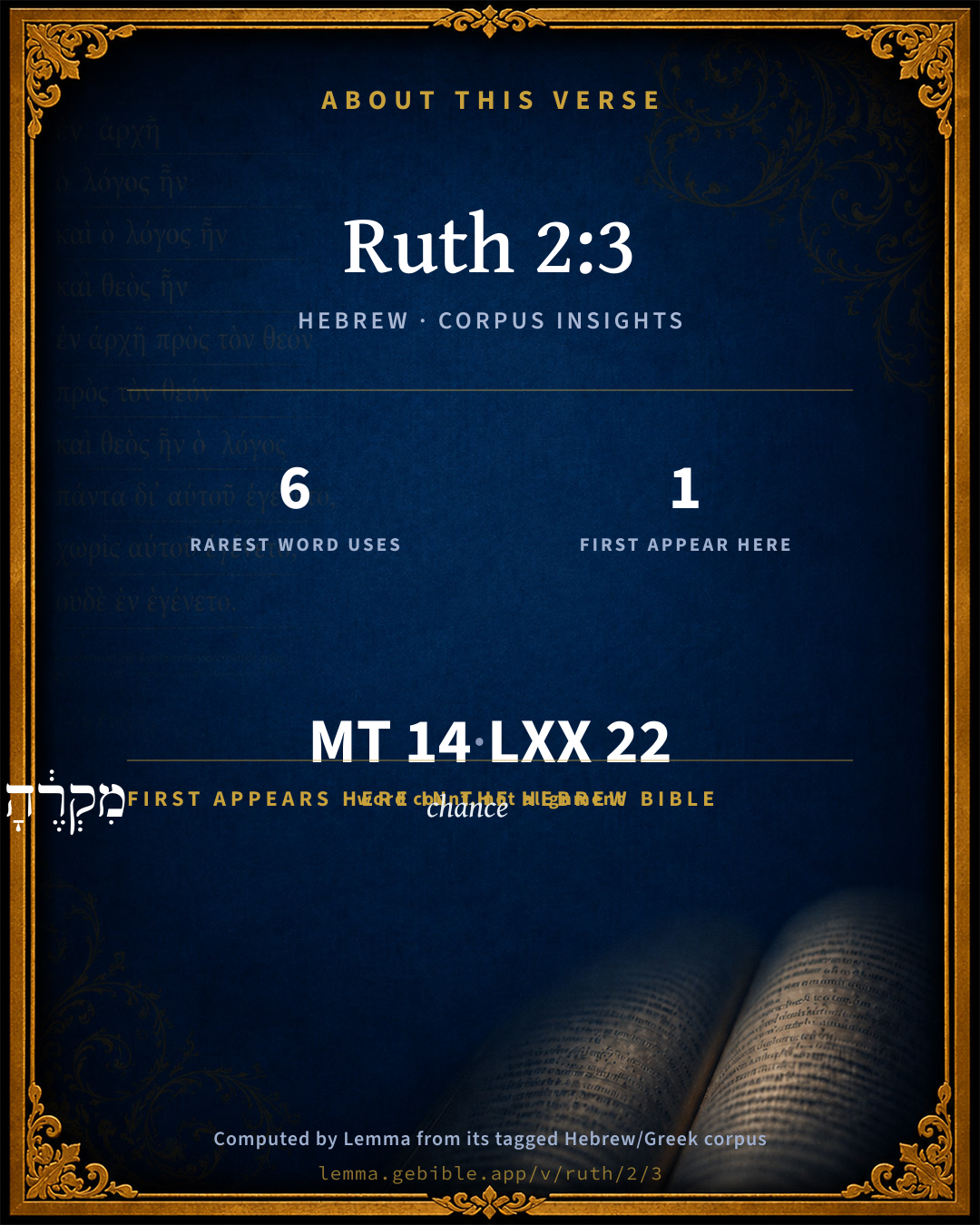
  • 1 first appearance in the Hebrew Bible
Full analysis ↓
Download a study sheet

One document with this verse’s original text, its word-by-word gloss line, the meaning frame, cross-references with their text, attributed commentary, and full source and license credits — printable, and it pastes into notes with its structure intact.

This verse Autodidact and up

Study sheet (.html) Plain text (.txt)

A passage Seminary Student

Up to 50 verses in one chapter. A passage sheet keeps up to 6 commentary sources and 12 cross-references per verse, in the order this page ranks them, and says so on the sheet whenever that leaves anything out. Ask for a single verse and you get the Autodidact verse sheet above.

Everything on this page stays free to read, with no account — the sheet is a download of what is already on screen, not access to it.

Want to remove ads? Support Godless Engineer
Compare translations 3

The same verse in 3 English versions, stacked beneath the original-language interlinear above. Click any original word for its lexicon entry.

Each is an independent rendering of the whole verse — the interlinear is not word-aligned to these translations.

Highlighted words mark where these versions differ — a whole-verse word diff, not a word-by-word alignment.

  • World English Bible Public Domain
    She went, and came and gleaned in the field after the reapers: and she happened to come to the portion of the field belonging to Boaz, who was of the family of Elimelech.
  • King James Version Public Domain
    And she went, and came, and gleaned in the field after the reapers: and her hap was to light on a part of the field belonging unto Boaz, who was of the kindred of Elimelech.
  • unfoldingWord Literal Text CC BY-SA 4.0
    So she left and went to glean in the field after the reapers. And her chance chanced upon the portion of the field belonging to Boaz, who was from the clan of Elimelek.

unfoldingWord Literal Text — © unfoldingWord, licensed CC BY-SA 4.0. Word-aligned USFM3 via Door43 (git.door43.org/unfoldingWord/en_ult).

Versions to compare (up to 4)

3 of 4 selected

Show all 18 translations

Every available English version of this verse, each an independent rendering of the whole verse.

  • World English Bible Public Domain
    She went, and came and gleaned in the field after the reapers: and she happened to come to the portion of the field belonging to Boaz, who was of the family of Elimelech.
  • Berean Standard Bible Public Domain
    So Ruth departed and went out into the field and gleaned after the harvesters. And she happened to come to the part of the field belonging to Boaz, who was from the clan of Elimelech.
  • Majority Standard Bible Public Domain
    So Ruth departed and went out into the field and gleaned after the harvesters. And she happened to come to the part of the field belonging to Boaz, who was from the clan of Elimelech.
  • King James Version Public Domain
    And she went, and came, and gleaned in the field after the reapers: and her hap was to light on a part of the field belonging unto Boaz, who was of the kindred of Elimelech.
  • American Standard Version (1901) Public Domain
    And she went, and came and gleaned in the field after the reapers: and her hap was to light on the portion of the field belonging unto Boaz, who was of the family of Elimelech.
  • Revised Version (1885) Public Domain
    And she went, and came and gleaned in the field after the reapers: and her hap was to light on the portion of the field belonging unto Boaz, who was of the family of Elimelech.
  • Geneva Bible (1599) Public Domain
    And she went, and came and gleaned in the fielde after the reapers, and it came to passe, that she met with the portion of the fielde of Boaz, who was of the familie of Elimelech.
  • Douay-Rheims (1899) Public Domain
    She went therefore and gleaned the ears of corn after the reapers. And it happened that the owner of that field was Booz, who was of the kindred of Elimelech.
  • Young's Literal Translation Public Domain
    And she goeth and cometh and gathereth in a field after the reapers, and her chance happeneth -- the portion of the field is Boaz's who `is' of the family of Elimelech.
  • Literal Standard Version CC BY-SA 4.0
    And she goes and comes and gathers in a field after the reapers, and her chance happens—the portion of the field is Boaz’s who [is] of the family of Elimelech.
  • Unlocked Literal Bible CC BY-SA 4.0
    Ruth went and gleaned what remained in the fields after they had harvested it. She happened to come to the portion of the fields belonging to Boaz, who was of the clan of Elimelek.
  • unfoldingWord Literal Text CC BY-SA 4.0
    So she left and went to glean in the field after the reapers. And her chance chanced upon the portion of the field belonging to Boaz, who was from the clan of Elimelek.
  • Darby Bible Public Domain
    And she went; and she came and gleaned in the fields after the reapers; and she chanced to light on an allotment of Boaz, who was of the family of Elimelech.
  • World Messianic Bible Public Domain
    She went, and came and gleaned in the field after the reapers; and she happened to come to the portion of the field belonging to Boaz, who was of the family of Elimelech.
  • Webster's Bible Public Domain
    And she went, and came, and gleaned in the field after the reapers: and her lot was to light on a part of the field belonging to Boaz, who was of the kindred of Elimelech.
  • Free Bible Version CC BY-SA 4.0
    So she went and picked up grain the reapers had left behind. She happened to be working in a field that belonged to Boaz, a relative of Elimelech.
  • Bible in Basic English Public Domain
    And she went, and came and took up the heads of grain in the field after the cutters; and by chance she went into that part of the field which was the property of Boaz, who was of the family of Elimelech.
  • JPS Tanakh (1917) Public Domain
    And she went, and came and gleaned in the field after the reapers; and her hap was to light on the portion of the field belonging unto Boaz, who was of the family of Elimelech.

Literal Standard Version (2020), Covenant Press — licensed CC BY-SA 4.0. Text via the HelloAO Bible API (eBible.org). Unlocked Literal Bible (unfoldingWord) — licensed CC BY-SA 4.0. Text via the HelloAO Bible API (eBible.org). unfoldingWord Literal Text — © unfoldingWord, licensed CC BY-SA 4.0. Word-aligned USFM3 via Door43 (git.door43.org/unfoldingWord/en_ult). Free Bible Version, Dr. Jonathan Gallagher — licensed CC BY-SA 4.0. Text via the HelloAO Bible API (eBible.org).

Word by word

More ways to search: Search by grammar → Find every occurrence → Compare this word →

Practice this passage: Drill this verse → Learn its vocabulary →

אֱלִימֶֽלֶךְ
ʼĔlîymelek
H458
“Elimelech”
Noun, Proper
Part of Speech
Noun
Type
Proper
Full BDB Definition

Origin: from H410 and H4428

TWOT: None

Elimelech = "my God is king" - Naomi's husband
  1. וַתֵּ֤לֶךְ yâlak H3212 “and · to walk” Conjunction + Verb, Qal, Sequential Imperfect, 3rd Person, Feminine, Singular
  2. וַתָּבוֹא֙ bôwʼ H935 “and · to enter” Conjunction + Verb, Qal, Sequential Imperfect, 3rd Person, Feminine, Singular
  3. וַתְּלַקֵּ֣ט lâqaṭ H3950 “and · to gather” Conjunction + Verb, Piel, Sequential Imperfect, 3rd Person, Feminine, Singular
  4. בַּשָּׂדֶ֔ה sâdeh H7704 “in/at the · field” Preposition, Determined + Noun, Common, Masculine, Singular, Absolute
  5. אַחֲרֵ֖י ʼachar H310 “after” Preposition
  6. הַקֹּצְרִ֑ים qâtsar H7114 “the · being short” Particle, Definite Article + Verb, Qal, Participle Active, Masculine, Plural, Absolute
  7. וַיִּ֣קֶר qârâh H7136 “and · to meet” Conjunction + Verb, Qal, Sequential Imperfect, 3rd Person, Masculine, Singular
  8. מִקְרֶ֔הָ miqreh H4745 “chance · her” Noun, Common, Masculine, Singular, Construct + Suffix, Personal, 3rd Person, Feminine, Singular
  9. חֶלְקַ֤ת chelqâh H2513 “smoothness of” Noun, Common, Feminine, Singular, Construct
  10. הַשָּׂדֶה֙ sâdeh H7704 “the · field” Particle, Definite Article + Noun, Common, Masculine, Singular, Absolute
  11. לְבֹ֔עַז Bôʻaz H1162 “to/for · Boaz” Preposition + Noun, Proper
  12. אֲשֶׁ֖ר ʼăsher H834 “which” Particle, Relative
  13. מִמִּשְׁפַּ֥חַת mishpâchâh H4940 “from · family of” Preposition + Noun, Common, Feminine, Singular, Construct

About this verse

These counts appear in no published source. They are computed here, from the morphology-tagged text and Lemma’s own curated glosses. What Lemma adds →

14
words
13
distinct lemmas
Historical
section

Notable vocabulary

The rarest word here is אֱלִימֶֽלֶךְ Elimelech H458 — appearing just 6 times in the whole Hebrew Bible.

First appearance in Scripture

This word makes its first canonical appearance in the Hebrew Bible here:

  • מִקְרֶ֔הָ chance H4745

Shared distinctive vocabulary

אֱלִימֶֽלֶךְ Elimelech H458 occurs in 6 verses of the Hebrew Bible. Also found in:

Grammatical profile

  • 5 verbs
  • 7 nouns
  • 1 preposition
  • 1 particle

Verb forms

  • וַתֵּ֤לֶךְ Qal · Sequential Imperfect
  • וַתָּבוֹא֙ Qal · Sequential Imperfect
  • וַתְּלַקֵּ֣ט Piel · Sequential Imperfect
  • הַקֹּצְרִ֑ים Qal · Participle Active
  • וַיִּ֣קֶר Qal · Sequential Imperfect

Repetition

A word recurs within this verse — often emphatic in Hebrew:

  • בַּשָּׂדֶ֔ה field H7704 ×2

Hebrew & Septuagint length

In English translation the verse runs 33 words from the Hebrew and 33 from the Septuagint (LXX English) — the same length.

A rough comparison of the two English renderings, which tokenize alike — not a word-level alignment.

Word counts can differ between the Hebrew and the Greek without any difference in meaning — e.g. the Hebrew direct-object marker אֵת has no separate Greek word, and Greek often adds the article ὁ.

In the original languages it is 14 Hebrew tokens and 22 Greek tokens — but the two are counted differently (Hebrew bundles its prefixes and suffixes into one token; the Greek is in lemma form), so that isn’t a like-for-like length.

Cross-references

6

Topical passages linked to Ruth 2:3 in the Treasury of Scripture Knowledge — connected by theme and wording, ordered by reader-vote popularity; previews shown in the World English Bible.

  • 2 Thessalonians 3:12 Now those who are that way, we command and exhort in the Lord Jesus Christ, that with quietness they work, and eat their own bread.
  • Matthew 10:29 "Aren't two sparrows sold for an assarion? Not one of them falls on the ground apart from your Father's will,
  • Luke 10:31 By chance a certain priest was going down that way. When he saw him, he passed by on the other side.
  • 1 Thessalonians 4:11–12 and that you make it your ambition to lead a quiet life, and to do your own business, and to work with your own hands, even as we charged you;
  • 2 Kings 8:5 It happened, as he was telling the king how he had restored to life him who was dead, that behold, the woman, whose son he had restored to life, cried to the king for her house and for her land. Gehazi said, My lord, O king, this is the woman, and this is her son, whom Elisha restored to life.
  • Esther 6:1–2 On that night the king couldn't sleep; and he commanded to bring the book of records of the chronicles, and they were read before the king.

Cross-references courtesy of OpenBible.info (CC BY 4.0).

Hebrew and Greek witnesses Masoretic Hebrew ↔ Greek Septuagint

The same verse in the two great witnesses to the Old Testament, shown verse-for-verse.

These are two independent witnesses, not word-aligned to each other, and the Septuagint is shown in lemma (dictionary) form.

Hebrew Ruth 2:3 Masoretic · Westminster Leningrad Codex

וַתֵּ֤לֶךְ וַתָּבוֹא֙ וַתְּלַקֵּ֣ט בַּשָּׂדֶ֔ה אַחֲרֵ֖י הַקֹּצְרִ֑ים וַיִּ֣קֶר מִקְרֶ֔הָ חֶלְקַ֤ת הַשָּׂדֶה֙ לְבֹ֔עַז אֲשֶׁ֖ר מִמִּשְׁפַּ֥חַת אֱלִימֶֽלֶךְ

She went, and came and gleaned in the field after the reapers: and she happened to come to the portion of the field belonging to Boaz, who was of the family of Elimelech.

World English Bible · Public Domain

Greek LXX Ruth 2:3 Septuagint · lemma form

καί πορεύομαι καί συνλέγω ἐν ὁ ἀγρός κατόπισθεν ὁ θερίζω καί περιπίπτω περίπτωμα ὁ μερίς ὁ ἀγρός βοος ὁ ἐκ συγγένεια αβιμελεχ

And she went; and came and gleaned in the field behind the reapers; and she happened by chance to come on a portion of the land of Booz, of the kindred of Elimelech.

LXX2012 (modern English Septuagint) · Public Domain

Hebrew: Westminster Leningrad Codex (CC BY 4.0). Greek: Septuagint (public domain); English from LXX2012 (modern English Septuagint) (Public Domain). How the Septuagint differs from the Hebrew →

Commentary

Notes on Ruth 2:3 from classic Christian and Jewish commentators (each source and its license shown beneath its notes). The classic Christian expositions comment on the surrounding passage and are grouped to its opening verse, so a note may address several verses; the Jewish commentaries on the Tanakh (Rashi and others) are per-verse, so they appear only where the commentator wrote on this verse.

Lemma curates 59 commentaries, every one of them public domain or Creative Commons licensed, each selected and text-cleaned for this edition rather than reprinted as found. About our sources →

Trapp's Complete Commentary

John Trapp

Rth 2:3 And she went, and came, and gleaned in the field after the reapers: and her hap was to light on a part of the field [belonging] unto Boaz, who [was] of the kindred of Elimelech.

Ver. 3. And she went, and came, and gleaned.] A mean, but honest employment, which therefore she stoopeth unto, and it proved a step to her highest preferment. A diligent person liveth not long in a low place. {Pro 22:29}

And her hap was to light, &c.] Accidit accidens vel eventus. By mere chance, in respect of Ruth, - who, being a stranger, knew not whose field it was, - but by a sweet providence of God, who led her hither by the hand as it were, for her present encouragement and future advancement. God will direct and succeed the attempts of the well minded.

John Trapp, A Commentary or Exposition upon All the Books of the Old and New Testament (1647–1656) — public domain. Text from a community e-Sword module.

The Biblical Illustrator

Joseph S. Exell

Rth_2:3

Her hap was to light on a part of the field belonging unto Boaz.

Gleanings in the field of Boaz

1. I learn, first, from this subject, how trouble develops character.

2. Again, I see in my text the beauty of unfaltering friendship.

3. Again, I learn from this subject that paths which open in hardship and darkness often come out in places of joy. And so it often is that a path which starts very darkly ends very brightly. When you started out for heaven, oh, how dark was the hour of conviction--how Sinai thundered, and devils tormented, and the darkness thickened! All the sins of your life pounced upon you. After a while you went into the harvest field of Gods mercy; you began to glean in the fields of Divine promise, and you had more sheaves than you could carry, as the voice of God addressed you, saying, Blessed is the man whose transgressions are forgiven and whose sins are covered. A very dark starting in conviction; a very bright ending in the pardon, and the hope, and the triumph of the gospel. So, very often, in our worldly business or in our spiritual career, we start off on a very dark path. We have to ford the river, we have to climb the mountain, we have to storm the castle; but, blessed be God! the day of rest and reward will come.

4. Again, I have to learn from my subject that events which seem to be most insignificant may be momentous. Can you imagine anything more unimportant than the coming of a poor woman from Moab to Judah? Can you imagine anything more trivial than the fact that this Ruth just happened to alight--as they say--just happened to alight on that field of Boaz? Yet all ages, all generations, have an interest in the fact. So it is in your history and in mine; events that you thought of no importance at all have been of very great moment. That casual conversation, that accidental meeting--you did not think of it again for a long while; but how it changed all the phase of your life.

5. Again, I see in my subject an illustration of the beauty of female industry.

6. Once more; I learn from my subject the value of gleanings. It is all the straws that make the harvest, it is the pence that make the pound, and it is all the opportunities of doing good that make a life of usefulness if rightly employed. Elihu Burritt learned many things while toiling in a blacksmiths shop. Abercrombie, the world-renowned philosopher, was a philosopher in Scotland, and he got his philosophy, or the chief part of it, while as a physician he was waiting for the door of the sick-room to open. (T. De Witt Talmage.)

Great issues out of little things

It was strikingly remarked by Pascal that if the nose of Cleopatra had been a little longer or shorter it would have changed the history of the world. The cackling of geese once saved Rome. An apple failing from a tree suggested to Sir Isaac Newton that great law by which he unlocked the mysteries of the starry firmament and shed a new light on the whole creation of God. The lifting of the lid of a common tea-kettle by the steam generated within it set James Watt upon a train of thought that led to the invention of a steam-engine, which has revolutionised our whole manufacturing industry and multiplied human intercourse a thousandfold. A reed of an unknown species, borne to the feet of Columbus by the Atlantic wave awakened in his mind the conjecture that there must be another continent; and this issued at length in the discovery of America. A little bird, flying from the mouth of the cave in which Mohammed is concealed, misleads the soldiers that are seeking his destruction; and this influences the character of religion and the history of our race for many centuries over the larger portion of the earth. Pharaohs daughter, coming down to the waters of the Nile to bathe, finds a smiling infant in its floating cradle among the bulrushes, and becomes Gods unconscious instrument in saving the life of one who is to deliver a nation from cruel bondage, to ascend Sinai and speak with God, and to conduct the million hosts of the chosen people, amid miracle and wonder, to the borders of the promised land. Ruths hap is to light on a part of the field belonging unto Boaz; and this eventually raises the poor stranger to affluence, and brings her name into the golden genealogy of the Saviour of men. (A. Thomson, D. D.)

The stranger in the harvest field

1. We see how God raises up friends for His people if they really need them. If you are poor, perhaps you could tell how, when times were hard the Lord has sent you a friend in your distress. Or, in some gloomy hour, when your heart has been ready to burst with inward grief, some kind Christian friend has called upon you, into whose ear you made bold to pour all your troubles, and found unspeakable relief.

2. We may learn, too, from this part of Ruths history, what a happy thing it is to put ourselves under the shelter of Gods care. Happy, happy, those who are thus dwelling in the secret place of the Most High, and abiding under the shadow of the Almighty, who can say, He is my refuge and my fortress; my God, in Him will I trust.(Bp. Oxenden.)

The Biblical Illustrator, edited by Joseph S. Exell (c. 1880s–1900s) — public domain. Text from a community e-Sword module.

Joseph Benson's Commentary

Rth 2:3. Her hap was, &c. — It was a chance in appearance, and in reference to second causes, but ordered by God’s providence. God wisely orders small events, even those that seem altogether contingent. Many a great affair is brought about by a little turn, fortuitous as to men, but designed by God.

Joseph Benson's Commentary on the Old and New Testaments (1811–1818) — public domain. Text from a community e-Sword module.

The Pulpit Commentary

Ruth, having obtained the con. sent of her mother-in-law, went, and came, and gleaned in the field after the reapers. That is, she "went forth," viz., from the city, "and came to the cornfields, and gleaned." "There are some," says Lawson, "whose virtue and industry lie only in their tongues. They say, and do not. But Ruth was no less diligent in business than wise in resolution." The later Jews had a set of fantastic bylaws concerning gleaning, detailed by Maimonides. One of them was, that if only one or two stalks fell from the sickle or hand of the reaper, these should be left lying for the gleaners; but if three stalks fell, then the whole of them belonged to the proprietor (see Carpzov"s "Collegium Rabbinico-Biblicum," p. 242). Happily for Ruth, her steps were so ordered that the field which she entered as a gleaner belonged to Elimelech"s kinsman, Boaz. And it so happened, runs the story, that it was the portion of the fields that belonged to Boas, who was of the kindred of Elimelech.

HOMILIES BY J.R. THOMSON Rth_1:22 Rth_2:3. The gleaner

Bethlehem, "the house of bread" was famous Lethe pastures of its hills, and for the rich cornfields in its fertile valleys. The barley-harvest usually happened in April, and it was then that Naomi and Ruth returned to the village of Judah with which their names are associated. The Mosaic law sanctioned the practice of gleaning, commanded that the produce of the fields and vineyards should not be wholly removed, but that a portion should be left "for the stranger, the fatherless, and the widow." Ruth had, therefore, a right to glean.

I Ruth"s gleaning indicates THE POVERTY OF HER CONDITION". None but the in-necessitous would undertake such an occupation. Naomi and she must indeed have returned empty. In our land, and in our days, happily for the poor, there is always more remunerative work to be had by the industrious poor than this, which accordingly has, with the growing prosperity of the country, almost dropped out of use.

II Ruth"s ABSENCE OF PRIDE is very apparent. The family into which she had married had owned some of the adjoining land; but in changed circumstances she was not too proud to mingle with the gleaners, and in lowly guise to gather ears of corn.

III We cannot but admire Ruth"s VIRTUOUS INDUSTRY. Boaz afterwards said, in praise of her conduct "Thou followedst not young men." She chose a blameless, though laborious, life. An example to all to avoid dependence, and to cultivate the habit of self-reliance and diligence.

IV Remark Ruth"s FILIAL LOVE. She worked not only for herself, but for her mother-in-law, and found a, pleasure in supporting her.

V SUCCESS attends Ruth s honest toil. She gathered barley with her hands; special favor was shown to her; a friend was raised up to assist her; prosperity crowned her efforts. "Thy bread shall be given thee, and thy water shall be sure. T.

Her hap.

Words could hardly be more suggestive than these. They may be applied to circumstances in the life of every one of us. There have been turning-points in our history; we took one path rather than another, and with results (as we now see) how momentous to ourselves! So was it with Ruth of Moab, the gleaner.

I MANY OF OUR ACTIONS ARE PERFORMED WITHOUT ANY THOUGHT OR INTENTION REGARDING THEIR RESULTS. In ordinary affairs how often do we decide and act without any special sense of the wisdom of one course rather than another! And there are positions in which our choice seems quite immaterial. It seemed of little consequence in which field this young foreigner, this friendless widow, went to glean a few ears of barley. So is it often with us. Shall we go to such a place? shall we pay such a visit? shall we form such an acquaintance? shall we read such a book? shall we venture on such a remark? shall we write such a note?

II UNFORESEEN AND IMPORTANT ISSUES MAY DEPEND UPON CASUAL ACTIONS. Though it seemed of little consequence in which field Ruth gleaned, "her hap was to light on a part of the field belonging unto Boaz," and from this fact sprang results of the greatest importance. "Her hap" determined her marriage, her wealth, her happiness and that of her mother-in-law, her union with Israel, her motherhood, her position as an ancestress of David and of Christ. In such seemingly insignificant causes originate the most momentous issues. Thus oftentimes it comes to pass that family relationships are formed, a professional career is determined; nay, religious decision may be brought about, life-work for Christ may be appointed, eternal destiny is affected.

Lessons:

1. Regard nothing as insignificant.

2. Look out for, and follow, the leadings of Divine providence.

3. "In all thy ways acknowledge him, and he shall direct thy paths! T.

The Pulpit Commentary (1880–1919), ed. H.D.M. Spence-Jones & Joseph S. Exell — public domain. Text from a community e-Sword module.

Tyndale Open Study Notes

Tyndale Open Resources

2:3 as it happened, she found herself: Ruth seemingly selected at random the field in which she would glean; God works through ordinary choices to provide for those who trust him.

Tyndale Open Study Notes — © Tyndale Open Resources, licensed CC BY-SA 4.0. Text via the HelloAO Bible API.

Jamieson, Fausset & Brown

Robert Jamieson, A. R. Fausset & David Brown

her hap was to light on a part of the field belonging unto Boaz--Fields in Palestine being unenclosed, the phrase signifies that portion of the open ground which lay within the landmarks of Boaz.

Jamieson, Fausset & Brown — Commentary Critical and Explanatory on the Whole Bible (1871) — public domain (CC PDM 1.0). Text via the HelloAO Bible API.

Adam Clarke's Commentary

Verse 3. And her hap was] So she was accidentally or providentially led to that part of the cultivated country which belonged to Boaz.

Adam Clarke's Commentary on the Bible (1810–1826) — public domain. Text from a community e-Sword/MySword module.

Ellicott's Commentary for English Readers

(3) Her hap was to light on.—Literally, her hap happened. A chance in outward seeming, yet a clear shaping of her course by unseen hands. Her steps were divinely guided to a certain field, that God’s good purposes should be worked out.

A Bible Commentary for English Readers, edited by Charles John Ellicott (1878–1897) — public domain. Text from a community e-Sword module.

The Cambridge Bible for Schools and Colleges

gen. ed. J. J. S. Perowne

3. her hap … Boaz] The word for hap occurs in 1Sa_6:9 (‘a chance’), 1Sa_20:26. Throughout the story the writer intends us to share his strong belief in Providence, over-ruling unpremeditated actions and words (cf. Rth_2:12; Rth_2:19 f.), and rewarding those who trust it (Rth_3:4; Rth_3:9; Rth_3:11, Rth_4:6; Rth_4:14). ‘The cosmos is a fighter for the righteous,’ says the Jewish sage, Wis_16:17

The Cambridge Bible for Schools and Colleges (gen. ed. J. J. S. Perowne; Cambridge University Press, 1878–1918) — public domain. Text from a community e-Sword module.

John Gill's Exposition

And she went, and came,.... That is, she went out of the house where she was, and out of the city, and came into the field; though, according to the Midrash (p), she marked the ways as she went, before she entered into the field, and then came back to the city to observe the marks and signs she made, that she might not mistake the way, and might know how to come back again:

and gleaned in the field after the reapers; when they had cut down and bound up the corn, what fell and was left she picked up, having first asked leave so to do:

and her hap was to light on a part of the field belonging unto Boaz, who was of the kindred of Elimelech; the providence of God so ordering and directing it; for though it was hap and chance to her, and what some people call good luck, it was according to the purpose, and by the providence and direction of God that she came to the reapers in that part of the field Boaz, a near kinsman of her father-in-law, was owner of, and asked leave of them to glean and follow them.

(p) Midrash Ruth, fol. 31. 4. Vid. Jarchi & Alshech in loc.

John Gill's Exposition of the Whole Bible (1746–1763) — public domain (CC PDM 1.0). Text via the HelloAO Bible API.

Matthew Poole's English Annotations

Her hap was; for it was indeed a chance in reference to second causes, but ordered and designed by God’s providence.

Matthew Poole's English Annotations on the Holy Bible (1683–1685) — public domain. Text from a community e-Sword/MySword module.

Whedon's Commentary on the Bible

Daniel D. Whedon

3. She went… and gleaned — But not without first asking permission of the overseer of the reapers. Rth_2:7.

Her hap was — To human observation her lighting upon Boaz’s field was accidental; in the Divine economy it was providentially designed.

Daniel D. Whedon (gen. ed.), Commentary on the Old and New Testaments (1874–1909) — public domain. Text from a community e-Sword module.

John Wesley's Explanatory Notes

Her hap - It was a chance in reference to second causes, but ordered by God's providence. God wisely orders small events, even those that seem altogether contingent. Many a great affair is brought about by a little turn, fortuitous as to men, but designed by God.

John Wesley, Explanatory Notes Upon the Whole Bible (1754–1765) — public domain. Text via the GEBible commentary corpus.

unfoldingWord translationNotes

Door43 World Missions Community

She happened to come

Ruth was not aware that the field she picked to glean in belonged to Naomi's relative Boaz.

Behold, Boaz

The word "behold" alerts us to the important event of Boaz arriving at the field. Your language may also have a specific way of introducing important events or characters.

came from Bethlehem

The fields were an unspecified distance outside of Bethlehem.

bless you

"give you good things" or "make you happy"

translationWords

glean

reap

Boaz

Bethlehem

Yahweh

bless

unfoldingWord translationNotes — © Distant Shores Media and the Door43 World Missions Community, licensed CC BY-SA 4.0. Source: git.door43.org/Door43/en_tn.

Rashi

Rabbi Shlomo Yitzchaki (Rashi)

And she went, and she came, and she gleaned in the field We find in Midrash Ruth [Rabbah]: Before she went she came; Scripture says: And she came, and she gleaned? But rather, she marked the roads before she entered the field, and she went and came and returned to the city, in order to make signs and markings so that she would not stray in the paths and know how to return.

and her chance was to come to the portion of the field belonging to Boaz.

Rashi on the Tanakh — English translations: “The Judaica Press complete Tanach with Rashi, translated by A. J. Rosenberg” (CC BY 4.0); “Pentateuch with Rashi's commentary by M. Rosenbaum and A.M. Silbermann, 1929-1934” (public domain); “The Metsudah Tanach series, Lakewood, N.J” (CC BY 4.0); and “The Book of Joshua, Metsudah Publications, 1997” (CC BY 4.0). Text via Sefaria.

Lesson kit

Teaching starters — assembled from the data on this page, not authored interpretation. Every prompt links to the verse data it draws on. Edit before teaching.

Ruth, in the Historical, opens this verse with 14 words (13 distinct Hebrew lemmas). Its most distinctive word is ʼĔlîymelek (“Elimelech”). A historical commentator’s framing appears above. Read the whole chapter for the surrounding context.

Discussion questions

  1. What does “Elimelech” (ʼĔlîymelek) contribute to the verse as a whole?
  2. The word “chance” first appears here in Scripture. What is being introduced at this debut?
  3. Ruth 1:2 shares the word «Elimelech» with this verse. How do the two illuminate each other?
  4. “field” occurs 2× in this one verse. What is the effect of the repetition?
  5. The translations on this page render this verse differently — a whole-verse word diff, not a word-by-word alignment. What might account for the different wordings?
  6. The verb «וַתֵּ֤לֶךְ» is Qal Sequential Imperfect. How does its form color the action?
  7. Reading how Trapp's Complete Commentary and The Biblical Illustrator read this verse, where do the two commentators agree and where do they part?

Things to notice

Reading settings

Reading text

Shown beneath each verse's original-language words.

Old Testament
Old Testament edition

Read the OT as the Masoretic Hebrew (MT) or the Greek Septuagint (LXX).

English shown for the Greek Septuagint (in the Hebrew ↔ Greek comparison).

Comparing translations? Open the Compare panel on any verse page to stack up to four side by side.