
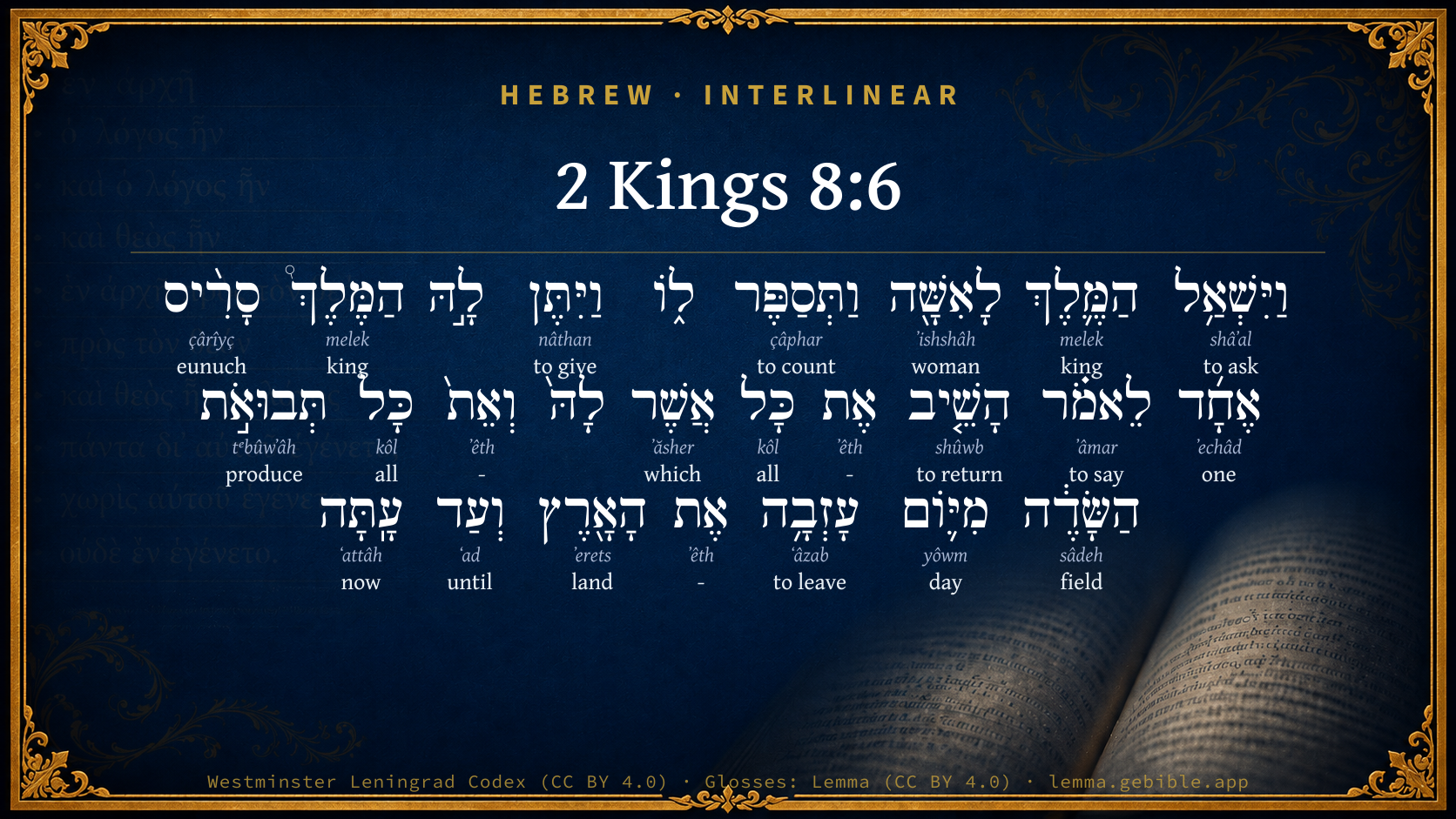
2 Kings 8:6

Hebrew (Westminster Leningrad Codex) 2 Kings 8:6 appears in the Hebrew Old Testament. The text above is from the Westminster Leningrad Codex. Each word links to its Strong’s number, a concise gloss, and parsing drawn from the Open Scriptures Hebrew Bible morphology. Click any word for its full Brown-Driver-Briggs (BDB) entry.
Download image
Cite this verse

2 Kings 8:6 (World English Bible). Public Domain. Lemma interlinear Bible study tool, https://lemma.gebible.app/v/2-kings/8/6.

Show BibTeX & RIS
BibTeX
RIS
English Translation
When the king asked the woman, she told him. So the king appointed to her a certain officer, saying, Restore all that was hers, and all the fruits of the field since the day that she left the land, even until now.
World English Bible · Public Domain
Download a study sheet

One document with this verse’s original text, its word-by-word gloss line, the meaning frame, cross-references with their text, attributed commentary, and full source and license credits — printable, and it pastes into notes with its structure intact.

This verse Autodidact and up

Study sheet (.html) Plain text (.txt)

A passage Seminary Student

Up to 50 verses in one chapter. A passage sheet keeps up to 6 commentary sources and 12 cross-references per verse, in the order this page ranks them, and says so on the sheet whenever that leaves anything out. Ask for a single verse and you get the Autodidact verse sheet above.

Everything on this page stays free to read, with no account — the sheet is a download of what is already on screen, not access to it.

Want to remove ads? Support Godless Engineer
Compare translations 3

The same verse in 3 English versions, stacked beneath the original-language interlinear above. Click any original word for its lexicon entry.

Each is an independent rendering of the whole verse — the interlinear is not word-aligned to these translations.

Highlighted words mark where these versions differ — a whole-verse word diff, not a word-by-word alignment.

  • World English Bible Public Domain
    When the king asked the woman, she told him. So the king appointed to her a certain officer, saying, Restore all that was hers, and all the fruits of the field since the day that she left the land, even until now.
  • King James Version Public Domain
    And when the king asked the woman, she told him. So the king appointed unto her a certain officer, saying, Restore all that was hers, and all the fruits of the field since the day that she left the land, even until now.
  • unfoldingWord Literal Text CC BY-SA 4.0
    And the king inquired of the woman, and she recounted to him. And the king assigned to her a eunuch, saying, “Return everything that to her and all of the produce of the field from the day she left the land and until now.”

unfoldingWord Literal Text — © unfoldingWord, licensed CC BY-SA 4.0. Word-aligned USFM3 via Door43 (git.door43.org/unfoldingWord/en_ult).

Versions to compare (up to 4)

3 of 4 selected

Show all 18 translations

Every available English version of this verse, each an independent rendering of the whole verse.

  • World English Bible Public Domain
    When the king asked the woman, she told him. So the king appointed to her a certain officer, saying, Restore all that was hers, and all the fruits of the field since the day that she left the land, even until now.
  • Berean Standard Bible Public Domain
    When the king asked the woman, she confirmed it. So the king appointed for her an officer, saying, “Restore all that was hers, along with all the proceeds of the field from the day that she left the country until now.”
  • Majority Standard Bible Public Domain
    When the king asked the woman, she confirmed it. So the king appointed for her an officer, saying, “Restore all that was hers, along with all the proceeds of the field from the day that she left the country until now.”
  • King James Version Public Domain
    And when the king asked the woman, she told him. So the king appointed unto her a certain officer, saying, Restore all that was hers, and all the fruits of the field since the day that she left the land, even until now.
  • American Standard Version (1901) Public Domain
    And when the king asked the woman, she told him. So the king appointed unto her a certain officer, saying, Restore all that was hers, and all the fruits of the field since the day that she left the land, even until now.
  • Revised Version (1885) Public Domain
    And when the king asked the woman, she told him. So the king appointed unto her a certain officer, saying, Restore all that was hers, and all the fruits of the field since the day that she left the land, even until now.
  • Geneva Bible (1599) Public Domain
    And when the King asked the woman, shee told him: so the King appoynted her an Eunuch, saying, Restore thou all that are hers, and all the fruites of her landes since the day shee left the land, euen vntill this time.
  • Douay-Rheims (1899) Public Domain
    And the king asked the woman: and she told him. And the king appointed her an eunuch, saying: Restore her all that is hers, and all the revenues of the lands, from the day that she left the land, to this present.
  • Young's Literal Translation Public Domain
    And the king asketh at the woman, and she recounteth to him, and the king appointeth to her a certain eunuch, saying, `Give back all that she hath, and all the increase of the field from the day of her leaving the land even till now.'
  • Literal Standard Version CC BY-SA 4.0
    And the king inquires of the woman, and she recounts to him, and the king appoints a certain eunuch to her, saying, “Give back all that she has, and all the increase of the field from the day of her leaving the land even until now.”
  • Unlocked Literal Bible CC BY-SA 4.0
    When the king asked the woman about her son, she explained it to him. So the king ordered a certain officer for her, saying, “Give back to her all that was hers and all the harvests of her fields since the day that she left the land until now.”
  • unfoldingWord Literal Text CC BY-SA 4.0
    And the king inquired of the woman, and she recounted to him. And the king assigned to her a eunuch, saying, “Return everything that to her and all of the produce of the field from the day she left the land and until now.”
  • Darby Bible Public Domain
    And the king asked the woman, and she told him. And the king appointed a certain chamberlain, saying, Restore all that was hers, and all the revenue of the land since the day that she left the country even until now.
  • World Messianic Bible Public Domain
    When the king asked the woman, she told him. So the king appointed to her a certain officer, saying, “Restore all that was hers, and all the fruits of the field since the day that she left the land, even until now.”
  • Webster's Bible Public Domain
    And when the king asked the woman, she told him. So the king appointed to her a certain officer, saying, Restore all that was hers, and all the fruits of the field since the day that she left the land even till now.
  • Free Bible Version CC BY-SA 4.0
    The king asked the woman about it and she explained the whole story to him. The king gave orders to an official, saying, “Make sure everything that belonged to her is returned to her, together with all the profit from her lands from the day that she left the country until now.”
  • Bible in Basic English Public Domain
    And in answer to the king's questions, the woman gave him all the story. So the king gave orders to one of his unsexed servants, saying, Give her back all her property, and all the produce of her fields from the day when she went away from the land up till now.
  • JPS Tanakh (1917) Public Domain
    And when the king asked the woman, she told him. So the king appointed unto her a certain officer, saying: 'Restore all that was hers, and all the fruits of the field since the day that she left the land, even until now.'

Literal Standard Version (2020), Covenant Press — licensed CC BY-SA 4.0. Text via the HelloAO Bible API (eBible.org). Unlocked Literal Bible (unfoldingWord) — licensed CC BY-SA 4.0. Text via the HelloAO Bible API (eBible.org). unfoldingWord Literal Text — © unfoldingWord, licensed CC BY-SA 4.0. Word-aligned USFM3 via Door43 (git.door43.org/unfoldingWord/en_ult). Free Bible Version, Dr. Jonathan Gallagher — licensed CC BY-SA 4.0. Text via the HelloAO Bible API (eBible.org).

Word by word

More ways to search: Search by grammar → Find every occurrence → Compare this word →

Practice this passage: Drill this verse → Learn its vocabulary →

סָרִ֨יס
çârîyç
H5631
“eunuch”
Noun, Common, Masculine, Singular, Absolute
Part of Speech
Noun
Type
Common
Gender
Masculine
Number
Singular
State
Absolute
Full BDB Definition

Origin: from an unused root meaning to castrate

TWOT: 1545

official, eunuch
  1. וַיִּשְׁאַ֥ל shâʼal H7592 “and · to ask” Conjunction + Verb, Qal, Sequential Imperfect, 3rd Person, Masculine, Singular
  2. הַמֶּ֛לֶךְ melek H4428 “the · king” Particle, Definite Article + Noun, Common, Masculine, Singular, Absolute
  3. לָאִשָּׁ֖ה ʼishshâh H802 “to/for the · woman” Preposition, Determined + Noun, Common, Feminine, Singular, Absolute
  4. וַתְּסַפֶּר çâphar H5608 “and · to count” Conjunction + Verb, Piel, Sequential Imperfect, 3rd Person, Feminine, Singular
  5. וַיִּתֶּן nâthan H5414 “and · to give” Conjunction + Verb, Qal, Sequential Imperfect, 3rd Person, Masculine, Singular
  6. הַמֶּלֶךְ֩ melek H4428 “the · king” Particle, Definite Article + Noun, Common, Masculine, Singular, Absolute
  7. אֶחָ֜ד ʼechâd H259 “one” Adjective, Cardinal number, Masculine, Singular, Absolute
  8. לֵאמֹ֗ר ʼâmar H559 “to say” Preposition + Verb, Qal, Infinitive Construct
  9. הָשֵׁ֤יב shûwb H7725 “return” Verb, Hiphil, Imperative, 2nd Person, Masculine, Singular
  10. אֶת ʼêth H853 “-” Particle, Direct Object
  11. כָּל kôl H3605 “all of” Noun, Common, Masculine, Singular, Construct
  12. אֲשֶׁר ʼăsher H834 “which” Particle, Relative
  13. וְאֵת֙ ʼêth H853 “and · -” Conjunction + Particle, Direct Object
  14. כָּל kôl H3605 “all of” Noun, Common, Masculine, Singular, Construct
  15. תְּבוּאֹ֣ת tᵉbûwʼâh H8393 “produce of” Noun, Common, Feminine, Plural, Construct
  16. הַשָּׂדֶ֔ה sâdeh H7704 “the · field” Particle, Definite Article + Noun, Common, Masculine, Singular, Absolute
  17. מִיּ֛וֹם yôwm H3117 “from · day of” Preposition + Noun, Common, Masculine, Singular, Construct
  18. עָזְבָ֥ה ʻâzab H5800 “to leave” Verb, Qal, Perfect, 3rd Person, Feminine, Singular
  19. אֶת ʼêth H853 “-” Particle, Direct Object
  20. הָאָ֖רֶץ ʼerets H776 “the · land” Particle, Definite Article + Noun, Common, Both, Singular, Absolute
  21. וְעַד ʻad H5704 “and · until” Conjunction + Preposition
  22. עָֽתָּה ʻattâh H6258 “now” Adverb

About this verse

These counts appear in no published source. They are computed here, from the morphology-tagged text and Lemma’s own curated glosses. What Lemma adds →

26
words
19
distinct lemmas
Historical
section

Shared distinctive vocabulary

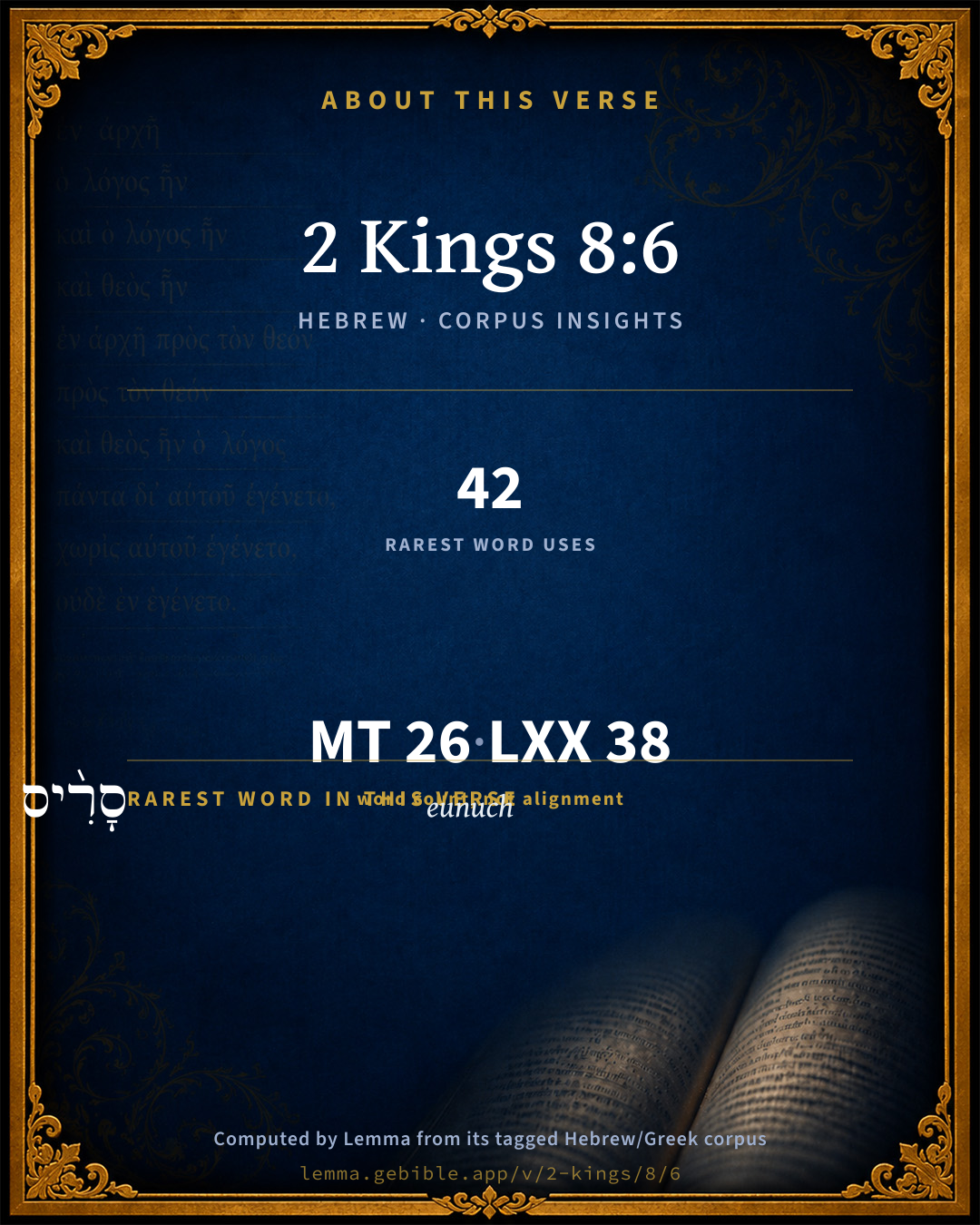
סָרִ֨יס eunuch H5631 occurs in 42 verses of the Hebrew Bible. Also found in:

Grammatical profile

  • 6 verbs
  • 10 nouns
  • 1 adjective
  • 4 prepositions
  • 1 adverb
  • 4 particles

Verb forms

  • וַיִּשְׁאַ֥ל Qal · Sequential Imperfect
  • וַתְּסַפֶּר Piel · Sequential Imperfect
  • וַיִּתֶּן Qal · Sequential Imperfect
  • לֵאמֹ֗ר Qal · Infinitive Construct
  • הָשֵׁ֤יב Hiphil · Imperative
  • עָזְבָ֥ה Qal · Perfect

Repetition

Words recur within this verse — often emphatic in Hebrew:

  • הַמֶּ֛לֶךְ king H4428 ×2
  • כָּל all H3605 ×2

Hebrew & Septuagint length

In English translation the verse runs 42 words from the Hebrew and 40 from the Septuagint (LXX English) — closely comparable.

A rough comparison of the two English renderings, which tokenize alike — not a word-level alignment.

Word counts can differ between the Hebrew and the Greek without any difference in meaning — e.g. the Hebrew direct-object marker אֵת has no separate Greek word, and Greek often adds the article ὁ.

In the original languages it is 26 Hebrew tokens and 38 Greek tokens — but the two are counted differently (Hebrew bundles its prefixes and suffixes into one token; the Greek is in lemma form), so that isn’t a like-for-like length.

Cross-references

8

Topical passages linked to 2 Kings 8:6 in the Treasury of Scripture Knowledge — connected by theme and wording, ordered by reader-vote popularity; previews shown in the World English Bible.

  • Proverbs 16:7 When a man's ways please Yahweh, He makes even his enemies to be at peace with him.
  • Proverbs 21:1 The king's heart is in Yahweh's hand like the watercourses. He turns it wherever he desires.
  • 2 Samuel 9:7 David said to him, "Don't be afraid of him; for I will surely show you kindness for Jonathan your father's sake, and will restore you all the land of Saul your father; and you shall eat bread at my table continually."
  • 2 Kings 9:32 He lifted up his face to the window, and said, Who is on my side? who? There looked out to him two or three eunuchs.
  • 1 Chronicles 28:1 David assembled all the princes of Israel, the princes of the tribes, and the captains of the companies who served the king by division, and the captains of thousands, and the captains of hundreds, and the rulers over all the substance and possessions of the king and of his sons, with the officers, and the mighty men, even all the mighty men of valor, to Jerusalem.
  • Genesis 37:36 The Midianites sold him into Egypt to Potiphar, an officer of Pharaoh's, the captain of the guard.
  • Deuteronomy 22:2 If your brother isn't near to you, or if you don't know him, then you shall bring it home to your house, and it shall be with you until your brother seek after it, and you shall restore it to him.
  • Judges 11:13 The king of the children of Ammon answered to the messengers of Jephthah, Because Israel took away my land, when he came up out of Egypt, from the Arnon even to the Jabbok, and to the Jordan: now therefore restore those [lands] again peaceably.

Cross-references courtesy of OpenBible.info (CC BY 4.0).

Hebrew and Greek witnesses Masoretic Hebrew ↔ Greek Septuagint

The same verse in the two great witnesses to the Old Testament, shown verse-for-verse.

These are two independent witnesses, not word-aligned to each other, and the Septuagint is shown in lemma (dictionary) form.

Hebrew 2 Kings 8:6 Masoretic · Westminster Leningrad Codex

וַיִּשְׁאַ֥ל הַמֶּ֛לֶךְ לָאִשָּׁ֖ה וַתְּסַפֶּר ל֑וֹ וַיִּתֶּן לָ֣הּ הַמֶּלֶךְ֩ סָרִ֨יס אֶחָ֜ד לֵאמֹ֗ר הָשֵׁ֤יב אֶת כָּל אֲשֶׁר לָהּ֙ וְאֵת֙ כָּל תְּבוּאֹ֣ת הַשָּׂדֶ֔ה מִיּ֛וֹם עָזְבָ֥ה אֶת הָאָ֖רֶץ וְעַד עָֽתָּה

When the king asked the woman, she told him. So the king appointed to her a certain officer, saying, Restore all that was hers, and all the fruits of the field since the day that she left the land, even until now.

World English Bible · Public Domain

Greek LXX 2 Kings 8:6 Septuagint · lemma form

καί ἐπιἐρωτάω ὁ βασιλεύς ὁ γυνή καί διαἡγέομαι αὐτός καί δίδωμι αὐτός ὁ βασιλεύς εὐνοῦχος εἷς λέγω ἐπιστρέφω πᾶς ὁ αὐτός καί πᾶς ὁ γένημα ὁ ἀγρός αὐτός ἀπό ὁ ἡμέρα ὅς καταλείπω ὁ γῆ ἕως ὁ νῦν

And the king asked the woman, and she told him: and the king appointed her a eunuch, saying, Restore all that was hers, and all the fruits of the field from the day that she left the land until now.

LXX2012 (modern English Septuagint) · Public Domain

Hebrew: Westminster Leningrad Codex (CC BY 4.0). Greek: Septuagint (public domain); English from LXX2012 (modern English Septuagint) (Public Domain). How the Septuagint differs from the Hebrew →

Targum (Aramaic paraphrase)

1

The Targum is the ancient Jewish Aramaic paraphrase of the Hebrew Scriptures — an interpretive translation, not the Hebrew text itself. Onkelos (literal) and Pseudo-Jonathan (expansive) render the Torah, and Jonathan the Prophets. Coverage is partial: where no permissively-licensed English translation exists for a verse, only the Aramaic is shown. This is verse-level text, not a word-by-word alignment to the Hebrew.

  1. Targum Jonathan Prophets (Joshua–Malachi)
    וּשְׁאֵיל מַלְכָּא לְאִתְּתָא וְאִשְׁתְּעִיאַת לֵיהּ וּמַנֵי לָהּ מַלְכָּא גְוָזָא חַד לְמֵימַר אֲתֵיב יַת כָּל דִילָהּ וְיַת כָּל עַלְלַת חַקְלָא מִיוֹמָא דְשַׁבְקַת יַת אַרְעָא וְעַד כְּעַן:

    (no public-domain English translation for this verse)

    Targum Jonathan — Aramaic: “Mikraot Gedolot” (public domain). English: “Sefaria Community Translation” (CC0 1.0 (public-domain dedication)); “London "Chaldee Paraphrase," 1871” (public domain). Text via Sefaria.

Commentary

Notes on 2 Kings 8:6 from classic Christian and Jewish commentators (each source and its license shown beneath its notes). The classic Christian expositions comment on the surrounding passage and are grouped to its opening verse, so a note may address several verses; the Jewish commentaries on the Tanakh (Rashi and others) are per-verse, so they appear only where the commentator wrote on this verse.

Lemma curates 59 commentaries, every one of them public domain or Creative Commons licensed, each selected and text-cleaned for this edition rather than reprinted as found. About our sources →

Trapp's Complete Commentary

John Trapp

2Ki 8:6 And when the king asked the woman, she told him. So the king appointed unto her a certain officer, saying, Restore all that [was] hers, and all the fruits of the field since the day that she left the land, even until now.

Ver. 6. Restore all that was hers.] Now the Shunammite thinks her table and stool, her bed and her candlestick, well bestowed. He is a niggard to himself that scants his beneficence to a prophet, whose very "cold water" shall not go unrewarded.

John Trapp, A Commentary or Exposition upon All the Books of the Old and New Testament (1647–1656) — public domain. Text from a community e-Sword module.

Tyndale Open Study Notes

Tyndale Open Resources

8:6 everything . . . was restored: Not only did the woman receive her land but Joram made sure that she received all income due to the selling of crops that had been harvested during her absence. Joram, who sometimes displayed less than noble characteristics (3:13-14; 6:31-33), on this occasion showed higher ethical standards than his father Ahab had regarding Naboth’s vineyard (1 Kgs 21:1-16).

Tyndale Open Study Notes — © Tyndale Open Resources, licensed CC BY-SA 4.0. Text via the HelloAO Bible API.

Geneva Bible (1599)

Geneva Bible translators

The King caused that to be justly restored, which was wrongfully holden from her.

Geneva Bible (1599) marginal notes — public domain. Text via Bolls.life.

Ellicott's Commentary for English Readers

(6) Told.—Related to him, i.e., the story. So in 2Ki_8:4-5.

Officer.—Literally, eunuch (sârîs). (Comp. Note on Gen_37:36; 1Ch_28:1.)

Fruits.—Literally, revenues, produce in kind, which must have been paid out of the royal stores. This seems to imply that her land had been annexed to the royal domains.

A Bible Commentary for English Readers, edited by Charles John Ellicott (1878–1897) — public domain. Text from a community e-Sword module.

The Cambridge Bible for Schools and Colleges

gen. ed. J. J. S. Perowne

6. she told him] i.e. confirmed the narrative which Gehazi had given, and at the same time took advantage of the king’s interest in Elisha, to press her plea for the restitution of her land.

Restore all that was hers] It would seem from this as if the king himself had been put in possession of the land. Hence he could order all the seven years, produce to be given back to her either in kind or in money from the royal stores.

The Cambridge Bible for Schools and Colleges (gen. ed. J. J. S. Perowne; Cambridge University Press, 1878–1918) — public domain. Text from a community e-Sword module.

John Gill's Exposition

And when the king asked the woman, she told him,.... The whole affair; how that she had a son according to the word of Elisha, when she had been barren, and her husband old; that this child was struck with sickness, and died; and that the prophet, through his prayers, restored it to life:

so the king appointed unto her a certain officer; the word signifies an "eunuch": him he ordered to attend upon her, and assist her, and see to it that she was put into the possession of her house and land:

saying, restore all that was her's, and all the fruits of the field, since the day that she left the land, even till now; not only her house and land, but all the rent, profits, and dues arising from thence during the time of her absence: the Jews except the rent of her house.

John Gill's Exposition of the Whole Bible (1746–1763) — public domain (CC PDM 1.0). Text via the HelloAO Bible API.

Albert Barnes' Notes on the Bible

A certain officer - literally, “a certain eunuch” (margin). Eunuchs were now in common use at the Samaritan court (compare 2Ki 9:32). They are ascribed to the court of David in Chronicles 1Ch 28:1; and we may conjecture that they were maintained by Solomon. But otherwise we do not find them in the kingdom of Judah until the time of Hezekiah Isa 56:3-4.

Albert Barnes' Notes on the Bible (1834–1885) — public domain. Text from a community e-Sword/MySword module.

Haydock's Catholic Bible Commentary

Restore. "Restituere est possessorem facere fructusque reddere." (Caius.) --- Some think that the lands had been confiscated to the king, as being abandoned; or his authority was requisite, at least, to make the present occupiers give them up.

George Leo Haydock (1774–1849), Haydock's Catholic Family Bible and Commentary, 1859 edition — public domain. Excludes Psalms (Douay-Rheims chapter numbering differs from Protestant) and Deuterocanonical books (Catholic canon only).

Matthew Poole's English Annotations

The king asked the woman concerning the truth of Gehazi’s relation.

Matthew Poole's English Annotations on the Holy Bible (1683–1685) — public domain. Text from a community e-Sword/MySword module.

Whedon's Commentary on the Bible

Daniel D. Whedon

6. Restore all that was hers — Her estate was of no small value, for, according to 2Ki_4:8. she was a great, that is, a wealthy and influential person at Shunem.

All the fruits of the field — All the produce that her land had yielded for the seven years, whether it were more or less. She was thus reimbursed according to the yield of the land.

On the above narrative Dr. Thomson has the following: “It is still common for even petty sheiks to confiscate the property of any person who is exiled for a time, or who moves away temporarily from his district. Especially is this true of widows and orphans, and the Shunammite was now a widow. And small is the chance to such of having their property restored, unless they can secure the mediation of some one more influential than themselves. The conversation between the king and Gehazi about his master is also in perfect keeping with the habits of Eastern princes; and the appearance of the widow and her son so opportunely, would have precisely the same effect now that it had then. The thing happened just as recorded.

It is too natural to be an invention or fabrication.”

Daniel D. Whedon (gen. ed.), Commentary on the Old and New Testaments (1874–1909) — public domain. Text from a community e-Sword module.

The Pulpit Commentary

And when the king asked the woman, she told him; rather, and the king made inquiry of the woman, and she answered him. The extent of the inquiries is not indicated. They may have included questions concerning the miracle, as well as questions concerning the woman"s claim to the land and house, and the evidence which she could produce of proprietorship. So the king appointed unto her a certain officer literally, a certain eunuch, or chamberlainan officer of the court, who was in his confidence, and would give effect to his directions saying, Restore all that was hers, and all the fruits of the field since the day that she left the land, even until now. The order was, that not only was the Shunammite to receive back her house and estate, but that she was also to have "the mesne profits" i.e. the full value of all that the land had produced beyond the expense of cultivation during the seven yearn of her absence. English law lays down the same rule in cases of unlawful possession for which there is no valid excuse.

The Pulpit Commentary (1880–1919), ed. H.D.M. Spence-Jones & Joseph S. Exell — public domain. Text from a community e-Sword module.

Lesson kit

Teaching starters — assembled from the data on this page, not authored interpretation. Every prompt links to the verse data it draws on. Edit before teaching.

2 Kings, in the Historical, opens this verse with 26 words (19 distinct Hebrew lemmas). Its most distinctive word is çârîyç (“eunuch”). A historical commentator’s framing appears above. Read the whole chapter for the surrounding context.

Discussion questions

  1. How does “eunuch” (çârîyç) shape what this verse is saying?
  2. Genesis 37:36 shares the word «eunuch» with this verse. How do the two illuminate each other?
  3. “king” occurs 2× in this one verse. What is the effect of the repetition?
  4. The translations on this page render this verse differently — a whole-verse word diff, not a word-by-word alignment. What might account for the different wordings?
  5. The verb «וַיִּשְׁאַ֥ל» is Qal Sequential Imperfect. How does its form color the action?
  6. Reading how Trapp's Complete Commentary and Tyndale Open Study Notes read this verse, where do the two commentators agree and where do they part?

Things to notice

Reading settings

Reading text

Shown beneath each verse's original-language words.

Old Testament
Old Testament edition

Read the OT as the Masoretic Hebrew (MT) or the Greek Septuagint (LXX).

English shown for the Greek Septuagint (in the Hebrew ↔ Greek comparison).

Comparing translations? Open the Compare panel on any verse page to stack up to four side by side.