
Leviticus 25:12

Hebrew (Westminster Leningrad Codex) Leviticus 25:12 appears in the Hebrew Old Testament. The text above is from the Westminster Leningrad Codex. Each word links to its Strong’s number, a concise gloss, and parsing drawn from the Open Scriptures Hebrew Bible morphology. Click any word for its full Brown-Driver-Briggs (BDB) entry.
Download image
Cite this verse

Leviticus 25:12 (World English Bible). Public Domain. Lemma interlinear Bible study tool, https://lemma.gebible.app/v/leviticus/25/12.

Show BibTeX & RIS
BibTeX
RIS
English Translation
For it is a jubilee; it shall be holy to you. You shall eat of its increase out of the field.
World English Bible · Public Domain
Download a study sheet

One document with this verse’s original text, its word-by-word gloss line, the meaning frame, cross-references with their text, attributed commentary, and full source and license credits — printable, and it pastes into notes with its structure intact.

This verse Autodidact and up

Study sheet (.html) Plain text (.txt)

A passage Seminary Student

Up to 50 verses in one chapter. A passage sheet keeps up to 6 commentary sources and 12 cross-references per verse, in the order this page ranks them, and says so on the sheet whenever that leaves anything out. Ask for a single verse and you get the Autodidact verse sheet above.

Everything on this page stays free to read, with no account — the sheet is a download of what is already on screen, not access to it.

Want to remove ads? Support Godless Engineer
Compare translations 3

The same verse in 3 English versions, stacked beneath the original-language interlinear above. Click any original word for its lexicon entry.

Each is an independent rendering of the whole verse — the interlinear is not word-aligned to these translations.

Highlighted words mark where these versions differ — a whole-verse word diff, not a word-by-word alignment.

  • World English Bible Public Domain
    For it is a jubilee; it shall be holy to you. You shall eat of its increase out of the field.
  • King James Version Public Domain
    For it is the jubilee; it shall be holy unto you: ye shall eat the increase thereof out of the field.
  • unfoldingWord Literal Text CC BY-SA 4.0
    For it a jubilee. Holy it shall be to you. From the field you shall eat its produce.

unfoldingWord Literal Text — © unfoldingWord, licensed CC BY-SA 4.0. Word-aligned USFM3 via Door43 (git.door43.org/unfoldingWord/en_ult).

Versions to compare (up to 4)

3 of 4 selected

Show all 18 translations

Every available English version of this verse, each an independent rendering of the whole verse.

  • World English Bible Public Domain
    For it is a jubilee; it shall be holy to you. You shall eat of its increase out of the field.
  • Berean Standard Bible Public Domain
    For it is a Jubilee; it shall be holy to you. You may eat only the crops taken directly from the field.
  • Majority Standard Bible Public Domain
    For it is a Jubilee; it shall be holy to you. You may eat only the crops taken directly from the field.
  • King James Version Public Domain
    For it is the jubilee; it shall be holy unto you: ye shall eat the increase thereof out of the field.
  • American Standard Version (1901) Public Domain
    For it is a jubilee; it shall be holy unto you: ye shall eat the increase thereof out of the field.
  • Revised Version (1885) Public Domain
    For it is a jubile; it shall be holy unto you: ye shall eat the increase thereof out of the field.
  • Geneva Bible (1599) Public Domain
    For it is the Iubile, it shall be holy vnto you: ye shall eate of the encrease thereof out of the fielde.
  • Douay-Rheims (1899) Public Domain
    Because of the sanctification of the jubilee: but as they grow you shall presently eat them.
  • Young's Literal Translation Public Domain
    for a jubilee it `is', holy it is to you; out of the field ye eat its increase;
  • Literal Standard Version CC BY-SA 4.0
    for it [is] a Jubilee—it is holy to you; you eat its increase from the field;
  • Unlocked Literal Bible CC BY-SA 4.0
    For it is a Jubilee, which will be holy for you. You must eat the produce that grows by itself out of the fields.
  • unfoldingWord Literal Text CC BY-SA 4.0
    For it a jubilee. Holy it shall be to you. From the field you shall eat its produce.
  • Darby Bible Public Domain
    For it is the jubilee; it shall be holy unto you; out of the field shall ye eat its produce.
  • World Messianic Bible Public Domain
    For it is a jubilee; it shall be holy to you. You shall eat of its increase out of the field.
  • Webster's Bible Public Domain
    For it is the jubilee; it shall be holy to you: ye shall eat the increase of it out of the field.
  • Free Bible Version CC BY-SA 4.0
    It is a Jubilee and it is to be holy to you. You can eat whatever the land produces.
  • Bible in Basic English Public Domain
    For it is the Jubilee, and it is holy to you; your food will be the natural increase of the field.
  • JPS Tanakh (1917) Public Domain
    For it is a jubilee; it shall be holy unto you; ye shall eat the increase thereof out of the field.

Literal Standard Version (2020), Covenant Press — licensed CC BY-SA 4.0. Text via the HelloAO Bible API (eBible.org). Unlocked Literal Bible (unfoldingWord) — licensed CC BY-SA 4.0. Text via the HelloAO Bible API (eBible.org). unfoldingWord Literal Text — © unfoldingWord, licensed CC BY-SA 4.0. Word-aligned USFM3 via Door43 (git.door43.org/unfoldingWord/en_ult). Free Bible Version, Dr. Jonathan Gallagher — licensed CC BY-SA 4.0. Text via the HelloAO Bible API (eBible.org).

Word by word

More ways to search: Search by grammar → Find every occurrence → Compare this word →

Practice this passage: Drill this verse → Learn its vocabulary →

יוֹבֵ֣ל
yôwbêl
H3104
“ram's horn”
Noun, Common, Masculine, Singular, Absolute
Part of Speech
Noun
Type
Common
Gender
Masculine
Number
Singular
State
Absolute
Full BDB Definition

Origin: apparently from H2986

TWOT: 835e

ram, ram's horn, trumpet, cornet - ram (only in combination) - ram's horn, trumpet - jubilee year (marked by the blowing of cornets) (metonymy)
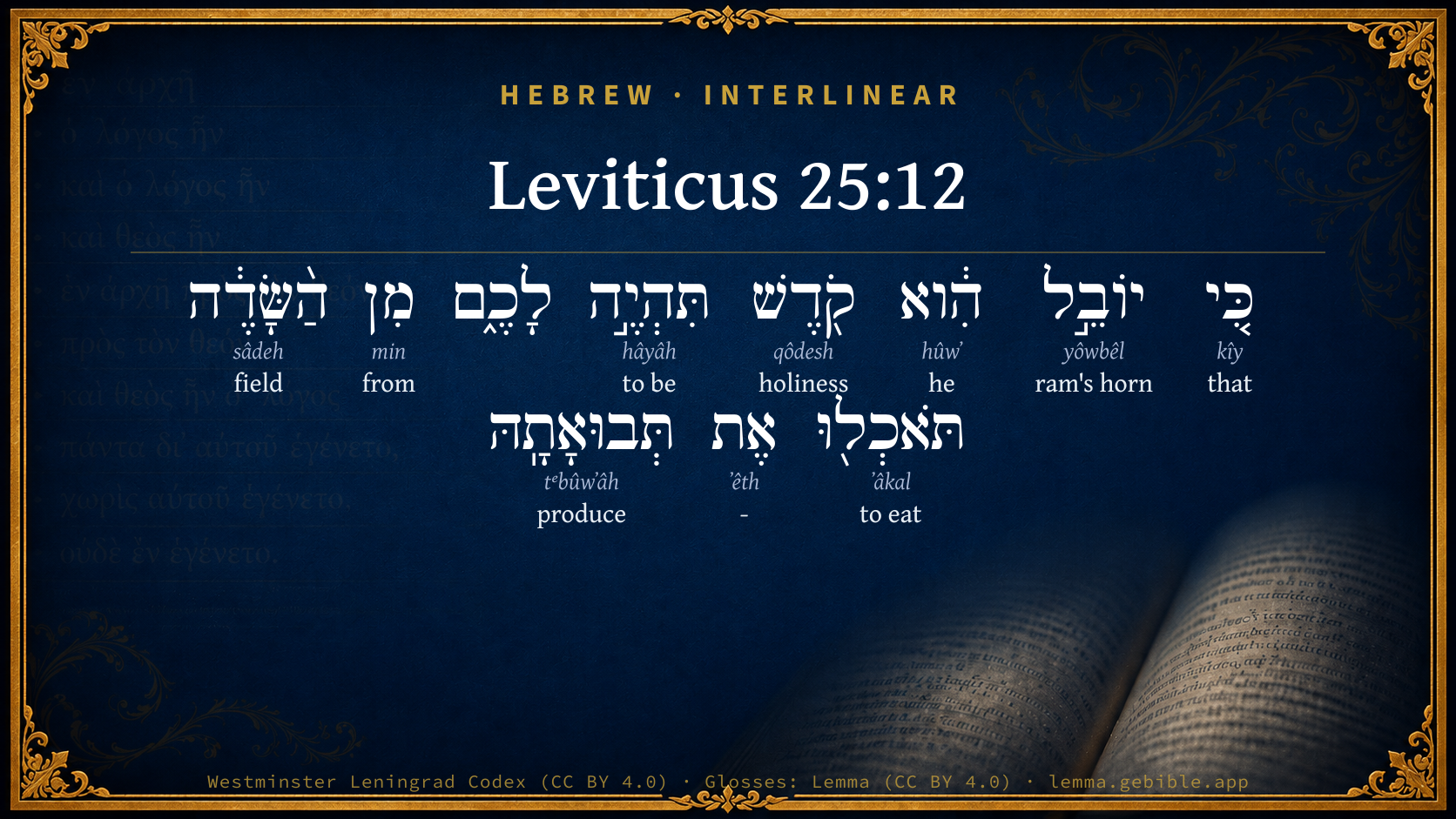
  1. כִּ֚י kîy H3588 “that” Conjunction
  2. הִ֔וא hûwʼ H1931 “he” Pronoun, Personal, 3rd Person, Feminine, Singular
  3. קֹ֖דֶשׁ qôdesh H6944 “holiness” Noun, Common, Masculine, Singular, Absolute
  4. תִּהְיֶ֣ה hâyâh H1961 “to be” Verb, Qal, Imperfect, 3rd Person, Feminine, Singular
  5. מִן min H4480 “from” Preposition
  6. הַ֨שָּׂדֶ֔ה sâdeh H7704 “the · field” Particle, Definite Article + Noun, Common, Masculine, Singular, Absolute
  7. תֹּאכְל֖וּ ʼâkal H398 “to eat” Verb, Qal, Imperfect, 2nd Person, Masculine, Plural
  8. אֶת ʼêth H853 “-” Particle, Direct Object
  9. תְּבוּאָתָֽהּ tᵉbûwʼâh H8393 “produce · her” Noun, Common, Feminine, Singular, Construct + Suffix, Personal, 3rd Person, Feminine, Singular

About this verse

These counts appear in no published source. They are computed here, from the morphology-tagged text and Lemma’s own curated glosses. What Lemma adds →

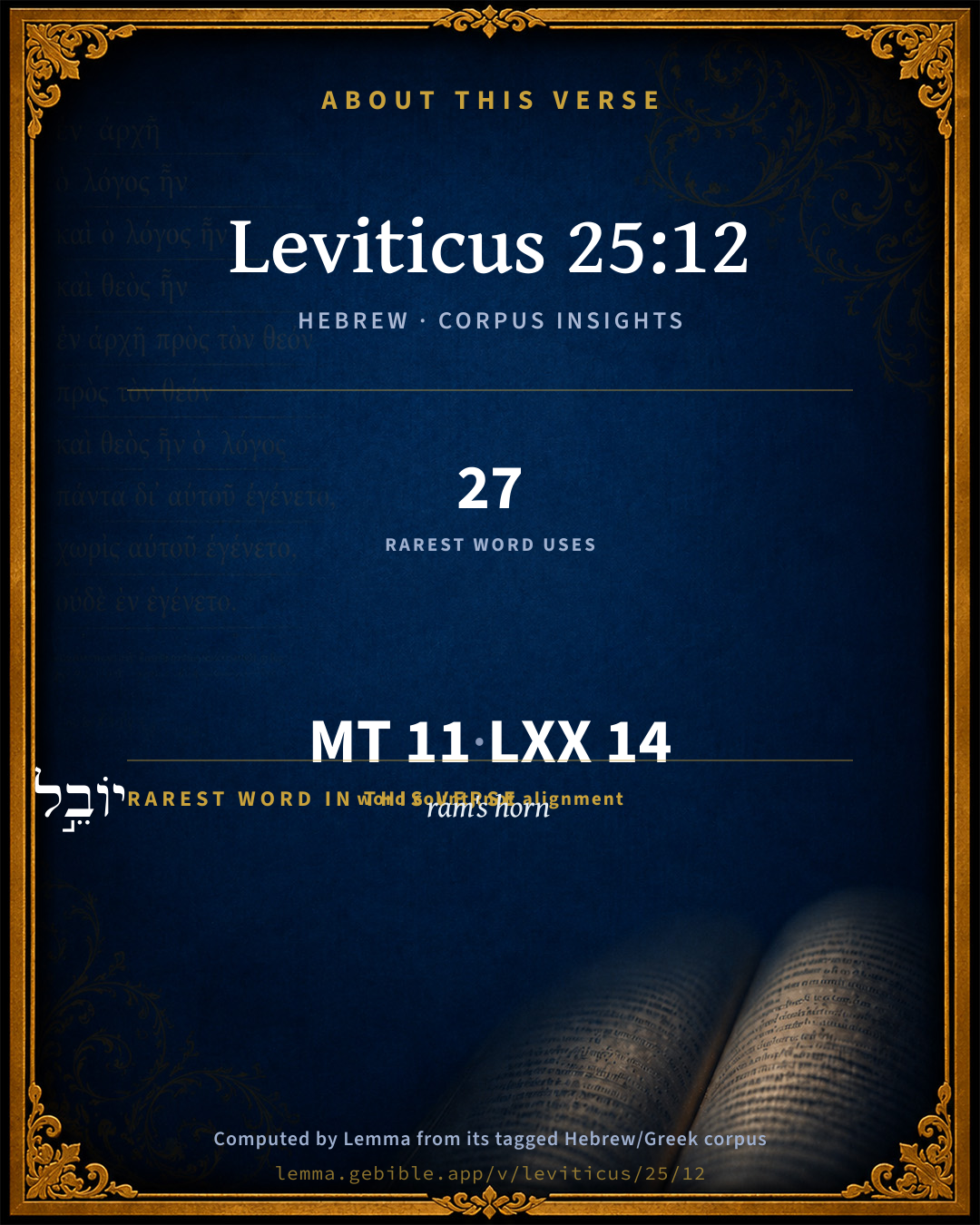
11
words
10
distinct lemmas
Pentateuch
section

Shared distinctive vocabulary

יוֹבֵ֣ל ram's horn H3104 occurs in 25 verses of the Hebrew Bible. Also found in:

Grammatical profile

  • 2 verbs
  • 4 nouns
  • 1 pronoun
  • 2 prepositions
  • 1 conjunction
  • 1 particle

Verb forms

  • תִּהְיֶ֣ה Qal · Imperfect
  • תֹּאכְל֖וּ Qal · Imperfect

Hebrew & Septuagint length

In English translation the verse runs 21 words from the Hebrew and 21 from the Septuagint (LXX English) — the same length.

A rough comparison of the two English renderings, which tokenize alike — not a word-level alignment.

Word counts can differ between the Hebrew and the Greek without any difference in meaning — e.g. the Hebrew direct-object marker אֵת has no separate Greek word, and Greek often adds the article ὁ.

In the original languages it is 11 Hebrew tokens and 14 Greek tokens — but the two are counted differently (Hebrew bundles its prefixes and suffixes into one token; the Greek is in lemma form), so that isn’t a like-for-like length.

Cross-references

1

Topical passages linked to Leviticus 25:12 in the Treasury of Scripture Knowledge — connected by theme and wording, ordered by reader-vote popularity; previews shown in the World English Bible.

  • Leviticus 25:6–7 The Sabbath of the land shall be for food for you; for yourself, for your servant, for your maid, for your hired servant, and for your stranger, who lives as a foreigner with you.

Cross-references courtesy of OpenBible.info (CC BY 4.0).

Hebrew and Greek witnesses Masoretic Hebrew ↔ Greek Septuagint

The same verse in the two great witnesses to the Old Testament, shown verse-for-verse.

These are two independent witnesses, not word-aligned to each other, and the Septuagint is shown in lemma (dictionary) form.

Hebrew Leviticus 25:12 Masoretic · Westminster Leningrad Codex

כִּ֚י יוֹבֵ֣ל הִ֔וא קֹ֖דֶשׁ תִּהְיֶ֣ה לָכֶ֑ם מִן הַ֨שָּׂדֶ֔ה תֹּאכְל֖וּ אֶת תְּבוּאָתָֽהּ

For it is a jubilee; it shall be holy to you. You shall eat of its increase out of the field.

World English Bible · Public Domain

Greek LXX Leviticus 25:12 Septuagint · lemma form

ὅτι ἄφεσις σημασία εἰμί ἅγιος εἰμί σύ ἀπό ὁ πεδίον ἐσθίω ὁ γένημα αὐτός

For it is a jubilee of release; it shall be holy to you, you⌃ shall eat its fruits off the fields.

LXX2012 (modern English Septuagint) · Public Domain

Hebrew: Westminster Leningrad Codex (CC BY 4.0). Greek: Septuagint (public domain); English from LXX2012 (modern English Septuagint) (Public Domain). How the Septuagint differs from the Hebrew →

Targum (Aramaic paraphrase)

2

The Targum is the ancient Jewish Aramaic paraphrase of the Hebrew Scriptures — an interpretive translation, not the Hebrew text itself. Onkelos (literal) and Pseudo-Jonathan (expansive) render the Torah, and Jonathan the Prophets. Coverage is partial: where no permissively-licensed English translation exists for a verse, only the Aramaic is shown. This is verse-level text, not a word-by-word alignment to the Hebrew.

  1. Targum Onkelos Torah (Genesis–Deuteronomy)
    אֲרֵי יוֹבֵלָא הִיא קוּדְשָׁא תְּהֵי לְכוֹן מִן חַקְלָא תֵּיכְלוּן יָת עֲלַלְתָּהּ

    (no public-domain English translation for this verse)

    Targum Onkelos — Aramaic: “Onkelos Genesis” (public domain); “Onkelos Exodus” (public domain); “Onkelos Leviticus” (public domain); “Onkelos Numbers” (public domain); “Onkelos Deuteronomy” (public domain). English: “Sefaria Community Translation” (CC0 1.0 (public-domain dedication)); “J.W. Etheridge. The Targums of Onkelos and Jonathan Ben Uzziel on the Pentateuch. London: Longmans, Green, 1862” (public domain). Text via Sefaria.

  2. Targum Pseudo-Jonathan Torah (Genesis–Deuteronomy)
    אֲרוּם יוּבְלָא הִיא קוּדְשָׁא תְּהֵי לְכוֹן מִן חַקְלָא תֵּיכְלוּן יַת עֲלַלְתָּהּ

    For that Jubela shall be sacred to you, the produce of the field shall you eat.

    Targum Pseudo-Jonathan — Aramaic: “Targum Jonathan on Genesis” (public domain); “Targum Jonathan on Exodus” (public domain); “Targum Jonathan on Leviticus” (public domain); “Targum Jonathan on Numbers” (public domain); “Targum Jonathan on Deuteronomy” (public domain). English: “The Targum of Jonathan ben Uzziel, trans. J. W. Etheridge, London, 1862” (public domain). Text via Sefaria.

Commentary

Notes on Leviticus 25:12 from classic Christian and Jewish commentators (each source and its license shown beneath its notes). The classic Christian expositions comment on the surrounding passage and are grouped to its opening verse, so a note may address several verses; the Jewish commentaries on the Tanakh (Rashi and others) are per-verse, so they appear only where the commentator wrote on this verse.

Lemma curates 59 commentaries, every one of them public domain or Creative Commons licensed, each selected and text-cleaned for this edition rather than reprinted as found. About our sources →

Trapp's Complete Commentary

John Trapp

Lev 25:12 For it [is] the jubile; it shall be holy unto you: ye shall eat the increase thereof out of the field.

Ver. 12. Out of the field.] {See Trapp on "Lev 25:6"}

John Trapp, A Commentary or Exposition upon All the Books of the Old and New Testament (1647–1656) — public domain. Text from a community e-Sword module.

Joseph Benson's Commentary

Lev 25:12. It shall be holy — So it was, because it was sequestered, in great part, from worldly employments, and dedicated to God, and to the exercise of holy joy and thankfulness; and because it was a type of that holy and happy jubilee which they were to expect and enjoy under the Messiah. The increase thereof — Such things as it produced of itself. Out of the field — Whence they, in common with others, might take it as they needed it; but must not put it into barns. See Lev 25:5, and Exo 23:11.

Joseph Benson's Commentary on the Old and New Testaments (1811–1818) — public domain. Text from a community e-Sword module.

Jamieson, Fausset & Brown

Robert Jamieson, A. R. Fausset & David Brown

ye shall eat the increase thereof out of the field, &c.--All that the ground yielded spontaneously during that period might be eaten for their necessary subsistence, but no persons were at liberty to hoard or form a private stock in reserve.

Jamieson, Fausset & Brown — Commentary Critical and Explanatory on the Whole Bible (1871) — public domain (CC PDM 1.0). Text via the HelloAO Bible API.

Ellicott's Commentary for English Readers

(12) Ye shall eat the increase thereof out of the field.—Better, Ye shall eat its produce from the field. Because it is the jubile, which must be observed as a sacred institution, the spontaneous produce of this year is not to be stored, but as much of it must each time be taken direct from the field as is wanted for daily consumption.

A Bible Commentary for English Readers, edited by Charles John Ellicott (1878–1897) — public domain. Text from a community e-Sword module.

John Gill's Exposition

For it is the jubilee, it shall be holy,.... Men being restored to their liberty, possessions, and families, it must be matter of joy to them, and therefore this year was to be separated from all others, and devoted to the ends and uses before mentioned; and men were to live upon the spontaneous productions of the earth, without any tillage of land, or cultivation of vines, &c.

ye shall eat the increase thereof out of the field; they were not to reap corn, and gather grapes and olives, and bring them into their barns and storehouses, as in other years; but were to go out every day into their fields, and gather for present use, and all were common to all sorts of men, and to cattle, as in the sabbatical year; See Gill on Lev 25:7.

John Gill's Exposition of the Whole Bible (1746–1763) — public domain (CC PDM 1.0). Text via the HelloAO Bible API.

Haydock's Catholic Bible Commentary

Eat them. No wine was to be made of the grapes, nor the corn heaped up, to the detriment of the poor. All is claimed by God, as his own property.

George Leo Haydock (1774–1849), Haydock's Catholic Family Bible and Commentary, 1859 edition — public domain. Excludes Psalms (Douay-Rheims chapter numbering differs from Protestant) and Deuterocanonical books (Catholic canon only).

Matthew Poole's English Annotations

It shall be holy unto you: so it was, because it was sequestered in great part from worldly employments, and dedicated to God, and to the exercise of holy joy and thankfulness; and because it was a type of that holy and happy jubilee which they were to expect and enjoy by and under the Messias.

The increase thereof; such things as it produced of itself; for the year before nothing was sowed. Out of the field; whence they in common with others might take it as they needed it; but must not put it into barns. See Lev 25:5; Exo 23:11.

Matthew Poole's English Annotations on the Holy Bible (1683–1685) — public domain. Text from a community e-Sword/MySword module.

Whedon's Commentary on the Bible

Daniel D. Whedon

12. Ye shall eat the increase — See Lev_25:6, note.

Daniel D. Whedon (gen. ed.), Commentary on the Old and New Testaments (1874–1909) — public domain. Text from a community e-Sword module.

John Wesley's Explanatory Notes

It shall be holy - So it was, because it was sequestered in great part from worldly employments and dedicated to God, and to the exercise of holy joy and thankfulness; and because it was a type of that holy and happy jubilee which they were to expect and enjoy under the Messiah. The increase thereof - Such things as it produced of itself. Out of the field - Whence they in common with others might take it as they needed it; but must not put it into barns, See ver. 5, and Exod. xxiii, 11.

John Wesley, Explanatory Notes Upon the Whole Bible (1754–1765) — public domain. Text via the GEBible commentary corpus.

Rashi

Rabbi Shlomo Yitzchaki (Rashi)

‎ קדש תהיה לכם IT SHALL BE HOLY UNTO YOU — The sacred character of the produce of that year attaches itself to its equivalent (i. e. to the articles given in exchange for it), just as is the case with Temple property (הקדש). One might think that after having been exchanged it (the fruit) leaves (loses) its sacred character and becomes חולין (ordinary produce), as is the case with many “holy” objects when they have thus been exchanged! Scripture, however, states תהיה “[holy] shall it be”, it shall always be in its original (holy) status (Sifra, Behar, Chapter 3 3; cf. Sukkah 40b).

מן השדה תאכלו את תבואתה YE SHALL EAT THE INCREASE THEREOF מן השדה — only by virtue of what is to be found in the field mayest thou eat of what is stored in the house; because if it (a particular fruit) has disappeared for food for the wild beasts in the field, you must clear it out of the house. Just as this is stated in reference to the produce of the Sabbatical year so is it slated also in reference to that of the Jubilee (Sifra, Behar, Chapter 3 4).

Rashi on the Tanakh — English translations: “The Judaica Press complete Tanach with Rashi, translated by A. J. Rosenberg” (CC BY 4.0); “Pentateuch with Rashi's commentary by M. Rosenbaum and A.M. Silbermann, 1929-1934” (public domain); “The Metsudah Tanach series, Lakewood, N.J” (CC BY 4.0); and “The Book of Joshua, Metsudah Publications, 1997” (CC BY 4.0). Text via Sefaria.

Ramban (Nachmanides)

Rabbi Moshe ben Nachman (Ramban / Nachmanides)

OUT OF THE FIELD YE SHALL EAT THE INCREASE THEREOF. “By virtue of the produce to be found in the field, you may eat of what is in the house, but if it is no longer to be found by the beast in the field, you must remove it from the house, just as it is said in the case of the Sabbatical year.” This is Rashi’s language. But if so, the verse is not well-connected [to the preceding part].. And then it continues: out of the field ye shall eat … Now according to Rashi’s interpretation there is no connection between these two parts of the verse. Instead, the verse is stating etc. Ramban, in other words, is explaining that the end of Verse 12 before us continues from the end of Verse 11 above, as stated in the text. Instead, Scripture is stating: Ye shall not sow, neither reap that which groweth of itself in it … For it is a Jubilee; it shall be holy unto you, and out of the field ye shall eat the increase thereof, and not out of the house. And Rabbi Abraham ibn Ezra interpreted: “out of the field ye shall eat, out of what the field brings forth of its own accord you shall all eat, as is written in the case of the Sabbatical year.”In my opinion Scripture is stating: “You shall not reap nor gather in this year, for it is a Jubilee and it shall be holy unto you; out of the field you shall bring the produce and eat, meaning: that you are to go forth into the field to glean and eat together with the poor and destitute, the beast and cattle, and it is not to be for you a time of reaping and gathering in the produce, and bringing it into your house and store-houses like the produce of all other years.” Now we are taught in the Torath Kohanim: 3:5. See above, Note 129. “From this the Sages have inferred that if one preserves three kinds of vegetables in a single barrel, Rabbi Elazar says: ‘They may be eaten only as long as the first [to ripen of the three kinds] remains in the field’ [but as soon as one vegetable is no longer found in the field, all three are forbidden to be eaten, since by preserving them together he makes all three as one]. Rabbi Yehoshua says: ‘Even as long as the last [to ripen of the three kinds] remains in the field’ [they may all be eaten, although the first two vegetables are no longer to be found in the field]. Rabban Gamaliel says: ‘When any one of the species comes to an end in the field, he is to remove that kind from the house’. And the final decision of the law is according to him. Rabbi Shimon says: ‘All vegetables are considered one with regard to the law of Removal.’” All this interpretation is because Scripture does not say “out of the field you shall bring and eat,” but instead [said, out of the field ye shall eat, thus] placing “the eating” next to “the field,” meaning that one may eat [what is stored in the house] only because of it [that which is still to be found in the field]. It is possible that this matter is only a Scriptural support for a law of Rabbinic origin, and that is why Rabbi Yehoshua was lenient [even] about it [the actual vegetable], and Rabban Gamaliel [who was more stringent about it than Rabbi Yehoshua, also] was lenient about the taste [of the vegetable which remains in the other vegetables after it is taken out of the barrel]. I have already written on this subject above. It is possible that according to Rabban Gamaliel the commandment of Removal is by law of the Torah, but the taste of a vegetable, once it is absorbed [by other food] at the beginning [i.e., before the time of the Removal], is considered as if it were “removed” [since it is absorbed and has no independent existence].

Ramban (Nachmanides) on the Tanakh — English translation: “Commentary on the Torah by Ramban (Nachmanides). Translated and annotated by Charles B. Chavel. New York, Shilo Pub. House, 1971-1976” (CC BY 4.0). Text via Sefaria.

Sforno

Rabbi Ovadia Sforno

It shall be holy to you. I prohibited the landowners from using the fields for planting and harvesting, and they may not gather all the field’s produce as they do the other years, as it says (v. 11), “You shall not reap crops that grew on their own; and you shall not gather.” Nevertheless, I did not prohibit them from eating its produce like any other person, as in the Sabbatical year.

Sforno on the Tanakh — English translation: “Yalkut, Sifsei Chachomim Chumash, Metsudah Publications, 2009” (CC BY 4.0). Text via Sefaria.

Lesson kit

Teaching starters — assembled from the data on this page, not authored interpretation. Every prompt links to the verse data it draws on. Edit before teaching.

Leviticus, in the Pentateuch, opens this verse with 11 words (10 distinct Hebrew lemmas). Its most distinctive word is yôwbêl (“ram's horn”). A historical commentator’s framing appears above. Read the whole chapter for the surrounding context.

Discussion questions

  1. The word yôwbêl carries the sense “ram's horn.” How does it shape the verse?
  2. Exodus 19:13 shares the word «ram's horn» with this verse. How do the two illuminate each other?
  3. These translations render this verse differently. What is at stake in choosing one wording over another?
  4. The verb «תִּהְיֶ֣ה» is Qal Imperfect. How does its form color the action?
  5. Reading how Trapp's Complete Commentary and Joseph Benson's Commentary read this verse, where do the two commentators agree and where do they part?

Things to notice

Reading settings

Reading text

Shown beneath each verse's original-language words.

Old Testament
Old Testament edition

Read the OT as the Masoretic Hebrew (MT) or the Greek Septuagint (LXX).

English shown for the Greek Septuagint (in the Hebrew ↔ Greek comparison).

Comparing translations? Open the Compare panel on any verse page to stack up to four side by side.