
2 Chronicles 31:19

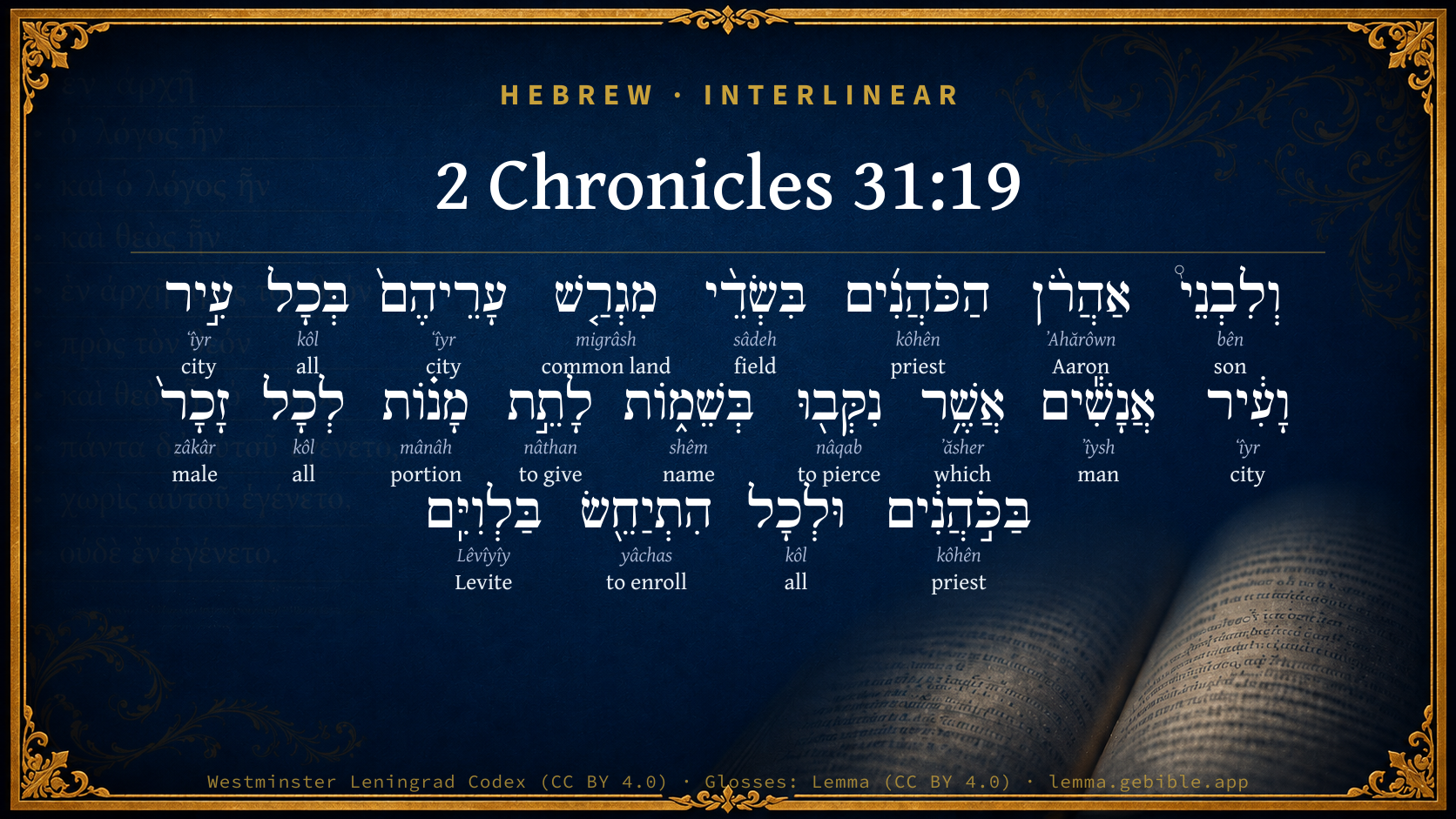
Hebrew (Westminster Leningrad Codex) 2 Chronicles 31:19 appears in the Hebrew Old Testament. The text above is from the Westminster Leningrad Codex. Each word links to its Strong’s number, a concise gloss, and parsing drawn from the Open Scriptures Hebrew Bible morphology. Click any word for its full Brown-Driver-Briggs (BDB) entry.
Download image
Cite this verse

2 Chronicles 31:19 (World English Bible). Public Domain. Lemma interlinear Bible study tool, https://lemma.gebible.app/v/2-chronicles/31/19.

Show BibTeX & RIS
BibTeX
RIS
English Translation
Also for the sons of Aaron the priests, who were in the fields of the suburbs of their cities, in every city, there were men who were mentioned by name, to give portions to all the males among the priests, and to all who were reckoned by genealogy among the Levites.
World English Bible · Public Domain
Download a study sheet

One document with this verse’s original text, its word-by-word gloss line, the meaning frame, cross-references with their text, attributed commentary, and full source and license credits — printable, and it pastes into notes with its structure intact.

This verse Autodidact and up

Study sheet (.html) Plain text (.txt)

A passage Seminary Student

Up to 50 verses in one chapter. A passage sheet keeps up to 6 commentary sources and 12 cross-references per verse, in the order this page ranks them, and says so on the sheet whenever that leaves anything out. Ask for a single verse and you get the Autodidact verse sheet above.

Everything on this page stays free to read, with no account — the sheet is a download of what is already on screen, not access to it.

Want to remove ads? Support Godless Engineer
Compare translations 3

The same verse in 3 English versions, stacked beneath the original-language interlinear above. Click any original word for its lexicon entry.

Each is an independent rendering of the whole verse — the interlinear is not word-aligned to these translations.

Highlighted words mark where these versions differ — a whole-verse word diff, not a word-by-word alignment.

  • World English Bible Public Domain
    Also for the sons of Aaron the priests, who were in the fields of the suburbs of their cities, in every city, there were men who were mentioned by name, to give portions to all the males among the priests, and to all who were reckoned by genealogy among the Levites.
  • King James Version Public Domain
    Also of the sons of Aaron the priests, which were in the fields of the suburbs of their cities, in every several city, the men that were expressed by name, to give portions to all the males among the priests, and to all that were reckoned by genealogies among the Levites.
  • unfoldingWord Literal Text CC BY-SA 4.0
    And for the sons of Aaron, the priests, in the fields of open land of their cities, in each city and city, were men who were marked by names to give portions to every male among the priests, and to all genealogically among the Levites.

unfoldingWord Literal Text — © unfoldingWord, licensed CC BY-SA 4.0. Word-aligned USFM3 via Door43 (git.door43.org/unfoldingWord/en_ult).

Versions to compare (up to 4)

3 of 4 selected

Show all 18 translations

Every available English version of this verse, each an independent rendering of the whole verse.

  • World English Bible Public Domain
    Also for the sons of Aaron the priests, who were in the fields of the suburbs of their cities, in every city, there were men who were mentioned by name, to give portions to all the males among the priests, and to all who were reckoned by genealogy among the Levites.
  • Berean Standard Bible Public Domain
    As for the priests, the descendants of Aaron, who lived on the farmlands around each of their cities or in any other city, men were designated by name to distribute a portion to every male among the priests and to every Levite listed by the genealogies.
  • Majority Standard Bible Public Domain
    As for the priests, the descendants of Aaron, who lived on the farmlands around each of their cities or in any other city, men were designated by name to distribute a portion to every male among the priests and to every Levite listed by the genealogies.
  • King James Version Public Domain
    Also of the sons of Aaron the priests, which were in the fields of the suburbs of their cities, in every several city, the men that were expressed by name, to give portions to all the males among the priests, and to all that were reckoned by genealogies among the Levites.
  • American Standard Version (1901) Public Domain
    Also for the sons of Aaron the priests, that were in the fields of the suburbs of their cities, in every city, there were men that were mentioned by name, to give portions to all the males among the priests, and to all that were reckoned by genealogy among the Levites.
  • Revised Version (1885) Public Domain
    Also for the sons of Aaron the priests, which were in the fields of the suburbs of their cities, in every several city; there were men that were expressed by name, to give portions to all the males among the priests, and to all that were reckoned by genealogy among the Levites.
  • Geneva Bible (1599) Public Domain
    Also to the sonnes of Aaron, the Priestes, which were in the fieldes and suburbes of their cities, in euery citie the men that were appointed by names, shoulde giue portions to all the males of the Priestes, and to all the generation of the Leuites.
  • Douay-Rheims (1899) Public Domain
    Also of the sons of Aaron who were in the fields and in the suburbs of each city, there were men appointed, to distribute portions to all the males, among the priests and the Levites.
  • Young's Literal Translation Public Domain
    And to sons of Aaron, the priests, in the fields of the suburb of their cities, in every city and city, `are' men who have been defined by name, to give portions to every male among the priests, and to every one who reckoned himself by genealogy among the Levites.
  • Literal Standard Version CC BY-SA 4.0
    And for sons of Aaron, the priests, in the fields of the outskirt of their cities, in each and every city, [are] men who have been defined by name, to give portions to every male among the priests, and to everyone who reckoned himself by genealogy among the Levites.
  • Unlocked Literal Bible CC BY-SA 4.0
    For the priests, the descendants of Aaron, who were in the fields of the villages belonging to their cities, or in every city, there were men assigned by name to give portions to all the males among the priests, and to all who were listed in the records of their ancestors as being among the Levites.
  • unfoldingWord Literal Text CC BY-SA 4.0
    And for the sons of Aaron, the priests, in the fields of open land of their cities, in each city and city, were men who were marked by names to give portions to every male among the priests, and to all genealogically among the Levites.
  • Darby Bible Public Domain
    And for the sons of Aaron the priests who were in the country, in the suburbs of their cities, there were, in every several city, men expressed by name, to give portions to all the males among the priests, and to all the Levites that were entered in the register.
  • World Messianic Bible Public Domain
    Also for the sons of Aaron the priests, who were in the fields of the pasture lands of their cities, in every city, there were men who were mentioned by name to give portions to all the males among the priests and to all who were listed by genealogy among the Levites.
  • Webster's Bible Public Domain
    Also of the sons of Aaron the priests, who were in the fields of the suburbs of their cities, in every several city, the men that were expressed by name, to give portions to all the males among the priests, and to all that were reckoned by genealogies among the Levites.
  • Free Bible Version CC BY-SA 4.0
    In the case of the priests, the descendants of Aaron, those who lived on the farmlands around their towns, men were appointed by name in all the towns to distribute an allocation to every male among the priests and to every Levite as listed in the genealogies.
  • Bible in Basic English Public Domain
    And as for the sons of Aaron, the priests, living in the country on the outskirts of their towns, every different town there were men, marked out by name, to give their part of the goods to all the males among the priests, and to all who were listed among the Levites.
  • JPS Tanakh (1917) Public Domain
    also for the sons of Aaron the priests, that were in the fields of the open land about their cities, in every city, there were men that were mentioned by name, to give portions to all the males among the priests, and to all that were reckoned by genealogy among the Levites.

Literal Standard Version (2020), Covenant Press — licensed CC BY-SA 4.0. Text via the HelloAO Bible API (eBible.org). Unlocked Literal Bible (unfoldingWord) — licensed CC BY-SA 4.0. Text via the HelloAO Bible API (eBible.org). unfoldingWord Literal Text — © unfoldingWord, licensed CC BY-SA 4.0. Word-aligned USFM3 via Door43 (git.door43.org/unfoldingWord/en_ult). Free Bible Version, Dr. Jonathan Gallagher — licensed CC BY-SA 4.0. Text via the HelloAO Bible API (eBible.org).

Word by word

More ways to search: Search by grammar → Find every occurrence → Compare this word →

Practice this passage: Drill this verse → Learn its vocabulary →

מָנ֗וֹת
mânâh
H4490
“portions”
Noun, Common, Feminine, Plural, Absolute
Part of Speech
Noun
Type
Common
Gender
Feminine
Number
Plural
State
Absolute
Full BDB Definition

Origin: from H4487

TWOT: 1213a

part, portion
  1. וְלִבְנֵי֩ bên H1121 “and · to/for · sons of” Conjunction + Preposition + Noun, Common, Masculine, Plural, Construct
  2. אַהֲרֹ֨ן ʼAhărôwn H175 “Aaron” Noun, Proper
  3. הַכֹּהֲנִ֜ים kôhên H3548 “the · priests” Particle, Definite Article + Noun, Common, Masculine, Plural, Absolute
  4. בִּשְׂדֵ֨י sâdeh H7704 “in/at · fields of” Preposition + Noun, Common, Masculine, Plural, Construct
  5. מִגְרַ֤שׁ migrâsh H4054 “common land of” Noun, Common, Masculine, Singular, Construct
  6. עָרֵיהֶם֙ ʻîyr H5892 “cities · their” Noun, Common, Feminine, Plural, Construct + Suffix, Personal, 3rd Person, Masculine, Plural
  7. בְּכָל kôl H3605 “in/at · all of” Preposition + Noun, Common, Masculine, Singular, Construct
  8. עִ֣יר ʻîyr H5892 “city” Noun, Common, Feminine, Singular, Absolute
  9. וָעִ֔יר ʻîyr H5892 “and · city” Conjunction + Noun, Common, Feminine, Singular, Absolute
  10. אֲנָשִׁ֕ים ʼîysh H376 “men” Noun, Common, Masculine, Plural, Absolute
  11. אֲשֶׁ֥ר ʼăsher H834 “which” Particle, Relative
  12. נִקְּב֖וּ nâqab H5344 “to pierce” Verb, Niphal, Perfect, 3rd Person, Common, Plural
  13. בְּשֵׁמ֑וֹת shêm H8034 “in/at · names” Preposition + Noun, Common, Masculine, Plural, Absolute
  14. לָתֵ֣ת nâthan H5414 “to give” Preposition + Verb, Qal, Infinitive Construct
  15. לְכָל kôl H3605 “to/for · all of” Preposition + Noun, Common, Masculine, Singular, Construct
  16. זָכָר֙ zâkâr H2145 “male” Adjective, Adjective, Masculine, Singular, Absolute
  17. בַּכֹּ֣הֲנִ֔ים kôhên H3548 “in/at the · priests” Preposition, Determined + Noun, Common, Masculine, Plural, Absolute
  18. וּלְכָל kôl H3605 “and · to/for · all of” Conjunction + Preposition + Noun, Common, Masculine, Singular, Construct
  19. הִתְיַחֵ֖שׂ yâchas H3187 “to enroll” Verb, Hithpael, Infinitive Construct
  20. בַּלְוִיִּֽם Lêvîyîy H3881 “in/at · Levites” Preposition + Noun, Gentilic, Masculine, Plural, Absolute

About this verse

These counts appear in no published source. They are computed here, from the morphology-tagged text and Lemma’s own curated glosses. What Lemma adds →

21
words
16
distinct lemmas
Historical
section

Notable vocabulary

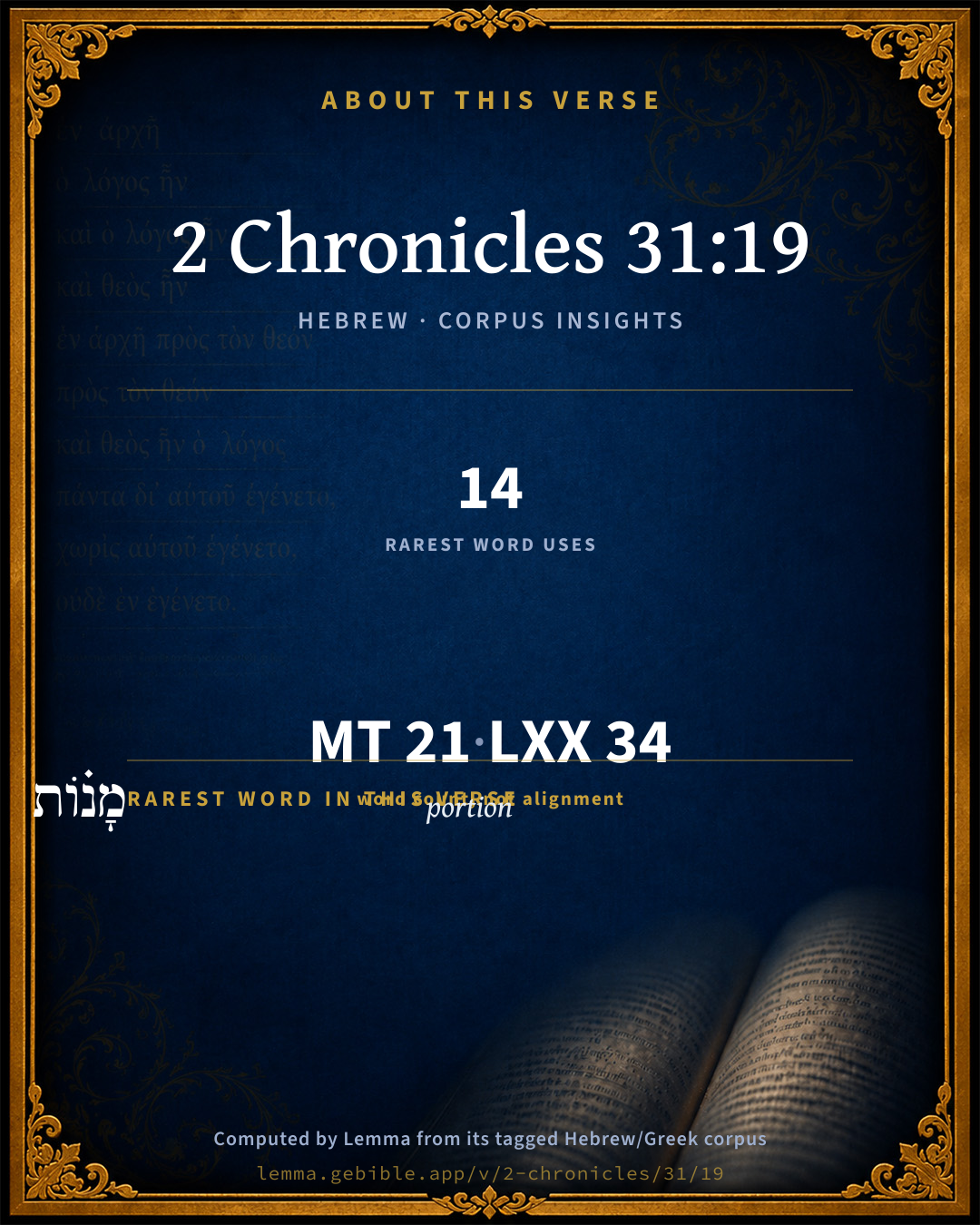
The rarest word here is מָנ֗וֹת portion H4490 — appearing just 14 times in the whole Hebrew Bible.

Shared distinctive vocabulary

מָנ֗וֹת portion H4490 occurs in 14 verses of the Hebrew Bible. Also found in:

Grammatical profile

  • 3 verbs
  • 16 nouns
  • 1 adjective
  • 1 particle

Verb forms

  • נִקְּב֖וּ Niphal · Perfect
  • לָתֵ֣ת Qal · Infinitive Construct
  • הִתְיַחֵ֖שׂ Hithpael · Infinitive Construct

Repetition

Words recur within this verse — often emphatic in Hebrew:

  • עָרֵיהֶם֙ city H5892 ×3
  • בְּכָל all H3605 ×3
  • הַכֹּהֲנִ֜ים priest H3548 ×2

Hebrew & Septuagint length

In English translation the verse runs 51 words from the Hebrew and 46 from the Septuagint (LXX English) — closely comparable.

A rough comparison of the two English renderings, which tokenize alike — not a word-level alignment.

Word counts can differ between the Hebrew and the Greek without any difference in meaning — e.g. the Hebrew direct-object marker אֵת has no separate Greek word, and Greek often adds the article ὁ.

In the original languages it is 21 Hebrew tokens and 34 Greek tokens — but the two are counted differently (Hebrew bundles its prefixes and suffixes into one token; the Greek is in lemma form), so that isn’t a like-for-like length.

Cross-references

6

Topical passages linked to 2 Chronicles 31:19 in the Treasury of Scripture Knowledge — connected by theme and wording, ordered by reader-vote popularity; previews shown in the World English Bible.

  • 2 Chronicles 31:12–15 They brought in the offerings and the tithes and the dedicated things faithfully: and over them Conaniah the Levite was ruler, and Shimei his brother was second.
  • Leviticus 25:34 But the field of the suburbs of their cities may not be sold; for it is their perpetual possession.
  • Numbers 35:2–5 Command the children of Israel that they give to the Levites of the inheritance of their possession cities to dwell in; and suburbs for the cities round about them shall you give to the Levites.
  • 2 Chronicles 28:15 The men who have been mentioned by name rose up, and took the captives, and with the spoil clothed all who were naked among them, and arrayed them, and shod them, and gave them to eat and to drink, and anointed them, and carried all the feeble of them on donkeys, and brought them to Jericho, the city of palm trees, to their brothers: then they returned to Samaria.
  • 1 Chronicles 6:54 Now these are their dwelling-places according to their encampments in their borders: to the sons of Aaron, of the families of the Kohathites (for theirs was the [first] lot),
  • 1 Chronicles 6:60 and out of the tribe of Benjamin, Geba with its suburbs, and Allemeth with its suburbs, and Anathoth with its suburbs. All their cities throughout their families were thirteen cities.

Cross-references courtesy of OpenBible.info (CC BY 4.0).

Hebrew and Greek witnesses Masoretic Hebrew ↔ Greek Septuagint

The same verse in the two great witnesses to the Old Testament, shown verse-for-verse.

These are two independent witnesses, not word-aligned to each other, and the Septuagint is shown in lemma (dictionary) form.

Hebrew 2 Chronicles 31:19 Masoretic · Westminster Leningrad Codex

וְלִבְנֵי֩ אַהֲרֹ֨ן הַכֹּהֲנִ֜ים בִּשְׂדֵ֨י מִגְרַ֤שׁ עָרֵיהֶם֙ בְּכָל עִ֣יר וָעִ֔יר אֲנָשִׁ֕ים אֲשֶׁ֥ר נִקְּב֖וּ בְּשֵׁמ֑וֹת לָתֵ֣ת מָנ֗וֹת לְכָל זָכָר֙ בַּכֹּ֣הֲנִ֔ים וּלְכָל הִתְיַחֵ֖שׂ בַּלְוִיִּֽם

Also for the sons of Aaron the priests, who were in the fields of the suburbs of their cities, in every city, there were men who were mentioned by name, to give portions to all the males among the priests, and to all who were reckoned by genealogy among the Levites.

World English Bible · Public Domain

Greek LXX 2 Chronicles 31:19 Septuagint · lemma form

ὁ υἱός ἀαρών ὁ ἱερατεύω καί ὁ ἀπό ὁ πόλις αὐτός ἐν πᾶς πόλις καί πόλις ἀνήρ ὅς ὀνομάζω ἐν ὄνομα δίδωμι μερίς πᾶς ἀρσενικός ἐν ὁ ἱερεύς καί πᾶς καταἀριθμέω ἐν ὁ λευείτης

As for the sons of Aaron that executed the priests' office, —even those from their cities the men in each several city who were named expressly, —were appointed to give a portion to every male among the priests, and to every one reckoned among the Levites.

LXX2012 (modern English Septuagint) · Public Domain

Hebrew: Westminster Leningrad Codex (CC BY 4.0). Greek: Septuagint (public domain); English from LXX2012 (modern English Septuagint) (Public Domain). How the Septuagint differs from the Hebrew →

Commentary

Notes on 2 Chronicles 31:19 from classic Christian and Jewish commentators (each source and its license shown beneath its notes). The classic Christian expositions comment on the surrounding passage and are grouped to its opening verse, so a note may address several verses; the Jewish commentaries on the Tanakh (Rashi and others) are per-verse, so they appear only where the commentator wrote on this verse.

Lemma curates 59 commentaries, every one of them public domain or Creative Commons licensed, each selected and text-cleaned for this edition rather than reprinted as found. About our sources →

Joseph Benson's Commentary

2Ch 31:19. Also of the priests that were in the fields — Care was taken of those that lived in the country, though at the greatest distance, as well as of those that lived in or near Jerusalem. And they that were not waiting in their courses, but at home with their families, had provision made for them, as if they had been at the house of God, by the care of the fore-named persons, who had the charge of the whole.

Joseph Benson's Commentary on the Old and New Testaments (1811–1818) — public domain. Text from a community e-Sword module.

Ellicott's Commentary for English Readers

(19) Also of the sons of Aaron the priests.—Officers were likewise appointed to distribute portions. to the priests and Levites who dwelt on their farms. outside of the sacerdotal cities. Render, “and for the sons of Aaron the priests, in the farms of the pasturage of their cities, in each several city, there were men who were specified by names, to give portions to every male among the priests, and to every one that was registered among the Levites.”

Fields of the suburbs.—See Lev_25:34; Num_35:5.

Expressed by name.—See 1Ch_12:31; 2Ch_28:15.

To all that were reckoned by genealogies.—Registered. The relative is omitted before the verb hiththyahçsh, which is here the perfect as in 2Ch_31:18, not the infinitive as in 2Ch_31:16.

A Bible Commentary for English Readers, edited by Charles John Ellicott (1878–1897) — public domain. Text from a community e-Sword module.

The Cambridge Bible for Schools and Colleges

gen. ed. J. J. S. Perowne

19. also of the sons] R.V. also for the sons. The Chronicler now passes to a third class of priests, viz. those in the country; cp. 2Ch_31:15 (note).

the suburbs] Cp. 1Ch_5:16 (R.V. mg. “pasture-lands”); 1Ch_6:55; 1Ch_6:57 [40, 42, Heb.].

the men] R.V. there were men.

by genealogies] R.V. by genealogy.

The Cambridge Bible for Schools and Colleges (gen. ed. J. J. S. Perowne; Cambridge University Press, 1878–1918) — public domain. Text from a community e-Sword module.

John Gill's Exposition

And thus did Hezekiah throughout all Judah,.... Settled the courses of the priests and Levites, and made a provision for them and their families:

and wrought that which was good and right and truth before the Lord his God: or did that which was truly right and good, according to the law and will of God, in the sincerity and uprightness of his soul, and as in the presence of the omniscient God, he approving and accepting it for Christ's sake.

John Gill's Exposition of the Whole Bible (1746–1763) — public domain (CC PDM 1.0). Text via the HelloAO Bible API.

Albert Barnes' Notes on the Bible

The country priests and Levites are here distinguished from those who dwelt in the towns. The writer means to note that not even were they neglected.

Albert Barnes' Notes on the Bible (1834–1885) — public domain. Text from a community e-Sword/MySword module.

Haydock's Catholic Bible Commentary

Aaron. Heb. and Sept. add, "the priests," (M.) which is sufficiently understood. --- And in. Heb. "of." H.

George Leo Haydock (1774–1849), Haydock's Catholic Family Bible and Commentary, 1859 edition — public domain. Excludes Psalms (Douay-Rheims chapter numbering differs from Protestant) and Deuterocanonical books (Catholic canon only).

Matthew Poole's English Annotations

The priests, which were in the fields; who are opposed to those that lived in or resorted to the great city Jerusalem.

Matthew Poole's English Annotations on the Holy Bible (1683–1685) — public domain. Text from a community e-Sword/MySword module.

The Pulpit Commentary

The much more manifest meaning of this verse confirms the interpretation favoured just above for vers. 15, 17, 18. The men that were expressed by name; translate, men were expressed to give. The purport of this verse is to say that all priests and Levites of full age were sacredly remembered and similarly carefully provided for, viz. those also who lived in the fields of the suburbs of the cities (Lev_25:32-34; Num_35:2-5)

The Pulpit Commentary (1880–1919), ed. H.D.M. Spence-Jones & Joseph S. Exell — public domain. Text from a community e-Sword module.

Rashi

Rabbi Shlomo Yitzchaki (Rashi)

were men who were mentioned by names Above (verses 12ff.) Conaniah and his brethren were appointed over them to receive the portions: the heave-offerings and the tithes from the Israelites to distribute the portions to every male among the priests and the Levites

to every male among the priests and also to their wives, their sons, and their daughters. The Chronicler says “to every male” here to teach something remarkable, i.e., they would provide even to the young male children, as above (verse 16): “of the males from three years old and over,” and they would surely provide for their wives, sons and daughters.

Rashi on the Tanakh — English translations: “The Judaica Press complete Tanach with Rashi, translated by A. J. Rosenberg” (CC BY 4.0); “Pentateuch with Rashi's commentary by M. Rosenbaum and A.M. Silbermann, 1929-1934” (public domain); “The Metsudah Tanach series, Lakewood, N.J” (CC BY 4.0); and “The Book of Joshua, Metsudah Publications, 1997” (CC BY 4.0). Text via Sefaria.

Lesson kit

Teaching starters — assembled from the data on this page, not authored interpretation. Every prompt links to the verse data it draws on. Edit before teaching.

2 Chronicles, in the Historical, opens this verse with 21 words (16 distinct Hebrew lemmas). Its most distinctive word is mânâh (“portion”). A historical commentator’s framing appears above. Read the whole chapter for the surrounding context.

Discussion questions

  1. What does “portion” (mânâh) contribute to the verse as a whole?
  2. Exodus 29:26 shares the word «portion» with this verse. How do the two illuminate each other?
  3. “city” occurs 3× in this one verse. What is the effect of the repetition?
  4. These translations render this verse differently; the difference is in the English rendering, not the original. What questions does that raise?
  5. The verb «נִקְּב֖וּ» is Niphal Perfect. How does its form color the action?
  6. Reading how Joseph Benson's Commentary and Ellicott's Commentary for English Readers read this verse, where do the two commentators agree and where do they part?

Things to notice

Reading settings

Reading text

Shown beneath each verse's original-language words.

Old Testament
Old Testament edition

Read the OT as the Masoretic Hebrew (MT) or the Greek Septuagint (LXX).

English shown for the Greek Septuagint (in the Hebrew ↔ Greek comparison).

Comparing translations? Open the Compare panel on any verse page to stack up to four side by side.