
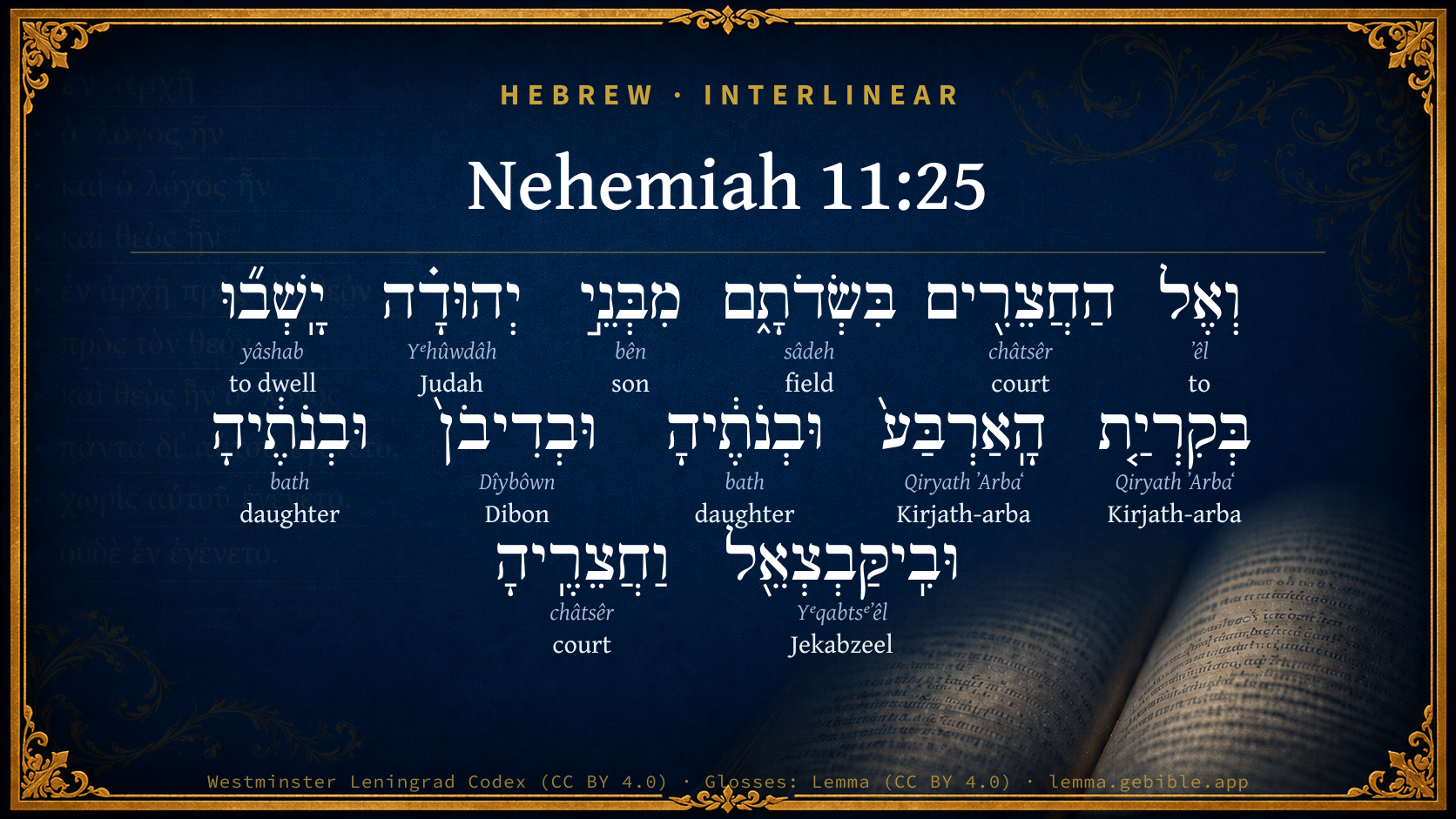
Nehemiah 11:25

Hebrew (Westminster Leningrad Codex) Nehemiah 11:25 appears in the Hebrew Old Testament. The text above is from the Westminster Leningrad Codex. Each word links to its Strong’s number, a concise gloss, and parsing drawn from the Open Scriptures Hebrew Bible morphology. Click any word for its full Brown-Driver-Briggs (BDB) entry.
Download image
Cite this verse

Nehemiah 11:25 (World English Bible). Public Domain. Lemma interlinear Bible study tool, https://lemma.gebible.app/v/nehemiah/11/25.

Show BibTeX & RIS
BibTeX
RIS
English Translation
As for the villages, with their fields, some of the children of Judah lived in Kiriath Arba and the towns of it, and in Dibon and the towns of it, and in Jekabzeel and the villages of it,
World English Bible · Public Domain
Highlights
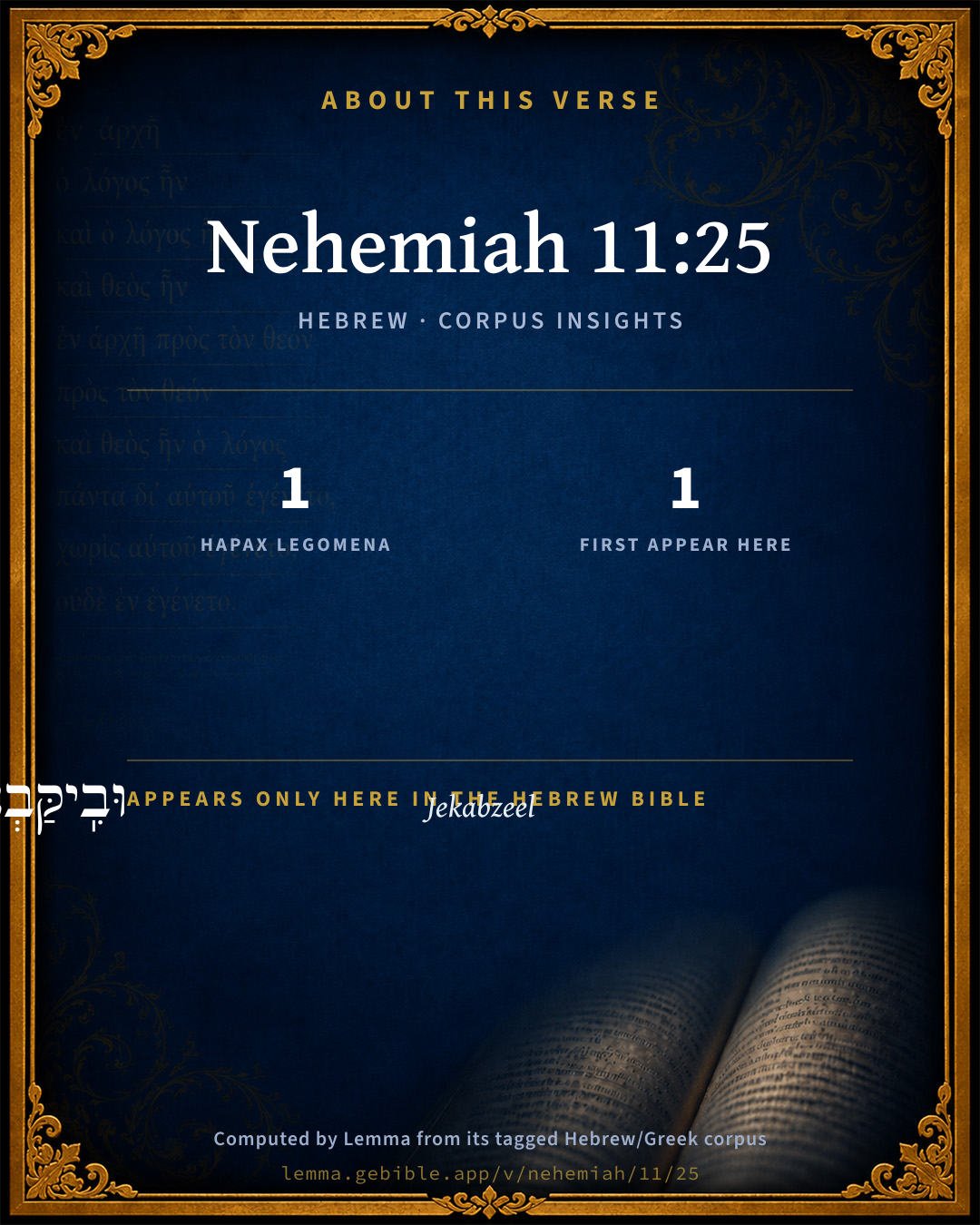
  • 1 hapax legomenon — only here in the Hebrew Bible
  • 1 first appearance in the Hebrew Bible
Full analysis ↓
Download a study sheet

One document with this verse’s original text, its word-by-word gloss line, the meaning frame, cross-references with their text, attributed commentary, and full source and license credits — printable, and it pastes into notes with its structure intact.

This verse Autodidact and up

Study sheet (.html) Plain text (.txt)

A passage Seminary Student

Up to 50 verses in one chapter. A passage sheet keeps up to 6 commentary sources and 12 cross-references per verse, in the order this page ranks them, and says so on the sheet whenever that leaves anything out. Ask for a single verse and you get the Autodidact verse sheet above.

Everything on this page stays free to read, with no account — the sheet is a download of what is already on screen, not access to it.

Want to remove ads? Support Godless Engineer
Compare translations 3

The same verse in 3 English versions, stacked beneath the original-language interlinear above. Click any original word for its lexicon entry.

Each is an independent rendering of the whole verse — the interlinear is not word-aligned to these translations.

Highlighted words mark where these versions differ — a whole-verse word diff, not a word-by-word alignment.

  • World English Bible Public Domain
    As for the villages, with their fields, some of the children of Judah lived in Kiriath Arba and the towns of it, and in Dibon and the towns of it, and in Jekabzeel and the villages of it,
  • King James Version Public Domain
    And for the villages, with their fields, some of the children of Judah dwelt at Kirjatharba, and in the villages thereof, and at Dibon, and in the villages thereof, and at Jekabzeel, and in the villages thereof,
  • unfoldingWord Literal Text CC BY-SA 4.0
    And for the villages in their fields, some from the sons of Judah dwelt: in Kiriath Arba and its daughters; and in Dibon and its daughters; and in Jekabzeel and its villages;

unfoldingWord Literal Text — © unfoldingWord, licensed CC BY-SA 4.0. Word-aligned USFM3 via Door43 (git.door43.org/unfoldingWord/en_ult).

Versions to compare (up to 4)

3 of 4 selected

Show all 18 translations

Every available English version of this verse, each an independent rendering of the whole verse.

  • World English Bible Public Domain
    As for the villages, with their fields, some of the children of Judah lived in Kiriath Arba and the towns of it, and in Dibon and the towns of it, and in Jekabzeel and the villages of it,
  • Berean Standard Bible Public Domain
    As for the villages with their fields, some of the people of Judah lived in Kiriath-arba, Dibon, Jekabzeel, and their villages;
  • Majority Standard Bible Public Domain
    As for the villages with their fields, some of the people of Judah lived in Kiriath-arba, Dibon, Jekabzeel, and their villages;
  • King James Version Public Domain
    And for the villages, with their fields, some of the children of Judah dwelt at Kirjatharba, and in the villages thereof, and at Dibon, and in the villages thereof, and at Jekabzeel, and in the villages thereof,
  • American Standard Version (1901) Public Domain
    And as for the villages, with their fields, some of the children of Judah dwelt in Kiriath-arba and the towns thereof, and in Dibon and the towns thereof, and in Jekabzeel and the villages thereof,
  • Revised Version (1885) Public Domain
    And for the villages, with their fields, some of the children of Judah dwelt in Kiriath-arba and the towns thereof, and in Dibon and the towns thereof, and in Jekabzeel and the villages thereof;
  • Geneva Bible (1599) Public Domain
    And in the villages in their landes, some of the children of Iudah dwelt in Kiriath-arba, and in the villages thereof, and in Dibon, and in the villages thereof, and in Iekabzeel. and in the villages thereof,
  • Douay-Rheims (1899) Public Domain
    And in the houses through all their countries. Of the children of Juda so dwelt at Cariath-Arbe, and in the villages thereof: and at Dibon, and in the villages thereof: and at Cabseel, and in the villages thereof.
  • Young's Literal Translation Public Domain
    And at the villages with their fields, of the sons of Judah there have dwelt, in Kirjath-Arba and its small towns, and in Dibon and its small towns, and in Jekabzeel and its villages,
  • Literal Standard Version CC BY-SA 4.0
    And at the villages with their fields, of the sons of Judah there have dwelt, in Kirjath-Arba and its small towns, and in Dibon and its small towns, and in Jekabzeel and its villages,
  • Unlocked Literal Bible CC BY-SA 4.0
    As for the villages and their fields, some of the people of Judah lived in Kiriath Arba and its villages, and in Dibon and its villages, and in Jekabzeel and its villages,
  • unfoldingWord Literal Text CC BY-SA 4.0
    And for the villages in their fields, some from the sons of Judah dwelt: in Kiriath Arba and its daughters; and in Dibon and its daughters; and in Jekabzeel and its villages;
  • Darby Bible Public Domain
    And as to the hamlets in their fields, [some] of the children of Judah dwelt in Kirjath-Arba and its dependent villages, and in Dibon and its dependent villages, and in Jekabzeel and its dependent villages,
  • World Messianic Bible Public Domain
    As for the villages with their fields, some of the children of Judah lived in Kiriath Arba and its towns, in Dibon and its towns, in Jekabzeel and its villages,
  • Webster's Bible Public Domain
    And for the villages, with their fields, some of the children of Judah dwelt at Kirjath-arba, and in its villages, and at Dibon, and in its villages, and at Jekabzeel, and in its villages,
  • Free Bible Version CC BY-SA 4.0
    Regarding the villages with their nearby fields: some of the people of Judah lived in Kiriath-arba, Dibon, and Jekabzeel, and their smaller settlements;
  • Bible in Basic English Public Domain
    And for the daughter-towns with their fields, some of the men of Judah were living in Kiriath-arba and its daughter-towns, and in Dibon and its daughter-towns, and in Jekabzeel and its daughter-towns,
  • JPS Tanakh (1917) Public Domain
    And for the villages, with their fields, some of the children of Judah dwelt in Kiriath-arba and the towns thereof, and in Dibon and the towns thereof, and in Jekabzeel and the villages thereof;

Literal Standard Version (2020), Covenant Press — licensed CC BY-SA 4.0. Text via the HelloAO Bible API (eBible.org). Unlocked Literal Bible (unfoldingWord) — licensed CC BY-SA 4.0. Text via the HelloAO Bible API (eBible.org). unfoldingWord Literal Text — © unfoldingWord, licensed CC BY-SA 4.0. Word-aligned USFM3 via Door43 (git.door43.org/unfoldingWord/en_ult). Free Bible Version, Dr. Jonathan Gallagher — licensed CC BY-SA 4.0. Text via the HelloAO Bible API (eBible.org).

Word by word

More ways to search: Search by grammar → Find every occurrence → Compare this word →

Practice this passage: Drill this verse → Learn its vocabulary →

וּבִֽיקַּבְצְאֵ֖ל
Yᵉqabtsᵉʼêl
H3343
“and · in/at · Jekabzeel”
Conjunction + Preposition + Noun, Proper
Part of Speech
Conjunction + Preposition + Noun
Type
Proper
Full BDB Definition

Origin: from H6908 and H410

TWOT: None

Jekabzeel = "God gathers" - the most remote city of Judah; located in southern Judah on the border of Edom
  1. וְאֶל ʼêl H413 “and · to” Conjunction + Preposition
  2. הַחֲצֵרִ֖ים châtsêr H2691 “the · courts” Particle, Definite Article + Noun, Common, Both, Plural, Absolute
  3. בִּשְׂדֹתָ֑ם sâdeh H7704 “in/at · fields · their” Preposition + Noun, Common, Masculine, Plural, Construct + Suffix, Personal, 3rd Person, Masculine, Plural
  4. מִבְּנֵ֣י bên H1121 “from · sons of” Preposition + Noun, Common, Masculine, Plural, Construct
  5. יְהוּדָ֗ה Yᵉhûwdâh H3063 “Judah” Noun, Proper
  6. יָֽשְׁב֞וּ yâshab H3427 “to dwell” Verb, Qal, Perfect, 3rd Person, Common, Plural
  7. בְּקִרְיַ֤ת Qiryath ʼArbaʻ H7153 “in/at · Kirjath-arba” Preposition + Noun, Proper
  8. הָֽאַרְבַּע֙ Qiryath ʼArbaʻ H7153 “Kirjath-arba” Noun, Proper
  9. וּבְנֹתֶ֔יהָ bath H1323 “and · daughters · her” Conjunction + Noun, Common, Feminine, Plural, Construct + Suffix, Personal, 3rd Person, Feminine, Singular
  10. וּבְדִיבֹן֙ Dîybôwn H1769 “and · in/at · Dibon” Conjunction + Preposition + Noun, Proper
  11. וּבְנֹתֶ֔יהָ bath H1323 “and · daughters · her” Conjunction + Noun, Common, Feminine, Plural, Construct + Suffix, Personal, 3rd Person, Feminine, Singular
  12. וַחֲצֵרֶֽיהָ châtsêr H2691 “and · courts · her” Conjunction + Noun, Common, Both, Plural, Construct + Suffix, Personal, 3rd Person, Feminine, Singular

About this verse

These counts appear in no published source. They are computed here, from the morphology-tagged text and Lemma’s own curated glosses. What Lemma adds →

13
words
10
distinct lemmas
Historical
section

Notable vocabulary

1 hapax legomenon — a word that appears only here in the entire Hebrew Bible:

  • וּבִֽיקַּבְצְאֵ֖ל Jekabzeel H3343

First appearance in Scripture

This word makes its first canonical appearance in the Hebrew Bible here:

  • וּבִֽיקַּבְצְאֵ֖ל Jekabzeel H3343

Shared distinctive vocabulary

וּבְדִיבֹן֙ Dibon H1769 occurs in 11 verses of the Hebrew Bible. Also found in:

Grammatical profile

  • 1 verb
  • 11 nouns
  • 1 preposition

Verb forms

  • יָֽשְׁב֞וּ Qal · Perfect

Repetition

Words recur within this verse — often emphatic in Hebrew:

  • הַחֲצֵרִ֖ים court H2691 ×2
  • בְּקִרְיַ֤ת Kirjath-arba H7153 ×2
  • וּבְנֹתֶ֔יהָ daughter H1323 ×2

Cross-references

2

Topical passages linked to Nehemiah 11:25 in the Treasury of Scripture Knowledge — connected by theme and wording, ordered by reader-vote popularity; previews shown in the World English Bible.

  • Joshua 14:15 Now the name of Hebron before was Kiriath Arba; [which Arba was] the greatest man among the Anakim. The land had rest from war.
  • Joshua 15:21–22 The uttermost cities of the tribe of the children of Judah toward the border of Edom in the South were Kabzeel, and Eder, and Jagur,

Cross-references courtesy of OpenBible.info (CC BY 4.0).

Hebrew and Greek witnesses Masoretic Hebrew ↔ Greek Septuagint

The same verse in the two great witnesses to the Old Testament, shown verse-for-verse.

These are two independent witnesses, not word-aligned to each other, and the Septuagint is shown in lemma (dictionary) form.

Hebrew Nehemiah 11:25 Masoretic · Westminster Leningrad Codex

וְאֶל הַחֲצֵרִ֖ים בִּשְׂדֹתָ֑ם מִבְּנֵ֣י יְהוּדָ֗ה יָֽשְׁב֞וּ בְּקִרְיַ֤ת הָֽאַרְבַּע֙ וּבְנֹתֶ֔יהָ וּבְדִיבֹן֙ וּבְנֹתֶ֔יהָ וּבִֽיקַּבְצְאֵ֖ל וַחֲצֵרֶֽיהָ

As for the villages, with their fields, some of the children of Judah lived in Kiriath Arba and the towns of it, and in Dibon and the towns of it, and in Jekabzeel and the villages of it,

World English Bible · Public Domain

Greek LXX Structure differs

The Septuagint has no separate book of Nehemiah. Its Greek text is the second half of Esdras B (2 Esdras), chapters 11–23; Ezra is the first half (1–10).

A verse-for-verse comparison isn’t shown here because the chapters and verses don’t line up. Switch to the LXX edition with the MT / LXX toggle above to read the Greek directly.

Hebrew: Westminster Leningrad Codex (CC BY 4.0). Greek: Septuagint (public domain); English from a public-domain English Septuagint. How the Septuagint differs from the Hebrew →

Commentary

Notes on Nehemiah 11:25 from classic Christian and Jewish commentators (each source and its license shown beneath its notes). The classic Christian expositions comment on the surrounding passage and are grouped to its opening verse, so a note may address several verses; the Jewish commentaries on the Tanakh (Rashi and others) are per-verse, so they appear only where the commentator wrote on this verse.

Lemma curates 59 commentaries, every one of them public domain or Creative Commons licensed, each selected and text-cleaned for this edition rather than reprinted as found. About our sources →

Trapp's Complete Commentary

John Trapp

Neh 11:25 And for the villages, with their fields, [some] of the children of Judah dwelt at Kirjatharba, and [in] the villages thereof, and at Dibon, and [in] the villages thereof, and at Jekabzeel, and [in] the villages thereof,

Ver. 25. In the villages thereof] Heb. In the daughters: for villages seem to be so to the greater cities.

John Trapp, A Commentary or Exposition upon All the Books of the Old and New Testament (1647–1656) — public domain. Text from a community e-Sword module.

Keil & Delitzsch

C. F. Keil & F. Delitzsch

The inhabitants of the towns of Judah and Benjamin. - The heads who, with their houses, inhabited country districts are here no longer enumerated, but only the towns, with their adjacent neighbourhoods, which were inhabited by Jews and Benjamites; and even these are but summarily mentioned.

Neh 11:25-30

The districts inhabited by the children of Judah. "And with respect to the towns in their fields, there dwelt of the sons of Judah in Kirjath-arba and its daughters," etc. The use of אל as an introductory or emphatic particle is peculiar to this passage, ל ,egassap being elsewhere customary in this sense; comp. Ew. 310, a. אל denotes a respect to something. חצרים, properly enclosures, signifies, according to Lev 25:31, villages, towns, boroughs, without walls. שׂדות, fields, field boundaries. בּנותיה, the villages and estates belonging to a town; as frequently in the lists of towns in the book of Joshua. Kirjath-arba is Hebron, Gen 23:2. Jekabzeel, like Kabzeel, Jos 15:21. חצריה, its enclosed places, the estates belonging to a town, as in Jos 15:45. Jeshua, mentioned only here, and unknown. Moladah and Beth-phelet, Jos 15:26-27. Hazar-shual, i.e., Fox-court, probably to be sought for in the ruins of Thaly; see rem. on Jos 15:28. Beersheba, now Bir es Seba; see rem. on Gen 21:31. Ziklag, at the ancient Asluj, see Jos 15:31. Mekonah, mentioned only here, and unknown. En-rimmon; see rem. on Ch1 4:32. Zareah, Jarmuth, Zanoah, and Adullam in the plains (see Jos 15:33-35), where were also Lachish and Azekah; see on Ch2 11:9. - In Neh 11:30 the whole region then inhabited by Jews is comprised in the words: "And they dwelt from Beer-sheba (the south-western boundary of Canaan) to the valley of Hinnom, in Jerusalem," through which ran the boundaries of the tribes of Benjamin and Judah (Jos 15:8).

Neh 11:31-35

The dwellings of the Benjamites. Neh 11:31 The children of Benjamin dwelt from Geba to Michmash, Aija, etc. Geba, according to Kg2 23:8 and Jos 14:10, the northern boundary of the kingdom of Judah, is the half-ruined village of Jibia in the Wady el Jib, three leagues north of Jerusalem, and three-quarters of a league north-east of Ramah (Er Ram); see on Jos 18:24. Michmash (מכמשׁ or מכמס), now Mukhmas, sixty-three minutes north-east of Geba, and three and a half leagues north of Jerusalem; see rem. on Sa1 13:2. Aija (עיּא or עיּת, Isa 10:28), probably one with העי, Jos 7:2; Jos 8:1., the situation of which is still a matter of dispute, Van de Velde supposing it to be the present Tell el Hadshar, three-quarters of a league south-east of Beitin; while Schegg, on the contrary, places it in the position of the present Tayibeh, six leagues north of Jerusalem (see Delitzsch on Isa. at Isa 10:28-32, etc., translation), - a position scarcely according with Isa 10:28., the road from Tayibeh to Michmash and Geba not leading past Migron (Makhrun), which is not far from Beitin. We therefore abide by the view advocated by Krafft and Strauss, that the ruins of Medinet Chai or Gai, east of Geba, point out the situation of the ancient Ai or Ajja; see rem. on Jos 7:2. Bethel is the present Beitin; see on Jos 7:2. The position of Nob is not as yet certainly ascertained, important objections existing to its identification with the village el-Isawije, between Anta and Jerusalem; comp. Valentiner (in the Zeitschrift d. deutsch. morgld. Gesellsch. xii. p. 169), who, on grounds worthy of consideration, transposes Nob to the northern heights before Jerusalem, the road from which leads into the valley of Kidron. Ananiah (ענניה), a place named only here, is conjectured by Van de Velde (after R. Schwartz), Mem. p. 284, to be the present Beit Hanina (Arab. hnı̂nâ), east of Nebi Samwil; against which conjecture even the exchange of ע and ח raises objections; comp. Tobler, Topographie, ii. p. 414. Hazor of Benjamin, supposed by Robinson (Palestine) to be Tell 'Assur, north of Tayibeh, is much more probably found by Tobler, Topographie, ii. p. 400, in Khirbet Arsr, perhaps Assur, Arab. ‛ṣûr, eight minutes eastward of Bir Nebla (between Rama and Gibeon); comp. Van de Velde, Mem. p. 319. Ramah, now er Rm, two leagues north of Jerusalem; see rem. on Jos 18:25. Githaim, whither the Beerothites fled, Sa2 4:3, is not yet discovered. Tobler (dritte Wand. p. 175) considers it very rash to identify it with the village Katanneh in Wady Mansur. Hadid, Ἀδιδά, see rem. on Ezr 2:33. Zeboim, in a valley of the same name (Sa1 13:18), is not yet discovered. Neballat, mentioned only here, is preserved in Beith Nebala, about two leagues north-east of Ludd (Lydda); comp. Rob. Palestine, and Van de Velde, Mem. p. 336. With respect to Lod and Ono, see rem. on Ch1 8:12; and on the valley of craftsmen, comp. Ch1 4:14. The omission of Jericho, Gibeon, and Mizpah is the more remarkable, inasmuch as inhabitants of these towns are mentioned as taking part in the building of the wall (Neh 3:2, Neh 3:7).

Neh 11:36

The enumeration concludes with the remark, "Of the Levites came divisions of Judah to Benjamin," which can only signify that divisions of Levites who, according to former arrangements, belonged to Judah, now came to Benjamin, i.e., dwelt among the Benjamites.

Keil & Delitzsch — Biblical Commentary on the Old Testament (1861–1891) — public domain (CC PDM 1.0). Text via the HelloAO Bible API. (Old Testament only.)

Jamieson, Fausset & Brown

Robert Jamieson, A. R. Fausset & David Brown

some of the children of Judah dwelt at Kirjath-arba--The whole region in which the villages here mentioned were situated had been completely devastated by the Chaldean invasion; and, therefore, it must be assumed, that these villages had been rebuilt before "the children dwelt in them."

Jamieson, Fausset & Brown — Commentary Critical and Explanatory on the Whole Bible (1871) — public domain (CC PDM 1.0). Text via the HelloAO Bible API.

Ellicott's Commentary for English Readers

(25) The children of Judah are now described very generally with respect to their distribution.

Kirjath-arba.—Hebron no longer, the ancient name being now recovered.

In the villages thereof.—Literally, the daughters thereof; being a different word from the “villages” at the beginning.

A Bible Commentary for English Readers, edited by Charles John Ellicott (1878–1897) — public domain. Text from a community e-Sword module.

The Cambridge Bible for Schools and Colleges

gen. ed. J. J. S. Perowne

25. And for the villages, with their fields] The preposition ‘for’ = ‘with respect to.’ The verse takes up the thread which had been interrupted by the parenthesis (21–24).

at Kirjath-arba, and in the villages thereof] R.V. in Kirjath-arba and the towns (Marg. Heb. daughters thereof).

Kirjath-arba, the old name of Hebron (Gen_23:2; Jos_14:15), the capital of the tribe of Judah (cf. 2Sa_2:1-4). Rawlinson conjectures that ‘during the captivity the old name had reasserted itself.’ Its employment here is certainly peculiar. But it is more probable that the ancient name reproduces the formal language of the official register. It is noticeable that in Joshua, which contains so many of the towns mentioned in this passage, Hebron is called by its archaic name (Jos_15:54). Kirjath-arba, or the city of Arba, was traditionally so called after Arba, one of the Anakim or pre-Canaanite princes. According to others it means ‘the city of four quarters,’ ‘a Tetrapolis.’ Its modern name El-Khalil, ‘the Friend (of God),’ preserves the memory of the patriarch Abraham, who dwelt there (Genesis 13, 14, 18, 23).

It should be observed that hitherto we have had no mention of the Jews after the exile re-occupying Hebron.

‘the towns (Heb. daughters) thereof.’ By this expression is denoted the hamlets and villages adjacent to a principal town, which were dependent on it in some degree for supplies and for protection, and were originally offshoots. Cf. Num_21:25; Num_21:32; Jos_15:45; Jdg_11:26.

Dibon … Jekabzeel] Probably the same as Dimonah and Kabzeel, which occur in connexion with Moladah in Jos_15:21-22; Jos_15:26.

The Cambridge Bible for Schools and Colleges (gen. ed. J. J. S. Perowne; Cambridge University Press, 1878–1918) — public domain. Text from a community e-Sword module.

Albert Barnes' Notes on the Bible

Kirjath-arba - i. e., Hebron. In the absence of the Hebrews during the captivity, the place had recovered its old name Jos 15:13.

Albert Barnes' Notes on the Bible (1834–1885) — public domain. Text from a community e-Sword/MySword module.

Haydock's Catholic Bible Commentary

The houses. Hebrew, "and for the dwellings, (Calmet) or villages." (Pagnin) (Menochius) --- Villages. Literally, "daughters," which is often used in this sense. (Haydock)

George Leo Haydock (1774–1849), Haydock's Catholic Family Bible and Commentary, 1859 edition — public domain. Excludes Psalms (Douay-Rheims chapter numbering differs from Protestant) and Deuterocanonical books (Catholic canon only).

Matthew Poole's English Annotations

Kirjath-arba: this and most of the other places here named had been destroyed by the Chaldeans; but the Jews now repaired the best of the ruinated houses, and by degrees rebuilt others.

Matthew Poole's English Annotations on the Holy Bible (1683–1685) — public domain. Text from a community e-Sword/MySword module.

Whedon's Commentary on the Bible

Daniel D. Whedon

25. And for the villages — Or we may render, now in respect to the villages. The writer thus turns to an enumeration of the towns or villages of the province in which children of Judah and Benjamin dwelt.

Kirjath-arba — The same is Hebron. See on Jos_10:3.

Dibon is probably identical with the Dimonah of Jos_15:22, and Jekabzeel with the Kabzeel of Jos_15:21; towns in the extreme south of Judah, whose sites have not been clearly identified.

Daniel D. Whedon (gen. ed.), Commentary on the Old and New Testaments (1874–1909) — public domain. Text from a community e-Sword module.

The Pulpit Commentary

And for the villages. Or, "And, as regards the villages." The writer here at last passes away altogether from Jerusalem, and proceeds to speak of the country population of Judaea. This was chiefly located in villages or hamlets, to each of which was attached a territory suitable for cultivation. The principal of these settlements are now enumerated, and will be found to comprise seventeen places belonging to Judah, and fifteen belonging to Benjamin. Of these thirty-two, a considerable proportion had subordinate hamlets attached to them. Kirjath-arba, or Hebron. During the captivity the old name had reasserted itself. (see Jos_14:15) Dibon is not the important Moabite town whence came the famous "Moabite Stone," but the city anciently called Dimonah, which is coupled with "Kabzeel" and "Moladah" in Jos_15:21-26. Jekabzeel is no doubt the ancient Kabzeel". (Jos_15:21)

The Pulpit Commentary (1880–1919), ed. H.D.M. Spence-Jones & Joseph S. Exell — public domain. Text from a community e-Sword module.

unfoldingWord translationNotes

Door43 World Missions Community

Kiriath Arba ... Dibon ... Jekabzeel ... Jeshua ... Moladah ... Beth Pelet ... Hazar Shual ... Beersheba

These are the names of places. (See: How to Translate Names)

translationWords

people group

kingdom of Judah

life

unfoldingWord translationNotes — © Distant Shores Media and the Door43 World Missions Community, licensed CC BY-SA 4.0. Source: git.door43.org/Door43/en_tn.

Lesson kit

Teaching starters — assembled from the data on this page, not authored interpretation. Every prompt links to the verse data it draws on. Edit before teaching.

Nehemiah, in the Historical, opens this verse with 13 words (10 distinct Hebrew lemmas). Its most distinctive word is Yᵉqabtsᵉʼêl (“Jekabzeel”). A historical commentator’s framing appears above. Read the whole chapter for the surrounding context.

Discussion questions

  1. How does “Jekabzeel” (Yᵉqabtsᵉʼêl) shape what this verse is saying?
  2. This verse holds 1 word here found nowhere else in the Hebrew Bible. What might the rare word draw attention to?
  3. The word “Jekabzeel” first appears here in Scripture. What is being introduced at this debut?
  4. Numbers 21:30 shares the word «Dibon» with this verse. How do the two illuminate each other?
  5. “court” occurs 2× in this one verse. What is the effect of the repetition?
  6. These translations render this verse differently. What is at stake in choosing one wording over another?
  7. The verb «יָֽשְׁב֞וּ» is Qal Perfect. How does its form color the action?
  8. Reading how Trapp's Complete Commentary and Keil & Delitzsch read this verse, where do the two commentators agree and where do they part?

Things to notice

  • 1 word in this verse appears nowhere else in the Hebrew Bible.
  • 1 word makes its first canonical appearance in Scripture here.
  • These translations choose different wording for 10 words in this verse.
  • “court” occurs 2× in this single verse.
  • 10 distinct Hebrew lemmas span 13 words in this verse.

Reading settings

Reading text

Shown beneath each verse's original-language words.

Old Testament
Old Testament edition

Read the OT as the Masoretic Hebrew (MT) or the Greek Septuagint (LXX).

English shown for the Greek Septuagint (in the Hebrew ↔ Greek comparison).

Comparing translations? Open the Compare panel on any verse page to stack up to four side by side.