Leviticus 14:53

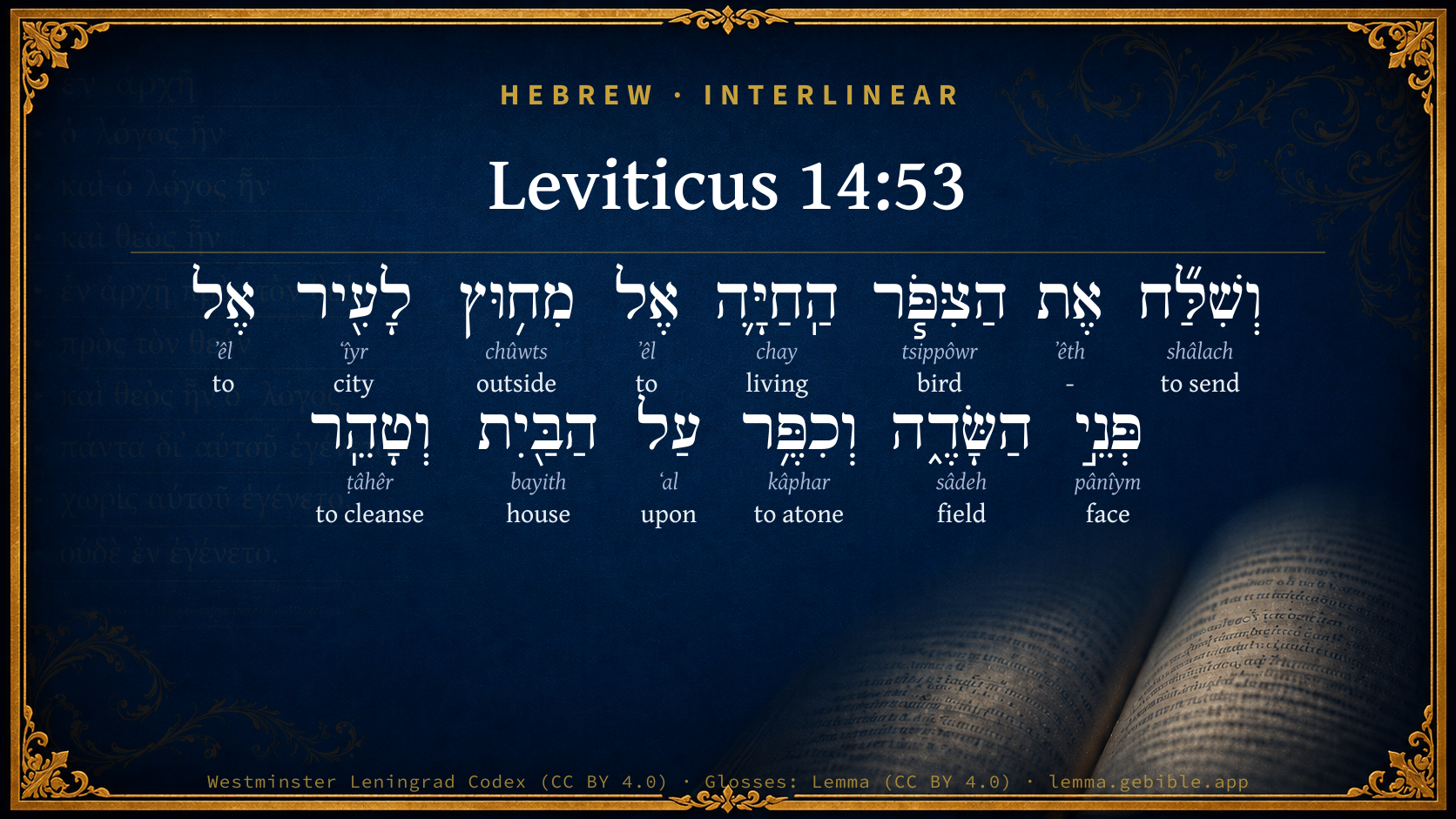
Hebrew (Westminster Leningrad Codex) Leviticus 14:53 appears in the Hebrew Old Testament. The text above is from the Westminster Leningrad Codex. Each word links to its Strong’s number, a concise gloss, and parsing drawn from the Open Scriptures Hebrew Bible morphology. Click any word for its full Brown-Driver-Briggs (BDB) entry.
Download image
Cite this verse

Leviticus 14:53 (World English Bible). Public Domain. Lemma interlinear Bible study tool, https://lemma.gebible.app/v/leviticus/14/53.

Show BibTeX & RIS
BibTeX
RIS
English Translation
but he shall let the living bird go out of the city into the open field. So shall he make atonement for the house; and it shall be clean."
World English Bible · Public Domain
Download a study sheet

One document with this verse’s original text, its word-by-word gloss line, the meaning frame, cross-references with their text, attributed commentary, and full source and license credits — printable, and it pastes into notes with its structure intact.

This verse Autodidact and up

Study sheet (.html) Plain text (.txt)

A passage Seminary Student

Up to 50 verses in one chapter. A passage sheet keeps up to 6 commentary sources and 12 cross-references per verse, in the order this page ranks them, and says so on the sheet whenever that leaves anything out. Ask for a single verse and you get the Autodidact verse sheet above.

Everything on this page stays free to read, with no account — the sheet is a download of what is already on screen, not access to it.

Want to remove ads? Support Godless Engineer
Compare translations 3

The same verse in 3 English versions, stacked beneath the original-language interlinear above. Click any original word for its lexicon entry.

Each is an independent rendering of the whole verse — the interlinear is not word-aligned to these translations.

Highlighted words mark where these versions differ — a whole-verse word diff, not a word-by-word alignment.

  • World English Bible Public Domain
    but he shall let the living bird go out of the city into the open field. So shall he make atonement for the house; and it shall be clean."
  • King James Version Public Domain
    But he shall let go the living bird out of the city into the open fields, and make an atonement for the house: and it shall be clean.
  • unfoldingWord Literal Text CC BY-SA 4.0
    And he shall send the live bird to on the outside of the city, to the face of the field. And he shall make atonement for the house, and it will be clean.

unfoldingWord Literal Text — © unfoldingWord, licensed CC BY-SA 4.0. Word-aligned USFM3 via Door43 (git.door43.org/unfoldingWord/en_ult).

Versions to compare (up to 4)

3 of 4 selected

Show all 18 translations

Every available English version of this verse, each an independent rendering of the whole verse.

  • World English Bible Public Domain
    but he shall let the living bird go out of the city into the open field. So shall he make atonement for the house; and it shall be clean."
  • Berean Standard Bible Public Domain
    Finally, he is to release the live bird into the open fields outside the city. In this way he will make atonement for the house, and it will be clean.
  • Majority Standard Bible Public Domain
    Finally, he is to release the live bird into the open fields outside the city. In this way he will make atonement for the house, and it will be clean.
  • King James Version Public Domain
    But he shall let go the living bird out of the city into the open fields, and make an atonement for the house: and it shall be clean.
  • American Standard Version (1901) Public Domain
    but he shall let got the living bird out of the city into the open field: so shall he make atonement for the house; and it shall be clean.
  • Revised Version (1885) Public Domain
    but he shall let go the living bird out of the city into the open field: so shall he make atonement for the house: and it shall be clean.
  • Geneva Bible (1599) Public Domain
    Afterwarde he shall let go the liue sparowe out of the towne into the broad fieldes: so shall he make atonement for the house, and it shall be cleane.
  • Douay-Rheims (1899) Public Domain
    And when he hath let go the sparrow to fly freely away into the field, he shall pray for the house, and it shall be rightly cleansed.
  • Young's Literal Translation Public Domain
    and he hath sent away the living bird unto the outside of the city unto the face of the field, and hath made atonement for the house, and it hath been clean.
  • Literal Standard Version CC BY-SA 4.0
    and he has sent the living bird away to the outside of the city to the face of the field, and has made atonement for the house, and it has been clean.
  • Unlocked Literal Bible CC BY-SA 4.0
    But he will let the live bird go out of the city into the open fields. In this way he must make atonement for the house, and it will be clean.
  • unfoldingWord Literal Text CC BY-SA 4.0
    And he shall send the live bird to on the outside of the city, to the face of the field. And he shall make atonement for the house, and it will be clean.
  • Darby Bible Public Domain
    and he shall let the living bird loose out of the city into the open field; and he shall make atonement for the house, and it is clean.
  • World Messianic Bible Public Domain
    but he shall let the living bird go out of the city into the open field. So shall he make atonement for the house; and it shall be clean.”
  • Webster's Bible Public Domain
    But he shall let go the living bird out of the city into the open fields, and make an atonement for the house: and it shall be clean.
  • Free Bible Version CC BY-SA 4.0
    Then he will let the live bird fly away outside the town. This is how he will make the house right, and it will be clean.
  • Bible in Basic English Public Domain
    But he will let the living bird go out of the town into the open country; so he will take away sin from the house and it will be clean.
  • JPS Tanakh (1917) Public Domain
    But he shall let go the living bird out of the city into the open field; so shall he make atonement for the house; and it shall be clean.

Literal Standard Version (2020), Covenant Press — licensed CC BY-SA 4.0. Text via the HelloAO Bible API (eBible.org). Unlocked Literal Bible (unfoldingWord) — licensed CC BY-SA 4.0. Text via the HelloAO Bible API (eBible.org). unfoldingWord Literal Text — © unfoldingWord, licensed CC BY-SA 4.0. Word-aligned USFM3 via Door43 (git.door43.org/unfoldingWord/en_ult). Free Bible Version, Dr. Jonathan Gallagher — licensed CC BY-SA 4.0. Text via the HelloAO Bible API (eBible.org).

Word by word

More ways to search: Search by grammar → Find every occurrence → Compare this word →

Practice this passage: Drill this verse → Learn its vocabulary →

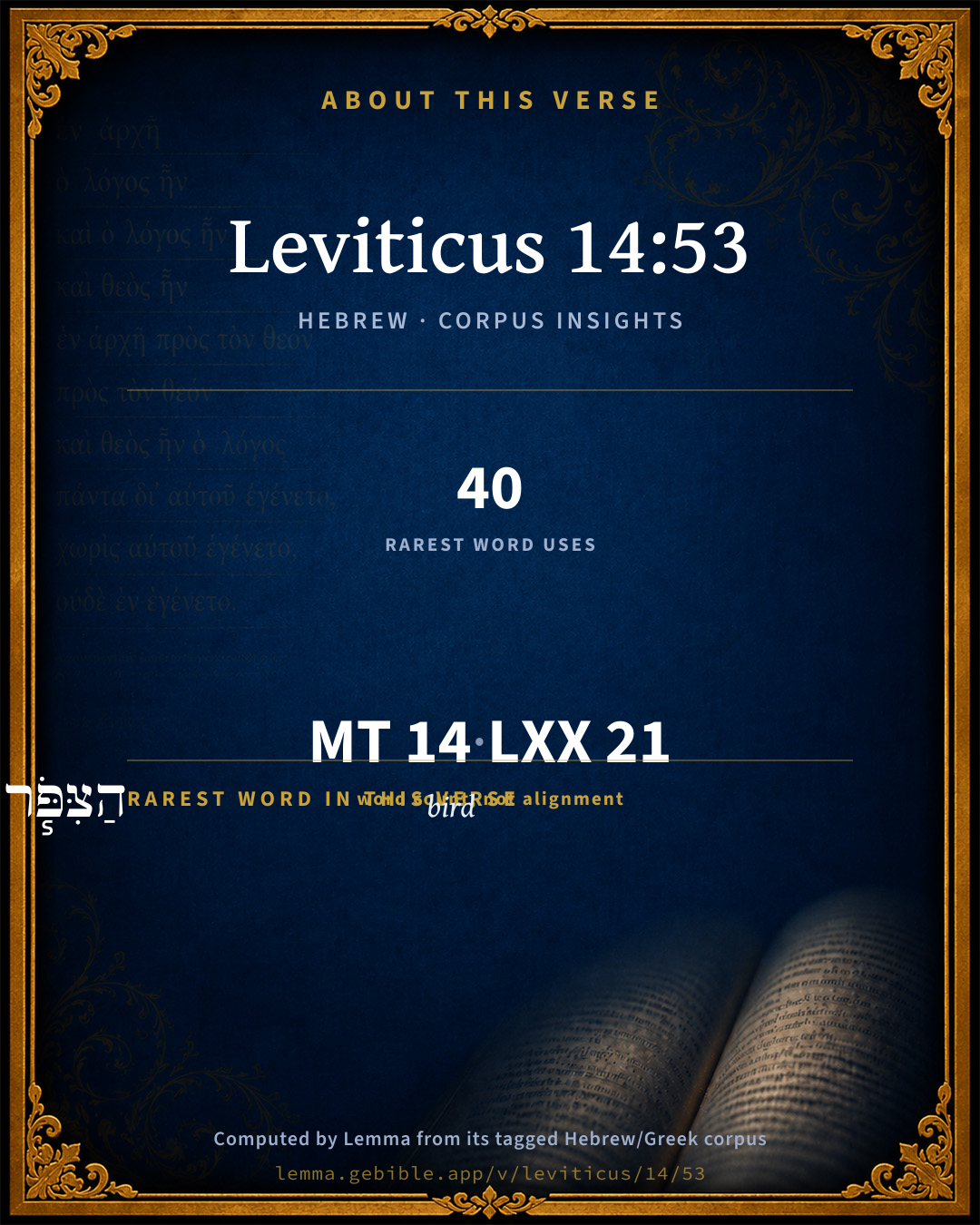
הַצִּפֹּ֧ר
tsippôwr
H6833
“the · bird”
Particle, Definite Article + Noun, Common, Both, Singular, Absolute
Part of Speech
Particle + Noun
Type
Common
Gender
Both
Number
Singular
State
Absolute
Full BDB Definition

Origin: from H6852

TWOT: 1959a

bird, fowl - bird (singular) - birds (collective)
  1. וְשִׁלַּ֞ח shâlach H7971 “and · to send” Conjunction + Verb, Piel, Sequential Perfect, 3rd Person, Masculine, Singular
  2. אֶת ʼêth H853 “-” Particle, Direct Object
  3. הַֽחַיָּ֛ה chay H2416 “the · living” Particle, Definite Article + Adjective, Adjective, Feminine, Singular, Absolute
  4. אֶל ʼêl H413 “to” Preposition
  5. מִח֥וּץ chûwts H2351 “from · outside” Preposition + Noun, Common, Masculine, Singular, Absolute
  6. לָעִ֖יר ʻîyr H5892 “to/for the · city” Preposition, Determined + Noun, Common, Feminine, Singular, Absolute
  7. אֶל ʼêl H413 “to” Preposition
  8. פְּנֵ֣י pânîym H6440 “face(s) of” Noun, Common, Both, Plural, Construct
  9. הַשָּׂדֶ֑ה sâdeh H7704 “the · field” Particle, Definite Article + Noun, Common, Masculine, Singular, Absolute
  10. וְכִפֶּ֥ר kâphar H3722 “and · to atone” Conjunction + Verb, Piel, Sequential Perfect, 3rd Person, Masculine, Singular
  11. עַל ʻal H5921 “upon” Preposition
  12. הַבַּ֖יִת bayith H1004 “the · house” Particle, Definite Article + Noun, Common, Masculine, Singular, Absolute
  13. וְטָהֵֽר ṭâhêr H2891 “and · to cleanse” Conjunction + Verb, Qal, Sequential Perfect, 3rd Person, Masculine, Singular

About this verse

These counts appear in no published source. They are computed here, from the morphology-tagged text and Lemma’s own curated glosses. What Lemma adds →

14
words
13
distinct lemmas
Pentateuch
section

Shared distinctive vocabulary

הַצִּפֹּ֧ר bird H6833 occurs in 36 verses of the Hebrew Bible. Also found in:

Grammatical profile

  • 3 verbs
  • 6 nouns
  • 1 adjective
  • 3 prepositions
  • 1 particle

Verb forms

  • וְשִׁלַּ֞ח Piel · Sequential Perfect
  • וְכִפֶּ֥ר Piel · Sequential Perfect
  • וְטָהֵֽר Qal · Sequential Perfect

Repetition

A word recurs within this verse — often emphatic in Hebrew:

  • אֶל to H413 ×2

Hebrew & Septuagint length

In English translation the verse runs 29 words from the Hebrew and 27 from the Septuagint (LXX English) — closely comparable.

A rough comparison of the two English renderings, which tokenize alike — not a word-level alignment.

Word counts can differ between the Hebrew and the Greek without any difference in meaning — e.g. the Hebrew direct-object marker אֵת has no separate Greek word, and Greek often adds the article ὁ.

In the original languages it is 14 Hebrew tokens and 21 Greek tokens — but the two are counted differently (Hebrew bundles its prefixes and suffixes into one token; the Greek is in lemma form), so that isn’t a like-for-like length.

Cross-references

2

Topical passages linked to Leviticus 14:53 in the Treasury of Scripture Knowledge — connected by theme and wording, ordered by reader-vote popularity; previews shown in the World English Bible.

  • Leviticus 14:7 He shall sprinkle on him who is to be cleansed from the leprosy seven times, and shall pronounce him clean, and shall let the living bird go into the open field.
  • Leviticus 14:20 and the priest shall offer the burnt offering and the meal offering on the altar. The priest shall make atonement for him, and he shall be clean.

Cross-references courtesy of OpenBible.info (CC BY 4.0).

Hebrew and Greek witnesses Masoretic Hebrew ↔ Greek Septuagint

The same verse in the two great witnesses to the Old Testament, shown verse-for-verse.

These are two independent witnesses, not word-aligned to each other, and the Septuagint is shown in lemma (dictionary) form.

Hebrew Leviticus 14:53 Masoretic · Westminster Leningrad Codex

וְשִׁלַּ֞ח אֶת הַצִּפֹּ֧ר הַֽחַיָּ֛ה אֶל מִח֥וּץ לָעִ֖יר אֶל פְּנֵ֣י הַשָּׂדֶ֑ה וְכִפֶּ֥ר עַל הַבַּ֖יִת וְטָהֵֽר

but he shall let the living bird go out of the city into the open field. So shall he make atonement for the house; and it shall be clean."

World English Bible · Public Domain

Greek LXX Leviticus 14:53 Septuagint · lemma form

καί ἐκ ἀποστέλλω ὁ ὀρνίθιον ὁ ζάω ἔξω ὁ πόλις εἰς ὁ πεδίον καί ἐκἱλάσκομαι περί ὁ οἰκία καί καθαρός εἰμί

And he shall let the living bird go out of the city into the field, and shall make atonement for the house, and it shall be clean.

LXX2012 (modern English Septuagint) · Public Domain

Hebrew: Westminster Leningrad Codex (CC BY 4.0). Greek: Septuagint (public domain); English from LXX2012 (modern English Septuagint) (Public Domain). How the Septuagint differs from the Hebrew →

Targum (Aramaic paraphrase)

2

The Targum is the ancient Jewish Aramaic paraphrase of the Hebrew Scriptures — an interpretive translation, not the Hebrew text itself. Onkelos (literal) and Pseudo-Jonathan (expansive) render the Torah, and Jonathan the Prophets. Coverage is partial: where no permissively-licensed English translation exists for a verse, only the Aramaic is shown. This is verse-level text, not a word-by-word alignment to the Hebrew.

  1. Targum Onkelos Torah (Genesis–Deuteronomy)
    וִישַׁלַח יָת צִפֲּרָא חַיְתָא לְמִבָּרָא לְקַרְתָּא לְאַפֵּי חַקְלָא וִיכַפֵּר עַל בֵּיתָא וְיִדְכֵּי

    (no public-domain English translation for this verse)

    Targum Onkelos — Aramaic: “Onkelos Genesis” (public domain); “Onkelos Exodus” (public domain); “Onkelos Leviticus” (public domain); “Onkelos Numbers” (public domain); “Onkelos Deuteronomy” (public domain). English: “Sefaria Community Translation” (CC0 1.0 (public-domain dedication)); “J.W. Etheridge. The Targums of Onkelos and Jonathan Ben Uzziel on the Pentateuch. London: Longmans, Green, 1862” (public domain). Text via Sefaria.

  2. Targum Pseudo-Jonathan Torah (Genesis–Deuteronomy)
    וְיִפְטוֹר יַת צִיפּוֹרָא חַיְיתָא לְמִבָּרָא לְקַרְתָּא עַל אַנְפֵּי חַקְלָא וִיכַפֵּר עַל בֵּיתָא וְיִדְכֵּי בְּרַם אִין אִיטוּמוֹס בַּיְיתָא לְמִילְקָא תוּב בְּצוֹרְעָא תַיְיבָא צִפּוֹרָא תַּמָּן בְּיוֹמָא הַהוּא וּמִתְכַּשְׁרָא לְמֵיכְלָא וְיַת צִיפְּרָא נְכִיסְתָּא הֲוָה מִקְבַּר כַּהֲנָא בְּמֵיחְמֵי מָרֵי בֵיתָא

    And the living bird he shall send forth out of the town upon the face of the field, and shall atone for the house, and it shall be clean. But if it is to be that the house will be again struck with leprosy, the bird on that day will return, and may be fit for food. But the bird that was killed shall the priest bury in the presence of the owner of the house.

    Targum Pseudo-Jonathan — Aramaic: “Targum Jonathan on Genesis” (public domain); “Targum Jonathan on Exodus” (public domain); “Targum Jonathan on Leviticus” (public domain); “Targum Jonathan on Numbers” (public domain); “Targum Jonathan on Deuteronomy” (public domain). English: “The Targum of Jonathan ben Uzziel, trans. J. W. Etheridge, London, 1862” (public domain). Text via Sefaria.

Commentary

Notes on Leviticus 14:53 from classic Christian and Jewish commentators (each source and its license shown beneath its notes). The classic Christian expositions comment on the surrounding passage and are grouped to its opening verse, so a note may address several verses; the Jewish commentaries on the Tanakh (Rashi and others) are per-verse, so they appear only where the commentator wrote on this verse.

Lemma curates 59 commentaries, every one of them public domain or Creative Commons licensed, each selected and text-cleaned for this edition rather than reprinted as found. About our sources →

Geneva Bible (1599)

Geneva Bible translators

Hebrew, city.

Hebrew, on the face of the field.

Geneva Bible (1599) marginal notes — public domain. Text via Bolls.life.

Adam Clarke's Commentary

Verse 53. He shall let go the living bird] This might as well be called the scape-bird; as the goat, in Le 16:5-10, is called the scape-goat. The rites are similar in both cases, and probably had nearly the same meaning.

We have already taken occasion to observe (see the end of the preceding chapter) that the leprosy was strongly emblematical of sin; to which we may add here: -

1. That the leprosy was a disease generally acknowledged to be incurable by any human means; and therefore the Jews did not attempt to cure it. What is directed to be done here was not in order to cure the leper, but to declare him cured and fit for society. In like manner the contagion of sin, its guilt and its power, can only be removed by the hand of God; all means, without his especial influence, can be of no avail.

2. The body must be sprinkled and washed, and a sacrifice offered for the sin of the soul, before the leper could be declared to be clean. To cleanse the spiritual leper, the Lamb of God must be slain, and the sprinkling of his blood be applied. Without the shedding of this blood there is no remission.

3. When the leper was cleansed, he was obliged to show himself to the priest, whose province it was to pronounce him clean, and declare him fit for intercourse with civil and religious society. When a sinner is converted from the error of his ways, it is the business, as it is the prerogative, of the ministers of Christ, after having duly acquainted themselves with every circumstance, to declare the person converted from sin to holiness, to unite him with the people of God, and admit him to all the ordinances which belong to the faithful.

4. When the leper was cleansed, he was obliged by the law to offer a gift unto the Lord for his healing, as a proof of his gratitude, and an evidence of his obedience. When a sinner is restored to the Divine favour, he should offer continually the sacrifice of a grateful heart, and, in willing obedience, show forth the virtues of Him who has called him from darkness and wretchedness to marvellous light and happiness.

Reader, such was the leprosy, its destructive nature and consequences, and the means of removing it; such is the spiritual evil represented by it, such its consequences, and such the means by which alone it can be removed. The disease of sin, inflicted by the devil, can only be cured by the power of God.

1. Art thou a leper? Do the spots of this spiritual infection begin to appear on thee?

2. Art thou young, and only entering into the ways of the world and sin? Stop! bad habits are more easily conquered to-day than they will be tomorrow.

3. Art thou stricken in years, and rooted in transgression? How kind is thy Maker to have preserved thee alive so long! Turn from thy transgressions, humble thy soul before him, confess thine iniquity and implore forgiveness. Seek, and thou shalt find. Behold the Lamb of God, who taketh away the sin of the world!

4. Hast thou been cleansed, and hast not returned to give glory to God? hast not continued in the truth, serving thy Maker and Saviour with a loving and obedient heart? How cutting is that word, Were there not TEN cleansed? but where are the NINE? Thou art probably one of them. Be confounded at thy ingratitude, and distressed for thy backsliding; and apply a second time for the healing efficacy of the great Atonement. Turn, thou backslider; for he is married unto thee, and will heal thy backslidings, and will love thee freely. Amen. So be it, Lord Jesus!

Adam Clarke's Commentary on the Bible (1810–1826) — public domain. Text from a community e-Sword/MySword module.

Haydock's Catholic Bible Commentary

For the house, that it may be no more infected; and for the people, to whom it belongs, that they may carefully avoid offending God, the avenger of all sin. Hebrew, "you shall make an atonement for the house," or for the sins of its inhabitants. (Haydock)

George Leo Haydock (1774–1849), Haydock's Catholic Family Bible and Commentary, 1859 edition — public domain. Excludes Psalms (Douay-Rheims chapter numbering differs from Protestant) and Deuterocanonical books (Catholic canon only).

Whedon's Commentary on the Bible

Daniel D. Whedon

53. Atonement for the house — The Hebrew verb kipper should here be translated purge, as it is in Eze_43:20; Eze_43:26. It should be so rendered whenever it has a thing for its object, as in Lev_16:33, and Deu_32:43, where the tabernacle, altar, and land are atoned.

The generic notion of freeing from impurity inheres in its use everywhere — moral impurity, or guilt, in persons, and ceremonial impurity in things. The impurity of the healed leper is not atoned till he has performed the requirements of the altar ritual at the door of the tabernacle. This ritual was impossible in the case of the house.

Daniel D. Whedon (gen. ed.), Commentary on the Old and New Testaments (1874–1909) — public domain. Text from a community e-Sword module.

Scofield Reference Notes

C. I. Scofield

atonement

(See Scofield "Exo 29:33").

The Scofield Reference Bible (1917 edition), notes by C. I. Scofield — public domain. Text from a community e-Sword module.

Ramban (Nachmanides)

Rabbi Moshe ben Nachman (Ramban / Nachmanides)

AND HE SHALL LET GO THE LIVING BIRD OUT OF THE CITY INTO THE OPEN FIELD, AND MAKE ATONEMENT FOR THE HOUSE, AND IT SHALL BE CLEAN. Now this atonement was effected by the bird which is to be sent away, the bird carrying away all his sins out of the city into the open field, like the atonement effected by the goat that is to be sent away. Now since the punishment of the plague which appears in a person’s house is unlike [i.e., less in severity than] that of a plague which afflicts his body, Scripture did not make it necessary for him [the owner of the house] to bring a guilt-offering and sin-offering [as it required for the purification of a leper], because the first [stage of] atonement that the leper brings for his purification — namely, the birds, the cedar-wood and the hyssop — is sufficient for him [i.e., the owner of the house].

Ramban (Nachmanides) on the Tanakh — English translation: “Commentary on the Torah by Ramban (Nachmanides). Translated and annotated by Charles B. Chavel. New York, Shilo Pub. House, 1971-1976” (CC BY 4.0). Text via Sefaria.

Lesson kit

Teaching starters — assembled from the data on this page, not authored interpretation. Every prompt links to the verse data it draws on. Edit before teaching.

Leviticus, in the Pentateuch, opens this verse with 14 words (13 distinct Hebrew lemmas). Its most distinctive word is tsippôwr (“bird”). A historical commentator’s framing appears above. Read the whole chapter for the surrounding context.

Discussion questions

  1. The word tsippôwr carries the sense “bird.” How does it shape the verse?
  2. How does Genesis 7:14, which shares the word «bird», read alongside this verse?
  3. What does the repetition of “to” (2× in this one verse) do in this verse?
  4. These translations render this verse differently. What is at stake in choosing one wording over another?
  5. «וְשִׁלַּ֞ח» is a Piel Sequential Perfect verb. How does that grammatical form shape the action described?
  6. Compare how Geneva Bible (1599) and Adam Clarke's Commentary read this verse. Where do they agree or differ?

Things to notice

Reading settings

Reading text

Shown beneath each verse's original-language words.

Old Testament
Old Testament edition

Read the OT as the Masoretic Hebrew (MT) or the Greek Septuagint (LXX).

English shown for the Greek Septuagint (in the Hebrew ↔ Greek comparison).

Comparing translations? Open the Compare panel on any verse page to stack up to four side by side.