
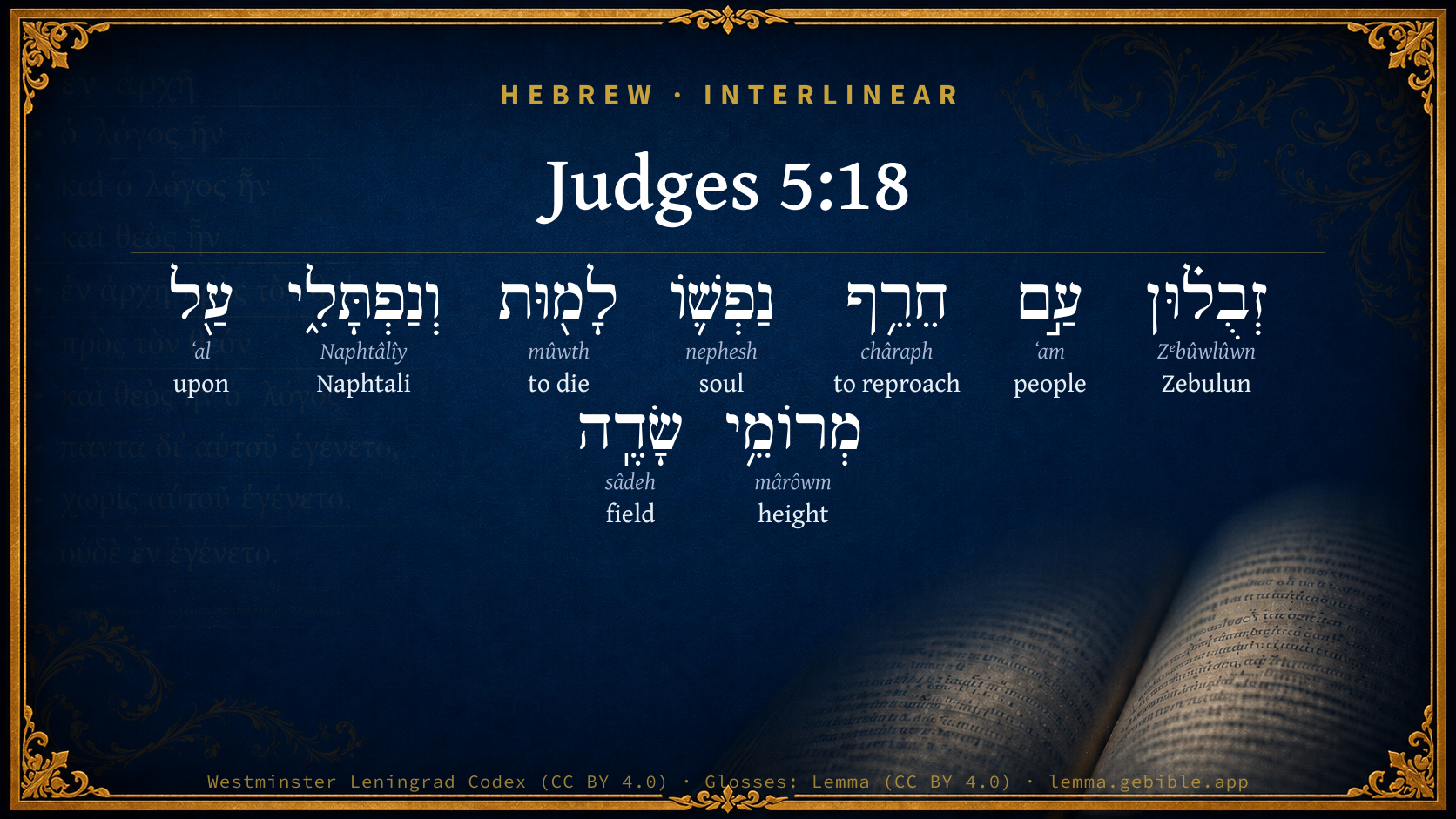
Judges 5:18

Hebrew (Westminster Leningrad Codex) Judges 5:18 appears in the Hebrew Old Testament. The text above is from the Westminster Leningrad Codex. Each word links to its Strong’s number, a concise gloss, and parsing drawn from the Open Scriptures Hebrew Bible morphology. Click any word for its full Brown-Driver-Briggs (BDB) entry.
Download image
Cite this verse

Judges 5:18 (World English Bible). Public Domain. Lemma interlinear Bible study tool, https://lemma.gebible.app/v/judges/5/18.

Show BibTeX & RIS
BibTeX
RIS
English Translation
Zebulun was a people that jeopardized their lives to the death, Naphtali, on the high places of the field.
World English Bible · Public Domain
Highlights
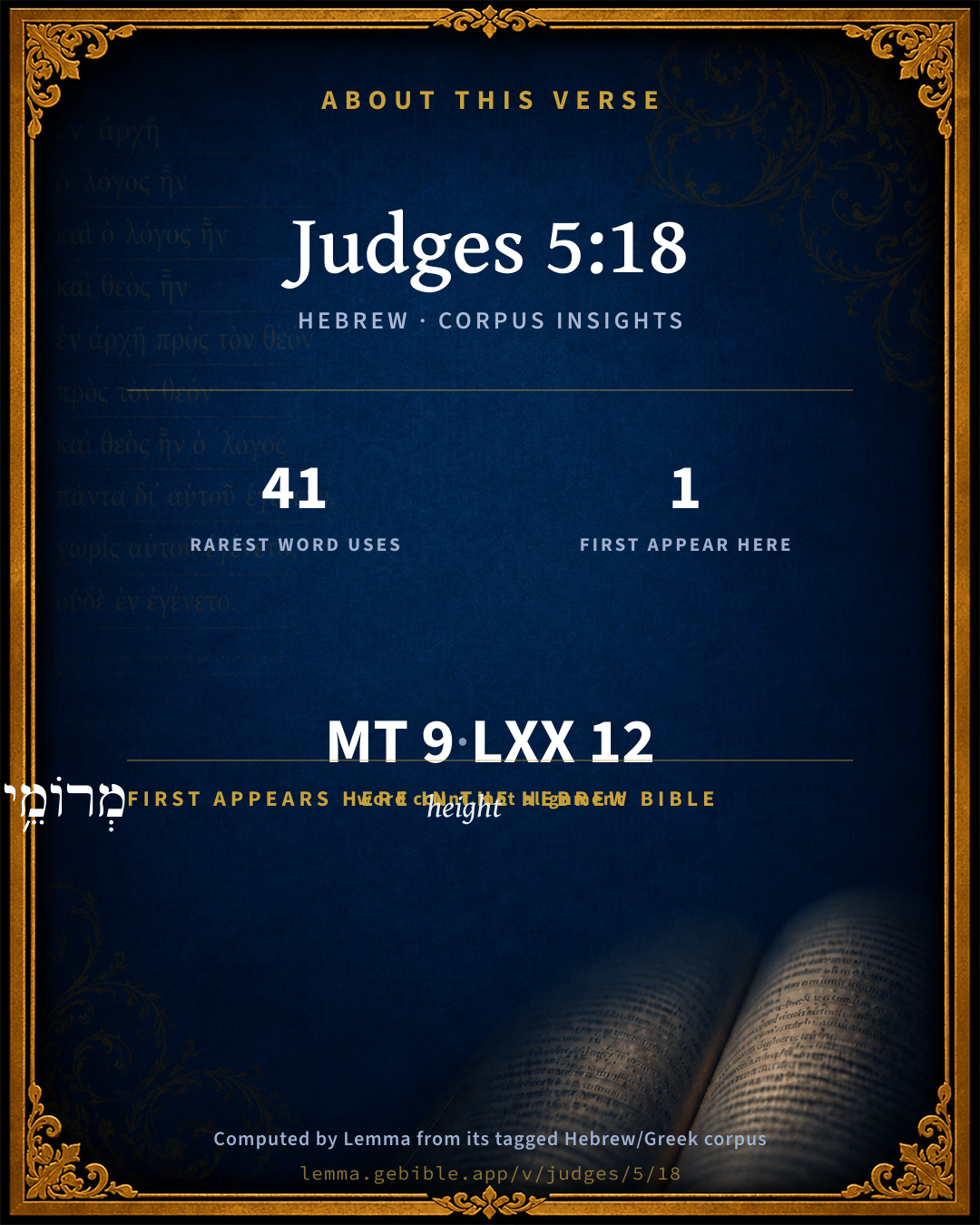
  • 1 first appearance in the Hebrew Bible
Full analysis ↓
Download a study sheet

One document with this verse’s original text, its word-by-word gloss line, the meaning frame, cross-references with their text, attributed commentary, and full source and license credits — printable, and it pastes into notes with its structure intact.

This verse Autodidact and up

Study sheet (.html) Plain text (.txt)

A passage Seminary Student

Up to 50 verses in one chapter. A passage sheet keeps up to 6 commentary sources and 12 cross-references per verse, in the order this page ranks them, and says so on the sheet whenever that leaves anything out. Ask for a single verse and you get the Autodidact verse sheet above.

Everything on this page stays free to read, with no account — the sheet is a download of what is already on screen, not access to it.

Want to remove ads? Support Godless Engineer
Compare translations 3

The same verse in 3 English versions, stacked beneath the original-language interlinear above. Click any original word for its lexicon entry.

Each is an independent rendering of the whole verse — the interlinear is not word-aligned to these translations.

Highlighted words mark where these versions differ — a whole-verse word diff, not a word-by-word alignment.

  • World English Bible Public Domain
    Zebulun was a people that jeopardized their lives to the death, Naphtali, on the high places of the field.
  • King James Version Public Domain
    Zebulun and Naphtali were a people that jeoparded their lives unto the death in the high places of the field.
  • unfoldingWord Literal Text CC BY-SA 4.0
    Zebulun a people reproaching its soul unto death, also Naphtali on the heights of the field.

unfoldingWord Literal Text — © unfoldingWord, licensed CC BY-SA 4.0. Word-aligned USFM3 via Door43 (git.door43.org/unfoldingWord/en_ult).

Versions to compare (up to 4)

3 of 4 selected

Show all 18 translations

Every available English version of this verse, each an independent rendering of the whole verse.

  • World English Bible Public Domain
    Zebulun was a people that jeopardized their lives to the death, Naphtali, on the high places of the field.
  • Berean Standard Bible Public Domain
    Zebulun was a people who risked their lives; Naphtali, too, on the heights of the battlefield.
  • Majority Standard Bible Public Domain
    Zebulun was a people who risked their lives; Naphtali, too, on the heights of the battlefield.
  • King James Version Public Domain
    Zebulun and Naphtali were a people that jeoparded their lives unto the death in the high places of the field.
  • American Standard Version (1901) Public Domain
    Zebulun was a people that jeoparded their lives unto the death, And Naphtali, upon the high places of the field.
  • Revised Version (1885) Public Domain
    Zebulun was a people that jeoparded their lives unto the death, and Naphtali, upon the high places of the field.
  • Geneva Bible (1599) Public Domain
    But the people of Zebulun and Naphtali haue ieopard their liues vnto the death in the hie places of the field.
  • Douay-Rheims (1899) Public Domain
    But Zabulon and Nephtali offered their lives to death in the region of Merome.
  • Young's Literal Translation Public Domain
    Zebulun `is' a people who exposed its soul to death, Naphtali also -- on high places of the field.
  • Literal Standard Version CC BY-SA 4.0
    Zebulun [is] a people who exposed its soul to death, || Naphtali also—on high places of the field.
  • Unlocked Literal Bible CC BY-SA 4.0
    Zebulun was a tribe who would risk their lives to the point of death, and Naphtali, also, on the field of battle.
  • unfoldingWord Literal Text CC BY-SA 4.0
    Zebulun a people reproaching its soul unto death, also Naphtali on the heights of the field.
  • Darby Bible Public Domain
    Zeb'ulun is a people that jeoparded their lives to the death; Naph'tali too, on the heights of the field.
  • World Messianic Bible Public Domain
    Zebulun was a people that jeopardized their lives to the death; Naphtali also, on the high places of the field.
  • Webster's Bible Public Domain
    Zebulun and Naphtali were a people that jeoparded their lives to death in the high places of the field.
  • Free Bible Version CC BY-SA 4.0
    The people of Zebulun risked their lives; as did Naphtali on the high battlefields.
  • Bible in Basic English Public Domain
    It was the people of Zebulun who put their lives in danger, even to death, with Naphtali on the high places of the field.
  • JPS Tanakh (1917) Public Domain
    Zebulun is a people that jeoparded their lives unto the death, and Naphtali, upon the high places of the field.

Literal Standard Version (2020), Covenant Press — licensed CC BY-SA 4.0. Text via the HelloAO Bible API (eBible.org). Unlocked Literal Bible (unfoldingWord) — licensed CC BY-SA 4.0. Text via the HelloAO Bible API (eBible.org). unfoldingWord Literal Text — © unfoldingWord, licensed CC BY-SA 4.0. Word-aligned USFM3 via Door43 (git.door43.org/unfoldingWord/en_ult). Free Bible Version, Dr. Jonathan Gallagher — licensed CC BY-SA 4.0. Text via the HelloAO Bible API (eBible.org).

Word by word

More ways to search: Search by grammar → Find every occurrence → Compare this word →

Practice this passage: Drill this verse → Learn its vocabulary →

About this verse

These counts appear in no published source. They are computed here, from the morphology-tagged text and Lemma’s own curated glosses. What Lemma adds →

9
words
9
distinct lemmas
Historical
section

First appearance in Scripture

This word makes its first canonical appearance in the Hebrew Bible here:

  • מְרוֹמֵ֥י height H4791

Shared distinctive vocabulary

חֵרֵ֥ף to reproach H2778 occurs in 40 verses of the Hebrew Bible. Also found in:

Grammatical profile

  • 2 verbs
  • 6 nouns
  • 1 preposition

Verb forms

  • חֵרֵ֥ף Piel · Perfect
  • לָמ֖וּת Qal · Infinitive Construct

Hebrew & Septuagint length

In English translation the verse runs 19 words from the Hebrew and 18 from the Septuagint (LXX English) — closely comparable.

A rough comparison of the two English renderings, which tokenize alike — not a word-level alignment.

Word counts can differ between the Hebrew and the Greek without any difference in meaning — e.g. the Hebrew direct-object marker אֵת has no separate Greek word, and Greek often adds the article ὁ.

In the original languages it is 9 Hebrew tokens and 12 Greek tokens — but the two are counted differently (Hebrew bundles its prefixes and suffixes into one token; the Greek is in lemma form), so that isn’t a like-for-like length.

Cross-references

7

Topical passages linked to Judges 5:18 in the Treasury of Scripture Knowledge — connected by theme and wording, ordered by reader-vote popularity; previews shown in the World English Bible.

  • Judges 4:10 Barak called Zebulun and Naphtali together to Kedesh; and there went up ten thousand men at his feet: and Deborah went up with him.
  • Judges 4:6 She sent and called Barak the son of Abinoam out of Kedesh-naphtali, and said to him, Hasn't Yahweh, the God of Israel, commanded, [saying], Go and draw to Mount Tabor, and take with you ten thousand men of the children of Naphtali and of the children of Zebulun?
  • Judges 4:14 Deborah said to Barak, Up; for this is the day in which Yahweh has delivered Sisera into your hand; hasn't Yahweh gone out before you? So Barak went down from Mount Tabor, and ten thousand men after him.
  • Esther 4:16 Go, gather together all the Jews who are present in Shushan, and fast you for me, and neither eat nor drink three days, night or day: I also and my maidens will fast in like manner; and so will I go in to the king, which is not according to the law: and if I perish, I perish.
  • Acts 20:24 But these things don't count; nor do I hold my life dear to myself, so that I may finish my race with joy, and the ministry which I received from the Lord Jesus, to fully testify to the Gospel of the grace of God.
  • 1 John 3:16 By this we know love, because he laid down his life for us. And we ought to lay down our lives for the brothers.
  • Revelation 12:11 They overcame him because of the Lamb's blood, and because of the word of their testimony. They didn't love their life, even to death.

Cross-references courtesy of OpenBible.info (CC BY 4.0).

Hebrew and Greek witnesses Masoretic Hebrew ↔ Greek Septuagint

The same verse in the two great witnesses to the Old Testament, shown verse-for-verse.

These are two independent witnesses, not word-aligned to each other, and the Septuagint is shown in lemma (dictionary) form.

Hebrew Judges 5:18 Masoretic · Westminster Leningrad Codex

זְבֻל֗וּן עַ֣ם חֵרֵ֥ף נַפְשׁ֛וֹ לָמ֖וּת וְנַפְתָּלִ֑י עַ֖ל מְרוֹמֵ֥י שָׂדֶֽה

Zebulun was a people that jeopardized their lives to the death, Naphtali, on the high places of the field.

World English Bible · Public Domain

Greek LXX Judges 5:18 Septuagint · lemma form

ζαβουλων λαός ὀνειδίζω ψυχή αὐτός εἰς θάνατος καί νεφθαλι ἐπί ὕψος ἀγρός

The people Zabulon exposed their soul to death, and Nephthali came to the high places of their land.

LXX2012 (modern English Septuagint) · Public Domain

Hebrew: Westminster Leningrad Codex (CC BY 4.0). Greek: Septuagint (public domain); English from LXX2012 (modern English Septuagint) (Public Domain). How the Septuagint differs from the Hebrew →

Targum (Aramaic paraphrase)

1

The Targum is the ancient Jewish Aramaic paraphrase of the Hebrew Scriptures — an interpretive translation, not the Hebrew text itself. Onkelos (literal) and Pseudo-Jonathan (expansive) render the Torah, and Jonathan the Prophets. Coverage is partial: where no permissively-licensed English translation exists for a verse, only the Aramaic is shown. This is verse-level text, not a word-by-word alignment to the Hebrew.

  1. Targum Jonathan Prophets (Joshua–Malachi)
    דְבֵית זְבוּלֻן לָקֳבֵיל עַמְמַיָא דְגַדִיפוּ קֳדָם יְיָ מְסַרוּ נַפְשֵׁיהוֹן לְקַטָלָא אִנוּן וּדְבֵית נַפְתָּלִי יְשַׁבְּחוּנוּן כָּל עַמְמֵי אַרְעָא:

    (no public-domain English translation for this verse)

    Targum Jonathan — Aramaic: “Mikraot Gedolot” (public domain). English: “Sefaria Community Translation” (CC0 1.0 (public-domain dedication)); “London "Chaldee Paraphrase," 1871” (public domain). Text via Sefaria.

Commentary

Notes on Judges 5:18 from classic Christian and Jewish commentators (each source and its license shown beneath its notes). The classic Christian expositions comment on the surrounding passage and are grouped to its opening verse, so a note may address several verses; the Jewish commentaries on the Tanakh (Rashi and others) are per-verse, so they appear only where the commentator wrote on this verse.

Lemma curates 59 commentaries, every one of them public domain or Creative Commons licensed, each selected and text-cleaned for this edition rather than reprinted as found. About our sources →

Trapp's Complete Commentary

John Trapp

Jdg 5:18 Zebulun and Naphtali [were] a people [that] jeoparded their lives unto the death in the high places of the field.

Ver. 18. That jeoparded their lives.] Or, Devoted, exposed; and are therefore worthily renowned and never enough commended. They that "do worthily in Ephrata," shall be "famous in Bethlehem." {Rth 4:11} What a name hath Seanderbeg, Hunniades, Zisca, the Black Prince, who was so called, not of his colour, but of his dreaded acts in battle! {a}

{a} Speed.

John Trapp, A Commentary or Exposition upon All the Books of the Old and New Testament (1647–1656) — public domain. Text from a community e-Sword module.

Joseph Benson's Commentary

Jdg 5:18. Zebulun and Naphtali, &c. — These were the two tribes out of which Barak, by the order of God, (Jdg 4:6,) drew ten thousand men, who charged the enemy from mount Tabor; and Deborah here celebrates their gallant behaviour. That jeoparded their lives — Hebrew, חרŠ, cherep, despised their lives, or exposed them to the danger of death, as making no account of them, in comparison of joining with their brethren to shake off the yoke of the Canaanites, and recover their liberty. They chose rather to venture upon a generous and honourable death than to enjoy a shameful and servile life. In the high places of the field — That is, upon that large and eminent plain in the top of mount Tabor, where they put themselves in battle array, and expected the enemy; though, when they saw that the Canaanites did not come up to them, they marched down to meet them.

Joseph Benson's Commentary on the Old and New Testaments (1811–1818) — public domain. Text from a community e-Sword module.

Adam Clarke's Commentary

Verse 18. Zebulun and Naphtali - jeoparded their lives] The original is very emphatic, חרף נפשו למות chereph naphsho lamuth, they desolated their lives to death - they were determined to conquer or die, and therefore plunged into the thickest of the battle. The word jeoparded is a silly French term, and comes from the exclamation of a disappointed gamester: Jeu perdu! The game is lost; or J'ai perdue! I have lost.

Adam Clarke's Commentary on the Bible (1810–1826) — public domain. Text from a community e-Sword/MySword module.

Ellicott's Commentary for English Readers

(18) Jeoparded their lives.—Comp. Jdg_9:7; Isa_53:12. The courage of Zebulon and Naphtali is contrasted with the empty debates of Reuben, the sloth of Gilead, the cowardly selfishness of Dan and Asher.

In the high places of the field.—That is, on Mount Tabor. The Hebrew word is the Meroms; hence the Vulgate has in regione Merome. (Comp. Jos_11:5; Jos_11:7.)

A Bible Commentary for English Readers, edited by Charles John Ellicott (1878–1897) — public domain. Text from a community e-Sword module.

The Cambridge Bible for Schools and Colleges

gen. ed. J. J. S. Perowne

18. In contrast to the lethargy of the tribes on the E. and N. was the heroic valour of Zebulun and Naphtali.

the high places of the field] is hardly applicable to the field of battle, which was a plain; perhaps the general meaning is, the two tribes came fearlessly down from their mountain homes prepared to sacrifice all for the cause. See further on Jdg_4:6.

The Cambridge Bible for Schools and Colleges (gen. ed. J. J. S. Perowne; Cambridge University Press, 1878–1918) — public domain. Text from a community e-Sword module.

John Gill's Exposition

Zebulun and Naphtali were a people,.... These two tribes were chiefly concerned in this war; out of them were the 10,000 men that followed Barak, who willingly offered themselves, and were the most active and vigorous:

that jeoparded themselves unto the death; exposed them to the utmost danger, fearless of death itself: or reproached (k) their lives; were careless of them, valued them not; they were not dear to them, but were ready to part with them freely, in the cause of liberty in which they were engaged:

in the high places of the field; on the top of Mount Tabor, where they were mustered, and from whence they beheld the vast host of Sisera surrounding them; and yet, with an undaunted bravery and courage, descended the hill to fight with them. The Vulgate Latin version reads, "in the country of Merome"; in the plains and fields of it, near which were the waters of Merom, where Joshua fought Jabin, a former king of Canaan, and supposed by some to be the same with Kishon here, Jos 11:5.

(k) "probris affecit", Pagninus; so the Targum.

John Gill's Exposition of the Whole Bible (1746–1763) — public domain (CC PDM 1.0). Text via the HelloAO Bible API.

Albert Barnes' Notes on the Bible

In contrast with the selfishness of the tribes just named, Deborah reverts with enthusiasm to the heroic prowess of Zebulun and Naphtali.

Albert Barnes' Notes on the Bible (1834–1885) — public domain. Text from a community e-Sword/MySword module.

Haydock's Catholic Bible Commentary

Merone. Hebrew, "In the heights of the field, or of Merome." Some take this place to be the lake Semechon, but we have endeavoured to shew that it was in the vicinity of Thanac, Josue xi. 5. (Calmet) --- Thabor was in the midst of a great field or plain. (Du Hamel) --- Barac seems to have been at the head of 10,000 men, of the tribe of Issachar, attacking Sisara, at the foot of Thabor, while 40,000 of the tribes of Nephthali and Zabulon, almost without arms, fell upon the kings of Chanaan, who had posted themselves near the waters of Mageddo, to intercept any recruits that might be sent from the southern tribes, ver. 8, 15, 19. (Calmet)

George Leo Haydock (1774–1849), Haydock's Catholic Family Bible and Commentary, 1859 edition — public domain. Excludes Psalms (Douay-Rheims chapter numbering differs from Protestant) and Deuterocanonical books (Catholic canon only).

Matthew Poole's English Annotations

Jeoparded, Heb. despised, or reproached, or contemned, comparatively; they chose rather to venture upon a generous and honourable death, than to enjoy a shameful and servile life.

In the high places of the field, i.e. upon that large and eminent plain in the top of Mount Tabor, where they put themselves in battle-array, and expected the enemy; though when they saw he did not come up to them, they marched down to meet and fight him.

Matthew Poole's English Annotations on the Holy Bible (1683–1685) — public domain. Text from a community e-Sword/MySword module.

Whedon's Commentary on the Bible

Daniel D. Whedon

18. Zebulun — Mentioned a second time (compare Jdg_5:14) because of the extraordinary bravery and heroism of the warriors of this tribe.

Scorned his soul to death — Hazarded his life on the most conspicuous places of the battle field. So bold and fearless was he that he seemed actually to scorn (חרŠ) his own life, and to treat it with contempt.

And Naphtali — The same heroism and daring are predicated of the warriors of this tribe also, only the name of the tribe occurs but this once. The prominence of these two tribes in the action is seen in chap. Jdg_4:6; Jdg_4:10.

Daniel D. Whedon (gen. ed.), Commentary on the Old and New Testaments (1874–1909) — public domain. Text from a community e-Sword module.

John Wesley's Explanatory Notes

Jeoparded - Hebrew. despised, comparatively; they chose rather to venture upon a generous and honourable death, than to enjoy a shameful and servile life. High-places - That is, upon that large and eminent plain in the top of mount Tabor, where they put themselves in battle array, and expected the enemy; though when they saw they did not come up to them, they marched down to meet them.

John Wesley, Explanatory Notes Upon the Whole Bible (1754–1765) — public domain. Text via the GEBible commentary corpus.

Keil & Delitzsch

C. F. Keil & F. Delitzsch

Zebulun and Naphtali acted quite differently. Zebulun showed itself as a people that despised its life even to death, i.e., that sacrificed its life for the deliverance of its fatherland. Naphtali did the same in its mountain home. The two tribes had raised 10,000 fighting men at Barak's call (Jdg 4:10), who constituted at any rate the kernel of the Israelitish army.

If we run over the tribes enumerated, it seems strange that the tribes of Judah and Simeon are not mentioned either among those who joined in the battle, or among those who stayed away. The only way in which this can be explained is on the supposition that these two tribes were never summoned by Barak, either because they were so involved in conflict with the Philistines, that they were unable to render any assistance to the northern tribes against their Canaanitish oppressors, as we might infer from Jdg 3:31, or because of some inward disagreement between these tribes and the rest. But even apart from Judah and Simeon, the want of sympathy on the part of the tribes that are reproved is a sufficient proof that the enthusiasm for the cause of the Lord had greatly diminished in the nation, and that the internal unity of the congregation was considerably loosened.

In the next strophe the battle and the victory are described: -

Keil & Delitzsch — Biblical Commentary on the Old Testament (1861–1891) — public domain (CC PDM 1.0). Text via the HelloAO Bible API. (Old Testament only.)

Rashi

Rabbi Shlomo Yitzchaki (Rashi)

Zevulun; a people who disdained, etc. They were contemptuous of their lives, and subjected themselves to death in battle with Barak. Likewise, Naftoli at the highland field on Mount Tovor.

Rashi on the Tanakh — English translations: “The Judaica Press complete Tanach with Rashi, translated by A. J. Rosenberg” (CC BY 4.0); “Pentateuch with Rashi's commentary by M. Rosenbaum and A.M. Silbermann, 1929-1934” (public domain); “The Metsudah Tanach series, Lakewood, N.J” (CC BY 4.0); and “The Book of Joshua, Metsudah Publications, 1997” (CC BY 4.0). Text via Sefaria.

Radak

Rabbi David Kimhi (Radak)

Zevulun mocked his life: He revealed and publicized himself and handed himself over to death, so great was his desire for war. And likewise did Naphtali place himself upon the open heights to fight. And Yonatan translated [it] (in the Targum), "all the nations of the earth will praise those of the House of Naphtali."

Radak on the Tanakh — English translations: “Sefaria Community Translation” (CC0 1.0 (public-domain dedication)); “Eliyahu Munk, HaChut Hameshulash” (CC BY 4.0); “Rabbi Mike Feuer, Jerusalem Anthology” (CC BY 4.0); and “R. David Kimhi on the first book of Psalms, Translated by R.G. Finch, London, 1919” (public domain). Text via Sefaria.

Lesson kit

Teaching starters — assembled from the data on this page, not authored interpretation. Every prompt links to the verse data it draws on. Edit before teaching.

Judges, in the Historical, opens this verse with 9 words (9 distinct Hebrew lemmas). Its most distinctive word is châraph (“to reproach”). A historical commentator’s framing appears above. Read the whole chapter for the surrounding context.

Discussion questions

  1. The word châraph carries the sense “to reproach.” How does it shape the verse?
  2. The word “height” first appears here in Scripture. What is being introduced at this debut?
  3. Leviticus 19:20 shares the word «to reproach» with this verse. How do the two illuminate each other?
  4. The translations on this page render this verse differently — a whole-verse word diff, not a word-by-word alignment. What might account for the different wordings?
  5. The verb «חֵרֵ֥ף» is Piel Perfect. How does its form color the action?
  6. Reading how Trapp's Complete Commentary and Joseph Benson's Commentary read this verse, where do the two commentators agree and where do they part?

Things to notice

Reading settings

Reading text

Shown beneath each verse's original-language words.

Old Testament
Old Testament edition

Read the OT as the Masoretic Hebrew (MT) or the Greek Septuagint (LXX).

English shown for the Greek Septuagint (in the Hebrew ↔ Greek comparison).

Comparing translations? Open the Compare panel on any verse page to stack up to four side by side.