
2 Kings 8:3

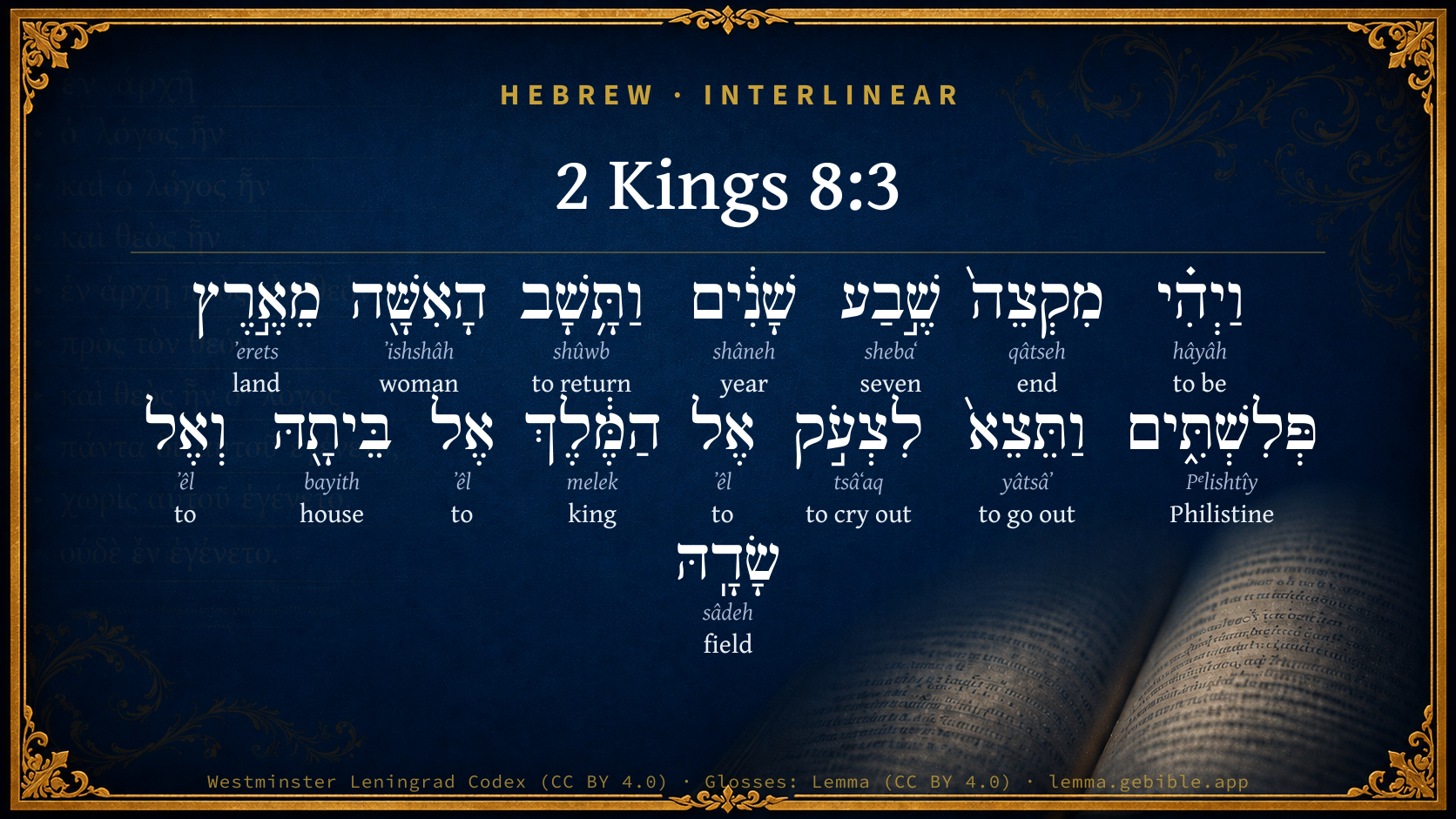
Hebrew (Westminster Leningrad Codex) 2 Kings 8:3 appears in the Hebrew Old Testament. The text above is from the Westminster Leningrad Codex. Each word links to its Strong’s number, a concise gloss, and parsing drawn from the Open Scriptures Hebrew Bible morphology. Click any word for its full Brown-Driver-Briggs (BDB) entry.
Download image
Cite this verse

2 Kings 8:3 (World English Bible). Public Domain. Lemma interlinear Bible study tool, https://lemma.gebible.app/v/2-kings/8/3.

Show BibTeX & RIS
BibTeX
RIS
English Translation
It happened at the seven years' end, that the woman returned out of the land of the Philistines: and she went forth to cry to the king for her house and for her land.
World English Bible · Public Domain
Download a study sheet

One document with this verse’s original text, its word-by-word gloss line, the meaning frame, cross-references with their text, attributed commentary, and full source and license credits — printable, and it pastes into notes with its structure intact.

This verse Autodidact and up

Study sheet (.html) Plain text (.txt)

A passage Seminary Student

Up to 50 verses in one chapter. A passage sheet keeps up to 6 commentary sources and 12 cross-references per verse, in the order this page ranks them, and says so on the sheet whenever that leaves anything out. Ask for a single verse and you get the Autodidact verse sheet above.

Everything on this page stays free to read, with no account — the sheet is a download of what is already on screen, not access to it.

Want to remove ads? Support Godless Engineer
Compare translations 3

The same verse in 3 English versions, stacked beneath the original-language interlinear above. Click any original word for its lexicon entry.

Each is an independent rendering of the whole verse — the interlinear is not word-aligned to these translations.

Highlighted words mark where these versions differ — a whole-verse word diff, not a word-by-word alignment.

  • World English Bible Public Domain
    It happened at the seven years' end, that the woman returned out of the land of the Philistines: and she went forth to cry to the king for her house and for her land.
  • King James Version Public Domain
    And it came to pass at the seven years' end, that the woman returned out of the land of the Philistines: and she went forth to cry unto the king for her house and for her land.
  • unfoldingWord Literal Text CC BY-SA 4.0
    And it happened at the end of seven years that the woman returned from the land of the Philistines. And she went out to cry out to the king for her house and for her land.

unfoldingWord Literal Text — © unfoldingWord, licensed CC BY-SA 4.0. Word-aligned USFM3 via Door43 (git.door43.org/unfoldingWord/en_ult).

Versions to compare (up to 4)

3 of 4 selected

Show all 18 translations

Every available English version of this verse, each an independent rendering of the whole verse.

  • World English Bible Public Domain
    It happened at the seven years' end, that the woman returned out of the land of the Philistines: and she went forth to cry to the king for her house and for her land.
  • Berean Standard Bible Public Domain
    At the end of seven years, when the woman returned from the land of the Philistines, she went to the king to appeal for her house and her land.
  • Majority Standard Bible Public Domain
    At the end of seven years, when the woman returned from the land of the Philistines, she went to the king to appeal for her house and her land.
  • King James Version Public Domain
    And it came to pass at the seven years' end, that the woman returned out of the land of the Philistines: and she went forth to cry unto the king for her house and for her land.
  • American Standard Version (1901) Public Domain
    And it came to pass at the seven years' end, that the woman returned out of the land of the Philistines: and she went forth to cry unto the king for her house and for her land.
  • Revised Version (1885) Public Domain
    And it came to pass at the seven years’ end, that the woman returned out of the land of the Philistines: and she went forth to cry unto the king for her house and for her land.
  • Geneva Bible (1599) Public Domain
    And at the seuen yeeres ende, the woman returned out of the lande of the Philistims, and went out to call vpon the King for her house and for her land.
  • Douay-Rheims (1899) Public Domain
    And when the seven years were ended, the woman returned out of the land of the Philistines, and she went forth to speak to the king for her house, and for her lands.
  • Young's Literal Translation Public Domain
    And it cometh to pass, at the end of seven years, that the woman turneth back from the land of the Philistines, and goeth out to cry unto the king, for her house, and for her field.
  • Literal Standard Version CC BY-SA 4.0
    And it comes to pass, at the end of seven years, that the woman turns back from the land of the Philistines, and goes out to cry to the king for her house and for her field.
  • Unlocked Literal Bible CC BY-SA 4.0
    It came about at the end of seven years that the woman returned from the land of the Philistines, and she went to the king to beg him for her house and for her land.
  • unfoldingWord Literal Text CC BY-SA 4.0
    And it happened at the end of seven years that the woman returned from the land of the Philistines. And she went out to cry out to the king for her house and for her land.
  • Darby Bible Public Domain
    And it came to pass at the seven years' end, that the woman returned out of the land of the Philistines; and she went forth to cry to the king for her house and for her land.
  • World Messianic Bible Public Domain
    At the end of seven years, the woman returned from the land of the Philistines. Then she went out to beg the king for her house and for her land.
  • Webster's Bible Public Domain
    And it came to pass at the seven years' end, that the woman returned from the land of the Philistines: and she went forth to cry to the king for her house, and for her land.
  • Free Bible Version CC BY-SA 4.0
    When the seven years were over, she came back from the country of the Philistines and went to the king to appeal for the return of her house and lands.
  • Bible in Basic English Public Domain
    And when the seven years were ended, the woman came back from the land of the Philistines and went to the king with a request for her house and her land.
  • JPS Tanakh (1917) Public Domain
    And it came to pass at the seven years' end, that the woman returned out of the land of the Philistines; and she went forth to cry unto the king for her house and for her land.

Literal Standard Version (2020), Covenant Press — licensed CC BY-SA 4.0. Text via the HelloAO Bible API (eBible.org). Unlocked Literal Bible (unfoldingWord) — licensed CC BY-SA 4.0. Text via the HelloAO Bible API (eBible.org). unfoldingWord Literal Text — © unfoldingWord, licensed CC BY-SA 4.0. Word-aligned USFM3 via Door43 (git.door43.org/unfoldingWord/en_ult). Free Bible Version, Dr. Jonathan Gallagher — licensed CC BY-SA 4.0. Text via the HelloAO Bible API (eBible.org).

Word by word

More ways to search: Search by grammar → Find every occurrence → Compare this word →

Practice this passage: Drill this verse → Learn its vocabulary →

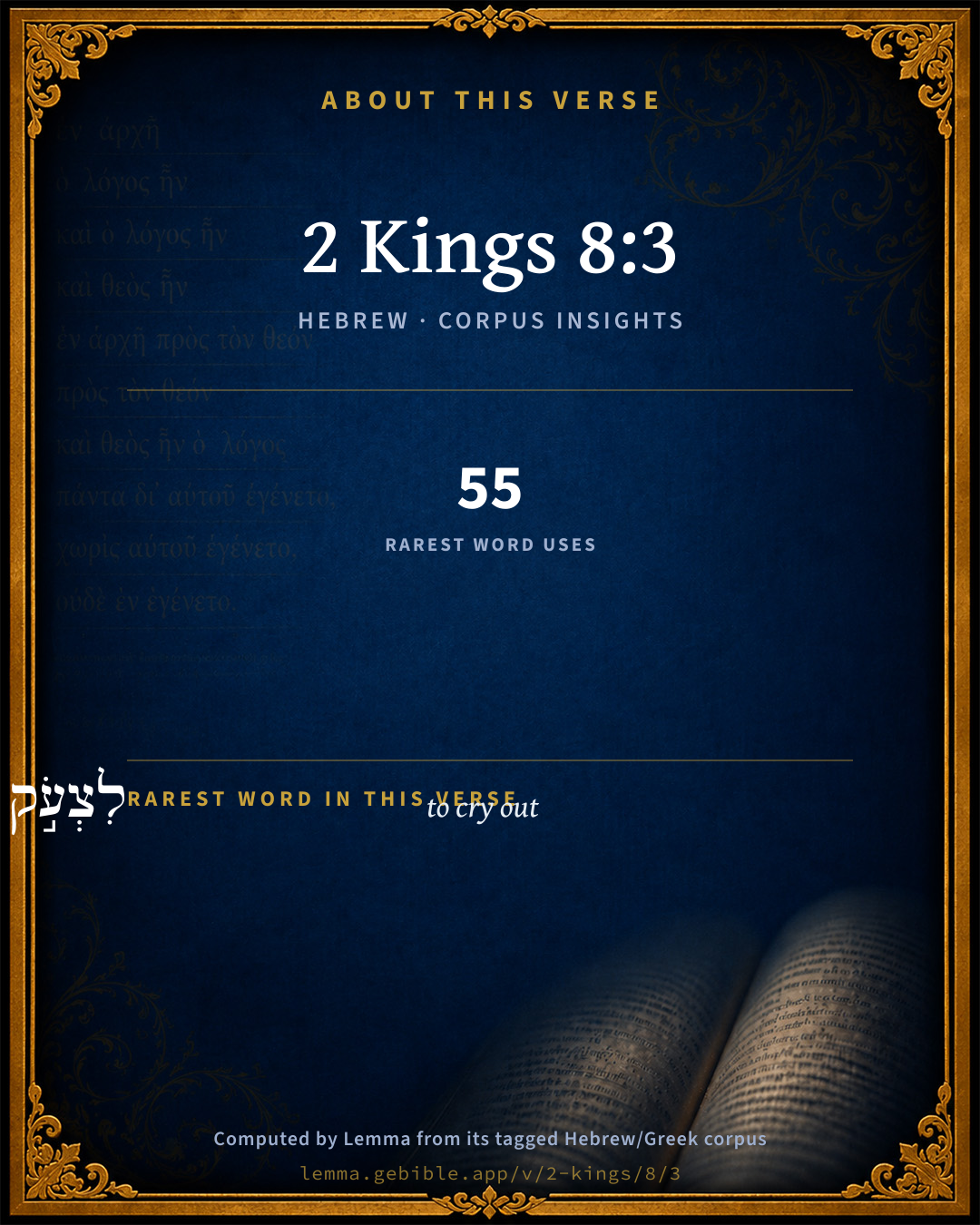
לִצְעֹ֣ק
tsâʻaq
H6817
“to cry out”
Preposition + Verb, Qal, Infinitive Construct
Part of Speech
Preposition + Verb
Stem
Qal
Form
Infinitive Construct
Full BDB Definition

Origin: a primitive root

TWOT: 1947

to cry, cry out, call, cry for help - (Qal) - to cry, cry out (for help) - to cry, cry out (in distress or need) - to make outcry, clamour - (Niphal) to be summoned - (Piel) to cry aloud (in grief) - (Hiphil) to call together
  1. וַיְהִ֗י hâyâh H1961 “and · to be” Conjunction + Verb, Qal, Sequential Imperfect, 3rd Person, Masculine, Singular
  2. מִקְצֵה֙ qâtseh H7097 “from · end of” Preposition + Noun, Common, Both, Singular, Construct
  3. שֶׁ֣בַע shebaʻ H7651 “seven” Adjective, Cardinal number, Feminine, Singular, Absolute
  4. שָׁנִ֔ים shâneh H8141 “years” Noun, Common, Feminine, Plural, Absolute
  5. וַתָּ֥שָׁב shûwb H7725 “and · to return” Conjunction + Verb, Qal, Sequential Imperfect, 3rd Person, Feminine, Singular
  6. הָאִשָּׁ֖ה ʼishshâh H802 “the · woman” Particle, Definite Article + Noun, Common, Feminine, Singular, Absolute
  7. מֵאֶ֣רֶץ ʼerets H776 “from · land of” Preposition + Noun, Common, Both, Singular, Construct
  8. פְּלִשְׁתִּ֑ים Pᵉlishtîy H6430 “Philistines” Noun, Gentilic, Masculine, Plural, Absolute
  9. וַתֵּצֵא֙ yâtsâʼ H3318 “and · to go out” Conjunction + Verb, Qal, Sequential Imperfect, 3rd Person, Feminine, Singular
  10. אֶל ʼêl H413 “to” Preposition
  11. הַמֶּ֔לֶךְ melek H4428 “the · king” Particle, Definite Article + Noun, Common, Masculine, Singular, Absolute
  12. אֶל ʼêl H413 “to” Preposition
  13. בֵּיתָ֖הּ bayith H1004 “house · her” Noun, Common, Masculine, Singular, Construct + Suffix, Personal, 3rd Person, Feminine, Singular
  14. וְאֶל ʼêl H413 “and · to” Conjunction + Preposition
  15. שָׂדָֽהּ sâdeh H7704 “field · her” Noun, Common, Masculine, Singular, Construct + Suffix, Personal, 3rd Person, Feminine, Singular

About this verse

These counts appear in no published source. They are computed here, from the morphology-tagged text and Lemma’s own curated glosses. What Lemma adds →

16
words
14
distinct lemmas
Historical
section

Shared distinctive vocabulary

לִצְעֹ֣ק to cry out H6817 occurs in 53 verses of the Hebrew Bible. Also found in:

Grammatical profile

  • 4 verbs
  • 8 nouns
  • 1 adjective
  • 3 prepositions

Verb forms

  • וַיְהִ֗י Qal · Sequential Imperfect
  • וַתָּ֥שָׁב Qal · Sequential Imperfect
  • וַתֵּצֵא֙ Qal · Sequential Imperfect
  • לִצְעֹ֣ק Qal · Infinitive Construct

Repetition

A word recurs within this verse — often emphatic in Hebrew:

  • אֶל to H413 ×3

Hebrew & Septuagint length

In English translation the verse runs 34 words from the Hebrew and 40 from the Septuagint (LXX English) — closely comparable.

A rough comparison of the two English renderings, which tokenize alike — not a word-level alignment.

Word counts can differ between the Hebrew and the Greek without any difference in meaning — e.g. the Hebrew direct-object marker אֵת has no separate Greek word, and Greek often adds the article ὁ.

Cross-references

7

Topical passages linked to 2 Kings 8:3 in the Treasury of Scripture Knowledge — connected by theme and wording, ordered by reader-vote popularity; previews shown in the World English Bible.

  • 2 Samuel 14:4 When the woman of Tekoa spoke to the king, she fell on her face to the ground, and did obeisance, and said, Help, O king.
  • 2 Kings 4:13 He said to him, Say now to her, Behold, you have been careful for us with all this care; what is to be done for you? would you be spoken for to the king, or to the captain of the host? She answered, I dwell among my own people.
  • 2 Kings 6:26 As the king of Israel was passing by on the wall, there cried a woman to him, saying, Help, my lord, O king.
  • 2 Kings 8:6 When the king asked the woman, she told him. So the king appointed to her a certain officer, saying, Restore all that was hers, and all the fruits of the field since the day that she left the land, even until now.
  • Psalms 82:3–4 "Defend the weak, the poor, and the fatherless. Maintain the rights of the poor and oppressed.
  • Jeremiah 22:16 He judged the cause of the poor and needy; then it was well. Wasn't this to know me? says Yahweh.
  • Luke 18:3–5 A widow was in that city, and she often came to him, saying, 'Defend me from my adversary!'

Cross-references courtesy of OpenBible.info (CC BY 4.0).

Hebrew and Greek witnesses Masoretic Hebrew ↔ Greek Septuagint

The same verse in the two great witnesses to the Old Testament, shown verse-for-verse.

These are two independent witnesses, not word-aligned to each other, and the Septuagint is shown in lemma (dictionary) form.

Hebrew 2 Kings 8:3 Masoretic · Westminster Leningrad Codex

וַיְהִ֗י מִקְצֵה֙ שֶׁ֣בַע שָׁנִ֔ים וַתָּ֥שָׁב הָאִשָּׁ֖ה מֵאֶ֣רֶץ פְּלִשְׁתִּ֑ים וַתֵּצֵא֙ לִצְעֹ֣ק אֶל הַמֶּ֔לֶךְ אֶל בֵּיתָ֖הּ וְאֶל שָׂדָֽהּ

It happened at the seven years' end, that the woman returned out of the land of the Philistines: and she went forth to cry to the king for her house and for her land.

World English Bible · Public Domain

Greek LXX 2 Kings 8:3 Septuagint · lemma form

καί γίγνομαι μετά ὁ τέλος ὁ ἑπτά ἔτος καί ἐπιστρέφω ὁ γυνή ἐκ γῆ ἀλλόφυλος εἰς ὁ πόλις καί ἔρχομαι βοάω πρός ὁ βασιλεύς περί ὁ οἶκος ἑαυτοῦ καί περί ὁ ἀγρός ἑαυτοῦ

And it came to pass after the expiration of the seven years, that the woman returned out of the land of the Philistines to the city; and came to cry to the king for her house and for her lands.

LXX2012 (modern English Septuagint) · Public Domain

Hebrew: Westminster Leningrad Codex (CC BY 4.0). Greek: Septuagint (public domain); English from LXX2012 (modern English Septuagint) (Public Domain). How the Septuagint differs from the Hebrew →

Targum (Aramaic paraphrase)

1

The Targum is the ancient Jewish Aramaic paraphrase of the Hebrew Scriptures — an interpretive translation, not the Hebrew text itself. Onkelos (literal) and Pseudo-Jonathan (expansive) render the Torah, and Jonathan the Prophets. Coverage is partial: where no permissively-licensed English translation exists for a verse, only the Aramaic is shown. This is verse-level text, not a word-by-word alignment to the Hebrew.

  1. Targum Jonathan Prophets (Joshua–Malachi)
    וַהֲוָה מִסוֹף שְׁבַע שְׁנִין וְתָבַת אִתְּתָא מֵאַרְעָא פְלִשְׁתָּאֵי וּנְפָקַת לְמִיקְבַּל קֳדָם מַלְכָּא עַל בֵּיתָהּ וְעַל חַקְלָהּ:

    (no public-domain English translation for this verse)

    Targum Jonathan — Aramaic: “Mikraot Gedolot” (public domain). English: “Sefaria Community Translation” (CC0 1.0 (public-domain dedication)); “London "Chaldee Paraphrase," 1871” (public domain). Text via Sefaria.

Commentary

Notes on 2 Kings 8:3 from classic Christian and Jewish commentators (each source and its license shown beneath its notes). The classic Christian expositions comment on the surrounding passage and are grouped to its opening verse, so a note may address several verses; the Jewish commentaries on the Tanakh (Rashi and others) are per-verse, so they appear only where the commentator wrote on this verse.

Lemma curates 59 commentaries, every one of them public domain or Creative Commons licensed, each selected and text-cleaned for this edition rather than reprinted as found. About our sources →

Trapp's Complete Commentary

John Trapp

2Ki 8:3 And it came to pass at the seven years’ end, that the woman returned out of the land of the Philistines: and she went forth to cry unto the king for her house and for her land.

Ver. 3. To cry unto the king for her house and for her land.] Which in her so long absence was seized on, either by the king’s officers, or by some of her kindred.

John Trapp, A Commentary or Exposition upon All the Books of the Old and New Testament (1647–1656) — public domain. Text from a community e-Sword module.

Joseph Benson's Commentary

2Ki 8:3. She went to cry unto the king for her house and land — Which, having been forsaken by her, were possessed by her kindred or others, who probably had obtained a grant of them from the king, and now intended to keep possession of them.

Joseph Benson's Commentary on the Old and New Testaments (1811–1818) — public domain. Text from a community e-Sword module.

Tyndale Open Study Notes

Tyndale Open Resources

8:3 getting back her house and land: Her property might have been held in trust or confiscated.

Tyndale Open Study Notes — © Tyndale Open Resources, licensed CC BY-SA 4.0. Text via the HelloAO Bible API.

Geneva Bible (1599)

Geneva Bible translators

That is, to complain on them which had taken her possessions while she was absent.

Geneva Bible (1599) marginal notes — public domain. Text via Bolls.life.

Jamieson, Fausset & Brown

Robert Jamieson, A. R. Fausset & David Brown

she went forth to cry unto the king for her house and for her land--In consequence of her long-continued absence from the country, her possessions were occupied by her kindred, or had been confiscated by the crown. No statute in the law of Moses ordained that alienation. But the innovation seems to have been adopted in Israel.

Jamieson, Fausset & Brown — Commentary Critical and Explanatory on the Whole Bible (1871) — public domain (CC PDM 1.0). Text via the HelloAO Bible API.

Ellicott's Commentary for English Readers

(3) At the seven years’ end.—Omit the.

She went forth.—From Shunem to Samaria.

For her house and for her land.—Literally, with regard to her house, &c. She found them in the possession of strangers. The State may have occupied the property as abandoned by its owner; or, as is more likely, some neighbouring landowner may have encroached upon her rights. She therefore appealed to the king.

A Bible Commentary for English Readers, edited by Charles John Ellicott (1878–1897) — public domain. Text from a community e-Sword module.

The Cambridge Bible for Schools and Colleges

gen. ed. J. J. S. Perowne

3. she went forth to cry unto the king] She had reached Shunem, and found her land in other hands. It may be that some encroaching neighbour had entered on the untenanted property, or it may have been seized for the king as being deserted of its owner. In either case the king is the person to be appealed to, and to the court she makes her way.

The Cambridge Bible for Schools and Colleges (gen. ed. J. J. S. Perowne; Cambridge University Press, 1878–1918) — public domain. Text from a community e-Sword module.

John Gill's Exposition

And it came to pass, at the seven years end, that the woman returned out of the land of the Philistines,.... Either hearing that the famine was over, or believing that it was, the time being expired the prophet fixed for it:

and she went forth to cry unto the king for her house, and for her land; which her nearest relations in her absence had seized upon, as heirs to them; or those in whose hands she had intrusted them refused, upon her return, to deliver them to her; or the king's officers had seized upon them for him, as forfeited to the crown by her going out of the land without leave; and now she needed a friend to speak for her to the king, which, in time past, she had no occasion for, and thought she never should, see Kg2 4:13.

John Gill's Exposition of the Whole Bible (1746–1763) — public domain (CC PDM 1.0). Text via the HelloAO Bible API.

Albert Barnes' Notes on the Bible

During the Shunammite’s absence in Philistia, her dwelling and her grain-fields had been appropriated by some one who refused to restore them. She therefore determined to appeal to the king. Such direct appeals are common in Oriental countries. Compare 2Ki 6:26; 2Sa 14:4; 1Ki 3:16.

Albert Barnes' Notes on the Bible (1834–1885) — public domain. Text from a community e-Sword/MySword module.

Haydock's Catholic Bible Commentary

Lands, which others had seized. (Du Hamel)

George Leo Haydock (1774–1849), Haydock's Catholic Family Bible and Commentary, 1859 edition — public domain. Excludes Psalms (Douay-Rheims chapter numbering differs from Protestant) and Deuterocanonical books (Catholic canon only).

Matthew Poole's English Annotations

Which having been forsaken by her, were possessed by her kindred, or others, who had obtained them from the king, and now intended to keep the possession of them.

Matthew Poole's English Annotations on the Holy Bible (1683–1685) — public domain. Text from a community e-Sword/MySword module.

Whedon's Commentary on the Bible

Daniel D. Whedon

3. To cry unto the king for her house — During her long absence others had taken possession of her house and land, but whether it had been seized by public authority or otherwise does not appear. See Thomson’s note below. From 2Ki_8:5 we learn that this woman’s son, whom Elisha had restored to life, accompanied her on this occasion.

Daniel D. Whedon (gen. ed.), Commentary on the Old and New Testaments (1874–1909) — public domain. Text from a community e-Sword module.

The Pulpit Commentary

And it earns to pass at the seven years" end, that the woman returned out of the land of the Philistines. She stayed no longer than she could help. Her own land, where she could have the ministrations of a "man of God", (2Ki_4:23) was dear to her; and no sooner had the famine abated than she returned to it. And she went forth to cry unto the king for her house and for her land. During her prolonged absence, some grasping neighbor had seized on the unoccupied house and the uncultivated estate adjoining it, and now refused to restore them to the rightful owner. Widows were especially liable to such treatment on the part of greedy oppressors, since they were, comparatively speaking, weak and defenseless. (see Isa_10:2 Mat_23:14) Under suchcircumstances the injured party would naturally, in an Oriental country, make appeal to the king. (comp. 2Sa_14:4; 1Ki_3:16; 2Ki_6:26, etc.)

The Pulpit Commentary (1880–1919), ed. H.D.M. Spence-Jones & Joseph S. Exell — public domain. Text from a community e-Sword module.

John Wesley's Explanatory Notes

Her house - Which having been forsaken by her, were possessed by her kindred.

John Wesley, Explanatory Notes Upon the Whole Bible (1754–1765) — public domain. Text via the GEBible commentary corpus.

Keil & Delitzsch

C. F. Keil & F. Delitzsch

When the woman returned to her home at the end of the seven years, she went to the king to cry, i.e., to invoke his help, with regard to her house and her field, of which, as is evident from the context, another had taken possession during her absence.

Keil & Delitzsch — Biblical Commentary on the Old Testament (1861–1891) — public domain (CC PDM 1.0). Text via the HelloAO Bible API. (Old Testament only.)

unfoldingWord translationNotes

Door43 World Missions Community

to the king

This refers to the king of Israel.

for her house and for her land

While the woman was gone, her home and property were sieged. She is begging for them to be returned to her. The full meaning of this statement can be made clear. AT: "for her home and her property to be returned to her" (See: Assumed Knowledge and Implicit Information)

Now

This word is used here to mark a break in the main story line. Here the author tells us background information about what the king was doing when the woman arrived. (See: Background Information)

translationWords

king

servant

unfoldingWord translationNotes — © Distant Shores Media and the Door43 World Missions Community, licensed CC BY-SA 4.0. Source: git.door43.org/Door43/en_tn.

Rashi

Rabbi Shlomo Yitzchaki (Rashi)

About her house and her field. Which robbers had occupied.

Rashi on the Tanakh — English translations: “The Judaica Press complete Tanach with Rashi, translated by A. J. Rosenberg” (CC BY 4.0); “Pentateuch with Rashi's commentary by M. Rosenbaum and A.M. Silbermann, 1929-1934” (public domain); “The Metsudah Tanach series, Lakewood, N.J” (CC BY 4.0); and “The Book of Joshua, Metsudah Publications, 1997” (CC BY 4.0). Text via Sefaria.

Lesson kit

Teaching starters — assembled from the data on this page, not authored interpretation. Every prompt links to the verse data it draws on. Edit before teaching.

2 Kings, in the Historical, opens this verse with 16 words (14 distinct Hebrew lemmas). Its most distinctive word is tsâʻaq (“to cry out”). A historical commentator’s framing appears above. Read the whole chapter for the surrounding context.

Discussion questions

  1. The word tsâʻaq carries the sense “to cry out.” How does it shape the verse?
  2. How does Genesis 4:10, which shares the word «to cry out», read alongside this verse?
  3. What does the repetition of “to” (3× in this one verse) do in this verse?
  4. These translations render this verse differently; the difference is in the English rendering, not the original. What questions does that raise?
  5. «וַיְהִ֗י» is a Qal Sequential Imperfect verb. How does that grammatical form shape the action described?
  6. Compare how Trapp's Complete Commentary and Joseph Benson's Commentary read this verse. Where do they agree or differ?

Things to notice

Reading settings

Reading text

Shown beneath each verse's original-language words.

Old Testament
Old Testament edition

Read the OT as the Masoretic Hebrew (MT) or the Greek Septuagint (LXX).

English shown for the Greek Septuagint (in the Hebrew ↔ Greek comparison).

Comparing translations? Open the Compare panel on any verse page to stack up to four side by side.