1 Samuel 27:7

Hebrew (Westminster Leningrad Codex) 1 Samuel 27:7 appears in the Hebrew Old Testament. The text above is from the Westminster Leningrad Codex. Each word links to its Strong’s number, a concise gloss, and parsing drawn from the Open Scriptures Hebrew Bible morphology. Click any word for its full Brown-Driver-Briggs (BDB) entry.
Download image
Cite this verse

1 Samuel 27:7 (World English Bible). Public Domain. Lemma interlinear Bible study tool, https://lemma.gebible.app/v/1-samuel/27/7.

Show BibTeX & RIS
BibTeX
RIS
English Translation
The number of the days that David lived in the country of the Philistines was a full year and four months.
World English Bible · Public Domain
Download a study sheet

One document with this verse’s original text, its word-by-word gloss line, the meaning frame, cross-references with their text, attributed commentary, and full source and license credits — printable, and it pastes into notes with its structure intact.

This verse Autodidact and up

Study sheet (.html) Plain text (.txt)

A passage Seminary Student

Up to 50 verses in one chapter. A passage sheet keeps up to 6 commentary sources and 12 cross-references per verse, in the order this page ranks them, and says so on the sheet whenever that leaves anything out. Ask for a single verse and you get the Autodidact verse sheet above.

Everything on this page stays free to read, with no account — the sheet is a download of what is already on screen, not access to it.

Want to remove ads? Support Godless Engineer
Compare translations 3

The same verse in 3 English versions, stacked beneath the original-language interlinear above. Click any original word for its lexicon entry.

Each is an independent rendering of the whole verse — the interlinear is not word-aligned to these translations.

Highlighted words mark where these versions differ — a whole-verse word diff, not a word-by-word alignment.

  • World English Bible Public Domain
    The number of the days that David lived in the country of the Philistines was a full year and four months.
  • King James Version Public Domain
    And the time that David dwelt in the country of the Philistines was a full year and four months.
  • unfoldingWord Literal Text CC BY-SA 4.0
    And the number of the days that David dwelled in the field of the Philistines was days and four months.

unfoldingWord Literal Text — © unfoldingWord, licensed CC BY-SA 4.0. Word-aligned USFM3 via Door43 (git.door43.org/unfoldingWord/en_ult).

Versions to compare (up to 4)

3 of 4 selected

Show all 18 translations

Every available English version of this verse, each an independent rendering of the whole verse.

  • World English Bible Public Domain
    The number of the days that David lived in the country of the Philistines was a full year and four months.
  • Berean Standard Bible Public Domain
    And the time that David lived in Philistine territory amounted to a year and four months.
  • Majority Standard Bible Public Domain
    And the time that David lived in Philistine territory amounted to a year and four months.
  • King James Version Public Domain
    And the time that David dwelt in the country of the Philistines was a full year and four months.
  • American Standard Version (1901) Public Domain
    And the number of the days that David dwelt in the country of the Philistines was a full year and four months.
  • Revised Version (1885) Public Domain
    And the number of the days that David dwelt in the country of the Philistines was a full year and four months.
  • Geneva Bible (1599) Public Domain
    And the time that Dauid dwelt in the countrey of the Philistims, was foure moneths and certaine dayes.
  • Douay-Rheims (1899) Public Domain
    And the time that David dwelt in the country of the Philistines, was four months.
  • Young's Literal Translation Public Domain
    And the number of the days which David hath dwelt in the field of the Philistines `is' days and four months;
  • Literal Standard Version CC BY-SA 4.0
    And the number of the days which David has dwelt in the field of the Philistines [is one year] of days and four months;
  • Unlocked Literal Bible CC BY-SA 4.0
    The number of days that David lived in the land of the Philistines was a full year and four months.
  • unfoldingWord Literal Text CC BY-SA 4.0
    And the number of the days that David dwelled in the field of the Philistines was days and four months.
  • Darby Bible Public Domain
    And the time that David abode in the country of the Philistines was a year and four months.
  • World Messianic Bible Public Domain
    The number of the days that David lived in the country of the Philistines was a full year and four months.
  • Webster's Bible Public Domain
    And the time that David dwelt in the country of the Philistines was a full year and four months.
  • Free Bible Version CC BY-SA 4.0
    David lived in the country of the Philistines for a year and four months.
  • Bible in Basic English Public Domain
    And David was living in the land of the Philistines for the space of a year and four months.
  • JPS Tanakh (1917) Public Domain
    And the number of the days that David dwelt in the country of the Philistines was a full year and four months.

Literal Standard Version (2020), Covenant Press — licensed CC BY-SA 4.0. Text via the HelloAO Bible API (eBible.org). Unlocked Literal Bible (unfoldingWord) — licensed CC BY-SA 4.0. Text via the HelloAO Bible API (eBible.org). unfoldingWord Literal Text — © unfoldingWord, licensed CC BY-SA 4.0. Word-aligned USFM3 via Door43 (git.door43.org/unfoldingWord/en_ult). Free Bible Version, Dr. Jonathan Gallagher — licensed CC BY-SA 4.0. Text via the HelloAO Bible API (eBible.org).

Word by word

More ways to search: Search by grammar → Find every occurrence → Compare this word →

Practice this passage: Drill this verse → Learn its vocabulary →

מִסְפַּ֣ר
miçpâr
H4557
“number of”
Noun, Common, Masculine, Singular, Construct
Part of Speech
Noun
Type
Common
Gender
Masculine
Number
Singular
State
Construct
Full BDB Definition

Origin: from H5608

TWOT: 1540e

number, tale - number - number - innumerable (with negative) - few, numerable (alone) - by count, in number, according to number (with preposition) - recounting, relation
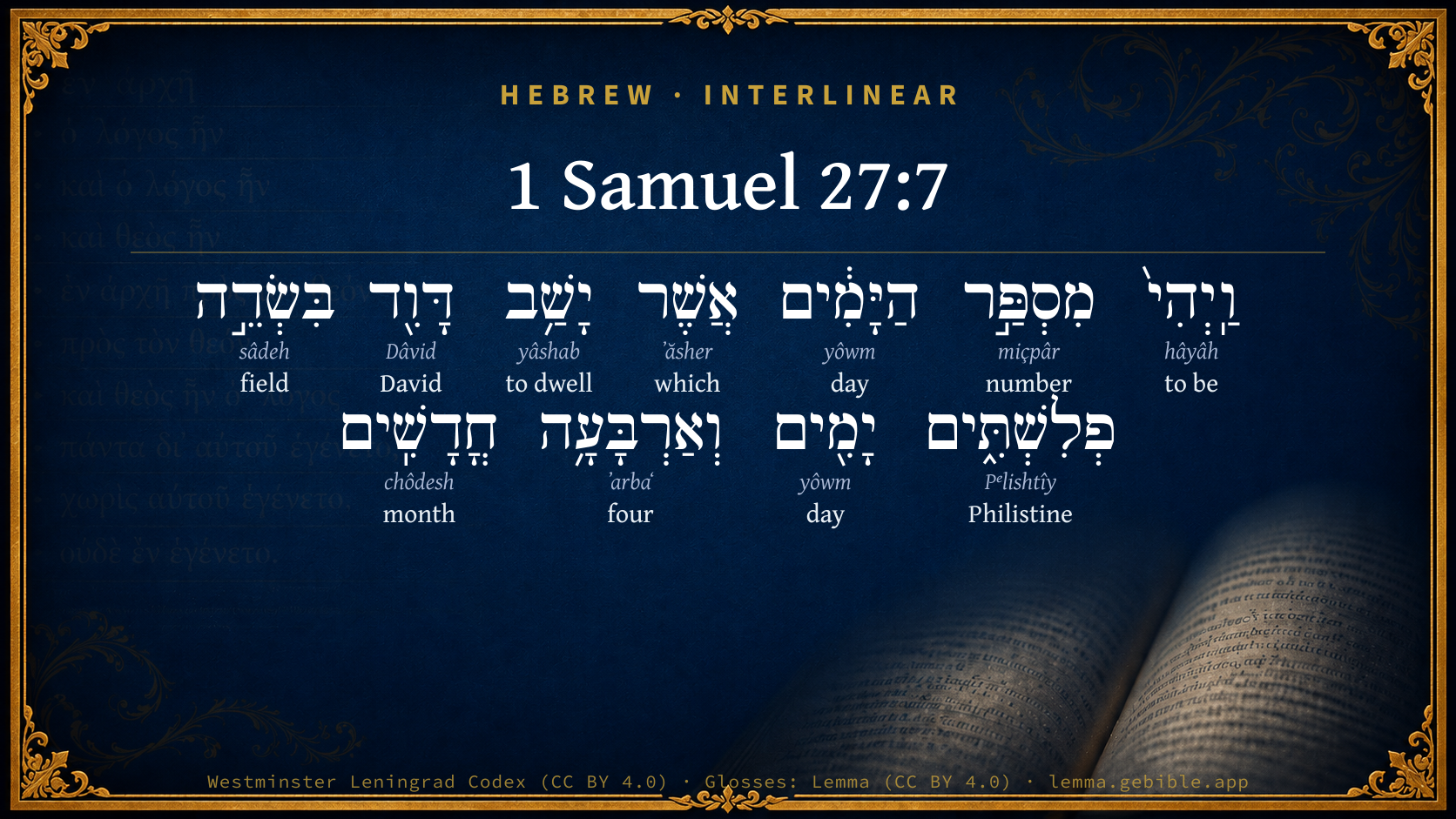
  1. וַֽיְהִי֙ hâyâh H1961 “and · to be” Conjunction + Verb, Qal, Sequential Imperfect, 3rd Person, Masculine, Singular
  2. הַיָּמִ֔ים yôwm H3117 “the · days” Particle, Definite Article + Noun, Common, Masculine, Plural, Absolute
  3. אֲשֶׁר ʼăsher H834 “which” Particle, Relative
  4. יָשַׁ֥ב yâshab H3427 “to dwell” Verb, Qal, Perfect, 3rd Person, Masculine, Singular
  5. דָּוִ֖ד Dâvid H1732 “David” Noun, Proper
  6. בִּשְׂדֵ֣ה sâdeh H7704 “in/at · field of” Preposition + Noun, Common, Masculine, Singular, Construct
  7. פְלִשְׁתִּ֑ים Pᵉlishtîy H6430 “Philistines” Noun, Gentilic, Masculine, Plural, Absolute
  8. יָמִ֖ים yôwm H3117 “days” Noun, Common, Masculine, Plural, Absolute
  9. וְאַרְבָּעָ֥ה ʼarbaʻ H702 “and · four” Conjunction + Adjective, Cardinal number, Masculine, Singular, Absolute
  10. חֳדָשִֽׁים chôdesh H2320 “months” Noun, Common, Masculine, Plural, Absolute

About this verse

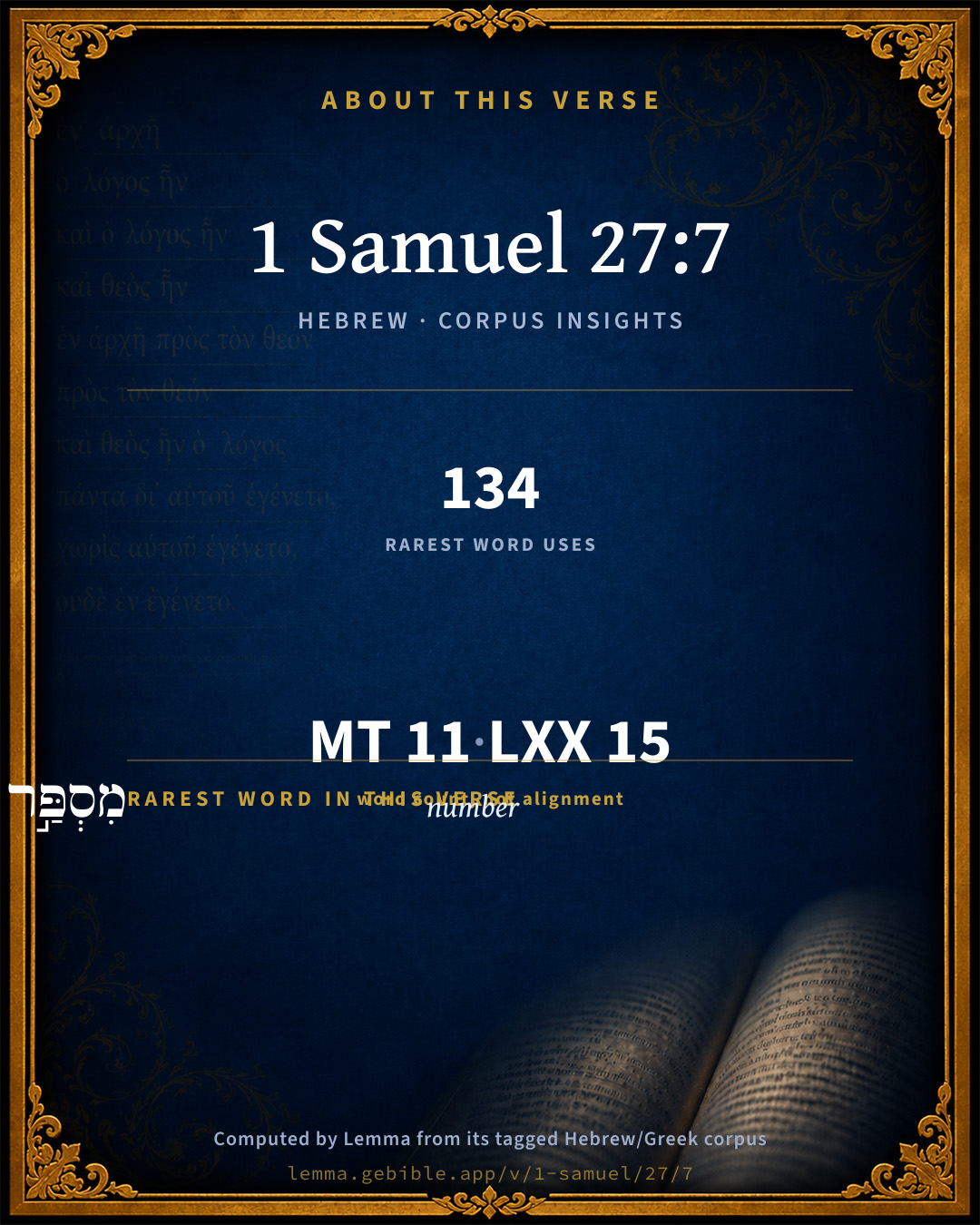
These counts appear in no published source. They are computed here, from the morphology-tagged text and Lemma’s own curated glosses. What Lemma adds →

11
words
10
distinct lemmas
Historical
section

Grammatical profile

  • 2 verbs
  • 7 nouns
  • 1 adjective
  • 1 particle

Verb forms

  • וַֽיְהִי֙ Qal · Sequential Imperfect
  • יָשַׁ֥ב Qal · Perfect

Repetition

A word recurs within this verse — often emphatic in Hebrew:

  • הַיָּמִ֔ים day H3117 ×2

Hebrew & Septuagint length

In English translation the verse runs 21 words from the Hebrew and 18 from the Septuagint (LXX English) — closely comparable.

A rough comparison of the two English renderings, which tokenize alike — not a word-level alignment.

Word counts can differ between the Hebrew and the Greek without any difference in meaning — e.g. the Hebrew direct-object marker אֵת has no separate Greek word, and Greek often adds the article ὁ.

In the original languages it is 11 Hebrew tokens and 15 Greek tokens — but the two are counted differently (Hebrew bundles its prefixes and suffixes into one token; the Greek is in lemma form), so that isn’t a like-for-like length.

Cross-references

1

Topical passages linked to 1 Samuel 27:7 in the Treasury of Scripture Knowledge — connected by theme and wording, ordered by reader-vote popularity; previews shown in the World English Bible.

  • 1 Samuel 29:3 Then said the princes of the Philistines, What [do] these Hebrews [here]? Achish said to the princes of the Philistines, Isn't this David, the servant of Saul the king of Israel, who has been with me these days, or [rather] these years, and I have found no fault in him since he fell away [to me] to this day?

Cross-references courtesy of OpenBible.info (CC BY 4.0).

Hebrew and Greek witnesses Masoretic Hebrew ↔ Greek Septuagint

The same verse in the two great witnesses to the Old Testament, shown verse-for-verse.

These are two independent witnesses, not word-aligned to each other, and the Septuagint is shown in lemma (dictionary) form.

Hebrew 1 Samuel 27:7 Masoretic · Westminster Leningrad Codex

וַֽיְהִי֙ מִסְפַּ֣ר הַיָּמִ֔ים אֲשֶׁר יָשַׁ֥ב דָּוִ֖ד בִּשְׂדֵ֣ה פְלִשְׁתִּ֑ים יָמִ֖ים וְאַרְבָּעָ֥ה חֳדָשִֽׁים

The number of the days that David lived in the country of the Philistines was a full year and four months.

World English Bible · Public Domain

Greek LXX 1 Samuel 27:7 Septuagint · lemma form

καί γίγνομαι ὁ ἀριθμός ὁ ἡμέρα ὅς καταἵζω δαυίδ ἐν ἀγρός ὁ ἀλλόφυλος τέσσαρες μήν

And the number of the days that David lived in the country of the Philistines was four months.

LXX2012 (modern English Septuagint) · Public Domain

On this verse, John Gill's Exposition discusses the Septuagint’s reading. Read the note in Commentary ↓

Hebrew: Westminster Leningrad Codex (CC BY 4.0). Greek: Septuagint (public domain); English from LXX2012 (modern English Septuagint) (Public Domain). How the Septuagint differs from the Hebrew →

Targum (Aramaic paraphrase)

1

The Targum is the ancient Jewish Aramaic paraphrase of the Hebrew Scriptures — an interpretive translation, not the Hebrew text itself. Onkelos (literal) and Pseudo-Jonathan (expansive) render the Torah, and Jonathan the Prophets. Coverage is partial: where no permissively-licensed English translation exists for a verse, only the Aramaic is shown. This is verse-level text, not a word-by-word alignment to the Hebrew.

  1. Targum Jonathan Prophets (Joshua–Malachi)
    וַהֲוָה מִנְיַן יוֹמַיָא דִיתֵיב דָוִד בְּקִרְוֵי פְלִשְׁתָּאֵי יוֹמִין עִדַן בְּעִדַן וְאַרְבְּעָא יַרְחִין:

    (no public-domain English translation for this verse)

    Targum Jonathan — Aramaic: “Mikraot Gedolot” (public domain). English: “Sefaria Community Translation” (CC0 1.0 (public-domain dedication)); “London "Chaldee Paraphrase," 1871” (public domain). Text via Sefaria.

Commentary

Notes on 1 Samuel 27:7 from classic Christian and Jewish commentators (each source and its license shown beneath its notes). The classic Christian expositions comment on the surrounding passage and are grouped to its opening verse, so a note may address several verses; the Jewish commentaries on the Tanakh (Rashi and others) are per-verse, so they appear only where the commentator wrote on this verse.

Lemma curates 59 commentaries, every one of them public domain or Creative Commons licensed, each selected and text-cleaned for this edition rather than reprinted as found. About our sources →

Trapp's Complete Commentary

John Trapp

1Sa 27:7 And the time that David dwelt in the country of the Philistines was a full year and four months.

Ver. 7. A full year and four months,] viz., Till Saul’s death, and about two years after Samuel’s death.

John Trapp, A Commentary or Exposition upon All the Books of the Old and New Testament (1647–1656) — public domain. Text from a community e-Sword module.

Geneva Bible (1599)

Geneva Bible translators

Hebrew, the number of the days.

Geneva Bible (1599) marginal notes — public domain. Text via Bolls.life.

Ellicott's Commentary for English Readers

(7) A full year and four months.—Keil calls attention to the exact statement of time here as a proof of the historical character of the whole narrative. The Hebrew expression, translated “a year,” is a singular one: yamim—literally, days—a collective term, used in Lev_25:29, 1Sa_1:3; 1Sa_2:19, &c., to signify a term or period of days which amounted to a full year. This year and four months were among the darkest days of David’s life. He was sorely tried, it is true; but he had adopted the very course his bitterest foes would have wished him to select. In open arms, apparently leagued with the deadliest foes of Israel, like an Italian condottiere or captain of free lances of the Middle Ages, he had taken service and accepted the wages of that very Philistine city whose champion he once had slain in the morning of his career. At last his enemies at the court of Saul had reason when they spoke of him as a traitor. From the curt recital in this chapter, which deals with the saddest portion of David’s career, we shall see that while he apparently continued to make common cause with the enemies of his race, he still used his power to help, and not to injure, his countrymen; but the price he paid for his patriotism was a life of falsehood, stained, too, with deeds of fierce cruelty, shocking even in these rough, half-barbarous times.

A Bible Commentary for English Readers, edited by Charles John Ellicott (1878–1897) — public domain. Text from a community e-Sword module.

The Cambridge Bible for Schools and Colleges

gen. ed. J. J. S. Perowne

7. a full year and four months] The Sept. reading “four months” is improbable, though the Heb. might be rendered “a space of time, even four months.” Ch. 1Sa_29:3 implies a much longer residence. “In this city David laid the foundation of his kingdom. Here he could already rule with greater freedom and independence, collect fugitives and deserters around him in larger and larger numbers, send or receive embassies like a prince (1Sa_30:26-31), and as a ruler over soldiers and peaceable citizens rehearse, on a small scale, those arts by which he afterwards acquired and maintained his great kingdom.” Ewald, Hist. of Israel, III. 101. Here a band of archers and slingers from Saul’s own tribe joined him, together with men from the southern towns of Judah, and from Manasseh (1Ch_12:1-7; 1Ch_12:20-22).

The Cambridge Bible for Schools and Colleges (gen. ed. J. J. S. Perowne; Cambridge University Press, 1878–1918) — public domain. Text from a community e-Sword module.

John Gill's Exposition

And the time that David dwelt in the country of the Philistines,.... At Gath and Ziklag:

was a full year and four months; or "days and four months"; days being sometimes put for a year, Jdg 17:10; though some interpret it not of a year, but of some few days out of the fifth month, besides the four months; so Jarchi and Kimchi; and Josephus (h) makes his abode to be four months and twenty days; but, according to the Septuagint and Vulgate Latin versions, it was only four months; and so it may be rendered, "days, that is, four months"; for according to the Jewish chronology (i) Samuel died four months before Saul, and this flight of David was after the death of Samuel, and when Saul died he left the land of the Philistines, and took the throne of Judah; See Gill on Sa1 25:1.

(h) Antiqu. l. 6. c. 13. sect. 10. (i) Sepher Olam Rabba c. 13. p. 37.

John Gill's Exposition of the Whole Bible (1746–1763) — public domain (CC PDM 1.0). Text via the HelloAO Bible API.

Haydock's Catholic Bible Commentary

Months. Hebrew, "days and four months." The former expression denotes a year; though some would have it, that David remained "four months and a few days" in the country. He probably continued so many months at Geth, (ver. 9, 11,) and about a year at Siceleg. (Calmet) --- Septuagint have "days, four months;" and Salien adopts that term. (Haydock) See chap. xxix. 3. (Du Hamel)

George Leo Haydock (1774–1849), Haydock's Catholic Family Bible and Commentary, 1859 edition — public domain. Excludes Psalms (Douay-Rheims chapter numbering differs from Protestant) and Deuterocanonical books (Catholic canon only).

Matthew Poole's English Annotations

Heb. days and four months; days being put for a year; as Lev 25:29. Or, some days and four months, i.e. some days above four months. Or, some days and (for even, or that is, the conjunction and being oft so used, as hath been proved above) four months.

Matthew Poole's English Annotations on the Holy Bible (1683–1685) — public domain. Text from a community e-Sword/MySword module.

Whedon's Commentary on the Bible

Daniel D. Whedon

7. A full year and four months — This doubtless gives the true sense of the Hebrew, which is, literally, days and four months. The Septuagint and Vulgate render: The number of days which David dwelt in the country of the Philistines was four months. Josephus has four months and twenty days. The confusion seems to have come from misapprehension of the idiomatic use of ימים in the sense of a year. While David abode at Ziklag he was reinforced by multitudes from the land of Israel. See at 1Ch_12:1-22.

Daniel D. Whedon (gen. ed.), Commentary on the Old and New Testaments (1874–1909) — public domain. Text from a community e-Sword module.

The Pulpit Commentary

A full year. Hebrew, "days." Rashi argues in favour of its meaning some days, and Josephus says the time of David"s stay in Philistia was "four months and twenty days;" but already in 1Sa_1:3 1Sa_2:19, we have had the phrase "from days day-ward in the sense of yearly, and Lev_25:29; Jud_1:17:10; also Jdg_19:2, where the A.V translates the Hebrew days four months as meaning "four months" only. Probably, as here, it is a year and four months, though the omission of the conjunction is a difficulty. So too for "after a time" (Jud_1:14:8) it should be "after a year Hebrew, after days.

The Pulpit Commentary (1880–1919), ed. H.D.M. Spence-Jones & Joseph S. Exell — public domain. Text from a community e-Sword module.

Rashi

Rabbi Shlomo Yitzchaki (Rashi)

Days and four months. The minimum [number] of days is two. It is impossible to explain this word, 'יָמִים' as a year because Dovid did not go to Achish until Shmuel had died, and Shaul only reigned after Shmuel's death four months, as we learned in Seder Olam. Also [this can be deduced from the following:] the number of Eili's years [forty years which he judged Yisroel], and the twenty years that the Ark was in Kiryas Ye'arim total sixty years. Subtract from that Shmuel's fifty-two years, plus one year from his conception, with these four months, plus the seven years which Dovid reigned in Chevron before he brought the Ark from Kiryas Ye'arim. This [calculation] discloses that Shaul reigned after Shmuel's death but four months.

Rashi on the Tanakh — English translations: “The Judaica Press complete Tanach with Rashi, translated by A. J. Rosenberg” (CC BY 4.0); “Pentateuch with Rashi's commentary by M. Rosenbaum and A.M. Silbermann, 1929-1934” (public domain); “The Metsudah Tanach series, Lakewood, N.J” (CC BY 4.0); and “The Book of Joshua, Metsudah Publications, 1997” (CC BY 4.0). Text via Sefaria.

Lesson kit

Teaching starters — assembled from the data on this page, not authored interpretation. Every prompt links to the verse data it draws on. Edit before teaching.

1 Samuel, in the Historical, opens this verse with 11 words (10 distinct Hebrew lemmas). Its most distinctive word is miçpâr (“number”). A historical commentator’s framing appears above. Read the whole chapter for the surrounding context.

Discussion questions

  1. How does “number” (miçpâr) shape what this verse is saying?
  2. 1 Samuel 29:3 shares this passage’s theme. How do the two illuminate each other?
  3. “day” occurs 2× in this one verse. What is the effect of the repetition?
  4. These translations render this verse differently. What is at stake in choosing one wording over another?
  5. The verb «וַֽיְהִי֙» is Qal Sequential Imperfect. How does its form color the action?
  6. Reading how Trapp's Complete Commentary and Geneva Bible (1599) read this verse, where do the two commentators agree and where do they part?

Things to notice

Reading settings

Reading text

Shown beneath each verse's original-language words.

Old Testament
Old Testament edition

Read the OT as the Masoretic Hebrew (MT) or the Greek Septuagint (LXX).

English shown for the Greek Septuagint (in the Hebrew ↔ Greek comparison).

Comparing translations? Open the Compare panel on any verse page to stack up to four side by side.