

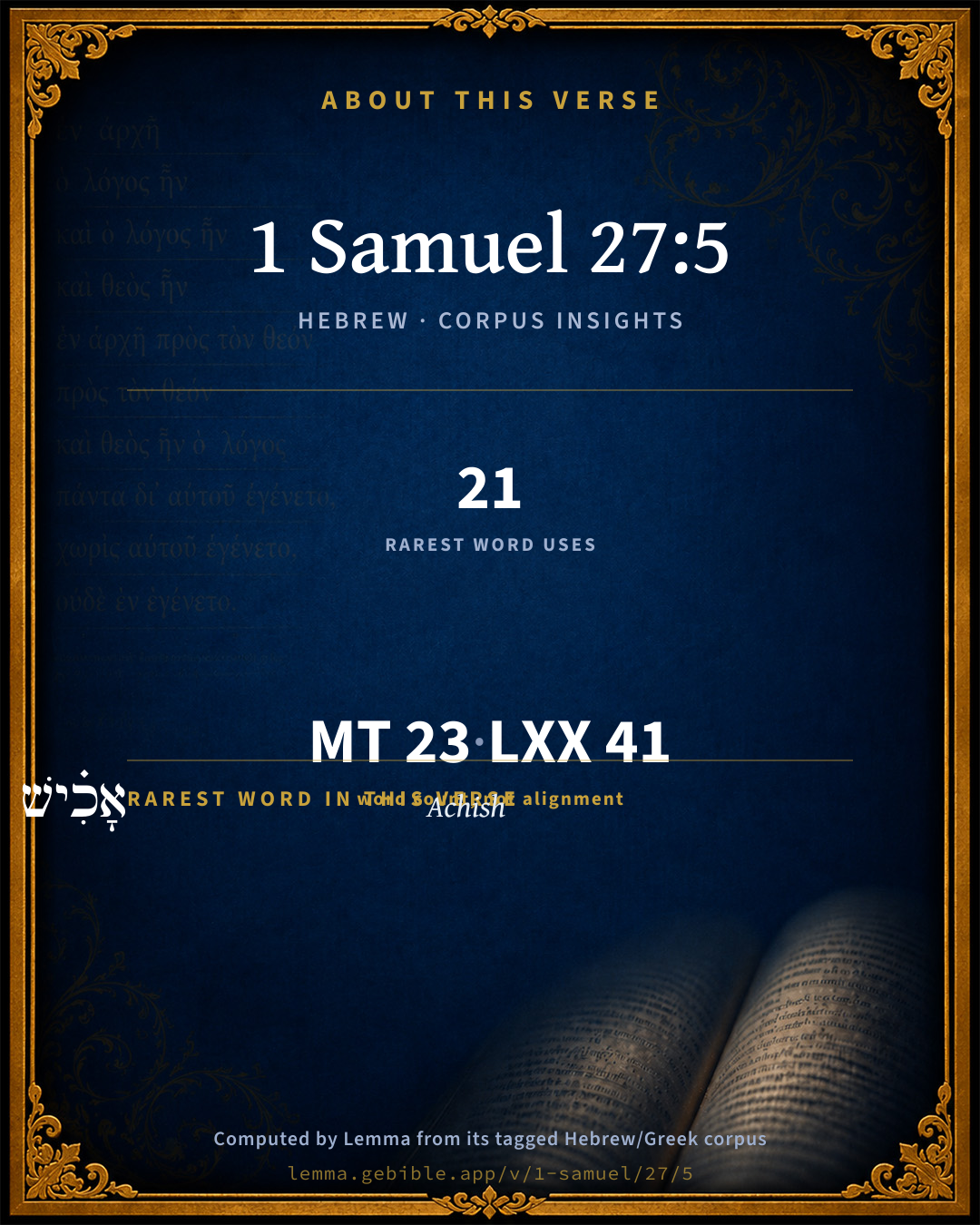
1 Samuel 27:5

Hebrew (Westminster Leningrad Codex) 1 Samuel 27:5 appears in the Hebrew Old Testament. The text above is from the Westminster Leningrad Codex. Each word links to its Strong’s number, a concise gloss, and parsing drawn from the Open Scriptures Hebrew Bible morphology. Click any word for its full Brown-Driver-Briggs (BDB) entry.
Download image
Cite this verse

1 Samuel 27:5 (World English Bible). Public Domain. Lemma interlinear Bible study tool, https://lemma.gebible.app/v/1-samuel/27/5.

Show BibTeX & RIS
BibTeX
RIS
English Translation
David said to Achish, If now I have found favor in your eyes, let them give me a place in one of the cities in the country, that I may dwell there: for why should your servant dwell in the royal city with you?
World English Bible · Public Domain
Download a study sheet

One document with this verse’s original text, its word-by-word gloss line, the meaning frame, cross-references with their text, attributed commentary, and full source and license credits — printable, and it pastes into notes with its structure intact.

This verse Autodidact and up

Study sheet (.html) Plain text (.txt)

A passage Seminary Student

Up to 50 verses in one chapter. A passage sheet keeps up to 6 commentary sources and 12 cross-references per verse, in the order this page ranks them, and says so on the sheet whenever that leaves anything out. Ask for a single verse and you get the Autodidact verse sheet above.

Everything on this page stays free to read, with no account — the sheet is a download of what is already on screen, not access to it.

Want to remove ads? Support Godless Engineer
Compare translations 3

The same verse in 3 English versions, stacked beneath the original-language interlinear above. Click any original word for its lexicon entry.

Each is an independent rendering of the whole verse — the interlinear is not word-aligned to these translations.

Highlighted words mark where these versions differ — a whole-verse word diff, not a word-by-word alignment.

  • World English Bible Public Domain
    David said to Achish, If now I have found favor in your eyes, let them give me a place in one of the cities in the country, that I may dwell there: for why should your servant dwell in the royal city with you?
  • King James Version Public Domain
    And David said unto Achish, If I have now found grace in thine eyes, let them give me a place in some town in the country, that I may dwell there: for why should thy servant dwell in the royal city with thee?
  • unfoldingWord Literal Text CC BY-SA 4.0
    And David said to Achish, “Please, if I have found favor in your eyes, may they give to me a place in one of the cities of the field, and let me dwell there. For why should your servant dwell in the city of the kingship with you?”

unfoldingWord Literal Text — © unfoldingWord, licensed CC BY-SA 4.0. Word-aligned USFM3 via Door43 (git.door43.org/unfoldingWord/en_ult).

Versions to compare (up to 4)

3 of 4 selected

Show all 18 translations

Every available English version of this verse, each an independent rendering of the whole verse.

  • World English Bible Public Domain
    David said to Achish, If now I have found favor in your eyes, let them give me a place in one of the cities in the country, that I may dwell there: for why should your servant dwell in the royal city with you?
  • Berean Standard Bible Public Domain
    Then David said to Achish, “If I have found favor in your eyes, let me be assigned a place in one of the outlying towns, so I can live there. For why should your servant live in the royal city with you?”
  • Majority Standard Bible Public Domain
    Then David said to Achish, “If I have found favor in your eyes, let me be assigned a place in one of the outlying towns, so I can live there. For why should your servant live in the royal city with you?”
  • King James Version Public Domain
    And David said unto Achish, If I have now found grace in thine eyes, let them give me a place in some town in the country, that I may dwell there: for why should thy servant dwell in the royal city with thee?
  • American Standard Version (1901) Public Domain
    And David said unto Achish, If now I have found favor in thine eyes, let them give me a place in one of the cities in the country, that I may dwell there: for why should thy servant dwell in the royal city with thee?
  • Revised Version (1885) Public Domain
    And David said unto Achish, If now I have found grace in thine eyes, let them give me a place in one of the cities in the country, that I may dwell there: for why should thy servant dwell in the royal city with thee?
  • Geneva Bible (1599) Public Domain
    And Dauid saide vnto Achish, If I haue nowe founde peace in thine eyes, let them giue me a place in some other citie of the countrey, that I may dwell there: for why should thy seruant dwel in ye head citie of the kingdome with thee?
  • Douay-Rheims (1899) Public Domain
    And David said to Achis: If I have found favour in thy sight, let a place be given me in one of the cities of this country, that I may dwell there: for why should thy servant dwell in the royal city with thee?
  • Young's Literal Translation Public Domain
    And David saith unto Achish, `If, I pray thee, I have found grace in thine eyes, they give to me a place in one of the cities of the field, and I dwell there, yea, why doth thy servant dwell in the royal city with thee?'
  • Literal Standard Version CC BY-SA 4.0
    And David says to Achish, “Now if I have found grace in your eyes, they give a place to me in one of the cities of the field, and I dwell there, indeed, why does your servant dwell in the royal city with you?”
  • Unlocked Literal Bible CC BY-SA 4.0
    David said to Achish, “If I have found favor in your eyes, let them give me a place in one of the cities in the country, that I may live there. Why should your servant live in the royal city with you?”
  • unfoldingWord Literal Text CC BY-SA 4.0
    And David said to Achish, “Please, if I have found favor in your eyes, may they give to me a place in one of the cities of the field, and let me dwell there. For why should your servant dwell in the city of the kingship with you?”
  • Darby Bible Public Domain
    And David said to Achish, If now I have found favour in thine eyes, let them give me a place in some country-town, that I may abide there; for why should thy servant abide in the royal city with thee?
  • World Messianic Bible Public Domain
    David said to Achish, “If now I have found favor in your eyes, let them give me a place in one of the cities in the country, that I may dwell there. For why should your servant dwell in the royal city with you?”
  • Webster's Bible Public Domain
    And David said to Achish, If I have now found grace in thy eyes, let them give me a place in some town in the country, that I may dwell there: for why should thy servant dwell in the royal city with thee?
  • Free Bible Version CC BY-SA 4.0
    David said to Achish, “Please do me a favor: assign me somewhere in one of the towns in the countryside so I can live there. I, your servant, don't really deserve to live in the royal city with you.”
  • Bible in Basic English Public Domain
    Then David said to Achish, If now I have grace in your eyes, let me have a place in one of the smaller towns of your land, to be my living-place; for it is not right for your servant to be living with you in the king's town.
  • JPS Tanakh (1917) Public Domain
    And David said unto Achish: 'If now I have found favour in thine eyes, let them give me a place in one of the cities in the country, that I may dwell there; for why should thy servant dwell in the royal city with thee?'

Literal Standard Version (2020), Covenant Press — licensed CC BY-SA 4.0. Text via the HelloAO Bible API (eBible.org). Unlocked Literal Bible (unfoldingWord) — licensed CC BY-SA 4.0. Text via the HelloAO Bible API (eBible.org). unfoldingWord Literal Text — © unfoldingWord, licensed CC BY-SA 4.0. Word-aligned USFM3 via Door43 (git.door43.org/unfoldingWord/en_ult). Free Bible Version, Dr. Jonathan Gallagher — licensed CC BY-SA 4.0. Text via the HelloAO Bible API (eBible.org).

Word by word

More ways to search: Search by grammar → Find every occurrence → Compare this word →

Practice this passage: Drill this verse → Learn its vocabulary →

אָכִ֗ישׁ
ʼĂkîysh
H397
“Achish”
Noun, Proper
Part of Speech
Noun
Type
Proper
Full BDB Definition

Origin: of uncertain derivation

TWOT: None

Achish = "I will blacken (or terrify)" or " only a man" - Philistine king of Gath
  1. וַיֹּ֨אמֶר ʼâmar H559 “and · to say” Conjunction + Verb, Qal, Sequential Imperfect, 3rd Person, Masculine, Singular
  2. דָּוִ֜ד Dâvid H1732 “David” Noun, Proper
  3. אֶל ʼêl H413 “to” Preposition
  4. אִם ʼim H518 “if” Conjunction
  5. נָא֩ nâʼ H4994 “please” Particle, Exhortation
  6. מָצָ֨אתִי mâtsâʼ H4672 “to find” Verb, Qal, Perfect, 1st Person, Common, Singular
  7. חֵ֤ן chên H2580 “grace” Noun, Common, Masculine, Singular, Absolute
  8. בְּעֵינֶ֨יךָ֙ ʻayin H5869 “in/at · eyes · your” Preposition + Noun, Common, Both, Dual, Construct + Suffix, Personal, 2nd Person, Masculine, Singular
  9. יִתְּנוּ nâthan H5414 “to give” Verb, Qal, Jussive, 3rd Person, Masculine, Plural
  10. מָק֗וֹם mâqôwm H4725 “place” Noun, Common, Masculine, Singular, Absolute
  11. בְּאַחַ֛ת ʼechâd H259 “in/at · one” Preposition + Adjective, Cardinal number, Feminine, Singular, Construct
  12. עָרֵ֥י ʻîyr H5892 “cities of” Noun, Common, Feminine, Plural, Construct
  13. הַשָּׂדֶ֖ה sâdeh H7704 “the · field” Particle, Definite Article + Noun, Common, Masculine, Singular, Absolute
  14. וְאֵ֣שְׁבָה yâshab H3427 “and · to dwell” Conjunction + Verb, Qal, Cohortative, 1st Person, Common, Singular
  15. שָּׁ֑ם shâm H8033 “there” Adverb
  16. וְלָ֨מָּה mâh H4100 “and · to/for · what” Conjunction + Preposition + Particle, Interrogative
  17. יֵשֵׁ֧ב yâshab H3427 “to dwell” Verb, Qal, Imperfect, 3rd Person, Masculine, Singular
  18. עַבְדְּךָ֛ ʻebed H5650 “servant · your” Noun, Common, Masculine, Singular, Construct + Suffix, Personal, 2nd Person, Masculine, Singular
  19. בְּעִ֥יר ʻîyr H5892 “in/at · city of” Preposition + Noun, Common, Feminine, Singular, Construct
  20. הַמַּמְלָכָ֖ה mamlâkâh H4467 “the · kingdom” Particle, Definite Article + Noun, Common, Feminine, Singular, Absolute
  21. עִמָּֽךְ ʻim H5973 “with · you” Preposition + Suffix, Personal, 2nd Person, Feminine, Singular

About this verse

These counts appear in no published source. They are computed here, from the morphology-tagged text and Lemma’s own curated glosses. What Lemma adds →

23
words
20
distinct lemmas
Historical
section

Notable vocabulary

The rarest word here is אָכִ֗ישׁ Achish H397 — appearing just 21 times in the whole Hebrew Bible.

Shared distinctive vocabulary

אָכִ֗ישׁ Achish H397 occurs in 20 verses of the Hebrew Bible. Also found in:

Grammatical profile

  • 5 verbs
  • 10 nouns
  • 1 adjective
  • 3 prepositions
  • 1 conjunction
  • 1 adverb
  • 2 particles

Verb forms

  • וַיֹּ֨אמֶר Qal · Sequential Imperfect
  • מָצָ֨אתִי Qal · Perfect
  • יִתְּנוּ Qal · Jussive
  • וְאֵ֣שְׁבָה Qal · Cohortative
  • יֵשֵׁ֧ב Qal · Imperfect

Repetition

Words recur within this verse — often emphatic in Hebrew:

  • עָרֵ֥י city H5892 ×2
  • וְאֵ֣שְׁבָה to dwell H3427 ×2

Hebrew & Septuagint length

In English translation the verse runs 44 words from the Hebrew and 49 from the Septuagint (LXX English) — closely comparable.

A rough comparison of the two English renderings, which tokenize alike — not a word-level alignment.

Word counts can differ between the Hebrew and the Greek without any difference in meaning — e.g. the Hebrew direct-object marker אֵת has no separate Greek word, and Greek often adds the article ὁ.

In the original languages it is 23 Hebrew tokens and 41 Greek tokens — but the two are counted differently (Hebrew bundles its prefixes and suffixes into one token; the Greek is in lemma form), so that isn’t a like-for-like length.

Cross-references

2

Topical passages linked to 1 Samuel 27:5 in the Treasury of Scripture Knowledge — connected by theme and wording, ordered by reader-vote popularity; previews shown in the World English Bible.

  • Genesis 46:34 that you shall say, 'Your servants have been keepers of cattle from our youth even until now, both we, and our fathers:' that you may dwell in the land of Goshen; for every shepherd is an abomination to the Egyptians."
  • 2 Corinthians 6:17 Therefore, "'Come out from among them, And be separate,' says the Lord, 'Touch no unclean thing. I will receive you.

Cross-references courtesy of OpenBible.info (CC BY 4.0).

Hebrew and Greek witnesses Masoretic Hebrew ↔ Greek Septuagint

The same verse in the two great witnesses to the Old Testament, shown verse-for-verse.

These are two independent witnesses, not word-aligned to each other, and the Septuagint is shown in lemma (dictionary) form.

Hebrew 1 Samuel 27:5 Masoretic · Westminster Leningrad Codex

וַיֹּ֨אמֶר דָּוִ֜ד אֶל אָכִ֗ישׁ אִם נָא֩ מָצָ֨אתִי חֵ֤ן בְּעֵינֶ֨יךָ֙ יִתְּנוּ לִ֣י מָק֗וֹם בְּאַחַ֛ת עָרֵ֥י הַשָּׂדֶ֖ה וְאֵ֣שְׁבָה שָּׁ֑ם וְלָ֨מָּה יֵשֵׁ֧ב עַבְדְּךָ֛ בְּעִ֥יר הַמַּמְלָכָ֖ה עִמָּֽךְ

David said to Achish, If now I have found favor in your eyes, let them give me a place in one of the cities in the country, that I may dwell there: for why should your servant dwell in the royal city with you?

World English Bible · Public Domain

Greek LXX 1 Samuel 27:5 Septuagint · lemma form

καί εἶπον δαυίδ πρός αγχους εἰ δή εὑρίσκω ὁ δοῦλος σύ χάρις ἐν ὀφθαλμός σύ δίδωμι δή ἐγώ τόπος ἐν εἷς ὁ πόλις ὁ κατά ἀγρός καί καταἷμαι ἐκεῖ καί ἵνα τίς καταἧμαι ὁ δοῦλος σύ ἐν πόλις βασιλεύω μετά σύ

And David said to Anchus, If now your servant has found grace in your eyes, let them give me, I pray you, a place in one of the cities in the country, and I will dwell there: for why does your servant dwell with you in a royal city?

LXX2012 (modern English Septuagint) · Public Domain

Hebrew: Westminster Leningrad Codex (CC BY 4.0). Greek: Septuagint (public domain); English from LXX2012 (modern English Septuagint) (Public Domain). How the Septuagint differs from the Hebrew →

Targum (Aramaic paraphrase)

1

The Targum is the ancient Jewish Aramaic paraphrase of the Hebrew Scriptures — an interpretive translation, not the Hebrew text itself. Onkelos (literal) and Pseudo-Jonathan (expansive) render the Torah, and Jonathan the Prophets. Coverage is partial: where no permissively-licensed English translation exists for a verse, only the Aramaic is shown. This is verse-level text, not a word-by-word alignment to the Hebrew.

  1. Targum Jonathan Prophets (Joshua–Malachi)
    וַאֲמַר דָוִד לְאָכִישׁ אִם כְּעַן אַשְׁכָּחֵית רַחֲמִין בְּעֵינָךְ יִתְּנוּן לִי אֲתַר בַּחֲדָא מִן קִרְוֵי חַקְלָא וְאֵתֵיב תַּמָן וּלְמָא יְתֵיב עַבְדָךְ בְּקִירְוַת מַלְכוּתָא עִמָךְ:

    (no public-domain English translation for this verse)

    Targum Jonathan — Aramaic: “Mikraot Gedolot” (public domain). English: “Sefaria Community Translation” (CC0 1.0 (public-domain dedication)); “London "Chaldee Paraphrase," 1871” (public domain). Text via Sefaria.

Commentary

Notes on 1 Samuel 27:5 from classic Christian and Jewish commentators (each source and its license shown beneath its notes). The classic Christian expositions comment on the surrounding passage and are grouped to its opening verse, so a note may address several verses; the Jewish commentaries on the Tanakh (Rashi and others) are per-verse, so they appear only where the commentator wrote on this verse.

Lemma curates 59 commentaries, every one of them public domain or Creative Commons licensed, each selected and text-cleaned for this edition rather than reprinted as found. About our sources →

Jamieson, Fausset & Brown

Robert Jamieson, A. R. Fausset & David Brown

DAVID BEGS ZIKLAG OF ACHISH. (Sa1 27:5-12)

let them give me a place in some town in the country--It was a prudent arrangement on the part of David; for it would prevent him being an object of jealous suspicion, or of mischievous plots among the Philistines. It would place his followers more beyond the risk of contamination by the idolatries of the court and capital; and it would give him an opportunity of making reprisals on the freebooting tribes that infested the common border of Israel and the Philistines.

Jamieson, Fausset & Brown — Commentary Critical and Explanatory on the Whole Bible (1871) — public domain (CC PDM 1.0). Text via the HelloAO Bible API.

Trapp's Complete Commentary

John Trapp

1Sa 27:5 And David said unto Achish, If I have now found grace in thine eyes, let them give me a place in some town in the country, that I may dwell there: for why should thy servant dwell in the royal city with thee?

Ver. 5. For why should thy servant dwell in the royal city?] Exeat aula qui vult esse pius. The court he found to be but an ill air for devotion to breathe in, and therefore beggeth a bene discessit, pretending modesty.

“Vive tibi, quantumqae potes praelustria vita.” - Ovid.

O Vacia, solus scis vivere, said the Romans of one that had retired himself from the court into the country.

John Trapp, A Commentary or Exposition upon All the Books of the Old and New Testament (1647–1656) — public domain. Text from a community e-Sword module.

Joseph Benson's Commentary

1Sa 27:5. Let them give me a place — This was a prudent request of David, who hereby intended to preserve his people, both from the vices to which conversation with the Philistines would have exposed them, and from that envy and malice which a different religion, and his appearing like a prince with so many men under his command, might have caused. For in a private town he might more freely worship the true God, and use the rites of his own religion without offence to the Philistines, who worshipped other gods, and might, with less notice and interruption, exercise his authority over his soldiers, and also more conveniently make incursions against the enemies of Israel. Why should thy servant dwell in the royal city? — Which is too great an honour for me, too burdensome to thee, and may be an occasion of offence to thy people.

Joseph Benson's Commentary on the Old and New Testaments (1811–1818) — public domain. Text from a community e-Sword module.

Whedon's Commentary on the Bible

Daniel D. Whedon

DAVID IN POSSESSION OF ZIKLAG, 1Sa_27:5-12.

David was known at Gath as the conqueror of Goliath, and at one time at least, if not now, was looked upon as an aspirant to the throne of Israel. 1Sa_21:11. To many persons in Gath he must therefore have been an object of suspicion. Also, as Kitto well observes, “it must have been obviously difficult for him and his men to be living there among idolaters without giving or taking offence; and there was constant danger lest, with so many strong and reckless men moving about among their old enemies, some affray might arise on religions or national grounds, which might have a fatal and ruinous termination. He, therefore, at length ventured to ask the king to assign him some town in the land where he might live apart with his men; and where, as seems to be adroitly implied, they might provide for themselves, and be no longer burdensome as guests in the royal city.”

Daniel D. Whedon (gen. ed.), Commentary on the Old and New Testaments (1874–1909) — public domain. Text from a community e-Sword module.

Geneva Bible (1599)

Geneva Bible translators

Let thine officers appoint me a place.

Geneva Bible (1599) marginal notes — public domain. Text via Bolls.life.

Adam Clarke's Commentary

Verse 5. Why should thy servant dwell in the royal city] He seemed to intimate that two princely establishments in the same city were too many. Achish appears to have felt the propriety of his proposal, and therefore appoints him Ziklag.

Adam Clarke's Commentary on the Bible (1810–1826) — public domain. Text from a community e-Sword/MySword module.

Ellicott's Commentary for English Readers

(5) Why should thy servant dwell in the royal city with thee?—The real reason why David wished a separate residence was that he might conduct his forays and other affairs apart from the supervision of his Philistine friends. They had one purpose in welcoming him and his band, he had quite another. Achish trusted that through David’s assistance powerful military demonstrations in the southern districts of Saul’s kingdom might be made. At this time the Philistine nation were preparing for that grand national effort against Saul which culminated in the battle of Mount Gilboa. David, on the other hand, intended, from a comparatively secure centre of operations somewhere in Philistia, to harry those nomad foes of Israel whose home was in the deserts to the south of Canaan.

A Bible Commentary for English Readers, edited by Charles John Ellicott (1878–1897) — public domain. Text from a community e-Sword module.

The Cambridge Bible for Schools and Colleges

gen. ed. J. J. S. Perowne

5. in some town in the country] In one of the provincial cities as distinguished from the metropolis Gath.

why should thy servant dwell, &c.] He wished for a more independent position, where he might be less exposed to the jealousy of the Philistine lords, and have free opportunity for ruling and organizing his followers.

The Cambridge Bible for Schools and Colleges (gen. ed. J. J. S. Perowne; Cambridge University Press, 1878–1918) — public domain. Text from a community e-Sword module.

John Gill's Exposition

And David said unto Achish,.... After he had been some time with him:

if I have now found grace in thine eyes; or was in favour, as he thought himself to be, by various instances of respect shown him:

let them give me a place in some town in the country, that I may dwell there: he does not ask for a city or town, but a place in one of them, though one was given him; but of whom he asks it, it is not easy to say; though it is certain that Achish gave it him, Sa1 27:6. Perhaps he might desire it might be given him by Achish, with the consent of his princes and nobles, or at least of his privy council; that so it might be to general satisfaction, and the grant more authentic; though it may be impersonally read, as in the Vulgate Latin version, "let there be given me", &c. David's view in this might be partly to prevent the envy of the courtiers of Achish, who might think that David was too near the king, and might have too great an interest in him, and receive too many of his favours, and become his chief confidant and prime minister; and partly to preserve himself and people from all temptations to idolatry, and corruptions in religion; as also that ho might have an opportunity, without the knowledge of Achish, to fall upon the enemies of Israel; though the excuse he made was as follows:

for why should thy servant dwell in the royal city with thee? for so Gath was; and six hundred men and their families might seem to crowd the city; and this reasoning of his might suggest, that he and his men were a straitening of him, and a burden on him; and it might seem as if he was a rival with him in state and dignity, when he was no other than a servant of his.

John Gill's Exposition of the Whole Bible (1746–1763) — public domain (CC PDM 1.0). Text via the HelloAO Bible API.

Albert Barnes' Notes on the Bible

David, with characteristic Oriental subtlety (compare 1Sa 21:2), suggests as a reason for leaving Gath that his presence was burdensome and expensive to the king. His real motive was to be more out of the way of observation and control, so as to act the part of an enemy of Saul, without really lifting up his hand against him and his own countrymen of Israel.

Albert Barnes' Notes on the Bible (1834–1885) — public domain. Text from a community e-Sword/MySword module.

Haydock's Catholic Bible Commentary

Country, less peopled, and more remote from the sea. --- With thee. David was attended like a king, so that he wished to avoid giving umbrage to Achis, and, at the same time, keep his own men at a greater distance from the contagious morals of the idolaters.

George Leo Haydock (1774–1849), Haydock's Catholic Family Bible and Commentary, 1859 edition — public domain. Excludes Psalms (Douay-Rheims chapter numbering differs from Protestant) and Deuterocanonical books (Catholic canon only).

Matthew Poole's English Annotations

A prudent desire. Hereby David designed,

1. To preserve his people, both from the idolatry and other vices which conversation with the Philistines would have exposed them to; and from that envy, and malice, and mischief, which diversity of religion, or other prejudices, might have caused.

2. That he might have opportunity of enterprising something against God’s enemies, without the knowledge or observation of the Philistines.

Why should thy servant dwell in the royal city with thee? which is too great an honour for me, and too burdensome to thee, and may be an occasion of suspicion and offence to thy people, and of many other inconveniences.

Matthew Poole's English Annotations on the Holy Bible (1683–1685) — public domain. Text from a community e-Sword/MySword module.

The Pulpit Commentary

ACHISH ASSIGNS ZIKLAG TO DAVID AS A RESIDENCE (vers. 57).

Vers. 5, 6. If l have now found grace in thine eyes. Now is not an adverb of time, but means "I pray," i.e. If verily I have found favour with thee. David"s position was one of difficulty. The fame of his exploits, and of Saul"s vain pursuit of him, made Achish no doubt regard him as a bitter foe of the Israelite king, and expect valuable assistance from him; whereas David was unwilling to take up arms even against Saul, and much less against his own countrymen. He is anxious, therefore, to get away from a too close observation of his acts, and requests Achish to give him a place in some town in the country. Hebrew, "a place in one of the cities in the field." Why should thy servant, etc. David"s presence with so large a following must in many ways have been inconvenient as well as expensive to Achish. In some small country town David and his men would maintain themselves. Achish accordingly gives him Ziklag, a small place assigned first of all to Judah, (Jos_15:31) but subsequently to Simeon (ibid. 19:5). Its exact position is not known. It seems to have been valued by David"s successors, as it is noted that it still belonged unto the kings of Judah. This phrase proves that the Book of Samuel must have been compiled at a date subsequent to the revolt of Jeroboam, while the concluding words, unto this day, equally plainly indicate a date prior to the Babylonian exile.

Vers. 5-12.

The perils of expediency.

The facts are

1. David, being unwilling to live in the royal city, seeks and obtains Ziklag as his place of abode.

2. During his stay there he makes war on neighbouring tribes.

3. He gives Achish the impression that he was acting in hostility to Judah, and so creates the belief that henceforth he must be an ally of the Philistine. The painful backsliding of David is a reminder of the frailty of the best of men, and should induce great watchfulness over the subtle springs of thought and feeling. The prominent teaching of this section may be arranged thus:

I THE PERILS OF SELF-CHOSEN MEANS OF SAFETY. David"s passing over the border was a step unwillingly taken, originating in the proper belief that when possible dangers ought to be avoided, but chiefly in the fear that the oft experienced help in Judah would not be continued there. The imperfect spiritual condition which rendered groundless fear possible also induced a self-choice of means of safety irrespective of guidance of prophet or Urim. But no sooner is the step taken than dangers thicken. A sojourn with Achish meant dependence for support, exposure to treachery, increasing obligations to serve a heathen king, the evils to religious life of association with idolaters, and consciousness of self-debasement. We have to learn that the path of duty may be encompassed with difficulties, but is always better than any course we may from love of ease strike out for ourselves. The Church has never gained anything but ultimate loss and dishonour in evading the pains and sorrows of high spiritual service by a spirit of conformity to the world. The merchant beset with risks incurs worse dangers by passing" over the line of truthfulness and fraud. The soul sensible of its spiritual dangers and annoyed by restless temptations finds no real relief in leaving the "way everlasting" for the expedients suggested by a deceitful heart.

II THE SHAME OF SUPPRESSING OUR TRUE CHARACTER AND THE OBJECT FOR WHICH WE LIVE. Obviously David was careful not to let Achish know that he was the anointed, and was living in hope of rising to the throne of Israel. For as Israel was the declared and natural enemy of Philistia, this would be to foster the means of his future overthrow. It was impossible for a man of fine sensibilities to thus suppress his real character and objects without constant sense of shame, and even dread lest by some means he should be detected and suddenly assailed. Occasionally for political reasons men have adopted a policy of concealment, though even in this department of life it is attended with loss of self-respect and considerable peril. There are temptations for religious men to hide their religion, to pass unknown as professors, to assume for a while the habits and enter into too intimate associations with the irreligious. In festive scenes, in plans of business, in converse with strangers, there may arise a feeling of shame, or a thought of inexpediency, which not merely restrains from a natural expression of Christian feeling consonant to the occasion, but even prompts to an effort to give the impression that we are not religious. The sin of this suppression of our Christianity, this hiding of the great end for which we profess to live, cannot but bring most grievous trouble to the soul, as it so manifestly dishonours the name by which we are called.

III THE FUTILITY OF ALL EXPEDIENTS FOR COURTING THE FAVOUR OF THE IRRELIGIOUS. David"s scheme was to live in favour with the Philistines, and to this end he represented himself as their friend and the foe of their foe. Not only did he produce the false impression of having attacked Judah, an act of untruthfulness, but he did himself and brethren the cruel wrong of representing himself as alien to them. For awhile Achish was misled, but his people were suspicious, (1Sa_29:3) and the result was a loss of reputation to David. Good men cannot compromise their position with irreligious men and secure or confer any permanent advantage thereby. The consideration and interest they manifest for a season, resting on false representations, will soon yield to suspicions, distrust, and contempt. If it be thought that accommodations of life to the standard of the unspiritual will tend to benefit them, events will prove the thought to be delusive. "Be not conformed to the world" is the wise policy, as it is the solemn duty, of the Christian.

IV A COMPROMISE WITH THE IRRELIGIOUS MAY INVOLVE THE CONTRACTION OF VERY UNWELCOME OBLIGATIONS. From the day that David sought the friendly protection of Achish to the outbreak of war with Israel, David was becoming involved in obligations which could only be set aside at the cost of a reputation for deceit and ingratitude. He had to play a double part to save his own life and to avoid the fearful sin of raising his hand against his own countrymen (cf. vers. 11, 12; 28:1, 2). There is here warning for the Church and the individual. Christian action should always be so free and truly based on righteous principles as to raise no claim for service or friendship inconsistent with the holy vows of consecration to Christ. He who by suppression of his religious principles puts himself in the power of irreligious companions or associates will find his position to be one of increasing embarrassment; and after a painful and tortuous line of conduct it will be necessary to lose all respect by breaking away from the wicked alliance or retain friendship by a shipwreck of faith. "The friendship of the world is enmity with God". (Jam_4:4) Young persons who are thrown much among the irreligious should take to heart the lessons of David"s experience.

The Pulpit Commentary (1880–1919), ed. H.D.M. Spence-Jones & Joseph S. Exell — public domain. Text from a community e-Sword module.

John Wesley's Explanatory Notes

Give me a place - A prudent desire. Hereby David designed to preserve his people, both from the vices, which conversation with the Philistines would have exposed them to; and from that envy, and malice, which diversity of religion might have caused. With thee - Which is too great an honour for me, and too burdensome to thee, and may be an occasion of offense to thy people.

John Wesley, Explanatory Notes Upon the Whole Bible (1754–1765) — public domain. Text via the GEBible commentary corpus.

unfoldingWord translationNotes

Door43 World Missions Community

If I have found favor in your eyes

Here the eyes represent seeing, and seeing represents thoughts or judgment. See how you translated this in 1 Samuel 20:3. AT: "If I have pleased you" or "If you consider me favorably" (See: Metaphor)

let them give me a place

Since Achish was the one who would "give," this is a metonym for "please give me a place." (See: Metonymy)

one of the cities in the country

"one of the outlying towns" or "one of the towns outside the city"

Why should your servant live in the royal city with you?

This rhetorical question can be translated as a statement. AT: "I do not need to live in the city with you." or "I am not important enough to live here with you in the royal city." (See: Rhetorical Question)

your servant

David speaks as if he were another person to show that he respected Achish. (See: Pronouns)

Ziklag

This is the name of a city in the southwest part of Judah. (See: How to Translate Names)

translationWords

favor

servant

royal

king

Judah

day

year

month

unfoldingWord translationNotes — © Distant Shores Media and the Door43 World Missions Community, licensed CC BY-SA 4.0. Source: git.door43.org/Door43/en_tn.

Rashi

Rabbi Shlomo Yitzchaki (Rashi)

Why should your servant remain… And be a burden to you.

Rashi on the Tanakh — English translations: “The Judaica Press complete Tanach with Rashi, translated by A. J. Rosenberg” (CC BY 4.0); “Pentateuch with Rashi's commentary by M. Rosenbaum and A.M. Silbermann, 1929-1934” (public domain); “The Metsudah Tanach series, Lakewood, N.J” (CC BY 4.0); and “The Book of Joshua, Metsudah Publications, 1997” (CC BY 4.0). Text via Sefaria.

Lesson kit

Teaching starters — assembled from the data on this page, not authored interpretation. Every prompt links to the verse data it draws on. Edit before teaching.

1 Samuel, in the Historical, opens this verse with 23 words (20 distinct Hebrew lemmas). Its most distinctive word is ʼĂkîysh (“Achish”). A historical commentator’s framing appears above. Read the whole chapter for the surrounding context.

Discussion questions

  1. What does “Achish” (ʼĂkîysh) contribute to the verse as a whole?
  2. 1 Samuel 21:10 shares the word «Achish» with this verse. How do the two illuminate each other?
  3. “city” occurs 2× in this one verse. What is the effect of the repetition?
  4. These translations render this verse differently. What is at stake in choosing one wording over another?
  5. The verb «וַיֹּ֨אמֶר» is Qal Sequential Imperfect. How does its form color the action?
  6. Reading how Jamieson, Fausset & Brown and Trapp's Complete Commentary read this verse, where do the two commentators agree and where do they part?

Things to notice

Reading settings

Reading text

Shown beneath each verse's original-language words.

Old Testament
Old Testament edition

Read the OT as the Masoretic Hebrew (MT) or the Greek Septuagint (LXX).

English shown for the Greek Septuagint (in the Hebrew ↔ Greek comparison).

Comparing translations? Open the Compare panel on any verse page to stack up to four side by side.