
1 Samuel 27:11

Hebrew (Westminster Leningrad Codex) 1 Samuel 27:11 appears in the Hebrew Old Testament. The text above is from the Westminster Leningrad Codex. Each word links to its Strong’s number, a concise gloss, and parsing drawn from the Open Scriptures Hebrew Bible morphology. Click any word for its full Brown-Driver-Briggs (BDB) entry.
Download image
Cite this verse

1 Samuel 27:11 (World English Bible). Public Domain. Lemma interlinear Bible study tool, https://lemma.gebible.app/v/1-samuel/27/11.

Show BibTeX & RIS
BibTeX
RIS
English Translation
David saved neither man nor woman alive, to bring them to Gath, saying, Lest they should tell of us, saying, So did David, and so has been his manner all the while he has lived in the country of the Philistines.
World English Bible · Public Domain
Download a study sheet

One document with this verse’s original text, its word-by-word gloss line, the meaning frame, cross-references with their text, attributed commentary, and full source and license credits — printable, and it pastes into notes with its structure intact.

This verse Autodidact and up

Study sheet (.html) Plain text (.txt)

A passage Seminary Student

Up to 50 verses in one chapter. A passage sheet keeps up to 6 commentary sources and 12 cross-references per verse, in the order this page ranks them, and says so on the sheet whenever that leaves anything out. Ask for a single verse and you get the Autodidact verse sheet above.

Everything on this page stays free to read, with no account — the sheet is a download of what is already on screen, not access to it.

Want to remove ads? Support Godless Engineer
Compare translations 3

The same verse in 3 English versions, stacked beneath the original-language interlinear above. Click any original word for its lexicon entry.

Each is an independent rendering of the whole verse — the interlinear is not word-aligned to these translations.

Highlighted words mark where these versions differ — a whole-verse word diff, not a word-by-word alignment.

  • World English Bible Public Domain
    David saved neither man nor woman alive, to bring them to Gath, saying, Lest they should tell of us, saying, So did David, and so has been his manner all the while he has lived in the country of the Philistines.
  • King James Version Public Domain
    And David saved neither man nor woman alive, to bring tidings to Gath, saying, Lest they should tell on us, saying, So did David, and so will be his manner all the while he dwelleth in the country of the Philistines.
  • unfoldingWord Literal Text CC BY-SA 4.0
    Now David did not let a man or a woman live to bring Gath, saying, “Lest they declare about us, saying, ‘Thus did David do.’” And this his custom all of the days that he dwelled in the field of the Philistines.

unfoldingWord Literal Text — © unfoldingWord, licensed CC BY-SA 4.0. Word-aligned USFM3 via Door43 (git.door43.org/unfoldingWord/en_ult).

Versions to compare (up to 4)

3 of 4 selected

Show all 18 translations

Every available English version of this verse, each an independent rendering of the whole verse.

  • World English Bible Public Domain
    David saved neither man nor woman alive, to bring them to Gath, saying, Lest they should tell of us, saying, So did David, and so has been his manner all the while he has lived in the country of the Philistines.
  • Berean Standard Bible Public Domain
    David did not leave a man or woman alive to be brought to Gath, for he said, “Otherwise they will report us, saying, ‘This is what David did.’” And this was David’s custom the whole time he lived in Philistine territory.
  • Majority Standard Bible Public Domain
    David did not leave a man or woman alive to be brought to Gath, for he said, “Otherwise they will report us, saying, ‘This is what David did.’” And this was David’s custom the whole time he lived in Philistine territory.
  • King James Version Public Domain
    And David saved neither man nor woman alive, to bring tidings to Gath, saying, Lest they should tell on us, saying, So did David, and so will be his manner all the while he dwelleth in the country of the Philistines.
  • American Standard Version (1901) Public Domain
    And David saved neither man nor woman alive, to bring them to Gath, saying, Lest they should tell of us, saying, So did David, and so hath been his manner all the while he hath dwelt in the country of the Philistines.
  • Revised Version (1885) Public Domain
    And David saved neither man nor woman alive, to bring them to Gath, saying, Lest they should tell on us, saying: So did David, and so hath been his manner all the while he hath dwelt in the country of the Philistines.
  • Geneva Bible (1599) Public Domain
    And Dauid saued neither man nor woman aliue, to bring them to Gath, saying, Lest they should tel on vs, and say, So did Dauid, and so will be his maner all the while that he dwelleth in the countrey of the Philistims.
  • Douay-Rheims (1899) Public Domain
    And David saved neither man nor woman, neither brought he any of them to Geth, saying: Lest they should speak against us. So did David, and such was his proceeding all the days that he dwelt in the country of the Philistines.
  • Young's Literal Translation Public Domain
    Neither man nor woman doth David keep alive, to bring in `word' to Gath, saying, `Lest they declare `it' against us, saying, Thus hath David done, and thus `is' his custom all the days that he hath dwelt in the fields of the Philistines.'
  • Literal Standard Version CC BY-SA 4.0
    David keeps alive neither man nor woman, to bring in [word] to Gath, saying, “Lest they declare [it] against us, saying, Thus David has done, and thus [is] his custom all the days that he has dwelt in the fields of the Philistines.”
  • Unlocked Literal Bible CC BY-SA 4.0
    David would keep neither man nor woman alive to bring them to Gath, saying, “So that they cannot say about us, 'David did such and such.'” This was what he did all the while he was living in the country of the Philistines.
  • unfoldingWord Literal Text CC BY-SA 4.0
    Now David did not let a man or a woman live to bring Gath, saying, “Lest they declare about us, saying, ‘Thus did David do.’” And this his custom all of the days that he dwelled in the field of the Philistines.
  • Darby Bible Public Domain
    And David left neither man nor woman alive, to bring [them] to Gath, for he said, Lest they should tell of us, saying, So did David. And such was his custom as long as he abode in the country of the Philistines.
  • World Messianic Bible Public Domain
    David saved neither man nor woman alive to bring them to Gath, saying, “Lest they should tell about us, saying, ‘David did this, and this has been his way all the time he has lived in the country of the Philistines.’”
  • Webster's Bible Public Domain
    And David saved neither man nor woman alive, to bring tidings to Gath, saying, Lest they should inform against us, saying, So did David, and so will be his manner all the while he dwelleth in the country of the Philistines.
  • Free Bible Version CC BY-SA 4.0
    David didn't leave anybody alive that could come to Gath because he thought, “They might tell on us and say, ‘David did this.’” This is what he did all the time he lived in the country of the Philistines.
  • Bible in Basic English Public Domain
    Not one living man or woman did David ever take back with him to Gath, fearing that they might give an account of what had taken place, and say, This is what David did, and so has he been doing all the time while he has been living in the land of the Philistines.
  • JPS Tanakh (1917) Public Domain
    And David left neither man nor woman alive, to bring them to Gath, saying: 'Lest they should tell on us, saying: So did David, and so hath been his manner all the while he hath dwelt in the country of the Philistines.'

Literal Standard Version (2020), Covenant Press — licensed CC BY-SA 4.0. Text via the HelloAO Bible API (eBible.org). Unlocked Literal Bible (unfoldingWord) — licensed CC BY-SA 4.0. Text via the HelloAO Bible API (eBible.org). unfoldingWord Literal Text — © unfoldingWord, licensed CC BY-SA 4.0. Word-aligned USFM3 via Door43 (git.door43.org/unfoldingWord/en_ult). Free Bible Version, Dr. Jonathan Gallagher — licensed CC BY-SA 4.0. Text via the HelloAO Bible API (eBible.org).

Word by word

More ways to search: Search by grammar → Find every occurrence → Compare this word →

Practice this passage: Drill this verse → Learn its vocabulary →

גַת֙
Gath
H1661
“Gath”
Noun, Proper
Part of Speech
Noun
Type
Proper
Full BDB Definition

Origin: the same as H1660

TWOT: None

Gath = "winepress" - one of the five royal or chief cities of the Philistines and the native city of Goliath
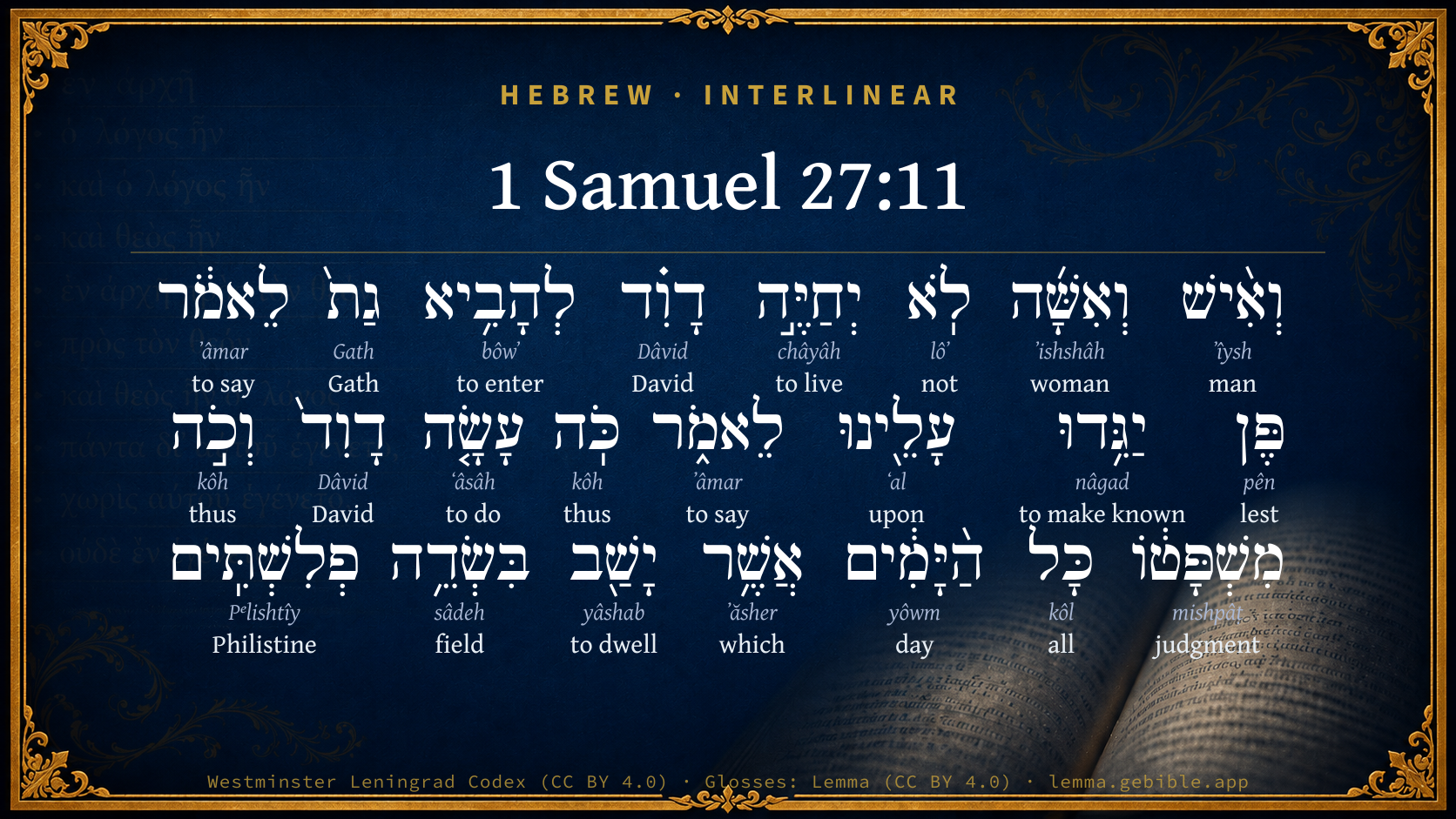
  1. וְאִ֨ישׁ ʼîysh H376 “and · man” Conjunction + Noun, Common, Masculine, Singular, Absolute
  2. וְאִשָּׁ֜ה ʼishshâh H802 “and · woman” Conjunction + Noun, Common, Feminine, Singular, Absolute
  3. לֹֽא lôʼ H3808 “not” Particle, Negative
  4. יְחַיֶּ֣ה châyâh H2421 “to live” Verb, Piel, Imperfect, 3rd Person, Masculine, Singular
  5. דָוִ֗ד Dâvid H1732 “David” Noun, Proper
  6. לְהָבִ֥יא bôwʼ H935 “to enter” Preposition + Verb, Hiphil, Infinitive Construct
  7. לֵאמֹ֔ר ʼâmar H559 “to say” Preposition + Verb, Qal, Infinitive Construct
  8. פֶּן pên H6435 “lest” Conjunction
  9. יַגִּ֥דוּ nâgad H5046 “to make known” Verb, Hiphil, Imperfect, 3rd Person, Masculine, Plural
  10. עָלֵ֖ינוּ ʻal H5921 “upon · us” Preposition + Suffix, Personal, 1st Person, Common, Plural
  11. לֵאמֹ֑ר ʼâmar H559 “to say” Preposition + Verb, Qal, Infinitive Construct
  12. כֹּֽה kôh H3541 “thus” Adverb
  13. עָשָׂ֤ה ʻâsâh H6213 “to do” Verb, Qal, Perfect, 3rd Person, Masculine, Singular
  14. דָוִד֙ Dâvid H1732 “David” Noun, Proper
  15. וְכֹ֣ה kôh H3541 “and · thus” Conjunction + Adverb
  16. מִשְׁפָּט֔וֹ mishpâṭ H4941 “judgment · his” Noun, Common, Masculine, Singular, Construct + Suffix, Personal, 3rd Person, Masculine, Singular
  17. כָּל kôl H3605 “all of” Noun, Common, Masculine, Singular, Construct
  18. הַ֨יָּמִ֔ים yôwm H3117 “the · days” Particle, Definite Article + Noun, Common, Masculine, Plural, Absolute
  19. אֲשֶׁ֥ר ʼăsher H834 “which” Particle, Relative
  20. יָשַׁ֖ב yâshab H3427 “to dwell” Verb, Qal, Perfect, 3rd Person, Masculine, Singular
  21. בִּשְׂדֵ֥ה sâdeh H7704 “in/at · field of” Preposition + Noun, Common, Masculine, Singular, Construct
  22. פְלִשְׁתִּֽים Pᵉlishtîy H6430 “Philistines” Noun, Gentilic, Masculine, Plural, Absolute

About this verse

These counts appear in no published source. They are computed here, from the morphology-tagged text and Lemma’s own curated glosses. What Lemma adds →

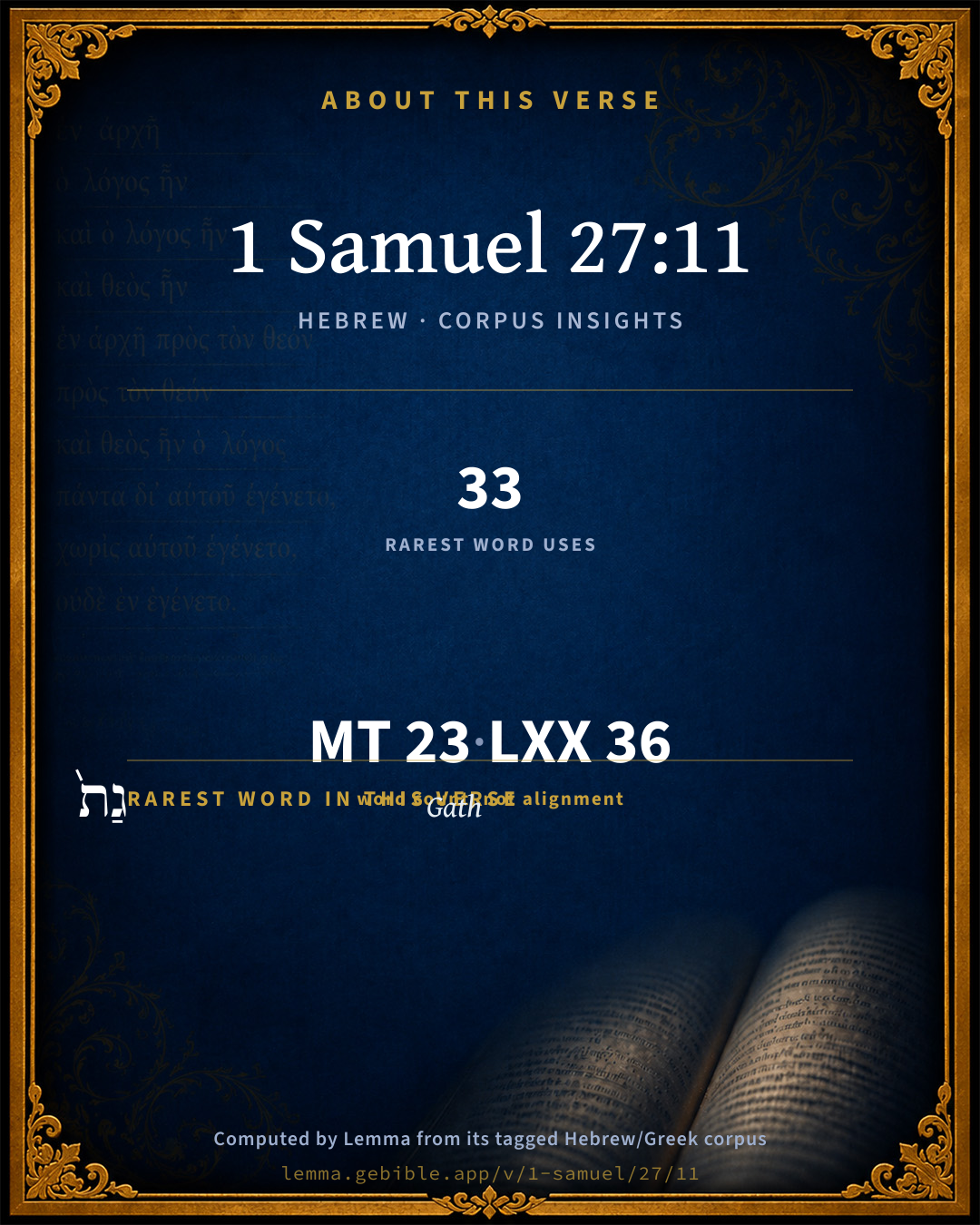
23
words
20
distinct lemmas
Historical
section

Shared distinctive vocabulary

גַת֙ Gath H1661 occurs in 31 verses of the Hebrew Bible. Also found in:

Grammatical profile

  • 7 verbs
  • 10 nouns
  • 1 preposition
  • 1 conjunction
  • 2 adverbs
  • 2 particles

Verb forms

  • יְחַיֶּ֣ה Piel · Imperfect
  • לְהָבִ֥יא Hiphil · Infinitive Construct
  • לֵאמֹ֔ר Qal · Infinitive Construct
  • יַגִּ֥דוּ Hiphil · Imperfect
  • לֵאמֹ֑ר Qal · Infinitive Construct
  • עָשָׂ֤ה Qal · Perfect
  • יָשַׁ֖ב Qal · Perfect

Repetition

Words recur within this verse — often emphatic in Hebrew:

  • דָוִ֗ד David H1732 ×2
  • לֵאמֹ֔ר to say H559 ×2
  • כֹּֽה thus H3541 ×2

Hebrew & Septuagint length

In English translation the verse runs 41 words from the Hebrew and 46 from the Septuagint (LXX English) — closely comparable.

A rough comparison of the two English renderings, which tokenize alike — not a word-level alignment.

Word counts can differ between the Hebrew and the Greek without any difference in meaning — e.g. the Hebrew direct-object marker אֵת has no separate Greek word, and Greek often adds the article ὁ.

In the original languages it is 23 Hebrew tokens and 36 Greek tokens — but the two are counted differently (Hebrew bundles its prefixes and suffixes into one token; the Greek is in lemma form), so that isn’t a like-for-like length.

Cross-references

3

Topical passages linked to 1 Samuel 27:11 in the Treasury of Scripture Knowledge — connected by theme and wording, ordered by reader-vote popularity; previews shown in the World English Bible.

  • 1 Samuel 22:22 David said to Abiathar, I knew on that day, when Doeg the Edomite was there, that he would surely tell Saul: I have occasioned [the death] of all the persons of your father's house.
  • Proverbs 12:19 Truth's lips will be established forever, But a lying tongue is only momentary.
  • Proverbs 29:25 The fear of man proves to be a snare, But whoever puts his trust in Yahweh is kept safe.

Cross-references courtesy of OpenBible.info (CC BY 4.0).

Hebrew and Greek witnesses Masoretic Hebrew ↔ Greek Septuagint

The same verse in the two great witnesses to the Old Testament, shown verse-for-verse.

These are two independent witnesses, not word-aligned to each other, and the Septuagint is shown in lemma (dictionary) form.

Hebrew 1 Samuel 27:11 Masoretic · Westminster Leningrad Codex

וְאִ֨ישׁ וְאִשָּׁ֜ה לֹֽא יְחַיֶּ֣ה דָוִ֗ד לְהָבִ֥יא גַת֙ לֵאמֹ֔ר פֶּן יַגִּ֥דוּ עָלֵ֖ינוּ לֵאמֹ֑ר כֹּֽה עָשָׂ֤ה דָוִד֙ וְכֹ֣ה מִשְׁפָּט֔וֹ כָּל הַ֨יָּמִ֔ים אֲשֶׁ֥ר יָשַׁ֖ב בִּשְׂדֵ֥ה פְלִשְׁתִּֽים

David saved neither man nor woman alive, to bring them to Gath, saying, Lest they should tell of us, saying, So did David, and so has been his manner all the while he has lived in the country of the Philistines.

World English Bible · Public Domain

Greek LXX 1 Samuel 27:11 Septuagint · lemma form

καί ἀνήρ καί γυνή οὐ ζωογονέω ὁ εἰςἄγω εἰς γεθ λέγω μή ἀναἀγγέλλω εἰς γεθ κατά ἐγώ λέγω ὅδε δαυίδ ποιέω καί ὅδε ὁ δικαίωμα αὐτός πᾶς ὁ ἡμέρα ὅς καταἧμαι δαυίδ ἐν ἀγρός ὁ ἀλλόφυλος

And I have not saved man or woman alive to bring them to Geth, saying, Lest they carry a report to Geth against us, saying, These things David does. And this was his manner all the days that David lived in the country of the Philistines.

LXX2012 (modern English Septuagint) · Public Domain

On this verse, Ellicott's Commentary for English Readers discusses the Septuagint’s reading. Read the note in Commentary ↓

Hebrew: Westminster Leningrad Codex (CC BY 4.0). Greek: Septuagint (public domain); English from LXX2012 (modern English Septuagint) (Public Domain). How the Septuagint differs from the Hebrew →

Targum (Aramaic paraphrase)

1

The Targum is the ancient Jewish Aramaic paraphrase of the Hebrew Scriptures — an interpretive translation, not the Hebrew text itself. Onkelos (literal) and Pseudo-Jonathan (expansive) render the Torah, and Jonathan the Prophets. Coverage is partial: where no permissively-licensed English translation exists for a verse, only the Aramaic is shown. This is verse-level text, not a word-by-word alignment to the Hebrew.

  1. Targum Jonathan Prophets (Joshua–Malachi)
    וּגְבַר וְאִתָּא לָא מְקַיֵם דָוִד לְאַיְתָאָה לְגַת לְמֵימָר דִלְמָא יְחַווּן עֲלָנָא לְמֵימָר כְּדֵין עֲבַד דָוִד וּכְדֵין הֲוַת הִלְכָתֵיהּ כָּל יוֹמִין דַהֲוָה יָתֵיב בְּקִירְוֵי פְלִשְׁתָּאֵי:

    (no public-domain English translation for this verse)

    Targum Jonathan — Aramaic: “Mikraot Gedolot” (public domain). English: “Sefaria Community Translation” (CC0 1.0 (public-domain dedication)); “London "Chaldee Paraphrase," 1871” (public domain). Text via Sefaria.

Commentary

Notes on 1 Samuel 27:11 from classic Christian and Jewish commentators (each source and its license shown beneath its notes). The classic Christian expositions comment on the surrounding passage and are grouped to its opening verse, so a note may address several verses; the Jewish commentaries on the Tanakh (Rashi and others) are per-verse, so they appear only where the commentator wrote on this verse.

Lemma curates 59 commentaries, every one of them public domain or Creative Commons licensed, each selected and text-cleaned for this edition rather than reprinted as found. About our sources →

Trapp's Complete Commentary

John Trapp

1Sa 27:11 And David saved neither man nor woman alive, to bring [tidings] to Gath, saying, Lest they should tell on us, saying, So did David, and so [will be] his manner all the while he dwelleth in the country of the Philistines.

Ver. 11. And David saved neither man.] See on 1Sa 27:9.

And so will be his manner.] Semel malus semper praesumitur esse malus. God was in it, otherwise it could not have been so concealed, though these nations dwelt remote, and scattered in a solitary wilderness. {a}

{a} Humanitus vix fieri id poterat.

John Trapp, A Commentary or Exposition upon All the Books of the Old and New Testament (1647–1656) — public domain. Text from a community e-Sword module.

Joseph Benson's Commentary

1Sa 27:11. To bring tidings to Gath — Our translation has here put in the word tidings, which entirely perverts the sense of this place. For in the Hebrew it is, he saved neither man nor woman alive to bring to Gath; that is, he brought no prisoners thither; and the reason was, because it would then have appeared that they were not Israelites that David had spoiled, as Achish supposed. But the words, to bring tidings to Gath, occasions the reader to make a very wrong conclusion, namely, that these people were in alliance with Achish, and that they would have sent messengers to have complained of David’s behaviour, but that he cruelly butchered them on purpose to prevent this. Whereas it is certain there is no sort of reason to believe that these people were in any kind of alliance with Achish, but quite the contrary.

Joseph Benson's Commentary on the Old and New Testaments (1811–1818) — public domain. Text from a community e-Sword module.

Ellicott's Commentary for English Readers

(11) And David saved neither man nor woman.—This and the following (12th) verse gives the reason for these atrocious acts of murder. The wild and irresponsible Arab chief alone seemed represented in David in this dark portion of his career. This saddest of all the chapters in David’s life follows close upon the death of Samuel. It appears that the holy man of God had exercised, all the time that he had lived, a great and beneficent influence over the son of Jesse; and when he passed away, other and less wise counsellors prevailed with David. Want of trust in God and a craven fear for his own life (see his words, 1Sa_26:20; 1Sa_26:24) drove him to leave the land of Israel, and to seek a refuge among his Philistine foes. One sin led on to another, when, in Philistia—to preserve that life of his—he commenced a course of duplicity, to carry out which he was driven to commit these terrible cruelties. “The prisoners taken would naturally have been part of the spoil; but David dared not bring them to Gath, lest his deceit should be discovered. Obviously these tribes (Geshurites, Gezerites, and Amalekites) were allies of the Philistines.”

Saying, So did David, and so will be his manner.—The English Version of this passage is in accordance with the present punctuation in the Hebrew Bible, and represents these words as the saying of the slaughtered enemies. This is of itself most improbable. The Hebrew, too, will scarcely bear this interpretation; for the verb “to dwell” is a past, and cannot correctly be rendered “while he dwelleth.” The Masoretic punctuation of the present Hebrew text is of comparatively recent date. It is better, then, in their place, with Maurer and Keil, the LXX., and Vulg. Versions, simply to put a stop after the words “so did David,” and then begin a new sentence, which will read, “And so was his manner all the while he dwelt in the land of the Philistines;” understanding these words as a remark of the narrator of the history.

A Bible Commentary for English Readers, edited by Charles John Ellicott (1878–1897) — public domain. Text from a community e-Sword module.

The Cambridge Bible for Schools and Colleges

gen. ed. J. J. S. Perowne

11. And David said, &c.] The tribes which David really plundered must evidently have lived in the neighbourhood of the southern boundary of Judah, so that he could represent his expeditions as made against his own countrymen and their allies, not, as was the fact, against allies of the Philistines. David’s falsehoods are not of course to be judged by the Christian standard of morality.

to bring tidings to Gath] Rather, to bring them to Gath, as prisoners. Such barbarity was nothing strange at the time, and David did not rise above the practice of his contemporaries.

tell on us] “On” used as we now use “of” is common in Shakespeare: e.g. Macbeth, A. i. Sc. 3:

“Or have we eaten on the insane root

That takes the reason prisoner?”

and so will be his manner, &c.] Render, “and so was his manner all the while he dwelt in the country of the Philistines.” A full stop must be placed after David, and the following words taken as a remark of the historian. Cp. 1Sa_27:7.

The Cambridge Bible for Schools and Colleges (gen. ed. J. J. S. Perowne; Cambridge University Press, 1878–1918) — public domain. Text from a community e-Sword module.

John Gill's Exposition

And David saved neither man nor woman alive to bring tidings to Gath,.... How David had fallen upon these people, and destroyed great numbers of them, and carried off their substance; which would have given great offence to Achish, and caused him to have driven him out of his country once more; though Abarbinel is of opinion that these Geshurites, &c. were haters and enemies of Achish, and therefore were smitten and spoiled by David; or otherwise it would have been such a piece of perfidy, rebellion, and ingratitude, as mast have made the name of David to stink, since it could not but be known sooner or later; but being the enemies of Achish, no notice was taken of it afterwards, nor inquiry made about it, nor complaint made of it, by any of their neighbours: nor does he suppose they were all cut off, and much less that this was done that it might not be told in Gath what destruction he had made; but that the sense is, that he did not carry the captives to Gath, to be disposed of there; for they would have told from whence they came, and so have contradicted what David said, and what he would have Achish understand, as if he had been out against and smote some of the cities of Judah, that he might place the greater confidence in him; which end would not have been answered, if he had brought any of them to Gath; and so the words may be read without the supplement we make, "spared neither man nor woman alive to bring to Gath": and so could tell no tales. Though Josephus expressly says (k) that David spared the men, and abstained from the slaughter of them, fearing lest they should declare to the king what he had done in plundering them:

saying, lest they should tell on us, saying, so did David: in such and such places, such numbers of people he destroyed, and such quantities of cattle and goods he carried off:

and so will be his manner all the while he dwelleth in the country of the Philistines: this is what may be expected will be done by him in one place or another, as long as he stays here; nothing will be heard of but desolation and destruction, in some part of the country of the Philistines or another; or among those that were tributaries to them; so that it was not safe that he should be allowed to abide in it.

(k) Antiqu. l. 6. c. 13. sect. 10.

John Gill's Exposition of the Whole Bible (1746–1763) — public domain (CC PDM 1.0). Text via the HelloAO Bible API.

Albert Barnes' Notes on the Bible

Tidings - The word is not in the original. The sense rather is “to bring them to Gath,” as captives and slaves. The prisoners taken would naturally have been part of the spoil, but David dared not to bring them to Gath lest his deceit should be discovered. Obviously these tribes were allies of the Philistines.

Albert Barnes' Notes on the Bible (1834–1885) — public domain. Text from a community e-Sword/MySword module.

Matthew Poole's English Annotations

Lest they should tell on us; that the tidings of this action against this people (who were, it seems, either tributaries to or confederates with Achish) might neither come quickly nor certainly to Achish’s court; which he might the rather promise himself, because Achish and all his men were now busily employed in their warlike preparations against the Israelites; and if any flying rumour came thither, he thought by his interest and artifices he could easily discredit and dash it. Besides, the consideration of God’s curse denounced against the people whom he had now destroyed, and of God’s particular promises made to him, and of his special providence which he constantly experienced watching over him, made him more secure and confident in this and in many other hazardous attempts.

Matthew Poole's English Annotations on the Holy Bible (1683–1685) — public domain. Text from a community e-Sword/MySword module.

Whedon's Commentary on the Bible

Daniel D. Whedon

11. Lest they should tell — This craftiness shows that David’s extermination of these tribes was not with the intention of executing the curse of God upon them, but to save himself from suspicion. By such foul means did he establish himself in the confidence of Achish, who now began to regard David as a powerful ally.

Daniel D. Whedon (gen. ed.), Commentary on the Old and New Testaments (1874–1909) — public domain. Text from a community e-Sword module.

The Pulpit Commentary

Vers. 11, 12. To bring tidings. The A.V is wrong in adding the word tidings, as the Hebrew means "to bring them to Gath." Prisoners to be sold as slaves formed an important part of the spoil of war in ancient times. But David, acting in accordance with the cruel customs of warfare in his days, and which he practised even when he had no urgent necessity as here, (see 2Sa_8:2) put all his prisoners to death, lest, if taken to Gath and sold, they should betray him. The A.V makes his conduct even more sanguinary, and supposes that he suffered none to escape. And so will be his manner all the while he dwelleth. The Hebrew is "he dwelt," and thus the rendering of the A.V, though supported by the Masoretic punctuation, is untenable. But this punctuation is of comparatively recent date, and of moderate authority. The words really belong to the narrator, and should be translated, "And so was his manner all the days that he dwelt in the field of the Philistines." It seems that Achish was completely deceived by David, and supposing that his conduct would make him hateful forever to his own tribesmen of Judah, and so preclude his return home, he rejoiced in him as one who would always remain his faithful vassal and adherent.

The Pulpit Commentary (1880–1919), ed. H.D.M. Spence-Jones & Joseph S. Exell — public domain. Text from a community e-Sword module.

unfoldingWord translationNotes

Door43 World Missions Community

Gath

one of five Philistine city-states. (See: How to Translate Names)

Achish

the king of Gath (See: Pronouns)

translationWords

David

people group

Israel

eternity

unfoldingWord translationNotes — © Distant Shores Media and the Door43 World Missions Community, licensed CC BY-SA 4.0. Source: git.door43.org/Door43/en_tn.

Lesson kit

Teaching starters — assembled from the data on this page, not authored interpretation. Every prompt links to the verse data it draws on. Edit before teaching.

1 Samuel, in the Historical, opens this verse with 23 words (20 distinct Hebrew lemmas). Its most distinctive word is Gath (“Gath”). A historical commentator’s framing appears above. Read the whole chapter for the surrounding context.

Discussion questions

  1. The word Gath carries the sense “Gath.” How does it shape the verse?
  2. How does Joshua 11:22, which shares the word «Gath», read alongside this verse?
  3. What does the repetition of “David” (2× in this one verse) do in this verse?
  4. These translations render this verse differently; the difference is in the English rendering, not the original. What questions does that raise?
  5. «יְחַיֶּ֣ה» is a Piel Imperfect verb. How does that grammatical form shape the action described?
  6. Compare how Trapp's Complete Commentary and Joseph Benson's Commentary read this verse. Where do they agree or differ?

Things to notice

Reading settings

Reading text

Shown beneath each verse's original-language words.

Old Testament
Old Testament edition

Read the OT as the Masoretic Hebrew (MT) or the Greek Septuagint (LXX).

English shown for the Greek Septuagint (in the Hebrew ↔ Greek comparison).

Comparing translations? Open the Compare panel on any verse page to stack up to four side by side.