
Ruth 4:5

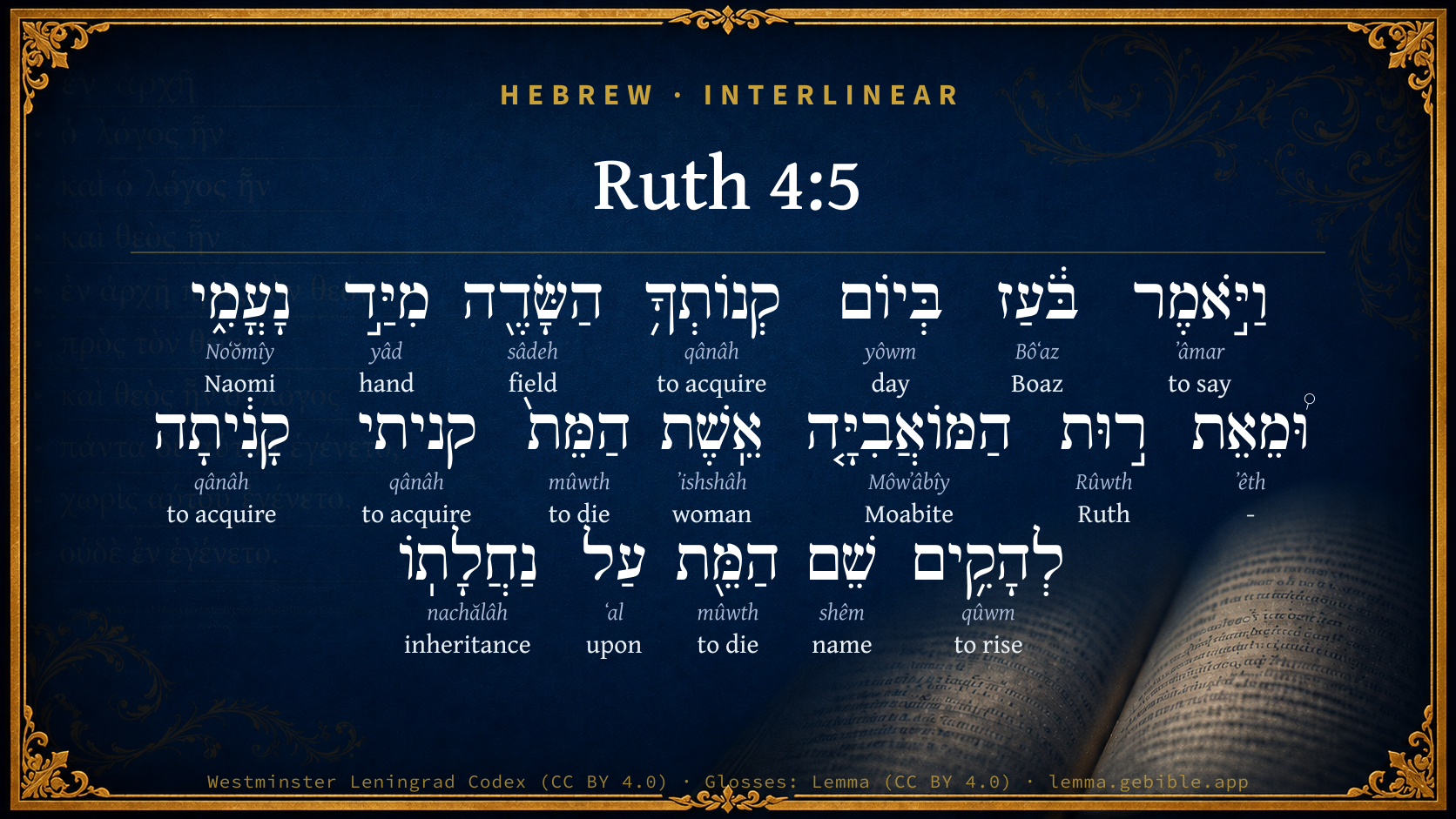
Hebrew (Westminster Leningrad Codex) Ruth 4:5 appears in the Hebrew Old Testament. The text above is from the Westminster Leningrad Codex. Each word links to its Strong’s number, a concise gloss, and parsing drawn from the Open Scriptures Hebrew Bible morphology. Click any word for its full Brown-Driver-Briggs (BDB) entry.
Download image
Cite this verse

Ruth 4:5 (World English Bible). Public Domain. Lemma interlinear Bible study tool, https://lemma.gebible.app/v/ruth/4/5.

Show BibTeX & RIS
BibTeX
RIS
English Translation
Then said Boaz, What day you buy the field of the hand of Naomi, you must buy it also of Ruth the Moabitess, the wife of the dead, to raise up the name of the dead on his inheritance.
World English Bible · Public Domain
Download a study sheet

One document with this verse’s original text, its word-by-word gloss line, the meaning frame, cross-references with their text, attributed commentary, and full source and license credits — printable, and it pastes into notes with its structure intact.

This verse Autodidact and up

Study sheet (.html) Plain text (.txt)

A passage Seminary Student

Up to 50 verses in one chapter. A passage sheet keeps up to 6 commentary sources and 12 cross-references per verse, in the order this page ranks them, and says so on the sheet whenever that leaves anything out. Ask for a single verse and you get the Autodidact verse sheet above.

Everything on this page stays free to read, with no account — the sheet is a download of what is already on screen, not access to it.

Want to remove ads? Support Godless Engineer
Compare translations 3

The same verse in 3 English versions, stacked beneath the original-language interlinear above. Click any original word for its lexicon entry.

Each is an independent rendering of the whole verse — the interlinear is not word-aligned to these translations.

Highlighted words mark where these versions differ — a whole-verse word diff, not a word-by-word alignment.

  • World English Bible Public Domain
    Then said Boaz, What day you buy the field of the hand of Naomi, you must buy it also of Ruth the Moabitess, the wife of the dead, to raise up the name of the dead on his inheritance.
  • King James Version Public Domain
    Then said Boaz, What day thou buyest the field of the hand of Naomi, thou must buy it also of Ruth the Moabitess, the wife of the dead, to raise up the name of the dead upon his inheritance.
  • unfoldingWord Literal Text CC BY-SA 4.0
    Then Boaz said, “On the day of your buying the field from the hand of Naomi, you also acquire Ruth the Moabite woman, the wife of the dead, in order to raise up the name of the dead over his inheritance.”

unfoldingWord Literal Text — © unfoldingWord, licensed CC BY-SA 4.0. Word-aligned USFM3 via Door43 (git.door43.org/unfoldingWord/en_ult).

Versions to compare (up to 4)

3 of 4 selected

Show all 18 translations

Every available English version of this verse, each an independent rendering of the whole verse.

  • World English Bible Public Domain
    Then said Boaz, What day you buy the field of the hand of Naomi, you must buy it also of Ruth the Moabitess, the wife of the dead, to raise up the name of the dead on his inheritance.
  • Berean Standard Bible Public Domain
    Then Boaz said, “On the day you buy the land from Naomi and also from Ruth the Moabitess, you must also acquire the widow of the deceased in order to raise up the name of the deceased on his inheritance.”
  • Majority Standard Bible Public Domain
    Then Boaz said, “On the day you buy the land from Naomi and also from Ruth the Moabitess, you must also acquire the widow of the deceased in order to raise up the name of the deceased on his inheritance.”
  • King James Version Public Domain
    Then said Boaz, What day thou buyest the field of the hand of Naomi, thou must buy it also of Ruth the Moabitess, the wife of the dead, to raise up the name of the dead upon his inheritance.
  • American Standard Version (1901) Public Domain
    Then said Boaz, What day thou buyest the field of the hand of Naomi, thou must buy it also of Ruth the Moabitess, the wife of the dead, to raise up the name of the dead upon his inheritance.
  • Revised Version (1885) Public Domain
    Then said Boaz, What day thou buyest the field of the hand of Naomi, thou must buy it also of Ruth the Moabitess, the wife of the dead, to raise up the name of the dead upon his inheritance.
  • Geneva Bible (1599) Public Domain
    Then said Boaz, What day thou buyest the field of the hand of Naomi, thou mnst also buy it of Ruth the Moabitesse the wife of the dead, to stirre vp the name of the dead, vpon his inheritance.
  • Douay-Rheims (1899) Public Domain
    And Booz said to him: When thou shalt buy the field at the woman's hand, thou must take also Ruth the Moabitess, who was the wife of the deceased: to raise up the name of thy kinsman in his inheritance.
  • Young's Literal Translation Public Domain
    And Boaz saith, `In the day of thy buying the field from the hand of Naomi, then from Ruth the Moabitess, wife of the dead, thou hast bought `it', to raise up the name of the dead over his inheritance.'
  • Literal Standard Version CC BY-SA 4.0
    And Boaz says, “In the day of your buying the field from the hand of Naomi, then from Ruth the Moabitess, wife of the dead, you have bought [it], to raise up the name of the dead over his inheritance.”
  • Unlocked Literal Bible CC BY-SA 4.0
    Then Boaz said, “On the day that you buy the field from the hand of Naomi, you must also take Ruth the Moabite woman, the widow of a dead man, in order to raise up the name of the dead on his inheritance.”
  • unfoldingWord Literal Text CC BY-SA 4.0
    Then Boaz said, “On the day of your buying the field from the hand of Naomi, you also acquire Ruth the Moabite woman, the wife of the dead, in order to raise up the name of the dead over his inheritance.”
  • Darby Bible Public Domain
    And Boaz said, On the day thou buyest the field of the hand of Naomi, thou must buy [it] also of Ruth the Moabitess, the wife of the dead, to raise up the name of the dead upon his inheritance.
  • World Messianic Bible Public Domain
    Then Boaz said, “On the day you buy the field from the hand of Naomi, you must buy it also from Ruth the Moabitess, the wife of the dead, to raise up the name of the dead on his inheritance.”
  • Webster's Bible Public Domain
    Then said Boaz, What day thou buyest the field of the hand of Naomi, thou must buy it also of Ruth the Moabitess, the wife of the dead, to raise up the name of the dead upon his inheritance.
  • Free Bible Version CC BY-SA 4.0
    “When you buy the land from Naomi you also acquire Ruth the Moabite, Mahlon's widow, so you can marry her and have children with her to ensure the man's line continues,” Boaz explained.
  • Bible in Basic English Public Domain
    Then Boaz said, On the day when you take this field, you will have to take with it Ruth, the Moabitess, the wife of the dead, so that you may keep the name of the dead living in his heritage.
  • JPS Tanakh (1917) Public Domain
    Then said Boaz: 'What day thou buyest the field of the hand of Naomi — hast thou also bought of Ruth the Moabitess, the wife of the dead, to raise up the name of the dead upon his inheritance?'

Literal Standard Version (2020), Covenant Press — licensed CC BY-SA 4.0. Text via the HelloAO Bible API (eBible.org). Unlocked Literal Bible (unfoldingWord) — licensed CC BY-SA 4.0. Text via the HelloAO Bible API (eBible.org). unfoldingWord Literal Text — © unfoldingWord, licensed CC BY-SA 4.0. Word-aligned USFM3 via Door43 (git.door43.org/unfoldingWord/en_ult). Free Bible Version, Dr. Jonathan Gallagher — licensed CC BY-SA 4.0. Text via the HelloAO Bible API (eBible.org).

Word by word

More ways to search: Search by grammar → Find every occurrence → Compare this word →

Practice this passage: Drill this verse → Learn its vocabulary →

ר֣וּת
Rûwth
H7327
“Ruth”
Noun, Proper
Part of Speech
Noun
Type
Proper
Full BDB Definition

Origin: probably for H7468

TWOT: None

Ruth = "friendship" - daughter-in-law of Naomi, wife of Boaz, and grandmother of David
  1. וַיֹּ֣אמֶר ʼâmar H559 “and · to say” Conjunction + Verb, Qal, Sequential Imperfect, 3rd Person, Masculine, Singular
  2. בֹּ֔עַז Bôʻaz H1162 “Boaz” Noun, Proper
  3. בְּיוֹם yôwm H3117 “in/at · day of” Preposition + Noun, Common, Masculine, Singular, Construct
  4. קְנוֹתְךָ֥ qânâh H7069 “to acquire · you” Verb, Qal, Infinitive Construct + Suffix, Personal, 2nd Person, Masculine, Singular
  5. הַשָּׂדֶ֖ה sâdeh H7704 “the · field” Particle, Definite Article + Noun, Common, Masculine, Singular, Absolute
  6. מִיַּ֣ד yâd H3027 “from · hand of” Preposition + Noun, Common, Both, Singular, Construct
  7. נָעֳמִ֑י Noʻŏmîy H5281 “Naomi” Noun, Proper
  8. וּ֠מֵאֵת ʼêth H853 “and · from · -” Conjunction + Preposition + Particle, Direct Object
  9. הַמּוֹאֲבִיָּ֤ה Môwʼâbîy H4125 “the · Moabite” Particle, Definite Article + Noun, Gentilic, Feminine, Singular, Absolute
  10. אֵֽשֶׁת ʼishshâh H802 “woman of” Noun, Common, Feminine, Singular, Construct
  11. הַמֵּת֙ mûwth H4191 “the · dying” Particle, Definite Article + Verb, Qal, Participle Active, Masculine, Singular, Absolute
  12. קניתי qânâh H7069 “to acquire” Verb, Qal, Perfect, 1st Person, Common, Singular
  13. קָנִ֔יתָה qânâh H7069 “to acquire” Verb, Qal, Perfect, 2nd Person, Masculine, Singular
  14. לְהָקִ֥ים qûwm H6965 “to rise” Preposition + Verb, Hiphil, Infinitive Construct
  15. שֵׁם shêm H8034 “name of” Noun, Common, Masculine, Singular, Construct
  16. הַמֵּ֖ת mûwth H4191 “the · dying” Particle, Definite Article + Verb, Qal, Participle Active, Masculine, Singular, Absolute
  17. עַל ʻal H5921 “upon” Preposition
  18. נַחֲלָתֽוֹ nachălâh H5159 “inheritance · his” Noun, Common, Feminine, Singular, Construct + Suffix, Personal, 3rd Person, Masculine, Singular

About this verse

These counts appear in no published source. They are computed here, from the morphology-tagged text and Lemma’s own curated glosses. What Lemma adds →

19
words
16
distinct lemmas
Historical
section

Notable vocabulary

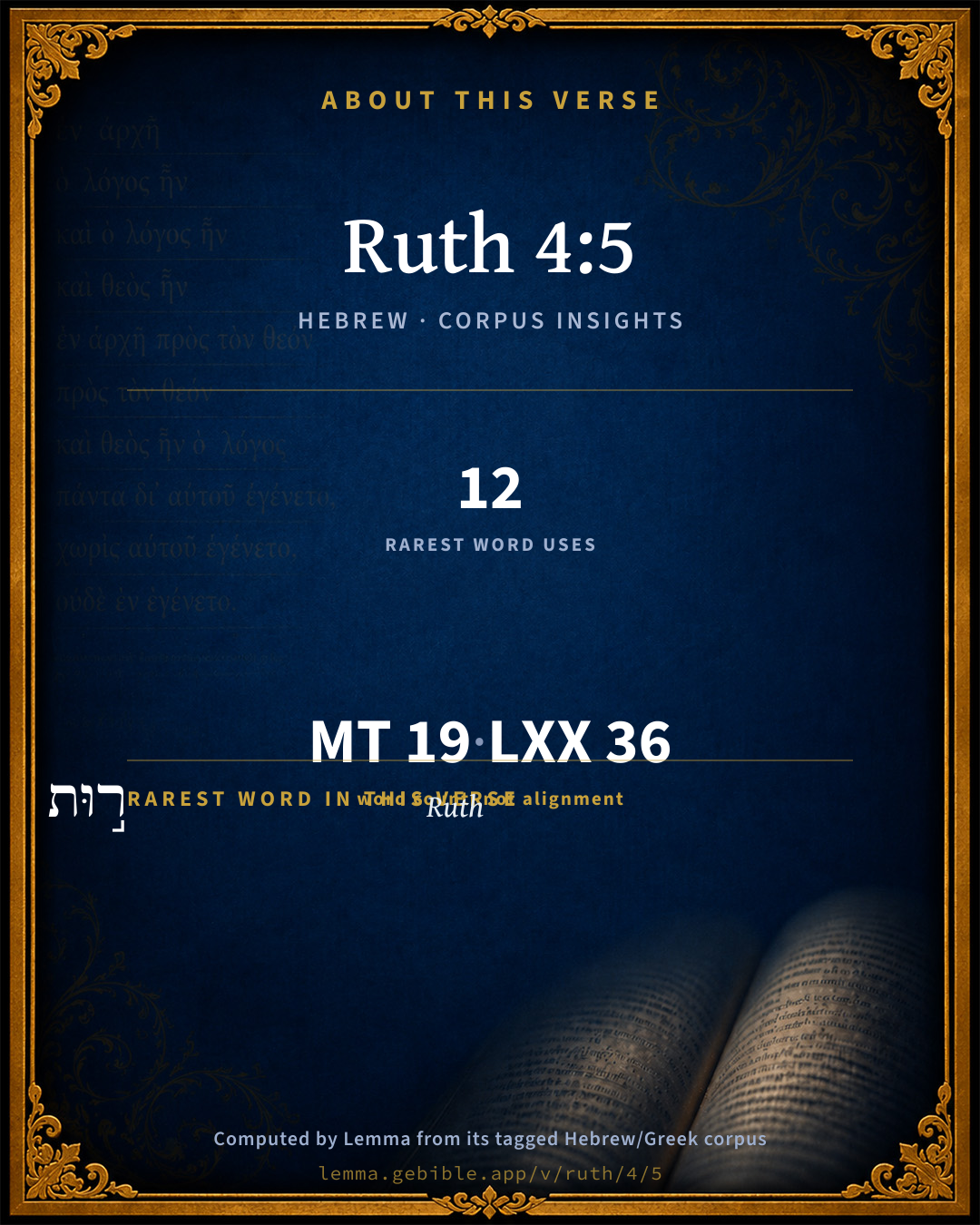
The rarest word here is ר֣וּת Ruth H7327 — appearing just 12 times in the whole Hebrew Bible.

Shared distinctive vocabulary

ר֣וּת Ruth H7327 occurs in 12 verses of the Hebrew Bible. Also found in:

Grammatical profile

  • 7 verbs
  • 10 nouns
  • 1 preposition
  • 1 particle

Verb forms

  • וַיֹּ֣אמֶר Qal · Sequential Imperfect
  • קְנוֹתְךָ֥ Qal · Infinitive Construct
  • הַמֵּת֙ Qal · Participle Active
  • קניתי Qal · Perfect
  • קָנִ֔יתָה Qal · Perfect
  • לְהָקִ֥ים Hiphil · Infinitive Construct
  • הַמֵּ֖ת Qal · Participle Active

Repetition

Words recur within this verse — often emphatic in Hebrew:

  • קְנוֹתְךָ֥ to acquire H7069 ×3
  • הַמֵּת֙ to die H4191 ×2

Hebrew & Septuagint length

In English translation the verse runs 39 words from the Hebrew and 44 from the Septuagint (LXX English) — closely comparable.

A rough comparison of the two English renderings, which tokenize alike — not a word-level alignment.

Word counts can differ between the Hebrew and the Greek without any difference in meaning — e.g. the Hebrew direct-object marker אֵת has no separate Greek word, and Greek often adds the article ὁ.

In the original languages it is 19 Hebrew tokens and 36 Greek tokens — but the two are counted differently (Hebrew bundles its prefixes and suffixes into one token; the Greek is in lemma form), so that isn’t a like-for-like length.

Cross-references

5

Topical passages linked to Ruth 4:5 in the Treasury of Scripture Knowledge — connected by theme and wording, ordered by reader-vote popularity; previews shown in the World English Bible.

  • Genesis 38:8 Judah said to Onan, "Go in to your brother's wife, and perform the duty of a husband's brother to her, and raise up seed to your brother."
  • Deuteronomy 25:5–6 If brothers dwell together, and one of them die, and have no son, the wife of the dead shall not be married outside to a stranger: her husband's brother shall go in to her, and take her to him as wife, and perform the duty of a husband's brother to her.
  • Matthew 22:24 saying, "Teacher, Moses said, 'If a man dies, having no children, his brother shall marry his wife, and raise up seed for his brother.'
  • Ruth 3:12–13 Now it is true that I am a near kinsman; however there is a kinsman nearer than I.
  • Luke 20:28 They asked him, "Teacher, Moses wrote to us that if a man's brother dies having a wife, and he is childless, his brother should take the wife, and raise up children for his brother.

Cross-references courtesy of OpenBible.info (CC BY 4.0).

Hebrew and Greek witnesses Masoretic Hebrew ↔ Greek Septuagint

The same verse in the two great witnesses to the Old Testament, shown verse-for-verse.

These are two independent witnesses, not word-aligned to each other, and the Septuagint is shown in lemma (dictionary) form.

Hebrew Ruth 4:5 Masoretic · Westminster Leningrad Codex

וַיֹּ֣אמֶר בֹּ֔עַז בְּיוֹם קְנוֹתְךָ֥ הַשָּׂדֶ֖ה מִיַּ֣ד נָעֳמִ֑י וּ֠מֵאֵת ר֣וּת הַמּוֹאֲבִיָּ֤ה אֵֽשֶׁת הַמֵּת֙ קניתי קָנִ֔יתָה לְהָקִ֥ים שֵׁם הַמֵּ֖ת עַל נַחֲלָתֽוֹ

Then said Boaz, What day you buy the field of the hand of Naomi, you must buy it also of Ruth the Moabitess, the wife of the dead, to raise up the name of the dead on his inheritance.

World English Bible · Public Domain

Greek LXX Ruth 4:5 Septuagint · lemma form

καί εἶπον βοος ἐν ἡμέρα ὁ κτάομαι σύ ὁ ἀγρός ἐκ χείρ νωεμιν καί παρά ρουθ ὁ μωαβῖτις γυνή ὁ θνήσκω καί αὐτός κτάομαι σύ δέω ὥστε ἀναἵστημι ὁ ὄνομα ὁ θνήσκω ἐπί ὁ κληρονομία αὐτός

And Booz said, In the day of your buying the field of the hand of Noemin and of Ruth the Moabitess the wife of the deceased, you must also buy her, so as to raise up the name of the dead upon his inheritance.

LXX2012 (modern English Septuagint) · Public Domain

On this verse, The Cambridge Bible for Schools and Colleges discusses the Septuagint’s reading. Read the note in Commentary ↓

Hebrew: Westminster Leningrad Codex (CC BY 4.0). Greek: Septuagint (public domain); English from LXX2012 (modern English Septuagint) (Public Domain). How the Septuagint differs from the Hebrew →

Commentary

Notes on Ruth 4:5 from classic Christian and Jewish commentators (each source and its license shown beneath its notes). The classic Christian expositions comment on the surrounding passage and are grouped to its opening verse, so a note may address several verses; the Jewish commentaries on the Tanakh (Rashi and others) are per-verse, so they appear only where the commentator wrote on this verse.

Lemma curates 59 commentaries, every one of them public domain or Creative Commons licensed, each selected and text-cleaned for this edition rather than reprinted as found. About our sources →

Trapp's Complete Commentary

John Trapp

Rth 4:5 Then said Boaz, What day thou buyest the field of the hand of Naomi, thou must buy [it] also of Ruth the Moabitess, the wife of the dead, to raise up the name of the dead upon his inheritance.

Ver. 5. What day thou buyest the field.] Here God is making provision for these two widows, his clients; maintenance for Naomi, and marriage for Ruth. Henceforth it shall be no more Marah, but, as heretofore, Naomi: and while Orpah lacked bread in her own country, Ruth is grown a great lady in Israel. "Who would not serve thee, O King of Nations?" &c.

To raise up the name of the dead.] This Boaz kept in till now at last; at the hearing whereof, the other relinquisheth his right in the land, since it was so encumbered. It is a witty and pious advice that a grave divine giveth; When thou art making a covenant with sin, saith he, say to thy soul as Boaz did to his kinsman, At what time thou buyest it, thou must have Ruth with it. If thou wilt have the pleasure of sin, the wages of wickedness, thou must also have the curse that is due to it. And let thy soul answer as he there doth, No, I may not do it, I shall mar and spoil a better inheritance.

John Trapp, A Commentary or Exposition upon All the Books of the Old and New Testament (1647–1656) — public domain. Text from a community e-Sword module.

Tyndale Open Study Notes

Tyndale Open Resources

4:5 your purchase . . . requires that you marry Ruth (literally on the day you purchase . . . you acquire Ruth): In the Hebrew manuscripts that we have, the body of this verse reads I acquire, but a scribal correction in the margin reads you acquire, a difference of one letter. (The scribe believed you acquire was the original reading and that the body of the text contained an error.) Some interpreters believe the body of the Hebrew text (I acquire) is the original reading of the text, indicating that the marriage between Boaz and Ruth was already set to occur (see study note on 3:11). Most translators, however, believe that the marginal correction (you acquire) represents the original reading of the text because: (1) The scribe who made the marginal correction believed that you acquire was the original reading; (2) most ancient translations of Ruth, which predate our oldest copies of the Hebrew text, also read you acquire; and (3) it is easy to envision that an earlier Hebrew scribe (working before our earliest manuscript copies) substituted I acquire—as it appears in 4:10—in place of you acquire. • That way she can have children who will carry on her husband’s name and keep the land in the family: This sentence draws heavily on Deut 25:7. Boaz connected the duties of a family redeemer (see study notes on Ruth 2:20; Lev 25:25) with the duties of a brother-in-law (Latin levir) to provide an heir for a deceased brother (see Deut 25:5-10 for a description of levirate marriage; cp. Gen 38). There is no precise precedent for Boaz’s legal maneuver. The duty of the levir as stated in Deut 25:5-10 was not binding in this situation (neither Boaz nor the other kinsman was Elimelech’s brother, and Ruth was not Elimelech’s widow). Boaz was apparently using the spirit of the law concerning the go’el (family redeemer) to establish a moral, if not a legal, obligation to serve as levir and provide the deceased with an heir to inherit the land (see study note on Lev 25:25). The concepts of land ownership and provision for an heir were intimately connected in ancient Israel (cp. Num 27:1-11). Because Naomi was beyond childbearing age, Ruth, the widow of Elimelech’s son, would be the mother for such an heir. This maneuver apparently surprised the other kinsman (Ruth 4:6), but it is clear from what follows that Boaz’s argument, while perhaps novel, was accepted as valid.

Tyndale Open Study Notes — © Tyndale Open Resources, licensed CC BY-SA 4.0. Text via the HelloAO Bible API.

Geneva Bible (1599)

Geneva Bible translators

That his inheritance might bear his name that is dead.

Geneva Bible (1599) marginal notes — public domain. Text via Bolls.life.

Adam Clarke's Commentary

Verse 5. Thou must buy it also of Ruth] More properly, Thou wilt also acquire Ruth. Thou canst not get the land without taking the wife of the deceased and then the children which thou mayest have shall be reputed the children of Mahlon, thy deceased kinsman.

Adam Clarke's Commentary on the Bible (1810–1826) — public domain. Text from a community e-Sword/MySword module.

Ellicott's Commentary for English Readers

(5) What day . . .—When the person had been bought out to whom Naomi had sold the land until the year of Jubilee should restore it to her family, there remained Naomi’s own claim on the land, and after wards that of Ruth, as the widow of the son of Elimelech. But further, this last carried with it the necessity of taking Ruth to wife, so that a child might be born to inherit, as the son of Mahlon, Mahlon’s inheritance.

A Bible Commentary for English Readers, edited by Charles John Ellicott (1878–1897) — public domain. Text from a community e-Sword module.

The Cambridge Bible for Schools and Colleges

gen. ed. J. J. S. Perowne

5. thou must buy it also of Ruth] The text is certainly wrong, for it gives a misleading sense; with a small change read as in Rth_4:10, Ruth also thou must buy, with Vulg., Pesh.; the LXX. gives both translations! Rendered strictly the whole sentence runs ‘What day thou buyest … thou wilt have bought (perf.) Ruth also’; see Driver, Tenses, § 124.

In primitive and semi-primitive societies women have no independent rights of their own; they are treated as part of the property of the family to which they belong. Hence ‘a wife who had been brought into her husband’s house by contract and payment of a price to her father was not free by the death of her husband to marry again at will. The right to her hand lay with the nearest heir of the dead’ (Robertson Smith, Encycl. Bibl., col. 4166). This was the old law in Arabia to the time of Mohammed, and that it prevailed with some modifications among the ancient Hebrews is shewn by the narrative in Genesis 38. (see on Rth_1:13 above), by the law of levirate marriage in Deu_25:5 ff., and by the present story, which implies that for the nearest kinsman to marry the widow was regarded as an act of compassion. It is important to notice that the law of Deu_25:5 ff, applies only to the case of brothers living together on the same estate; if one dies without a son, the survivor is bound to marry the widow. But neither the Go’el here, nor Boaz, was a brother of Ruth’s late husband; this, therefore, was not a levirate marriage. Again, in the Pentateuch (Leviticus 25.) the Go’el is not required to purchase the widow as well as the land of the dead kinsman, and it is clear that in the present case the Go’el did not consider that he was under an obligation to do so; he agrees to purchase the land (Rth_4:4), but when he is told that this involves the purchase of Ruth, he withdraws his consent. At the same time we gather from his language in Rth_4:6, and from the applause of the people in the gate, that custom admitted the propriety of the double purchase. It was in fact a work of charity, going beyond the strict letter of the law but sanctioned by ancient usage, and thoroughly in keeping with the generous, kindly disposition of Boaz. The writer holds him up as an edifying example.

to raise up the name of the dead] Again the law of levirate marriage furnishes a parallel; the object of such a marriage was ‘to raise up unto his brother a name in Israel’ Deu_25:7, as well as to prevent the estate passing out of the family. To leave behind no name in the community was considered a grave misfortune (cf. Rth_4:10); it meant that the dead was deprived of the reverence and service of posterity (cf. 2Sa_18:18). This feeling may be traced back to the religious instinct which prompted the worship of ancestors.

The Cambridge Bible for Schools and Colleges (gen. ed. J. J. S. Perowne; Cambridge University Press, 1878–1918) — public domain. Text from a community e-Sword module.

John Gill's Exposition

Then said Boaz,.... In order to try the kinsman, whether he would abide by his resolution, he acquaints him with what he had as yet concealed:

what day thou buyest the field of Naomi, thou must buy it also of Ruth the Moabitess, the wife of the dead; the wife of Mahlon, who was dead, the eldest son of Naomi, and so his widow, Ruth the Moabitess, had the reversion of the estate; wherefore the purchase must be made of her as well as of Naomi, and the purchase could not be made of her without marrying her; which, though no law obliged to, yet it seems to be a condition of the purchase annexed to it by Naomi, that she would sell it to no man, unless he would consent to marry Ruth, for whose settlement she had a great concern, having been very dutiful and affectionate to her; which is clearly intimated in the next clause:

to raise up the name of the dead upon his inheritance; and so Naomi had another end to answer thereby, not only to provide a good husband for her daughter-in-law, but to perpetuate the name of her son, agreeably to the design of the law in Deu 25:5.

John Gill's Exposition of the Whole Bible (1746–1763) — public domain (CC PDM 1.0). Text via the HelloAO Bible API.

Albert Barnes' Notes on the Bible

Observe the action of the Levirate law. If there had been no one interested but Naomi, she would have sold the land unclogged by any condition, the law of Levirate having no existence in her case. But there was a young widow upon whom the possession of the land would devolve at Naomi’s death, and who already had a right of partnership in it, and the law of Levirate did apply in her case. It was, therefore, the duty of the גאל gā'al to marry her and raise up seed to his brother, i. e. his kinsman. And he could not exercise his right of redeeming the land, unless he was willing at the same time to fulfill his obligations to the deceased by marrying the widow. This he was unwilling to do.

Albert Barnes' Notes on the Bible (1834–1885) — public domain. Text from a community e-Sword/MySword module.

Haydock's Catholic Bible Commentary

When. Hebrew again corruptly, "On the day thou buyest the land of the hand of Noemi, I will also buy it of Ruth," &c. It ought to be, conformably to some manuscripts and the ancient versions, "thou must also take Ruth," ver. 10. (Capel, p. 144, and 362.) (Kennicott) (Haydock) --- We see here the observance of two laws, the one preserving the inheritance in the same family, and the other obliging the next of kin to marry the widow of the deceased, if he would enjoy his land, Leviticus xxv. 10., and Deuteronomy xxv. 5. (Calmet) --- Such widows as designed to comply with this condition, took possession of the land on the death of their husband, and conveyed it to those whom they married, till their eldest son became entitled to it. (Abulensis, q. 30 to 61.) --- Inheritance. The son to be born, would be esteemed the heir of his legal parent. (Menochius)

George Leo Haydock (1774–1849), Haydock's Catholic Family Bible and Commentary, 1859 edition — public domain. Excludes Psalms (Douay-Rheims chapter numbering differs from Protestant) and Deuterocanonical books (Catholic canon only).

Matthew Poole's English Annotations

The wife of the dead; according to the law, Deu 25:5; Mat 22:24, &c.

To raise up the name of the dead; to revive his name, which was lost and buried with his body, by raising up a seed to him, to be called by his name.

Matthew Poole's English Annotations on the Holy Bible (1683–1685) — public domain. Text from a community e-Sword/MySword module.

Whedon's Commentary on the Bible

Daniel D. Whedon

5. Thou must buy it also of Ruth — The estate of Elimelech would have been Chilion and Mahlon’s had they lived. Chilion’s widow had gone to her mother’s house in Moab, and perhaps married again, so that she had no legal claim on the property; but Mahlon’s widow, Ruth, had clung to Naomi, and therefore while she lived had a share with her mother-in-law in Mahlon’s inheritance. Naomi was too old to expect a husband, (Rth_1:12,) or to claim of her deceased husband’s kinsmen the duty of the levirate marriage. But not so Ruth, who was young and beautiful, and had a right to ask in marriage the man who redeemed the inheritance of Mahlon.

To raise up the name of the dead — According to the law (Deu_25:6) the firstborn of the levirate marriage succeeded in the name of the deceased husband of his mother. Thus the family to whom the deceased belonged did not become extinct in Israel. See on Rth_4:10.

Daniel D. Whedon (gen. ed.), Commentary on the Old and New Testaments (1874–1909) — public domain. Text from a community e-Sword module.

The Pulpit Commentary

And Boaz said, In the day when thou acquirest the land from the hand of Naomi, and from Ruth the Moabitess, (in that day) thou hast acquired the wife of the deceased, to establish the name of the deceased upon his inheritance. So we would punctuate and render this verse. Boaz distinctly informed his relative that if the land was acquired at all by a kinsman, it must be acquired with its living appurtenance, Ruth the Moabitess, so that, by the blessing of God, the Fountain of families, there might he the opportunity of retaining the possession of the property in the line of her deceased husband, that line coalescing in the line of her second husband. It was the pleasure of Naomi and Ruth, in offering their property for sale, to burden its acquisition, on the part of a kinsman, with the condition specified. If there should be fruit after the marriage, the child would be heir of the property, just as if he had been Machlon"s son, even though the father should have other and older sons by another wife.

The Pulpit Commentary (1880–1919), ed. H.D.M. Spence-Jones & Joseph S. Exell — public domain. Text from a community e-Sword module.

John Wesley's Explanatory Notes

Buy it - According to the law, Deut. xxv, 5. To raise,&c. - To revive his name, which was buried with his body, by raising up a seed to him, to be called by his name.

John Wesley, Explanatory Notes Upon the Whole Bible (1754–1765) — public domain. Text via the GEBible commentary corpus.

unfoldingWord translationNotes

Door43 World Missions Community

On the day that you buy ... you must also

Boaz uses this expression to inform his relative of the additional responsibility he will have if he buys the land.

from the hand of Naomi

Here the word "hand" represents Naomi, who owns the field. AT: "from Naomi" (See: Synecdoche)

you must also take Ruth

"you must also marry Ruth" (See: Idiom)

Ruth ... the widow of a dead man

"Ruth ... the widow of Elimelek's son"

to raise up the name of the dead

"that she may have a son to inherit the property and carry on the name of her dead husband"

damaging my own inheritance

He would have to give some of his own wealth to the children that Ruth might bear.

You take my right of redemption for yourself

"You redeem it yourself" or "You yourself redeem it instead of me"

translationWords

Boaz

Ruth

Moab

name

inherit

kin

redeem

unfoldingWord translationNotes — © Distant Shores Media and the Door43 World Missions Community, licensed CC BY-SA 4.0. Source: git.door43.org/Door43/en_tn.

Rashi

Rabbi Shlomo Yitzchaki (Rashi)

and from Ruth the Moabitess you must buy, and she agrees only if you marry her.

Rashi on the Tanakh — English translations: “The Judaica Press complete Tanach with Rashi, translated by A. J. Rosenberg” (CC BY 4.0); “Pentateuch with Rashi's commentary by M. Rosenbaum and A.M. Silbermann, 1929-1934” (public domain); “The Metsudah Tanach series, Lakewood, N.J” (CC BY 4.0); and “The Book of Joshua, Metsudah Publications, 1997” (CC BY 4.0). Text via Sefaria.

Ibn Ezra

Rabbi Abraham ibn Ezra

"You have acquired the wife of the deceased." The reason for this phrase is 'you will acquire,' with a past tense verb used for future action. For the woman has a ketubah (marriage contract), and also, a mother inherits what remains. It is written 'I have acquired,' meaning 'thus I will acquire.'

Ibn Ezra on the Tanakh — English translations: “Sefaria Community Translation” (CC0 1.0 (public-domain dedication)); “Yalkut, Sifsei Chachomim Chumash, Metsudah Publications, 2009” (CC BY 4.0); and “Commentary of Ibn Ezra on Isaiah - trans. by M. Friedlander, 1873” (public domain). Text via Sefaria.

Lesson kit

Teaching starters — assembled from the data on this page, not authored interpretation. Every prompt links to the verse data it draws on. Edit before teaching.

Ruth, in the Historical, opens this verse with 19 words (16 distinct Hebrew lemmas). Its most distinctive word is Rûwth (“Ruth”). A historical commentator’s framing appears above. Read the whole chapter for the surrounding context.

Discussion questions

  1. How does “Ruth” (Rûwth) shape what this verse is saying?
  2. Ruth 1:4 shares the word «Ruth» with this verse. How do the two illuminate each other?
  3. “to acquire” occurs 3× in this one verse. What is the effect of the repetition?
  4. The translations on this page render this verse differently — a whole-verse word diff, not a word-by-word alignment. What might account for the different wordings?
  5. The verb «וַיֹּ֣אמֶר» is Qal Sequential Imperfect. How does its form color the action?
  6. Reading how Trapp's Complete Commentary and Tyndale Open Study Notes read this verse, where do the two commentators agree and where do they part?

Things to notice

Reading settings

Reading text

Shown beneath each verse's original-language words.

Old Testament
Old Testament edition

Read the OT as the Masoretic Hebrew (MT) or the Greek Septuagint (LXX).

English shown for the Greek Septuagint (in the Hebrew ↔ Greek comparison).

Comparing translations? Open the Compare panel on any verse page to stack up to four side by side.