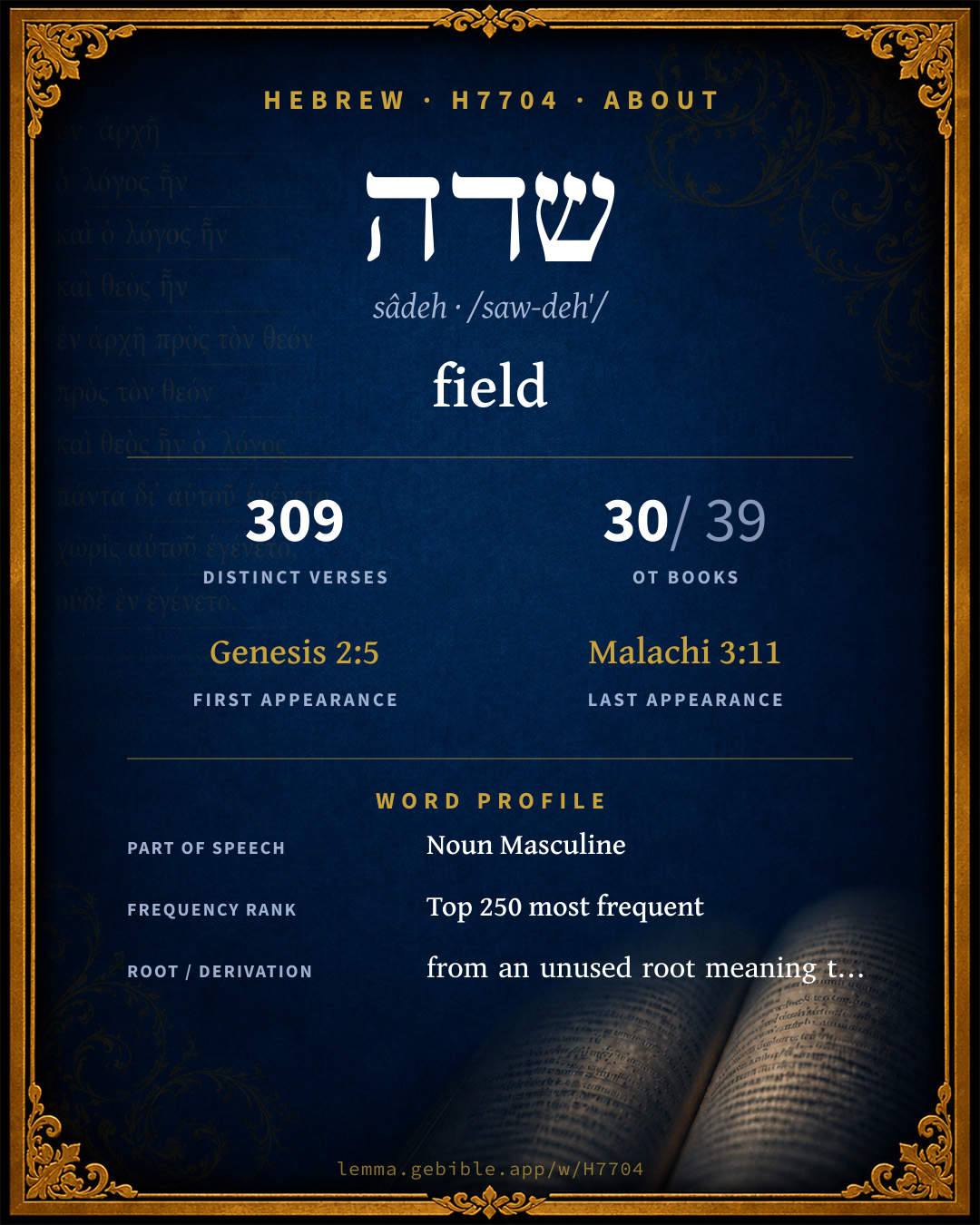
שָׂדֶה
field
‘field’ is one of 5 main senses fuller range ↓
Full lexicon entry — Brown-Driver-Briggs (BDB)
From Brown-Driver-Briggs (BDB)
Where this word appears
See every Absolute-state word in the Hebrew Bible →
Grammar key — what these labels mean
Part of speech
- Noun
- A naming word — a person, place, thing, or idea.
Noun type
- Common
- A common noun — a general class of person, place, or thing (“king,” “city,” “water”), not a specific name.
State
- Absolute
- The independent form of a noun, not bound to a following word.
- Construct
- A noun bound to a following noun in a possessive / “of” relationship (the construct chain).
Gender
- Masculine
- Grammatically masculine.
Number
- Singular
- One.
- Plural
- More than one (in Hebrew, generally three or more).
82 distinct verses where H7704 appears in the Construct state, across 23 books. Filtered view — show all forms. Click any verse to open its interlinear word-by-word view. Verse text shown in the World English Bible for context — . Each verse’s Hebrew form is shown with its reference; the English is not keyword-highlighted, since the data carries no word-level English alignment. Use “Compare translations” on any verse to read it across multiple English versions. This concordance covers the Hebrew Bible; Septuagint (Greek Old Testament) occurrences are not indexed here.
Genesis 12 verses
- Genesis 14:7 שְׂדֵ֖ה n c ms cs They returned, and came to En-mishpat (the same is Kadesh), and struck all the country of the Amalekites, and also the Amorites, that lived in Hazazon Tamar.
- Genesis 23:9 שָׂדֵ֑/הוּ n c ms cs + sfx pers 3ms that he may give me the cave of Machpelah, which he has, which is in the end of his field. For the full price let him give it to me in the midst of you for a possession of a burying-place."
- Genesis 23:17 שְׂדֵ֣ה הַ/שָּׂדֶה֙ בַּ/שָּׂדֶ֔ה n c ms cs ptcl def.art + n c ms prep det + n c ms So the field of Ephron, which was in Machpelah, which was before Mamre, the field, the cave which was therein, and all the trees that were in the field, that were in all the border of it round about, were made sure
- Genesis 23:19 שְׂדֵ֧ה n c ms cs After this, Abraham buried Sarah his wife in the cave of the field of Machpelah before Mamre (the same is Hebron), in the land of Canaan.
- Genesis 25:9 שְׂדֵ֞ה n c ms cs Isaac and Ishmael, his sons, buried him in the cave of Machpelah, in the field of Ephron, the son of Zohar the Hittite, which is before Mamre,
- Genesis 32:3 שְׂדֵ֥ה n c ms cs Jacob sent messengers in front of him to Esau, his brother, to the land of Seir, the field of Edom.
- Genesis 36:35 בִּ/שְׂדֵ֣ה prep + n c ms cs Husham died, and Hadad, the son of Bedad, who struck Midian in the field of Moab, reigned in his place. The name of his city was Avith.
- Genesis 41:48 שְׂדֵה n c ms cs He gathered up all the food of the seven years which were in the land of Egypt, and laid up the food in the cities: the food of the field, which was round about every city, he laid up in the same.
- Genesis 47:20 שָׂדֵ֔/הוּ n c ms cs + sfx pers 3ms So Joseph bought all the land of Egypt for Pharaoh, for the Egyptians sold every man his field, because the famine was severe on them, and the land became Pharaoh's.
- Genesis 49:29 בִּ/שְׂדֵ֖ה prep + n c ms cs He charged them, and said to them, "I am to be gathered to my people. Bury me with my fathers in the cave that is in the field of Ephron the Hittite,
- Genesis 49:30 בִּ/שְׂדֵ֧ה הַ/שָּׂדֶ֗ה prep + n c ms cs ptcl def.art + n c ms in the cave that is in the field of Machpelah, which is before Mamre, in the land of Canaan, which Abraham bought with the field from Ephron the Hittite as a burial place.
- Genesis 50:13 שְׂדֵ֣ה הַ/שָּׂדֶ֜ה n c ms cs ptcl def.art + n c ms for his sons carried him into the land of Canaan, and buried him in the cave of the field of Machpelah, which Abraham bought with the field, for a possession of a burying-place, from Ephron the Hittite, before Mamre.
Exodus 1 verse
Leviticus 13 verses
- Leviticus 19:9 שָׂדְ/ךָ֖ n c ms cs + sfx pers 2ms "'When you reap the harvest of your land, you shall not wholly reap the corners of your field, neither shall you gather the gleanings of your harvest.
- Leviticus 19:19 שָׂדְ/ךָ֖ n c ms cs + sfx pers 2ms "'You shall keep my statutes. "'You shall not crossbreed different kinds of animals. "'you shall not sow your field with two kinds of seed; "'neither shall there come upon on you a garment made of two kinds of material.
- Leviticus 23:22 שָֽׂדְ/ךָ֙ n c ms cs + sfx pers 2ms "'When you reap the harvest of your land, you shall not wholly reap into the corners of your field, neither shall you gather the gleanings of your harvest: you shall leave them for the poor, and for the foreigner. I am Yahweh your God.'"
- Leviticus 25:3 שָׂדֶ֔/ךָ n c ms cs + sfx pers 2ms Six years you shall sow your field, and six years you shall prune your vineyard, and gather in its fruits;
- Leviticus 25:4 שָֽׂדְ/ךָ֙ n c ms cs + sfx pers 2ms but in the seventh year there shall be a Sabbath of solemn rest for the land, a Sabbath to Yahweh. You shall not sow your field or prune your vineyard.
- Leviticus 25:31 שְׂדֵ֥ה n c ms cs But the houses of the villages which have no wall round about them shall be reckoned with the fields of the country: they may be redeemed, and they shall be released in the Jubilee.
- Leviticus 25:34 וּֽ/שְׂדֵ֛ה conj + n c ms cs But the field of the suburbs of their cities may not be sold; for it is their perpetual possession.
- Leviticus 27:16 מִ/שְּׂדֵ֣ה prep + n c ms cs "'If a man dedicates to Yahweh part of the field of his possession, then your valuation shall be according to the seed for it: the sowing of a homer of barley shall be valued at fifty shekels of silver.
- Leviticus 27:17 שָׂדֵ֑/הוּ n c ms cs + sfx pers 3ms If he dedicates his field from the Year of Jubilee, according to your valuation it shall stand.
- Leviticus 27:18 שָׂדֵ/הוּ֒ n c ms cs + sfx pers 3ms But if he dedicates his field after the Jubilee, then the priest shall reckon to him the money according to the years that remain to the Year of Jubilee; and an abatement shall be made from your valuation.
- Leviticus 27:21 הַ/שָּׂדֶ֜ה כִּ/שְׂדֵ֣ה ptcl def.art + n c ms prep + n c ms cs but the field, when it goes out in the Jubilee, shall be holy to Yahweh, as a field devoted; it shall be owned by the priests.
- Leviticus 27:22 שְׂדֵ֣ה מִ/שְּׂדֵ֣ה n c ms cs prep + n c ms cs "'If he dedicates to Yahweh a field which he has bought, which is not of the field of his possession,
- Leviticus 27:28 וּ/מִ/שְּׂדֵ֣ה conj + prep + n c ms cs "'Notwithstanding, no devoted thing, that a man shall devote to Yahweh of all that he has, whether of man or animal, or of the field of his possession, shall be sold or redeemed: every devoted thing is most holy to Yahweh.
Numbers 2 verses
- Numbers 21:20 בִּ/שְׂדֵ֣ה prep + n c ms cs and from Bamoth to the valley that is in the field of Moab, to the top of Pisgah, which looks down on the desert.
- Numbers 23:14 שְׂדֵ֣ה n c ms cs He took him into the field of Zophim, to the top of Pisgah, and built seven altars, and offered up a bull and a ram on every altar.
Deuteronomy 3 verses
- Deuteronomy 5:21 שָׂדֵ֜/הוּ n c ms cs + sfx pers 3ms "Neither shall you covet your neighbor's wife; neither shall you desire your neighbor's house, his field, or his man-servant, or his maid-servant, his ox, or his donkey, or anything that is your neighbor's."
- Deuteronomy 11:15 בְּ/שָׂדְ/ךָ֖ prep + n c ms cs + sfx pers 2ms I will give grass in your fields for your cattle, and you shall eat and be full.
- Deuteronomy 24:19 בְ/שָׂדֶ֜/ךָ בַּ/שָּׂדֶ֗ה prep + n c ms cs + sfx pers 2ms prep det + n c ms When you reap your harvest in your field, and have forgot a sheaf in the field, you shall not go again to get it: it shall be for the foreigner, for the fatherless, and for the widow; that Yahweh your God may bless you in all the work of your hands.
Joshua 1 verse
Judges 2 verses
- Judges 5:4 מִ/שְּׂדֵ֣ה prep + n c ms cs Yahweh, when you went forth out of Seir, When you marched out of the field of Edom, The earth trembled, the sky also dropped, Yes, the clouds dropped water.
- Judges 20:6 שְׂדֵ֖ה n c ms cs I took my concubine, and cut her in pieces, and sent her throughout all the country of the inheritance of Israel; for they have committed lewdness and folly in Israel.
Ruth 6 verses
- Ruth 1:1 בִּ/שְׂדֵ֣י prep + n c mp cs It happened in the days when the judges judged, that there was a famine in the land. A certain man of Bethlehem Judah went to sojourn in the country of Moab, he, and his wife, and his two sons.
- Ruth 1:2 שְׂדֵי n c mp cs The name of the man was Elimelech, and the name of his wife Naomi, and the name of his two sons Mahlon and Chilion, Ephrathites of Bethlehem Judah. They came into the country of Moab, and continued there.
- Ruth 1:6 מִ/שְּׂדֵ֣י בִּ/שְׂדֵ֣ה prep + n c mp cs prep + n c ms cs Then she arose with her daughters-in-law, that she might return from the country of Moab: for she had heard in the country of Moab how that Yahweh had visited his people in giving them bread.
- Ruth 1:22 מִ/שְּׂדֵ֣י prep + n c mp cs So Naomi returned, and Ruth the Moabitess, her daughter-in-law, with her, who returned out of the country of Moab: and they came to Bethlehem in the beginning of barley harvest.
- Ruth 2:6 מִ/שְּׂדֵ֥ה prep + n c ms cs The servant who was set over the reapers answered, It is the Moabite lady who came back with Naomi out of the country of Moab:
- Ruth 4:3 הַ/שָּׂדֶ֔ה מִ/שְּׂדֵ֥ה ptcl def.art + n c ms prep + n c ms cs He said to the near kinsman, Naomi, who has come back out of the country of Moab, is selling the parcel of land, which was our brother Elimelech's:
1 Samuel 6 verses
- 1 Samuel 6:1 בִּ/שְׂדֵ֥ה prep + n c ms cs The ark of Yahweh was in the country of the Philistines seven months.
- 1 Samuel 6:14 שְׂדֵ֨ה n c ms cs The cart came into the field of Joshua the Beth-shemite, and stood there, where there was a great stone: and they split the wood of the cart, and offered up the cattle for a burnt offering to Yahweh.
- 1 Samuel 6:18 בִּ/שְׂדֵ֥ה prep + n c ms cs and the golden mice, according to the number of all the cities of the Philistines belonging to the five lords, both of fortified cities and of country villages, even to the great stone, whereon they set down the ark of Yahweh, [which stone remains] to this day in the field of Joshua the Beth-shemite.
- 1 Samuel 8:14 שְׂ֠דֽוֹתֵי/כֶם n c mp cs + sfx pers 2mp He will take your fields, and your vineyards, and your olive groves, even the best of them, and give them to his servants.
- 1 Samuel 27:7 בִּ/שְׂדֵ֣ה prep + n c ms cs The number of the days that David lived in the country of the Philistines was a full year and four months.
- 1 Samuel 27:11 בִּ/שְׂדֵ֥ה prep + n c ms cs David saved neither man nor woman alive, to bring them to Gath, saying, Lest they should tell of us, saying, So did David, and so has been his manner all the while he has lived in the country of the Philistines.
2 Samuel 2 verses
- 2 Samuel 1:21 וּ/שְׂדֵ֣י conj + n c mp cs You mountains of Gilboa, Let there be no dew nor rain on you, neither fields of offerings: For there the shield of the mighty was vilely cast away, The shield of Saul, not anointed with oil.
- 2 Samuel 9:7 שְׂדֵ֖ה n c ms cs David said to him, "Don't be afraid of him; for I will surely show you kindness for Jonathan your father's sake, and will restore you all the land of Saul your father; and you shall eat bread at my table continually."
1 Kings 1 verse
2 Kings 4 verses
- 2 Kings 8:3 שָׂדָֽ/הּ n c ms cs + sfx pers 3fs It happened at the seven years' end, that the woman returned out of the land of the Philistines: and she went forth to cry to the king for her house and for her land.
- 2 Kings 8:5 שָׂדָ֑/הּ n c ms cs + sfx pers 3fs It happened, as he was telling the king how he had restored to life him who was dead, that behold, the woman, whose son he had restored to life, cried to the king for her house and for her land. Gehazi said, My lord, O king, this is the woman, and this is her son, whom Elisha restored to life.
- 2 Kings 9:25 שְׂדֵ֖ה n c ms cs Then said [Jehu] to Bidkar his captain, Take up, and cast him in the portion of the field of Naboth the Jezreelite; for remember how that, when I and you rode together after Ahab his father, Yahweh laid this burden on him:
- 2 Kings 18:17 שְׂדֵ֥ה n c ms cs The king of Assyria sent Tartan and Rabsaris and Rabshakeh from Lachish to king Hezekiah with a great army to Jerusalem. They went up and came to Jerusalem. When they were come up, they came and stood by the conduit of the upper pool, which is in the highway of the fuller's field.
1 Chronicles 3 verses
- 1 Chronicles 1:46 בִּ/שְׂדֵ֣ה prep + n c ms cs Husham died, and Hadad the son of Bedad, who struck Midian in the field of Moab, reigned in his place; and the name of his city was Avith.
- 1 Chronicles 6:56 שְׂדֵ֥ה n c ms cs but the fields of the city, and the villages of it, they gave to Caleb the son of Jephunneh.
- 1 Chronicles 8:8 בִּ/שְׂדֵ֣ה prep + n c ms cs Shaharaim became the father of children in the field of Moab, after he had sent them away; Hushim and Baara were his wives.
2 Chronicles 2 verses
- 2 Chronicles 26:23 בִּ/שְׂדֵ֤ה prep + n c ms cs So Uzziah slept with his fathers; and they buried him with his fathers in the field of burial which belonged to the kings; for they said, He is a leper: and Jotham his son reigned in his place.
- 2 Chronicles 31:19 בִּ/שְׂדֵ֨י prep + n c mp cs Also for the sons of Aaron the priests, who were in the fields of the suburbs of their cities, in every city, there were men who were mentioned by name, to give portions to all the males among the priests, and to all who were reckoned by genealogy among the Levites.
Nehemiah 9 verses
- Nehemiah 5:3 שְׂדֹתֵ֛י/נוּ n c mp cs + sfx pers 1cp Some also there were that said, We are mortgaging our fields, and our vineyards, and our houses: let us get grain, because of the dearth.
- Nehemiah 5:4 שְׂדֹתֵ֖י/נוּ n c mp cs + sfx pers 1cp There were also that said, We have borrowed money for the king's tribute [on] our fields and our vineyards.
- Nehemiah 5:5 וּ/שְׂדֹתֵ֥י/נוּ conj + n c mp cs + sfx pers 1cp Yet now our flesh is as the flesh of our brothers, our children as their children: and, behold, we bring into bondage our sons and our daughters to be servants, and some of our daughters are brought into bondage [already]: neither is it in our power to help it; for other men have our fields and our vineyards.
- Nehemiah 5:11 שְׂדֹתֵי/הֶ֛ם n c mp cs + sfx pers 3mp Please restore to them, even this day, their fields, their vineyards, their olive groves, and their houses, also the hundredth part of the money, and of the grain, the new wine, and the oil, that you exact of them.
- Nehemiah 11:25 בִּ/שְׂדֹתָ֑/ם prep + n c mp cs + sfx pers 3mp As for the villages, with their fields, some of the children of Judah lived in Kiriath Arba and the towns of it, and in Dibon and the towns of it, and in Jekabzeel and the villages of it,
- Nehemiah 11:30 וּ/שְׂדֹתֶ֔י/הָ conj + n c mp cs + sfx pers 3fs Zanoah, Adullam, and their villages, Lachish and the fields of it, Azekah and the towns of it. So they encamped from Beersheba to the valley of Hinnom.
- Nehemiah 12:29 וּ/מִ/שְּׂד֥וֹת conj + prep + n c mp cs also from Beth Gilgal, and out of the fields of Geba and Azmaveth: for the singers had built them villages round about Jerusalem.
- Nehemiah 12:44 לִ/שְׂדֵ֤י prep + n c mp cs On that day were men appointed over the chambers for the treasures, for the heave-offerings, for the first fruits, and for the tithes, to gather into them, according to the fields of the cities, the portions appointed by the law for the priests and Levites: for Judah rejoiced for the priests and for the Levites who waited.
- Nehemiah 13:10 לְ/שָׂדֵ֛/הוּ prep + n c ms cs + sfx pers 3ms I perceived that the portions of the Levites had not been given them; so that the Levites and the singers, who did the work, were fled everyone to his field.
Psalms 3 verses
- Psalms 78:12 שְׂדֵה n c ms cs He did marvelous things in the sight of their fathers, In the land of Egypt, in the field of Zoan.
- Psalms 78:43 בִּ/שְׂדֵה prep + n c ms cs How he set his signs in Egypt, His wonders in the field of Zoan,
- Psalms 132:6 בִּ/שְׂדֵי prep + n c mp cs Behold, we heard of it in Ephrathah. We found it in the field of Jaar:
Proverbs 2 verses
Isaiah 3 verses
- Isaiah 7:3 שְׂדֵ֥ה n c ms cs Then Yahweh said to Isaiah, "Go out now to meet Ahaz, you, and Shearjashub your son, at the end of the conduit of the upper pool, on the highway of the fuller's field.
- Isaiah 32:12 שְׂדֵי n c mp cs They shall strike on the breasts for the pleasant fields, for the fruitful vine.
- Isaiah 36:2 שְׂדֵ֥ה n c ms cs The king of Assyria sent Rabshakeh from Lachish to Jerusalem to king Hezekiah with a great army. He stood by the conduit of the upper pool in the highway of the fuller's field.
Jeremiah 3 verses
- Jeremiah 8:10 שְׂדֽוֹתֵי/הֶם֙ n c mp cs + sfx pers 3mp Therefore will I give their wives to others, and their fields to those who shall possess them: for everyone from the least even to the greatest is given to covetousness; from the prophet even to the priest every one deals falsely.
- Jeremiah 32:7 שָׂדִ/י֙ n c ms cs + sfx pers 1cs Behold, Hanamel the son of Shallum your uncle shall come to you, saying, Buy you my field that is in Anathoth; for the right of redemption is yours to buy it.
- Jeremiah 32:8 שָׂדִ֨/י n c ms cs + sfx pers 1cs So Hanamel my uncle's son came to me in the court of the guard according to the word of Yahweh, and said to me, Please buy my field that is in Anathoth, which is in the land of Benjamin; for the right of inheritance is yours, and the redemption is yours; buy it for yourself. Then I knew that this was the word of Yahweh.
Ezekiel 1 verse
Hosea 1 verse
Obadiah 1 verse
Micah 1 verse
About this entry
At a glance — auto-summarized from this page’s data, not written by a person. Every figure links to its source below. This summary describes the numbers; it doesn’t interpret them.
שדה (sâdeh) is a Hebrew noun most often rendered “field.” Not a single-sense word: explore its full sense range. The Hebrew Bible uses it across 309 verses — common. It first appears in Genesis 2:5. Sharing its root, it stands alongside שדמה, שדיאור and שדים. The sections below give every sense, occurrence, and version rendering.
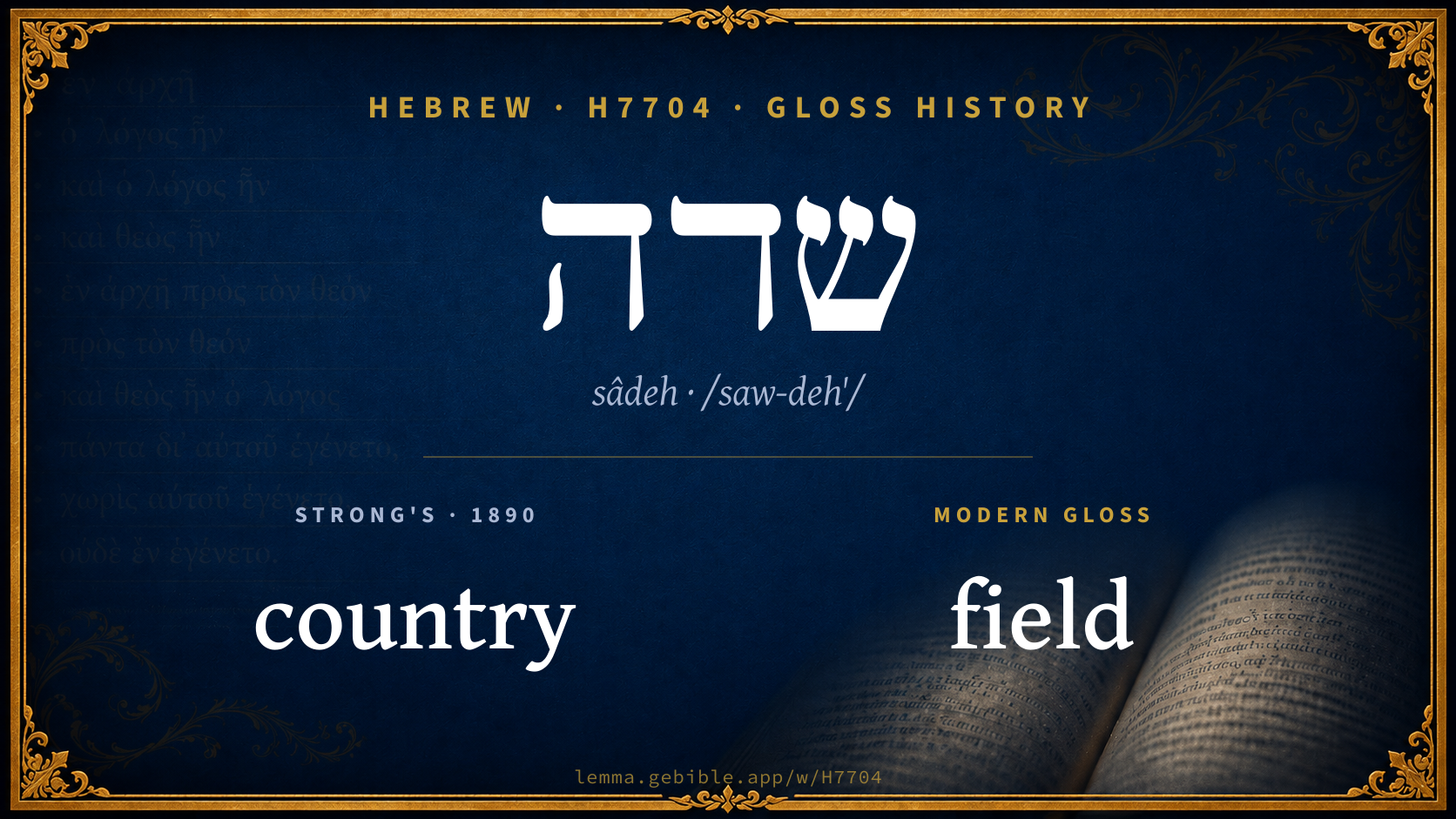
Gloss history
Strong's 1890 vs modern scholarship
About this word
Strong's H7704 catalogs a Hebrew word from the Hebrew Old Testament.
These counts are not copied from any lexicon or concordance. They are computed here, from the morphology-tagged Hebrew Old Testament. What Lemma adds →
- 309
- distinct verses
- The word appears in 309 distinct verses.
- 30 / 39
- OT books
- The word appears in 30 of 39 Old Testament books.
- #147
- by frequency
- Top 250 most frequent Hebrew words (rank 147 of 8,640 Hebrew words by occurrence).
View all 309 occurrences in the concordance →
By section of the Old Testament
By traditional corpus
Conventional, traditional groupings — biblical authorship is debated, so this is a traditional corpus grouping, not an authorship claim. Each share is this word’s portion of its verses in that division of the Hebrew canon. Each figure is a share of the word’s 309 distinct verses.
- Prophets (Nevi'im) 148 verses · 48%
- Torah (Pentateuch) 102 verses · 33%
- Writings (Ketuvim) 59 verses · 19%
How translations render this word
Counts come from each version’s own published word-to-Strong’s tagging or interlinear alignment — an approximate guide to how each version renders this word, not a word-level alignment the data otherwise carries. Because each total is that version’s own tagged count, the per-version totals vary from one another and need not match the appearance or distinct-verse counts above. These counts may also differ from a printed concordance because Lemma counts each distinctly tagged rendering and does not collapse phrase taggings into a single head-word total. This is a fixed set of word-tagged versions (KJV, ASV, BSB, ULT) and does not change with the reading translation you choose elsewhere. Each version’s license is shown beside its name below (and on Sources).
BDB lists this Strong’s number as 2 distinct words (homographs). Each count above pools all of them and is not split by sense — see the Senses section below. A low-frequency rendering may belong to a different one of those words, not the primary meaning.
- King James Version†: Field 214×, Fields 35×, Country 12×
- American Standard Version†: Field 204×, Fields 23×, Country 9×
- Berean Standard Bible†: Field 176×, Fields 50×, Land 18×
- unfoldingWord Literal Text†: Field 221×, Field of 35×, Fields 34×
King James Version Public Domain
Renders H7704 across 333† tagged occurrences — most commonly:
Plus 46 renderings that appear only once — usually multi-word phrases or single function words the recovered tagging swept in, not distinct renderings.
American Standard Version Public Domain
Renders H7704 across 331† tagged occurrences — most commonly:
Plus other, less common renderings. Plus 59 renderings that appear only once — usually multi-word phrases or single function words the recovered tagging swept in, not distinct renderings.
Berean Standard Bible Public Domain
Renders H7704 across 317† tagged occurrences — most commonly:
Plus other, less common renderings. Plus 28 renderings that appear only once — usually multi-word phrases or single function words the recovered tagging swept in, not distinct renderings. Not rendered by a distinct English word in 15 further occurrences.
unfoldingWord Literal Text CC BY-SA 4.0
Renders H7704 across 330† tagged occurrences — most commonly:
Plus 16 renderings that appear only once — usually multi-word phrases or single function words the recovered tagging swept in, not distinct renderings.
19 senses and sub-senses in the full BDB
What do BDB’s symbols mean?
BDB uses these scholarly abbreviations:
| Symbol | Meaning |
|---|---|
| 𝔊 | the Septuagint (the ancient Greek translation, LXX) |
| 𝔙 | the Vulgate (the Latin translation) |
| 𝔖 | the Syriac version (the Peshitta) |
| 𝔗 | the Targum (the Aramaic translation) |
| ψ | the Psalms |
| √ | root (the underlying root or stem) |
| ‖ | parallel passage (a synonymous or contrasted parallel) |
| † | the dagger: every passage where the word occurs is cited |
The 19 senses and sub-senses the full Brown-Driver-Briggs lexicon distinguishes for this word, in lexicon order (not ranked by frequency), with BDB’s own verbatim wording and sub-sense lettering. Shown in Hebrew script with BDB’s own scholarly abbreviations. The condensed entry is in the Lexicon Entry tab. See also the Forms in the corpus table below.
שדה I
- 1. cultivated field 12:12, also 10:4 (si vera l., but v. Now), yielding food Dt 32:13 La 4:9; שֹׁמְרֵי שׂ׳ Je 4:17 keepers, watchmen, of a field. e.g. Hosea 12:12
- 2. home of wild beasts: בְּהֵמוֹת שׂ׳ ψ 8:8 Jo 2:22, חַיְתוֹ שׂ׳ Is 56:9 ψ 104:11, זִיז שׂ׳ 50:11; 80:14. e.g. Psalms 8:8
- 3. plain, opp. mt., Je 18:14 (but dub., Co Du שִׂרְיֹן). e.g. Jeremiah 18:14
- 4. land, opp. sea, ψ 96:12 (cf. שָׂדֶה 3; ‖ תֵּבֵל ψ 98:7). e.g. Psalms 96:12
שדה II
- 1. open field, country:
- a. pasture-land Gn 29:2; 30:16; Ex 9:3 (all J), Dt 11:15; 1 S 11:5 + 10 times J, JE. e.g. Genesis 29:2
- b. unfrequented Gn 24:63, 65, exposed to violence 4:8 (J), 2 S 14:6; Dt 21:1; 22:25, 27, to wild beasts Ex 22:30 (E), Ez 33:27. e.g. Genesis 24:63
- c. specif. home of beasts: 2 S 17:8; Je 14:5; especially phr. חַיַּת הַשּׂ׳ Gn 2:19, 20; 3:1, 14 (all J) of beasts in gen., and, of wild beasts, Ex 23:11, 29 (E), Ho 2:14, 20; 4:3; 13:8; Dt 7:22; Lv 26:22 (H), Jb 5:23 (‖ חַיַּת הָאָרֶץ), + 16 times; בֶּהֱמַת הַשּׂ׳ 1 S 17:44 cf. Jo 1:20; אַיְלוֹת הַשּׂ׳ Ct 2:7; 3:5, cf. הַצְּבָיִם אֲשֶׁר בַּשּׂ׳ 2 S 2:18; hunting-ground Gn 25:29; 27:3, 5 (all JE), cf. אִישׁ שׂ׳ 25:27 (JE; ‖ אִישׁ יֹדֵעַ צַיִד). e.g. 2 Samuel 17:8
- d. yielding plants and trees: Gn 25:27 (JE), 30:14 (J), Ex 10:5 (JE), 2 K 4:39; Ez 21:2; 39:10; especially phr. עֵשֶׂב הַשּׂ׳ Gn 2:5; 3:18 (both J), + 6 times + ע׳ בַּשּׂ׳ Zc 10:1; שִׂיחַ הַשּׂ׳ Gn 2:5, גֶּפֶן שׂ׳ 2 K 4:39, פַּקֻּעֹת שׂ׳ v 39, צִיץ הַשּׂ׳ Is 40:15 ψ 103:15, צֶמַח הַשּׂ׳ Ez 16:7; עֵץ חַשּׂ׳ (4 times עֲצֵי) Ex 9:25 (JE), Dt 20:19; Lv 26:4 (H) Is 55:12 + 8 times; 2 S 1:21 v. תְּרוּמָה, √ רום. e.g. Genesis 25:27
- e. stony, אַבְנֵי הַשּׂ׳ Jb 5:23. e.g. Job 5:23
- f. open country, outside of walled city Ju 9:32, 42, 43, 44; 19:16; 1 S 19:3; 20:5, 11(×2), 24, 35; 2 K 7:12 Mi 4:10; as battle-ground Jos 8:24 (J), 2 S 10:8 = 1 Ch 19:9; 2 S 11:23; 18:6, outside of military camp 1 S 4:2; 14:15; opp. city (in formula) 1 K 14:11; 16:4; 21:24; Je 14:18; Ez 7:15; שְׂדֵה אֶרֶץ Lv 25:31; as site of small town, country-town 1 S 27:5 (opp. royal city), cf. 1 Ch 27:25; of high places, גְּבָעוֹת בַּשּׂ׳ Je 13:27; quite gen., 1 S 30:11; Je 40:7, 13; including road Ju 20:31; 1 K 11:29; Je 6:25; disting. from road Nu 22:23 (JE), 2 S 20:12; outside houses and courtyards Ex 8:9 (P), 1 S 25:15; בַּשּׂ׳ nearly = outdoors Ex 1:14 (P), Ju 13:9; of surface of country or ground, בַּשּׂ׳ Ex 16:25 (JE); = עַל־פְּנֵי הַמִּדְבָּר v 14), cf. 1 S 14:25; so עַל־פְּנֵי הַשּׂ׳ (אֶל) 2 K 9:37; Je 9:22; Ez 29:5 (‖ הַמִּדְבָּ֫רָה), 32:4; 39:5; sample phr. opp. house, comfort, etc., 2 S 11:11; Ez 16:5, opp. city Lv 14:7, 53, opp. tent Nu 19:16 (all P), opp. tent of meeting Lv 17:5 (H). e.g. Judges 9:32
- g. = expanse of country, opp. mt., in phr. מְרוֹמֵי שׂ׳ Ju 5:18; הֲרָרִי בַּשּׂ׳ Je 17:3 (of Jerus.) is dub.; cf. לְעִי הַשּׂ׳ Mi 1:6 (Je 18:14 v. שָׂדַי). e.g. Judges 5:18
- 2. definite portion of ground, field, land:
- a. cultivated ground Gn 37:7 (E), 47:24 (J; זֶרַע הַשָּׂדֶה), Ex 22:4(×3), 5 (E), Lv 27:16, 17 (P), Mi 3:12 (in sim.) Ru 2:2 + 47 times, + שְׂדֵי תְרוּמוֹת 2 S 1:21, שׂ׳־זָ֑רַע Ez 17:5, שָׂדֶה טוֹב v 8 good soil. e.g. Genesis 37:7
- b. as private property, Mi 2:2, 4; Is 5:8(×2); Gn 47:20 (J), 23:9, 11, 13 (P) + 50 times, + 2 Ch 26:23 (as burial-place); also חֶלְקַת (הַ)שּׂ׳, v. חֶלְקָה; and שׂ׳ צֹפִים, v. צפה. e.g. Micah 2:2
- c. city-land, adjacent to city (town) and subject to its control: Gn 41:48 (E), Lv 25:34 (P), Jos 21:12 (P) = 1 Ch 6:41; Ne 11:25; 30; 12:39, 44; specif. of Zoan ψ 78:12, 43. e.g. Genesis 41:48
- d. territory of nation, tribe: Gn 32:4; Nu 21:20 (both JE), Ju 5:4; Ru 1:1, 2; Gn 14:7 + 13 times + שְׂדֵה נַחֲלַת יִשׂ׳ Ju 20:6. e.g. Genesis 32:4
- e. personal estate of king, 2 S 9:7; 19:30. e.g. 2 Samuel 9:7
- 3. land, opp. sea, 1 Ch 16:32 (opp. הַיָּם; = שָׂדַי ψ 96:12), perhaps also mainland Ez 26:6, 8 (Co Krae Toy al.; not Sm). e.g. 1 Chronicles 16:32
Senses from the full Brown-Driver-Briggs lexicon (Brown, Driver, Briggs; Oxford 1906 — public domain), digitized via Sefaria, supplemented by the OpenScriptures HebrewLexicon (CC BY 4.0). Full attribution on Sources.
Word origin
I. n.m. ψ 96:12 field, land (rare orig. form of שָׂדֶה (q.v. infr.), only poet.);—abs. שׂ׳ Je 4:17, שָׂדָ֑י Ho 10:4 +;—
I. n.m. Lv 27:24 id. (ordinary contr. form Ges§ 84 a f);—abs. שׂ׳ Gn 2:5(×2) +; cstr. שְׂדֵה 14:7 +; sf. שָׂדִי Je 32:7, 8, שָֽׂדְךָ Dt 11:15 +, שָׂדֶ֑ךָ 24:19 Lv 25:3, etc.; pl. שָׂדוֹת 1 S 22:7 +, cstr. שְׂדוֹת Ne 12:29; also שְׂדֵי 2 S 1:21; Is 32:12; Ru 1:1 + 8 times (some might be sg. = שְׂדֵה cf. BaZMG xiii (1888), 351 SS Buhl; note, e.g. שְׂדֵי Ru 1:6a, = שְׂדֵה v b; 4:3; but v. Köii. 1, 77); sf. שְׂדֹתֶיהָ Ne 11:30, etc.; also שָׂדֶיךָ 1 K 2:26, שָׂדֵינוּ Mi 2:4;—
— Brown-Driver-Briggs (Oxford 1906, public domain), digitized via Sefaria, supplemented by the OpenScriptures HebrewLexicon (CC BY 4.0). See Sources.
Origin: from an unused root meaning to spread out
Jastrow Dictionary
A second Hebrew/Aramaic lexicon for comparison, covering Aramaic and post-biblical (Talmudic, Targumic, Midrashic) usage that the biblical-Hebrew BDB does not. Matched by lemma rather than by Strong’s number, so a lemma may carry more than one Jastrow headword (shown separately below), and the entries cover usage well beyond the Bible.
שֵׁדָה
- , pl. שֵׁדוֹת, v. שֵׁד.
שִׁדָּה
- , v. שִׁידָּה
שָׂדֶה
- c. (b. h.; cmp. שָׂדַד; v. Del. Assyr. Handw. s. v. šid(d) u, p. 64
- 2. tract of land, field. Shebi. I, 1, a. fr. שְׂדֵה האילן a cultivated field in which trees grow, opp. שְׂ׳ הלבן, v. לָבָן. Sifra B’ḥuck., Par. 4, ch. XI (ref. to Lev. XXVII, 21) מגיד שהש׳ קרוי לשון זכר וכ׳ this proves that sadeh is of masculine gender in the sacred (Biblical) language. Arakh. VIII, 1 המקדיש את שָׂדֵהוּ if a man consecrates his field. Ib. VII, 5 הלוקח … כשְׂ׳ אחוזה if a man bought a field of his father, and his father died, and after this he consecrated it, it is legally treated as an inherited field (Lev. XXVII, 16), contrad. to שְׂ׳ מקנה a purchased field (ib. 22); a. fr.—Keth. I, 6, a. e. נסתחפה שדהו, שָׂדְךָ, v. סָחַף.—Tosef. Shebi. VI, 21 ירקות סָדֶה ed. Zuck. (Var. ש׳) vegetable growing in the field (in the Sabbatical year).—Pl. שָׂדוֹת. Arakh. IX, 5 כל שהוא … חוץ מן הש׳ whatever is within a city wall is legally the same as houses, except fields. Ib. 7; a. fr. e.g. Leviticus 27:21
A Dictionary of the Targumim, the Talmud Babli and Yerushalmi, and the Midrashic Literature (Marcus Jastrow; London, Luzac, 1903) — Public Domain. Digitized via Sefaria. Digitized via Sefaria. Full attribution on Sources.
Forms in the corpus
The 113 distinct written forms H7704 takes in the Hebrew Bible, most frequent first — each parse links to that state’s occurrences in the concordance. Hebrew forms include their vowel points and cantillation, so a single lemma takes many written forms.
The 60 most common forms are shown; 53 rarer forms follow in the full concordance.
Same root — word family
Other BDB entries built from the same root as H7704, grouped by Strong’s listed origin. These share a root / origin per the lexicon — not necessarily a shared meaning. Each links to that word’s own entry.
Derived from this word
Proper names from this root
People and places named from this root — a name, not an additional meaning of the word.
Compare all same-root words → 2 of the same-root words are proper names (people or places). They share a root, not necessarily a meaning.
Septuagint verse parallels
This word appears in 289 verses that also exist in the Greek Old Testament (Septuagint), out of the 309 Hebrew verses it occurs in. You can read those verses in Greek by switching the Old Testament edition to the Septuagint.
Read these verses in the Septuagint
- Genesis 2:5
- Exodus 1:14
- Leviticus 14:7
- Numbers 16:14
- Deuteronomy 5:21
- Joshua 8:24
- Judges 1:14
- Ruth 1:1
- 1 Samuel 4:2
- 2 Samuel 1:21
- 1 Kings 2:26
- 2 Kings 4:39
This is a verse-level parallel only — the same verses exist in both the Hebrew and Greek Old Testaments. No word-level Hebrew↔Greek correspondence is claimed: the data carries no such alignment, so no Greek word is shown as this Hebrew word’s translation. Coverage is not total — the Septuagint omits the deuterocanon and renumbers the Psalms, so some Hebrew verses have no direct Greek parallel.