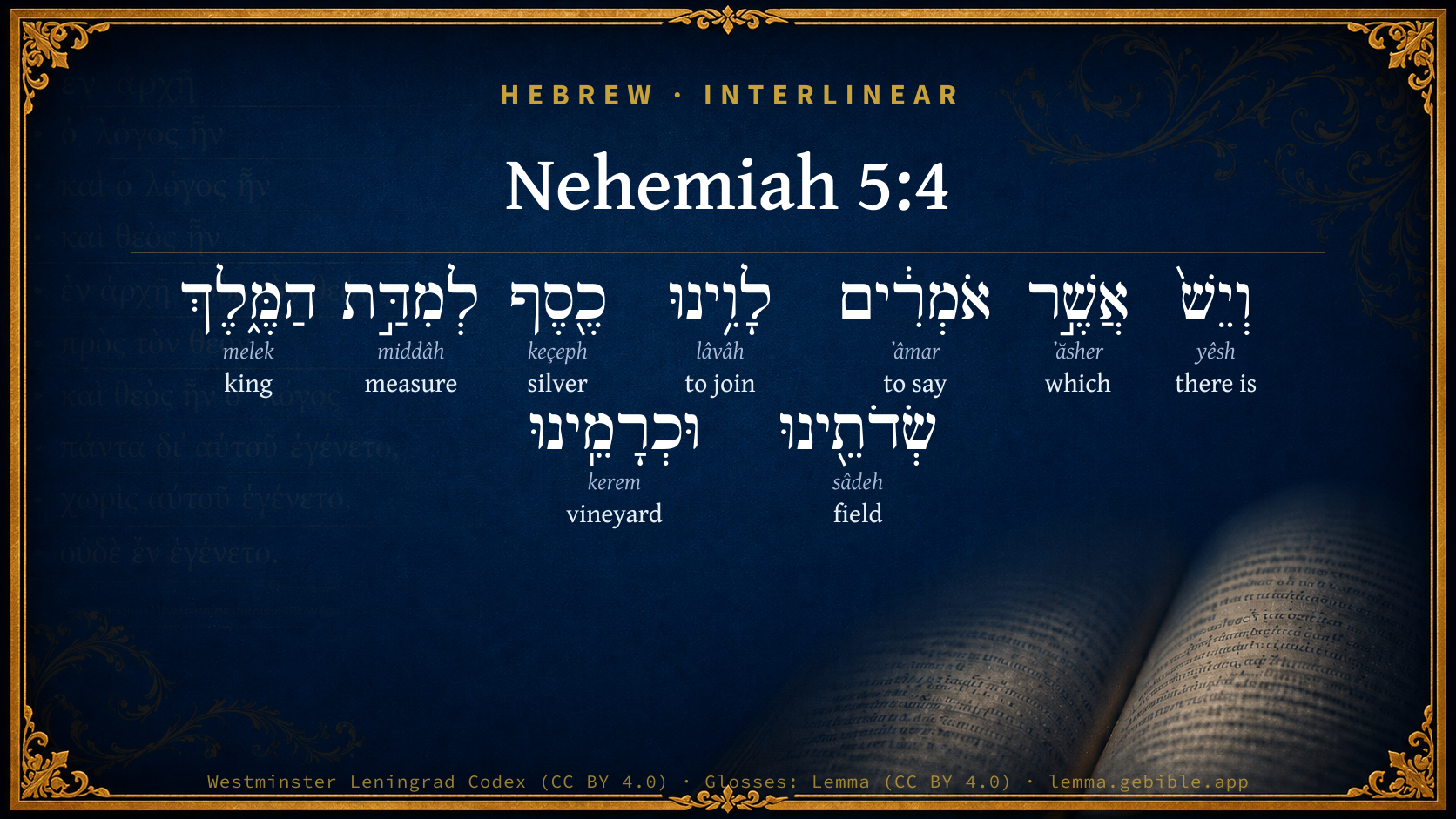
Nehemiah 5:4

Hebrew (Westminster Leningrad Codex) Nehemiah 5:4 appears in the Hebrew Old Testament. The text above is from the Westminster Leningrad Codex. Each word links to its Strong’s number, a concise gloss, and parsing drawn from the Open Scriptures Hebrew Bible morphology. Click any word for its full Brown-Driver-Briggs (BDB) entry.
Download image
Cite this verse

Nehemiah 5:4 (World English Bible). Public Domain. Lemma interlinear Bible study tool, https://lemma.gebible.app/v/nehemiah/5/4.

Show BibTeX & RIS
BibTeX
RIS
English Translation
There were also that said, We have borrowed money for the king's tribute [on] our fields and our vineyards.
World English Bible · Public Domain
Download a study sheet

One document with this verse’s original text, its word-by-word gloss line, the meaning frame, cross-references with their text, attributed commentary, and full source and license credits — printable, and it pastes into notes with its structure intact.

This verse Autodidact and up

Study sheet (.html) Plain text (.txt)

A passage Seminary Student

Up to 50 verses in one chapter. A passage sheet keeps up to 6 commentary sources and 12 cross-references per verse, in the order this page ranks them, and says so on the sheet whenever that leaves anything out. Ask for a single verse and you get the Autodidact verse sheet above.

Everything on this page stays free to read, with no account — the sheet is a download of what is already on screen, not access to it.

Want to remove ads? Support Godless Engineer
Compare translations 3

The same verse in 3 English versions, stacked beneath the original-language interlinear above. Click any original word for its lexicon entry.

Each is an independent rendering of the whole verse — the interlinear is not word-aligned to these translations.

Highlighted words mark where these versions differ — a whole-verse word diff, not a word-by-word alignment.

  • World English Bible Public Domain
    There were also that said, We have borrowed money for the king's tribute [on] our fields and our vineyards.
  • King James Version Public Domain
    There were also that said, We have borrowed money for the king's tribute, and that upon our lands and vineyards.
  • unfoldingWord Literal Text CC BY-SA 4.0
    And there were those who said, “We have borrowed silver for the tribute of the king on our fields and our vineyards.

unfoldingWord Literal Text — © unfoldingWord, licensed CC BY-SA 4.0. Word-aligned USFM3 via Door43 (git.door43.org/unfoldingWord/en_ult).

Versions to compare (up to 4)

3 of 4 selected

Show all 18 translations

Every available English version of this verse, each an independent rendering of the whole verse.

  • World English Bible Public Domain
    There were also that said, We have borrowed money for the king's tribute [on] our fields and our vineyards.
  • Berean Standard Bible Public Domain
    Still others were saying, “We have borrowed money to pay the king’s tax on our fields and vineyards.
  • Majority Standard Bible Public Domain
    Still others were saying, “We have borrowed money to pay the king’s tax on our fields and vineyards.
  • King James Version Public Domain
    There were also that said, We have borrowed money for the king's tribute, and that upon our lands and vineyards.
  • American Standard Version (1901) Public Domain
    There were also that said, We have borrowed money for the king's tribute `upon' our fields and our vineyards.
  • Revised Version (1885) Public Domain
    There were also that said, We have borrowed money for the king’s tribute upon our fields and our vineyards.
  • Geneva Bible (1599) Public Domain
    There were also that said, We haue borowed money for the Kings tribute vpon our landes and our vineyardes.
  • Douay-Rheims (1899) Public Domain
    And others said: Let us borrow money for the king's tribute, and let us give up our fields and vineyards:
  • Young's Literal Translation Public Domain
    And there are who are saying, `We have borrowed money for the tribute of the king, `on' our fields, and our vineyards;
  • Literal Standard Version CC BY-SA 4.0
    And there are [those] who are saying, “We have borrowed money for the tribute of the king, [on] our fields, and our vineyards;
  • Unlocked Literal Bible CC BY-SA 4.0
    Some also said, “We have borrowed money to pay the king's tax on our fields and our vineyards.
  • unfoldingWord Literal Text CC BY-SA 4.0
    And there were those who said, “We have borrowed silver for the tribute of the king on our fields and our vineyards.
  • Darby Bible Public Domain
    And there were that said, We have borrowed money for the king's tribute upon our fields and vineyards;
  • World Messianic Bible Public Domain
    There were also some who said, “We have borrowed money for the king’s tribute using our fields and our vineyards as collateral.
  • Webster's Bible Public Domain
    There were also that said, We have borrowed money for the king's tribute, and that upon our lands and vineyards.
  • Free Bible Version CC BY-SA 4.0
    Still more said, “We've had to borrow money on our fields and vineyards to pay the king's tax.
  • Bible in Basic English Public Domain
    And there were others who said, We have given up our fields and our vine-gardens to get money for the king's taxes.
  • JPS Tanakh (1917) Public Domain
    There were also that said: 'We have borrowed money for the king's tribute upon our fields and our vineyards.

Literal Standard Version (2020), Covenant Press — licensed CC BY-SA 4.0. Text via the HelloAO Bible API (eBible.org). Unlocked Literal Bible (unfoldingWord) — licensed CC BY-SA 4.0. Text via the HelloAO Bible API (eBible.org). unfoldingWord Literal Text — © unfoldingWord, licensed CC BY-SA 4.0. Word-aligned USFM3 via Door43 (git.door43.org/unfoldingWord/en_ult). Free Bible Version, Dr. Jonathan Gallagher — licensed CC BY-SA 4.0. Text via the HelloAO Bible API (eBible.org).

Word by word

More ways to search: Search by grammar → Find every occurrence → Compare this word →

Practice this passage: Drill this verse → Learn its vocabulary →

לָוִ֥ינוּ
lâvâh
H3867
“to join”
Verb, Qal, Perfect, 1st Person, Common, Plural
Part of Speech
Verb
Stem
Qal
Form
Perfect
Person
1st Person
Gender
Common
Number
Plural
Full BDB Definition

Origin: a primitive root

TWOT: 1087 , 1088

to join, be joined - (Qal) to join, be joined, attend - (Niphal) to join oneself to, be joined unto - to borrow, lend - (Qal) to borrow - (Hiphil) to cause to borrow, lend to
  1. וְיֵשׁ֙ yêsh H3426 “and · there is” Conjunction + Particle, Demonstrative
  2. אֲשֶׁ֣ר ʼăsher H834 “which” Particle, Relative
  3. אֹמְרִ֔ים ʼâmar H559 “saying” Verb, Qal, Participle Active, Masculine, Plural, Absolute
  4. כֶ֖סֶף keçeph H3701 “silver” Noun, Common, Masculine, Singular, Absolute
  5. לְמִדַּ֣ת middâh H4060 “to/for · measure of” Preposition + Noun, Common, Feminine, Singular, Construct
  6. הַמֶּ֑לֶךְ melek H4428 “the · king” Particle, Definite Article + Noun, Common, Masculine, Singular, Absolute
  7. שְׂדֹתֵ֖ינוּ sâdeh H7704 “fields · our” Noun, Common, Masculine, Plural, Construct + Suffix, Personal, 1st Person, Common, Plural
  8. וּכְרָמֵֽינוּ kerem H3754 “and · vineyards · our” Conjunction + Noun, Common, Both, Plural, Construct + Suffix, Personal, 1st Person, Common, Plural

About this verse

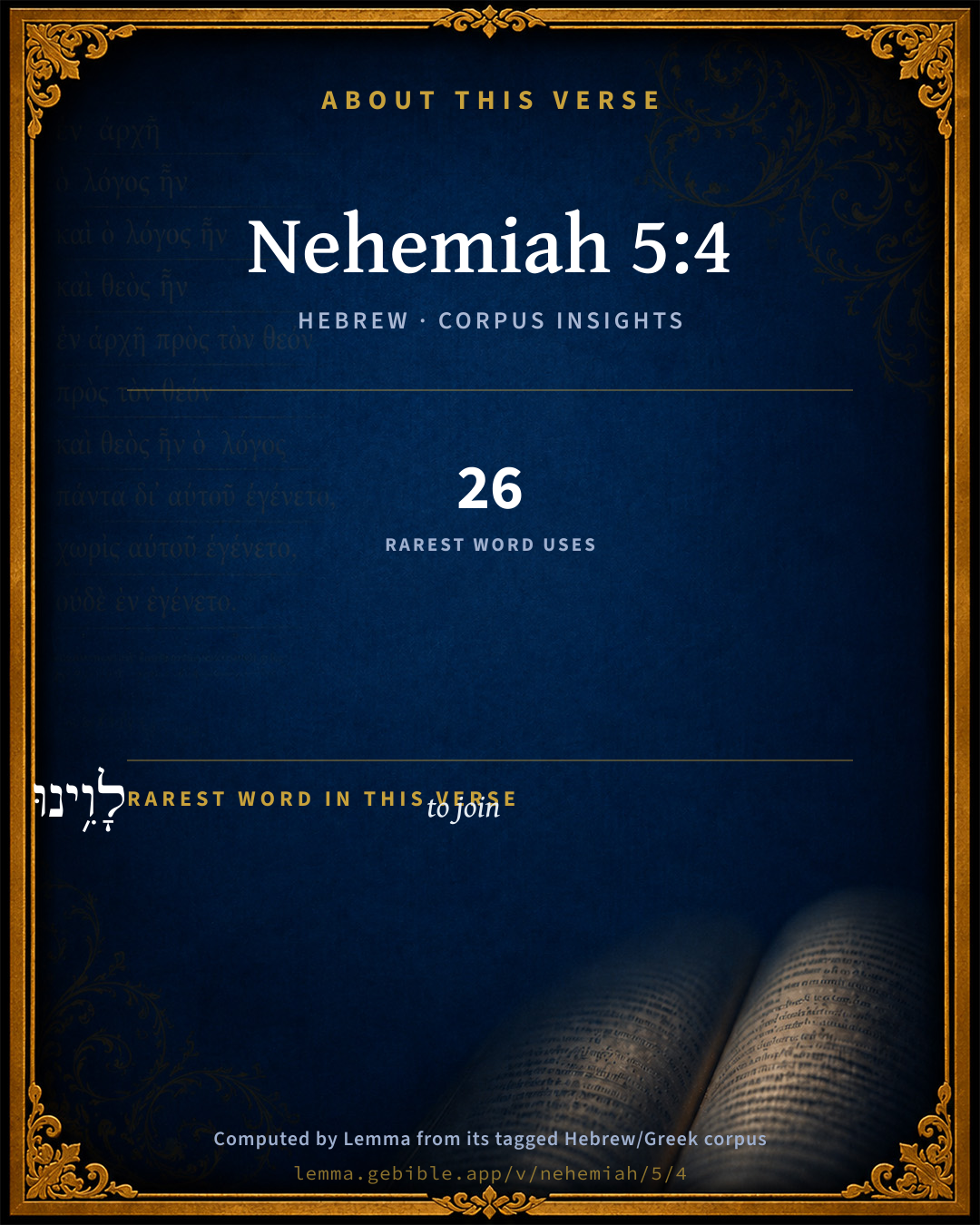
These counts appear in no published source. They are computed here, from the morphology-tagged text and Lemma’s own curated glosses. What Lemma adds →

9
words
9
distinct lemmas
Historical
section

Shared distinctive vocabulary

לָוִ֥ינוּ to join H3867 occurs in 22 verses of the Hebrew Bible. Also found in:

Grammatical profile

  • 2 verbs
  • 5 nouns
  • 2 particles

Verb forms

  • אֹמְרִ֔ים Qal · Participle Active
  • לָוִ֥ינוּ Qal · Perfect

Cross-references

7

Topical passages linked to Nehemiah 5:4 in the Treasury of Scripture Knowledge — connected by theme and wording, ordered by reader-vote popularity; previews shown in the World English Bible.

  • Ezra 4:13 Be it known now to the king that if this city is built, and the walls finished, they will not pay tribute, custom, or toll, and in the end it will be hurtful to the kings.
  • Ezra 4:20 There have been mighty kings also over Jerusalem, who have ruled over all [the country] beyond the River; and tribute, custom, and toll, was paid to them.
  • Deuteronomy 28:47–48 Because you didn't serve Yahweh your God with joyfulness, and with gladness of heart, by reason of the abundance of all things;
  • Joshua 16:10 They didn't drive out the Canaanites who lived in Gezer: but the Canaanites dwell in the midst of Ephraim to this day, and are become servants to do forced labor.
  • 1 Kings 9:21 their children who were left after them in the land, whom the children of Israel were not able utterly to destroy, of them did Solomon raise a levy of bondservants to this day.
  • Ezra 7:24 Also we inform you, that touching any of the priests and Levites, the singers, porters, Nethinim, or servants of this house of God, it shall not be lawful to impose tribute, custom, or toll, on them.
  • Nehemiah 9:37 It yields much increase to the kings whom you have set over us because of our sins: also they have power over our bodies, and over our cattle, at their pleasure, and we are in great distress.

Cross-references courtesy of OpenBible.info (CC BY 4.0).

Hebrew and Greek witnesses Masoretic Hebrew ↔ Greek Septuagint

The same verse in the two great witnesses to the Old Testament, shown verse-for-verse.

These are two independent witnesses, not word-aligned to each other, and the Septuagint is shown in lemma (dictionary) form.

Hebrew Nehemiah 5:4 Masoretic · Westminster Leningrad Codex

וְיֵשׁ֙ אֲשֶׁ֣ר אֹמְרִ֔ים לָוִ֥ינוּ כֶ֖סֶף לְמִדַּ֣ת הַמֶּ֑לֶךְ שְׂדֹתֵ֖ינוּ וּכְרָמֵֽינוּ

There were also that said, We have borrowed money for the king's tribute [on] our fields and our vineyards.

World English Bible · Public Domain

Greek LXX Structure differs

The Septuagint has no separate book of Nehemiah. Its Greek text is the second half of Esdras B (2 Esdras), chapters 11–23; Ezra is the first half (1–10).

A verse-for-verse comparison isn’t shown here because the chapters and verses don’t line up. Switch to the LXX edition with the MT / LXX toggle above to read the Greek directly.

On this verse, Haydock's Catholic Bible Commentary discusses the Septuagint’s reading. Read the note in Commentary ↓

Hebrew: Westminster Leningrad Codex (CC BY 4.0). Greek: Septuagint (public domain); English from a public-domain English Septuagint. How the Septuagint differs from the Hebrew →

Commentary

Notes on Nehemiah 5:4 from classic Christian and Jewish commentators (each source and its license shown beneath its notes). The classic Christian expositions comment on the surrounding passage and are grouped to its opening verse, so a note may address several verses; the Jewish commentaries on the Tanakh (Rashi and others) are per-verse, so they appear only where the commentator wrote on this verse.

Lemma curates 59 commentaries, every one of them public domain or Creative Commons licensed, each selected and text-cleaned for this edition rather than reprinted as found. About our sources →

Trapp's Complete Commentary

John Trapp

Neh 5:4 There were also that said, We have borrowed money for the king’s tribute, [and that upon] our lands and vineyards.

Ver. 4. There were also that said] Here was a third complaint to good Nehemiah; to whom whosoever lamented were sure to have redress and remedy, he did not serve these poor people as that merciless bishop of Mentz, in Germany, did; who, to rid his hands of them in a time of famine, in horreo conclusos iussit concremari, shut them up all together in a barn, and there burnt them (Hatto, Archiep. Mogunt. A. D. 923). He was afterwards eaten to death by rats, non sine maxima divinae vindictae suspicione, saith mine author, by a just hand of God upon him for his cruelty to those poor, whom he would not relieve with his grain, but let the rats eat it; and of whom he said, when they were burning in his barn, that they cried like a company of rats.

We have borrowed money for the king’s tribute] They did not deny payment, and rise up in arms, making poverty their captain, as the Suffolk men did here in Henry VIII’s time. Neither did they answer the king of Persia’s officers, as the men of Andros once did Themistocles. He, being sent by the Athenians to them for tribute, told them that he came unto them on that errand, accompanied with two goddesses, Eloquence, to persuade, and Violence, to enforce them. Their answer was, that they also had on their side two goddesses as strong; Necessity, for they had it not, and Impossibility, for they knew not how to raise it (Plutarch). These men pawn their lands to pay tribute; but it went to their hearts, and caused this complaint.

John Trapp, A Commentary or Exposition upon All the Books of the Old and New Testament (1647–1656) — public domain. Text from a community e-Sword module.

Joseph Benson's Commentary

Neh 5:4. We have borrowed money for the king’s tribute — Which was laid upon them all, Ezr 4:13; Ezr 7:24. Houbigant renders the last part of this verse, for the king’s tribute on our lands and vineyards.

Joseph Benson's Commentary on the Old and New Testaments (1811–1818) — public domain. Text from a community e-Sword module.

Tyndale Open Study Notes

Tyndale Open Resources

5:4 to pay our taxes: Despite the famine, the Persians did not cancel the onerous royal tribute due at harvest time.

Tyndale Open Study Notes — © Tyndale Open Resources, licensed CC BY-SA 4.0. Text via the HelloAO Bible API.

Geneva Bible (1599)

Geneva Bible translators

To pay our tribute to the king of the Persians, which was exacted yearly of us.

Geneva Bible (1599) marginal notes — public domain. Text via Bolls.life.

Adam Clarke's Commentary

Verse 4. We have borrowed money] This should be read, We have borrowed money for the king's tribute on our lands and vineyards. They had a tax to pay to the Persian king in token of their subjection to him, and though it is not likely it was heavy, yet they were not able to pay it.

Adam Clarke's Commentary on the Bible (1810–1826) — public domain. Text from a community e-Sword/MySword module.

Ellicott's Commentary for English Readers

(4) We have borrowed money for the king’s tribute.—Literally, we have made our fields and vineyards answerable for the payment of the Persian tribute. They had pledged the coming produce.

A Bible Commentary for English Readers, edited by Charles John Ellicott (1878–1897) — public domain. Text from a community e-Sword module.

The Cambridge Bible for Schools and Colleges

gen. ed. J. J. S. Perowne

4. Yet a third class is mentioned, who had been compelled to borrow in order to pay the taxes and, not having the means to pay their creditors, sold their children as slaves.

we have borrowed … for the king’s tribute] One special cause of distress seems to have been the heaviness of the royal taxes. Jews who were poor to start with and impoverished by recent circumstances, found themselves under the necessity of borrowing in order to pay the tribute levied by the Persian king from his foreign subjects. See on ‘tribute’ note on Ezr_4:13; Ezr_4:20; Ezr_6:8; Ezr_7:24. On the severity of this taxation in the Persian Empire see Neh_9:37.

and that upon our lands and vineyards] R.V. upon our fields and vineyards. The poor people, in order to pay the tax, borrowed money upon the security of their small holdings. In this way a considerable portion of the property of the poorer classes had passed into the hands of the wealthy money-lenders, who exacted high usury (Neh_5:11), and had no compunction in plying their trade, and visiting default of payment with seizure of a fellow-countryman’s few acres of field and vineyard. At a time when distress was due to the presence of a common foe, this want of generosity and patriotism excited the indignation of the working classes. Even in the more favourable cases, the necessity of paying the interest upon the mortgages deprived the poor Jew of any profits from his holding.

The Cambridge Bible for Schools and Colleges (gen. ed. J. J. S. Perowne; Cambridge University Press, 1878–1918) — public domain. Text from a community e-Sword module.

John Gill's Exposition

There were also that said,.... Who though they were able to buy corn for their families without mortgaging their estates: yet, say they:

we have borrowed money for the king's tribute, and that upon our lands and vineyards; for though the priests, Levites, and Nethinims, were exempted from it, yet not the people in common; and some of these were so poor, that they could not pay it without borrowing upon their estates, and paying large usury for it, see

John Gill's Exposition of the Whole Bible (1746–1763) — public domain (CC PDM 1.0). Text via the HelloAO Bible API.

Albert Barnes' Notes on the Bible

The king’s tribute - The tax payable to the Persian monarch (compare Ezr 4:13; Est 10:1). In ancient times, heavy taxation was often productive of debt and distress.

Albert Barnes' Notes on the Bible (1834–1885) — public domain. Text from a community e-Sword/MySword module.

Haydock's Catholic Bible Commentary

Let us. Septuagint Mont.[Montanus?], "We have borrowed" on usury, contrary to Exodus xxii. 25. The Jews were still obliged to pay tribute.

George Leo Haydock (1774–1849), Haydock's Catholic Family Bible and Commentary, 1859 edition — public domain. Excludes Psalms (Douay-Rheims chapter numbering differs from Protestant) and Deuterocanonical books (Catholic canon only).

Matthew Poole's English Annotations

The kings tribute was laid upon them all. See Ezr 4:13; 7:24

Matthew Poole's English Annotations on the Holy Bible (1683–1685) — public domain. Text from a community e-Sword/MySword module.

Whedon's Commentary on the Bible

Daniel D. Whedon

4. We have borrowed money for the king’s tribute — These represent a third class, whose lands and vineyards seem to have afforded them food for their personal wants, but not money with which to pay the taxes assessed upon them. The princes and wealthier men among the Jews took advantage of this impoverishment of their poorer brethren to exact exorbitant and unlawful interest upon the money they loaned them. Neh_5:7. This was expressly forbidden in the law. Exo_22:25; Deu_23:19. But to obtain this money these persons also had to mortgage or pledge their lands and vineyards. These last two nouns are to be construed, grammatically, as accusatives after borrowed, which verb has not only the sense of borrowing something, but also of pledging something for that which is borrowed.

Daniel D. Whedon (gen. ed.), Commentary on the Old and New Testaments (1874–1909) — public domain. Text from a community e-Sword module.

The Pulpit Commentary

The king"s tribute. Judaea, like other Persian provinces, had to pay a tribute, partly in money and partly in kind, yearly to the Persian monarch; (see the comment on Ezr_4:13) but there is no reason to believe that this burthen was generally felt as oppressive, nor that it was heavier in Judaea than elsewhere. But by the very poor even a small amount of direct taxation is felt as a grievance; and the necessity of meeting the demands of the tax-gatherer was in the ancient world often the turning-point, which compelled the contracting of a debt (Liv., 2:23); and so it seems to have been with these complainants.

The Pulpit Commentary (1880–1919), ed. H.D.M. Spence-Jones & Joseph S. Exell — public domain. Text from a community e-Sword module.

unfoldingWord translationNotes

Door43 World Missions Community

Yet now our flesh and blood is the same as our brothers, and our children are the same as their children

Here the Jews are implying that they are of the same Jewish descent as the other Jews and that they of the same importance as the others. The meaning of this can be made clear. AT: "Yet our families are Jews just like the other Jew's families, and our children are just as important to us as their children are to them" (See: Assumed Knowledge and Implicit Information)

our flesh and blood

This is an idiom which refers to their family members. AT: "our family" (See: Idiom)

Some of our daughters have already been enslaved

This can be stated in active form. AT: "We have already sold some of our daughters into slavery" (See: Active or Passive)

But it is not in our power to help it because other men now own our fields and our vineyards

Since the mens' fields and vineyards are not in their possession, they are unable to produce the money they need to support their families. The full meaning of this can be made clear. AT: "But we are unable to change this situation because other men now own our fields and our vineyards which we need to support our lives" (See: Assumed Knowledge and Implicit Information)

it is not in our power

This is an idiom which means that they do not have the resources to do something. AT: "we are unable" (See: Idiom)

translationWords

king

tax

vineyard

flesh

brother

children

servant

power

unfoldingWord translationNotes — © Distant Shores Media and the Door43 World Missions Community, licensed CC BY-SA 4.0. Source: git.door43.org/Door43/en_tn.

Rashi

Rabbi Shlomo Yitzchaki (Rashi)

And there were some who were saying, “We have borrowed money” And there were some who were saying, “We have already borrowed money from others on our fields and our vineyards to pay the king’s tax, and now we have nothing for our support.”

for the king’s tax Heb. לְמִדַּת, for the king’s tax, like (Ezra 4:13): “...the king’s due (מִנְדָּה), the head tax, and the meal tax.”

Rashi on the Tanakh — English translations: “The Judaica Press complete Tanach with Rashi, translated by A. J. Rosenberg” (CC BY 4.0); “Pentateuch with Rashi's commentary by M. Rosenbaum and A.M. Silbermann, 1929-1934” (public domain); “The Metsudah Tanach series, Lakewood, N.J” (CC BY 4.0); and “The Book of Joshua, Metsudah Publications, 1997” (CC BY 4.0). Text via Sefaria.

Lesson kit

Teaching starters — assembled from the data on this page, not authored interpretation. Every prompt links to the verse data it draws on. Edit before teaching.

Nehemiah, in the Historical, opens this verse with 9 words (9 distinct Hebrew lemmas). Its most distinctive word is lâvâh (“to join”). A historical commentator’s framing appears above. Read the whole chapter for the surrounding context.

Discussion questions

  1. The word lâvâh carries the sense “to join.” How does it shape the verse?
  2. Genesis 29:34 shares the word «to join» with this verse. How do the two illuminate each other?
  3. The translations on this page render this verse differently — a whole-verse word diff, not a word-by-word alignment. What might account for the different wordings?
  4. The verb «אֹמְרִ֔ים» is Qal Participle Active. How does its form color the action?
  5. Reading how Trapp's Complete Commentary and Joseph Benson's Commentary read this verse, where do the two commentators agree and where do they part?

Things to notice

Reading settings

Reading text

Shown beneath each verse's original-language words.

Old Testament
Old Testament edition

Read the OT as the Masoretic Hebrew (MT) or the Greek Septuagint (LXX).

English shown for the Greek Septuagint (in the Hebrew ↔ Greek comparison).

Comparing translations? Open the Compare panel on any verse page to stack up to four side by side.