
1 Samuel 25:15

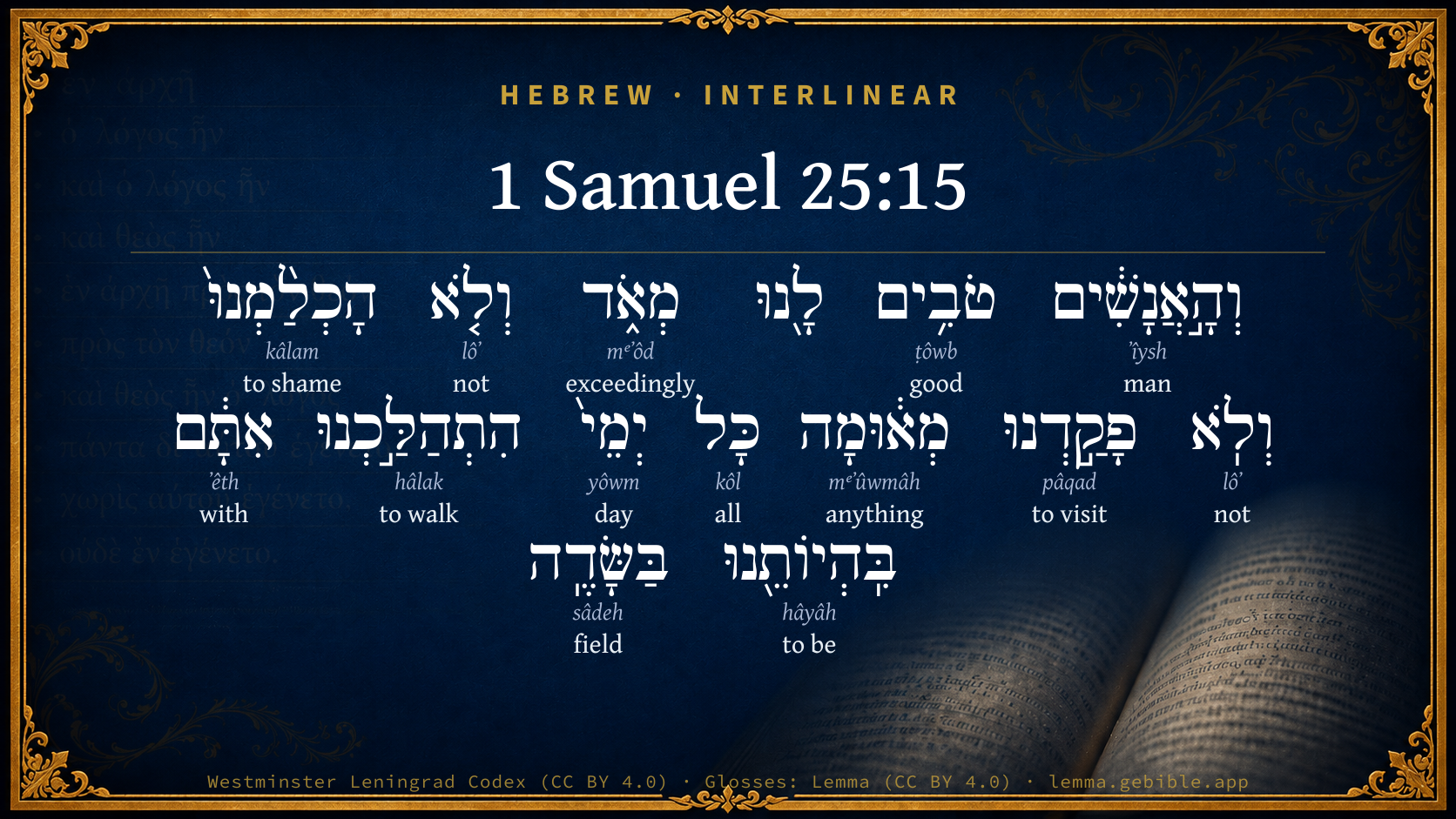
Hebrew (Westminster Leningrad Codex) 1 Samuel 25:15 appears in the Hebrew Old Testament. The text above is from the Westminster Leningrad Codex. Each word links to its Strong’s number, a concise gloss, and parsing drawn from the Open Scriptures Hebrew Bible morphology. Click any word for its full Brown-Driver-Briggs (BDB) entry.
Download image
Cite this verse

1 Samuel 25:15 (World English Bible). Public Domain. Lemma interlinear Bible study tool, https://lemma.gebible.app/v/1-samuel/25/15.

Show BibTeX & RIS
BibTeX
RIS
English Translation
But the men were very good to us, and we were not hurt, neither missed we anything, as long as we went with them, when we were in the fields:
World English Bible · Public Domain
Download a study sheet

One document with this verse’s original text, its word-by-word gloss line, the meaning frame, cross-references with their text, attributed commentary, and full source and license credits — printable, and it pastes into notes with its structure intact.

This verse Autodidact and up

Study sheet (.html) Plain text (.txt)

A passage Seminary Student

Up to 50 verses in one chapter. A passage sheet keeps up to 6 commentary sources and 12 cross-references per verse, in the order this page ranks them, and says so on the sheet whenever that leaves anything out. Ask for a single verse and you get the Autodidact verse sheet above.

Everything on this page stays free to read, with no account — the sheet is a download of what is already on screen, not access to it.

Want to remove ads? Support Godless Engineer
Compare translations 3

The same verse in 3 English versions, stacked beneath the original-language interlinear above. Click any original word for its lexicon entry.

Each is an independent rendering of the whole verse — the interlinear is not word-aligned to these translations.

Highlighted words mark where these versions differ — a whole-verse word diff, not a word-by-word alignment.

  • World English Bible Public Domain
    But the men were very good to us, and we were not hurt, neither missed we anything, as long as we went with them, when we were in the fields:
  • King James Version Public Domain
    But the men were very good unto us, and we were not hurt, neither missed we any thing, as long as we were conversant with them, when we were in the fields:
  • unfoldingWord Literal Text CC BY-SA 4.0
    But the men very good to us. And we were not hurt, and we did not miss anything all of the days when we went about with them in our being in the field.

unfoldingWord Literal Text — © unfoldingWord, licensed CC BY-SA 4.0. Word-aligned USFM3 via Door43 (git.door43.org/unfoldingWord/en_ult).

Versions to compare (up to 4)

3 of 4 selected

Show all 18 translations

Every available English version of this verse, each an independent rendering of the whole verse.

  • World English Bible Public Domain
    But the men were very good to us, and we were not hurt, neither missed we anything, as long as we went with them, when we were in the fields:
  • Berean Standard Bible Public Domain
    Yet these men were very good to us. When we were in the field, we were not harassed, and nothing of ours went missing the whole time we lived among them.
  • Majority Standard Bible Public Domain
    Yet these men were very good to us. When we were in the field, we were not harassed, and nothing of ours went missing the whole time we lived among them.
  • King James Version Public Domain
    But the men were very good unto us, and we were not hurt, neither missed we any thing, as long as we were conversant with them, when we were in the fields:
  • American Standard Version (1901) Public Domain
    But the men were very good unto us, and we were not hurt, neither missed we anything, as long as we went with them, when we were in the fields:
  • Revised Version (1885) Public Domain
    But the men were very good unto us, and we were not hurt, neither missed we any thing, as long as we were conversant with them, when we were in the fields:
  • Geneva Bible (1599) Public Domain
    Notwithstanding the men were very good vnto vs, and we had no displeasure, neither missed we any thing as long as we were conuersant with them, when we were in the fieldes.
  • Douay-Rheims (1899) Public Domain
    These men were very good to us, and gave us no trouble: neither did we ever lose any thing all the time that we conversed with them in the desert.
  • Young's Literal Translation Public Domain
    and the men `are' very good to us, and have not put us to shame, and we have not looked after anything all the days we have gone up and down with them, in our being in the field;
  • Literal Standard Version CC BY-SA 4.0
    and the men [are] very good to us, and have not put us to shame, and we have not looked after anything all the days we have gone up and down with them, in our being in the field;
  • Unlocked Literal Bible CC BY-SA 4.0
    Yet the men were very good to us. We were not harmed and did not miss anything as long as we went with them when we were in the fields.
  • unfoldingWord Literal Text CC BY-SA 4.0
    But the men very good to us. And we were not hurt, and we did not miss anything all of the days when we went about with them in our being in the field.
  • Darby Bible Public Domain
    And the men were very good to us, and we were not hurt, neither missed we anything, as long as we companied with them, when we were in the fields.
  • World Messianic Bible Public Domain
    But the men were very good to us, and we were not harmed, and we didn’t miss anything as long as we went with them, when we were in the fields.
  • Webster's Bible Public Domain
    But the men were very good to us, and we were not hurt, neither missed we any thing, as long as we were conversant with them, when we were in the fields:
  • Free Bible Version CC BY-SA 4.0
    David's men were always very good to us and they never mistreated us. All the time we were out in the fields with them nothing was stolen from us.
  • Bible in Basic English Public Domain
    But these men have been very good to us; they did us no wrong and nothing of ours was touched while we were with them in the fields:
  • JPS Tanakh (1917) Public Domain
    But the men were very good unto us, and we were not hurt, neither missed we any thing, as long as we went with them, when we were in the fields;

Literal Standard Version (2020), Covenant Press — licensed CC BY-SA 4.0. Text via the HelloAO Bible API (eBible.org). Unlocked Literal Bible (unfoldingWord) — licensed CC BY-SA 4.0. Text via the HelloAO Bible API (eBible.org). unfoldingWord Literal Text — © unfoldingWord, licensed CC BY-SA 4.0. Word-aligned USFM3 via Door43 (git.door43.org/unfoldingWord/en_ult). Free Bible Version, Dr. Jonathan Gallagher — licensed CC BY-SA 4.0. Text via the HelloAO Bible API (eBible.org).

Word by word

More ways to search: Search by grammar → Find every occurrence → Compare this word →

Practice this passage: Drill this verse → Learn its vocabulary →

מְא֔וּמָה
mᵉʼûwmâh
H3972
“anything”
Noun, Common, Feminine, Singular, Absolute
Part of Speech
Noun
Type
Common
Gender
Feminine
Number
Singular
State
Absolute
Full BDB Definition

Origin: apparently a form of H3971

TWOT: 1136

anything
  1. וְהָ֣אֲנָשִׁ֔ים ʼîysh H376 “and · the · men” Conjunction + Particle, Definite Article + Noun, Common, Masculine, Plural, Absolute
  2. טֹבִ֥ים ṭôwb H2896 “good” Adjective, Adjective, Masculine, Plural, Absolute
  3. מְאֹ֑ד mᵉʼôd H3966 “exceedingly” Adverb
  4. וְלֹ֤א lôʼ H3808 “and · not” Conjunction + Particle, Negative
  5. הָכְלַ֨מְנוּ֙ kâlam H3637 “to shame” Verb, Hophal, Perfect, 1st Person, Common, Plural
  6. וְלֹֽא lôʼ H3808 “and · not” Conjunction + Particle, Negative
  7. פָקַ֣דְנוּ pâqad H6485 “to visit” Verb, Qal, Perfect, 1st Person, Common, Plural
  8. כָּל kôl H3605 “all of” Noun, Common, Masculine, Singular, Construct
  9. יְמֵי֙ yôwm H3117 “days of” Noun, Common, Masculine, Plural, Construct
  10. הִתְהַלַּ֣כְנוּ hâlak H1980 “to walk” Verb, Hithpael, Perfect, 1st Person, Common, Plural
  11. אִתָּ֔ם ʼêth H854 “with · them” Preposition + Suffix, Personal, 3rd Person, Masculine, Plural
  12. בִּֽהְיוֹתֵ֖נוּ hâyâh H1961 “in/at · to be · us” Preposition + Verb, Qal, Infinitive Construct + Suffix, Personal, 1st Person, Common, Plural
  13. בַּשָּׂדֶֽה sâdeh H7704 “in/at the · field” Preposition, Determined + Noun, Common, Masculine, Singular, Absolute

About this verse

These counts appear in no published source. They are computed here, from the morphology-tagged text and Lemma’s own curated glosses. What Lemma adds →

15
words
13
distinct lemmas
Historical
section

Shared distinctive vocabulary

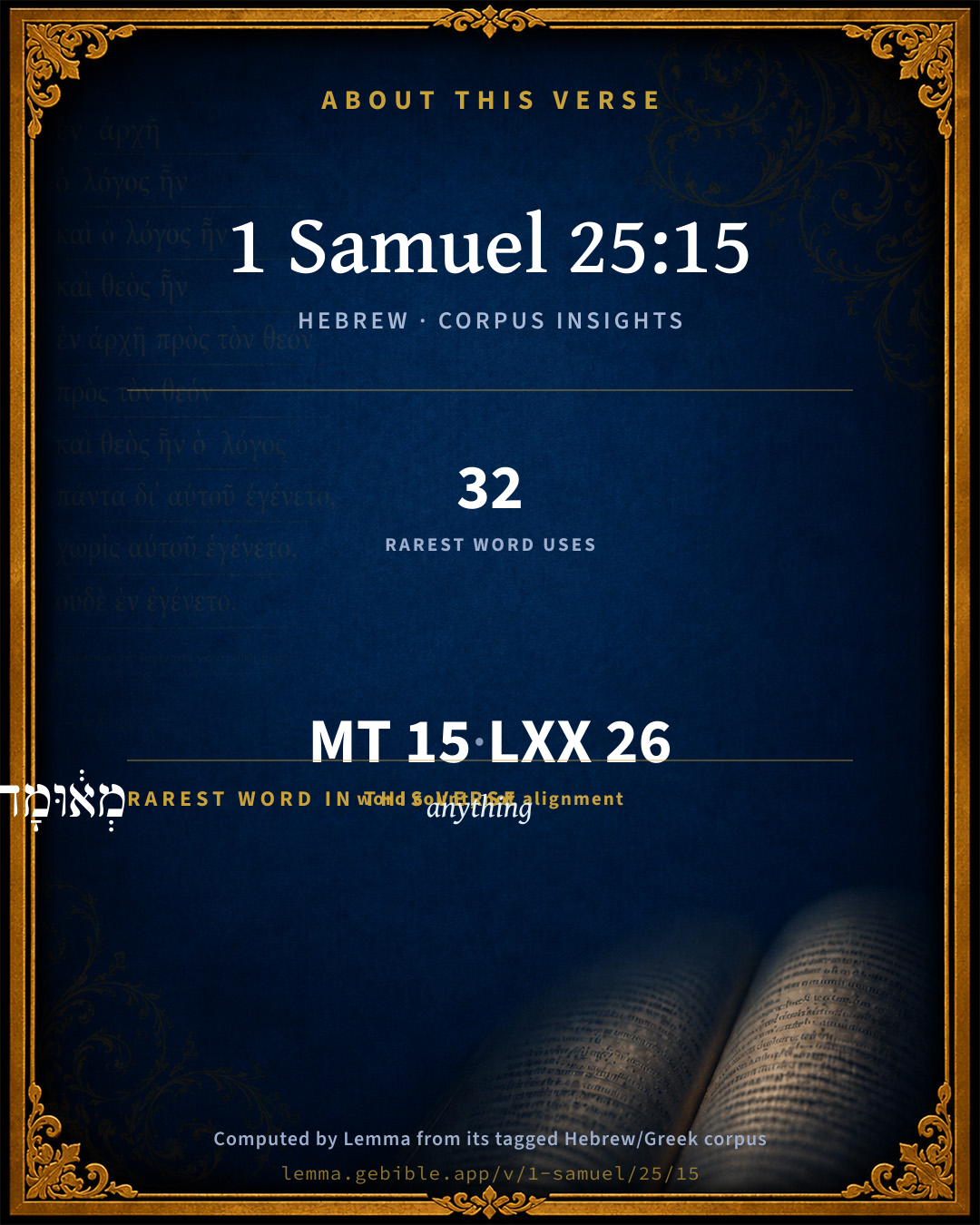
מְא֔וּמָה anything H3972 occurs in 32 verses of the Hebrew Bible. Also found in:

Grammatical profile

  • 4 verbs
  • 5 nouns
  • 1 adjective
  • 2 prepositions
  • 1 adverb
  • 2 particles

Verb forms

  • הָכְלַ֨מְנוּ֙ Hophal · Perfect
  • פָקַ֣דְנוּ Qal · Perfect
  • הִתְהַלַּ֣כְנוּ Hithpael · Perfect
  • בִּֽהְיוֹתֵ֖נוּ Qal · Infinitive Construct

Repetition

A word recurs within this verse — often emphatic in Hebrew:

  • וְלֹ֤א not H3808 ×2

Hebrew & Septuagint length

In English translation the verse runs 30 words from the Hebrew and 29 from the Septuagint (LXX English) — closely comparable.

A rough comparison of the two English renderings, which tokenize alike — not a word-level alignment.

Word counts can differ between the Hebrew and the Greek without any difference in meaning — e.g. the Hebrew direct-object marker אֵת has no separate Greek word, and Greek often adds the article ὁ.

In the original languages it is 15 Hebrew tokens and 26 Greek tokens — but the two are counted differently (Hebrew bundles its prefixes and suffixes into one token; the Greek is in lemma form), so that isn’t a like-for-like length.

Cross-references

3

Topical passages linked to 1 Samuel 25:15 in the Treasury of Scripture Knowledge — connected by theme and wording, ordered by reader-vote popularity; previews shown in the World English Bible.

  • 1 Samuel 25:7 Now I have heard that you have shearers: your shepherds have now been with us, and we did them no hurt, neither was there anything missing to them, all the while they were in Carmel.
  • 1 Samuel 25:21 Now David had said, Surely in vain have I kept all that this fellow has in the wilderness, so that nothing was missed of all that pertained to him: and he has returned me evil for good.
  • Philippians 2:15 that you may become blameless and harmless, children of God without blemish in the midst of a crooked and perverse generation, among whom you are seen as lights in the world,

Cross-references courtesy of OpenBible.info (CC BY 4.0).

Hebrew and Greek witnesses Masoretic Hebrew ↔ Greek Septuagint

The same verse in the two great witnesses to the Old Testament, shown verse-for-verse.

These are two independent witnesses, not word-aligned to each other, and the Septuagint is shown in lemma (dictionary) form.

Hebrew 1 Samuel 25:15 Masoretic · Westminster Leningrad Codex

וְהָ֣אֲנָשִׁ֔ים טֹבִ֥ים לָ֖נוּ מְאֹ֑ד וְלֹ֤א הָכְלַ֨מְנוּ֙ וְלֹֽא פָקַ֣דְנוּ מְא֔וּמָה כָּל יְמֵי֙ הִתְהַלַּ֣כְנוּ אִתָּ֔ם בִּֽהְיוֹתֵ֖נוּ בַּשָּׂדֶֽה

But the men were very good to us, and we were not hurt, neither missed we anything, as long as we went with them, when we were in the fields:

World English Bible · Public Domain

Greek LXX 1 Samuel 25:15 Septuagint · lemma form

καί ὁ ἀνήρ ἀγαθός ἐγώ σφόδρα οὐ ἀποκωλύω ἐγώ οὐδέ ἐντέλλομαι ἐγώ πᾶς ὁ ἡμέρα ὅς εἰμί παρά αὐτός καί ἐν ὁ εἰμί ἐγώ ἐν ἀγρός

And the men were very good to us; they did not hinder us, neither did they demand from us any thing all the days that we were with them.

LXX2012 (modern English Septuagint) · Public Domain

Hebrew: Westminster Leningrad Codex (CC BY 4.0). Greek: Septuagint (public domain); English from LXX2012 (modern English Septuagint) (Public Domain). How the Septuagint differs from the Hebrew →

Targum (Aramaic paraphrase)

1

The Targum is the ancient Jewish Aramaic paraphrase of the Hebrew Scriptures — an interpretive translation, not the Hebrew text itself. Onkelos (literal) and Pseudo-Jonathan (expansive) render the Torah, and Jonathan the Prophets. Coverage is partial: where no permissively-licensed English translation exists for a verse, only the Aramaic is shown. This is verse-level text, not a word-by-word alignment to the Hebrew.

  1. Targum Jonathan Prophets (Joshua–Malachi)
    וְגַבְרַיָא טָבִין לָנָא לַחֲדָא וְלָא אִתְנְזֵיקְנָא וְלָא שְׁגָא לָנָא מִדַעַם כָּל יוֹמִין דִי הֲלֵכְנָא עִמְהוֹן כַּד הֲוֵינָא שָׁרָן בְחַקְלָא:

    (no public-domain English translation for this verse)

    Targum Jonathan — Aramaic: “Mikraot Gedolot” (public domain). English: “Sefaria Community Translation” (CC0 1.0 (public-domain dedication)); “London "Chaldee Paraphrase," 1871” (public domain). Text via Sefaria.

Commentary

Notes on 1 Samuel 25:15 from classic Christian and Jewish commentators (each source and its license shown beneath its notes). The classic Christian expositions comment on the surrounding passage and are grouped to its opening verse, so a note may address several verses; the Jewish commentaries on the Tanakh (Rashi and others) are per-verse, so they appear only where the commentator wrote on this verse.

Lemma curates 59 commentaries, every one of them public domain or Creative Commons licensed, each selected and text-cleaned for this edition rather than reprinted as found. About our sources →

Ellicott's Commentary for English Readers

(15) But the men were very good unto us.—The “young man” in question who spoke thus to his mistress, Abigail, was evidently one in high authority in the sheep farms of Nabal. His testimony in 1Sa_25:15-16, respecting David is clear and decisive, and occurring as it does in the heart of an episode most discreditable to David, it bears weighty testimony to the admirable discipline and the kind forethought of the son of Jesse in times when lawlessness and pillage would have been, if not excusable, certainly to be expected. The great powers of the future king were admirably displayed in this difficult period of his life. Few men could have so moulded a wild company of free lances into a force which, according to the rather unwilling testimony of these shepherds of Nabal’s, was positively a blessing to the country, instead of being, as these bands of free lances usually have been, a terrible curse.

A Bible Commentary for English Readers, edited by Charles John Ellicott (1878–1897) — public domain. Text from a community e-Sword module.

Trapp's Complete Commentary

John Trapp

1Sa 25:15 But the men [were] very good unto us, and we were not hurt, neither missed we any thing, as long as we were conversant with them, when we were in the fields:

Ver. 15. And we were not hurt.] So strict was David’s military discipline; so was afterwards Tamerlane’s; {a} who punished with death that soldier of his that but took an apple, or a little milk, &c., from another, without permission.

{a} Turk. Hist., 216.

John Trapp, A Commentary or Exposition upon All the Books of the Old and New Testament (1647–1656) — public domain. Text from a community e-Sword module.

Geneva Bible (1599)

Geneva Bible translators

When we kept our sheep in the wilderness of Paran.

Geneva Bible (1599) marginal notes — public domain. Text via Bolls.life.

The Cambridge Bible for Schools and Colleges

gen. ed. J. J. S. Perowne

15. as long as we were conversant with them] Lit. all the days we went to and fro with them. “Conversant” from Lat. conversari, to dwell or abide with, signifies “associated” or “living along with.”

The Cambridge Bible for Schools and Colleges (gen. ed. J. J. S. Perowne; Cambridge University Press, 1878–1918) — public domain. Text from a community e-Sword module.

John Gill's Exposition

But the men were very good unto us,.... Very kind and civil, yea, very useful and serviceable, even all the messengers David sent and Nabal railed on, yea, all David's men, and therefore deserved better treatment than they met with from Nabal:

and we were not hurt; neither by them nor others:

neither missed we anything: of our flocks, or anything belonging to us; they neither robbed us themselves, nor suffered others to rob us:

as long as we were conversant with them, when we were in the fields; feeding the sheep by them: thus he confirms everything that David said of himself and his men; see Gill on Sa1 25:7, and says even more of them to their commendation, as follows.

John Gill's Exposition of the Whole Bible (1746–1763) — public domain (CC PDM 1.0). Text via the HelloAO Bible API.

Rashi

Rabbi Shlomo Yitzchaki (Rashi)

We were not shamed. We were not disgraced.

Rashi on the Tanakh — English translations: “The Judaica Press complete Tanach with Rashi, translated by A. J. Rosenberg” (CC BY 4.0); “Pentateuch with Rashi's commentary by M. Rosenbaum and A.M. Silbermann, 1929-1934” (public domain); “The Metsudah Tanach series, Lakewood, N.J” (CC BY 4.0); and “The Book of Joshua, Metsudah Publications, 1997” (CC BY 4.0). Text via Sefaria.

Lesson kit

Teaching starters — assembled from the data on this page, not authored interpretation. Every prompt links to the verse data it draws on. Edit before teaching.

1 Samuel, in the Historical, opens this verse with 15 words (13 distinct Hebrew lemmas). Its most distinctive word is mᵉʼûwmâh (“anything”). A historical commentator’s framing appears above. Read the whole chapter for the surrounding context.

Discussion questions

  1. The word mᵉʼûwmâh carries the sense “anything.” How does it shape the verse?
  2. How does Genesis 22:12, which shares the word «anything», read alongside this verse?
  3. What does the repetition of “not” (2× in this one verse) do in this verse?
  4. These translations render this verse differently. What is at stake in choosing one wording over another?
  5. «הָכְלַ֨מְנוּ֙» is a Hophal Perfect verb. How does that grammatical form shape the action described?
  6. Compare how Ellicott's Commentary for English Readers and Trapp's Complete Commentary read this verse. Where do they agree or differ?

Things to notice

Reading settings

Reading text

Shown beneath each verse's original-language words.

Old Testament
Old Testament edition

Read the OT as the Masoretic Hebrew (MT) or the Greek Septuagint (LXX).

English shown for the Greek Septuagint (in the Hebrew ↔ Greek comparison).

Comparing translations? Open the Compare panel on any verse page to stack up to four side by side.