
Judges 9:43

Hebrew (Westminster Leningrad Codex) Judges 9:43 appears in the Hebrew Old Testament. The text above is from the Westminster Leningrad Codex. Each word links to its Strong’s number, a concise gloss, and parsing drawn from the Open Scriptures Hebrew Bible morphology. Click any word for its full Brown-Driver-Briggs (BDB) entry.
Download image
Cite this verse

Judges 9:43 (World English Bible). Public Domain. Lemma interlinear Bible study tool, https://lemma.gebible.app/v/judges/9/43.

Show BibTeX & RIS
BibTeX
RIS
English Translation
He took the people, and divided them into three companies, and laid wait in the field; and he looked, and, behold, the people came forth out of the city; He rose up against them, and struck them.
World English Bible · Public Domain
Download a study sheet

One document with this verse’s original text, its word-by-word gloss line, the meaning frame, cross-references with their text, attributed commentary, and full source and license credits — printable, and it pastes into notes with its structure intact.

This verse Autodidact and up

Study sheet (.html) Plain text (.txt)

A passage Seminary Student

Up to 50 verses in one chapter. A passage sheet keeps up to 6 commentary sources and 12 cross-references per verse, in the order this page ranks them, and says so on the sheet whenever that leaves anything out. Ask for a single verse and you get the Autodidact verse sheet above.

Everything on this page stays free to read, with no account — the sheet is a download of what is already on screen, not access to it.

Want to remove ads? Support Godless Engineer
Compare translations 3

The same verse in 3 English versions, stacked beneath the original-language interlinear above. Click any original word for its lexicon entry.

Each is an independent rendering of the whole verse — the interlinear is not word-aligned to these translations.

Highlighted words mark where these versions differ — a whole-verse word diff, not a word-by-word alignment.

  • World English Bible Public Domain
    He took the people, and divided them into three companies, and laid wait in the field; and he looked, and, behold, the people came forth out of the city; He rose up against them, and struck them.
  • King James Version Public Domain
    And he took the people, and divided them into three companies, and laid wait in the field, and looked, and, behold, the people were come forth out of the city; and he rose up against them, and smote them.
  • unfoldingWord Literal Text CC BY-SA 4.0
    So he took the people and divided them into three companies and hid in the field. Then he saw and behold, the people gone out from the city, and he arose against them and killed them.

unfoldingWord Literal Text — © unfoldingWord, licensed CC BY-SA 4.0. Word-aligned USFM3 via Door43 (git.door43.org/unfoldingWord/en_ult).

Versions to compare (up to 4)

3 of 4 selected

Show all 18 translations

Every available English version of this verse, each an independent rendering of the whole verse.

  • World English Bible Public Domain
    He took the people, and divided them into three companies, and laid wait in the field; and he looked, and, behold, the people came forth out of the city; He rose up against them, and struck them.
  • Berean Standard Bible Public Domain
    So he took his men, divided them into three companies, and lay in wait in the fields. When he saw the people coming out of the city, he rose up against them and attacked them.
  • Majority Standard Bible Public Domain
    So he took his men, divided them into three companies, and lay in wait in the fields. When he saw the people coming out of the city, he rose up against them and attacked them.
  • King James Version Public Domain
    And he took the people, and divided them into three companies, and laid wait in the field, and looked, and, behold, the people were come forth out of the city; and he rose up against them, and smote them.
  • American Standard Version (1901) Public Domain
    And he took the people, and divided them into three companies, and laid wait in the field; and he looked, and, behold, the people came forth out of the city; And he rose up against them, and smote them.
  • Revised Version (1885) Public Domain
    And he took the people, and divided them into three companies, and laid wait in the field; and he looked, and, behold, the people came forth out of the city; and he rose up against them, and smote them.
  • Geneva Bible (1599) Public Domain
    And he tooke the people, and deuided them into three bandes, and layde wayte in the fieldes, and looked, and beholde, the people were come out of the citie, and he rose vp against them, and smote them.
  • Douay-Rheims (1899) Public Domain
    And he took his army, and divided it into three companies, and laid ambushes in the fields. And seeing that the people came out of the city, he arose and set upon them,
  • Young's Literal Translation Public Domain
    and he taketh the people, and divideth them into three detachments, and layeth wait in a field, and looketh, and lo, the people are coming out from the city, and he riseth against them, and smiteth them.
  • Literal Standard Version CC BY-SA 4.0
    and he takes the people, and divides them into three detachments, and lays wait in a field, and looks, and behold, the people are coming out from the city, and he rises against them, and strikes them.
  • Unlocked Literal Bible CC BY-SA 4.0
    He took his people, divided them into three units, and they set an ambush in the fields. He looked and saw the people coming out from the city and he attacked and killed them.
  • unfoldingWord Literal Text CC BY-SA 4.0
    So he took the people and divided them into three companies and hid in the field. Then he saw and behold, the people gone out from the city, and he arose against them and killed them.
  • Darby Bible Public Domain
    He took his men and divided them into three companies, and laid wait in the fields; and he looked and saw the men coming out of the city, and he rose against them and slew them.
  • World Messianic Bible Public Domain
    He took the people and divided them into three companies, and laid wait in the field; and he looked, and behold, the people came out of the city. So, he rose up against them and struck them.
  • Webster's Bible Public Domain
    And he took the people, and divided them into three companies, and laid wait in the field, and looked, and behold, the people had come out of the city; and he rose up against them, and smote them.
  • Free Bible Version CC BY-SA 4.0
    He divided his army into three companies and had them lay in ambush in the fields. When he saw the people coming out of the city, he attacked and killed them.
  • Bible in Basic English Public Domain
    And he took his people, separating them into three bands, and was waiting secretly in the field; and when he saw the people coming out of the town, he went up and made an attack on them.
  • JPS Tanakh (1917) Public Domain
    And he took the people, and divided them into three companies, and lay in wait in the field; and he looked, and, behold, the people were coming forth out of the city; and he rose up against them, and smote them.

Literal Standard Version (2020), Covenant Press — licensed CC BY-SA 4.0. Text via the HelloAO Bible API (eBible.org). Unlocked Literal Bible (unfoldingWord) — licensed CC BY-SA 4.0. Text via the HelloAO Bible API (eBible.org). unfoldingWord Literal Text — © unfoldingWord, licensed CC BY-SA 4.0. Word-aligned USFM3 via Door43 (git.door43.org/unfoldingWord/en_ult). Free Bible Version, Dr. Jonathan Gallagher — licensed CC BY-SA 4.0. Text via the HelloAO Bible API (eBible.org).

Word by word

More ways to search: Search by grammar → Find every occurrence → Compare this word →

Practice this passage: Drill this verse → Learn its vocabulary →

וַֽיֶּחֱצֵם֙
châtsâh
H2673
“and · to divide · them”
Conjunction + Verb, Qal, Sequential Imperfect, 3rd Person, Masculine, Singular + Suffix, Personal, 3rd Person, Masculine, Plural
Part of Speech
Conjunction + Verb
Stem
Qal
Form
Sequential Imperfect
Person
3rd Person
Gender
Masculine
Number
Singular
Full BDB Definition

Origin: a primitive root [compare H2686 ])

TWOT: 719

to divide, cut in two, cut short, live half (of one's life) - (Qal) - to divide - to half, cut in two - (Niphal) to be divided
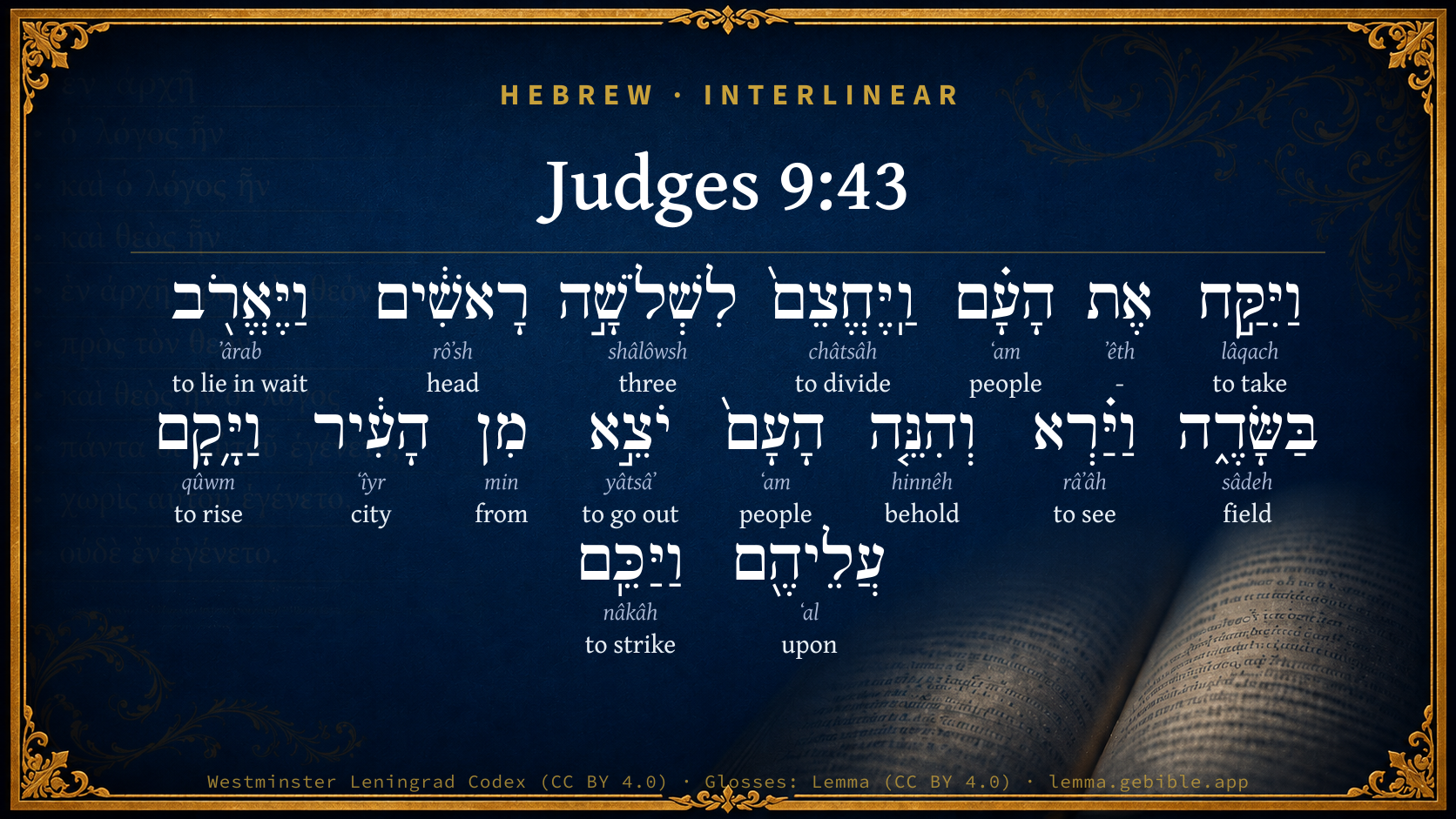
  1. וַיִּקַּ֣ח lâqach H3947 “and · to take” Conjunction + Verb, Qal, Sequential Imperfect, 3rd Person, Masculine, Singular
  2. אֶת ʼêth H853 “-” Particle, Direct Object
  3. הָעָ֗ם ʻam H5971 “the · people” Particle, Definite Article + Noun, Common, Masculine, Singular, Absolute
  4. לִשְׁלֹשָׁ֣ה shâlôwsh H7969 “to/for · three” Preposition + Adjective, Cardinal number, Masculine, Singular, Absolute
  5. רָאשִׁ֔ים rôʼsh H7218 “heads” Noun, Common, Masculine, Plural, Absolute
  6. וַיֶּאֱרֹ֖ב ʼârab H693 “and · to lie in wait” Conjunction + Verb, Qal, Sequential Imperfect, 3rd Person, Masculine, Singular
  7. בַּשָּׂדֶ֑ה sâdeh H7704 “in/at the · field” Preposition, Determined + Noun, Common, Masculine, Singular, Absolute
  8. וַיַּ֗רְא râʼâh H7200 “and · to see” Conjunction + Verb, Qal, Sequential Imperfect, 3rd Person, Masculine, Singular
  9. וְהִנֵּ֤ה hinnêh H2009 “and · behold” Conjunction + Particle, Demonstrative
  10. הָעָם֙ ʻam H5971 “the · people” Particle, Definite Article + Noun, Common, Masculine, Singular, Absolute
  11. יֹצֵ֣א yâtsâʼ H3318 “going out” Verb, Qal, Participle Active, Masculine, Singular, Absolute
  12. מִן min H4480 “from” Preposition
  13. הָעִ֔יר ʻîyr H5892 “the · city” Particle, Definite Article + Noun, Common, Feminine, Singular, Absolute
  14. וַיָּ֥קָם qûwm H6965 “and · to rise” Conjunction + Verb, Qal, Sequential Imperfect, 3rd Person, Masculine, Singular
  15. עֲלֵיהֶ֖ם ʻal H5921 “upon · them” Preposition + Suffix, Personal, 3rd Person, Masculine, Plural
  16. וַיַּכֵּֽם nâkâh H5221 “and · to strike · them” Conjunction + Verb, Hiphil, Sequential Imperfect, 3rd Person, Masculine, Singular + Suffix, Personal, 3rd Person, Masculine, Plural

About this verse

These counts appear in no published source. They are computed here, from the morphology-tagged text and Lemma’s own curated glosses. What Lemma adds →

17
words
16
distinct lemmas
Historical
section

Notable vocabulary

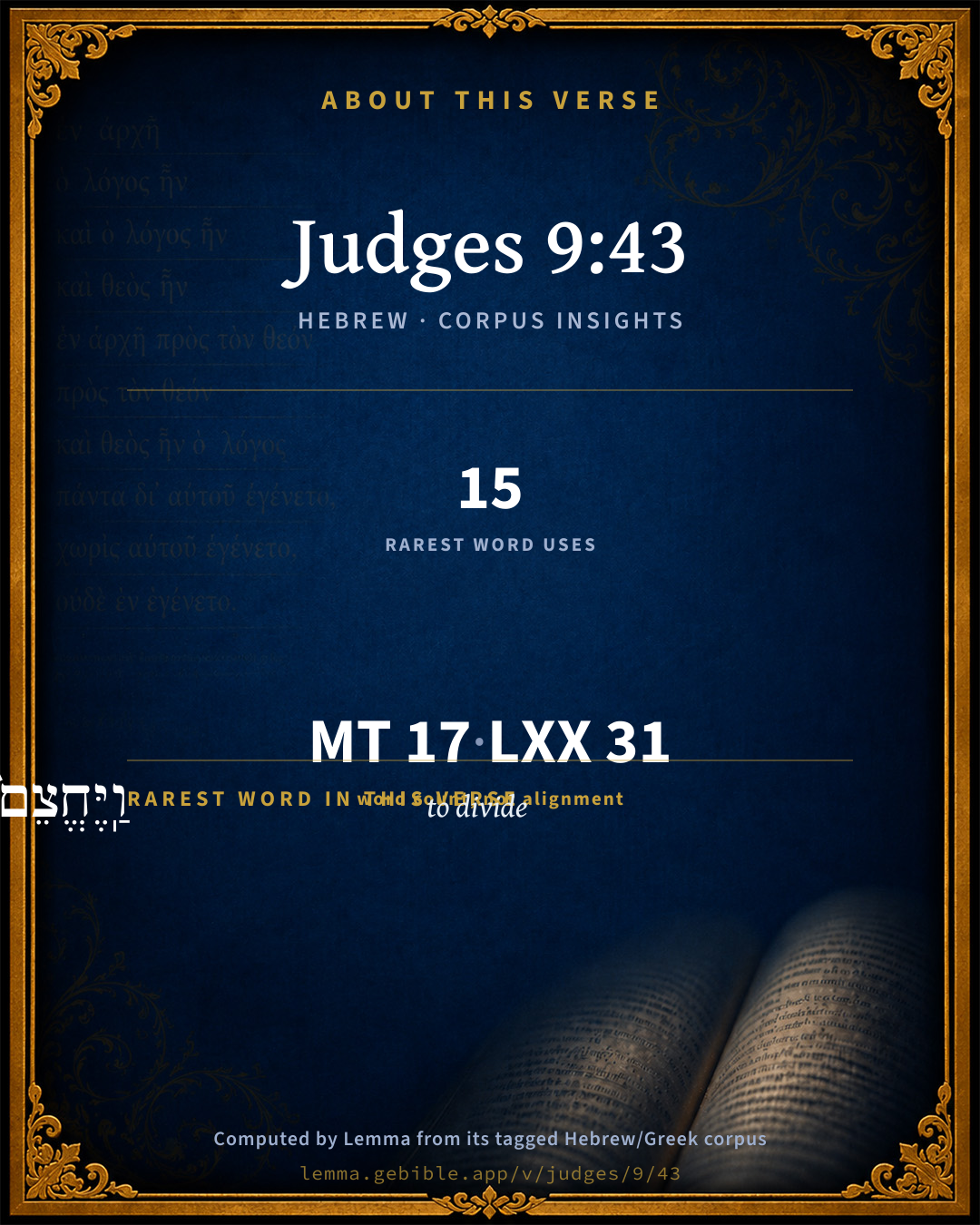
The rarest word here is וַֽיֶּחֱצֵם֙ to divide H2673 — appearing just 15 times in the whole Hebrew Bible.

Shared distinctive vocabulary

וַֽיֶּחֱצֵם֙ to divide H2673 occurs in 14 verses of the Hebrew Bible. Also found in:

Grammatical profile

  • 7 verbs
  • 5 nouns
  • 1 adjective
  • 2 prepositions
  • 2 particles

Verb forms

  • וַיִּקַּ֣ח Qal · Sequential Imperfect
  • וַֽיֶּחֱצֵם֙ Qal · Sequential Imperfect
  • וַיֶּאֱרֹ֖ב Qal · Sequential Imperfect
  • וַיַּ֗רְא Qal · Sequential Imperfect
  • יֹצֵ֣א Qal · Participle Active
  • וַיָּ֥קָם Qal · Sequential Imperfect
  • וַיַּכֵּֽם Hiphil · Sequential Imperfect

Repetition

A word recurs within this verse — often emphatic in Hebrew:

  • הָעָ֗ם people H5971 ×2

Hebrew & Septuagint length

In English translation the verse runs 37 words from the Hebrew and 40 from the Septuagint (LXX English) — closely comparable.

A rough comparison of the two English renderings, which tokenize alike — not a word-level alignment.

Word counts can differ between the Hebrew and the Greek without any difference in meaning — e.g. the Hebrew direct-object marker אֵת has no separate Greek word, and Greek often adds the article ὁ.

In the original languages it is 17 Hebrew tokens and 31 Greek tokens — but the two are counted differently (Hebrew bundles its prefixes and suffixes into one token; the Greek is in lemma form), so that isn’t a like-for-like length.

Hebrew and Greek witnesses Masoretic Hebrew ↔ Greek Septuagint

The same verse in the two great witnesses to the Old Testament, shown verse-for-verse.

These are two independent witnesses, not word-aligned to each other, and the Septuagint is shown in lemma (dictionary) form.

Hebrew Judges 9:43 Masoretic · Westminster Leningrad Codex

וַיִּקַּ֣ח אֶת הָעָ֗ם וַֽיֶּחֱצֵם֙ לִשְׁלֹשָׁ֣ה רָאשִׁ֔ים וַיֶּאֱרֹ֖ב בַּשָּׂדֶ֑ה וַיַּ֗רְא וְהִנֵּ֤ה הָעָם֙ יֹצֵ֣א מִן הָעִ֔יר וַיָּ֥קָם עֲלֵיהֶ֖ם וַיַּכֵּֽם

He took the people, and divided them into three companies, and laid wait in the field; and he looked, and, behold, the people came forth out of the city; He rose up against them, and struck them.

World English Bible · Public Domain

Greek LXX Judges 9:43 Septuagint · lemma form

καί λαμβάνω ὁ λαός καί διααἱρέω αὐτός εἰς τρεῖς ἀρχή καί ἐνεδρεύω ἐν ἀγρός καί ὁράω καί ἰδού ὁ λαός ἐκἔρχομαι ἐκ ὁ πόλις καί ἀναἵστημι ἐπί αὐτός καί πατάσσω αὐτός

And he took the people, and divided them into three companies, and formed an ambush in the field; and he looked, and, behold, the people went forth out of the city, and he rose up against them, and struck them.

LXX2012 (modern English Septuagint) · Public Domain

On this verse, John Gill's Exposition discusses the Septuagint’s reading. Read the note in Commentary ↓

Hebrew: Westminster Leningrad Codex (CC BY 4.0). Greek: Septuagint (public domain); English from LXX2012 (modern English Septuagint) (Public Domain). How the Septuagint differs from the Hebrew →

Targum (Aramaic paraphrase)

1

The Targum is the ancient Jewish Aramaic paraphrase of the Hebrew Scriptures — an interpretive translation, not the Hebrew text itself. Onkelos (literal) and Pseudo-Jonathan (expansive) render the Torah, and Jonathan the Prophets. Coverage is partial: where no permissively-licensed English translation exists for a verse, only the Aramaic is shown. This is verse-level text, not a word-by-word alignment to the Hebrew.

  1. Targum Jonathan Prophets (Joshua–Malachi)
    וְדַבֵּר יַת עַמָא וּפַלְגִנוּן לִתְלַת מַשִׁרְיָן וּכְמַן בְּחַקְלָא וַחֲזָא וְהָא עַמָא נָפֵיק מִן קַרְתָּא וְקָם עֲלֵיהוֹן וּמְחָנוּן:

    (no public-domain English translation for this verse)

    Targum Jonathan — Aramaic: “Mikraot Gedolot” (public domain). English: “Sefaria Community Translation” (CC0 1.0 (public-domain dedication)); “London "Chaldee Paraphrase," 1871” (public domain). Text via Sefaria.

Commentary

Notes on Judges 9:43 from classic Christian and Jewish commentators (each source and its license shown beneath its notes). The classic Christian expositions comment on the surrounding passage and are grouped to its opening verse, so a note may address several verses; the Jewish commentaries on the Tanakh (Rashi and others) are per-verse, so they appear only where the commentator wrote on this verse.

Lemma curates 59 commentaries, every one of them public domain or Creative Commons licensed, each selected and text-cleaned for this edition rather than reprinted as found. About our sources →

Trapp's Complete Commentary

John Trapp

Jdg 9:43 And he took the people, and divided them into three companies, and laid wait in the field, and looked, and, behold, the people [were] come forth out of the city; and he rose up against them, and smote them.

Ver. 43. Were come forth out of the city.] As ambitious of their own destruction. Judgments need not go to find out wicked persons; they run to meet their bane.

John Trapp, A Commentary or Exposition upon All the Books of the Old and New Testament (1647–1656) — public domain. Text from a community e-Sword module.

Geneva Bible (1599)

Geneva Bible translators

Which were in his company.

Geneva Bible (1599) marginal notes — public domain. Text via Bolls.life.

Ellicott's Commentary for English Readers

(43) Into three companies.—Why he only made three companies this time can only be matter of conjecture.

He rose up against them, and smote them.—He was evidently a man of ruthlessly vindictive temperament, for these people whom he slew were mere husbandmen, not an armed host.

A Bible Commentary for English Readers, edited by Charles John Ellicott (1878–1897) — public domain. Text from a community e-Sword module.

The Cambridge Bible for Schools and Colleges

gen. ed. J. J. S. Perowne

43. three companies] Cf. Jdg_7:16.

The Cambridge Bible for Schools and Colleges (gen. ed. J. J. S. Perowne; Cambridge University Press, 1878–1918) — public domain. Text from a community e-Sword module.

John Gill's Exposition

And Abimelech, and the company that was with him,.... Which he had the particular command of; or "the heads" (m), for in the company with him, as Kimchi observes, were great men; and so the Septuagint renders it, the princes that were with him:

rushed forward, and stood in the entering of the gate of the city; to prevent the people that were in the field getting into it, and any from coming out of it to their relief:

and the two other companies ran upon all the people that were in the fields, and slew them; so that by this means none escaped.

(m) "et capita", Pagninus, Montanus, Drusius; "et principes", Vatablus.

John Gill's Exposition of the Whole Bible (1746–1763) — public domain (CC PDM 1.0). Text via the HelloAO Bible API.

Matthew Poole's English Annotations

Three companies; whereof he kept one with himself, Jdg 9:44, and put the rest under other commanders.

Matthew Poole's English Annotations on the Holy Bible (1683–1685) — public domain. Text from a community e-Sword/MySword module.

John Wesley's Explanatory Notes

Three companies - Whereof he kept one with himself, ver. 44, and put the rest under other commanders.

John Wesley, Explanatory Notes Upon the Whole Bible (1754–1765) — public domain. Text via the GEBible commentary corpus.

Lesson kit

Teaching starters — assembled from the data on this page, not authored interpretation. Every prompt links to the verse data it draws on. Edit before teaching.

Judges, in the Historical, opens this verse with 17 words (16 distinct Hebrew lemmas). Its most distinctive word is châtsâh (“to divide”). A historical commentator’s framing appears above. Read the whole chapter for the surrounding context.

Discussion questions

  1. The word châtsâh carries the sense “to divide.” How does it shape the verse?
  2. Genesis 32:7 shares the word «to divide» with this verse. How do the two illuminate each other?
  3. “people” occurs 2× in this one verse. What is the effect of the repetition?
  4. These translations render this verse differently. What is at stake in choosing one wording over another?
  5. The verb «וַיִּקַּ֣ח» is Qal Sequential Imperfect. How does its form color the action?
  6. Reading how Trapp's Complete Commentary and Geneva Bible (1599) read this verse, where do the two commentators agree and where do they part?

Things to notice

Reading settings

Reading text

Shown beneath each verse's original-language words.

Old Testament
Old Testament edition

Read the OT as the Masoretic Hebrew (MT) or the Greek Septuagint (LXX).

English shown for the Greek Septuagint (in the Hebrew ↔ Greek comparison).

Comparing translations? Open the Compare panel on any verse page to stack up to four side by side.