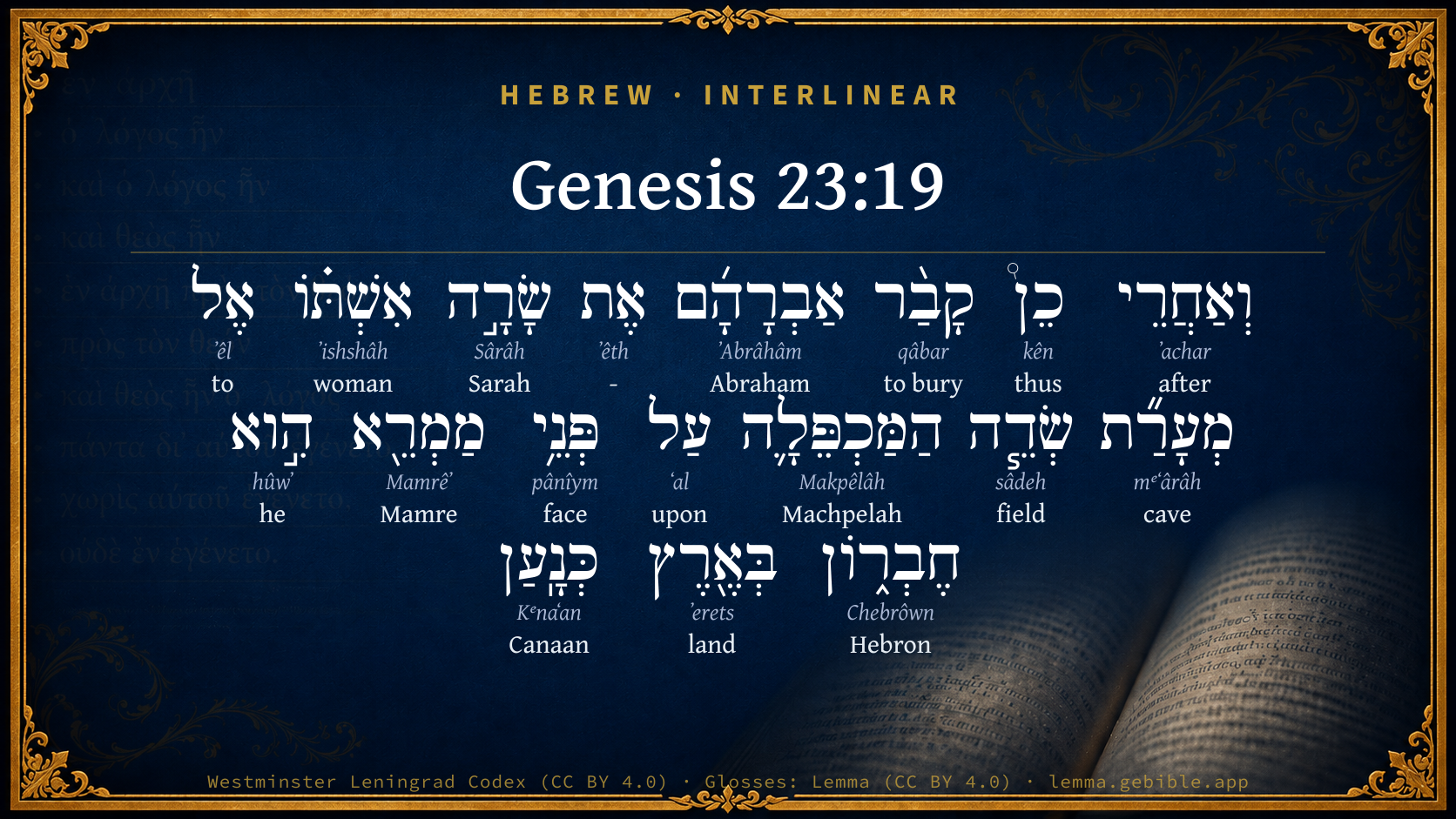
Genesis 23:19

Hebrew (Westminster Leningrad Codex) Genesis 23:19 appears in the Hebrew Old Testament. The text above is from the Westminster Leningrad Codex. Each word links to its Strong’s number, a concise gloss, and parsing drawn from the Open Scriptures Hebrew Bible morphology. Click any word for its full Brown-Driver-Briggs (BDB) entry.
Download image
Cite this verse

Genesis 23:19 (World English Bible). Public Domain. Lemma interlinear Bible study tool, https://lemma.gebible.app/v/genesis/23/19.

Show BibTeX & RIS
BibTeX
RIS
English Translation
After this, Abraham buried Sarah his wife in the cave of the field of Machpelah before Mamre (the same is Hebron), in the land of Canaan.
World English Bible · Public Domain
Download a study sheet

One document with this verse’s original text, its word-by-word gloss line, the meaning frame, cross-references with their text, attributed commentary, and full source and license credits — printable, and it pastes into notes with its structure intact.

This verse Autodidact and up

Study sheet (.html) Plain text (.txt)

A passage Seminary Student

Up to 50 verses in one chapter. A passage sheet keeps up to 6 commentary sources and 12 cross-references per verse, in the order this page ranks them, and says so on the sheet whenever that leaves anything out. Ask for a single verse and you get the Autodidact verse sheet above.

Everything on this page stays free to read, with no account — the sheet is a download of what is already on screen, not access to it.

Want to remove ads? Support Godless Engineer
Compare translations 3

The same verse in 3 English versions, stacked beneath the original-language interlinear above. Click any original word for its lexicon entry.

Each is an independent rendering of the whole verse — the interlinear is not word-aligned to these translations.

Highlighted words mark where these versions differ — a whole-verse word diff, not a word-by-word alignment.

  • World English Bible Public Domain
    After this, Abraham buried Sarah his wife in the cave of the field of Machpelah before Mamre (the same is Hebron), in the land of Canaan.
  • King James Version Public Domain
    And after this, Abraham buried Sarah his wife in the cave of the field of Machpelah before Mamre: the same is Hebron in the land of Canaan.
  • unfoldingWord Literal Text CC BY-SA 4.0
    Then after that, Abraham buried Sarah his wife in the cave of the field of Machpelah before Mamre, which Hebron, in the land of Canaan.

unfoldingWord Literal Text — © unfoldingWord, licensed CC BY-SA 4.0. Word-aligned USFM3 via Door43 (git.door43.org/unfoldingWord/en_ult).

Versions to compare (up to 4)

3 of 4 selected

Show all 18 translations

Every available English version of this verse, each an independent rendering of the whole verse.

  • World English Bible Public Domain
    After this, Abraham buried Sarah his wife in the cave of the field of Machpelah before Mamre (the same is Hebron), in the land of Canaan.
  • Berean Standard Bible Public Domain
    After this, Abraham buried his wife Sarah in the cave of the field at Machpelah near Mamre (that is, Hebron) in the land of Canaan.
  • Majority Standard Bible Public Domain
    After this, Abraham buried his wife Sarah in the cave of the field at Machpelah near Mamre (that is, Hebron) in the land of Canaan.
  • King James Version Public Domain
    And after this, Abraham buried Sarah his wife in the cave of the field of Machpelah before Mamre: the same is Hebron in the land of Canaan.
  • American Standard Version (1901) Public Domain
    And after this, Abraham buried Sarah his wife in the cave of the field of Machpelah before Mamre (the same is Hebron), in the land of Canaan.
  • Revised Version (1885) Public Domain
    And after this, Abraham buried Sarah his wife in the cave of the field of Machpelah before Mamre (the same is Hebron), in the land of Canaan.
  • Geneva Bible (1599) Public Domain
    And after this, Abraham buried Sarah his wife in the caue of the fielde of Machpelah ouer against Mamre: the same is Hebron in the land of Canaan.
  • Douay-Rheims (1899) Public Domain
    And so Abraham buried Sara his wife, in a double cave of the field, that looked towards Mambre, this is Hebron in the land of Chanaan.
  • Young's Literal Translation Public Domain
    And after this hath Abraham buried Sarah his wife at the cave of the field of Machpelah before Mamre (which `is' Hebron), in the land of Canaan;
  • Literal Standard Version CC BY-SA 4.0
    And after this Abraham has buried his wife Sarah at the cave of the field of Machpelah before Mamre (which [is] Hebron), in the land of Canaan;
  • Unlocked Literal Bible CC BY-SA 4.0
    After this, Abraham buried Sarah his wife in the cave of the field of Machpelah, which is next to Mamre, that is, Hebron, in the land of Canaan.
  • unfoldingWord Literal Text CC BY-SA 4.0
    Then after that, Abraham buried Sarah his wife in the cave of the field of Machpelah before Mamre, which Hebron, in the land of Canaan.
  • Darby Bible Public Domain
    And after this, Abraham buried Sarah his wife in the cave of the field at Machpelah, opposite to Mamre: that is Hebron, in the land of Canaan.
  • World Messianic Bible Public Domain
    After this, Abraham buried Sarah his wife in the cave of the field of Machpelah before Mamre (that is, Hebron), in the land of Canaan.
  • Webster's Bible Public Domain
    And after this, Abraham buried Sarah his wife in the cave of the field of Machpelah, before Mamre: the same is Hebron in the land of Canaan.
  • Free Bible Version CC BY-SA 4.0
    Then Abraham went and buried Sarah his wife in the cave in the field at Machpelah near Mamre (or Hebron) in the land of Canaan.
  • Bible in Basic English Public Domain
    Then Abraham put Sarah his wife to rest in the hollow rock in the field of Machpelah near Mamre, that is, Hebron in the land of Canaan.
  • JPS Tanakh (1917) Public Domain
    And after this, Abraham buried Sarah his wife in the cave of the field of Machpelah before Mamre — the same is Hebron — in the land of Canaan.

Literal Standard Version (2020), Covenant Press — licensed CC BY-SA 4.0. Text via the HelloAO Bible API (eBible.org). Unlocked Literal Bible (unfoldingWord) — licensed CC BY-SA 4.0. Text via the HelloAO Bible API (eBible.org). unfoldingWord Literal Text — © unfoldingWord, licensed CC BY-SA 4.0. Word-aligned USFM3 via Door43 (git.door43.org/unfoldingWord/en_ult). Free Bible Version, Dr. Jonathan Gallagher — licensed CC BY-SA 4.0. Text via the HelloAO Bible API (eBible.org).

Word by word

More ways to search: Search by grammar → Find every occurrence → Compare this word →

Practice this passage: Drill this verse → Learn its vocabulary →

הַמַּכְפֵּלָ֛ה
Makpêlâh
H4375
“the · Machpelah”
Particle, Definite Article + Noun, Proper
Part of Speech
Particle + Noun
Type
Proper
Full BDB Definition

Origin: from H3717

TWOT: 1019b

Machpelah = "double" or " portion" - the location of a burial cave for the patriarchs, near Hebron
  1. וְאַחֲרֵי ʼachar H310 “and · after” Conjunction + Preposition
  2. כֵן֩ kên H3651 “thus” Adverb
  3. קָבַ֨ר qâbar H6912 “to bury” Verb, Qal, Perfect, 3rd Person, Masculine, Singular
  4. אַבְרָהָ֜ם ʼAbrâhâm H85 “Abraham” Noun, Proper
  5. אֶת ʼêth H853 “-” Particle, Direct Object
  6. שָׂרָ֣ה Sârâh H8283 “Sarah” Noun, Proper
  7. אִשְׁתּ֗וֹ ʼishshâh H802 “woman · his” Noun, Common, Feminine, Singular, Construct + Suffix, Personal, 3rd Person, Masculine, Singular
  8. אֶל ʼêl H413 “to” Preposition
  9. מְעָרַ֞ת mᵉʻârâh H4631 “cave of” Noun, Common, Feminine, Singular, Construct
  10. שְׂדֵ֧ה sâdeh H7704 “field of” Noun, Common, Masculine, Singular, Construct
  11. עַל ʻal H5921 “upon” Preposition
  12. פְּנֵ֥י pânîym H6440 “face(s) of” Noun, Common, Both, Plural, Construct
  13. מַמְרֵ֖א Mamrêʼ H4471 “Mamre” Noun, Proper
  14. הִ֣וא hûwʼ H1931 “he” Pronoun, Personal, 3rd Person, Feminine, Singular
  15. חֶבְר֑וֹן Chebrôwn H2275 “Hebron” Noun, Proper
  16. בְּאֶ֖רֶץ ʼerets H776 “in/at · land of” Preposition + Noun, Common, Both, Singular, Construct
  17. כְּנָֽעַן Kᵉnaʻan H3667 “Canaan” Noun, Proper

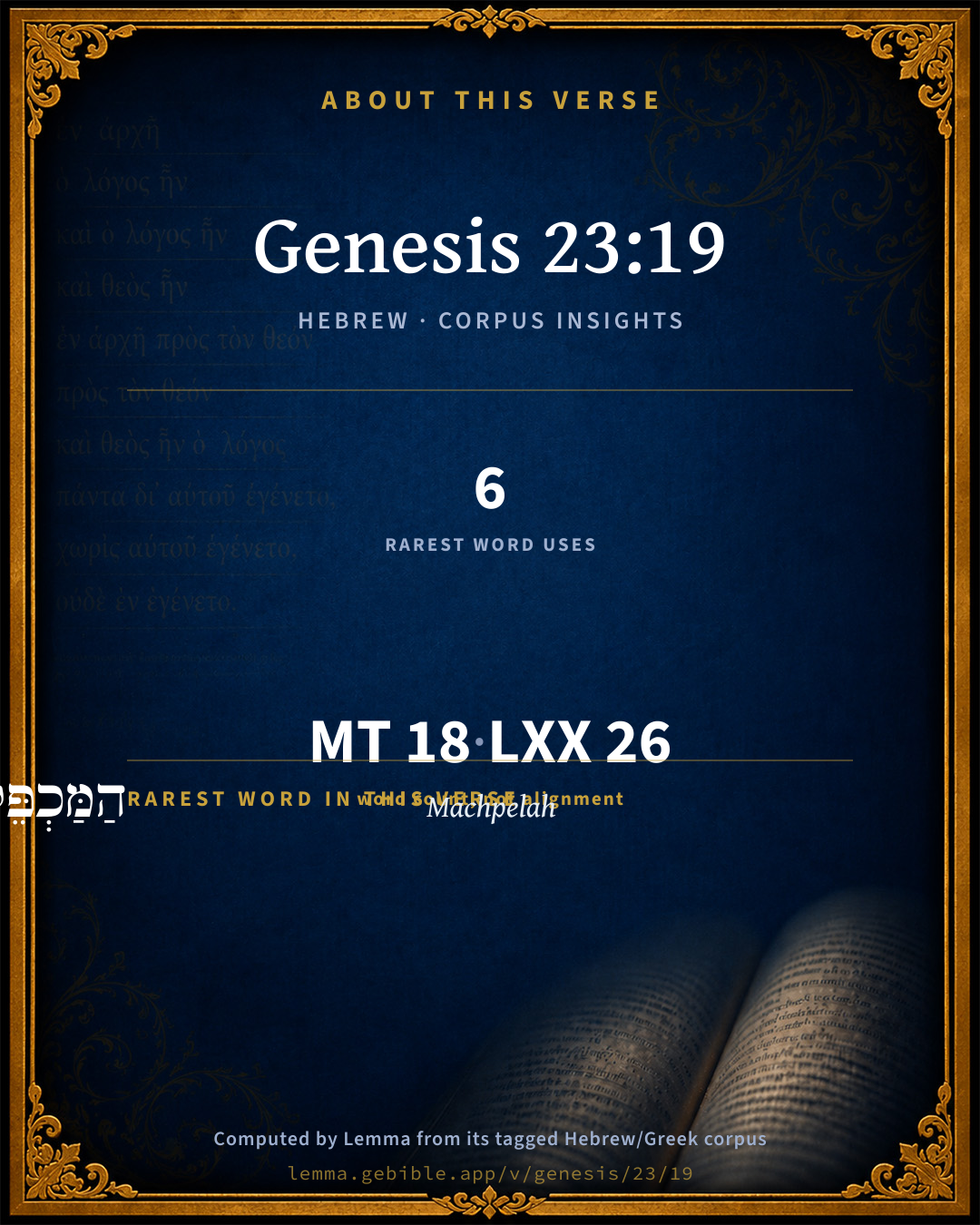
About this verse

These counts appear in no published source. They are computed here, from the morphology-tagged text and Lemma’s own curated glosses. What Lemma adds →

18
words
18
distinct lemmas
Pentateuch
section

Notable vocabulary

The rarest word here is הַמַּכְפֵּלָ֛ה Machpelah H4375 — appearing just 6 times in the whole Hebrew Bible.

Shared distinctive vocabulary

הַמַּכְפֵּלָ֛ה Machpelah H4375 occurs in 6 verses of the Hebrew Bible. Also found in:

Grammatical profile

  • 1 verb
  • 11 nouns
  • 1 pronoun
  • 3 prepositions
  • 1 adverb
  • 1 particle

Verb forms

  • קָבַ֨ר Qal · Perfect

Hebrew & Septuagint length

In English translation the verse runs 26 words from the Hebrew and 26 from the Septuagint (LXX English) — the same length.

A rough comparison of the two English renderings, which tokenize alike — not a word-level alignment.

Word counts can differ between the Hebrew and the Greek without any difference in meaning — e.g. the Hebrew direct-object marker אֵת has no separate Greek word, and Greek often adds the article ὁ.

In the original languages it is 18 Hebrew tokens and 26 Greek tokens — but the two are counted differently (Hebrew bundles its prefixes and suffixes into one token; the Greek is in lemma form), so that isn’t a like-for-like length.

Cross-references

11

Topical passages linked to Genesis 23:19 in the Treasury of Scripture Knowledge — connected by theme and wording, ordered by reader-vote popularity; previews shown in the World English Bible.

  • Genesis 3:19 By the sweat of your face will you eat bread until you return to the ground, for out of it you were taken. For you are dust, and to dust you shall return."
  • Genesis 25:9–10 Isaac and Ishmael, his sons, buried him in the cave of Machpelah, in the field of Ephron, the son of Zohar the Hittite, which is before Mamre,
  • Genesis 35:27–29 Jacob came to Isaac his father, to Mamre, to Kiriath Arba (the same is Hebron), where Abraham and Isaac lived as foreigners.
  • Genesis 47:30 but when I sleep with my fathers, you shall carry me out of Egypt, and bury me in their burying place." He said, "I will do as you have said."
  • Genesis 49:29–32 He charged them, and said to them, "I am to be gathered to my people. Bury me with my fathers in the cave that is in the field of Ephron the Hittite,
  • Genesis 50:13 for his sons carried him into the land of Canaan, and buried him in the cave of the field of Machpelah, which Abraham bought with the field, for a possession of a burying-place, from Ephron the Hittite, before Mamre.
  • Genesis 50:25 Joseph took an oath of the children of Israel, saying, "God will surely visit you, and you shall carry up my bones from here."
  • Job 30:23 For I know that you will bring me to death, To the house appointed for all living.
  • Ecclesiastes 6:3 If a man fathers a hundred children, and lives many years, so that the days of his years are many, but his soul is not filled with good, and moreover he has no burial; I say, that an untimely birth is better than he:
  • Ecclesiastes 12:5 Yes, they shall be afraid of heights, And terrors will be in the way; And the almond tree shall blossom, And the grasshopper shall be a burden, And desire shall fail; Because man goes to his everlasting home, And the mourners go about the streets:
  • Ecclesiastes 12:7 And the dust returns to the earth as it was, And the spirit returns to God who gave it.

Cross-references courtesy of OpenBible.info (CC BY 4.0).

Hebrew and Greek witnesses Masoretic Hebrew ↔ Greek Septuagint

The same verse in the two great witnesses to the Old Testament, shown verse-for-verse.

These are two independent witnesses, not word-aligned to each other, and the Septuagint is shown in lemma (dictionary) form.

Hebrew Genesis 23:19 Masoretic · Westminster Leningrad Codex

וְאַחֲרֵי כֵן֩ קָבַ֨ר אַבְרָהָ֜ם אֶת שָׂרָ֣ה אִשְׁתּ֗וֹ אֶל מְעָרַ֞ת שְׂדֵ֧ה הַמַּכְפֵּלָ֛ה עַל פְּנֵ֥י מַמְרֵ֖א הִ֣וא חֶבְר֑וֹן בְּאֶ֖רֶץ כְּנָֽעַן

After this, Abraham buried Sarah his wife in the cave of the field of Machpelah before Mamre (the same is Hebron), in the land of Canaan.

World English Bible · Public Domain

Greek LXX Genesis 23:19 Septuagint · lemma form

μετά οὗτος θάπτω αβρααμ σαρρα ὁ γυνή αὐτός ἐν ὁ σπήλαιον ὁ ἀγρός ὁ διπλοῦς ὅς εἰμί ἀπέναντι μαμβρη οὗτος εἰμί χεβρων ἐν ὁ γῆ χανααν

After this Abraam buried Sarrha his wife in the Double Cave of the field, which is opposite Mambre, this is Chebron in the land of Chanaan.

LXX2012 (modern English Septuagint) · Public Domain

Hebrew: Westminster Leningrad Codex (CC BY 4.0). Greek: Septuagint (public domain); English from LXX2012 (modern English Septuagint) (Public Domain). How the Septuagint differs from the Hebrew →

Targum (Aramaic paraphrase)

2

The Targum is the ancient Jewish Aramaic paraphrase of the Hebrew Scriptures — an interpretive translation, not the Hebrew text itself. Onkelos (literal) and Pseudo-Jonathan (expansive) render the Torah, and Jonathan the Prophets. Coverage is partial: where no permissively-licensed English translation exists for a verse, only the Aramaic is shown. This is verse-level text, not a word-by-word alignment to the Hebrew.

  1. Targum Onkelos Torah (Genesis–Deuteronomy)
    וּבָתַר כֵּן קְבַר אַבְרָהָם יָת שָׂרָה אִתְּתֵהּ בִּמְעָרַת חֲקַל כָּפֶלְתָּא עַל אַפֵּי מַמְרֵא הִיא חֶבְרוֹן בְּאַרְעָא דִּכְנָעַן

    (no public-domain English translation for this verse)

    Targum Onkelos — Aramaic: “Onkelos Genesis” (public domain); “Onkelos Exodus” (public domain); “Onkelos Leviticus” (public domain); “Onkelos Numbers” (public domain); “Onkelos Deuteronomy” (public domain). English: “Sefaria Community Translation” (CC0 1.0 (public-domain dedication)); “J.W. Etheridge. The Targums of Onkelos and Jonathan Ben Uzziel on the Pentateuch. London: Longmans, Green, 1862” (public domain). Text via Sefaria.

  2. Targum Pseudo-Jonathan Torah (Genesis–Deuteronomy)
    וּמִן בָּתַר כְּדֵין קְבַר אַבְרָהָם יַת שָרָה אִנְתְּתֵיהּ לִמְעָרַת חֲקֵיל כָּפֶלְתָּא דְעַל אַנְפֵּי מַמְרֵא הוּא חֶבְרוֹן בְּאַרְעָא דִכְנָעַן

    And afterwards Abraham buried Sarah his wife in the cave of the field Kapheilta which is before Mamre, that is, Hebron in the land of Kenaan.

    Targum Pseudo-Jonathan — Aramaic: “Targum Jonathan on Genesis” (public domain); “Targum Jonathan on Exodus” (public domain); “Targum Jonathan on Leviticus” (public domain); “Targum Jonathan on Numbers” (public domain); “Targum Jonathan on Deuteronomy” (public domain). English: “The Targum of Jonathan ben Uzziel, trans. J. W. Etheridge, London, 1862” (public domain). Text via Sefaria.

Commentary

Notes on Genesis 23:19 from classic Christian and Jewish commentators (each source and its license shown beneath its notes). The classic Christian expositions comment on the surrounding passage and are grouped to its opening verse, so a note may address several verses; the Jewish commentaries on the Tanakh (Rashi and others) are per-verse, so they appear only where the commentator wrote on this verse.

Lemma curates 59 commentaries, every one of them public domain or Creative Commons licensed, each selected and text-cleaned for this edition rather than reprinted as found. About our sources →

Trapp's Complete Commentary

John Trapp

Gen 23:19 And after this, Abraham buried Sarah his wife in the cave of the field of Machpelah before Mamre: the same [is] Hebron in the land of Canaan.

Ver. 19. And Abraham buried Sarah his wife.] The last office of love to bring the deceased saints honourably to their "long home," {Ecc 12:5} to lay them in their last "bed," {Isa 57:2} to put them into the grave, as into a haven and harbout, where they may rest from their labours, "till their change shall come." {Job 14:14} This is to "deal kindly with the dead"; {Rth 1:8} "to show mercy to them," {2Sa 2:5} especially when "the mourners go about the streets," {Ecc 12:5} when there is a "great mourning made over them," as for Stephen, {Act 8:2} and a "great burning for them," as for Asa, {2Ch 16:14} - of whom also it is further added, as an honour, that he was "buried in his own sepulchre, which he had dug for himself among the kings of Israel in the city of David, and laid in the bed that was filled with sweet odours," &c. Of Joram, Joas, and Ahaz, it is expressly noted in the Chronicles, that they were buried in the city of David, but not in the sepulchres of the kings of Judah. A worse place was thought good enough for them, unless they had been better. As of Tiberius the emperor it is storied, that he was so hated for his tyranny, that when he was dead, some of the people would have had him thrown into the river Tiber; {a} some, hanged up at such another place as Tyburn. Others also made prayer to mother Earth, to grant him, now dead, no place but among the wicked. {b} Contrarily when Dio died, the people of Syracuse would have gladly redeemed his life with their own blood; which because they could not, they buried him very honourably in an eminent place of their city. {c} Whereas anciently, as Lambinus well noteth, {d} kings and princes, in Homer and other poets, are not read to have been buried, but without the gates, somewhere in the fields and gardens; as the patriarchs also were, looking for the return of that everlasting spring.

{a} Scalae Gemoniae, [a place in Rome where condemned persons were cast down from a pair of stairs into the Tiber. - Ainsworth].

{b} Quidam etiam Terrain matrem orarent, &c. - Pareus.

{c} Cornel. Nepos in Vita Dionis.

{d} Dionys. Lambin. in Annot. ad locum.

John Trapp, A Commentary or Exposition upon All the Books of the Old and New Testament (1647–1656) — public domain. Text from a community e-Sword module.

Jamieson, Fausset & Brown

Robert Jamieson, A. R. Fausset & David Brown

Abraham buried Sarah--Thus he got possession of Machpelah and deposited the remains of his lamented partner in a family vault which was the only spot of ground he owned.

Next: Genesis Chapter 24

Jamieson, Fausset & Brown — Commentary Critical and Explanatory on the Whole Bible (1871) — public domain (CC PDM 1.0). Text via the HelloAO Bible API.

Whedon's Commentary on the Bible

Daniel D. Whedon

19. After this, Abraham buried Sarah — He has now one secure possession wherein to bury his dead. Here he himself was afterwards buried, (Gen_25:9,) and here also Isaac, Rebekah, Jacob, and Leah. Gen_49:31; Gen_50:13. Is it not noticeable of Abraham and his seed that their first and last possession in the land of promise is — a grave?

Daniel D. Whedon (gen. ed.), Commentary on the Old and New Testaments (1874–1909) — public domain. Text from a community e-Sword module.

The Pulpit Commentary

And after this, Abraham buried Sarah his wife with what funeral rites can only be conjectured. Monumental evidence attests that the practice of embalming the dead existed in Egypt in the reign of Amunophth I (B.C. 1500), though probably originating, earlier. (Sharpe"s "Egypt, vol. 1. p. 31); and an examination of the Mugheir vaults for burying the dead shows that among the early Chaldaeans it was customary to place the corpse upon a matting of reed spread upon a brick floor, the head being pillowed on a single sun-dried brick, and the body turned on its left side, the right arm falling towards the left, and the fingers resting on the edge of a copper bowl, usually placed on the palm of the left hand (vide Rawlinson s "Ancient Monarchies," vol. 1. p. 87)in the cave of the field of Machpelah before: Mamre. In which also in succession his own remains and those of Isaac, Rebekah, Jacob, and Leah were deposited, Rachel alone of the great patriarchal family being absent. This last resting-place of Abraham and his sons, as of Sarah and her daughters, has been identified with Ramet-el-Kalil, an hour"s journey to the north of Hebron (which is too distant), where the foundations of an ancient heathen temple are still pointed out as Abraham"s house; but is more probably to be sought for in the Mohammedan mosque Haram, built of colossal blocks, and situated on the mountain slope of Hebron towards the east (Robinson, Thomson, Stanley, Tristram), which, after having been for 600 years hermetically sealed against Europeans, only three during that period having gained access to it in disguise, was visited in 1862 by the Prince of Wales and party (vide Stanley, "Lectures on Jewish Church," App. 2.). The same is Hebron in the land of Canaan (vide Ver. 2).

HOMILIES BY R.A. REDFORD Vers. 19, 20.

The death and burial of Sarah.

I TRUE RELIGION SANCTIFIES NATURAL RELATIONSHIPS. Those who know themselves blessed of God do not only feel that their human affections are precious and true, but do, in obedience to his will, preserve the greatest respect for their bodily frame, and for their dead who died in the Lord, and whose dust is committed tenderly to his keeping.

II THE PEOPLE OF GOD WERE UPHELD BY FAITH IN THEIR CARE FOR THE DEAD. They looked beyond the grave. Some say there is no evidence of the doctrine of immortality in the Old Testament until after the captivity Surely Abraham"s feelings were not those of one who sorrowed without hope. The purchase of the field, the securing possession for all time of the burying-place, pointed to faith, not the lack of it. Where there is no sense of immortality there is no reverence for the dead.

III THE PURCHASE OF THE FIELD was not only its security, but a testimony to the heathen that the people of God held in reverence both the memory of the dead and the rights of the living. All social prosperity has its root in religious life. R.

The Pulpit Commentary (1880–1919), ed. H.D.M. Spence-Jones & Joseph S. Exell — public domain. Text from a community e-Sword module.

unfoldingWord translationNotes

Door43 World Missions Community

After this

"After he bought the field"

the cave of the field

"the cave in the field"

the field of Machpelah

"the field in Machpelah"

that is, Hebron

Possible meanings are 1) Mamre was another name for Hebron or 2) Hebron was formerly called Mamre or 3) Mamre was very near the larger city of Hebron, so people usually called it Hebron.

passed to Abraham as a property for a burial place from the sons of Heth

"became Abraham's property for a burial ground when he bought it from the sons of Heth"

the sons of Heth

Here "sons" stands for those who descended from Heth. See how you translated this in Genesis 23:3. AT: "the descendants of Heth" (See: How to Translate Names)

translationWords

Abraham

Sarah

Hebron

Canaan

grave

unfoldingWord translationNotes — © Distant Shores Media and the Door43 World Missions Community, licensed CC BY-SA 4.0. Source: git.door43.org/Door43/en_tn.

Ramban (Nachmanides)

Rabbi Moshe ben Nachman (Ramban / Nachmanides)

AND AFTER THIS, ABRAHAM BURIED SARAH HIS WIFE IN THE CAVE OF THE FIELD OF MACHPELAH BEFORE MAMRE — THE SAME IS HEBRON — IN THE LAND OF CANAAN. The reason why Scripture reverts to clarify the field, the place and the land is that the whole section mentioned the sons of Heth and Ephron the Hittite. Therefore Scripture mentions at the conclusion that the field was in the land of Canaan which is the land of Israel. And so it said at the beginning of the section: in Kiryath arba — the same is Hebron — in the land of Canaan. All this is to explain that the righteous woman died in the land of Israel, and there she was interred, as the Hittites were of the families of Canaan., 10:15.In my opinion, the reason for the verses is only to mention that this was the land of Canaan, not the land of the Philistines. Having said, And Abraham sojourned in the land of the Philistines many days, 21:34. and since all his habitats were in that land — in Gerar, 20:1. and the valley of Gerar, and Beer-sheba, and from there to Hebron and back — Scripture therefore mentioned that Hebron is in the land of the Canaanite who dwelt in that hill country, not in the land of the Philistines, which is mentioned in connection with Abraham. And in the end Scripture added a phrase to inform us that the cave was in the field of Machpelah before Mamre, for this was the name by which it was known.This section was written to inform us of G-d’s kindnesses to Abraham, i.e., that in the land in which he came to live he was regarded as a prince of G-d, and each individual as well as all the people called him “my lord” although he did not tell them that he was a prince and a great man. Also, in his lifetime G-d fulfilled His promise to him: And I will make thy name great, and thou shalt be a blessing., 12:2. Moreover, his wife died and was buried in the inheritance of the Eternal. Further, Scripture wanted to inform us of the place of the burial of the patriarchs since we are obligated to honor the burial place of our holy ancestors. Our Rabbis said that this also was one of the trials of Abraham: he desired a place to bury Sarah but did not find it until he purchased it, [despite G-d’s promise that the entire land would be given to him].I do not know a reason for the words of Rabbi Abraham ibn Ezra, who says that the purpose of this section is to let us know the superiority of the land of Israel as regards the living and the dead, and also to fulfill the word of G-d which promised him that the land would be an inheritance of his. But what superiority of the land was thus demonstrated? Abraham would not have carried her to another land to bury her, and the word of G-d to Abraham applied to the whole land, and that was fulfilled only with his seed.

Ramban (Nachmanides) on the Tanakh — English translation: “Commentary on the Torah by Ramban (Nachmanides). Translated and annotated by Charles B. Chavel. New York, Shilo Pub. House, 1971-1976” (CC BY 4.0). Text via Sefaria.

Radak

Rabbi David Kimhi (Radak)

ואחרי כן...אל מערת, the preposition אל means the same as the prefix ב, i.e. במערת שדה המכפלה. Compare Exodus 25,21 ואל הארון תתן את העדות instead of בארון.

Radak on the Tanakh — English translations: “Sefaria Community Translation” (CC0 1.0 (public-domain dedication)); “Eliyahu Munk, HaChut Hameshulash” (CC BY 4.0); “Rabbi Mike Feuer, Jerusalem Anthology” (CC BY 4.0); and “R. David Kimhi on the first book of Psalms, Translated by R.G. Finch, London, 1919” (public domain). Text via Sefaria.

Lesson kit

Teaching starters — assembled from the data on this page, not authored interpretation. Every prompt links to the verse data it draws on. Edit before teaching.

Genesis, in the Pentateuch, opens this verse with 18 words (18 distinct Hebrew lemmas). Its most distinctive word is Makpêlâh (“Machpelah”). A historical commentator’s framing appears above. Read the whole chapter for the surrounding context.

Discussion questions

  1. What does “Machpelah” (Makpêlâh) contribute to the verse as a whole?
  2. How does Genesis 23:9, which shares the word «Machpelah», read alongside this verse?
  3. The translations on this page render this verse differently — a whole-verse word diff, not a word-by-word alignment. What might account for the different wordings?
  4. «קָבַ֨ר» is a Qal Perfect verb. How does that grammatical form shape the action described?
  5. Compare how Trapp's Complete Commentary and Jamieson, Fausset & Brown read this verse. Where do they agree or differ?

Things to notice

Reading settings

Reading text

Shown beneath each verse's original-language words.

Old Testament
Old Testament edition

Read the OT as the Masoretic Hebrew (MT) or the Greek Septuagint (LXX).

English shown for the Greek Septuagint (in the Hebrew ↔ Greek comparison).

Comparing translations? Open the Compare panel on any verse page to stack up to four side by side.