
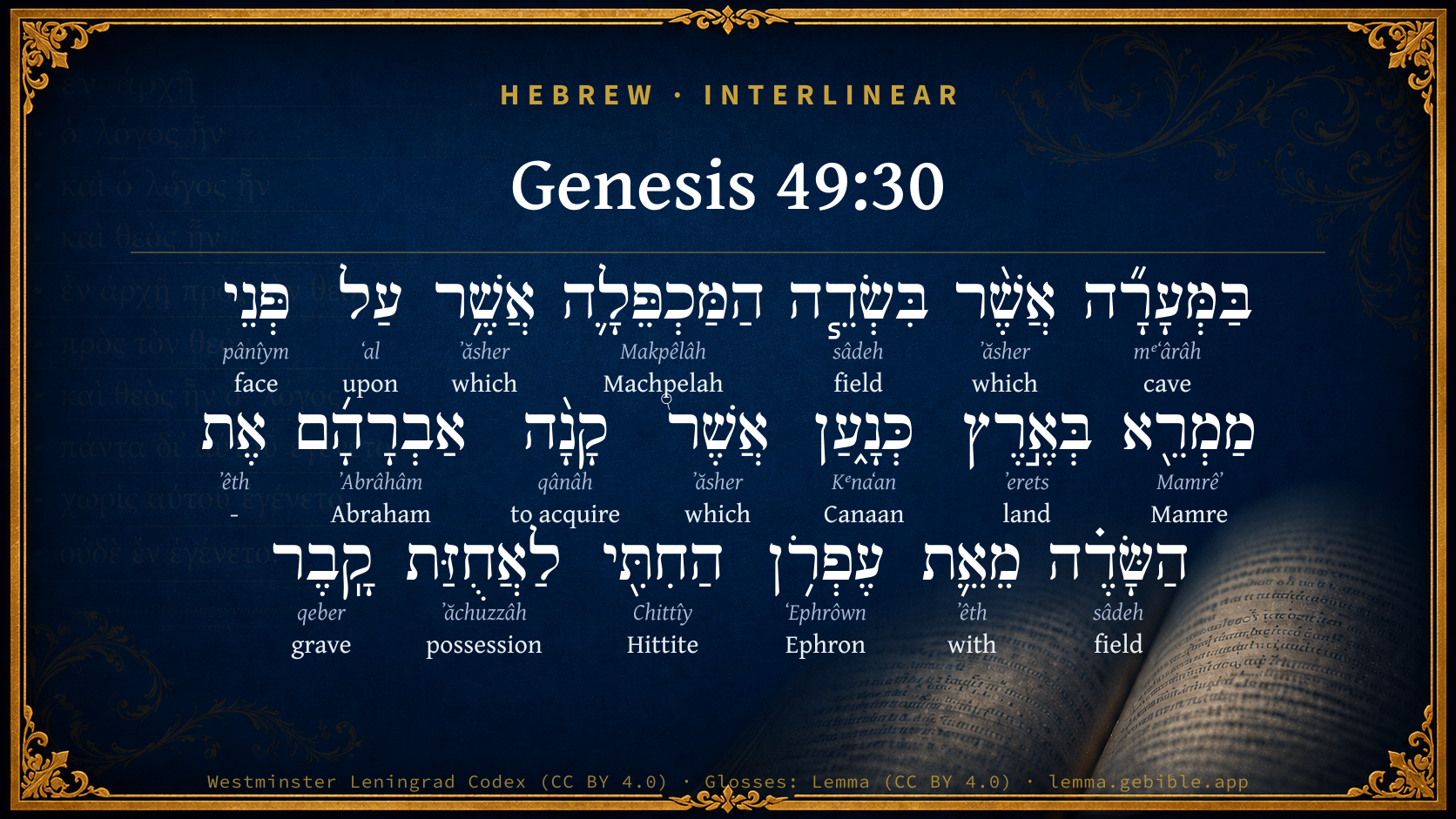
Genesis 49:30

Hebrew (Westminster Leningrad Codex) Genesis 49:30 appears in the Hebrew Old Testament. The text above is from the Westminster Leningrad Codex. Each word links to its Strong’s number, a concise gloss, and parsing drawn from the Open Scriptures Hebrew Bible morphology. Click any word for its full Brown-Driver-Briggs (BDB) entry.
Download image
Cite this verse

Genesis 49:30 (World English Bible). Public Domain. Lemma interlinear Bible study tool, https://lemma.gebible.app/v/genesis/49/30.

Show BibTeX & RIS
BibTeX
RIS
English Translation
in the cave that is in the field of Machpelah, which is before Mamre, in the land of Canaan, which Abraham bought with the field from Ephron the Hittite as a burial place.
World English Bible · Public Domain
Download a study sheet

One document with this verse’s original text, its word-by-word gloss line, the meaning frame, cross-references with their text, attributed commentary, and full source and license credits — printable, and it pastes into notes with its structure intact.

This verse Autodidact and up

Study sheet (.html) Plain text (.txt)

A passage Seminary Student

Up to 50 verses in one chapter. A passage sheet keeps up to 6 commentary sources and 12 cross-references per verse, in the order this page ranks them, and says so on the sheet whenever that leaves anything out. Ask for a single verse and you get the Autodidact verse sheet above.

Everything on this page stays free to read, with no account — the sheet is a download of what is already on screen, not access to it.

Want to remove ads? Support Godless Engineer
Compare translations 3

The same verse in 3 English versions, stacked beneath the original-language interlinear above. Click any original word for its lexicon entry.

Each is an independent rendering of the whole verse — the interlinear is not word-aligned to these translations.

Highlighted words mark where these versions differ — a whole-verse word diff, not a word-by-word alignment.

  • World English Bible Public Domain
    in the cave that is in the field of Machpelah, which is before Mamre, in the land of Canaan, which Abraham bought with the field from Ephron the Hittite as a burial place.
  • King James Version Public Domain
    In the cave that is in the field of Machpelah, which is before Mamre, in the land of Canaan, which Abraham bought with the field of Ephron the Hittite for a possession of a buryingplace.
  • unfoldingWord Literal Text CC BY-SA 4.0
    in the cave that in the field of Machpelah that in front of Mamre in the land of Canaan, that Abraham bought with the field from Ephron the Hittite as property a burial place.

unfoldingWord Literal Text — © unfoldingWord, licensed CC BY-SA 4.0. Word-aligned USFM3 via Door43 (git.door43.org/unfoldingWord/en_ult).

Versions to compare (up to 4)

3 of 4 selected

Show all 17 translations

Every available English version of this verse, each an independent rendering of the whole verse.

  • World English Bible Public Domain
    in the cave that is in the field of Machpelah, which is before Mamre, in the land of Canaan, which Abraham bought with the field from Ephron the Hittite as a burial place.
  • Berean Standard Bible Public Domain
    The cave is in the field of Machpelah near Mamre, in the land of Canaan. This is the field Abraham purchased from Ephron the Hittite as a burial site.
  • Majority Standard Bible Public Domain
    The cave is in the field of Machpelah near Mamre, in the land of Canaan. This is the field Abraham purchased from Ephron the Hittite as a burial site.
  • King James Version Public Domain
    In the cave that is in the field of Machpelah, which is before Mamre, in the land of Canaan, which Abraham bought with the field of Ephron the Hittite for a possession of a buryingplace.
  • American Standard Version (1901) Public Domain
    in the cave that is in the field of Machpelah, which is before Mamre, in the land of Canaan, which Abraham bought with the field from Ephron the Hittite for a possession of a burying-place.
  • Revised Version (1885) Public Domain
    in the cave that is in the field of Machpelah, which is before Mamre, in the land of Canaan, which Abraham bought with the field from Ephron the Hittite for a possession of a buryingplace:
  • Geneva Bible (1599) Public Domain
    In the caue that is in the field of Machpelah besides Mamre in the land of Canaan: which caue Abraham bought with the fielde of Ephron the Hittite for a possession to burie in.
  • Young's Literal Translation Public Domain
    in the cave which `is' in the field of Machpelah, which `is' on the front of Mamre, in the land of Canaan, which Abraham bought with the field from Ephron the Hittite for a possession of a burying-place;
  • Literal Standard Version CC BY-SA 4.0
    in the cave which [is] in the field of Machpelah, which [is] on the front of Mamre, in the land of Canaan, which Abraham bought with the field from Ephron the Hittite for a possession of a burying-place;
  • Unlocked Literal Bible CC BY-SA 4.0
    in the cave that is in the field of Machpelah, which is near Mamre in the land of Canaan, the field that Abraham bought for a burial place from Ephron the Hittite.
  • unfoldingWord Literal Text CC BY-SA 4.0
    in the cave that in the field of Machpelah that in front of Mamre in the land of Canaan, that Abraham bought with the field from Ephron the Hittite as property a burial place.
  • Darby Bible Public Domain
    in the cave that is in the field of Machpelah, which is opposite to Mamre, in the land of Canaan, which Abraham bought of Ephron the Hittite along with the field for a possession of a sepulchre.
  • World Messianic Bible Public Domain
    in the cave that is in the field of Machpelah, which is before Mamre, in the land of Canaan, which Abraham bought with the field from Ephron the Hittite as a burial place.
  • Webster's Bible Public Domain
    In the cave that is in the field of Machpelah, which is before Mamre, in the land of Canaan, which Abraham bought with the field of Ephron the Hittite for a possession of a burying-place.
  • Free Bible Version CC BY-SA 4.0
    This is the cave in the field of Machpelah, near Mamre in Canaan, that Abraham bought together with the field from Ephron the Hittite to own as a burial site.
  • Bible in Basic English Public Domain
    In the rock in the field of Machpelah, near Mamre in the land of Canaan, which Abraham got from Ephron the Hittite, to be his resting-place.
  • JPS Tanakh (1917) Public Domain
    in the cave that is in the field of Machpelah, which is before Mamre, in the land of Canaan, which Abraham bought with the field from Ephron the Hittite for a possession of a burying-place.

Literal Standard Version (2020), Covenant Press — licensed CC BY-SA 4.0. Text via the HelloAO Bible API (eBible.org). Unlocked Literal Bible (unfoldingWord) — licensed CC BY-SA 4.0. Text via the HelloAO Bible API (eBible.org). unfoldingWord Literal Text — © unfoldingWord, licensed CC BY-SA 4.0. Word-aligned USFM3 via Door43 (git.door43.org/unfoldingWord/en_ult). Free Bible Version, Dr. Jonathan Gallagher — licensed CC BY-SA 4.0. Text via the HelloAO Bible API (eBible.org).

Word by word

More ways to search: Search by grammar → Find every occurrence → Compare this word →

Practice this passage: Drill this verse → Learn its vocabulary →

הַמַּכְפֵּלָ֛ה
Makpêlâh
H4375
“the · Machpelah”
Particle, Definite Article + Noun, Proper
Part of Speech
Particle + Noun
Type
Proper
Full BDB Definition

Origin: from H3717

TWOT: 1019b

Machpelah = "double" or " portion" - the location of a burial cave for the patriarchs, near Hebron
  1. בַּמְּעָרָ֞ה mᵉʻârâh H4631 “in/at the · cave” Preposition, Determined + Noun, Common, Feminine, Singular, Absolute
  2. אֲשֶׁ֨ר ʼăsher H834 “which” Particle, Relative
  3. בִּשְׂדֵ֧ה sâdeh H7704 “in/at · field of” Preposition + Noun, Common, Masculine, Singular, Construct
  4. אֲשֶׁ֥ר ʼăsher H834 “which” Particle, Relative
  5. עַל ʻal H5921 “upon” Preposition
  6. פְּנֵי pânîym H6440 “face(s) of” Noun, Common, Both, Plural, Construct
  7. מַמְרֵ֖א Mamrêʼ H4471 “Mamre” Noun, Proper
  8. בְּאֶ֣רֶץ ʼerets H776 “in/at · land of” Preposition + Noun, Common, Both, Singular, Construct
  9. כְּנָ֑עַן Kᵉnaʻan H3667 “Canaan” Noun, Proper
  10. אֲשֶׁר֩ ʼăsher H834 “which” Particle, Relative
  11. קָנָ֨ה qânâh H7069 “to acquire” Verb, Qal, Perfect, 3rd Person, Masculine, Singular
  12. אַבְרָהָ֜ם ʼAbrâhâm H85 “Abraham” Noun, Proper
  13. אֶת ʼêth H853 “-” Particle, Direct Object
  14. הַשָּׂדֶ֗ה sâdeh H7704 “the · field” Particle, Definite Article + Noun, Common, Masculine, Singular, Absolute
  15. מֵאֵ֛ת ʼêth H854 “from · with” Preposition + Preposition
  16. עֶפְרֹ֥ן ʻEphrôwn H6085 “Ephron” Noun, Proper
  17. הַחִתִּ֖י Chittîy H2850 “the · Hittite” Particle, Definite Article + Noun, Gentilic, Masculine, Singular, Absolute
  18. לַאֲחֻזַּת ʼăchuzzâh H272 “to/for · possession of” Preposition + Noun, Common, Feminine, Singular, Construct
  19. קָֽבֶר qeber H6913 “grave” Noun, Common, Masculine, Singular, Absolute

About this verse

These counts appear in no published source. They are computed here, from the morphology-tagged text and Lemma’s own curated glosses. What Lemma adds →

20
words
17
distinct lemmas
Pentateuch
section

Notable vocabulary

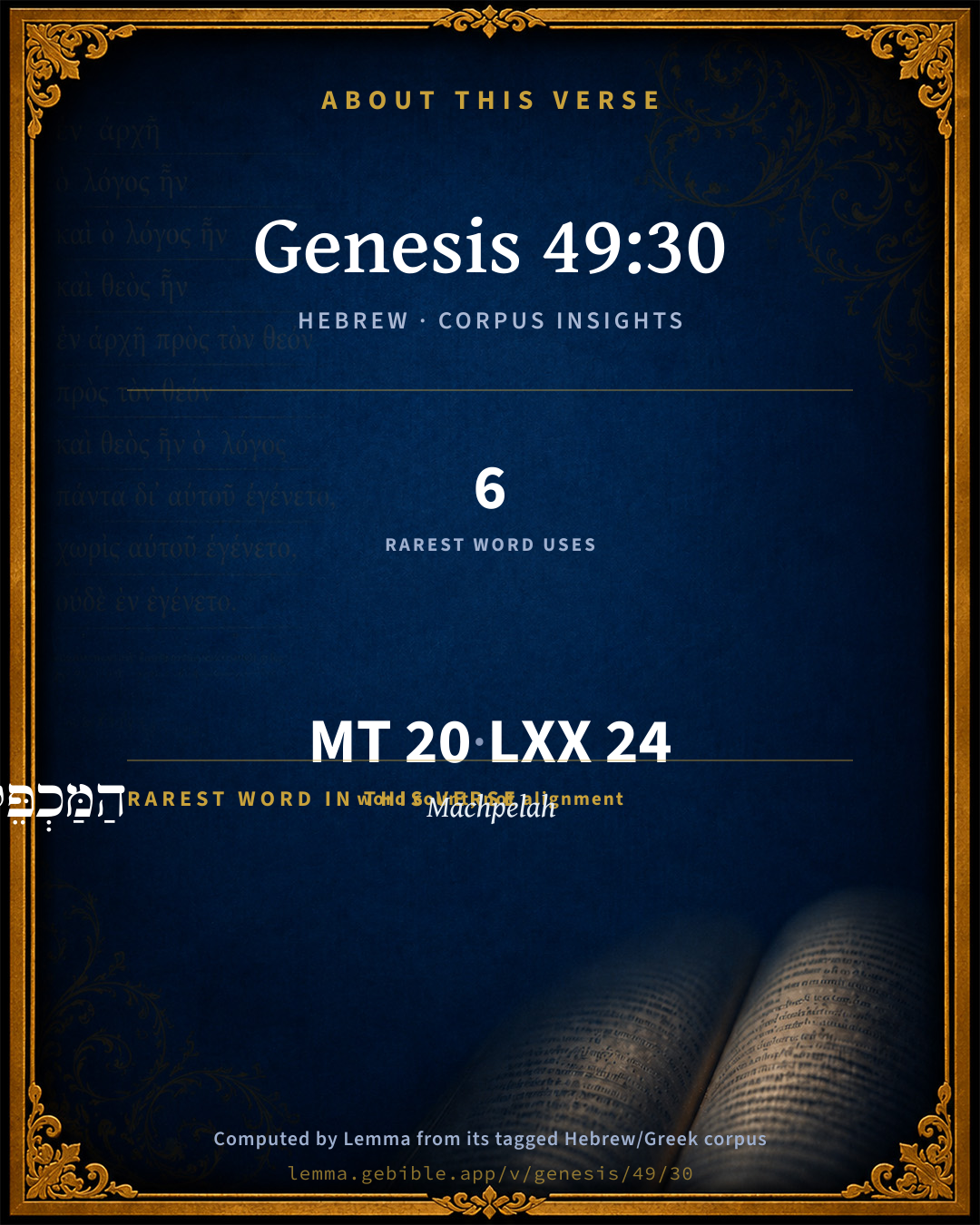
The rarest word here is הַמַּכְפֵּלָ֛ה Machpelah H4375 — appearing just 6 times in the whole Hebrew Bible.

Shared distinctive vocabulary

הַמַּכְפֵּלָ֛ה Machpelah H4375 occurs in 6 verses of the Hebrew Bible. Also found in:

Grammatical profile

  • 1 verb
  • 13 nouns
  • 2 prepositions
  • 4 particles

Verb forms

  • קָנָ֨ה Qal · Perfect

Repetition

Words recur within this verse — often emphatic in Hebrew:

  • בִּשְׂדֵ֧ה field H7704 ×2
  • אֲשֶׁ֨ר which H834 ×3

Hebrew & Septuagint length

In English translation the verse runs 33 words from the Hebrew and 28 from the Septuagint (LXX English) — closely comparable.

A rough comparison of the two English renderings, which tokenize alike — not a word-level alignment.

Word counts can differ between the Hebrew and the Greek without any difference in meaning — e.g. the Hebrew direct-object marker אֵת has no separate Greek word, and Greek often adds the article ὁ.

In the original languages it is 20 Hebrew tokens and 24 Greek tokens — but the two are counted differently (Hebrew bundles its prefixes and suffixes into one token; the Greek is in lemma form), so that isn’t a like-for-like length.

Cross-references

3

Topical passages linked to Genesis 49:30 in the Treasury of Scripture Knowledge — connected by theme and wording, ordered by reader-vote popularity; previews shown in the World English Bible.

  • Genesis 23:8–9 He talked with them, saying, "If it be your mind that I should bury my dead out of my sight, hear me, and entreat for me to Ephron the son of Zohar,
  • Genesis 23:16–18 Abraham listened to Ephron. Abraham weighed to Ephron the silver which he had named in the audience of the children of Heth, four hundred shekels of silver, according to the current merchants' standard.
  • Genesis 23:20 The field, and the cave that is therein, were made sure to Abraham for a possession of a burying place by the children of Heth.

Cross-references courtesy of OpenBible.info (CC BY 4.0).

Hebrew and Greek witnesses Masoretic Hebrew ↔ Greek Septuagint

The same verse in the two great witnesses to the Old Testament, shown verse-for-verse.

These are two independent witnesses, not word-aligned to each other, and the Septuagint is shown in lemma (dictionary) form.

Hebrew Genesis 49:30 Masoretic · Westminster Leningrad Codex

בַּמְּעָרָ֞ה אֲשֶׁ֨ר בִּשְׂדֵ֧ה הַמַּכְפֵּלָ֛ה אֲשֶׁ֥ר עַל פְּנֵי מַמְרֵ֖א בְּאֶ֣רֶץ כְּנָ֑עַן אֲשֶׁר֩ קָנָ֨ה אַבְרָהָ֜ם אֶת הַשָּׂדֶ֗ה מֵאֵ֛ת עֶפְרֹ֥ן הַחִתִּ֖י לַאֲחֻזַּת קָֽבֶר

in the cave that is in the field of Machpelah, which is before Mamre, in the land of Canaan, which Abraham bought with the field from Ephron the Hittite as a burial place.

World English Bible · Public Domain

Greek LXX Genesis 49:30 Septuagint · lemma form

ἐν ὁ σπήλαιον ὁ διπλοῦς ὁ ἀπέναντι μαμβρη ἐν ὁ γῆ χανααν ὅς κτάομαι αβρααμ ὁ σπήλαιον παρά εφρων ὁ χετταῖος ἐν κτῆσις μνημεῖον

in the double cave which is opposite Mambre, in the land of Chanaan, the cave which Abraam bought of Ephron the Chettite, for a possession of a sepulchre.

LXX2012 (modern English Septuagint) · Public Domain

Hebrew: Westminster Leningrad Codex (CC BY 4.0). Greek: Septuagint (public domain); English from LXX2012 (modern English Septuagint) (Public Domain). How the Septuagint differs from the Hebrew →

Targum (Aramaic paraphrase)

2

The Targum is the ancient Jewish Aramaic paraphrase of the Hebrew Scriptures — an interpretive translation, not the Hebrew text itself. Onkelos (literal) and Pseudo-Jonathan (expansive) render the Torah, and Jonathan the Prophets. Coverage is partial: where no permissively-licensed English translation exists for a verse, only the Aramaic is shown. This is verse-level text, not a word-by-word alignment to the Hebrew.

  1. Targum Onkelos Torah (Genesis–Deuteronomy)
    בִּמְעַרְתָּא דִי בַחֲקַל כָּפֶלְתָּא דִי עַל אַפֵּי מַמְרֵא בְּאַרְעָא דִכְנָעַן דִי זְבַן אַבְרָהָם יָת חַקְלָא מִן עֶפְרֹן חִתָּאָה לְאַחֲסָנַת קְבוּרָא

    (no public-domain English translation for this verse)

    Targum Onkelos — Aramaic: “Onkelos Genesis” (public domain); “Onkelos Exodus” (public domain); “Onkelos Leviticus” (public domain); “Onkelos Numbers” (public domain); “Onkelos Deuteronomy” (public domain). English: “Sefaria Community Translation” (CC0 1.0 (public-domain dedication)); “J.W. Etheridge. The Targums of Onkelos and Jonathan Ben Uzziel on the Pentateuch. London: Longmans, Green, 1862” (public domain). Text via Sefaria.

  2. Targum Pseudo-Jonathan Torah (Genesis–Deuteronomy)
    בִּמְעַרְתָּא דִי בַּחֲקַל כְּפֵילְתָּא דְעַל אַפֵּי מַמְרֵא בְּאַרְעָא דִכְנָעַן דִזְבַּן אַבְרָהָם יַת חַקְלָא מִן עֶפְרוֹן חִתָּאָה לְאַחֲסָנַת קְבוּרְתָּא

    in the cave that is in the Double Field over against Mamre in the land of Kenaan; for Abraham bought the field of Ephron the Hitah for an inheritance of burial.

    Targum Pseudo-Jonathan — Aramaic: “Targum Jonathan on Genesis” (public domain); “Targum Jonathan on Exodus” (public domain); “Targum Jonathan on Leviticus” (public domain); “Targum Jonathan on Numbers” (public domain); “Targum Jonathan on Deuteronomy” (public domain). English: “The Targum of Jonathan ben Uzziel, trans. J. W. Etheridge, London, 1862” (public domain). Text via Sefaria.

Commentary

Notes on Genesis 49:30 from classic Christian and Jewish commentators (each source and its license shown beneath its notes). The classic Christian expositions comment on the surrounding passage and are grouped to its opening verse, so a note may address several verses; the Jewish commentaries on the Tanakh (Rashi and others) are per-verse, so they appear only where the commentator wrote on this verse.

Lemma curates 59 commentaries, every one of them public domain or Creative Commons licensed, each selected and text-cleaned for this edition rather than reprinted as found. About our sources →

Trapp's Complete Commentary

John Trapp

Gen 49:30 In the cave that [is] in the field of Machpelah, which [is] before Mamre, in the land of Canaan, which Abraham bought with the field of Ephron the Hittite for a possession of a buryingplace.

Ver. 30. In the cave that is in the field of Machpelah.] Mercer thinketh that this cave is here so copiously described by Jacob, lest, after so many years’ absence in Egypt, any of them should have forgotten it. As also, lest they should doubt or fear that any one would claim it from them, or not permit them quiet possession thereof.

John Trapp, A Commentary or Exposition upon All the Books of the Old and New Testament (1647–1656) — public domain. Text from a community e-Sword module.

The Cambridge Bible for Schools and Colleges

gen. ed. J. J. S. Perowne

30. the cave, &c.] See Gen_23:16-18.

The Cambridge Bible for Schools and Colleges (gen. ed. J. J. S. Perowne; Cambridge University Press, 1878–1918) — public domain. Text from a community e-Sword module.

Matthew Poole's English Annotations

He describes it so particularly, both for their direction, because they had been some years absent thence; and to express how much his heart was set upon this matter; and thereby to oblige them to the more careful performance of his command.

Matthew Poole's English Annotations on the Holy Bible (1683–1685) — public domain. Text from a community e-Sword/MySword module.

Radak

Rabbi David Kimhi (Radak)

במערה, we have explained on Genesis 25,10 why this mention of the cave of Machpelah as the patriarchs’ burial site is mentioned so many times in the Torah as if we did not know already.

Radak on the Tanakh — English translations: “Sefaria Community Translation” (CC0 1.0 (public-domain dedication)); “Eliyahu Munk, HaChut Hameshulash” (CC BY 4.0); “Rabbi Mike Feuer, Jerusalem Anthology” (CC BY 4.0); and “R. David Kimhi on the first book of Psalms, Translated by R.G. Finch, London, 1919” (public domain). Text via Sefaria.

Lesson kit

Teaching starters — assembled from the data on this page, not authored interpretation. Every prompt links to the verse data it draws on. Edit before teaching.

Genesis, in the Pentateuch, opens this verse with 20 words (17 distinct Hebrew lemmas). Its most distinctive word is Makpêlâh (“Machpelah”). A historical commentator’s framing appears above. Read the whole chapter for the surrounding context.

Discussion questions

  1. How does “Machpelah” (Makpêlâh) shape what this verse is saying?
  2. Genesis 23:9 shares the word «Machpelah» with this verse. How do the two illuminate each other?
  3. “field” occurs 2× in this one verse. What is the effect of the repetition?
  4. These translations render this verse differently; the difference is in the English rendering, not the original. What questions does that raise?
  5. The verb «קָנָ֨ה» is Qal Perfect. How does its form color the action?
  6. Reading how Trapp's Complete Commentary and The Cambridge Bible for Schools and Colleges read this verse, where do the two commentators agree and where do they part?

Things to notice

Reading settings

Reading text

Shown beneath each verse's original-language words.

Old Testament
Old Testament edition

Read the OT as the Masoretic Hebrew (MT) or the Greek Septuagint (LXX).

English shown for the Greek Septuagint (in the Hebrew ↔ Greek comparison).

Comparing translations? Open the Compare panel on any verse page to stack up to four side by side.