
Judges 20:31

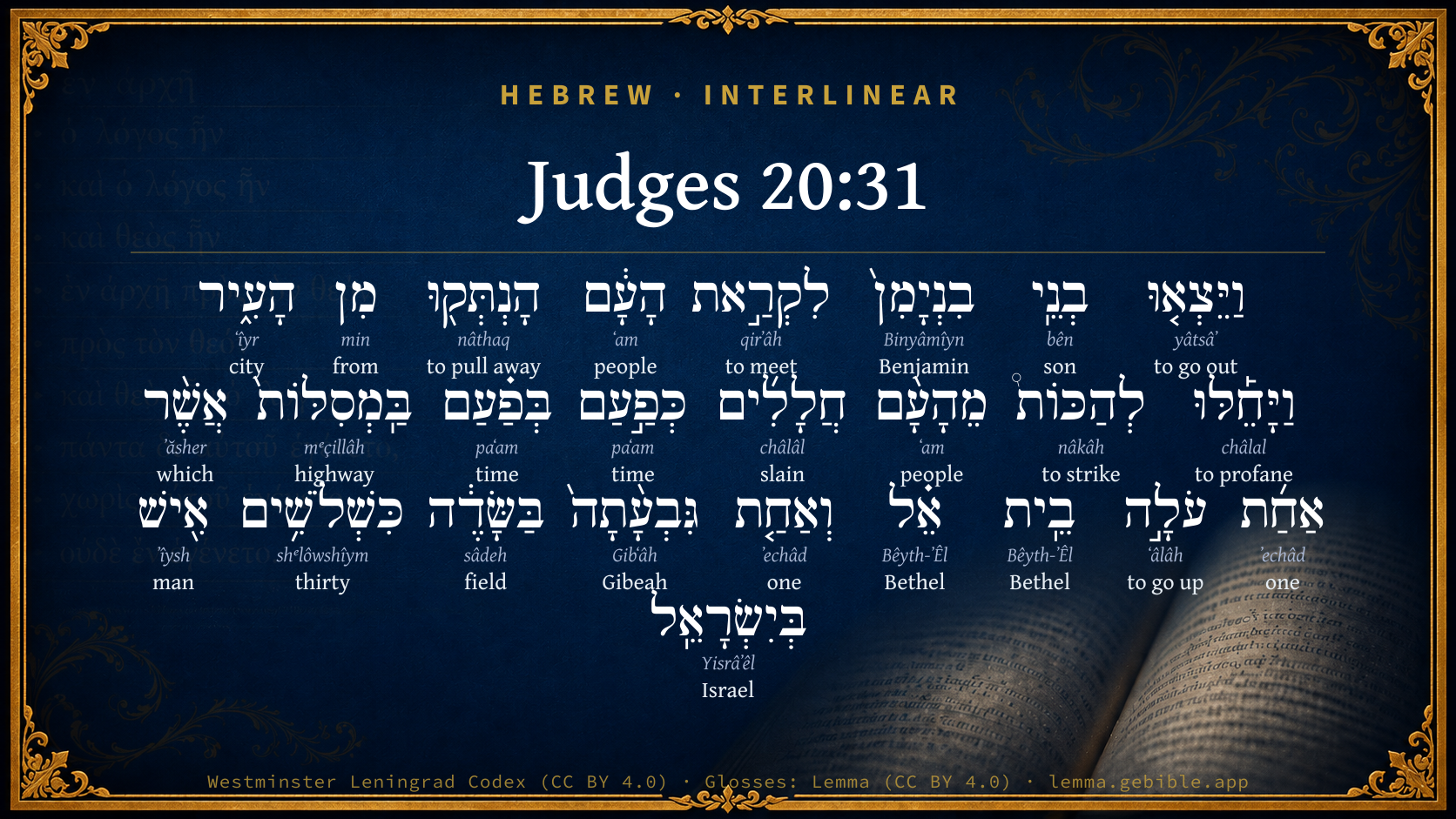
Hebrew (Westminster Leningrad Codex) Judges 20:31 appears in the Hebrew Old Testament. The text above is from the Westminster Leningrad Codex. Each word links to its Strong’s number, a concise gloss, and parsing drawn from the Open Scriptures Hebrew Bible morphology. Click any word for its full Brown-Driver-Briggs (BDB) entry.
Download image
Cite this verse

Judges 20:31 (World English Bible). Public Domain. Lemma interlinear Bible study tool, https://lemma.gebible.app/v/judges/20/31.

Show BibTeX & RIS
BibTeX
RIS
English Translation
The children of Benjamin went out against the people, and were drawn away from the city; and they began to strike and kill of the people, as at other times, in the highways, of which one goes up to Bethel, and the other to Gibeah, in the field, about thirty men of Israel.
World English Bible · Public Domain
Download a study sheet

One document with this verse’s original text, its word-by-word gloss line, the meaning frame, cross-references with their text, attributed commentary, and full source and license credits — printable, and it pastes into notes with its structure intact.

This verse Autodidact and up

Study sheet (.html) Plain text (.txt)

A passage Seminary Student

Up to 50 verses in one chapter. A passage sheet keeps up to 6 commentary sources and 12 cross-references per verse, in the order this page ranks them, and says so on the sheet whenever that leaves anything out. Ask for a single verse and you get the Autodidact verse sheet above.

Everything on this page stays free to read, with no account — the sheet is a download of what is already on screen, not access to it.

Want to remove ads? Support Godless Engineer
Compare translations 3

The same verse in 3 English versions, stacked beneath the original-language interlinear above. Click any original word for its lexicon entry.

Each is an independent rendering of the whole verse — the interlinear is not word-aligned to these translations.

Highlighted words mark where these versions differ — a whole-verse word diff, not a word-by-word alignment.

  • World English Bible Public Domain
    The children of Benjamin went out against the people, and were drawn away from the city; and they began to strike and kill of the people, as at other times, in the highways, of which one goes up to Bethel, and the other to Gibeah, in the field, about thirty men of Israel.
  • King James Version Public Domain
    And the children of Benjamin went out against the people, and were drawn away from the city; and they began to smite of the people, and kill, as at other times, in the highways, of which one goeth up to the house of God, and the other to Gibeah in the field, about thirty men of Israel.
  • unfoldingWord Literal Text CC BY-SA 4.0
    And the sons of Benjamin came out to meet the people. They were drawn from the city, and they began to strike down of the people, slain as time upon time on the roads, which one went up Bethel and one Gibeah by the field, about 30 men of Israel.

unfoldingWord Literal Text — © unfoldingWord, licensed CC BY-SA 4.0. Word-aligned USFM3 via Door43 (git.door43.org/unfoldingWord/en_ult).

Versions to compare (up to 4)

3 of 4 selected

Show all 18 translations

Every available English version of this verse, each an independent rendering of the whole verse.

  • World English Bible Public Domain
    The children of Benjamin went out against the people, and were drawn away from the city; and they began to strike and kill of the people, as at other times, in the highways, of which one goes up to Bethel, and the other to Gibeah, in the field, about thirty men of Israel.
  • Berean Standard Bible Public Domain
    The Benjamites came out against them and were drawn away from the city. They began to attack the people as before, killing about thirty men of Israel in the fields and on the roads, one of which led up to Bethel and the other to Gibeah.
  • Majority Standard Bible Public Domain
    The Benjamites came out against them and were drawn away from the city. They began to attack the people as before, killing about thirty men of Israel in the fields and on the roads, one of which led up to Bethel and the other to Gibeah.
  • King James Version Public Domain
    And the children of Benjamin went out against the people, and were drawn away from the city; and they began to smite of the people, and kill, as at other times, in the highways, of which one goeth up to the house of God, and the other to Gibeah in the field, about thirty men of Israel.
  • American Standard Version (1901) Public Domain
    And the children of Benjamin went out against the people, and were drawn away from the city; and they began to smite and kill of the people, as at other times, in the highways, of which one goeth up to Beth-el, and the other to Gibeah, in the field, about thirty men of Israel.
  • Revised Version (1885) Public Domain
    And the children of Benjamin went out against the people, and were drawn away from the city; and they began to smite and kill of the people, as at other times, in the highways, of which one goeth up to Beth-el, and the other to Gibeah, in the field, about thirty men of Israel.
  • Geneva Bible (1599) Public Domain
    Then the children of Beniamin comming out against the people, were drawen from the citie: and they began to smite of ye people and kill as at other times, euen by the wayes in the fielde (whereof one goeth vp to the house of God, and the other to Gibeah) vpon a thirtie men of Israel.
  • Douay-Rheims (1899) Public Domain
    And the children of Benjamin boldly issued out of the city, and seeing their enemies flee, pursued them a long way, so as to wound and kill some of them, as they had done the first and second day, whilst they fled by two highways, whereof one goeth up to Bethel, and the other to Gabaa, and they slew about thirty men:
  • Young's Literal Translation Public Domain
    And the sons of Benjamin come out to meet the people; they have been drawn away out of the city, and begin to smite `some' of the people -- wounded as time by time, in the highways (of which one is going up to Beth-El, and the other to Gibeah in the field), `are' about thirty men of Israel.
  • Literal Standard Version CC BY-SA 4.0
    And the sons of Benjamin come out to meet the people; they have been drawn away out of the city, and begin to strike [some] of the people—wounded as time by time—in the highways (of which one is going up to Beth-El, and the other to Gibeah in the field), [are] about thirty men of Israel.
  • Unlocked Literal Bible CC BY-SA 4.0
    The people of Benjamin went and fought against the people, and they were drawn away from the city. They began to kill some of the people. There were about thirty men of Israel who died in the fields and on the roads. One of the roads went up to Bethel, and the other went to Gibeah.
  • unfoldingWord Literal Text CC BY-SA 4.0
    And the sons of Benjamin came out to meet the people. They were drawn from the city, and they began to strike down of the people, slain as time upon time on the roads, which one went up Bethel and one Gibeah by the field, about 30 men of Israel.
  • Darby Bible Public Domain
    And the Benjaminites went out against the people, and were drawn away from the city; and as at other times they began to smite and kill some of the people, in the highways, one of which goes up to Bethel and the other to Gib'e-ah, and in the open country, about thirty men of Israel.
  • World Messianic Bible Public Domain
    The children of Benjamin went out against the people, and were drawn away from the city; and they began to strike and kill of the people as at other times, in the highways, of which one goes up to Bethel and the other to Gibeah, in the field, about thirty men of Israel.
  • Webster's Bible Public Domain
    And the children of Benjamin went out against the people, and were drawn away from the city; and they began to smite of the people, and kill, as at other times, in the highways, of which one goeth up to the house of God, and the other to Gibeah in the field, about thirty men of Israel.
  • Free Bible Version CC BY-SA 4.0
    The Benjamites came out to attack them and were lured away from the town as they began to kill Israelites as they had before. Some thirty Israelites died on the battlefield and along the roads, the one that goes towards Bethel and the other that goes back towards Gibeah.
  • Bible in Basic English Public Domain
    And the children of Benjamin went out against the people, moving away from the town; and as before, at their first attack, they put to death about thirty men of Israel on the highways, of which one goes up to Beth-el and the other to Gibeah, and in the open country.
  • JPS Tanakh (1917) Public Domain
    And the children of Benjamin went out against the people, and were drawn away from the city; and they began to smite and kill of the people, as at other times, in the field, in the highways, of which one goeth up to Beth-el, and the other to Gibeah, about thirty men of Israel.

Literal Standard Version (2020), Covenant Press — licensed CC BY-SA 4.0. Text via the HelloAO Bible API (eBible.org). Unlocked Literal Bible (unfoldingWord) — licensed CC BY-SA 4.0. Text via the HelloAO Bible API (eBible.org). unfoldingWord Literal Text — © unfoldingWord, licensed CC BY-SA 4.0. Word-aligned USFM3 via Door43 (git.door43.org/unfoldingWord/en_ult). Free Bible Version, Dr. Jonathan Gallagher — licensed CC BY-SA 4.0. Text via the HelloAO Bible API (eBible.org).

Word by word

More ways to search: Search by grammar → Find every occurrence → Compare this word →

Practice this passage: Drill this verse → Learn its vocabulary →

הָנְתְּק֖וּ
nâthaq
H5423
“to pull away”
Verb, Hophal, Perfect, 3rd Person, Common, Plural
Part of Speech
Verb
Stem
Hophal
Form
Perfect
Person
3rd Person
Gender
Common
Number
Plural
Full BDB Definition

Origin: a primitive root

TWOT: 1447

to pull or tear or draw off or away or apart, draw out, pluck up, break, lift, root out - (Qal) - to draw away - to draw or pull off - to pull or tear away - (Niphal) - to be drawn away, be drawn out - to be torn apart or in two, be snapped - to be separated - (Piel) - to tear apart, snap - to tear out, tear up, tear away - (Hiphil) - to draw away - to drag away - (Hophal) to be drawn away
  1. וַיֵּצְא֤וּ yâtsâʼ H3318 “and · to go out” Conjunction + Verb, Qal, Sequential Imperfect, 3rd Person, Masculine, Plural
  2. בְנֵֽי bên H1121 “sons of” Noun, Common, Masculine, Plural, Construct
  3. בִנְיָמִן֙ Binyâmîyn H1144 “Benjamin” Noun, Proper
  4. לִקְרַ֣את qirʼâh H7125 “to meet” Preposition + Verb, Qal, Infinitive Construct
  5. הָעָ֔ם ʻam H5971 “the · people” Particle, Definite Article + Noun, Common, Masculine, Singular, Absolute
  6. מִן min H4480 “from” Preposition
  7. הָעִ֑יר ʻîyr H5892 “the · city” Particle, Definite Article + Noun, Common, Feminine, Singular, Absolute
  8. וַיָּחֵ֡לּוּ châlal H2490 “and · to profane” Conjunction + Verb, Hiphil, Sequential Imperfect, 3rd Person, Masculine, Plural
  9. לְהַכּוֹת֩ nâkâh H5221 “to strike” Preposition + Verb, Hiphil, Infinitive Construct
  10. מֵהָעָ֨ם ʻam H5971 “from · the · people” Preposition + Particle, Definite Article + Noun, Common, Masculine, Singular, Absolute
  11. חֲלָלִ֜ים châlâl H2491 “slain” Adjective, Adjective, Masculine, Plural, Absolute
  12. כְּפַ֣עַם paʻam H6471 “like/as · time” Preposition + Noun, Common, Feminine, Singular, Absolute
  13. בְּפַ֗עַם paʻam H6471 “in/at · time” Preposition + Noun, Common, Feminine, Singular, Absolute
  14. בַּֽמְסִלּוֹת֙ mᵉçillâh H4546 “in/at the · highways” Preposition, Determined + Noun, Common, Feminine, Plural, Absolute
  15. אֲשֶׁ֨ר ʼăsher H834 “which” Particle, Relative
  16. אַחַ֜ת ʼechâd H259 “one” Adjective, Cardinal number, Feminine, Singular, Absolute
  17. עֹלָ֣ה ʻâlâh H5927 “going up” Verb, Qal, Participle Active, Feminine, Singular, Absolute
  18. בֵֽית Bêyth-ʼÊl H1008 “Bethel” Noun, Proper
  19. אֵ֗ל Bêyth-ʼÊl H1008 “Bethel” Noun, Proper
  20. וְאַחַ֤ת ʼechâd H259 “and · one” Conjunction + Adjective, Cardinal number, Feminine, Singular, Absolute
  21. גִּבְעָ֨תָה֙ Gibʻâh H1390 “Gibeah · toward” Noun, Proper + Suffix, Demonstrative
  22. בַּשָּׂדֶ֔ה sâdeh H7704 “in/at the · field” Preposition, Determined + Noun, Common, Masculine, Singular, Absolute
  23. כִּשְׁלֹשִׁ֥ים shᵉlôwshîym H7970 “like/as · thirty” Preposition + Adjective, Cardinal number, Both, Plural, Absolute
  24. אִ֖ישׁ ʼîysh H376 “man” Noun, Common, Masculine, Singular, Absolute
  25. בְּיִשְׂרָאֵֽל Yisrâʼêl H3478 “in/at · Israel” Preposition + Noun, Proper

About this verse

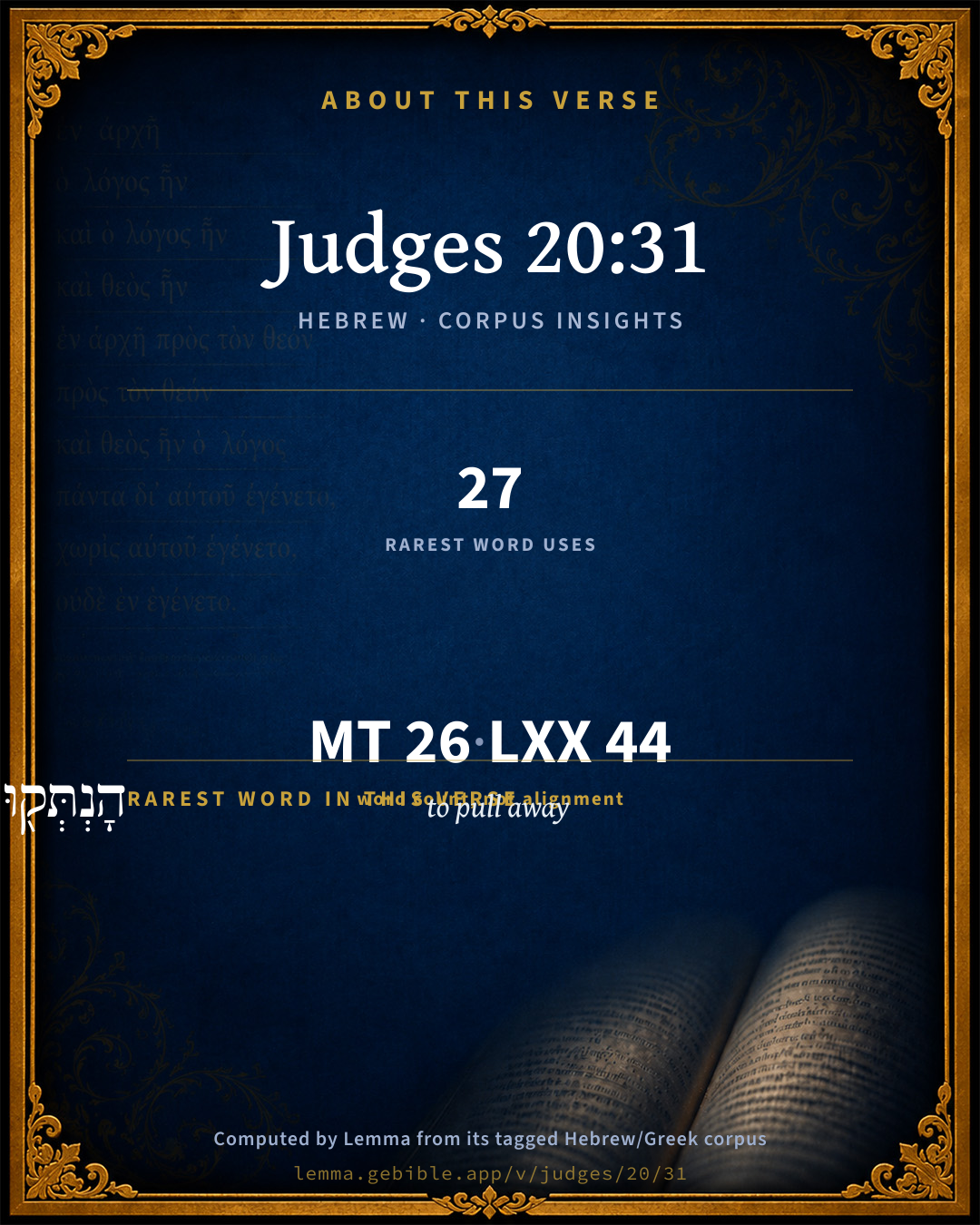
These counts appear in no published source. They are computed here, from the morphology-tagged text and Lemma’s own curated glosses. What Lemma adds →

26
words
22
distinct lemmas
Historical
section

Shared distinctive vocabulary

הָנְתְּק֖וּ to pull away H5423 occurs in 26 verses of the Hebrew Bible. Also found in:

Grammatical profile

  • 6 verbs
  • 14 nouns
  • 4 adjectives
  • 1 preposition
  • 1 particle

Verb forms

  • וַיֵּצְא֤וּ Qal · Sequential Imperfect
  • לִקְרַ֣את Qal · Infinitive Construct
  • הָנְתְּק֖וּ Hophal · Perfect
  • וַיָּחֵ֡לּוּ Hiphil · Sequential Imperfect
  • לְהַכּוֹת֩ Hiphil · Infinitive Construct
  • עֹלָ֣ה Qal · Participle Active

Repetition

Words recur within this verse — often emphatic in Hebrew:

  • הָעָ֔ם people H5971 ×2
  • כְּפַ֣עַם time H6471 ×2
  • אַחַ֜ת one H259 ×2
  • בֵֽית Bethel H1008 ×2

Hebrew & Septuagint length

In English translation the verse runs 53 words from the Hebrew and 50 from the Septuagint (LXX English) — closely comparable.

A rough comparison of the two English renderings, which tokenize alike — not a word-level alignment.

Word counts can differ between the Hebrew and the Greek without any difference in meaning — e.g. the Hebrew direct-object marker אֵת has no separate Greek word, and Greek often adds the article ὁ.

In the original languages it is 26 Hebrew tokens and 44 Greek tokens — but the two are counted differently (Hebrew bundles its prefixes and suffixes into one token; the Greek is in lemma form), so that isn’t a like-for-like length.

Cross-references

4

Topical passages linked to Judges 20:31 in the Treasury of Scripture Knowledge — connected by theme and wording, ordered by reader-vote popularity; previews shown in the World English Bible.

  • Joshua 8:14–16 It happened, when the king of Ai saw it, that they hurried and rose up early, and the men of the city went out against Israel to battle, he and all his people, at the time appointed, before the Arabah; but he didn't know that there was an ambush against him behind the city.
  • Joshua 7:5 The men of Ai struck of them about thirty-six men; and they chased them [from] before the gate even to Shebarim, and struck them at the descent; and the hearts of the people melted, and became as water.
  • Judges 19:13–14 He said to his servant, Come and let us draw near to one of these places; and we will lodge in Gibeah, or in Ramah.
  • Isaiah 10:29 they are gone over the pass; they have taken up their lodging at Geba; Ramah trembles; Gibeah of Saul is fled.

Cross-references courtesy of OpenBible.info (CC BY 4.0).

Hebrew and Greek witnesses Masoretic Hebrew ↔ Greek Septuagint

The same verse in the two great witnesses to the Old Testament, shown verse-for-verse.

These are two independent witnesses, not word-aligned to each other, and the Septuagint is shown in lemma (dictionary) form.

Hebrew Judges 20:31 Masoretic · Westminster Leningrad Codex

וַיֵּצְא֤וּ בְנֵֽי בִנְיָמִן֙ לִקְרַ֣את הָעָ֔ם הָנְתְּק֖וּ מִן הָעִ֑יר וַיָּחֵ֡לּוּ לְהַכּוֹת֩ מֵהָעָ֨ם חֲלָלִ֜ים כְּפַ֣עַם בְּפַ֗עַם בַּֽמְסִלּוֹת֙ אֲשֶׁ֨ר אַחַ֜ת עֹלָ֣ה בֵֽית אֵ֗ל וְאַחַ֤ת גִּבְעָ֨תָה֙ בַּשָּׂדֶ֔ה כִּשְׁלֹשִׁ֥ים אִ֖ישׁ בְּיִשְׂרָאֵֽל

The children of Benjamin went out against the people, and were drawn away from the city; and they began to strike and kill of the people, as at other times, in the highways, of which one goes up to Bethel, and the other to Gibeah, in the field, about thirty men of Israel.

World English Bible · Public Domain

Greek LXX Judges 20:31 Septuagint · lemma form

καί ἐκἔρχομαι ὁ υἱός βενιαμίν εἰς συνάντησις ὁ λαός καί ἐκκενόω ὁ πόλις καί ἄρχω πατάσσω ἀπό ὁ λαός τραυματίας ὡς ἅπαξ καί ἅπαξ ἐν ὁ ὁδός ὅς εἰμί εἷς ἀναβαίνω εἰς βαιθηλ καί εἷς εἰς γαβαα ἐν ἀγρός ὡς τριάκοντα ἀνήρ ἐν ἰσραήλ

And the children of Benjamin went out to meet the people, and were all drawn out of the city, and began to strike and kill the people as before in the roads, whereof one goes up to Baethel, and one to Gabaa in the field, about thirty men of Israel.

LXX2012 (modern English Septuagint) · Public Domain

On this verse, The Pulpit Commentary discusses the Septuagint’s reading. Read the note in Commentary ↓

Hebrew: Westminster Leningrad Codex (CC BY 4.0). Greek: Septuagint (public domain); English from LXX2012 (modern English Septuagint) (Public Domain). How the Septuagint differs from the Hebrew →

Targum (Aramaic paraphrase)

1

The Targum is the ancient Jewish Aramaic paraphrase of the Hebrew Scriptures — an interpretive translation, not the Hebrew text itself. Onkelos (literal) and Pseudo-Jonathan (expansive) render the Torah, and Jonathan the Prophets. Coverage is partial: where no permissively-licensed English translation exists for a verse, only the Aramaic is shown. This is verse-level text, not a word-by-word alignment to the Hebrew.

  1. Targum Jonathan Prophets (Joshua–Malachi)
    וּנְפָקוּ בְּנֵי בִּנְיָמִין לִקְדָמוּת עַמָא אִתְנְגִידוּ מִן קַרְתָּא וּשְׁרִיאוּ לְקַטָלָא מֵעַמָא קְטִילִין כִּזְמַן בִּזְמָן בִּכְבֵשׁ אָרְחָתָא דַחֲדָא סַלְקָא לְבֵית אֵל וַחֲדָא לְגִבְעֲתָא בְּחַקְלָא כִּתְלָתִין גַבְרָא בְּיִשְׂרָאֵל:

    (no public-domain English translation for this verse)

    Targum Jonathan — Aramaic: “Mikraot Gedolot” (public domain). English: “Sefaria Community Translation” (CC0 1.0 (public-domain dedication)); “London "Chaldee Paraphrase," 1871” (public domain). Text via Sefaria.

Commentary

Notes on Judges 20:31 from classic Christian and Jewish commentators (each source and its license shown beneath its notes). The classic Christian expositions comment on the surrounding passage and are grouped to its opening verse, so a note may address several verses; the Jewish commentaries on the Tanakh (Rashi and others) are per-verse, so they appear only where the commentator wrote on this verse.

Lemma curates 59 commentaries, every one of them public domain or Creative Commons licensed, each selected and text-cleaned for this edition rather than reprinted as found. About our sources →

Trapp's Complete Commentary

John Trapp

Jdg 20:31 And the children of Benjamin went out against the people, [and] were drawn away from the city; and they began to smite of the people, [and] kill, as at other times, in the highways, of which one goeth up to the house of God, and the other to Gibeah in the field, about thirty men of Israel.

Ver. 31. And they began to smite of the people.] This flushed the Benjamites, and made them cry Victoria; but the scene was soon altered. It is not good to triumph before the victory.

John Trapp, A Commentary or Exposition upon All the Books of the Old and New Testament (1647–1656) — public domain. Text from a community e-Sword module.

Geneva Bible (1599)

Geneva Bible translators

By the policy of the children of Israel.

Geneva Bible (1599) marginal notes — public domain. Text via Bolls.life.

Ellicott's Commentary for English Readers

(31) To smite of the people, and kill.—Rather, to smite the wounded or beaten of the people. It means, apparently, that when some of the Israelites had been wounded with slings, the Benjamites began to rush on them, for the purpose of killing them, and they feigned flight along two highways, of which one led to Bethel, and the other to a place which, to distinguish it from Gibeah, seems to have been called “Gibeah in the field.” In this feigned flight thirty Israelites were killed. “Gibeah in the field” seems to be Jeba, and the main road from Gibeah (Tuleil el Fûl), at about a mile’s distance from the hill, branches off into two, of which one leads to Beitin (Bethel), and the other to Jeba (“Gibeah in the field”).

The highways.—(Mesilloth.) Roads like the Roman viae regiae, regularly built.

A Bible Commentary for English Readers, edited by Charles John Ellicott (1878–1897) — public domain. Text from a community e-Sword module.

The Cambridge Bible for Schools and Colleges

gen. ed. J. J. S. Perowne

31. The opening sentence follows the pattern of Jdg_20:21; Jdg_20:25. The remainder of the v. raises difficulties; it is partly repeated in Jdg_20:39; the pretence of flight does not come properly till Jdg_20:32. Either we may regard as additional glosses they were drawn away from the city (there is no and in the Hebr.), and the topographical note in the high ways, of which … to Gibeah, leaving the statement that the Benjamites began to smite and kill in the open country as on the former occasions (so Moore): or we may retain the words just quoted, and slightly rearrange them on the model of Jdg_20:32; Jdg_20:39 : they were drawn away from the city into the highways, of which … to Gibeah, and they began to smite and kill in the field about thirty men of Israel (so Budde, Nowack, who distinguish three, instead of two versions). The first alternative has the merit of simplicity.

to Gibeah] cannot be right, for the Israelites were retreating towards the N., away from Gibeah; the general direction of the two roads must be the same. For Gibeah, therefore, read Gibeon; at a short distance beyond Tell el-Fûl the road branches northwards to Beitîn (= Beth-el) and N.W. to el-Jib (= Gibeon), 3 m. N.W. of Tell el-Fûl.

The Cambridge Bible for Schools and Colleges (gen. ed. J. J. S. Perowne; Cambridge University Press, 1878–1918) — public domain. Text from a community e-Sword module.

John Gill's Exposition

And the children of Benjamin said, they are smitten down before us, as at first,.... At the first battle, which gave them great spirit, and they concluded they should have victory, as before:

but the children of Israel said, let us flee, and draw them from the city unto the highways; pretending to be afraid of them, and not able to face them, and therefore made as if they fled through fear and cowardice, which inspired the Benjaminites with fresh ardour to pursue them closely, and so were drawn from the city to the highways, as expressed in the preceding verse.

John Gill's Exposition of the Whole Bible (1746–1763) — public domain (CC PDM 1.0). Text via the HelloAO Bible API.

Albert Barnes' Notes on the Bible

To the house of God - “To Bethel,” as in the margin. On “Gibeah in the field,” see Jos 18:24 note.

Albert Barnes' Notes on the Bible (1834–1885) — public domain. Text from a community e-Sword/MySword module.

Haydock's Catholic Bible Commentary

To Gabaa, from some other city. (Haydock) --- This body of men consisted of 10,000, who were designed to draw off the Benjamites from the city into the midst of the forces of Israel, at Baalthamar; while another division, in ambush, on the west of Gabaa, had to enter the city, and having set it on fire, were to prevent the inhabitants from re-entering. (Calmet) --- They use a similar stratagem to that which Josue (Josue viii.) had employed against Hai. (Salien)

George Leo Haydock (1774–1849), Haydock's Catholic Family Bible and Commentary, 1859 edition — public domain. Excludes Psalms (Douay-Rheims chapter numbering differs from Protestant) and Deuterocanonical books (Catholic canon only).

Matthew Poole's English Annotations

Drawn away from the city, by the dissembled flight of the Israelites.

As at other times; with the same kind, though not with the same degree of success.

Gibeah in the field; so called, to difference it from this Gibeah, which was upon a hill; wherefore they are constantly said to ascend or go up against it, as Jdg 20:23,30. See Jos 18:24,28.

Matthew Poole's English Annotations on the Holy Bible (1683–1685) — public domain. Text from a community e-Sword/MySword module.

Whedon's Commentary on the Bible

Daniel D. Whedon

31. To smite of the people, and kill — Rather, to smite of the people the wounded, or pierced. Some thirty men were hit and wounded by the slingers, and the Benjamites rushed upon them and smote them.

In the highways — The contest shows that the highways here mentioned was a spot where two roads parted, one leading up to Beth-el, (not house of God, as here again rendered,) the other to Gibeah. In the field designates not the site of Gibeah, (as Gibeah in the field,) but the place where the two roads parted.

Daniel D. Whedon (gen. ed.), Commentary on the Old and New Testaments (1874–1909) — public domain. Text from a community e-Sword module.

The Pulpit Commentary

The house of God. Here manifestly Bethel, as in the margin. Gibeah in the field. The A.V is the natural rendering of the Hebrew words, which imply a Gibeah in the field different from Gibeah, as the Septuagint seems to have understood them (Gabaa en agrw ). It is a happy conjecture, borne out by the existing roads, that this Gibeah-in-the-field is the same as Gobs, now Jeba. Indeed it is almost impossible to conceive how the pursuers, coming out of Gibeah, could be described as coming to two highways, of which one led to Bethel and the other to the very place they had come from. The latest explorers of the district fully concur in this identification of Gibeah-in-the-field with Jeba.

The Pulpit Commentary (1880–1919), ed. H.D.M. Spence-Jones & Joseph S. Exell — public domain. Text from a community e-Sword module.

unfoldingWord translationNotes

Door43 World Missions Community

fought against the people

The full meaning of this statement can be made explicit. AT: "fought against the people of Israel" (See: Assumed Knowledge and Implicit Information)

they were drawn away from the city

This can be stated in active form. AT: "the people of Israel drew them away from the city" (See: Active or Passive)

They began to kill some of the people

The full meaning of this statement can be made explicit. AT: "The people of Benjamin began to kill some of the men of Israel" (See: Assumed Knowledge and Implicit Information)

translationWords

Bethel

unfoldingWord translationNotes — © Distant Shores Media and the Door43 World Missions Community, licensed CC BY-SA 4.0. Source: git.door43.org/Door43/en_tn.

Lesson kit

Teaching starters — assembled from the data on this page, not authored interpretation. Every prompt links to the verse data it draws on. Edit before teaching.

Judges, in the Historical, opens this verse with 26 words (22 distinct Hebrew lemmas). Its most distinctive word is nâthaq (“to pull away”). A historical commentator’s framing appears above. Read the whole chapter for the surrounding context.

Discussion questions

  1. What does “to pull away” (nâthaq) contribute to the verse as a whole?
  2. Leviticus 22:24 shares the word «to pull away» with this verse. How do the two illuminate each other?
  3. “people” occurs 2× in this one verse. What is the effect of the repetition?
  4. These translations render this verse differently. What is at stake in choosing one wording over another?
  5. The verb «וַיֵּצְא֤וּ» is Qal Sequential Imperfect. How does its form color the action?
  6. Reading how Trapp's Complete Commentary and Geneva Bible (1599) read this verse, where do the two commentators agree and where do they part?

Things to notice

Reading settings

Reading text

Shown beneath each verse's original-language words.

Old Testament
Old Testament edition

Read the OT as the Masoretic Hebrew (MT) or the Greek Septuagint (LXX).

English shown for the Greek Septuagint (in the Hebrew ↔ Greek comparison).

Comparing translations? Open the Compare panel on any verse page to stack up to four side by side.