
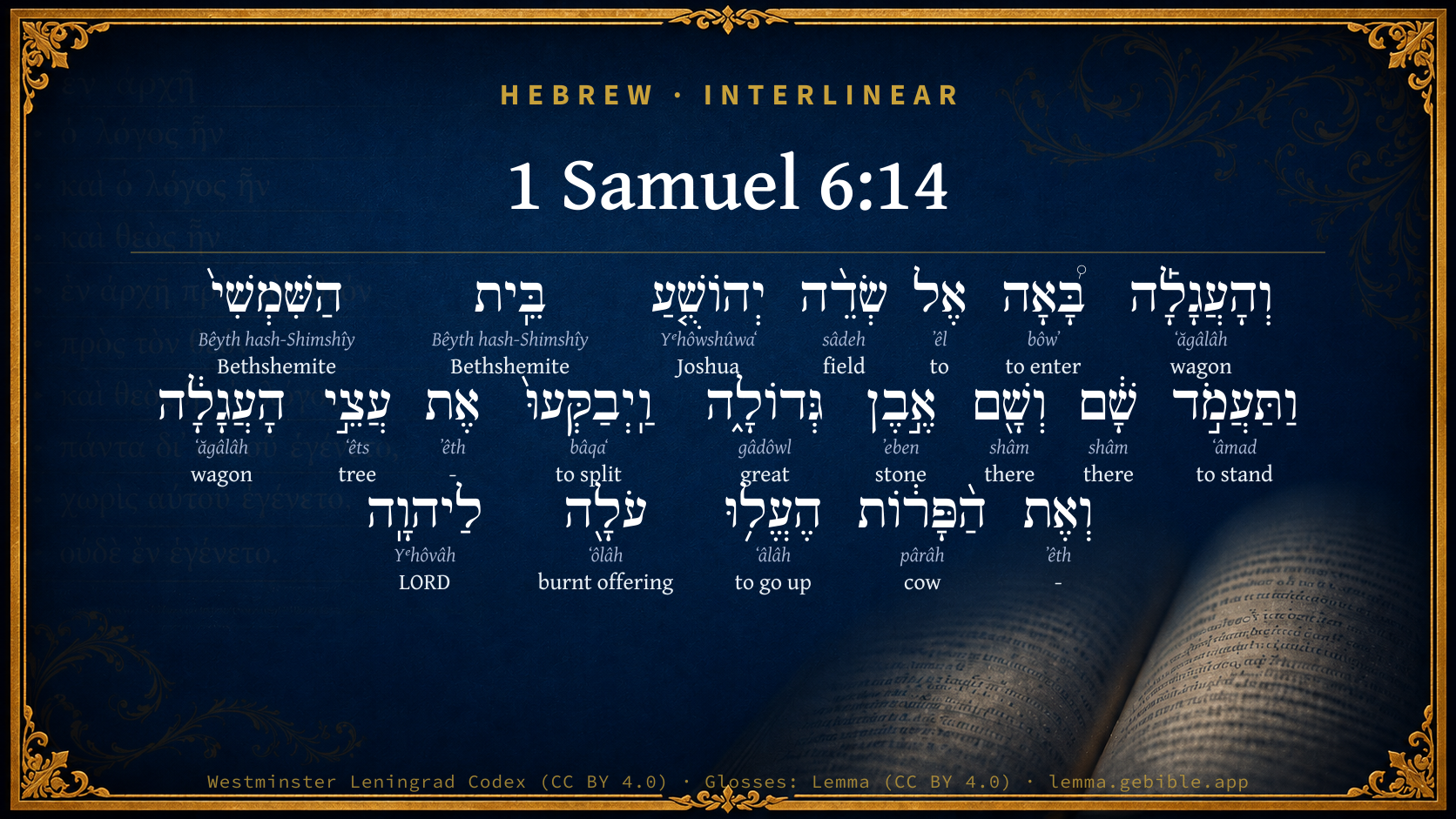
1 Samuel 6:14

Hebrew (Westminster Leningrad Codex) 1 Samuel 6:14 appears in the Hebrew Old Testament. The text above is from the Westminster Leningrad Codex. Each word links to its Strong’s number, a concise gloss, and parsing drawn from the Open Scriptures Hebrew Bible morphology. Click any word for its full Brown-Driver-Briggs (BDB) entry.
Download image
Cite this verse

1 Samuel 6:14 (World English Bible). Public Domain. Lemma interlinear Bible study tool, https://lemma.gebible.app/v/1-samuel/6/14.

Show BibTeX & RIS
BibTeX
RIS
English Translation
The cart came into the field of Joshua the Beth-shemite, and stood there, where there was a great stone: and they split the wood of the cart, and offered up the cattle for a burnt offering to Yahweh.
World English Bible · Public Domain
Highlights
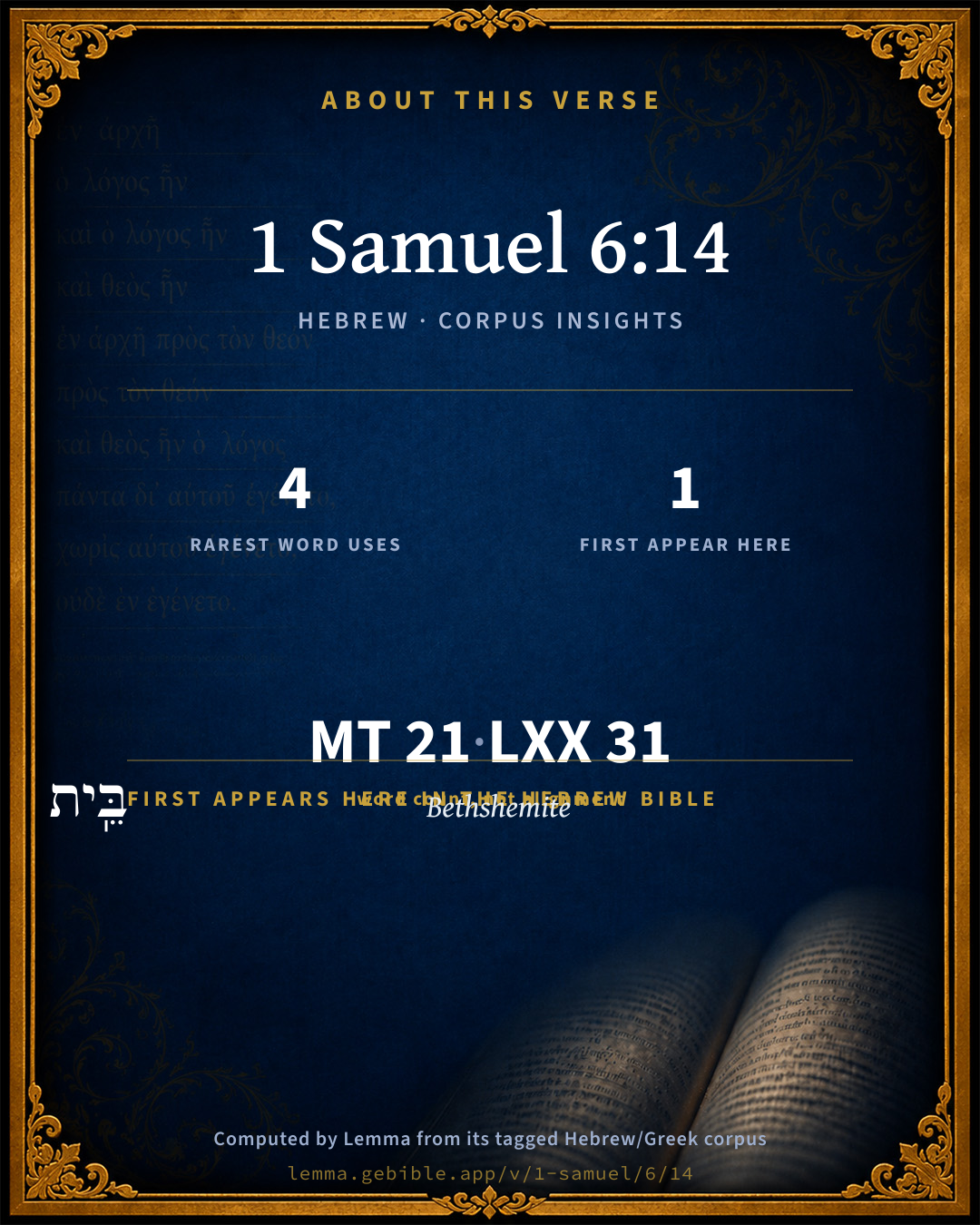
  • 1 first appearance in the Hebrew Bible
Full analysis ↓
Download a study sheet

One document with this verse’s original text, its word-by-word gloss line, the meaning frame, cross-references with their text, attributed commentary, and full source and license credits — printable, and it pastes into notes with its structure intact.

This verse Autodidact and up

Study sheet (.html) Plain text (.txt)

A passage Seminary Student

Up to 50 verses in one chapter. A passage sheet keeps up to 6 commentary sources and 12 cross-references per verse, in the order this page ranks them, and says so on the sheet whenever that leaves anything out. Ask for a single verse and you get the Autodidact verse sheet above.

Everything on this page stays free to read, with no account — the sheet is a download of what is already on screen, not access to it.

Want to remove ads? Support Godless Engineer
Compare translations 3

The same verse in 3 English versions, stacked beneath the original-language interlinear above. Click any original word for its lexicon entry.

Each is an independent rendering of the whole verse — the interlinear is not word-aligned to these translations.

Highlighted words mark where these versions differ — a whole-verse word diff, not a word-by-word alignment.

  • World English Bible Public Domain
    The cart came into the field of Joshua the Beth-shemite, and stood there, where there was a great stone: and they split the wood of the cart, and offered up the cattle for a burnt offering to Yahweh.
  • King James Version Public Domain
    And the cart came into the field of Joshua, a Bethshemite, and stood there, where there was a great stone: and they clave the wood of the cart, and offered the kine a burnt offering unto the LORD.
  • unfoldingWord Literal Text CC BY-SA 4.0
    And the cart came into the field of Joshua the Bethshemite, and it stood still there. Now a great stone was there. And they broke up the wood of the cart, and they offered the cows a burnt offering to Yahweh.

unfoldingWord Literal Text — © unfoldingWord, licensed CC BY-SA 4.0. Word-aligned USFM3 via Door43 (git.door43.org/unfoldingWord/en_ult).

Versions to compare (up to 4)

3 of 4 selected

Show all 18 translations

Every available English version of this verse, each an independent rendering of the whole verse.

  • World English Bible Public Domain
    The cart came into the field of Joshua the Beth-shemite, and stood there, where there was a great stone: and they split the wood of the cart, and offered up the cattle for a burnt offering to Yahweh.
  • Berean Standard Bible Public Domain
    The cart came to the field of Joshua of Beth-shemesh and stopped there near a large rock. The people chopped up the cart and offered the cows as a burnt offering to the LORD.
  • Majority Standard Bible Public Domain
    The cart came to the field of Joshua of Beth-shemesh and stopped there near a large rock. The people chopped up the cart and offered the cows as a burnt offering to the LORD.
  • King James Version Public Domain
    And the cart came into the field of Joshua, a Bethshemite, and stood there, where there was a great stone: and they clave the wood of the cart, and offered the kine a burnt offering unto the LORD.
  • American Standard Version (1901) Public Domain
    And the cart came into the field of Joshua the Beth-shemite, and stood there, where there was a great stone: and they clave the wood of the cart, and offered up the kine for a burnt-offering unto Jehovah.
  • Revised Version (1885) Public Domain
    And the cart came into the field of Joshua the Beth-shemite, and stood there, where there was a great stone: and they clave the wood of the cart, and offered up the kine for a burnt offering unto the LORD.
  • Geneva Bible (1599) Public Domain
    And the cart came into the fielde of Ioshua a Beth-shemite, and stood still there. There was also a great stone, and they claue the wood of the cart, and offered the kine for a burnt offring vnto the Lord.
  • Douay-Rheims (1899) Public Domain
    And the cart came into the field of Josue a Bethsamite, and stood there. And there was a great stone, and they cut in pieces the wood of the cart, and laid the kine upon it a holocaust to the Lord.
  • Young's Literal Translation Public Domain
    And the cart hath come in unto the field of Joshua the Beth-Shemeshite, and standeth there, and there `is' a great stone, and they cleave the wood of the cart, and the kine they have caused to ascend -- a burnt-offering to Jehovah.
  • Literal Standard Version CC BY-SA 4.0
    And the cart has come into the field of Joshua the Beth-Shemeshite, and stands there, and there [is] a great stone, and they cleave the wood of the cart, and they have caused the cows to ascend [as] a burnt-offering to YHWH.
  • Unlocked Literal Bible CC BY-SA 4.0
    The cart came into the field of Joshua from the town of Beth Shemesh and stopped there. A great stone was there, and they split the wood from the cart, and offered the cows as a burnt offering to Yahweh.
  • unfoldingWord Literal Text CC BY-SA 4.0
    And the cart came into the field of Joshua the Bethshemite, and it stood still there. Now a great stone was there. And they broke up the wood of the cart, and they offered the cows a burnt offering to Yahweh.
  • Darby Bible Public Domain
    And the cart came into the field of Joshua the Beth-shemeshite, and stood there; and a great stone was there. And they clave the wood of the cart, and offered up the kine as a burnt-offering to Jehovah.
  • World Messianic Bible Public Domain
    The cart came into the field of Joshua of Beth Shemesh, and stood there, where there was a great stone. Then they split the wood of the cart and offered up the cows for a burnt offering to the LORD.
  • Webster's Bible Public Domain
    And the cart came into the field of Joshua, a Beth-shemite, and stood there, where there was a great stone: and they cleaved the wood of the cart, and offered the cows a burnt-offering to the LORD.
  • Free Bible Version CC BY-SA 4.0
    The cart came into the field of Joshua of Beth-shemesh, and stopped there beside a large rock. The people cut up the cart for wood and sacrificed the cows as a burnt offering to the Lord.
  • Bible in Basic English Public Domain
    And the cart came into the field of Joshua the Beth-shemite, and came to a stop there by a great stone: and cutting up the wood of the cart they made a burned offering of the cows to the Lord.
  • JPS Tanakh (1917) Public Domain
    And the cart came into the field of Joshua the Beth-shemite, and stood there, where there was a great stone; and they cleaved the wood of the cart, and offered up the kine for a burnt-offering unto the LORD.

Literal Standard Version (2020), Covenant Press — licensed CC BY-SA 4.0. Text via the HelloAO Bible API (eBible.org). Unlocked Literal Bible (unfoldingWord) — licensed CC BY-SA 4.0. Text via the HelloAO Bible API (eBible.org). unfoldingWord Literal Text — © unfoldingWord, licensed CC BY-SA 4.0. Word-aligned USFM3 via Door43 (git.door43.org/unfoldingWord/en_ult). Free Bible Version, Dr. Jonathan Gallagher — licensed CC BY-SA 4.0. Text via the HelloAO Bible API (eBible.org).

Word by word

More ways to search: Search by grammar → Find every occurrence → Compare this word →

Practice this passage: Drill this verse → Learn its vocabulary →

בֵּֽית
Bêyth hash-Shimshîy
H1030
“Bethshemite”
Noun, Gentilic, Masculine, Singular, Absolute
Part of Speech
Noun
Type
Gentilic
Gender
Masculine
Number
Singular
State
Absolute
Full BDB Definition

Origin: patrial from H1053 with the article inserted

TWOT: None

Bethshemite or Beth-shemeshite = "house of the sun" - an inhabitant of Beth-shemesh
  1. וְהָעֲגָלָ֡ה ʻăgâlâh H5699 “and · the · wagon” Conjunction + Particle, Definite Article + Noun, Common, Feminine, Singular, Absolute
  2. בָּ֠אָה bôwʼ H935 “to enter” Verb, Qal, Perfect, 3rd Person, Feminine, Singular
  3. אֶל ʼêl H413 “to” Preposition
  4. שְׂדֵ֨ה sâdeh H7704 “field of” Noun, Common, Masculine, Singular, Construct
  5. יְהוֹשֻׁ֤עַ Yᵉhôwshûwaʻ H3091 “Joshua” Noun, Proper
  6. הַשִּׁמְשִׁי֙ Bêyth hash-Shimshîy H1030 “Bethshemite” Noun, Gentilic, Masculine, Singular, Absolute
  7. וַתַּעֲמֹ֣ד ʻâmad H5975 “and · to stand” Conjunction + Verb, Qal, Sequential Imperfect, 3rd Person, Feminine, Singular
  8. שָׁ֔ם shâm H8033 “there” Adverb
  9. וְשָׁ֖ם shâm H8033 “and · there” Conjunction + Adverb
  10. אֶ֣בֶן ʼeben H68 “stone” Noun, Common, Feminine, Singular, Absolute
  11. גְּדוֹלָ֑ה gâdôwl H1419 “great” Adjective, Adjective, Feminine, Singular, Absolute
  12. וַֽיְבַקְּעוּ֙ bâqaʻ H1234 “and · to split” Conjunction + Verb, Piel, Sequential Imperfect, 3rd Person, Masculine, Plural
  13. אֶת ʼêth H853 “-” Particle, Direct Object
  14. עֲצֵ֣י ʻêts H6086 “trees of” Noun, Common, Masculine, Plural, Construct
  15. הָעֲגָלָ֔ה ʻăgâlâh H5699 “the · wagon” Particle, Definite Article + Noun, Common, Feminine, Singular, Absolute
  16. וְאֶת ʼêth H853 “and · -” Conjunction + Particle, Direct Object
  17. הַ֨פָּר֔וֹת pârâh H6510 “the · cows” Particle, Definite Article + Noun, Common, Feminine, Plural, Absolute
  18. הֶעֱל֥וּ ʻâlâh H5927 “to go up” Verb, Hiphil, Perfect, 3rd Person, Common, Plural
  19. עֹלָ֖ה ʻôlâh H5930 “burnt offering” Noun, Common, Feminine, Singular, Absolute
  20. לַיהוָֽה Yᵉhôvâh H3068 “to/for · LORD” Preposition + Noun, Proper

About this verse

These counts appear in no published source. They are computed here, from the morphology-tagged text and Lemma’s own curated glosses. What Lemma adds →

21
words
17
distinct lemmas
Historical
section

Notable vocabulary

The rarest word here is בֵּֽית Bethshemite H1030 — appearing just 4 times in the whole Hebrew Bible.

First appearance in Scripture

This word makes its first canonical appearance in the Hebrew Bible here:

  • בֵּֽית Bethshemite H1030

Shared distinctive vocabulary

בֵּֽית Bethshemite H1030 occurs in 2 verses of the Hebrew Bible. Also found in:

Grammatical profile

  • 4 verbs
  • 11 nouns
  • 1 adjective
  • 1 preposition
  • 2 adverbs
  • 2 particles

Verb forms

  • בָּ֠אָה Qal · Perfect
  • וַתַּעֲמֹ֣ד Qal · Sequential Imperfect
  • וַֽיְבַקְּעוּ֙ Piel · Sequential Imperfect
  • הֶעֱל֥וּ Hiphil · Perfect

Repetition

Words recur within this verse — often emphatic in Hebrew:

  • וְהָעֲגָלָ֡ה wagon H5699 ×2
  • בֵּֽית Bethshemite H1030 ×2
  • שָׁ֔ם there H8033 ×2

Hebrew & Septuagint length

In English translation the verse runs 38 words from the Hebrew and 43 from the Septuagint (LXX English) — closely comparable.

A rough comparison of the two English renderings, which tokenize alike — not a word-level alignment.

Word counts can differ between the Hebrew and the Greek without any difference in meaning — e.g. the Hebrew direct-object marker אֵת has no separate Greek word, and Greek often adds the article ὁ.

In the original languages it is 21 Hebrew tokens and 31 Greek tokens — but the two are counted differently (Hebrew bundles its prefixes and suffixes into one token; the Greek is in lemma form), so that isn’t a like-for-like length.

Cross-references

11

Topical passages linked to 1 Samuel 6:14 in the Treasury of Scripture Knowledge — connected by theme and wording, ordered by reader-vote popularity; previews shown in the World English Bible.

  • 2 Samuel 24:22 Araunah said to David, Let my lord the king take and offer up what seems good to him: behold, the oxen for the burnt offering, and the threshing instruments and the yokes of the oxen for the wood:
  • Judges 21:4 It happened on the next day that the people rose early, and built there an altar, and offered burnt offerings and peace-offerings.
  • Exodus 20:24 You shall make an altar of earth for me, and shall sacrifice on it your burnt offerings and your peace-offerings, your sheep and your oxen. In every place where I record my name I will come to you and I will bless you.
  • Judges 6:26 and build an altar to Yahweh your God on the top of this stronghold, in the orderly manner, and take the second bull, and offer a burnt offering with the wood of the Asherah which you shall cut down.
  • 1 Samuel 7:9–17 Samuel took a sucking lamb, and offered it for a whole burnt-offering to Yahweh: and Samuel cried to Yahweh for Israel; and Yahweh answered him.
  • 1 Samuel 11:5 Behold, Saul came following the oxen out of the field; and Saul said, What ails the people that they weep? They told him the words of the men of Jabesh.
  • 1 Samuel 20:29 and he said, Please let me go, for our family has a sacrifice in the city; and my brother, he has commanded me [to be there]: and now, if I have found favor in your eyes, let me get away, I pray you, and see my brothers. Therefore he is not come to the king's table.
  • 2 Samuel 24:18 Gad came that day to David, and said to him, Go up, rear an altar to Yahweh in the threshing floor of Araunah the Jebusite.
  • 2 Samuel 24:25 David built there an altar to Yahweh, and offered burnt offerings and peace-offerings. So Yahweh was entreated for the land, and the plague was stayed from Israel.
  • 1 Kings 18:30–38 Elijah said to all the people, Come near to me; and all the people came near to him. He repaired the altar of Yahweh that was thrown down.
  • 1 Kings 19:21 He returned from following him, and took the yoke of oxen, and killed them, and boiled their flesh with the instruments of the oxen, and gave to the people, and they ate. Then he arose, and went after Elijah, and ministered to him.

Cross-references courtesy of OpenBible.info (CC BY 4.0).

Hebrew and Greek witnesses Masoretic Hebrew ↔ Greek Septuagint

The same verse in the two great witnesses to the Old Testament, shown verse-for-verse.

These are two independent witnesses, not word-aligned to each other, and the Septuagint is shown in lemma (dictionary) form.

Hebrew 1 Samuel 6:14 Masoretic · Westminster Leningrad Codex

וְהָעֲגָלָ֡ה בָּ֠אָה אֶל שְׂדֵ֨ה יְהוֹשֻׁ֤עַ בֵּֽית הַשִּׁמְשִׁי֙ וַתַּעֲמֹ֣ד שָׁ֔ם וְשָׁ֖ם אֶ֣בֶן גְּדוֹלָ֑ה וַֽיְבַקְּעוּ֙ אֶת עֲצֵ֣י הָעֲגָלָ֔ה וְאֶת הַ֨פָּר֔וֹת הֶעֱל֥וּ עֹלָ֖ה לַיהוָֽה

The cart came into the field of Joshua the Beth-shemite, and stood there, where there was a great stone: and they split the wood of the cart, and offered up the cattle for a burnt offering to Yahweh.

World English Bible · Public Domain

Greek LXX 1 Samuel 6:14 Septuagint · lemma form

καί ὁ ἅμαξα εἰςἔρχομαι εἰς ἀγρός ωσηε ὁ ἐν βαιθσαμυς καί ἵστημι ἐκεῖ παρά αὐτός λίθος μέγας καί σχίζω ὁ ξύλον ὁ ἅμαξα καί ὁ βοῦς ἀναφέρω εἰς ὁλοκαύτωσις ὁ κύριος

And the wagon entered into the field of Osee, which was in Baethsamys, and they set there by it a great stone; and they split the wood of the wagon, and offered up the cows for a whole burnt offering to the Lord.

LXX2012 (modern English Septuagint) · Public Domain

Hebrew: Westminster Leningrad Codex (CC BY 4.0). Greek: Septuagint (public domain); English from LXX2012 (modern English Septuagint) (Public Domain). How the Septuagint differs from the Hebrew →

Targum (Aramaic paraphrase)

1

The Targum is the ancient Jewish Aramaic paraphrase of the Hebrew Scriptures — an interpretive translation, not the Hebrew text itself. Onkelos (literal) and Pseudo-Jonathan (expansive) render the Torah, and Jonathan the Prophets. Coverage is partial: where no permissively-licensed English translation exists for a verse, only the Aramaic is shown. This is verse-level text, not a word-by-word alignment to the Hebrew.

  1. Targum Jonathan Prophets (Joshua–Malachi)
    וַעֲגָלָתָא אָתַת לַחֲקַל יְהוֹשֻׁעַ דִי בְּבֵית שֶׁמֶשׁ וְקָמָא תַמָן וְתַמָן אַבְנָא רַבְּתָא וְצַלָחוּ יַת אֲעֵי עֲגָלָתָא וְיַת תּוֹרָתָא אַסִיקוּ עֲלָתָא קֳדָם יְיָ:

    (no public-domain English translation for this verse)

    Targum Jonathan — Aramaic: “Mikraot Gedolot” (public domain). English: “Sefaria Community Translation” (CC0 1.0 (public-domain dedication)); “London "Chaldee Paraphrase," 1871” (public domain). Text via Sefaria.

Commentary

Notes on 1 Samuel 6:14 from classic Christian and Jewish commentators (each source and its license shown beneath its notes). The classic Christian expositions comment on the surrounding passage and are grouped to its opening verse, so a note may address several verses; the Jewish commentaries on the Tanakh (Rashi and others) are per-verse, so they appear only where the commentator wrote on this verse.

Lemma curates 59 commentaries, every one of them public domain or Creative Commons licensed, each selected and text-cleaned for this edition rather than reprinted as found. About our sources →

Trapp's Complete Commentary

John Trapp

1Sa 6:14 And the cart came into the field of Joshua, a Bethshemite, and stood there, where [there was] a great stone: and they clave the wood of the cart, and offered the kine a burnt offering unto the LORD.

Ver. 14. Where there was a great stone.] This stone, saith Comestor, is thought by some to have been an altar, which Abraham had set up unto the Lord.

And they clave the wood of the cart.] They would not put it to any common use, because it had borne the ark, and had been consecrated to God. The Turkish history telleth us that the very camels that are used to go to Mohammed’s tomb, are ever after of high esteem amongst them, and never afterwards used in a mean servile way, as before.

And offered the kine.] The priests did: for Bethshemesh was a city given to the priests, {Jos 21:16} and therefore they should have known better how to have demeaned themselves toward the ark.

John Trapp, A Commentary or Exposition upon All the Books of the Old and New Testament (1647–1656) — public domain. Text from a community e-Sword module.

Joseph Benson's Commentary

1Sa 6:14. The cart came into the field of Joshua, and stood there — This was another marvellous thing, that the kine went no further, but stood, as soon as they were come into the territory of a city belonging to the priests, (for such Beth-shemesh was,) whose office it was to take care of the ark. Where there was a great stone — Which seems to have been the boundary of the two countries. They offered the kine — That is, the Beth-shemites, the priests, did this, and not the lords of the Philistines. The great stone probably served for an altar, and on it they offered a whole burnt-offering, in praise to God for his goodness. But was there not a double error in this ?Acts 1 st, In that they offered females for a burnt-offering, contrary to Lev 1:3. 2d, In that they did it in a forbidden place? See Deu 12:5-6. To this it must be answered, that a case so singular is not to be brought to the test of the general rules. These regulations respected only ordinary offerings, and not such as an extraordinary occasion, like this, might require. Besides, the ark being here, and God having not yet appointed any place for its future residence, now Shiloh was destroyed, they thought in reason their sacrifice might be here acceptable to him. And they the rather chose to offer these cows to God, because they considered them as belonging to him, as having drawn his ark, and been particularly directed by him, and therefore to be his sacrifices.

Joseph Benson's Commentary on the Old and New Testaments (1811–1818) — public domain. Text from a community e-Sword module.

Tyndale Open Study Notes

Tyndale Open Resources

6:14 This burnt offering could have been for forgiveness of sin (see 7:9-10; Lev 1:3-17), but it was more likely a freewill expression of love or thanksgiving (see Lev 22:18-22).

Tyndale Open Study Notes — © Tyndale Open Resources, licensed CC BY-SA 4.0. Text via the HelloAO Bible API.

Geneva Bible (1599)

Geneva Bible translators

To wit, the men of Beth Shemesh, which was Israelites.

Geneva Bible (1599) marginal notes — public domain. Text via Bolls.life.

Jamieson, Fausset & Brown

Robert Jamieson, A. R. Fausset & David Brown

and they clave--that is, the Beth-shemites, in an irrepressible outburst of joy.

offered the kine--Though contrary to the requirements of the law (Lev 1:3; Lev 22:19), these animals might properly be offered, as consecrated by God Himself; and though not beside the tabernacle, there were many instances of sacrifices offered by prophets and holy men on extraordinary occasions in other places.

Jamieson, Fausset & Brown — Commentary Critical and Explanatory on the Whole Bible (1871) — public domain (CC PDM 1.0). Text via the HelloAO Bible API.

Adam Clarke's Commentary

Verse 14. They clave the wood of the cart] Both the cart and the cattle having been thus employed, could no longer be devoted to any secular services; therefore the cattle were sacrificed, and the cart was broken up for fuel to consume the sacrifice.

Adam Clarke's Commentary on the Bible (1810–1826) — public domain. Text from a community e-Sword/MySword module.

Ellicott's Commentary for English Readers

(14) The field of Joshua, a Beth-shemite.—The great stone—most likely a mass of natural rock rising from the soil—was the occasion of the cart being stopped there, Beth-shemesh and its suburbs being a city of the priests (Jos_21:16). The presence of Levites, among whom were doubtless priests, is natural. These were, of course, the principal men of the city and its suburbs, and they were familiar with all sacrificial rites prescribed by the Law. The offering of these sacrifices at Beth-shemesh, although the Tabernacle never had been stationed there, was no transgression against the law, for now the Ark of the Covenant was present, the occasional throne of the glory-presence of the Eternal, before which the sacrifices were really offered.

A Bible Commentary for English Readers, edited by Charles John Ellicott (1878–1897) — public domain. Text from a community e-Sword module.

The Cambridge Bible for Schools and Colleges

gen. ed. J. J. S. Perowne

14. Joshua a Beth-shemite] Joshua the Beth-shemeshite. Our translators have copied the Vulgate in abbreviating the form, as in the case of ‘Benjamite’ for ‘Benjaminite.’

they clave the wood of the cart, &c.] For a similarly extemporised sacrifice see 2Sa_24:22. Cp. also 1Ki_19:21.

The Cambridge Bible for Schools and Colleges (gen. ed. J. J. S. Perowne; Cambridge University Press, 1878–1918) — public domain. Text from a community e-Sword module.

John Gill's Exposition

And the cart came into the field of Joshua, a Bethshemite,.... In that part of the valley where they were reaping wheat which belonged to him, whom we nowhere else read; whether a priest or Levite, which is not improbable, since this was a city of the Levites, or a common Israelite, is not certain:

and stood there where there was a great stone; afterwards called the great stone of Abel, Sa1 6:18. By the providence of God it was so ordered, that the kine made a stop just at this place; and proceeded no further, as if sensible they were come to their journey's end, and had brought the ark into the hands of its friends, and to a proper place for them to express their thankfulness for it; for this stone seemed designed to be, as it was, the altar on which the burnt offering, by way of thanksgiving for the return of the ark, was to be offered; the Jews say (w) this stone was the altar built by Abraham:

and they clave the wood of the cart, and offered the kine a burnt offering unto the Lord; the cart they cut in pieces, and laid the wood of it in order upon the stone, and slew the two cows, and laid their pieces on the wood, and set fire to it, and burnt them with it, as expressive of joy and thankfulness that the ark was returned. This was done, not by the lords of the Philistines, as some of the ancient Jews thought, as Kimchi relates, in which they are followed by some Christian interpreters; but by the men of Bethshemesh, as Kimchi, by the priests there; for though this was not the proper and usual place for sacrifice, nor were cows offered in sacrifice; yet this being an extraordinary case, and thank offerings were necessary as soon as the ark was returned, these things were dispensed with; and the rather, since Shiloh, where the tabernacle was, was destroyed; and besides, the ark of the Lord was here present, which sanctified the place, as it did the tabernacle, and made it fit for such service; and as for these cows, they had been employed in sacred service, and the Lord had a right unto them, and claim upon them; and it seemed not fitting that they should be after employed to any other use and service than his own; nor were the men of Bethshemesh blamed or punished for this, though they afterwards were for looking into the ark.

(w) Hieron. Trad. Heb. in lib. Reg. fol. 75. D.

John Gill's Exposition of the Whole Bible (1746–1763) — public domain (CC PDM 1.0). Text via the HelloAO Bible API.

Albert Barnes' Notes on the Bible

A great stone - (Compare Gen 28:18; Jdg 13:19). This great stone was probably used as an altar on this occasion, and the kine stopping at it of their own accord was understood by the Bethshemites as an intimation that they were to offer sacrifices on it to the Lord God of Israel, who had so wonderfully brought back the ark from its captivity.

And they clave the wood of the cart ... - A similar expedient was resorted to by Araunah 2Sa 24:22, and by Elisha 1Ki 19:21.

Albert Barnes' Notes on the Bible (1834–1885) — public domain. Text from a community e-Sword/MySword module.

Haydock's Catholic Bible Commentary

Bethsamite, not the renowned general. (Calmet) --- Stone, which served instead of an altar. (Menochius) --- Lord. Some pretend that the lords of the Philistines followed so far, and offered this holocaust, as the cart belonged to them: but the Bethsamites might suppose that they had abandoned their property, as well as the golden figures; and, as the city belonged to the priests, it is most probable that they would perform this office. Males indeed were to be offered in the tabernacle. But this was an extraordinary case; so that, if there were no priests, the sacrifice might be lawful (Calmet) by dispensation, as we see Samuel and Elias did the like. (Haydock) --- The kine and cart being consecrated to God, it was thought that they could not be turned to a more suitable purpose. (Calmet) --- The ark was also present, on account of which, sacrifices were offered in the tabernacle. The arguments of Abulensis, (q. 19,) who accuses the Bethsamites of sin on this account, are not therefore satisfactory. (Menochius)

George Leo Haydock (1774–1849), Haydock's Catholic Family Bible and Commentary, 1859 edition — public domain. Excludes Psalms (Douay-Rheims chapter numbering differs from Protestant) and Deuterocanonical books (Catholic canon only).

Matthew Poole's English Annotations

They clave; not the lords of the Philistines, but the Beth-shemites, to wit, the priests that dwelt there.

A burnt-offering to the Lord: there may seem to be a double error in this act. First, That they offered females for a burnt-offering, contrary to Lev 1:3 22:19. Secondly, That they did it in a forbidden place, Deu 12:5,6, into which they might easily be led by excess of joy, and eager desire of returning to their long-interrupted course of offering sacrifices. And some think these irregularities were partial causes of the following punishment. But this case being very extraordinary, may in some sort excuse it, if they did not proceed by ordinary rules. As for the first, though they might not choose females for that use, yet when God himself had chosen, and in a manner consecrated them to his service, and employed them in so sacred and glorious a work, it may seem tolerable to offer them to the Lord, as being his peculiar, and improper for any other use. And for the latter, we have many instances of sacrifices offered to God by prophets and holy men in other places besides the tabernacle, upon extraordinary occasions, such as this certainly was; it being fit that the ark should at its first return be received with thanksgivings and sacrifice; and this place being sanctified by the presence of the ark, which was the very soul of the tabernacle, and that by which the tabernacle itself was sanctified, and for whose sake the sacrifices were offered at the door of the tabernacle.

Matthew Poole's English Annotations on the Holy Bible (1683–1685) — public domain. Text from a community e-Sword/MySword module.

Whedon's Commentary on the Bible

Daniel D. Whedon

14. And they — Namely, the Levites mentioned in the next verse, for probably a large proportion of the Beth-shemites were Levites.

Daniel D. Whedon (gen. ed.), Commentary on the Old and New Testaments (1874–1909) — public domain. Text from a community e-Sword module.

The Pulpit Commentary

Stood there, where there was a great stone. Probably a mass of natural rock rising through the soil. This they used as an altar, breaking up the cart for wood, and sacrificing the kine. In this joyful work all the people seem to have joined, though the sacrifice would be offered only by the priests.

The Pulpit Commentary (1880–1919), ed. H.D.M. Spence-Jones & Joseph S. Exell — public domain. Text from a community e-Sword module.

John Wesley's Explanatory Notes

They - Not the lords of the Philistines, but the Beth-shemites, the priest that dwelt there. Offered the kine - There may seem to be a double error in this act. First, that they offered females for a burnt-offering, contrary to Levit i, 3. Secondly, that they did it in a forbidden place, Deut. xii, 5, 6. But this case being extraordinary, may in some sort excuse it, if they did not proceed by ordinary rules.

John Wesley, Explanatory Notes Upon the Whole Bible (1754–1765) — public domain. Text via the GEBible commentary corpus.

unfoldingWord translationNotes

Door43 World Missions Community

A great stone was there

The people used this stone as an altar when they offered the cows as sacrifices.

The Levites took down the ark of Yahweh

This actually happened before they chopped the cart into firewood to use in offering the cows to Yahweh.

The Levites took down the ark

According to the law of Moses, only the Levites were permitted to handle the ark.

the box that was with it, where the golden figures were

"the box containing the gold models of the rats and the tumors"

translationWords

burnt offering

Yahweh

Levi

ark of the covenant

sacrifice

unfoldingWord translationNotes — © Distant Shores Media and the Door43 World Missions Community, licensed CC BY-SA 4.0. Source: git.door43.org/Door43/en_tn.

Lesson kit

Teaching starters — assembled from the data on this page, not authored interpretation. Every prompt links to the verse data it draws on. Edit before teaching.

1 Samuel, in the Historical, opens this verse with 21 words (17 distinct Hebrew lemmas). Its most distinctive word is Bêyth hash-Shimshîy (“Bethshemite”). A historical commentator’s framing appears above. Read the whole chapter for the surrounding context.

Discussion questions

  1. What does “Bethshemite” (Bêyth hash-Shimshîy) contribute to the verse as a whole?
  2. This is the first place “Bethshemite” appears in Scripture (first appears here). What does its debut here establish?
  3. How does 1 Samuel 6:18, which shares the word «Bethshemite», read alongside this verse?
  4. What does the repetition of “wagon” (2× in this one verse) do in this verse?
  5. These translations render this verse differently. What is at stake in choosing one wording over another?
  6. «בָּ֠אָה» is a Qal Perfect verb. How does that grammatical form shape the action described?
  7. Compare how Trapp's Complete Commentary and Joseph Benson's Commentary read this verse. Where do they agree or differ?

Things to notice

Reading settings

Reading text

Shown beneath each verse's original-language words.

Old Testament
Old Testament edition

Read the OT as the Masoretic Hebrew (MT) or the Greek Septuagint (LXX).

English shown for the Greek Septuagint (in the Hebrew ↔ Greek comparison).

Comparing translations? Open the Compare panel on any verse page to stack up to four side by side.