

Deuteronomy 14:22

Hebrew (Westminster Leningrad Codex) Deuteronomy 14:22 appears in the Hebrew Old Testament. The text above is from the Westminster Leningrad Codex. Each word links to its Strong’s number, a concise gloss, and parsing drawn from the Open Scriptures Hebrew Bible morphology. Click any word for its full Brown-Driver-Briggs (BDB) entry.
Download image
Cite this verse

Deuteronomy 14:22 (World English Bible). Public Domain. Lemma interlinear Bible study tool, https://lemma.gebible.app/v/deuteronomy/14/22.

Show BibTeX & RIS
BibTeX
RIS
English Translation
You shall surely tithe all the increase of your seed, that which comes forth from the field year by year.
World English Bible · Public Domain
Download a study sheet

One document with this verse’s original text, its word-by-word gloss line, the meaning frame, cross-references with their text, attributed commentary, and full source and license credits — printable, and it pastes into notes with its structure intact.

This verse Autodidact and up

Study sheet (.html) Plain text (.txt)

A passage Seminary Student

Up to 50 verses in one chapter. A passage sheet keeps up to 6 commentary sources and 12 cross-references per verse, in the order this page ranks them, and says so on the sheet whenever that leaves anything out. Ask for a single verse and you get the Autodidact verse sheet above.

Everything on this page stays free to read, with no account — the sheet is a download of what is already on screen, not access to it.

Want to remove ads? Support Godless Engineer
Compare translations 3

The same verse in 3 English versions, stacked beneath the original-language interlinear above. Click any original word for its lexicon entry.

Each is an independent rendering of the whole verse — the interlinear is not word-aligned to these translations.

Highlighted words mark where these versions differ — a whole-verse word diff, not a word-by-word alignment.

  • World English Bible Public Domain
    You shall surely tithe all the increase of your seed, that which comes forth from the field year by year.
  • King James Version Public Domain
    Thou shalt truly tithe all the increase of thy seed, that the field bringeth forth year by year.
  • unfoldingWord Literal Text CC BY-SA 4.0
    Tithing, you shall tithe all the produce of your seed that comes out of the field year year.

unfoldingWord Literal Text — © unfoldingWord, licensed CC BY-SA 4.0. Word-aligned USFM3 via Door43 (git.door43.org/unfoldingWord/en_ult).

Versions to compare (up to 4)

3 of 4 selected

Show all 18 translations

Every available English version of this verse, each an independent rendering of the whole verse.

  • World English Bible Public Domain
    You shall surely tithe all the increase of your seed, that which comes forth from the field year by year.
  • Berean Standard Bible Public Domain
    You must be sure to set aside a tenth of all the produce brought forth each year from your fields.
  • Majority Standard Bible Public Domain
    You must be sure to set aside a tenth of all the produce brought forth each year from your fields.
  • King James Version Public Domain
    Thou shalt truly tithe all the increase of thy seed, that the field bringeth forth year by year.
  • American Standard Version (1901) Public Domain
    Thou shalt surely tithe all the increase of thy seed, that which cometh forth from the field year by year.
  • Revised Version (1885) Public Domain
    Thou shalt surely tithe all the increase of thy seed, that which cometh forth of the field year by year.
  • Geneva Bible (1599) Public Domain
    Thou shalt giue the tithe of all the increase of thy seede, that commeth foorth of the fielde yeere by yeere.
  • Douay-Rheims (1899) Public Domain
    Every year thou shalt set aside the tithes of all thy fruits that the earth bringeth forth,
  • Young's Literal Translation Public Domain
    `Thou dost certainly tithe all the increase of thy seed which the field is bringing forth year by year;
  • Literal Standard Version CC BY-SA 4.0
    You certainly tithe all the increase of your seed which the field is bringing forth year by year;
  • Unlocked Literal Bible CC BY-SA 4.0
    You must surely tithe all the yield of your seed, that which comes out from the field year after year.
  • unfoldingWord Literal Text CC BY-SA 4.0
    Tithing, you shall tithe all the produce of your seed that comes out of the field year year.
  • Darby Bible Public Domain
    Thou shalt truly tithe all the increase of thy seed, the produce of the field, year by year.
  • World Messianic Bible Public Domain
    You shall surely tithe all the increase of your seed, that which comes out of the field year by year.
  • Webster's Bible Public Domain
    Thou shalt truly tithe all the increase of thy seed, that the field bringeth forth year by year.
  • Free Bible Version CC BY-SA 4.0
    Make sure you pay a tithe of every crop grown each year in your fields.
  • Bible in Basic English Public Domain
    Put on one side a tenth of all the increase of your seed, produced year by year.
  • JPS Tanakh (1917) Public Domain
    Thou shalt surely tithe all the increase of thy seed, that which is brought forth in the field year by year.

Literal Standard Version (2020), Covenant Press — licensed CC BY-SA 4.0. Text via the HelloAO Bible API (eBible.org). Unlocked Literal Bible (unfoldingWord) — licensed CC BY-SA 4.0. Text via the HelloAO Bible API (eBible.org). unfoldingWord Literal Text — © unfoldingWord, licensed CC BY-SA 4.0. Word-aligned USFM3 via Door43 (git.door43.org/unfoldingWord/en_ult). Free Bible Version, Dr. Jonathan Gallagher — licensed CC BY-SA 4.0. Text via the HelloAO Bible API (eBible.org).

Word by word

More ways to search: Search by grammar → Find every occurrence → Compare this word →

Practice this passage: Drill this verse → Learn its vocabulary →

עַשֵּׂ֣ר
ʻâsar
H6237
“to tithe”
Verb, Piel, Infinitive Absolute
Part of Speech
Verb
Stem
Piel
Form
Infinitive Absolute
Full BDB Definition

Origin: a primitive root (ident. with H6238 )

TWOT: 1711c

to tithe, take the tenth part of, give a tithe, take a tithe - (Qal) to tithe - (Piel) to give a tithe - (Hiphil) to take a tithe
  1. תְּעַשֵּׂ֔ר ʻâsar H6237 “to tithe” Verb, Piel, Imperfect, 2nd Person, Masculine, Singular
  2. אֵ֖ת ʼêth H853 “-” Particle, Direct Object
  3. כָּל kôl H3605 “all of” Noun, Common, Masculine, Singular, Construct
  4. תְּבוּאַ֣ת tᵉbûwʼâh H8393 “produce of” Noun, Common, Feminine, Singular, Construct
  5. זַרְעֶ֑ךָ zeraʻ H2233 “seed · your” Noun, Common, Masculine, Singular, Construct + Suffix, Personal, 2nd Person, Masculine, Singular
  6. הַיֹּצֵ֥א yâtsâʼ H3318 “the · going out” Particle, Definite Article + Verb, Qal, Participle Active, Masculine, Singular, Absolute
  7. הַשָּׂדֶ֖ה sâdeh H7704 “the · field” Particle, Definite Article + Noun, Common, Masculine, Singular, Absolute
  8. שָׁנָ֥ה shâneh H8141 “year” Noun, Common, Feminine, Singular, Absolute
  9. שָׁנָֽה shâneh H8141 “year” Noun, Common, Feminine, Singular, Absolute

About this verse

These counts appear in no published source. They are computed here, from the morphology-tagged text and Lemma’s own curated glosses. What Lemma adds →

10
words
8
distinct lemmas
Pentateuch
section

Notable vocabulary

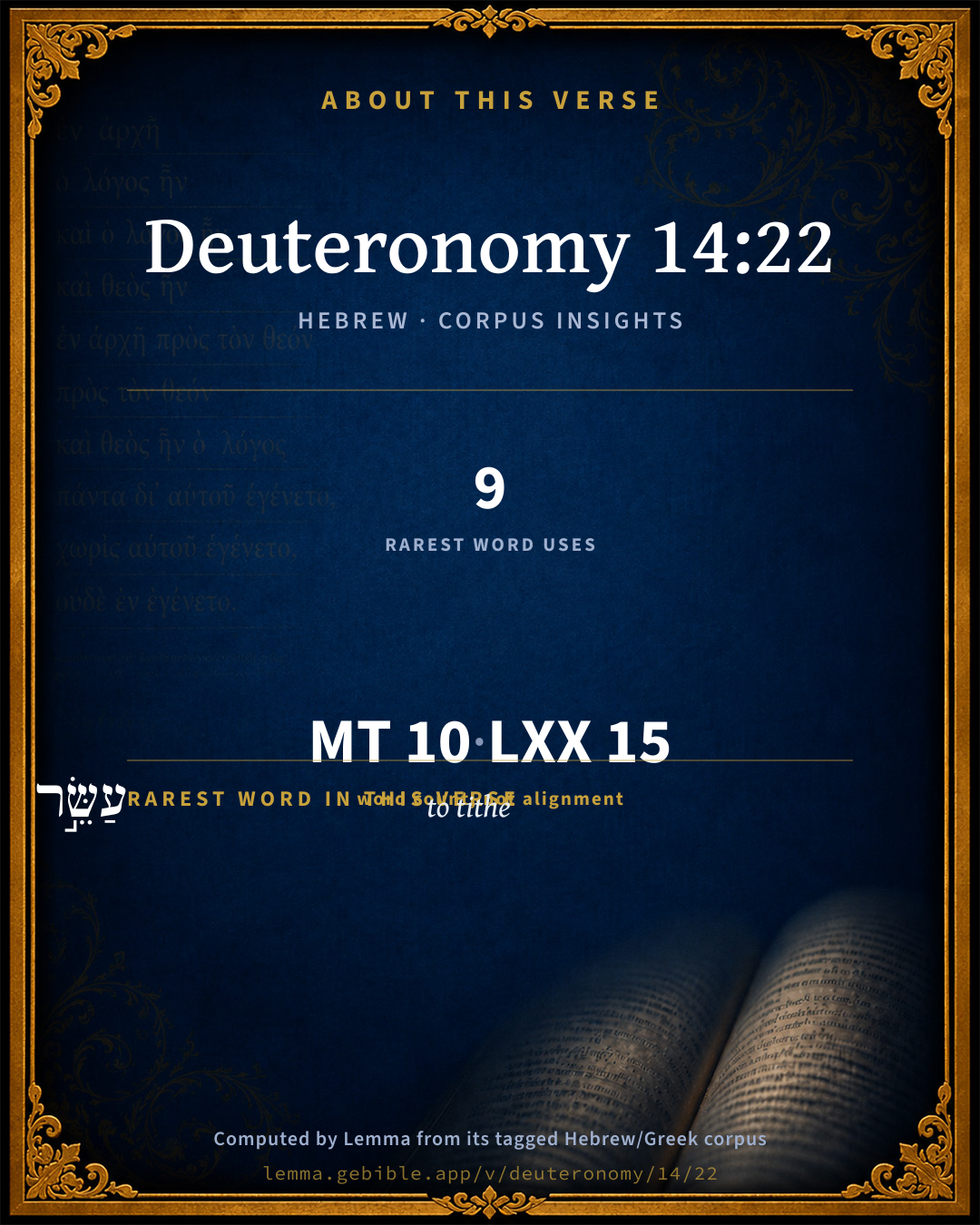
The rarest word here is עַשֵּׂ֣ר to tithe H6237 — appearing just 9 times in the whole Hebrew Bible.

Shared distinctive vocabulary

עַשֵּׂ֣ר to tithe H6237 occurs in 7 verses of the Hebrew Bible. Also found in:

Grammatical profile

  • 3 verbs
  • 6 nouns
  • 1 particle

Verb forms

  • עַשֵּׂ֣ר Piel · Infinitive Absolute
  • תְּעַשֵּׂ֔ר Piel · Imperfect
  • הַיֹּצֵ֥א Qal · Participle Active

Repetition

Words recur within this verse — often emphatic in Hebrew:

  • עַשֵּׂ֣ר to tithe H6237 ×2
  • שָׁנָ֥ה year H8141 ×2

Hebrew & Septuagint length

In English translation the verse runs 20 words from the Hebrew and 20 from the Septuagint (LXX English) — the same length.

A rough comparison of the two English renderings, which tokenize alike — not a word-level alignment.

Word counts can differ between the Hebrew and the Greek without any difference in meaning — e.g. the Hebrew direct-object marker אֵת has no separate Greek word, and Greek often adds the article ὁ.

In the original languages it is 10 Hebrew tokens and 15 Greek tokens — but the two are counted differently (Hebrew bundles its prefixes and suffixes into one token; the Greek is in lemma form), so that isn’t a like-for-like length.

Cross-references

6

Topical passages linked to Deuteronomy 14:22 in the Treasury of Scripture Knowledge — connected by theme and wording, ordered by reader-vote popularity; previews shown in the World English Bible.

  • Numbers 18:21 To the children of Levi, behold, I have given all the tithe in Israel for an inheritance, in return for their service which they serve, even the service of the tent of meeting.
  • Deuteronomy 12:6 and there you shall bring your burnt offerings, and your sacrifices, and your tithes, and the heave-offering of your hand, and your vows, and your freewill-offerings, and the firstborn of your herd and of your flock:
  • Deuteronomy 12:17 You may not eat within your gates the tithe of your grain, or of your new wine, or of your oil, or the firstborn of your herd or of your flock, nor any of your vows which you vow, nor your freewill-offerings, nor the heave-offering of your hand;
  • Deuteronomy 26:12–15 When you have made an end of tithing all the tithe of your increase in the third year, which is the year of tithing, then you shall give it to the Levite, to the foreigner, to the fatherless, and to the widow, that they may eat within your gates, and be filled.
  • Nehemiah 10:37 and that we should bring the first fruits of our dough, and our heave-offerings, and the fruit of all manner of trees, the new wine and the oil, to the priests, to the chambers of the house of our God; and the tithes of our ground to the Levites; for they, the Levites, take the tithes in all the cities of our tillage.
  • Leviticus 27:30–33 "'All the tithe of the land, whether of the seed of the land or of the fruit of the trees, is Yahweh's. It is holy to Yahweh.

Cross-references courtesy of OpenBible.info (CC BY 4.0).

Hebrew and Greek witnesses Masoretic Hebrew ↔ Greek Septuagint

The same verse in the two great witnesses to the Old Testament, shown verse-for-verse.

These are two independent witnesses, not word-aligned to each other, and the Septuagint is shown in lemma (dictionary) form.

Hebrew Deuteronomy 14:22 Masoretic · Westminster Leningrad Codex

עַשֵּׂ֣ר תְּעַשֵּׂ֔ר אֵ֖ת כָּל תְּבוּאַ֣ת זַרְעֶ֑ךָ הַיֹּצֵ֥א הַשָּׂדֶ֖ה שָׁנָ֥ה שָׁנָֽה

You shall surely tithe all the increase of your seed, that which comes forth from the field year by year.

World English Bible · Public Domain

Greek LXX Deuteronomy 14:22 Septuagint · lemma form

δέκατος ἀποδεκατόω πᾶς γένημα ὁ σπέρμα σύ ὁ γένημα ὁ ἀγρός σύ ἐνιαυτός κατά ἐνιαυτός

You shall tithe a tenth of all the produce of your seed, the fruit of your field year by year.

LXX2012 (modern English Septuagint) · Public Domain

Hebrew: Westminster Leningrad Codex (CC BY 4.0). Greek: Septuagint (public domain); English from LXX2012 (modern English Septuagint) (Public Domain). How the Septuagint differs from the Hebrew →

Targum (Aramaic paraphrase)

2

The Targum is the ancient Jewish Aramaic paraphrase of the Hebrew Scriptures — an interpretive translation, not the Hebrew text itself. Onkelos (literal) and Pseudo-Jonathan (expansive) render the Torah, and Jonathan the Prophets. Coverage is partial: where no permissively-licensed English translation exists for a verse, only the Aramaic is shown. This is verse-level text, not a word-by-word alignment to the Hebrew.

  1. Targum Onkelos Torah (Genesis–Deuteronomy)
    עַשְׂרָא תְעַשַׂר יָת כָּל עֲלָלַת זַרְעָךְ דְיִפּוֹק חַקְלָא שַׁתָּא בְשַׁתָּא

    (no public-domain English translation for this verse)

    Targum Onkelos — Aramaic: “Onkelos Genesis” (public domain); “Onkelos Exodus” (public domain); “Onkelos Leviticus” (public domain); “Onkelos Numbers” (public domain); “Onkelos Deuteronomy” (public domain). English: “Sefaria Community Translation” (CC0 1.0 (public-domain dedication)); “J.W. Etheridge. The Targums of Onkelos and Jonathan Ben Uzziel on the Pentateuch. London: Longmans, Green, 1862” (public domain). Text via Sefaria.

  2. Targum Pseudo-Jonathan Torah (Genesis–Deuteronomy)
    הֲווֹ זְהִירִין לְעַשְרָא פֵּירֵיכוֹן מִן דְּאַתּוּן מַפְקִין וּכְנָשׁוּן מִן חַקְלָא כָּל שַׁתָּא וְשַׁתָּא וְלָא פֵּירֵי שַׁתָּא עַל פֵּירֵי שַׁתָּא אוֹחֲרֵי

    Be mindful to tythe your fruitage of whatsoever cometh forth, and which you gather in from the field year by year; not giving the fruit of one year for the fruit of another.

    Targum Pseudo-Jonathan — Aramaic: “Targum Jonathan on Genesis” (public domain); “Targum Jonathan on Exodus” (public domain); “Targum Jonathan on Leviticus” (public domain); “Targum Jonathan on Numbers” (public domain); “Targum Jonathan on Deuteronomy” (public domain). English: “The Targum of Jonathan ben Uzziel, trans. J. W. Etheridge, London, 1862” (public domain). Text via Sefaria.

Commentary

Notes on Deuteronomy 14:22 from classic Christian and Jewish commentators (each source and its license shown beneath its notes). The classic Christian expositions comment on the surrounding passage and are grouped to its opening verse, so a note may address several verses; the Jewish commentaries on the Tanakh (Rashi and others) are per-verse, so they appear only where the commentator wrote on this verse.

Lemma curates 59 commentaries, every one of them public domain or Creative Commons licensed, each selected and text-cleaned for this edition rather than reprinted as found. About our sources →

Matthew Henry's Commentary

We have here a part of the statute concerning tithes. The productions of the ground were twice tithed, so that, putting both together, a fifth part was devoted to God out of their increase, and only four parts of five were for their own common use; and they could not but own they paid an easy rent, especially since God's part was disposed of to their own benefit and advantage. The first tithe was for the maintenance of their Levites, who taught them the good knowledge of God, and ministered to them in holy things; this is supposed as anciently due, and is entailed upon the Levites as an inheritance, by that law, Num 18:24, etc. But it is the second tithe that is here spoken of, which was to be taken out of the remainder when the Levites had had theirs.

I. They are here charged to separate it, and set it apart for God: Thou shalt truly tithe all the increase of they seed, Deu 14:22. The Levites took care of their own, but the separating of this was left to the owners themselves, the law encouraging them to be honest by reposing a confidence in them, and so trying their fear of God. They are commanded to tithe truly, that is, to be sure to do it, and to do it faithfully and carefully, that God's part might not be diminished either with design or by oversight. Note, We must be sure to give God his full dues out of our estates; for, being but stewards of them, it is required that we be faithful, as those that must give account.

II. They are here directed how to dispose of it when they had separated it. Let every man lay by as God prospers him and gives him success, and then let him lay out in pious uses as God gives him opportunity; and it will be the easier to lay out, and the proportion will be more satisfying, when first we have laid by. This second tithe may be disposed of,

1. In works of piety, for the first two years after the year of release. They must bring it up, either in kind or in the full value of it, to the place of the sanctuary, and there must spend it in holy feasting before the Lord. If they could do it with any convenience, they must bring it in kind (Deu 14:23); but, if not, they might turn it into money (Deu 14:24, Deu 14:25), and that money must be laid out in something to feast upon before the Lord. The comfortable cheerful using of what God has given us, with temperance and sobriety, is really the honouring of God with it. Contentment, holy joy, and thankfulness, make every meal a religious feast. The end of this law we have (Deu 14:23): That thou mayest learn to fear the Lord thy God always; it was to keep them right and firm to their religion, (1.) By acquainting them with the sanctuary, the holy things, and the solemn services that were there performed. What they read the appointment of their Bibles, it would do them good to see the observance of in the tabernacle; it would make a deeper impression upon them, which would keep them out of the snares of the idolatrous customs. Note, It will have a good influence upon our constancy in religion never to forsake the assembling of ourselves together, Heb 10:25. By the comfort of the communion of saints, we may be kept to our communion with God. (2.) By using them to the most pleasant and delightful services of religion. Let them rejoice before the Lord, that they may learn to fear him always. The more pleasure we find in the ways of religion the more likely we shall be to persevere in those ways. One thing they must remember in their pious entertainments - to bid their Levites welcome to them. Thou shalt not forsake the Levites (Deu 14:27): "Let him never be a stranger to thy table, especially when thou eatest before the Lord."

2. Every third year this tithe must be disposed of at home in works of charity (Deu 14:28, Deu 14:29): Lay it up within they own gates, and let it be given to the poor, who, knowing the provision this law had made for them, no doubt would come to seek it; and, that they might make the poor familiar to them and not disdain their company, they are here directed to welcome them to their houses. "Thither let them come, and eat and be satisfied." In this charitable distribution of the second tithe they must have an eye to the poor ministers and add to their encouragement by entertaining them, then to poor strangers (not only for the supply of their necessities, but to put a respect upon them, and so to invite them to turn proselytes), and then to the fatherless and widow, who, though perhaps they might have a competent maintenance left them, yet could not be supposed to live so plentifully and comfortably as they had done in months past, and therefore they were to countenance them, and help to make them easy by inviting them to this entertainment. God has a particular care for widows and fatherless, and he requires that we should have the same. It is his honour, and will be ours, to help the helpless. And if we thus serve God, and do good with what we have, it is promised here that the Lord our God will bless us in all the work of our hand. Note, (1.) The blessing of God is all in all to our outward prosperity, and, without that blessing, the work of our hands which we do will bring nothing to pass. (2.) The way to obtain that blessing is to be diligent and charitable. The blessing descends upon the working hand: "Except not that God should bless thee in thy idleness and love of ease, but in all the work of they hand." It is the hand of the diligent, with the blessing of God upon it, that makes rich, Pro 10:4, Pro 10:22. And it descends upon the giving hand; he that thus scatters certainly increases, and the liberal soul will be made fat. It is an undoubted truth, though little believed, that to be charitable to the poor, and to be free and generous in the support of religion and any good work, is the surest and safest way of thriving. What is lent to the Lord will be repaid with abundant interest. See Eze 44:30.

Matthew Henry's Commentary on the Whole Bible (1708–1710) — public domain (CC PDM 1.0). Text via the HelloAO Bible API.

The Cambridge Bible for Schools and Colleges

gen. ed. J. J. S. Perowne

22. Thou shalt surely tithe] Heb. tithing thou shalt tithe: an idiom emphasising the bare fact.

increase] Lit. income (or in-brought), revenue, all the produce.

of thy seed] Not of cereals alone, but inclusive of plantations as the next clause and the oil and wine of Deu_14:23 show. Dillm. cites Isa_17:10 f.; Jer_2:21; Eze_17:5.

field] sadeh, here in its latest sense of cultivated ground; see on Deu_7:22, Deu_11:15, etc.

22–29. Of Tithes

A tithe shall be taken of all the yearly produce of what is sown in the field, further defined as corn, wine and oil, and carried to the Sanctuary and eaten before God by the offerers along with the firstlings of oxen and sheep (Deu_14:22 f.); but Israelites who dwell too far from the Sanctuary for this may turn their tithes into money, purchase at the Temple whatever they desire, and feast before God along with their households and Levites (Deu_14:24-27). Every third year, however, they are to retain all the tithe within their gates for the Levites and other landless poor to consume (Deu_14:28 f.).—In the Sg. address throughout, like the third form of the law of the Single Sanctuary, Deu_12:13 ff., with which also it has in common some phrases and ideas not found in the Pl. form of that law:—the definition of the tithe, corn, wine and oil; thou shalt not forsake the Levite (unless this be an addition, see on Deu_14:27); the wide permission to eat whatsoever thy soul desireth = after all the desire of thy soul, Deu_12:20 f.; another qualification of the law, in order to meet the needs of those at a distance, with the identical phrase because the place is too far from thee which etc., Deu_12:21 (Steuernagel’s statement that the phrases eat before Jehovah, eat and be satisfied, etc., are also peculiar to the Sg. is very doubtful).

There is no law of tithes (so-called) in E or J; those in P, Num_18:21-32 (with the corresponding practice, Neh_10:37 f.) and Lev_27:30 f., fundamentally differ from D’s law of tithes. On this and the questions it raises and their solution in the later law of Israel, see Additional Note below.

The Cambridge Bible for Schools and Colleges (gen. ed. J. J. S. Perowne; Cambridge University Press, 1878–1918) — public domain. Text from a community e-Sword module.

Trapp's Complete Commentary

John Trapp

Deu 14:22 Thou shalt truly tithe all the increase of thy seed, that the field bringeth forth year by year.

Ver. 22. Thou shalt truly tithe.] He seems to mean that second tithe, wherewith they were to feast before the Lord, and not the tithe given to the Levites. {Num 18:24}

John Trapp, A Commentary or Exposition upon All the Books of the Old and New Testament (1647–1656) — public domain. Text from a community e-Sword module.

The Biblical Illustrator

Joseph S. Exell

Deu_14:22-29

Tithe all the increase of thy seed.

Systematic provision for beneficent work

I. The duty of Gods people. In Jewish law God claimed tithes and gifts for the worship of the sanctuary and the necessities of the poor. Conspicuous features of these demands are--the priority of Gods claim--that provision for it be made before mans self-enjoyment, that it bear some suitable proportion to the Divine glory and grace, and that for fullness and power, system is essential; i.e. that the work of God be provided for before mans indulgence (Lev_19:1-37; Num_18:1-32; Deu_14:1-29). The New Testament has also its plan of meeting Gods claim, containing the same elements of priority, certainty, proportion and system. See 1Co_16:2, sustained and illustrated by the weighty arguments and motives of 2Co_8:1-24; 2Co_9:1-15.

II. The financial law of Christ. Christ is sole King in His Church. The constitution of this Church is Christian, not Jewish. As I have given order to the Churches of Galatia, even so do ye. The method taught by the apostle to provide the revenues of the Church is an expansion of Jewish and pentecostal church systems, an example for us, an implied and inferential obligation sustained by cumulative and presumptive argument. New Testament institutions are not given with Sinaitic form and severity. They meet us as sacred provisions for urgent occasions. They appeal to a willing heart more than to a legal mind. Christ rules in love, but His will should not have less authority or constraining power on that account (Joh_7:17).

III. The necessity of the age. The present age needs loftiness of aim, seriousness of feeling, and ardour of devotion. Faithful consecration of substance to God, elevated by Christian love to a financial rule of life, would nourish every moral and spiritual principle in the soul. Storing the Lords portion is the necessity of the age, from its tendency.

1. To cheek the idolatry of money and to strengthen the love of God in the heart.

2. To meet adequately the demands of religion and humanity.

3. To exhibit the power and beauty of godliness. By fostering simplicity of life and personal fidelity to God. By liberally sustaining the honour of Christ in the sight of men. (John Ross.)

The Biblical Illustrator, edited by Joseph S. Exell (c. 1880s–1900s) — public domain. Text from a community e-Sword module.

Joseph Benson's Commentary

Deu 14:22-23. Thou shalt truly tithe all the increase of thy seed — There were three sorts of tithes to be paid from the people, besides those from the Levites to the priests; 1st, To the Levites for their maintenance, Lev 27:30-33; Num 18:21. These were to be eaten where they dwelt, (Num 14:31,) and therefore to be paid there. 2d, For the Lord’s feasts and sacrifices, to be eaten by the offerers at Jerusalem: these are here intended. 3d, Besides these two, there was to be every third year a tithe for the poor, to be eaten at their own dwellings, Deu 14:28-29. That thou mayest learn to fear the Lord thy God — That thou mayest not only be accustomed to the worship of Jehovah thy God, but mayest become truly pious. For the fear of God was taught in that place of his public worship, and the very presenting themselves before him was a good means to keep them in awe of him.

Joseph Benson's Commentary on the Old and New Testaments (1811–1818) — public domain. Text from a community e-Sword module.

Tyndale Open Study Notes

Tyndale Open Resources

14:22-27 set aside a tithe: The ancient practice of giving a tenth preceded the law of Moses (Gen 14:20; 28:22) and existed in other ancient cultures. Here it is viewed as a tax or tribute collected by the sovereign Lord from his vassals (see study notes on Deut 1:31 and 12:6).

Tyndale Open Study Notes — © Tyndale Open Resources, licensed CC BY-SA 4.0. Text via the HelloAO Bible API.

Geneva Bible (1599)

Geneva Bible translators

The tithes were ordained for the maintenance of the Levites, which had none inheritance.

Geneva Bible (1599) marginal notes — public domain. Text via Bolls.life.

Jamieson, Fausset & Brown

Robert Jamieson, A. R. Fausset & David Brown

Thou shalt truly tithe all the increase of thy seed--The dedication of a tenth part of the year's produce in everything was then a religious duty. It was to be brought as an offering to the sanctuary; and, where distance prevented its being taken in kind, it was by this statute convertible into money.

Jamieson, Fausset & Brown — Commentary Critical and Explanatory on the Whole Bible (1871) — public domain (CC PDM 1.0). Text via the HelloAO Bible API.

Adam Clarke's Commentary

Verse 22. Thou shalt truly tithe] Meaning the second tithe which themselves were to eat, De 14:23, for there was a first tithe that was given to the Levites, out of which they paid a tenth part to the priests, Nu 18:24-28; Neh 10:37-38. Then of that which remained, the owners separated a second tithe, which they ate before the Lord the first and second year; and in the third year it was given to the Levites and to the poor, De 14:28-29. In the fourth and fifth years it was eaten again by the owners, and in the sixth year was given to the poor. The seventh year was a Sabbath to the land, and then all things were common, Ex 23:10-11, where see the notes, See Clarke on Ex 23:11, and see Ainsworth on this verse.

Adam Clarke's Commentary on the Bible (1810–1826) — public domain. Text from a community e-Sword/MySword module.

Ellicott's Commentary for English Readers

(22) Thou shalt truly tithe.—The Talmud and Jewish interpreters in general are agreed in the view that the tithe mentioned in this passage, both here and in Deu_14:28, and also the tithe described in Deu_26:12-15, are all one thing—“the second tithe;” and entirely distinct from the ordinary tithe assigned to the Levites for their subsistence in Num_18:21, and by them tithed again for the priests (Num_18:26).

The tithe described in Numbers was called “the first tithe,” and was not considered sacred. The second tithe, on the contrary, was always regarded as a holy thing.

A Bible Commentary for English Readers, edited by Charles John Ellicott (1878–1897) — public domain. Text from a community e-Sword module.

John Gill's Exposition

Thou shalt then turn it into money,.... The tithe, which would be lighter and easier carriage:

and bind up the money in thine hand; put it into a bag or purse, and tie it up and carry it in the hand; which some think was ordered, that it might not be mixed with other money; but it seems only to have respect to journeying, and making it fit for that. The Jewish writers (u), some of them, give a different sense of the word we render "bind up", and interpret it of marking the silver, or impressing a form, figure, or image on it with the hand; they mean that it must be coined money; so Maimonides (w), they may not profane the sacred tithe with money not coined, nor with money not current, nor with money which is not in a man's power; for it is said:

in thine hand; which the man is possessed of and is his own property:

and shalt go unto the place which the Lord that God shall choose; carrying the money along with him, for which he sold the tithe.

(u) Bartenora in Misn. Beracot, c. 7. sect. 1. Maimon. & Bartenora in Misn. Maaser Sheni, c. 11. sect. 2. & in Misn. Sabbat, c. 18. sect. 1. (w) In Misn. Maaser Sheni, c. 11. sect. 2.

John Gill's Exposition of the Whole Bible (1746–1763) — public domain (CC PDM 1.0). Text via the HelloAO Bible API.

Albert Barnes' Notes on the Bible

These words recall in general terms the command of the earlier legislation respecting tithes (compare Lev 27:30; Num 18:26), but refer more particularly to the second or festival tithe, which was an exclusively vegetable one.

Albert Barnes' Notes on the Bible (1834–1885) — public domain. Text from a community e-Sword/MySword module.

Haydock's Catholic Bible Commentary

Tithes. The Jews carried with them some money to buy peace-offerings. (Estius)

George Leo Haydock (1774–1849), Haydock's Catholic Family Bible and Commentary, 1859 edition — public domain. Excludes Psalms (Douay-Rheims chapter numbering differs from Protestant) and Deuterocanonical books (Catholic canon only).

Matthew Poole's English Annotations

This is to be understood of the second tithes, which seem to be the same with the tithes of the third year, mentioned here below, Deu 14:28; 26:12, on which see above, on Deu 12:17. And to confirm this opinion, (though I would not lay too great a stress upon criticisms,) yet I cannot but observe that this tithing is spoken of only as the people’s act here, and Deu 26:12, and the Levites are not at all mentioned in either place as receivers or takers of them, but only as partakers of them together with the owners, and therefore they are so severely charged here upon their consciences,

thou shalt truly tithe all thine increase, because the execution of this was left wholly to themselves, whereas the first tithes were received by the Levites, who therefore are said to take or receive those tithes, Num 18:26; Neh 10:38; Heb 7:5.

Matthew Poole's English Annotations on the Holy Bible (1683–1685) — public domain. Text from a community e-Sword/MySword module.

Whedon's Commentary on the Bible

Daniel D. Whedon

22. Tithe all the increase of thy seed — It seems taken for granted that the people are familiar with the earlier legislation concerning tithes.

Lev_27:30; Num_18:26. Moses adds new requirements. It is generally conceded that this refers to what the Jewish tradition calls the second tithe, which was intended to furnish supplies for the sacred festivals. See CURTISS’S Levitical Priests, p. 39.

Daniel D. Whedon (gen. ed.), Commentary on the Old and New Testaments (1874–1909) — public domain. Text from a community e-Sword module.

The Pulpit Commentary

Vers. 22-29. A tithing of each year"s produce of the cultivated ground was to be made; and this tithe was to be brought to the place which the Lord should choose, as also the firstling of the herds and flocks; and there a sacrificial meal was to be partaken of, that Israel might learn to fear Jehovah their God always, reverencing him as their Ruler, and rejoicing in him as the Giver of all good.

Thy seed. "Seed" here refers to plants as well as what is raised from seed (cf. Jer_2:21; Eze_17:5, Eze_17:6) The reference is to the second or festival tithe which was exclusively of vegetables.

Vers. 22-29. A threefold cord; or, the triple use of property.

These details which so frequently occur respecting the use of property, specially of that which is possessed or gained in the form of produce, may seem burdensome. Probably, to us, they would be so, but it is nevertheless a topic of perpetual interest for our day, to see how tenderly and lovingly the Great Father trained his people, by such minute regulations as were needful for them, to the practice and perception of principles which were to be ultimately the possession of the world principles which would be a perpetual spring of holy and benevolent gladness. We say, advisedly, "practice and perception of principles," rather than perception and practice." For though it may seem as if perception must come first, yea, though indeed it is logically prior to practice, yet when a race tainted with heathen customs and tendencies has to be educated out of them, the sure mode of effecting this is by giving them rules to be put into practice, as m leverage to raise them to value the principles which were the basis of those rules. Now in the paragraph before us we have "a threefold cord" of duty with regard to the religious use of the produce of the field. The question (with which the Exposition has dealt) whether the third-named tithe was actually such, or simply a special application of the second, does not affect the homiletic treatment of the paragraph before us. There is here indicated to us a triple use which was to be made of the produce of the land. The enactment, however, is so framed as to be an appeal to the religion and devotion of the people; it is not a mere civil statute, enjoining that, if such devotement is not made, it is to be recoverable under pains and penalties. If a man failed in his duty in these respects, there was no compulsory enforcement thereof. It was a sin before the Lord.

I THE FIRST APPLICATION OF PRODUCE WAS FOR GOD"S SERVICE. It is taken for granted here that this was well understood (cf. Lev_27:30) Hence we find the general precept in Pr 3, Honor the Lord with thy substance, and with the firstfruits of all thine increase." There was to be a thankful recognition of God as the Author of all their mercies, without whose care and bounty no land would yield its supply; while there was also to be a recognition of themselves as devoted to the Lord, and that so completely and entirely, that the maintenance of his Name, honor, worship, and ordinances among them, was to be their first and chief concern. This twofold recognition was to find corresponding practice in the offering of the first tenth of their produce for God. Now we have, under the New Testament, no such detailed precepts. The appeal of apostles there is rather to honor, gratitude, love; while for the most part they take for granted that these emotions will prompt to a worthy course. Take, e.g. such an exhortation as this, "See that ye abound in this grace also... for ye know the grace of our Lord Jesus Christ," etc. If love to Christ is maintained in due fervor, it will prompt to corresponding devotion; and if by such constraining devotion, offerings to and for God are regulated, there will be no need, as indeed no one now has the right, to tell any man how much he ought to give to God. When a man carries out in all respects the precept," Seek ye first the kingdom of God and his righteousness," that will certainly include and ensure his honoring the Lord with his substance. The faith was once delivered to the saints," i.e. once for all, that they might guard and honor it, and also diffuse it through the world, and, without much detailed injunction, it is assumed that believers will be ready to devote themselves, heart and soul, to the spread of their Master"s honor.

II A SECOND RELIGIOUS APPLICATION THEREOF WAS TO FAMILY AND HOUSEHOLD USE. (Vers. 22-27.) When Israel should go up to the place the Lord their God should choose, they would go up to religious sacrifice and service. Hence all their family meals, then and there, would be baptized with the religious spirit. So all-pervading would be the presence of, and so sure the fellowship with, the Lord their God, that their family feasts on such occasions would be regarded as eating before the Lord their God." And by thus eating before the Lord on these special occasions, they would learn to hallow home joys on every occasion. So ver. 23 intimates: "that thou mayest learn to fear the Lord thy God always." Considerable latitude was allowed them according to their distance from the place of meeting, etc.; they might first turn the produce into money, and then the money into provision, and so on. And they might purchase what they desired. For they were not slaves, but free men. They were the loved and happy people of the Lord, and as such were to rejoice before him in their family feasts, at their sacred festivals, that from the impulses of joy and gladness so sanctified then, they might come to realize how near God was to them, and how he would have them glory in him as theirs all the year round. It is not possible to overrate the value of rhea, now. By a truly religious and devout man all the minor affairs of life are lifted up into the religious region. And he is not only at liberty to enjoy his possessions, when he has sanctified the firstfruits for God, but he ought so to enjoy them. God "hath given us all things richly to enjoy." And when a godly man gathers his family around him at his table, with the table abounding in ample provision, he may then joyfully "eat before the Lord his God," in the full assurance that such enjoyment is a part of the Divine intent, and that the love and care of God may and do put their own seal of hallowed and hallowing mirth upon the use of common things.

III A THIRD RELIGIOUS APPLICATION OF PRODUCE WAS FOR THE USE AND ENJOYMENT OF OTHERS. (Vers. 28, 29.) Whether this special use which was enjoined for every third year involved the setting apart a third tithe, or whether it was a triennial application of the second, is a point the discussion of which belongs to others. But either way, the principle, we conceive, is the same, which we understand to be this, "Let a man be a man all round." God first, then home, then him neighbors. Such is to be the order of his action. A special care was to be taken of the Levite (who, by the way, was to be thought of every year), as having charge of religious arrangements, but, besides these, how wide a scope is here opened up to a man"s kindness and generosity! "The stranger, and the fatherless, and the widow shall come, and shall eat and be satisfied." Is this an instance of the hardness of Judaism? They do not understand it who speak thus of it. Its spirit was kindness itself; for here the showing of goodness and benevolence to the poor and the needy is made a part of their religion. Need we ask the question whether Christianity has dropped this out? Details may change; principles, never! The Apostle James tells that the New Testament ritual is, "To visit the fatherless and widows in their affliction, and to keep himself unspotted from the world." Let us ask, in conclusion, Which part of this threefold cord could be broken without serious injury? For we see here that Judaism, in this triple direction of duty, does but recognize the triple relations of human life. We are related first and foremost to our God, to whom our supreme allegiance is due. We are related next to our home, to our families and households, whose interests and happiness it is our first earthly business to promote; and then to our fellow-citizens, to whom we are bound to do good, where we can and when we can. Finally, by way of ensuring the right discharge of other duties, special care is taken to guide Israel in regard to the right use of property. There is singular, yea, superhuman wisdom in this. Where a man"s getting and giving are right, he is not likely to be far wrong in anything. Wisdom in adding to, and giving from, the contents of the purse, is a fair guarantee of wisdom in other directions. "The love of money is a root of all evil," and by so much as love of money tends to deteriorate character, by so much will its right use tend to elevate it. And the lifting up of character is the surest sign of the blessing promised (ver. 29).

Vers. 22-29. The second tithe.

We adopt the usual view, that the lawgiver is here regulating the disposal of what, in later times, was called "the second tithe." The hypothesis that the book was written at a late date, when the gift of tithes to the Levites, prescribed in Numbers 18., had fallen into disuse, is unsupported by evidence. The provision in Deuteronomy would have furnished no support worth speaking of to the enormous Levitical establishments of the post-Davidic period; (1Ch 23-27; 2Ch 29) nor are we prepared to concede, what is often so conveniently assumed, the non-authenticity of these sections of the chronicler. We learn

I THAT PIETY AND CHARITY ARE TO BE LIBERALLY PROVIDED FOR IN THE APPORTIONMENT OF INCOME. The tithes were to be faithfully and punctually set apart as a first charge upon the Jew"s income. The second or vegetable tithe was appointed to be consumed in feasts at the sanctuary, or, in the third year, at home. A lesson is taught here as to the duty of liberal, systematic, and conscientious giving for religious and charitable purposes. Christians, it is true, are not under Law, but under grace. But it will scarcely be pleaded that on this account they are less bound to liberality than Jews were. The argument is all the other way: if this was done under Law, how much more ought to be done under the impulse of love to Christ! Unfortunately, the duty of systematic and proportionate giving is but little recognized. It would put many a Christian to the blush if he would sit down at the year"s end, and

(1) reckon up the sum of his year"s givings to Christ, and

(2) calculate its proportion to what he has thought himself at liberty to expend upon his own comforts and pleasures. Nor will there be improvement in this matter till giving for religious and charitable objects is made a point in conscience, and till a suitable proportion of income is set apart for this purpose in advance. That proportion is to be determined by the degree to which God has prospered us. (1Co_16:2) The ever-widening operations of the Church at homo and abroad, the constantly multiplying claims of a wise Christian philanthropy, render liberal givings increasingly necessary.

II THAT OBEDIENCE TO THE SPIRIT OF A LAW IS OF GREATER IMPORTANCE THAN OBEDIENCE TO ITS LETTER. (Vers. 24-26.) God is not a hard master reaping where he has not sown, and gathering where he has not strawed. (Mat_25:4) He is tenderly considerate of the circumstances of his people. He asks no more from them than they are able to render. Where laws could not be kept in the letter, modifications were introduced which made obedience practicable. This is seen in the accommodation of the laws of sacrifice to the circumstances of the poor, (Lev_5:7, etc.) in the rules for commutation, (Le 27) in the relaxation of the law about eating flesh, (Deu_12:21) in this law of tithes. Gleaming through these changes, it is easy to detect the principle that the letter of an ordinance is in all cases subordinate to the spirit of obedience which manifests itself through it; and that, while obedience to the letter is required where possible, the will, in circumstances where it cannot be observed, will readily be accepted by Jehovah for the deed.

III THAT PROVIDED RELIGIOUS MOTIVES PREDOMINATE, AND OTHER DUTIES ARE NOT NEGLECTED, THE ENJOYMENT OF WHAT WE HAVE IS PLEASING TO GOD. (Vers. 25, 26.) True religion is not ascetic. It does not frown our joy. It regulates, but does not seek to banish, the pleasures of the festive board, and the flow of the soul connected therewith. (Joh_2:1-12; 1Co_10:27; 1Ti_6:18) The sanctuary services were associated with feasts, in which, of course, religious motives were expected to predominate. The eating was before the Lord," and the guests were invariably to include the Levite, the stranger, the fatherless, and the widow. This would give a high-toned character to the feast, and would preclude coarse debauchery. Festivities should be so conducted that God"s presence can be invoked, and his blessing asked on all that is said and done.

IV THAT THE ENJOYMENT OF WHAT WE HAVE IS ENHANCED BY SHARING IT WITH OTHERS. (Ver. 29.) This is a truth recognized in all festivity. But the Law gave the truth a peculiar turn when it bade the Jew seek his guests among the classes who were most in need. The Savior would have us recall our feasting to the like pattern. (Luk_14:12-14) Each feast of the kind prescribed would be an invaluable education of the disinterested affections in their purest exercise. How far we have departed from this idea may be seen in the stiff, exclusive, and ceremonious, if often superb and stately, dinner-parties and public feasts of modern society. Which type of feast contributes most to happiness? And is it not in fulfilling the duties of a warm-hearted love that we are most entitled to expect blessing from our Maker (ver. 29)? When Jesus made his great supper, he acted on his own principle, and invited the "poor, and the maimed, and the halt, and the blind," to come and sit down at it. J.O. (Luk_14:21)

Vers. 22-29. Systematic provision for fellowship with God.

From the arrangements about ordinary diet, we pass now to the minute directions about "eating before God." A tithe of the corn, the wine, and the oil, together with the firstlings of their flocks and herds, must be devoted to the purposes of fellowship. It is clear from this, then, that God designed a systematic storing of the tenth part of the Jewish income for the purposes of religion. If the Jew resided far from the tabernacle, then he was to sell the tithe, and turning it into money, he was to go up with this to the central altar, and there invest in whatever his soul desired, and partake of it all before God. In this the Levite was to have his share. Over and above all this, every third year there was to be a second tithe devoted to the delectation of the poor. Now, we learn from these arrangements

I THAT FELLOWSHIP WITH GOD IS THE CROWN OF TRUE RELIGION. A feast with God, he taking the best portions, his priests the next best, and the offerer joyful over the remainder of the sacrifice, constituted the glory of the Jewish ritual. All the sin offerings, burnt offerings, and meat offerings were valueless if not crowned by the peace offering and its feast of fellowship. No wonder our Lord makes out fellowship to be the substance of eternal life, when in his prayer he says, "And this is life eternal, to know thee, the only true God, and Jesus Christ, whom thou hast sent". (Joh_17:3) If we are not led up into this acquaintanceship, our religion is a name and not a reality.

II THE FELLOWSHIP IS WELL WORTH ANY EXPENSE IT MAY INVOLVE. While it is, of course, true that God"s blessings are gratuitous, "without money and without price," it is also true that a niggardly soul will fall out of fellowship. In fact, fellowship with God will seem so precious as to be worth infinitely more than all our possessions, and any proportion of these required by God for the maintenance of fellowship will seem a small price. Our conviction will be that of the psalmist, "The Law of thy mouth is better unto me than thousands of gold and silver.

Now, while God"s favor is given freely, there must evidently be something about which he and we can have fellowship. In other words, fellowship requires a medium. Fellowship means having something in common. When we analyze all we have, we find that it is all "the gift of God." Jesus is his gift; the Holy Spirit is his gift; money is his gift; every good thing is his gift. (Jam_1:17) He has surely every right, then, to say to his people, "You must dedicate a proportion of my gifts to you, for the purposes of fellowship; let us have a tithe in common; let us rejoice mutually over it as ours." This was the principle underlying Jewish tithing it is the principle underlying all genuine beneficence. We are only returning to God such a proportion of what he gives as shall be the medium of fellowship.

A peace offering at the tabernacle was a most precious commodity. It was an animal regarding which the worshipper and God agreed to say, "It is ours," and each to feast upon it. It was the organ and means of fellowship. It was a delight to God and to man. Who would not pay anything required for such a privilege? Man is honored most highly in being allowed such a partnership with God.

III THE SENSE OF FELLOWSHIP WITH GOD IN THE FEAST IS THE REAL PRESERVATION OF MAN FROM UNDUE INDULGENCE. It is noticeable that "wine" and "strong drink" (XXX) might be included in the feast before God. The safety of the partaker lay in the sense of fellowship and its consequent consecration. Just as Paul afterwards maintained that "every creature of God is good, and nothing to be refused, if it be received with thanksgiving; for it is sanctified by the Word of God and prayer". (1Ti_4:4, 1Ti_4:5) It is the unhallowed use of God"s gifts which is the danger. The temperance reformation will do well to keep in view this Divine side of the question, where in the last resort the stress must be laid.

IV THE FELLOWSHIP WITH GOD IMPLIES THE INVITATION OF OTHERS TO SHARE THE BLESSING WITH US. Our households and the Levite are to be partakers with us of our sacred feasts. For God does not encourage lonely satisfactions; but as he calls us into his fellowship, it is on the understanding that we shall invite others, and make the fellowship a family thing. Now, the support of the Levites was to be a matter of cheerfulness and religious privilege. It was to be a joy embraced rather than a mere debt moodily discharged. It is surely here that "ministerial support" must be pleaded and advanced. It is not to be something doled out, but a feast of fellowship, the call of God"s minister to share in our good fortune and success.

V THE CARE OF THE POOR MUST ALSO BE PUT UPON THE BASIS OF FELLOWSHIP. It has been made a matter of law. And doubtless there is a noble element in the fact that a nation, passing beyond what old moralists called duties of debt, has entered upon duties of merit. Still, the national obligation embodied in the "poor rates" is apt to sap a certain amount of individual sympathy. The care of the poor is not the feast of joy and fellowship God meant it to be a The three years" system brought under our notice in this passage was an effort, apparently, to bring the lonely and needy classes up to the standard of fellowship and of joy that the religious Jew himself had attained. It was the systematic effort to make the needy ones glad before God. And it is here that we find the goal of our exertions, whether to support a minister, to comfort a stranger, or a fatherless child, or a widow. Let all be guests of our love, and lifted, if possible, into our light and fellowship with God. For this we should strive evermore.

VI THOSE WHO THUS HONOR GOD WILL BE BLESSED AND HONORED BY HIM. Not, of course, that systematic beneficence should be in any sense a speculation. It is not beneficence if it is a selfish investment. But at the same time, God blesses the system which recognizes obligation to him and tries to discharge it. The accurate survey of circumstances which systematic giving implies tends to financial success. There is no reason why religious men should not be "successful merchants." Were systematic beneficence more general, there would be less failure and heart-burning in the walks of business. R.M.E.

Vers. 22-29. God"s claim upon our money gains.

In every province of human life God requires his proprietorship to be recognized. The seventh part of our time is hallowed for his service. The firstfruits of corn were to be devoted to religious uses. The firstborn in the household belonged to God, and was to be redeemed by substitution. And now, of all their yearly gains, one-tenth was claimed by God.

I THE GROUND OF GOD"S CLAIM. His claim proceeds from his proprietorship. Towards the Hebrews he was obviously and directly landlord. He had put them into possession of their estates, and rightfully could exact from them a rent. And with respect to all national substance, God is absolute Proprietor. He has an original and indefeasible right as Creator; and it is his supreme power that maintains in existence the treasures of the earth. Even the power we have to accumulate wealth is derived from the same beneficent Source. It is his gift, not that he has conveyed to us the irresponsible right in it, but simply in the sense that we had nothing with which to purchase it. "The earth is the Lord"s, and the fullness thereof.

II A DEFINITE PROPORTION DEMANDED. It was competent for God to make such terms as he pleased with men. He might justly have permitted for our own use a bare existence, and required us to devote to him the residue of our gains. Or he might very properly have exacted as his tribute one-half. Whatever had been his will in the matter, it would become us meekly to acquiesce. He did make known his will very clearly to the Jews, and his terms were very generous. So small a portion as one-tenth he condescended to take, and even this was expended in advantage for the nation. Many significant hints have we that, in unwritten form, this part of his will was made known to ether nations. Among heathen tribes we find the custom prevails of consecrating one-tenth of their harvests unto idol gods; and when Abraham returned from the conquest of the invaders, he gave to Melchizedek the tithe of all his spoils. Hence we may regard the law, not as exclusively Jewish, but as intended for all peoples.

III THE METHOD OF ASSESSMENT. No official assessor was appointed. The cost of collection was nil. Each man was to act as his own assessor, and to separate, at harvest-time, God"s share of corn and wine and oil. It was a transaction between each man and his God. It was Israel"s privilege to live under the shield of Jehovah"s arm, and therefore "ever in his Great Taskmaster"s eye." The penalty for dishonesty was not immediate, nor visible. Every plan was devised to suit the convenience of the debtor. He might bring his tithe to the temple, either in kind or in coin. Jehovah was no hard Taskmaster, but a considerate and generous King. Giving to him was only another form of receiving. The absence of intermediary officers was a spiritual advantage. It brought each man into direct contact with God, and taught him to act with integrity towards the "Searcher of hearts.

IV THE EMPLOYMENT OF GOD"S TITHE. The tithe here spoken of is not the tithe of all profits, which was due to the Levite, but a second tithe. The first tithe was regarded as an equivalent to the tribe of Levi, for Levi"s share in the allotted possessions. Each man in the twelve tribes received, in the original distribution of land, one-twelfth more than his due, from the fact that Levi did not participate. In return for this increment of property, each proprietor paid to the tribe of Levi yearly one-tenth of the produce of the laud. This was due as a legal right, and as a just equivalent for non-participation in the territory. But this second tithe was peculiarly the Lord"s. Nevertheless, it was returned, with added blessing, into their own bosoms. Its first use was to afford a banquet for the offerers themselves. The temple was to be the scene of sacred feasting. The guests might select such viands as pleased their taste. The overshadowing presence of Jehovah would serve as a sufficient check against excess. To this banquet, in which the entire household shared, they were to invite the Levite, the stranger, the widow, and the orphan. The essential idea thus embodied was philanthropy. The institution was intended to foster a spirit of benevolence and charity. The presence of the poor in their midst was to be accounted a benefit. It offered scope for the exercise of noblest dispositions. There was to be no niggardly stint in this provision, for it was at Jehovah"s cost, and the occasion was to be characterized by unrestrained joy.

V THE MORAL ADVANTAGES WHICH ENSUED.

1. It served as a practical reminder of Gods proprietorship in them and in their possessions. Nothing is more easy than to forget cur obligations; and such forgetfulness is an immeasurable loss. Not an item was there in their persons, property, or enjoyments, but came from the hand of a generous God.

1. It was a potent check upon their worldly-mindedness. The propensity for selfish avarice is indigenous in human nature. Every wise man will welcome any breakwater that will withstand this mischievous tide of cupidity. Thus God, with wondrous forethought, provided a safeguard against the abuse of prosperity. He designs to make even worldly gain serve as a stepping-stone to piety. Money is nothing more than means to an end. Reconciliation with God, and personal holiness, these are to be the aims of human life.

2. It fostered kindly dispositions among all classes of the people. Though, as the children of Abraham, they enjoyed great external privileges, they were not to despise the stranger. Yea, he too might be admitted to a full share in their blessings. Brotherly love is a reciprocal boon: both parties are blessed. The fountain of love is replenished in the very act of giving. The helped today may become the helper tomorrow. We are only stewards of God"s possessions. D.

The Pulpit Commentary (1880–1919), ed. H.D.M. Spence-Jones & Joseph S. Exell — public domain. Text from a community e-Sword module.

John Wesley's Explanatory Notes

All the increase - This is to be understood of the second tithes, which seem to be the same with the tithes of the first year, mentioned ver. 28.

John Wesley, Explanatory Notes Upon the Whole Bible (1754–1765) — public domain. Text via the GEBible commentary corpus.

Keil & Delitzsch

C. F. Keil & F. Delitzsch

As the Israelites were to sanctify their food, on the one hand, positively by abstinence from everything unclean, so were they, on the other hand, to do so negatively by delivering the tithes and firstlings at the place where the Lord would cause His name to dwell, and by holding festal meals on the occasion, and rejoicing there before Jehovah their God. This law is introduced with the general precept, "Thou shalt tithe all the produce of thy seed which groweth out of the field (יצא construes with an accusative, as in Gen 9:10, etc.) year by year" (שׁנה שׁנה, i.e., every year; cf. Ewald, 313, a.), which recalls the earlier laws concerning the tithe (Lev 27:30, and Num 18:21, Num 18:26.), without repeating them one by one, for the purpose of linking on the injunction to celebrate sacrificial meals at the sanctuary from the tithes and firstlings. Moses had already directed (Deu 12:6.) that all the sacrificial meals should take place at the sanctuary, and had then alluded to the sacrificial meals to be prepared from the tithes, though only causally, because he intended to speak of them more fully afterwards. This he does here, and includes the firstlings also, inasmuch as the presentation of them was generally associated with that of the tithes, though only causally, as he intends to revert to the firstlings again, which he does in Deu 15:19. The connection between the tithes of the fruits of the ground and the firstlings of the cattle which were devoted to the sacrificial meals, and the tithes and first-fruits which were to be delivered to the Levites and priests, we have already discussed at Deut 12. The sacrificial meals were to be held before the Lord, in the place where He caused His name to dwell (see at Deu 12:5), that Israel might learn to fear Jehovah its God always; not, however, as Schultz supposes, that by the confession of its dependence upon Him it might accustom itself more and more to the feeling of dependence. For the fear of the Lord is not merely a feeling of dependence upon Him, but also includes the notion of divine blessedness, which is the predominant idea here, as the sacrificial meals were to furnish the occasion and object of the rejoicing before the Lord. The true meaning therefore is, that Israel might rejoice with holy reverence in the fellowship of its God.

Keil & Delitzsch — Biblical Commentary on the Old Testament (1861–1891) — public domain (CC PDM 1.0). Text via the HelloAO Bible API. (Old Testament only.)

Kretzmann's Popular Commentary

Paul E. Kretzmann

Of Tithing

v. 22. Thou shalt truly tithe all the increase of thy seed that the field bringeth forth year by year, set aside the tenth part of the income for the use of Jehovah.

v. 23. And thou shalt eat before the Lord, thy God, in the place which He shall choose to place His name there, the central Sanctuary which He intended to select in Canaan, the tithe of thy corn, that is, of grain in general, of thy wine, and of thine oil, and the firstlings of thy herds and of thy flocks, chap, 12:5-7, that thou mayest learn to fear the Lord, thy God, always. The fear of the Lord does not only include the feeling of utter dependence upon Him, but includes also the idea of piety, and Israel, with the proper reverence; was to rejoice in the fellowship of the covenant God.

v. 24. And if the way be too long for thee, so that thou art not able to carry it, namely, the tithe of the field and orchard, of the herd and of the flock, or if the place be too far from thee, which the Lord, thy God, shall choose to set His name there, when the Lord, thy God, hath blessed thee, for it happened later that some Israelites lived more than a week’s journey from Shiloh, from the heights of Gibeon, and from Jerusalem,

v. 25. then shalt thou turn it, the gift of the tenth, into money, by selling it or by taking its equivalent in cash, and bind up the money in thine hand, and shalt go unto the place which the Lord, thy God, shall choose;

v. 26. and thou shalt bestow that money for whatsoever thy soul lusteth after, that is, buy for that silver whatever sacrificial animal or offering he might want, for oxen, or for sheep, or for wine, or for strong drink, or for whatsoever thy soul desireth, whatever it might request of the person for the offering which it had determined to bring; and thou shalt eat there before the Lord, thy God, Deu 12:7-18, and thou shalt rejoice, thou and thine household,

v. 27. and the Levite that is within thy gates; thou shalt not forsake him, Deu 12:12 to Deu 18:19; for he hath no part nor inheritance with thee, Num 18:20, and should therefore be given special consideration by the members of the Jewish Church.

v. 28. At the end of three years, after the harvest of every third year, thou shalt bring forth, namely, out of the granaries and bins, all the tithe of thine increase the same year, and shalt lay it up within thy gates, in storehouses provided for that purpose in the cities;

v. 29. and the Levite (because he hath no part nor inheritance with thee) and the stranger and the fatherless and the widow which are within thy gates shall come, and shall eat and be satisfied, for once have their fill to eat and to drink; that the Lord, thy God, may bless thee in all the work of thine hand which thou doest, as a reward for this cheerful care of the poor, as it flowed out of true charity. Twice within the cycle of the Sabbatic year the tenth of the increase was thus set aside for the poor and needy, and four times it was taken to the Sanctuary of Jehovah. If the Lord blesses a Christian in his labor, the latter should not forget those that are less fortunate, lest the Lord withdraw His blessing in anger.

Paul E. Kretzmann, Popular Commentary of the Bible (1921–1924) — public domain. Text from a community e-Sword module.

unfoldingWord translationNotes

Door43 World Missions Community

tithe all the yield of your seed

This means they are to give one part out of every ten equal parts from their crops.

year after year

"every year"

before Yahweh

"in the presence of Yahweh"

translationWords

tenth

seed

year

sanctuary

grain

wine

oil

firstborn

flocks

honor

unfoldingWord translationNotes — © Distant Shores Media and the Door43 World Missions Community, licensed CC BY-SA 4.0. Source: git.door43.org/Door43/en_tn.

Rashi

Rabbi Shlomo Yitzchaki (Rashi)

THOU SHALT TRULY TITHE [ALL THE INCREASE OF THY SEED] — What has this matter to do with that? (Why are they placed in juxtaposition)? But the Holy One, blessed be He, says in effect to Israel: “Do not compel Me to blast by heat the tender kernels of the grain, whilst they are yet in their mother’s womb (i.e. in the husks), for if you do not tithe your products as is proper, when they are near ripening I shall bring forth the east wind and it will blast them”, as it is said, (2 Kings 19:26) “[Therefore … they were] as the corn blasted before it be grown up” (Midrash Tanchuma, Re'eh 17). A similar reason may be given for בכורים (for its juxtaposition to לא תבשל גדי (Exodus 34:26).

שנה שנה [THOU SHALT TRULY GIVE TITHE] YEAR BY YEAR — From here we may derive that one must not give tithe from the new grain for the old (Sifrei Devarim 105:1).

Rashi on the Tanakh — English translations: “The Judaica Press complete Tanach with Rashi, translated by A. J. Rosenberg” (CC BY 4.0); “Pentateuch with Rashi's commentary by M. Rosenbaum and A.M. Silbermann, 1929-1934” (public domain); “The Metsudah Tanach series, Lakewood, N.J” (CC BY 4.0); and “The Book of Joshua, Metsudah Publications, 1997” (CC BY 4.0). Text via Sefaria.

Ramban (Nachmanides)

Rabbi Moshe ben Nachman (Ramban / Nachmanides)

THOU SHALT SURELY TITHE ALL THE INCREASE OF THY SEED. This also is a [previously stated] commandment that he [Moses] now explains. For He stated, And all the tithe of the Land, whether of the seed of the Land, or of the fruit of the tree, is the Eternal’s; it is holy unto the Eternal, and He further said, And if a man will redeem aught of his tithe, he shall add unto it the fifth part thereof, Verse 31. Now these verses do not refer to the tithe of the Levites [i.e., the First Tithe], for of that it is said, And ye may eat it in every place, and it is unconsecrated food, and what reason is there for its redemption? And now he explained that He obligated [them] to tithe all the increase of thy seed [i.e., to set aside the Second Tithe] in order that he himself and his children eat it before G-d, that thou mayest learn to fear the Eternal. For the priests and judges who stand there before the Eternal, the teachers of the Torah, will instruct him in the fear [of G-d] and teach him the Torah and the Commandments. And he explained [here] the meaning of the redemption He mentioned there:, Verse 31. it is because sometimes the [Second] Tithe will be abundant because the Eternal will have blessed you and the way will be too long for you, and [therefore] it is better to redeem it with money and to bring the redemption-money [to Jerusalem for use in buying food]. He did not mention [here] the fifth [that is added to the value of the Second Tithe when redeeming it] because it has already been mentioned [there in Leviticus]., Verse 31.The purport of the expression, that which is brought forth in the field is “‘and all’ that which is brought forth in the field,” [so that the phrase does modify ‘the increase of thy seed,’ and adds additional categories of produce to the requirement of the Second Tithe], just as He has said, whether of the seed of the Land, or of the fruit of the tree, and the sense thereof is “that which comes forth ‘from’ the field.” Now the intent of the expression all the increase of thy seed is not that he is to tithe all produce from whatever he seeded, nor everything that is brought forth in the field year by year. The sense of the verse is that one is to tithe, of those species which are liable to the tithe, all of his produce [these being grain, wine, and oil, as will be explained] and all that was brought forth of them in the field. He is warning that he is not to tithe only a small part of that which cometh to his hand and thus exempt only a small quantity of the produce, but instead he is to tithe both the measures of seed that he planted and the increase upon them [in the process of growing], all of it faithfully. Then he mentions the species which are obligated to be tithed: the tithe of thy corn, of thy wine, and of thine oil, and so he mentions in all places, as it is said, Thou mayest not eat within thy gates the tithe of thy corn, or of thy wine, or of thine oil etc. And so He said in the section on the gifts to the priesthood, All the best of the oil, and all the best of the wine, and of the corn, the first part of them which they give unto the Eternal, for of these only we are obligated by the law of the Torah to set aside the heave-offering and the tithes. Similarly, what Scripture states, And all the tithe of the Land, whether of the seed of the Land, or of the fruit of the tree, is the Eternal’s [does not mean] that He commanded that one tithe all the seed of the Land and all the fruit of the tree, but rather the meaning thereof is as follows: “Whatever you tithe of the seed of the Land, which is corn, and of the fruit of the tree, which is wine and oil, are the Eternal’s.” In this identical language Rashi writes there: “Of the seed of the Land — corn. Or of the fruit of the tree — wine and oil.” Now Scripture abbreviates the matter there [in Leviticus] because it is not the place of the commandment obligating that one tithe, but it merely commands that the [Second] Tithe shall be holy unto the Eternal, Verse 31. until he redeems it by adding a fifth thereto. But the commandment regarding the heave-offerings and the tithes applies everywhere [in the Torah] to corn, wine and oil [exclusively and to no other produce of field or tree]. Now the term dagan (corn) in the Sacred Language applies to the five well-known species of grain; tirosh (wine) applies to the new wine in the overflowing vats, and yitzhar refers to the oil therein. No other kind of seedling or fruit of the trees at all, are obligated by law of the Torah neither in heave-offerings nor in tithes. Now, there are Beraithoth taught in the Torath Kohanim and in the Sifre that are Scriptural supports for Rabbinic ordinances, and they are misleading [because the Beraithoth indicate that Scripture requires heave-offerings and tithes from other produce as well]. However, the principle that emerges clearly from the Gemara of the Babylonian and Jerusalem Talmud and the plain meaning of Scripture is this: that even tithes of olives and grapes are not [required] by law of the Torah until they have been made into wine and oil. Be heedful of this matter, for some of the greatest authors are all products similar to these — that are used as food, and are guarded, and grow from the soil — that they too are to be tithed by law of the Torah (Hilchoth Terumoth 2:1). have erred concerning it.And the meaning of the expression year by year is that we are to set aside this [Second] Tithe in two consecutive years, one after the other [i.e., in the first and second years of the Sabbatical cycle, and again in the fourth and fifth years]. Such is the interpretation accepted by our Rabbis. And afterwards he explained that at the end of three years you shall bring forth the tithe of your increase of that [third] year and feed it to the poor, thus declaring that the third year [and the sixth year as well] the tithe is for the poor [unlike the Second Tithe which is to be eaten in Jerusalem, it is given to the poor anywhere in the Land]. He states thou shalt bring forth … and shalt lay it up within thy gates in order to teach us concerning the removal thereof [from the house], and he will yet explain it in the section of When thou hast made an end of tithing. The Midrash of the Sages relative to the expression aseir t’aseir (thou shalt surely tithe) is: 18. “Aseir (give tithes) so that tithasheir (you may become rich); give tithe so that you may not be deprived [of your belongings]. This is a hint to those who make their way through the seas [i.e., to merchants who travel abroad] to set aside one tenth [of their profits] for those who toil in the Torah.”

Ramban (Nachmanides) on the Tanakh — English translation: “Commentary on the Torah by Ramban (Nachmanides). Translated and annotated by Charles B. Chavel. New York, Shilo Pub. House, 1971-1976” (CC BY 4.0). Text via Sefaria.

Sforno

Rabbi Ovadia Sforno

Through tithing the crops and the animals the crops and the animals will increase, as our Sage have said, “Tithe so that you will become rich”.

Sforno on the Tanakh — English translation: “Yalkut, Sifsei Chachomim Chumash, Metsudah Publications, 2009” (CC BY 4.0). Text via Sefaria.

Lesson kit

Teaching starters — assembled from the data on this page, not authored interpretation. Every prompt links to the verse data it draws on. Edit before teaching.

Deuteronomy, in the Pentateuch, opens this verse with 10 words (8 distinct Hebrew lemmas). Its most distinctive word is ʻâsar (“to tithe”). A historical commentator’s framing appears above. Read the whole chapter for the surrounding context.

Discussion questions

  1. What does “to tithe” (ʻâsar) contribute to the verse as a whole?
  2. Genesis 28:22 shares the word «to tithe» with this verse. How do the two illuminate each other?
  3. “to tithe” occurs 2× in this one verse. What is the effect of the repetition?
  4. These translations render this verse differently; the difference is in the English rendering, not the original. What questions does that raise?
  5. The verb «עַשֵּׂ֣ר» is Piel Infinitive Absolute. How does its form color the action?
  6. Reading how Matthew Henry's Commentary and The Cambridge Bible for Schools and Colleges read this verse, where do the two commentators agree and where do they part?

Things to notice

Reading settings

Reading text

Shown beneath each verse's original-language words.

Old Testament
Old Testament edition

Read the OT as the Masoretic Hebrew (MT) or the Greek Septuagint (LXX).

English shown for the Greek Septuagint (in the Hebrew ↔ Greek comparison).

Comparing translations? Open the Compare panel on any verse page to stack up to four side by side.