
Leviticus 27:18

Hebrew (Westminster Leningrad Codex) Leviticus 27:18 appears in the Hebrew Old Testament. The text above is from the Westminster Leningrad Codex. Each word links to its Strong’s number, a concise gloss, and parsing drawn from the Open Scriptures Hebrew Bible morphology. Click any word for its full Brown-Driver-Briggs (BDB) entry.
Download image
Cite this verse

Leviticus 27:18 (World English Bible). Public Domain. Lemma interlinear Bible study tool, https://lemma.gebible.app/v/leviticus/27/18.

Show BibTeX & RIS
BibTeX
RIS
English Translation
But if he dedicates his field after the Jubilee, then the priest shall reckon to him the money according to the years that remain to the Year of Jubilee; and an abatement shall be made from your valuation.
World English Bible · Public Domain
Download a study sheet

One document with this verse’s original text, its word-by-word gloss line, the meaning frame, cross-references with their text, attributed commentary, and full source and license credits — printable, and it pastes into notes with its structure intact.

This verse Autodidact and up

Study sheet (.html) Plain text (.txt)

A passage Seminary Student

Up to 50 verses in one chapter. A passage sheet keeps up to 6 commentary sources and 12 cross-references per verse, in the order this page ranks them, and says so on the sheet whenever that leaves anything out. Ask for a single verse and you get the Autodidact verse sheet above.

Everything on this page stays free to read, with no account — the sheet is a download of what is already on screen, not access to it.

Want to remove ads? Support Godless Engineer
Compare translations 3

The same verse in 3 English versions, stacked beneath the original-language interlinear above. Click any original word for its lexicon entry.

Each is an independent rendering of the whole verse — the interlinear is not word-aligned to these translations.

Highlighted words mark where these versions differ — a whole-verse word diff, not a word-by-word alignment.

  • World English Bible Public Domain
    But if he dedicates his field after the Jubilee, then the priest shall reckon to him the money according to the years that remain to the Year of Jubilee; and an abatement shall be made from your valuation.
  • King James Version Public Domain
    But if he sanctify his field after the jubilee, then the priest shall reckon unto him the money according to the years that remain, even unto the year of the jubilee, and it shall be abated from thy estimation.
  • unfoldingWord Literal Text CC BY-SA 4.0
    But if after the jubilee he consecrates his field, then the priest shall calculate for him the silver upon the mouth of the years remaining until the year of the jubilee, and it shall be subtracted from your valuation.

unfoldingWord Literal Text — © unfoldingWord, licensed CC BY-SA 4.0. Word-aligned USFM3 via Door43 (git.door43.org/unfoldingWord/en_ult).

Versions to compare (up to 4)

3 of 4 selected

Show all 18 translations

Every available English version of this verse, each an independent rendering of the whole verse.

  • World English Bible Public Domain
    But if he dedicates his field after the Jubilee, then the priest shall reckon to him the money according to the years that remain to the Year of Jubilee; and an abatement shall be made from your valuation.
  • Berean Standard Bible Public Domain
    But if he consecrates his field after the Jubilee, the priest is to calculate the price in proportion to the years left until the next Year of Jubilee, so that your valuation will be reduced.
  • Majority Standard Bible Public Domain
    But if he consecrates his field after the Jubilee, the priest is to calculate the price in proportion to the years left until the next Year of Jubilee, so that your valuation will be reduced.
  • King James Version Public Domain
    But if he sanctify his field after the jubilee, then the priest shall reckon unto him the money according to the years that remain, even unto the year of the jubilee, and it shall be abated from thy estimation.
  • American Standard Version (1901) Public Domain
    But if he sanctify his field after the jubilee, then the priest shall reckon unto him the money according to the years that remain unto the year of jubilee; and an abatement shall be made from thy estimation.
  • Revised Version (1885) Public Domain
    But if he sanctify his field after the jubile, then the priest shall reckon unto him the money according to the years that remain unto the year of jubile, and an abatement shall be made from thy estimation.
  • Geneva Bible (1599) Public Domain
    But if hee dedicate his fielde after the Iubile, then the Priest shall recken him the money according to ye yeeres that remaine vnto the yere of Iubile, and it shalbe abated by thy estimation.
  • Douay-Rheims (1899) Public Domain
    But if some time after, the priest shall reckon the money according to the number of years that remain until the jubilee, and the price shall be abated.
  • Young's Literal Translation Public Domain
    and if after the jubilee he sanctify his field, then hath the priest reckoned to him the money according to the years which are left, unto the year of the jubilee, and it hath been abated from thy valuation.
  • Literal Standard Version CC BY-SA 4.0
    and if he sanctifies his field after the Jubilee, then the priest has reckoned the money to him according to the years which are left, to the Year of the Jubilee, and it has been diminished from your valuation.
  • Unlocked Literal Bible CC BY-SA 4.0
    But if he sets apart his field after the year of Jubilee, then the priest must calculate the value of the field by the number of years that remain until the next year of Jubilee, and the valuation of it must be reduced.
  • unfoldingWord Literal Text CC BY-SA 4.0
    But if after the jubilee he consecrates his field, then the priest shall calculate for him the silver upon the mouth of the years remaining until the year of the jubilee, and it shall be subtracted from your valuation.
  • Darby Bible Public Domain
    but if he hallow his field after the jubilee, then the priest shall reckon unto him the money according to the years that remain, until the year of the jubilee; and there shall be a reduction from thy valuation.
  • World Messianic Bible Public Domain
    But if he dedicates his field after the Jubilee, then the priest shall reckon to him the money according to the years that remain to the Year of Jubilee; and an abatement shall be made from your valuation.
  • Webster's Bible Public Domain
    But if he shall sanctify his field after the jubilee, then the priest shall reckon to him the money according to the years that remain, even to the year of the jubilee, and it shall be abated from thy estimation.
  • Free Bible Version CC BY-SA 4.0
    But if you dedicate your field after the Jubilee, the priest will work out the value depending on the number of years left until the next Jubilee Year, so reducing the value.
  • Bible in Basic English Public Domain
    But if he gives his field after the year of Jubilee, the amount of the money will be worked out by the priest in relation to the number of years till the coming year of Jubilee, and the necessary amount will be taken off your value.
  • JPS Tanakh (1917) Public Domain
    But if he sanctify his field after the jubilee, then the priest shall reckon unto him the money according to the years that remain unto the year of jubilee, and an abatement shall be made from thy valuation.

Literal Standard Version (2020), Covenant Press — licensed CC BY-SA 4.0. Text via the HelloAO Bible API (eBible.org). Unlocked Literal Bible (unfoldingWord) — licensed CC BY-SA 4.0. Text via the HelloAO Bible API (eBible.org). unfoldingWord Literal Text — © unfoldingWord, licensed CC BY-SA 4.0. Word-aligned USFM3 via Door43 (git.door43.org/unfoldingWord/en_ult). Free Bible Version, Dr. Jonathan Gallagher — licensed CC BY-SA 4.0. Text via the HelloAO Bible API (eBible.org).

Word by word

More ways to search: Search by grammar → Find every occurrence → Compare this word →

Practice this passage: Drill this verse → Learn its vocabulary →

וְנִגְרַ֖ע
gâraʻ
H1639
“and · to diminish”
Conjunction + Verb, Niphal, Sequential Perfect, 3rd Person, Masculine, Singular
Part of Speech
Conjunction + Verb
Stem
Niphal
Form
Sequential Perfect
Person
3rd Person
Gender
Masculine
Number
Singular
Full BDB Definition

Origin: a primitive root

TWOT: 384

to diminish, restrain, withdraw, abate, keep back, do away, take from, clip - (Qal) - to diminish - to restrain - to withdraw - (Niphal) - to be withdrawn - to be restrained - (Piel) to withdraw, draw up
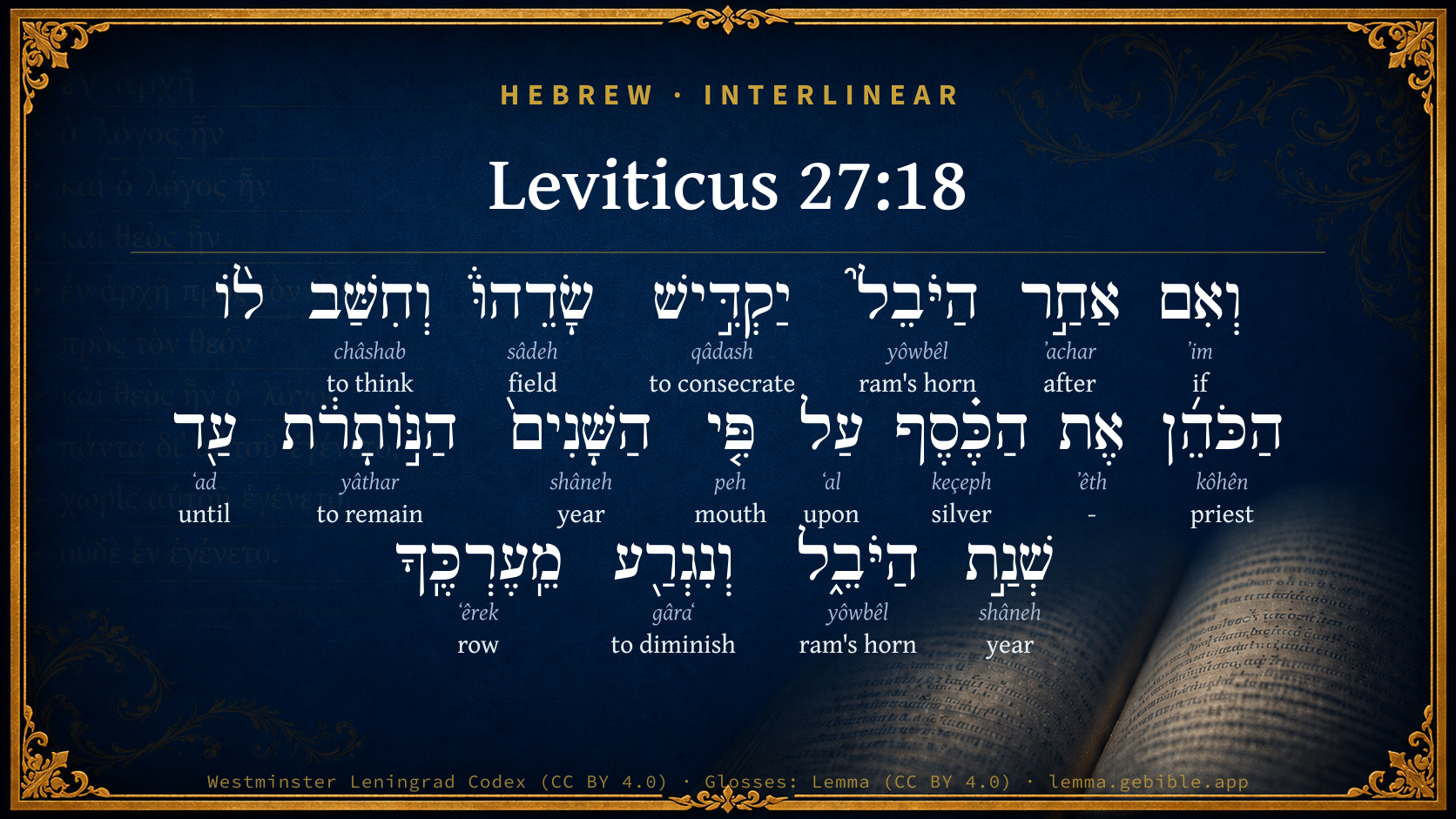
  1. וְאִם ʼim H518 “and · if” Conjunction + Conjunction
  2. אַחַ֣ר ʼachar H310 “after” Preposition
  3. הַיֹּבֵל֮ yôwbêl H3104 “the · ram's horn” Particle, Definite Article + Noun, Common, Masculine, Singular, Absolute
  4. יַקְדִּ֣ישׁ qâdash H6942 “to consecrate” Verb, Hiphil, Imperfect, 3rd Person, Masculine, Singular
  5. שָׂדֵהוּ֒ sâdeh H7704 “field · his” Noun, Common, Masculine, Singular, Construct + Suffix, Personal, 3rd Person, Masculine, Singular
  6. וְחִשַּׁב châshab H2803 “and · to think” Conjunction + Verb, Piel, Sequential Perfect, 3rd Person, Masculine, Singular
  7. הַכֹּהֵ֜ן kôhên H3548 “the · priest” Particle, Definite Article + Noun, Common, Masculine, Singular, Absolute
  8. אֶת ʼêth H853 “-” Particle, Direct Object
  9. הַכֶּ֗סֶף keçeph H3701 “the · silver” Particle, Definite Article + Noun, Common, Masculine, Singular, Absolute
  10. עַל ʻal H5921 “upon” Preposition
  11. פִּ֤י peh H6310 “mouth of” Noun, Common, Masculine, Singular, Construct
  12. הַשָּׁנִים֙ shâneh H8141 “the · years” Particle, Definite Article + Noun, Common, Feminine, Plural, Absolute
  13. הַנּ֣וֹתָרֹ֔ת yâthar H3498 “the · remaining” Particle, Definite Article + Verb, Niphal, Participle Active, Feminine, Plural, Absolute
  14. עַ֖ד ʻad H5704 “until” Preposition
  15. שְׁנַ֣ת shâneh H8141 “year of” Noun, Common, Feminine, Singular, Construct
  16. הַיֹּבֵ֑ל yôwbêl H3104 “the · ram's horn” Particle, Definite Article + Noun, Common, Masculine, Singular, Absolute
  17. מֵֽעֶרְכֶּֽךָ ʻêrek H6187 “from · row · your” Preposition + Noun, Common, Masculine, Singular, Construct + Suffix, Personal, 2nd Person, Masculine, Singular

About this verse

These counts appear in no published source. They are computed here, from the morphology-tagged text and Lemma’s own curated glosses. What Lemma adds →

19
words
16
distinct lemmas
Pentateuch
section

Notable vocabulary

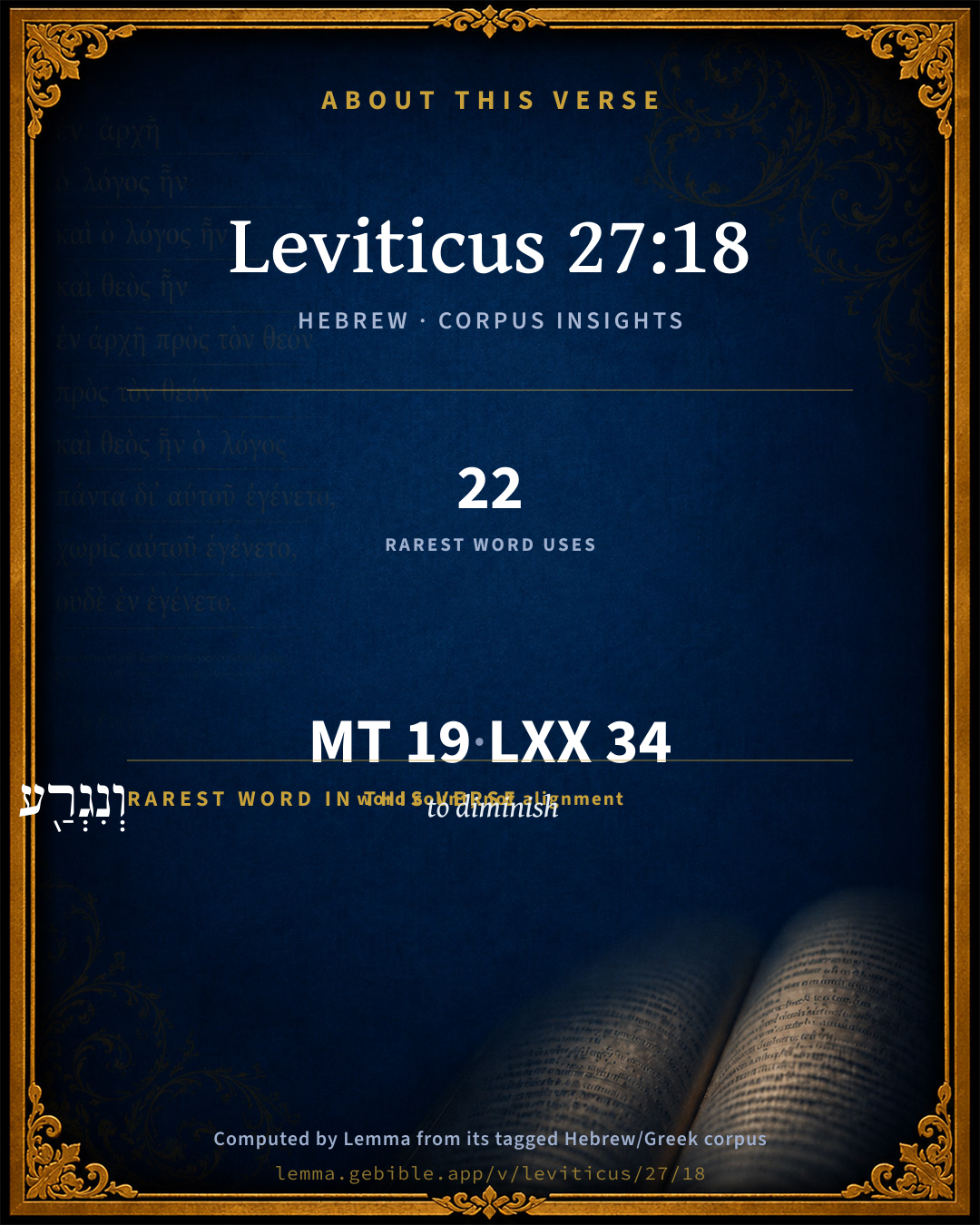
The rarest word here is וְנִגְרַ֖ע to diminish H1639 — appearing just 22 times in the whole Hebrew Bible.

Shared distinctive vocabulary

וְנִגְרַ֖ע to diminish H1639 occurs in 21 verses of the Hebrew Bible. Also found in:

Grammatical profile

  • 4 verbs
  • 9 nouns
  • 4 prepositions
  • 1 conjunction
  • 1 particle

Verb forms

  • יַקְדִּ֣ישׁ Hiphil · Imperfect
  • וְחִשַּׁב Piel · Sequential Perfect
  • הַנּ֣וֹתָרֹ֔ת Niphal · Participle Active
  • וְנִגְרַ֖ע Niphal · Sequential Perfect

Repetition

Words recur within this verse — often emphatic in Hebrew:

  • הַיֹּבֵל֮ ram's horn H3104 ×2
  • הַשָּׁנִים֙ year H8141 ×2

Hebrew & Septuagint length

In English translation the verse runs 38 words from the Hebrew and 44 from the Septuagint (LXX English) — closely comparable.

A rough comparison of the two English renderings, which tokenize alike — not a word-level alignment.

Word counts can differ between the Hebrew and the Greek without any difference in meaning — e.g. the Hebrew direct-object marker אֵת has no separate Greek word, and Greek often adds the article ὁ.

In the original languages it is 19 Hebrew tokens and 34 Greek tokens — but the two are counted differently (Hebrew bundles its prefixes and suffixes into one token; the Greek is in lemma form), so that isn’t a like-for-like length.

Cross-references

3

Topical passages linked to Leviticus 27:18 in the Treasury of Scripture Knowledge — connected by theme and wording, ordered by reader-vote popularity; previews shown in the World English Bible.

  • Leviticus 25:15–16 According to the number of years after the Jubilee you shall buy from your neighbor. According to the number of years of the crops he shall sell to you.
  • Leviticus 25:27 then let him reckon the years since the sale of it, and restore the surplus to the man to whom he sold it; and he shall return to his property.
  • Leviticus 25:51–52 If there are yet many years, according to them he shall give back the price of his redemption out of the money that he was bought for.

Cross-references courtesy of OpenBible.info (CC BY 4.0).

Hebrew and Greek witnesses Masoretic Hebrew ↔ Greek Septuagint

The same verse in the two great witnesses to the Old Testament, shown verse-for-verse.

These are two independent witnesses, not word-aligned to each other, and the Septuagint is shown in lemma (dictionary) form.

Hebrew Leviticus 27:18 Masoretic · Westminster Leningrad Codex

וְאִם אַחַ֣ר הַיֹּבֵל֮ יַקְדִּ֣ישׁ שָׂדֵהוּ֒ וְחִשַּׁב ל֨וֹ הַכֹּהֵ֜ן אֶת הַכֶּ֗סֶף עַל פִּ֤י הַשָּׁנִים֙ הַנּ֣וֹתָרֹ֔ת עַ֖ד שְׁנַ֣ת הַיֹּבֵ֑ל וְנִגְרַ֖ע מֵֽעֶרְכֶּֽךָ

But if he dedicates his field after the Jubilee, then the priest shall reckon to him the money according to the years that remain to the Year of Jubilee; and an abatement shall be made from your valuation.

World English Bible · Public Domain

Greek LXX Leviticus 27:18 Septuagint · lemma form

ἐάν δέ ἔσχατος μετά ὁ ἄφεσις ἁγιάζω ὁ ἀγρός αὐτός προςλογίζομαι αὐτός ὁ ἱερεύς ὁ ἀργύριον ἐπί ὁ ἔτος ὁ ἐπίλοιπος ἕως εἰς ὁ ἐνιαυτός ὁ ἄφεσις καί ἀντι ὑποαἱρέω ἀπό ὁ συντίμησις αὐτός

And if he should sanctify his field in the latter time after the release, the priest shall reckon to him the money for the remaining years, until the next year of release, and it shall be deducted as an equivalent from his full valuation.

LXX2012 (modern English Septuagint) · Public Domain

Hebrew: Westminster Leningrad Codex (CC BY 4.0). Greek: Septuagint (public domain); English from LXX2012 (modern English Septuagint) (Public Domain). How the Septuagint differs from the Hebrew →

Targum (Aramaic paraphrase)

2

The Targum is the ancient Jewish Aramaic paraphrase of the Hebrew Scriptures — an interpretive translation, not the Hebrew text itself. Onkelos (literal) and Pseudo-Jonathan (expansive) render the Torah, and Jonathan the Prophets. Coverage is partial: where no permissively-licensed English translation exists for a verse, only the Aramaic is shown. This is verse-level text, not a word-by-word alignment to the Hebrew.

  1. Targum Onkelos Torah (Genesis–Deuteronomy)
    וְאִם בָּתַר יוֹבֵלָא יַקְדֵשׁ חַקְלֵהּ וִיחַשֵׁב לֵהּ כַּהֲנָא יָת כַּסְפָּא עַל מֵימַר שְׁנַיָא דְאִשְׁתָּאָרָן עַד שַׁתָּא דְיוֹבֵלָא וְיִתִּמְנַע מִפֻּרְסָנֵהּ

    (no public-domain English translation for this verse)

    Targum Onkelos — Aramaic: “Onkelos Genesis” (public domain); “Onkelos Exodus” (public domain); “Onkelos Leviticus” (public domain); “Onkelos Numbers” (public domain); “Onkelos Deuteronomy” (public domain). English: “Sefaria Community Translation” (CC0 1.0 (public-domain dedication)); “J.W. Etheridge. The Targums of Onkelos and Jonathan Ben Uzziel on the Pentateuch. London: Longmans, Green, 1862” (public domain). Text via Sefaria.

  2. Targum Pseudo-Jonathan Torah (Genesis–Deuteronomy)
    וְאִין בָּתַר יוֹבֵלָא יַקְדִישׁ חַקְלֵיהּ וִידַיֵיק לֵיהּ כַּהֲנָא יַת סְכוּם כַּסְפָּא כְּמִיסַת שְׁנַיָיא דְמִשְׁתַּיְירָן עַד שַׁתָּא דְיוֹבֵלָא וּמְנַכֵּי לֵיהּ מִן עֲלוֹיֵיהּ

    But if he will dedicate his field after the year of Jubela, the priest shall compute with him the sum of the money according to the proportion of years that remain unto the next Jubela year, and shall abate it from the valuation.

    Targum Pseudo-Jonathan — Aramaic: “Targum Jonathan on Genesis” (public domain); “Targum Jonathan on Exodus” (public domain); “Targum Jonathan on Leviticus” (public domain); “Targum Jonathan on Numbers” (public domain); “Targum Jonathan on Deuteronomy” (public domain). English: “The Targum of Jonathan ben Uzziel, trans. J. W. Etheridge, London, 1862” (public domain). Text via Sefaria.

Commentary

Notes on Leviticus 27:18 from classic Christian and Jewish commentators (each source and its license shown beneath its notes). The classic Christian expositions comment on the surrounding passage and are grouped to its opening verse, so a note may address several verses; the Jewish commentaries on the Tanakh (Rashi and others) are per-verse, so they appear only where the commentator wrote on this verse.

Lemma curates 59 commentaries, every one of them public domain or Creative Commons licensed, each selected and text-cleaned for this edition rather than reprinted as found. About our sources →

Ellicott's Commentary for English Readers

(18) But if he sanctify his field after the jubile.—If, however, the vow is made after the jubile, the priest is to value the field according to the number of years from the time of the vow to the next jubile year.

And it shall be abated from thy estimation.—That is, the years which have elapsed since the last jubile up to the time when he made the vow are to be deducted from the jubile cycle, and hence so many shekels are to be taken off from the original valuation of fifty shekels. Thus, for instance, if he vowed the field at the estimated value of fifty shekels twenty years after the jubile, the priest is only to reckon the thirty years which have to run to the next jubile, and is to deduct twenty shekels for the twenty years which have elapsed since the last jubile. Accordingly, the vower would only have to pay thirty shekels, exclusive of the fifth part above the estimated value.

A Bible Commentary for English Readers, edited by Charles John Ellicott (1878–1897) — public domain. Text from a community e-Sword module.

John Gill's Exposition

And if he that sanctified the field shall in any wise redeem it,.... Is desirous of it, and determined upon it at any rate, repenting that he had parted with it in this manner:

then he shall add the fifth part of the money of thy estimation to it: the Jerusalem Targum is, the fifth part of the shekels of silver: that is, if he has a mind to redeem it, and is resolved on it, as soon as he has sanctified it, then, besides the fifty shekels of silver it is rated at, and might be sold for to another, he must pay a fifth part thereof, that is, ten shekels more, for reasons before given, Lev 27:15,

and it shall be assured to him; remain firm and stable with him, abide by him, and he in the possession of it as his property, ever after, as if he had never sanctified it.

John Gill's Exposition of the Whole Bible (1746–1763) — public domain (CC PDM 1.0). Text via the HelloAO Bible API.

Matthew Poole's English Annotations

After the jubilee, i.e. some considerable time after the jubilee, as appears from the following words.

Unto the year of the jubilee; the defalcation from the full price of fifty shekels being to be more or less, as the years are more or fewer. See Lev 25:15-17.

Matthew Poole's English Annotations on the Holy Bible (1683–1685) — public domain. Text from a community e-Sword/MySword module.

John Wesley's Explanatory Notes

After the jubilee - That is, some considerable time after. The defalcation from the full price of fifty shekels shall be more or less as the years are more or fewer.

John Wesley, Explanatory Notes Upon the Whole Bible (1754–1765) — public domain. Text via the GEBible commentary corpus.

Rashi

Rabbi Shlomo Yitzchaki (Rashi)

ואם אחר היבל יקדיש BUT IF HE SANCTIFY [HIS FIELD] AFTER (i. e. some years after) THE JUBILEE, — and similarly, of course, if he dedicated it from the year of (i. e. immediately after) the Jubilee, — and in either case it remained for a time in the possession of the treasurer and then this man comes to redeem it some years after the Jubilee,

וחשב לו הכהן את הכסף על פי השנים הנותרת THEN THE PRIEST SHALL RECKON FOR HIM THE MONEY ACCORDING TO THE YEARS THAT ARE LEFT — it must be according to a reckoning. How is it to be done? You see, it (Scripture) has fixed the value of forty-nine years at fifty shekels, that is, one shekel for each year and one additional shekel for all of them (for all the years together). Now a shekel is forty-eight pundion; that gives one selah (shekel) and one pundion for each year, except that there is one pundion short for all the years (reckoning the price per year as the Torah prescribes, he pays forty-nine shekels and forty-nine pundion, equal to fifty shekels and one pundion whereas really he should pay fifty shekels, which is one pundion less than the calculation based upon the yearly rate. Our Rabbis said that that pundion is the commission for the money-changing (Bekhorot 50a), and therefore if he comes to redeem the field some years after the Jubilee, he must give a selah and a pundion for each year of those years that remain until the Jubilee year (Sifra, Bechukotai, Chapter 10 10; Arakhin 24b).

ונגרע מערכך AND THERE SHALL BE ABATED FROM THE VALUATION the number of years that have elapsed from the Jubilee year until the year when the redemption takes place.

Rashi on the Tanakh — English translations: “The Judaica Press complete Tanach with Rashi, translated by A. J. Rosenberg” (CC BY 4.0); “Pentateuch with Rashi's commentary by M. Rosenbaum and A.M. Silbermann, 1929-1934” (public domain); “The Metsudah Tanach series, Lakewood, N.J” (CC BY 4.0); and “The Book of Joshua, Metsudah Publications, 1997” (CC BY 4.0). Text via Sefaria.

Lesson kit

Teaching starters — assembled from the data on this page, not authored interpretation. Every prompt links to the verse data it draws on. Edit before teaching.

Leviticus, in the Pentateuch, opens this verse with 19 words (16 distinct Hebrew lemmas). Its most distinctive word is gâraʻ (“to diminish”). A historical commentator’s framing appears above. Read the whole chapter for the surrounding context.

Discussion questions

  1. How does “to diminish” (gâraʻ) shape what this verse is saying?
  2. Exodus 5:8 shares the word «to diminish» with this verse. How do the two illuminate each other?
  3. “ram's horn” occurs 2× in this one verse. What is the effect of the repetition?
  4. These translations render this verse differently; the difference is in the English rendering, not the original. What questions does that raise?
  5. The verb «יַקְדִּ֣ישׁ» is Hiphil Imperfect. How does its form color the action?
  6. Reading how Ellicott's Commentary for English Readers and John Gill's Exposition read this verse, where do the two commentators agree and where do they part?

Things to notice

Reading settings

Reading text

Shown beneath each verse's original-language words.

Old Testament
Old Testament edition

Read the OT as the Masoretic Hebrew (MT) or the Greek Septuagint (LXX).

English shown for the Greek Septuagint (in the Hebrew ↔ Greek comparison).

Comparing translations? Open the Compare panel on any verse page to stack up to four side by side.