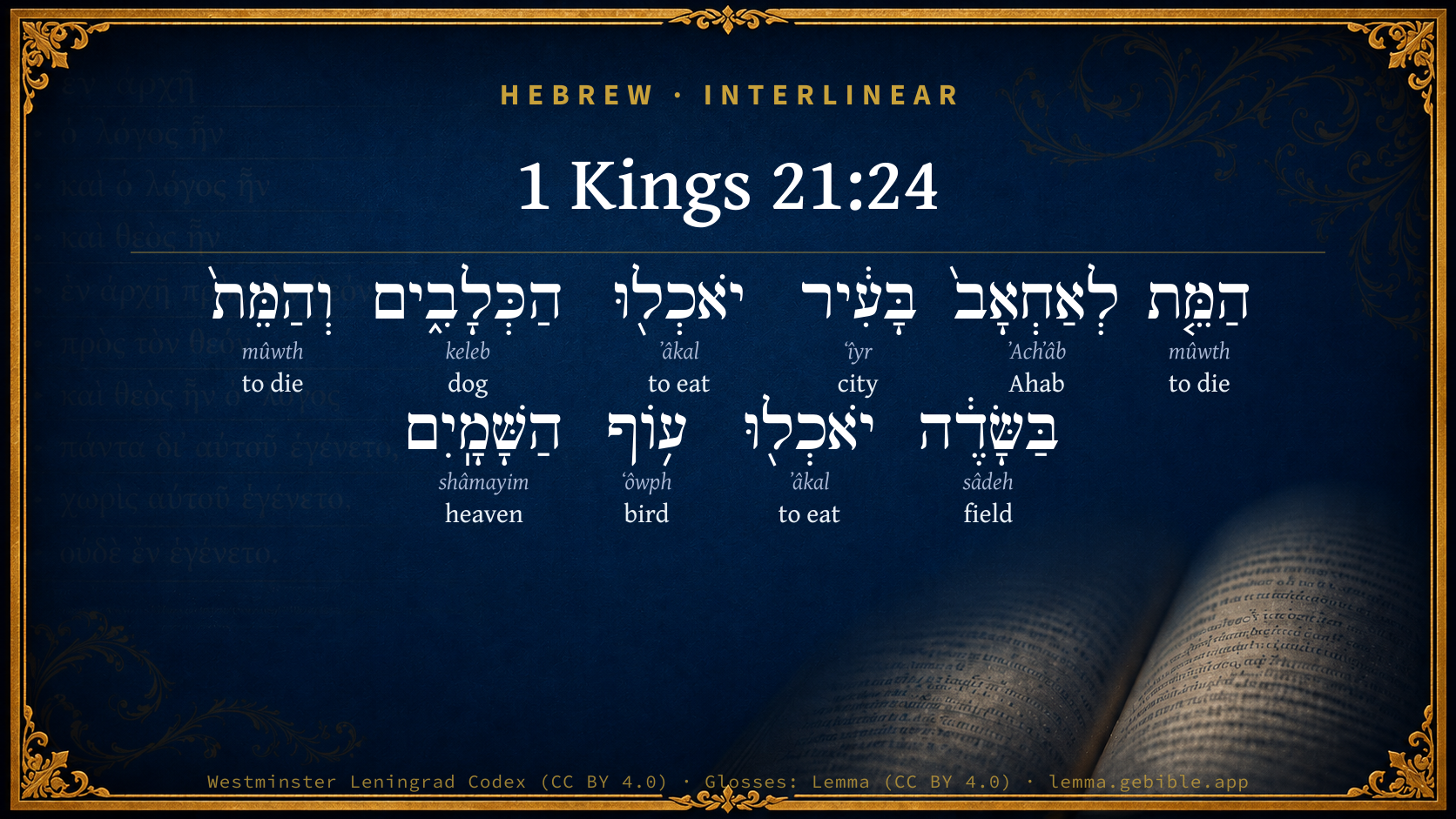
1 Kings 21:24

Hebrew (Westminster Leningrad Codex) 1 Kings 21:24 appears in the Hebrew Old Testament. The text above is from the Westminster Leningrad Codex. Each word links to its Strong’s number, a concise gloss, and parsing drawn from the Open Scriptures Hebrew Bible morphology. Click any word for its full Brown-Driver-Briggs (BDB) entry.
Download image
Cite this verse

1 Kings 21:24 (World English Bible). Public Domain. Lemma interlinear Bible study tool, https://lemma.gebible.app/v/1-kings/21/24.

Show BibTeX & RIS
BibTeX
RIS
English Translation
Him who dies of Ahab in the city the dogs shall eat; and him who dies in the field shall the birds of the sky eat.
World English Bible · Public Domain
Download a study sheet

One document with this verse’s original text, its word-by-word gloss line, the meaning frame, cross-references with their text, attributed commentary, and full source and license credits — printable, and it pastes into notes with its structure intact.

This verse Autodidact and up

Study sheet (.html) Plain text (.txt)

A passage Seminary Student

Up to 50 verses in one chapter. A passage sheet keeps up to 6 commentary sources and 12 cross-references per verse, in the order this page ranks them, and says so on the sheet whenever that leaves anything out. Ask for a single verse and you get the Autodidact verse sheet above.

Everything on this page stays free to read, with no account — the sheet is a download of what is already on screen, not access to it.

Want to remove ads? Support Godless Engineer
Compare translations 3

The same verse in 3 English versions, stacked beneath the original-language interlinear above. Click any original word for its lexicon entry.

Each is an independent rendering of the whole verse — the interlinear is not word-aligned to these translations.

Highlighted words mark where these versions differ — a whole-verse word diff, not a word-by-word alignment.

  • World English Bible Public Domain
    Him who dies of Ahab in the city the dogs shall eat; and him who dies in the field shall the birds of the sky eat.
  • King James Version Public Domain
    Him that dieth of Ahab in the city the dogs shall eat; and him that dieth in the field shall the fowls of the air eat.
  • unfoldingWord Literal Text CC BY-SA 4.0
    The one to Ahab dying in the city, dogs will eat, and the one dying in the field, the birds of the sky will eat.”

unfoldingWord Literal Text — © unfoldingWord, licensed CC BY-SA 4.0. Word-aligned USFM3 via Door43 (git.door43.org/unfoldingWord/en_ult).

Versions to compare (up to 4)

3 of 4 selected

Show all 18 translations

Every available English version of this verse, each an independent rendering of the whole verse.

  • World English Bible Public Domain
    Him who dies of Ahab in the city the dogs shall eat; and him who dies in the field shall the birds of the sky eat.
  • Berean Standard Bible Public Domain
    Anyone belonging to Ahab who dies in the city will be eaten by dogs, and anyone who dies in the field will be eaten by the birds of the air.”
  • Majority Standard Bible Public Domain
    Anyone belonging to Ahab who dies in the city will be eaten by dogs, and anyone who dies in the field will be eaten by the birds of the air.”
  • King James Version Public Domain
    Him that dieth of Ahab in the city the dogs shall eat; and him that dieth in the field shall the fowls of the air eat.
  • American Standard Version (1901) Public Domain
    Him that dieth of Ahab in the city the dogs shall eat; and him that dieth in the field shall the birds of the heavens eat.
  • Revised Version (1885) Public Domain
    Him that dieth of Ahab in the city the dogs shall eat; and him that dieth in the field shall the fowls of the air eat.
  • Geneva Bible (1599) Public Domain
    The dogs shall eate him of Ahabs stocke, that dyeth in the citie: and him that dyeth in the fieldes, shall the foules of the ayre eate.
  • Douay-Rheims (1899) Public Domain
    If Achab die in the city, the dogs shall eat him: but if he die in the field, the birds of the air shall eat him.
  • Young's Literal Translation Public Domain
    him who dieth of Ahab in a city do the dogs eat, and him who dieth in a field do fowl of the heavens eat;
  • Literal Standard Version CC BY-SA 4.0
    the dogs eat him who dies of Ahab in a city, and [the] bird of the heavens eats him who dies in a field;
  • Unlocked Literal Bible CC BY-SA 4.0
    Anyone who belongs to Ahab and dies in the city, the dogs will eat; and the birds of the sky will eat anyone who dies in the field.”
  • unfoldingWord Literal Text CC BY-SA 4.0
    The one to Ahab dying in the city, dogs will eat, and the one dying in the field, the birds of the sky will eat.”
  • Darby Bible Public Domain
    Him that dieth of Ahab in the city shall the dogs eat, and him that dieth in the field shall the fowl of the heavens eat.
  • World Messianic Bible Public Domain
    The dogs will eat he who dies of Ahab in the city; and the birds of the sky will eat he who dies in the field.”
  • Webster's Bible Public Domain
    Him that dieth of Ahab in the city the dogs shall eat; and him that dieth in the field shall the fowls of the air eat.
  • Free Bible Version CC BY-SA 4.0
    Those of Ahab's family who die in the town will be eaten by dogs, and those who die in the countryside will be eaten by birds.”
  • Bible in Basic English Public Domain
    Any man of the family of Ahab who comes to his death in the town will become food for the dogs; and he who comes to his death in the open country will be food for the birds of the air.
  • JPS Tanakh (1917) Public Domain
    Him that dieth of Ahab in the city the dogs shall eat; and him that dieth in the field shall the fowls of the air eat.'

Literal Standard Version (2020), Covenant Press — licensed CC BY-SA 4.0. Text via the HelloAO Bible API (eBible.org). Unlocked Literal Bible (unfoldingWord) — licensed CC BY-SA 4.0. Text via the HelloAO Bible API (eBible.org). unfoldingWord Literal Text — © unfoldingWord, licensed CC BY-SA 4.0. Word-aligned USFM3 via Door43 (git.door43.org/unfoldingWord/en_ult). Free Bible Version, Dr. Jonathan Gallagher — licensed CC BY-SA 4.0. Text via the HelloAO Bible API (eBible.org).

Word by word

More ways to search: Search by grammar → Find every occurrence → Compare this word →

Practice this passage: Drill this verse → Learn its vocabulary →

הַכְּלָבִ֑ים
keleb
H3611
“the · dogs”
Particle, Definite Article + Noun, Common, Masculine, Plural, Absolute
Part of Speech
Particle + Noun
Type
Common
Gender
Masculine
Number
Plural
State
Absolute
Full BDB Definition

Origin: from an unused root means. to yelp, or else to attack

TWOT: 981a

dog - dog (literal) - contempt or abasement (figuratively) - of pagan sacrifice - of male cult prostitute (figuratively)
  1. הַמֵּ֤ת mûwth H4191 “the · dying” Particle, Definite Article + Verb, Qal, Participle Active, Masculine, Singular, Absolute
  2. לְאַחְאָב֙ ʼAchʼâb H256 “to/for · Ahab” Preposition + Noun, Proper
  3. בָּעִ֔יר ʻîyr H5892 “in/at the · city” Preposition, Determined + Noun, Common, Feminine, Singular, Absolute
  4. יֹאכְל֖וּ ʼâkal H398 “to eat” Verb, Qal, Imperfect, 3rd Person, Masculine, Plural
  5. וְהַמֵּת֙ mûwth H4191 “and · the · dying” Conjunction + Particle, Definite Article + Verb, Qal, Participle Active, Masculine, Singular, Absolute
  6. בַּשָּׂדֶ֔ה sâdeh H7704 “in/at the · field” Preposition, Determined + Noun, Common, Masculine, Singular, Absolute
  7. יֹאכְל֖וּ ʼâkal H398 “to eat” Verb, Qal, Imperfect, 3rd Person, Masculine, Plural
  8. ע֥וֹף ʻôwph H5775 “bird of” Noun, Common, Masculine, Singular, Construct
  9. הַשָּׁמָֽיִם shâmayim H8064 “the · heaven(s)” Particle, Definite Article + Noun, Common, Masculine, Plural, Absolute

About this verse

These counts appear in no published source. They are computed here, from the morphology-tagged text and Lemma’s own curated glosses. What Lemma adds →

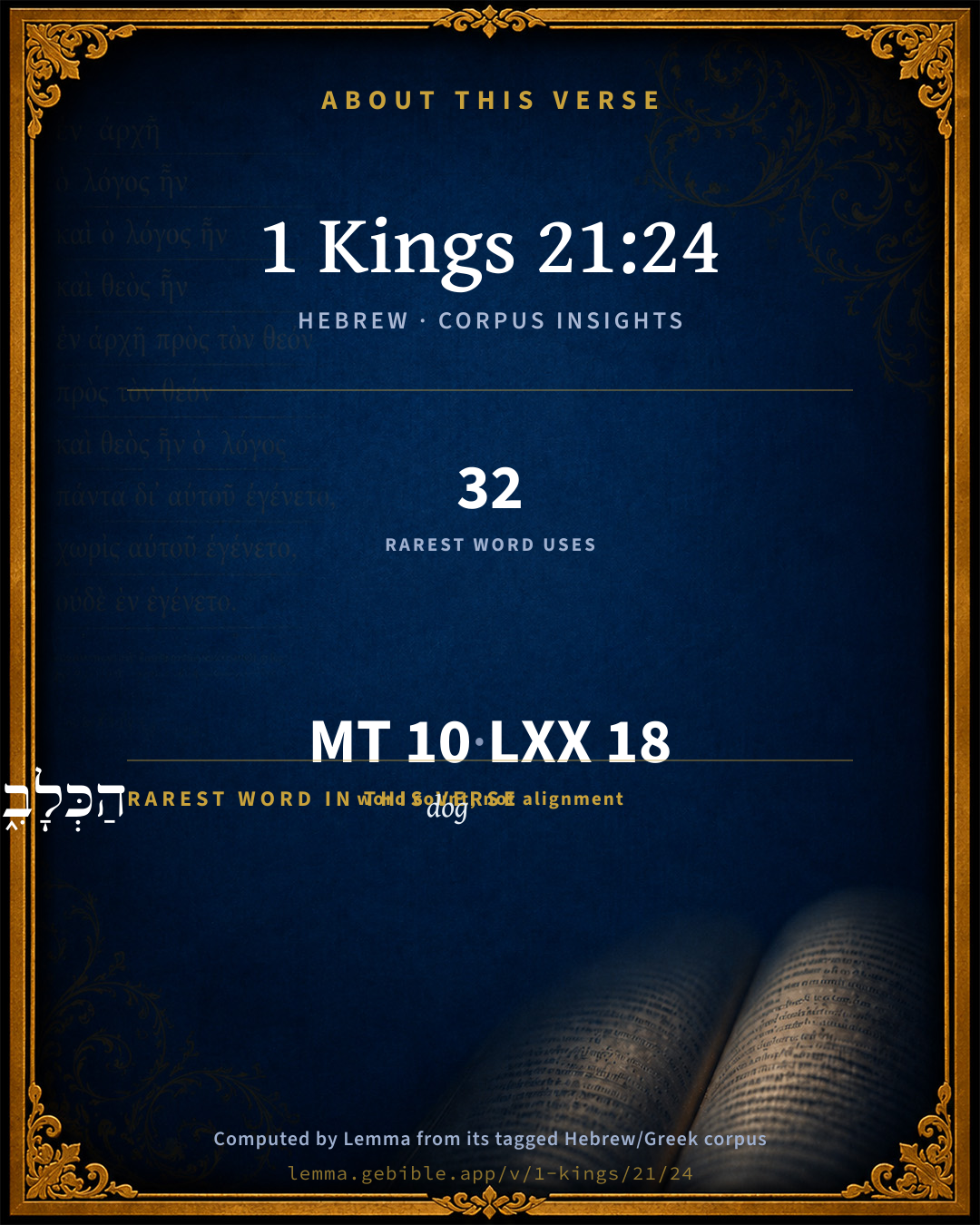
10
words
8
distinct lemmas
Historical
section

Shared distinctive vocabulary

הַכְּלָבִ֑ים dog H3611 occurs in 31 verses of the Hebrew Bible. Also found in:

Grammatical profile

  • 4 verbs
  • 6 nouns

Verb forms

  • הַמֵּ֤ת Qal · Participle Active
  • יֹאכְל֖וּ Qal · Imperfect
  • וְהַמֵּת֙ Qal · Participle Active
  • יֹאכְל֖וּ Qal · Imperfect

Repetition

Words recur within this verse — often emphatic in Hebrew:

  • הַמֵּ֤ת to die H4191 ×2
  • יֹאכְל֖וּ to eat H398 ×2

Hebrew & Septuagint length

In English translation the verse runs 26 words from the Hebrew and 20 from the Septuagint (LXX English) — closely comparable.

A rough comparison of the two English renderings, which tokenize alike — not a word-level alignment.

Word counts can differ between the Hebrew and the Greek without any difference in meaning — e.g. the Hebrew direct-object marker אֵת has no separate Greek word, and Greek often adds the article ὁ.

In the original languages it is 10 Hebrew tokens and 18 Greek tokens — but the two are counted differently (Hebrew bundles its prefixes and suffixes into one token; the Greek is in lemma form), so that isn’t a like-for-like length.

Cross-references

7

Topical passages linked to 1 Kings 21:24 in the Treasury of Scripture Knowledge — connected by theme and wording, ordered by reader-vote popularity; previews shown in the World English Bible.

  • 1 Kings 14:11 Him who dies of Jeroboam in the city shall the dogs eat; and him who dies in the field shall the birds of the sky eat: for Yahweh has spoken it.
  • 1 Kings 16:4 Him who dies of Baasha in the city shall the dogs eat; and him who dies of his in the field shall the birds of the sky eat.
  • Jeremiah 15:3 I will appoint over them four kinds, says Yahweh: the sword to kill, and the dogs to tear, and the birds of the sky, and the animals of the earth, to devour and to destroy.
  • Isaiah 14:19 But you are cast forth away from your tomb like an abominable branch, clothed with the slain, who are thrust through with the sword, who go down to the stones of the pit; as a dead body trodden under foot.
  • Ezekiel 32:4–5 I will leave you on the land, I will cast you forth on the open field, and will cause all the birds of the sky to settle on you, and I will satisfy the animals of the whole earth with you.
  • Ezekiel 39:18–20 You shall eat the flesh of the mighty, and drink the blood of the princes of the earth, of rams, of lambs, and of goats, of bulls, all of them fatlings of Bashan.
  • Revelation 19:18 that you may eat the flesh of kings, the flesh of captains, the flesh of mighty men, and the flesh of horses and of those who sit on them, and the flesh of all men, both free and slave, and small and great."

Cross-references courtesy of OpenBible.info (CC BY 4.0).

Hebrew and Greek witnesses Masoretic Hebrew ↔ Greek Septuagint

The same verse in the two great witnesses to the Old Testament, shown verse-for-verse.

These are two independent witnesses, not word-aligned to each other, and the Septuagint is shown in lemma (dictionary) form.

Hebrew 1 Kings 21:24 Masoretic · Westminster Leningrad Codex

הַמֵּ֤ת לְאַחְאָב֙ בָּעִ֔יר יֹאכְל֖וּ הַכְּלָבִ֑ים וְהַמֵּת֙ בַּשָּׂדֶ֔ה יֹאכְל֖וּ ע֥וֹף הַשָּׁמָֽיִם

Him who dies of Ahab in the city the dogs shall eat; and him who dies in the field shall the birds of the sky eat.

World English Bible · Public Domain

Greek LXX 1 Kings 21:24 Septuagint · lemma form

καί ὁ ῥῆμα οὗτος ποιέω ἀποἵστημι ὁ βασιλεύς ἕκαστος εἰς ὁ τόπος αὐτός καί τίθημι ἀντί αὐτός σατράπης

And do you this thing: Send away the kings, each one to his place, and set princes in their stead.

LXX2012 (modern English Septuagint) · Public Domain

On this verse, Haydock's Catholic Bible Commentary discusses the Septuagint’s reading. Read the note in Commentary ↓

Hebrew: Westminster Leningrad Codex (CC BY 4.0). Greek: Septuagint (public domain); English from LXX2012 (modern English Septuagint) (Public Domain). How the Septuagint differs from the Hebrew →

Targum (Aramaic paraphrase)

1

The Targum is the ancient Jewish Aramaic paraphrase of the Hebrew Scriptures — an interpretive translation, not the Hebrew text itself. Onkelos (literal) and Pseudo-Jonathan (expansive) render the Torah, and Jonathan the Prophets. Coverage is partial: where no permissively-licensed English translation exists for a verse, only the Aramaic is shown. This is verse-level text, not a word-by-word alignment to the Hebrew.

  1. Targum Jonathan Prophets (Joshua–Malachi)
    דִימוּת לְאַחְאָב בְּקַרְתָּא יֵיכְלוּן כַּלְבַיָא וְדִימוּת לֵיהּ בְּחַקְלָא יֵיכְלוּן עוֹפָא דִשְׁמַיָא:

    (no public-domain English translation for this verse)

    Targum Jonathan — Aramaic: “Mikraot Gedolot” (public domain). English: “Sefaria Community Translation” (CC0 1.0 (public-domain dedication)); “London "Chaldee Paraphrase," 1871” (public domain). Text via Sefaria.

Commentary

Notes on 1 Kings 21:24 from classic Christian and Jewish commentators (each source and its license shown beneath its notes). The classic Christian expositions comment on the surrounding passage and are grouped to its opening verse, so a note may address several verses; the Jewish commentaries on the Tanakh (Rashi and others) are per-verse, so they appear only where the commentator wrote on this verse.

Lemma curates 59 commentaries, every one of them public domain or Creative Commons licensed, each selected and text-cleaned for this edition rather than reprinted as found. About our sources →

Trapp's Complete Commentary

John Trapp

1Ki 21:24 Him that dieth of Ahab in the city the dogs shall eat; and him that dieth in the field shall the fowls of the air eat.

Ver. 24. Him that dieth.] See 1Ki 14:11.

John Trapp, A Commentary or Exposition upon All the Books of the Old and New Testament (1647–1656) — public domain. Text from a community e-Sword module.

The Cambridge Bible for Schools and Colleges

gen. ed. J. J. S. Perowne

24. Him that dieth &c.] See above, 1Ki_14:11.

The Cambridge Bible for Schools and Colleges (gen. ed. J. J. S. Perowne; Cambridge University Press, 1878–1918) — public domain. Text from a community e-Sword module.

Haydock's Catholic Bible Commentary

Eat him. Yet God remitted something from the severity of this sentence; and Achab was buried in Samaria, chap. xxii. 37. But his son was deprived of burial. (Tirinus) (4 Kings ix. 26.) --- According to the Hebrew, the prediction related to Achab’s posterity, as the Chaldean, Septuagint, Syriac, &c., have understood it. (Calmet) --- Protestants, "him that dieth of Achab in the city," &c.

George Leo Haydock (1774–1849), Haydock's Catholic Family Bible and Commentary, 1859 edition — public domain. Excludes Psalms (Douay-Rheims chapter numbering differs from Protestant) and Deuterocanonical books (Catholic canon only).

The Pulpit Commentary

Him that dieth of Ahab in the city the dogs shall eat; and him that dieth in the fields shall the fowls of the air eat. See on 1Ki_14:11 1Ki_16:4. Stanley, forgetting that the phrase is almost a formula, thinks that "the large vultures which in Eastern climes are always wheeling aloft under the clear blue sky doubtless suggested the expression to the prophet." "The horizon was darkened with the visions of vultures glutting on the carcases of the dead, and the packs of savage dogs feeding on their remains, or lapping up their blood."

The Pulpit Commentary (1880–1919), ed. H.D.M. Spence-Jones & Joseph S. Exell — public domain. Text from a community e-Sword module.

John Wesley's Explanatory Notes

Him that dieth, &c. - Punishments after death are here most insisted on. And these, tho' lighting on the body only, yet undoubtedly were designed as figures of the soul's misery in an after state.

25 Was none - None among all the kings of Israel which had been before him. Whom Jezebel - This is added to shew, that temptations to sin are no excuse to the sinner.

John Wesley, Explanatory Notes Upon the Whole Bible (1754–1765) — public domain. Text via the GEBible commentary corpus.

Lesson kit

Teaching starters — assembled from the data on this page, not authored interpretation. Every prompt links to the verse data it draws on. Edit before teaching.

1 Kings, in the Historical, opens this verse with 10 words (8 distinct Hebrew lemmas). Its most distinctive word is keleb (“dog”). A historical commentator’s framing appears above. Read the whole chapter for the surrounding context.

Discussion questions

  1. How does “dog” (keleb) shape what this verse is saying?
  2. Exodus 11:7 shares the word «dog» with this verse. How do the two illuminate each other?
  3. “to die” occurs 2× in this one verse. What is the effect of the repetition?
  4. These translations render this verse differently; the difference is in the English rendering, not the original. What questions does that raise?
  5. The verb «הַמֵּ֤ת» is Qal Participle Active. How does its form color the action?
  6. Reading how Trapp's Complete Commentary and The Cambridge Bible for Schools and Colleges read this verse, where do the two commentators agree and where do they part?

Things to notice

Reading settings

Reading text

Shown beneath each verse's original-language words.

Old Testament
Old Testament edition

Read the OT as the Masoretic Hebrew (MT) or the Greek Septuagint (LXX).

English shown for the Greek Septuagint (in the Hebrew ↔ Greek comparison).

Comparing translations? Open the Compare panel on any verse page to stack up to four side by side.