
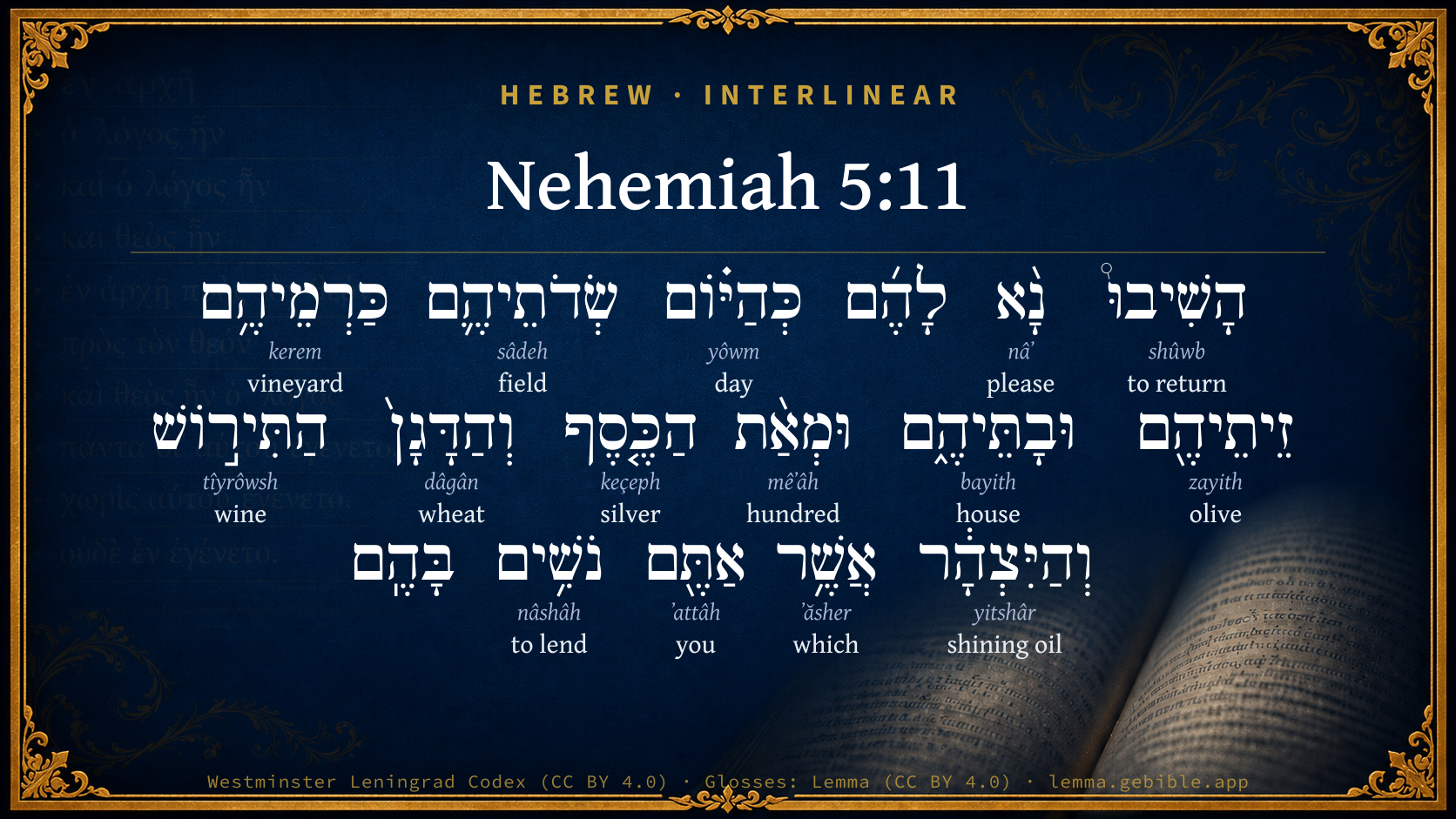
Nehemiah 5:11

Hebrew (Westminster Leningrad Codex) Nehemiah 5:11 appears in the Hebrew Old Testament. The text above is from the Westminster Leningrad Codex. Each word links to its Strong’s number, a concise gloss, and parsing drawn from the Open Scriptures Hebrew Bible morphology. Click any word for its full Brown-Driver-Briggs (BDB) entry.
Download image
Cite this verse

Nehemiah 5:11 (World English Bible). Public Domain. Lemma interlinear Bible study tool, https://lemma.gebible.app/v/nehemiah/5/11.

Show BibTeX & RIS
BibTeX
RIS
English Translation
Please restore to them, even this day, their fields, their vineyards, their olive groves, and their houses, also the hundredth part of the money, and of the grain, the new wine, and the oil, that you exact of them.
World English Bible · Public Domain
Download a study sheet

One document with this verse’s original text, its word-by-word gloss line, the meaning frame, cross-references with their text, attributed commentary, and full source and license credits — printable, and it pastes into notes with its structure intact.

This verse Autodidact and up

Study sheet (.html) Plain text (.txt)

A passage Seminary Student

Up to 50 verses in one chapter. A passage sheet keeps up to 6 commentary sources and 12 cross-references per verse, in the order this page ranks them, and says so on the sheet whenever that leaves anything out. Ask for a single verse and you get the Autodidact verse sheet above.

Everything on this page stays free to read, with no account — the sheet is a download of what is already on screen, not access to it.

Want to remove ads? Support Godless Engineer
Compare translations 3

The same verse in 3 English versions, stacked beneath the original-language interlinear above. Click any original word for its lexicon entry.

Each is an independent rendering of the whole verse — the interlinear is not word-aligned to these translations.

Highlighted words mark where these versions differ — a whole-verse word diff, not a word-by-word alignment.

  • World English Bible Public Domain
    Please restore to them, even this day, their fields, their vineyards, their olive groves, and their houses, also the hundredth part of the money, and of the grain, the new wine, and the oil, that you exact of them.
  • King James Version Public Domain
    Restore, I pray you, to them, even this day, their lands, their vineyards, their oliveyards, and their houses, also the hundredth part of the money, and of the corn, the wine, and the oil, that ye exact of them.
  • unfoldingWord Literal Text CC BY-SA 4.0
    Please, even today, return to them their fields, their vineyards, their olive orchards, and their houses, and a hundred of the silver and the grain, the new wine, and the oil that you are lending against them.”

unfoldingWord Literal Text — © unfoldingWord, licensed CC BY-SA 4.0. Word-aligned USFM3 via Door43 (git.door43.org/unfoldingWord/en_ult).

Versions to compare (up to 4)

3 of 4 selected

Show all 18 translations

Every available English version of this verse, each an independent rendering of the whole verse.

  • World English Bible Public Domain
    Please restore to them, even this day, their fields, their vineyards, their olive groves, and their houses, also the hundredth part of the money, and of the grain, the new wine, and the oil, that you exact of them.
  • Berean Standard Bible Public Domain
    Please restore to them immediately their fields, vineyards, olive groves, and houses, along with the percentage of the money, grain, new wine, and oil that you have been assessing them.”
  • Majority Standard Bible Public Domain
    Please restore to them immediately their fields, vineyards, olive groves, and houses, along with the percentage of the money, grain, new wine, and oil that you have been assessing them.”
  • King James Version Public Domain
    Restore, I pray you, to them, even this day, their lands, their vineyards, their oliveyards, and their houses, also the hundredth part of the money, and of the corn, the wine, and the oil, that ye exact of them.
  • American Standard Version (1901) Public Domain
    Restore, I pray you, to them, even this day, their fields, their vineyards, their oliveyards, and their houses, also the hundredth part of the money, and of the grain, the new wine, and the oil, that ye exact of them.
  • Revised Version (1885) Public Domain
    Restore, I pray you, to them, even this day, their fields, their vineyards, their oliveyards, and their houses, also the hundredth part of the money, and of the corn, the wine, and the oil, that ye exact of them.
  • Geneva Bible (1599) Public Domain
    Restore, I pray you, vnto them this day their landes, their vineyardes, their oliues, and their houses, and remit the hundreth part of the siluer and of the corne, of the wine, and of the oyle that ye exact of them.
  • Douay-Rheims (1899) Public Domain
    Restore ye to them this day their fields, and their vineyards, and their oliveyards, and their houses: and the hundredth part of the money, and of the corn, the wine, and the oil, which you mere wont to exact of them, give it rather for them.
  • Young's Literal Translation Public Domain
    Give back, I pray you, to them, as to-day, their fields, their vineyards, their olive-yards, and their houses, and the hundredth `part' of the money, and of the corn, of the new wine, and of the oil, that ye are exacting of them.'
  • Literal Standard Version CC BY-SA 4.0
    Please give back to them, as today, their fields, their vineyards, their olive-yards, and their houses, and the hundredth [part] of the money, and of the grain, of the new wine, and of the oil, that you are exacting of them.”
  • Unlocked Literal Bible CC BY-SA 4.0
    Return to them this very day their fields, their vineyards, their olive orchards, and their houses and the percentage of the money, the grain, the new wine, and the oil that you exacted from them.”
  • unfoldingWord Literal Text CC BY-SA 4.0
    Please, even today, return to them their fields, their vineyards, their olive orchards, and their houses, and a hundred of the silver and the grain, the new wine, and the oil that you are lending against them.”
  • Darby Bible Public Domain
    Restore, I pray you, to them this very day their fields, their vineyards, their olive-gardens, and their houses, also the hundredth [part] of the money, and of the corn, the wine and the oil, that ye have exacted of them.
  • World Messianic Bible Public Domain
    Please restore to them, even today, their fields, their vineyards, their olive groves, and their houses, also the hundredth part of the money, and of the grain, the new wine, and the oil, that you are charging them.”
  • Webster's Bible Public Domain
    Restore, I pray you, to them, even this day, their lands, their vineyards, their olive-yards, and their houses, also the hundredth part of the money, and of the corn, the wine, and the oil, that ye exact of them.
  • Free Bible Version CC BY-SA 4.0
    Give them back right now their fields, vineyards, olive groves, and houses, along with the one percent interest on the money, grain, new wine, and olive oil that you have been charging them.”
  • Bible in Basic English Public Domain
    Give back to them this very day their fields, their vine-gardens, their olive-gardens, and their houses, as well as a hundredth part of the money and the grain and the wine and the oil which you have taken from them.
  • JPS Tanakh (1917) Public Domain
    Restore, I pray you, to them, even this day, their fields, their vineyards, their oliveyards, and their houses, also the hundred pieces of silver, and the corn, the wine, and the oil, that ye exact of them.'

Literal Standard Version (2020), Covenant Press — licensed CC BY-SA 4.0. Text via the HelloAO Bible API (eBible.org). Unlocked Literal Bible (unfoldingWord) — licensed CC BY-SA 4.0. Text via the HelloAO Bible API (eBible.org). unfoldingWord Literal Text — © unfoldingWord, licensed CC BY-SA 4.0. Word-aligned USFM3 via Door43 (git.door43.org/unfoldingWord/en_ult). Free Bible Version, Dr. Jonathan Gallagher — licensed CC BY-SA 4.0. Text via the HelloAO Bible API (eBible.org).

Word by word

More ways to search: Search by grammar → Find every occurrence → Compare this word →

Practice this passage: Drill this verse → Learn its vocabulary →

נֹשִׁ֥ים
nâshâh
H5383
“lending”
Verb, Qal, Participle Active, Masculine, Plural, Absolute
Part of Speech
Verb
Stem
Qal
Form
Participle Active
Gender
Masculine
Number
Plural
State
Absolute
Full BDB Definition

Origin: a primitive root [rather identical with H5382 , in the sense of H5378 ]

TWOT: 1427

to lend, be a creditor - (Qal) - to lend - creditor (participle) (substantive) - (Hiphil) to lend
  1. הָשִׁיבוּ֩ shûwb H7725 “return” Verb, Hiphil, Imperative, 2nd Person, Masculine, Plural
  2. נָ֨א nâʼ H4994 “please” Particle, Exhortation
  3. כְּהַיּ֗וֹם yôwm H3117 “like/as · the · day” Preposition + Particle, Definite Article + Noun, Common, Masculine, Singular, Absolute
  4. שְׂדֹתֵיהֶ֛ם sâdeh H7704 “fields · their” Noun, Common, Masculine, Plural, Construct + Suffix, Personal, 3rd Person, Masculine, Plural
  5. כַּרְמֵיהֶ֥ם kerem H3754 “vineyards · their” Noun, Common, Both, Plural, Construct + Suffix, Personal, 3rd Person, Masculine, Plural
  6. זֵיתֵיהֶ֖ם zayith H2132 “olives · their” Noun, Common, Masculine, Plural, Construct + Suffix, Personal, 3rd Person, Masculine, Plural
  7. וּבָתֵּיהֶ֑ם bayith H1004 “and · houses · their” Conjunction + Noun, Common, Masculine, Plural, Construct + Suffix, Personal, 3rd Person, Masculine, Plural
  8. וּמְאַ֨ת mêʼâh H3967 “and · hundred” Conjunction + Adjective, Cardinal number, Both, Singular, Construct
  9. הַכֶּ֤סֶף keçeph H3701 “the · silver” Particle, Definite Article + Noun, Common, Masculine, Singular, Absolute
  10. וְהַדָּגָן֙ dâgân H1715 “and · the · wheat” Conjunction + Particle, Definite Article + Noun, Common, Masculine, Singular, Absolute
  11. הַתִּיר֣וֹשׁ tîyrôwsh H8492 “the · wine” Particle, Definite Article + Noun, Common, Masculine, Singular, Absolute
  12. וְהַיִּצְהָ֔ר yitshâr H3323 “and · the · shining oil” Conjunction + Particle, Definite Article + Noun, Common, Masculine, Singular, Absolute
  13. אֲשֶׁ֥ר ʼăsher H834 “which” Particle, Relative
  14. אַתֶּ֖ם ʼattâh H859 “you” Pronoun, Personal, 2nd Person, Masculine, Plural

About this verse

These counts appear in no published source. They are computed here, from the morphology-tagged text and Lemma’s own curated glosses. What Lemma adds →

17
words
15
distinct lemmas
Historical
section

Notable vocabulary

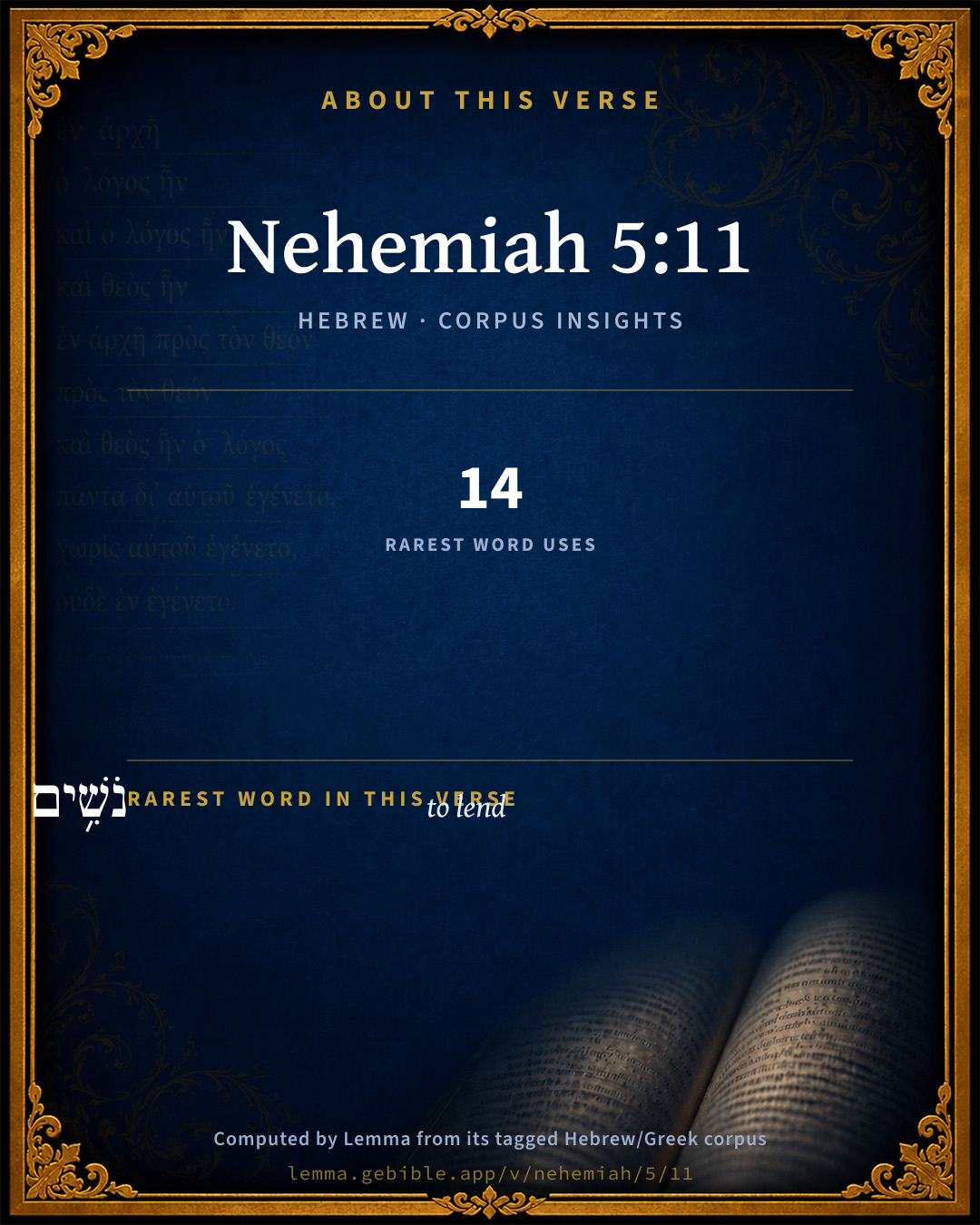
The rarest word here is נֹשִׁ֥ים to lend H5383 — appearing just 14 times in the whole Hebrew Bible.

Shared distinctive vocabulary

נֹשִׁ֥ים to lend H5383 occurs in 12 verses of the Hebrew Bible. Also found in:

Grammatical profile

  • 2 verbs
  • 9 nouns
  • 1 adjective
  • 1 pronoun
  • 2 prepositions
  • 2 particles

Verb forms

  • הָשִׁיבוּ֩ Hiphil · Imperative
  • נֹשִׁ֥ים Qal · Participle Active

Cross-references

6

Topical passages linked to Nehemiah 5:11 in the Treasury of Scripture Knowledge — connected by theme and wording, ordered by reader-vote popularity; previews shown in the World English Bible.

  • Isaiah 58:6 Isn't this the fast that I have chosen: to loose the bonds of wickedness, to undo the bands of the yoke, and to let the oppressed go free, and that you break every yoke?
  • Leviticus 6:4–5 then it shall be, if he has sinned, and is guilty, he shall restore that which he took by robbery, or the thing which he has gotten by oppression, or the deposit which was committed to him, or the lost thing which he found,
  • 1 Samuel 12:3 Here I am: witness against me before Yahweh, and before his anointed: whose ox have I taken? or whose donkey have I taken? or whom have I defrauded? whom have I oppressed? or of whose hand have I taken a ransom to blind my eyes therewith? and I will restore it you.
  • 2 Samuel 12:6 He shall restore the lamb fourfold, because he did this thing, and because he had no pity!"
  • Nehemiah 5:3–4 Some also there were that said, We are mortgaging our fields, and our vineyards, and our houses: let us get grain, because of the dearth.
  • Luke 3:8 Bring forth therefore fruits worthy of repentance, and don't begin to say among yourselves, 'We have Abraham for our father;' for I tell you that God is able to raise up children to Abraham from these stones!

Cross-references courtesy of OpenBible.info (CC BY 4.0).

Hebrew and Greek witnesses Masoretic Hebrew ↔ Greek Septuagint

The same verse in the two great witnesses to the Old Testament, shown verse-for-verse.

These are two independent witnesses, not word-aligned to each other, and the Septuagint is shown in lemma (dictionary) form.

Hebrew Nehemiah 5:11 Masoretic · Westminster Leningrad Codex

הָשִׁיבוּ֩ נָ֨א לָהֶ֜ם כְּהַיּ֗וֹם שְׂדֹתֵיהֶ֛ם כַּרְמֵיהֶ֥ם זֵיתֵיהֶ֖ם וּבָתֵּיהֶ֑ם וּמְאַ֨ת הַכֶּ֤סֶף וְהַדָּגָן֙ הַתִּיר֣וֹשׁ וְהַיִּצְהָ֔ר אֲשֶׁ֥ר אַתֶּ֖ם נֹשִׁ֥ים בָּהֶֽם

Please restore to them, even this day, their fields, their vineyards, their olive groves, and their houses, also the hundredth part of the money, and of the grain, the new wine, and the oil, that you exact of them.

World English Bible · Public Domain

Greek LXX Structure differs

The Septuagint has no separate book of Nehemiah. Its Greek text is the second half of Esdras B (2 Esdras), chapters 11–23; Ezra is the first half (1–10).

A verse-for-verse comparison isn’t shown here because the chapters and verses don’t line up. Switch to the LXX edition with the MT / LXX toggle above to read the Greek directly.

On this verse, Adam Clarke's Commentary discusses the Septuagint’s reading. Read the note in Commentary ↓

Hebrew: Westminster Leningrad Codex (CC BY 4.0). Greek: Septuagint (public domain); English from a public-domain English Septuagint. How the Septuagint differs from the Hebrew →

Commentary

Notes on Nehemiah 5:11 from classic Christian and Jewish commentators (each source and its license shown beneath its notes). The classic Christian expositions comment on the surrounding passage and are grouped to its opening verse, so a note may address several verses; the Jewish commentaries on the Tanakh (Rashi and others) are per-verse, so they appear only where the commentator wrote on this verse.

Lemma curates 59 commentaries, every one of them public domain or Creative Commons licensed, each selected and text-cleaned for this edition rather than reprinted as found. About our sources →

Trapp's Complete Commentary

John Trapp

Neh 5:11 Restore, I pray you, to them, even this day, their lands, their vineyards, their oliveyards, and their houses, also the hundredth [part] of the money, and of the corn, the wine, and the oil, that ye exact of them.

Ver. 11. Restore, I pray you, to them, even this day] While you are in a melting temper, and in a good mind, make restitution. Say not, This is a hard saying, who can brook it? But say rather, as the civilian saith, Perquam durum est; sed ita lex scripta est, ‘Tis hard to be done, but the law will have it so done; Aut faciendam, aut patiendum (Ulpian.). Either we must do it, or do worse. The law for restitution, see Lev 6:1; Lev 6:4 Num 5:6-7, &c. The wrong-doer must not only confess, but restore. The transgression was against God, but the trespass against man; and he must be satisfied, if the sin shall be pardoned. Samuel proffered to restore, if it might appear that he had wronged any, 1Sa 12:3. Micah, though an idolater did so, Jdg 17:2-3. So did Queen Mary she restored again all ecclesiastical livings asstoned to the crown. Her grandfather, Henry VII, in his last will and testament, devised and willed restitution should be forthwith made of all such monies as had been unjustly levied by the officers. Selimus, the Great Turk, did the like upon his death bed; so great is the force of natural conscience. Gravel in the kidneys will not grate so much as a little guilt in this kind. Restore your evil gotten goods, saith father Latimer, or else you will cough in hell, and the devils will laugh at you. He set this point so well home, that he wrought upon many; and particularly upon Master Bradford. Austin saith, that if a man be able to make actual restitution, and do it not, poenitentia non agitur, sed fingitur, his repentance is not right; if he have wasted all, and is not able to restore, he must desire pardon very humbly, and water the earth with his tears.

Also the hundredth part of the money] That is, all that they had received for interest, whether money, or else. It appeareth, by this text, that they took twelve in the hundred (for so much the hundredth part monthly amounteth to), as at this day in Italy, and elsewhere, the Jews are permitted to strain up their usury to eighteen in the hundred upon the Christian (for among themselves they now use it not), which causeth many of those Pseudo-Christians to use those Jews underhand, in improving their lawful rents to the utmost proportion. (Sandys’ Survey.)

John Trapp, A Commentary or Exposition upon All the Books of the Old and New Testament (1647–1656) — public domain. Text from a community e-Sword module.

Joseph Benson's Commentary

Neh 5:11. Restore their land, &c. — Give them up their mortgages, put them again in possession of their estates, remit the interest, and give them time to pay the principal. I pray you — Though he had authority to command, yet, for love’s sake, he rather beseeches. Also the hundredth part of the money — Require not this, as the next verse explains it, where it is expressed in their grant of this desire. The hundredth part of the money lent was wont to be required every month for the use of it, according to the custom then prevailing in those countries, and afterward adopted by the Romans. So that every year an eighth part of the principal was paid for interest, which was a very extravagant usury.

Joseph Benson's Commentary on the Old and New Testaments (1811–1818) — public domain. Text from a community e-Sword module.

Tyndale Open Study Notes

Tyndale Open Resources

5:11 Nehemiah demanded that the rich lenders restore their fields and repay the interest (literally the hundredth part), which they should not have collected (see also Exod 22:25; Lev 25:35-37). The literal hundredth part suggests that the interest was one percent per month, lower than the twenty percent annual rate found in some documents of that time, or the sixty percent annual rate charged at Elephantine in Egypt. But even a relatively low rate of interest violated God’s covenant.

Tyndale Open Study Notes — © Tyndale Open Resources, licensed CC BY-SA 4.0. Text via the HelloAO Bible API.

Geneva Bible (1599)

Geneva Bible translators

Which ye take of them for the loan.

Geneva Bible (1599) marginal notes — public domain. Text via Bolls.life.

Adam Clarke's Commentary

Verse 11. Also the hundredth part of the money] Houbigant contends,

1. That the word מאת meath, which we and the Vulgate translate one hundredth part, never means so anywhere; and

2. That it would have answered no end to have remitted to people so distressed merely the one hundredth part of the money which had been taken from them by usury.

He understands מאת meath as signifying the same as מן את min eth, contracted into מאת meeth, a preposition and demonstrative particle joined together, also a part FROM THE money. Neither the Syriac, Septuagint, nor Arabic acknowledges this hundredth part. Some think that the hundredth part is that which they obliged the poor debtors to pay each month, which would amount to what we would call twelve per cent. interest for the money lent, or the debt contracted. See the introduction.

Adam Clarke's Commentary on the Bible (1810–1826) — public domain. Text from a community e-Sword/MySword module.

Ellicott's Commentary for English Readers

(11) Also the hundredth part of the money.—The monthly payment of one per cent. per month, twelve per cent. in the year, they were required to give up for the future.

A Bible Commentary for English Readers, edited by Charles John Ellicott (1878–1897) — public domain. Text from a community e-Sword module.

The Cambridge Bible for Schools and Colleges

gen. ed. J. J. S. Perowne

11. Restore, I pray you, &c.] On ‘I pray you’ see note on Neh_5:10. Nehemiah demands immediate redress for the wrongs done to fellow-countrymen. He demands restoration of property and remission of interest on loans.

even this day] The same Hebrew word as is rendered in 1Sa_9:13, ‘at this time.’ Literally = ‘as if to-day,’ i.e. ‘immediately.’

their lands … houses] R.V. their fields … houses. The first part of the demand is the restoration to the poor of the property which had been offered as security for the sums borrowed from the money-lenders.

also the hundredth part, &c.] This ‘hundredth part’ was in all probability reckoned by month. It corresponded therefore to the Latin ‘centesima usura,’ and represented interest at the rate of 12 per cent.

corn, the wine, and the oil] This exorbitant rate of interest seems to have been exacted in kind if cash was not forthcoming.

The second part of Nehemiah’s demand refers to the exaction of interest. It is impossible to suppose that he required the moneylenders to restore the sums which had already been paid in interest. The main verb ‘restore’ is only by ‘zeugma’ applicable to ‘the hundredth part;’ and the meaning is ‘do not exact,’ ‘remit your claim to the 12 p. c. interest which you are accustomed to levy in money or produce of the land.’

His twofold demand, for immediate restoration of property and for future renunciation of interest, corresponds to the twofold reply of the money-lenders in the following verse. It is probable that we are only to understand Nehemiah’s intervention to be made in the interests of the poor. The transactions of the wealthy with one another are not contemplated by the early Israelite or the Levitical laws, Exo_22:25; Lev_25:36-37.

An ingenious conjecture, which alters the text by the insertion of one letter only, would read, instead of ‘the hundredth part’ (um’ath), ‘the usury’ (umash’ath). The latter part of the verse would then only expand in greater detail the substance of the first. The LXX. ἀπὸ follows a different pointing of the word.

The Cambridge Bible for Schools and Colleges (gen. ed. J. J. S. Perowne; Cambridge University Press, 1878–1918) — public domain. Text from a community e-Sword module.

John Gill's Exposition

Then said they, we will restore them,.... The lands, vineyards, oliveyards, and houses:

and will require nothing of them; not the hundredth part of the fruits of the earth by way of salary:

so will we do as thou sayest; they approved of his proposal, and readily agreed to it:

then I called the priests, and took an oath of them that they should do according to this promise; not that the priests were delinquents, they were not charged with anything of this kind, nor were they the men that promised restitution; but the priests were called to administer the oath to the nobles, and rulers, and rich men, to oblige them the more to keep their word; an oath being sacred, priests in an holy office were made use of to give it, that it might be the more solemn, and the more strictly regarded.

John Gill's Exposition of the Whole Bible (1746–1763) — public domain (CC PDM 1.0). Text via the HelloAO Bible API.

Albert Barnes' Notes on the Bible

The hundredth part of the money ... - i. e. the interest. It is conjectured that the 100th part was payable monthly, or, in other words, that interest was taken at the rate of twelve per cent. The Law altogether disallowed the taking of interest from Israelites (see Exo 22:25; Lev 25:36, etc.).

Albert Barnes' Notes on the Bible (1834–1885) — public domain. Text from a community e-Sword/MySword module.

Haydock's Catholic Bible Commentary

For them, to the Persian governors, ver. 14. (Haydock) --- Nehemias remits this pension, which was before paid by the people, and exacted by the rich. (Wolphius) --- Du Moulin asserts that there is no question of usury, which the Jews always abhorred, much less of that which the Romans called the 100th, (Calmet) consisting in the payment of 12 per cent, (Tirinus) or one every month. (Menochius) --- Hebrew, "Give back to them, " (Haydock) that they may enjoy those things.

George Leo Haydock (1774–1849), Haydock's Catholic Family Bible and Commentary, 1859 edition — public domain. Excludes Psalms (Douay-Rheims chapter numbering differs from Protestant) and Deuterocanonical books (Catholic canon only).

Matthew Poole's English Annotations

Also the hundredth part of the money; also require not; which is to be supplied out of the next verse, where it is expressed in their answer to and grant of this desire. The hundredth part; which they required every month for the use of their monies or goods, according to the custom then used, and afterwards by the Romans.

Matthew Poole's English Annotations on the Holy Bible (1683–1685) — public domain. Text from a community e-Sword/MySword module.

Whedon's Commentary on the Bible

Daniel D. Whedon

11. Restore… this day — Wrongs cannot be too speedily righted.

The hundredth part — This is commonly supposed to mean one per cent. paid monthly, thus corresponding with the Roman centesimae usurae, or twelve per cent. per annum. We know not what rate of interest was legal among the Jews. It is said that the laws of Menu allow eighteen and even twenty-four per cent. This hundredth part, which these usurers were required to restore, may have been only the excess of the legal rate.

Daniel D. Whedon (gen. ed.), Commentary on the Old and New Testaments (1874–1909) — public domain. Text from a community e-Sword module.

The Pulpit Commentary

Restore, I pray you, etc. Nay, more. Let us not only give up this practice in the future, but let us remedy its evils in the past. You are in possession of lands and houses that have become yours through these mortgages, and you have received a heavy interest on the sums of money, or on the corn, wine, and oil that you have advanced. I bid you restore it all. Give back at once the houses and the lands that you will in any case have to restore in the year of jubilee. Give back the interest that you have illegally taken, and so, as far as is possible, undo the past; make restitution of your ill-gotten gains, relinquish even your legal rights, and become self-denying patriots, instead of tyrants and oppressors.

The Pulpit Commentary (1880–1919), ed. H.D.M. Spence-Jones & Joseph S. Exell — public domain. Text from a community e-Sword module.

John Wesley's Explanatory Notes

Also - Also require not: which is to be supplied out of the next verse, where it is expressed in their grant of this desire. Hundredth part - Which they required every month for the use of their monies or goods, according to the custom then used.

John Wesley, Explanatory Notes Upon the Whole Bible (1754–1765) — public domain. Text via the GEBible commentary corpus.

Rashi

Rabbi Shlomo Yitzchaki (Rashi)

give back And you shall also do as I do, to relinquish all their debts to them.

and the hundred silver pieces and the large amount of money that they owe you with the corn and the wine, etc.

Rashi on the Tanakh — English translations: “The Judaica Press complete Tanach with Rashi, translated by A. J. Rosenberg” (CC BY 4.0); “Pentateuch with Rashi's commentary by M. Rosenbaum and A.M. Silbermann, 1929-1934” (public domain); “The Metsudah Tanach series, Lakewood, N.J” (CC BY 4.0); and “The Book of Joshua, Metsudah Publications, 1997” (CC BY 4.0). Text via Sefaria.

Lesson kit

Teaching starters — assembled from the data on this page, not authored interpretation. Every prompt links to the verse data it draws on. Edit before teaching.

Nehemiah, in the Historical, opens this verse with 17 words (15 distinct Hebrew lemmas). Its most distinctive word is nâshâh (“to lend”). A historical commentator’s framing appears above. Read the whole chapter for the surrounding context.

Discussion questions

  1. How does “to lend” (nâshâh) shape what this verse is saying?
  2. Exodus 22:25 shares the word «to lend» with this verse. How do the two illuminate each other?
  3. These translations render this verse differently; the difference is in the English rendering, not the original. What questions does that raise?
  4. The verb «הָשִׁיבוּ֩» is Hiphil Imperative. How does its form color the action?
  5. Reading how Trapp's Complete Commentary and Joseph Benson's Commentary read this verse, where do the two commentators agree and where do they part?

Things to notice

Reading settings

Reading text

Shown beneath each verse's original-language words.

Old Testament
Old Testament edition

Read the OT as the Masoretic Hebrew (MT) or the Greek Septuagint (LXX).

English shown for the Greek Septuagint (in the Hebrew ↔ Greek comparison).

Comparing translations? Open the Compare panel on any verse page to stack up to four side by side.