

Judges 19:16

Hebrew (Westminster Leningrad Codex) Judges 19:16 appears in the Hebrew Old Testament. The text above is from the Westminster Leningrad Codex. Each word links to its Strong’s number, a concise gloss, and parsing drawn from the Open Scriptures Hebrew Bible morphology. Click any word for its full Brown-Driver-Briggs (BDB) entry.
Download image
Cite this verse

Judges 19:16 (World English Bible). Public Domain. Lemma interlinear Bible study tool, https://lemma.gebible.app/v/judges/19/16.

Show BibTeX & RIS
BibTeX
RIS
English Translation
Behold, there came an old man from his work out of the field at even: now the man was of the hill-country of Ephraim, and he sojourned in Gibeah; but the men of the place were Benjamites.
World English Bible · Public Domain
Download a study sheet

One document with this verse’s original text, its word-by-word gloss line, the meaning frame, cross-references with their text, attributed commentary, and full source and license credits — printable, and it pastes into notes with its structure intact.

This verse Autodidact and up

Study sheet (.html) Plain text (.txt)

A passage Seminary Student

Up to 50 verses in one chapter. A passage sheet keeps up to 6 commentary sources and 12 cross-references per verse, in the order this page ranks them, and says so on the sheet whenever that leaves anything out. Ask for a single verse and you get the Autodidact verse sheet above.

Everything on this page stays free to read, with no account — the sheet is a download of what is already on screen, not access to it.

Want to remove ads? Support Godless Engineer
Compare translations 3

The same verse in 3 English versions, stacked beneath the original-language interlinear above. Click any original word for its lexicon entry.

Each is an independent rendering of the whole verse — the interlinear is not word-aligned to these translations.

Highlighted words mark where these versions differ — a whole-verse word diff, not a word-by-word alignment.

  • World English Bible Public Domain
    Behold, there came an old man from his work out of the field at even: now the man was of the hill-country of Ephraim, and he sojourned in Gibeah; but the men of the place were Benjamites.
  • King James Version Public Domain
    And, behold, there came an old man from his work out of the field at even, which was also of mount Ephraim; and he sojourned in Gibeah: but the men of the place were Benjamites.
  • unfoldingWord Literal Text CC BY-SA 4.0
    Then behold, an old man coming from his work, from the field in the evening. And the man from the hill country of Ephraim, and he sojourning in Gibeah. But the men of the place Benjaminite.

unfoldingWord Literal Text — © unfoldingWord, licensed CC BY-SA 4.0. Word-aligned USFM3 via Door43 (git.door43.org/unfoldingWord/en_ult).

Versions to compare (up to 4)

3 of 4 selected

Show all 18 translations

Every available English version of this verse, each an independent rendering of the whole verse.

  • World English Bible Public Domain
    Behold, there came an old man from his work out of the field at even: now the man was of the hill-country of Ephraim, and he sojourned in Gibeah; but the men of the place were Benjamites.
  • Berean Standard Bible Public Domain
    That evening an old man from the hill country of Ephraim, who was residing in Gibeah (the men of that place were Benjamites), came in from his work in the field.
  • Majority Standard Bible Public Domain
    That evening an old man from the hill country of Ephraim, who was residing in Gibeah (the men of that place were Benjamites), came in from his work in the field.
  • King James Version Public Domain
    And, behold, there came an old man from his work out of the field at even, which was also of mount Ephraim; and he sojourned in Gibeah: but the men of the place were Benjamites.
  • American Standard Version (1901) Public Domain
    And, behold, there came an old man from his work out of the field at even: now the man was of the hill-country of Ephraim, and he sojourned in Gibeah; but the men of the place were Benjamites.
  • Revised Version (1885) Public Domain
    And, behold, there came an old man from his work out of the field at even; now the man was of the hill country of Ephraim, and he sojourned in Gibeah: but the men of the place were Benjamites.
  • Geneva Bible (1599) Public Domain
    And beholde, there came an old man from his work out of the field at euen, and the man was of mount Ephraim, but dwelt in Gibeah: and the men of the place were the children of Iemini.
  • Douay-Rheims (1899) Public Domain
    And behold they saw an old man, returning out of the field and from his work in the evening, and he also was of mount Ephraim, and dwelt as a stranger in Gabaa; but the men of that country were the children of Jemini.
  • Young's Literal Translation Public Domain
    And lo, a man, an aged one, hath come from his work from the field in the evening, and the man `is' of the hill-country of Ephraim, and he `is' a sojourner in Gibeah, and the men of the place `are' Benjamites.
  • Literal Standard Version CC BY-SA 4.0
    And behold, an old man has come from his work from the field in the evening, and the man [is] of the hill-country of Ephraim, and he [is] a sojourner in Gibeah, and the men of the place [are] Benjamites.
  • Unlocked Literal Bible CC BY-SA 4.0
    But then an old man was coming from his work in the field that evening. He was from the hill country of Ephraim, and he was staying for a while in Gibeah. But the men living in that place were Benjamites.
  • unfoldingWord Literal Text CC BY-SA 4.0
    Then behold, an old man coming from his work, from the field in the evening. And the man from the hill country of Ephraim, and he sojourning in Gibeah. But the men of the place Benjaminite.
  • Darby Bible Public Domain
    And behold, an old man was coming from his work in the field at evening; the man was from the hill country of E'phraim, and he was sojourning in Gib'e-ah; the men of the place were Benjaminites.
  • World Messianic Bible Public Domain
    Behold, an old man came from his work out of the field at evening. Now the man was from the hill country of Ephraim, and he lived in Gibeah; but the men of the place were Benjamites.
  • Webster's Bible Public Domain
    And, behold, there came an old man from his work out of the field at evening, who was also of mount Ephraim; and he dwelt in Gibeah: but the men of the place were Benjaminites.
  • Free Bible Version CC BY-SA 4.0
    But later that evening an old man came by, returning from working in the fields. He was from the hill country of Ephraim, but was now living in Gibeah in the territory of Benjamin.
  • Bible in Basic English Public Domain
    Now when it was evening they saw an old man coming back from his work in the fields; he was from the hill-country of Ephraim and was living in Gibeah: but the men of the place were Benjamites.
  • JPS Tanakh (1917) Public Domain
    And, behold, there came an old man from his work out of the field at even; now the man was of the hill-country of Ephraim, and he sojourned in Gibeah; but the men of the place were Benjamites.

Literal Standard Version (2020), Covenant Press — licensed CC BY-SA 4.0. Text via the HelloAO Bible API (eBible.org). Unlocked Literal Bible (unfoldingWord) — licensed CC BY-SA 4.0. Text via the HelloAO Bible API (eBible.org). unfoldingWord Literal Text — © unfoldingWord, licensed CC BY-SA 4.0. Word-aligned USFM3 via Door43 (git.door43.org/unfoldingWord/en_ult). Free Bible Version, Dr. Jonathan Gallagher — licensed CC BY-SA 4.0. Text via the HelloAO Bible API (eBible.org).

Word by word

More ways to search: Search by grammar → Find every occurrence → Compare this word →

Practice this passage: Drill this verse → Learn its vocabulary →

בְּנֵ֥י
Ben-yᵉmîynîy
H1145
“Benjamites of”
Noun, Common, Masculine, Plural, Construct
Part of Speech
Noun
Type
Common
Gender
Masculine
Number
Plural
State
Construct
Full BDB Definition

Origin: sometimes (with article inserted) Ben-ha-y@miniy ben-hah-yem-ee-nee'with H376 inserted ( H1 ">1) Sa H9 :1) Ben-'iysh Y@miyniy ben-eesh' yem-ee-nee'

TWOT: adj

Benjamite = "son of the right hand" - one of the tribe of Benjamin
  1. וְהִנֵּ֣ה hinnêh H2009 “and · behold” Conjunction + Particle, Demonstrative
  2. אִ֣ישׁ ʼîysh H376 “man” Noun, Common, Masculine, Singular, Absolute
  3. זָקֵ֗ן zâqên H2205 “old” Adjective, Adjective, Masculine, Singular, Absolute
  4. בָּ֣א bôwʼ H935 “entering” Verb, Qal, Participle Active, Masculine, Singular, Absolute
  5. מִֽן min H4480 “from” Preposition
  6. מַעֲשֵׂ֤הוּ maʻăseh H4639 “work · his” Noun, Common, Masculine, Singular, Construct + Suffix, Personal, 3rd Person, Masculine, Singular
  7. מִן min H4480 “from” Preposition
  8. הַשָּׂדֶה֙ sâdeh H7704 “the · field” Particle, Definite Article + Noun, Common, Masculine, Singular, Absolute
  9. בָּעֶ֔רֶב ʻereb H6153 “in/at the · evening” Preposition, Determined + Noun, Common, Masculine, Singular, Absolute
  10. וְהָאִישׁ֙ ʼîysh H376 “and · the · man” Conjunction + Particle, Definite Article + Noun, Common, Masculine, Singular, Absolute
  11. מֵהַ֣ר har H2022 “from · mountain of” Preposition + Noun, Common, Masculine, Singular, Construct
  12. אֶפְרַ֔יִם ʼEphrayim H669 “Ephraim” Noun, Proper
  13. וְהוּא hûwʼ H1931 “and · he” Conjunction + Pronoun, Personal, 3rd Person, Masculine, Singular
  14. גָ֖ר gûwr H1481 “sojourning” Verb, Qal, Participle Active, Masculine, Singular, Absolute
  15. בַּגִּבְעָ֑ה Gibʻâh H1390 “in/at the · Gibeah” Preposition, Determined + Noun, Proper
  16. וְאַנְשֵׁ֥י ʼîysh H376 “and · men of” Conjunction + Noun, Common, Masculine, Plural, Construct
  17. הַמָּק֖וֹם mâqôwm H4725 “the · place” Particle, Definite Article + Noun, Common, Masculine, Singular, Absolute
  18. יְמִינִֽי Ben-yᵉmîynîy H1145 “Benjamite” Noun, Gentilic, Masculine, Singular, Absolute

About this verse

These counts appear in no published source. They are computed here, from the morphology-tagged text and Lemma’s own curated glosses. What Lemma adds →

19
words
15
distinct lemmas
Historical
section

Notable vocabulary

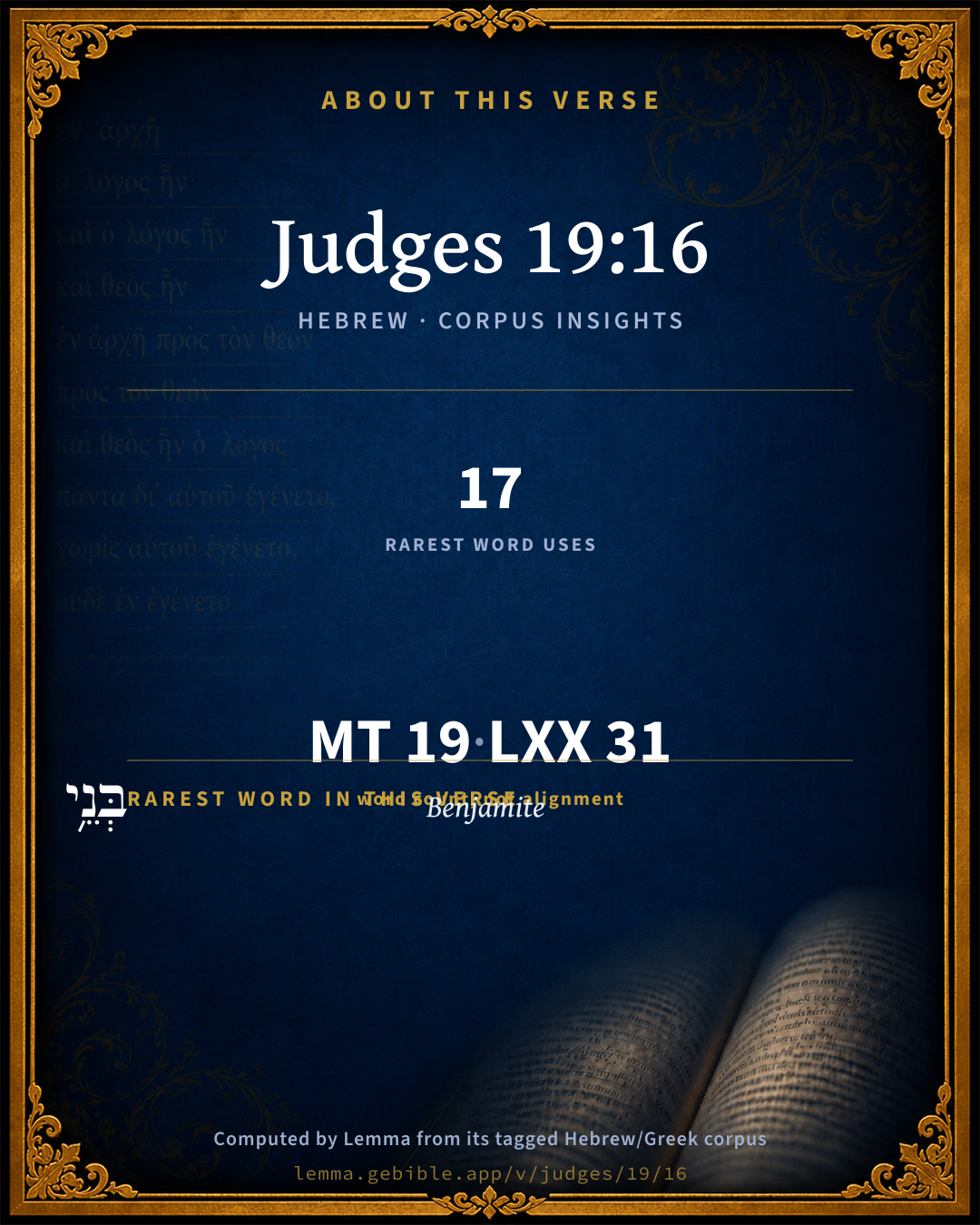
The rarest word here is בְּנֵ֥י Benjamite H1145 — appearing just 17 times in the whole Hebrew Bible.

Shared distinctive vocabulary

בְּנֵ֥י Benjamite H1145 occurs in 9 verses of the Hebrew Bible. Also found in:

Grammatical profile

  • 2 verbs
  • 12 nouns
  • 1 adjective
  • 1 pronoun
  • 2 prepositions
  • 1 particle

Verb forms

  • בָּ֣א Qal · Participle Active
  • גָ֖ר Qal · Participle Active

Repetition

Words recur within this verse — often emphatic in Hebrew:

  • אִ֣ישׁ man H376 ×3
  • בְּנֵ֥י Benjamite H1145 ×2
  • מִֽן from H4480 ×2

Hebrew & Septuagint length

In English translation the verse runs 37 words from the Hebrew and 38 from the Septuagint (LXX English) — closely comparable.

A rough comparison of the two English renderings, which tokenize alike — not a word-level alignment.

Word counts can differ between the Hebrew and the Greek without any difference in meaning — e.g. the Hebrew direct-object marker אֵת has no separate Greek word, and Greek often adds the article ὁ.

In the original languages it is 19 Hebrew tokens and 31 Greek tokens — but the two are counted differently (Hebrew bundles its prefixes and suffixes into one token; the Greek is in lemma form), so that isn’t a like-for-like length.

Cross-references

13

Topical passages linked to Judges 19:16 in the Treasury of Scripture Knowledge — connected by theme and wording, ordered by reader-vote popularity; previews shown in the World English Bible.

  • Judges 19:1 It happened in those days, when there was no king in Israel, that there was a certain Levite sojourning on the farther side of the hill-country of Ephraim, who took to him a concubine out of Bethlehem Judah.
  • Psalms 104:23 Man goes forth to his work, To his labor until the evening.
  • Psalms 128:2 For you will eat the labor of your hands. You will be happy, and it will be well with you.
  • Proverbs 14:23 In all hard work there is profit, But the talk of the lips leads only to poverty.
  • Genesis 3:19 By the sweat of your face will you eat bread until you return to the ground, for out of it you were taken. For you are dust, and to dust you shall return."
  • Judges 19:14 So they passed on and went their way; and the sun went down on them near to Gibeah, which belongs to Benjamin.
  • Proverbs 13:11 Wealth gained dishonestly dwindles away, But he who gathers by hand makes it grow.
  • Proverbs 24:27 Prepare your work outside, And get your fields ready. Afterwards, build your house.
  • Ecclesiastes 1:13 I applied my heart to seek and to search out by wisdom concerning all that is done under the sky. It is a heavy burden that God has given to the sons of men to be afflicted with.
  • Ecclesiastes 5:12 The sleep of a laboring man is sweet, whether he eats little or much; but the abundance of the rich will not allow him to sleep.
  • Ephesians 4:28 Let him who stole steal no more; but rather let him labor, working with his hands the thing that is good, that he may have something to give to him who has need.
  • 1 Thessalonians 4:11–12 and that you make it your ambition to lead a quiet life, and to do your own business, and to work with your own hands, even as we charged you;
  • 2 Thessalonians 3:10 For even when we were with you, we commanded you this: "If anyone will not work, neither let him eat."

Cross-references courtesy of OpenBible.info (CC BY 4.0).

Hebrew and Greek witnesses Masoretic Hebrew ↔ Greek Septuagint

The same verse in the two great witnesses to the Old Testament, shown verse-for-verse.

These are two independent witnesses, not word-aligned to each other, and the Septuagint is shown in lemma (dictionary) form.

Hebrew Judges 19:16 Masoretic · Westminster Leningrad Codex

וְהִנֵּ֣ה אִ֣ישׁ זָקֵ֗ן בָּ֣א מִֽן מַעֲשֵׂ֤הוּ מִן הַשָּׂדֶה֙ בָּעֶ֔רֶב וְהָאִישׁ֙ מֵהַ֣ר אֶפְרַ֔יִם וְהוּא גָ֖ר בַּגִּבְעָ֑ה וְאַנְשֵׁ֥י הַמָּק֖וֹם בְּנֵ֥י יְמִינִֽי

Behold, there came an old man from his work out of the field at even: now the man was of the hill-country of Ephraim, and he sojourned in Gibeah; but the men of the place were Benjamites.

World English Bible · Public Domain

Greek LXX Judges 19:16 Septuagint · lemma form

καί ἰδού ἀνήρ πρεσβύτης ἄρχω ἐκ ἔργον αὐτός ἐκ ἀγρός ἐν ἑσπέρα καί ὁ ἀνήρ εἰμί ἐκ ὄρος ἐφράιμ καί αὐτός παραοἰκέω ἐν γαβαα καί ὁ ἀνήρ ὁ τόπος υἱός βενιαμίν

And behold, an old man came out of the field from his work in the evening; and the man was of mount Ephraim, and he sojourned in Gabaa, and the men of the place were sons of Benjamin.

LXX2012 (modern English Septuagint) · Public Domain

On this verse, Ellicott's Commentary for English Readers discusses the Septuagint’s reading. Read the note in Commentary ↓

Hebrew: Westminster Leningrad Codex (CC BY 4.0). Greek: Septuagint (public domain); English from LXX2012 (modern English Septuagint) (Public Domain). How the Septuagint differs from the Hebrew →

Targum (Aramaic paraphrase)

1

The Targum is the ancient Jewish Aramaic paraphrase of the Hebrew Scriptures — an interpretive translation, not the Hebrew text itself. Onkelos (literal) and Pseudo-Jonathan (expansive) render the Torah, and Jonathan the Prophets. Coverage is partial: where no permissively-licensed English translation exists for a verse, only the Aramaic is shown. This is verse-level text, not a word-by-word alignment to the Hebrew.

  1. Targum Jonathan Prophets (Joshua–Malachi)
    וְהָא גַבְרָא סָבָא אָתָא מִן עִיבִידְתֵּיהּ מִן חַקְלָא בְּרַמְשָׁא וְגַבְרָא מִטוּרָא דְבֵית אֶפְרַיִם וְהוּא דָר בְּגִבְעָתָא וֶאֱנָשֵׁי אַתְרָא מִן שִׁבְטָא דְבֵית בִּנְיָמִין:

    (no public-domain English translation for this verse)

    Targum Jonathan — Aramaic: “Mikraot Gedolot” (public domain). English: “Sefaria Community Translation” (CC0 1.0 (public-domain dedication)); “London "Chaldee Paraphrase," 1871” (public domain). Text via Sefaria.

Commentary

Notes on Judges 19:16 from classic Christian and Jewish commentators (each source and its license shown beneath its notes). The classic Christian expositions comment on the surrounding passage and are grouped to its opening verse, so a note may address several verses; the Jewish commentaries on the Tanakh (Rashi and others) are per-verse, so they appear only where the commentator wrote on this verse.

Lemma curates 59 commentaries, every one of them public domain or Creative Commons licensed, each selected and text-cleaned for this edition rather than reprinted as found. About our sources →

Matthew Henry's Commentary

Though there as not one of Gibeah, yet it proved there was one in Gibeah, that showed some civility to this distressed Levite, who was glad that any one took notice of him. It was strange that some of those wicked people, who, when it was dark, designed so ill to him and his concubine, did not, under pretence of kindness, invite them in, that they might have a fairer opportunity of perpetrating their villany; but either they had not wit enough to be so designing, or not wickedness enough to be so deceiving. Or, perhaps, none of them separately thought of such a wickedness, till in the black and dark night they got together to contrive what mischief they should do. Bad people in confederacy make one another much worse than any of them would be by themselves. When the Levite, and his wife, and servant, were beginning to fear that they must lie in the street all night (and as good have laid in a den of lions) they were at length invited into a house, and we are here told,

I. Who that kind man was that invited them. 1. He was a man of Mount Ephraim, and only sojourned in Gibeah, Jdg 19:16. Of all the tribes of Israel, the Benjamites had most reason to be kind to poor travellers, for their ancestor, Benjamin, was born upon the road, his mother being then upon a journey, and very near to this place, Gen 35:16, Gen 35:17. Yet they were hard-hearted to a traveller in distress, while an honest Ephraimite had compassion on him, and, no doubt, was the more kind to him, when, upon enquiry, he found that he was his countryman, of Mount Ephraim likewise. He that was himself but a sojourner in Gibeah was the more compassionate to a wayfaring man, for he knew the heart of a stranger, Exo 23:9; Deu 10:19. Good people, that look upon themselves but as strangers and sojourners in this world, should for this reason be tender to one another, because they all belong to the same better country and are not at home here. 2. He was an old man, one that retained some of the expiring virtue of an Israelite. The rising generation was entirely corrupted; if there was any good remaining among them, it was only with those that were old and going off. 3. He was coming home from his work out of the field at eventide. The evening calls home labourers, Psa 104:23. But, it should seem, this was the only labourer that this evening brought home to Gibeah. The rest had given themselves up to sloth and luxury, and no marvel there was among them, as in Sodom, abundance of uncleanness, when there was among them, as in Sodom, abundance of idleness, Eze 16:49. But he that was honestly diligent in his business all day was disposed to be generously hospitable to these poor strangers at night. Let men labour, that they may have to give, Eph 4:28. It appears from Jdg 19:21 that he was a man of some substance, and yet had been himself at work in the field. No man's estate will privilege him in idleness.

II. How free and generous he was in his invitation. He did not stay till they applied to him to beg for a night's lodging; but when he saw them (Jdg 19:17) enquired into their circumstances, and anticipated them with his kindness. Thus our good God answers before we call. Note, A charitable disposition expects only opportunity, not importunity, to do good, and will succour upon sight, unsought unto. Hence we read of a bountiful eye, Pro 22:9. If Gibeah was like Sodom, this old man was like Lot in Sodom, who sat in the gate to invite strangers, Gen 19:1. Thus Job opened his doors to the traveller, and would not suffer him to lodge in the street, Job 31:32. Observe, 1. How ready he was to give credit to the Levite's account of himself when he saw no reason at all to question the truth of it. Charity is not apt to distrust, but hopeth all things (Co1 13:7) and will not make use of Nabal's excuse for his churlishness to David, Many servants now-a-days break away from their masters, Sa1 25:10. The Levite, in his account of himself, professed that he was now going to the house of the Lord (Jdg 19:18), for there he designed to attend, either with a trespass-offering for the sins of his family, or with a peace-offering for the mercies of his family, or both, before he went to his own house. And, if the men of Gibeah had any intimation of his being bound that way, probably they would therefore be disinclined to entertain him. The Samaritans would not receive Christ because his face was towards Jerusalem, Luk 9:53. But for this reason, because he was a Levite and was now going to the house of the Lord, this good old man was the more kind to him. Thus he received a disciples in the name of a disciple, a servant of God for his Master's sake. 2. How free he was to give him entertainment. The Levite was himself provided with all necessaries (Jdg 19:19), wanted nothing but a lodging, but his generous host would be himself at the charge of his entertainment (Jdg 19:20): Let all thy wants be upon me; so he brought him into his house, Jdg 19:21. Thus God will, some way or other, raise up friends for his people and ministers, even when they seem forlorn.

Matthew Henry's Commentary on the Whole Bible (1708–1710) — public domain (CC PDM 1.0). Text via the HelloAO Bible API.

Jamieson, Fausset & Brown

Robert Jamieson, A. R. Fausset & David Brown

AN OLD MAN ENTERTAINS HIM AT GIBEAH. (Jdg 19:16-21)

there came an old man from his work out of the field at even, which was also of mount Ephraim--Perhaps his hospitality was quickened by learning the stranger's occupation, and that he was on his return to his duties at Shiloh.

Jamieson, Fausset & Brown — Commentary Critical and Explanatory on the Whole Bible (1871) — public domain (CC PDM 1.0). Text via the HelloAO Bible API.

Trapp's Complete Commentary

John Trapp

Jdg 19:16 And, behold, there came an old man from his work out of the field at even, which [was] also of mount Ephraim; and he sojourned in Gibeah: but the men of the place [were] Benjamites.

Ver. 16. There came an old man from his work out of the field.] Though an "old man," yet a "workman," and at "field work," and "till the evening." It was wonder that this honest man had not been banished out of Gibeah, as once Hermodorus was out of Ephesus, merely for his honesty and frugality. {a} At which time also this law was made there, ουδεις ημων ονηιστος εστω. Let there be none honest amongst us: let no man excel others in any point of good husbandry; or if he do, let him be packing. Which law of theirs, when Heraclitus heard of, he said, it was pity they were not all hanged for public pests and botches of mankind.

{a} Strabo., l. 14. c. 1. s. 25. 6:231

John Trapp, A Commentary or Exposition upon All the Books of the Old and New Testament (1647–1656) — public domain. Text from a community e-Sword module.

Joseph Benson's Commentary

Jdg 19:16. Also of mount Ephraim — Whence likewise the Levite was, which inclined him to show the more kindness to his countryman. But the men of the place were Benjamites — This was indeed one of the cities belonging to the priests; but the cities which were given to the priests, and whereof they were owners, were not inhabited by the priests or Levites only, especially at this time, when they were but few in number, but by many other persons of different professions.

Joseph Benson's Commentary on the Old and New Testaments (1811–1818) — public domain. Text from a community e-Sword module.

Geneva Bible (1599)

Geneva Bible translators

That is, of the tribe of Benjamin.

Geneva Bible (1599) marginal notes — public domain. Text via Bolls.life.

Ellicott's Commentary for English Readers

(16) Which was also of mount Ephraim.—He was therefore a fellow-countryman of the Levite, but his hospitable feelings were aroused before he had been informed of this fact.

Toward the side of mount Ephraim.—Rather, the depths of the hill-country of Ephraim.

I am now going to the house of the Lord.—We are not told anywhere else in the story that the Levite was going to Shiloh (Jdg_18:31; Jos_18:1), but that he was returning to his home in Mount Ephraim. Hence some render the words, “I walk at the house of Jehovah”—i.e., I am a Levite, engaged in the service of the Tabernacle at Shiloh. It is true that this would be no answer to the question, “Whither goest thou?” On the other hand, the phrase is not a usual one for going to a place, and the Levite perhaps meant to imply an additional reason why the inhospitable reception was very unworthy. His office ought to have procured him a welcome, yet he who belongs to God’s house cannot find shelter in any house in Gibeah. The LXX. adopt another reading, and render it “to my house” (reading Bîthî). The reading of the MSS. may have come from regarding the last letter as an abbreviation of Jehovah.

A Bible Commentary for English Readers, edited by Charles John Ellicott (1878–1897) — public domain. Text from a community e-Sword module.

The Cambridge Bible for Schools and Colleges

gen. ed. J. J. S. Perowne

16. and he sojourned] Cf. Jdg_17:7 n. The only person that paid any attention to the travellers was not a native of the place: it was the same at Sodom, Gen_19:1 f. The last words of the verse are a topographical gloss, cf. Jdg_21:19.

The Cambridge Bible for Schools and Colleges (gen. ed. J. J. S. Perowne; Cambridge University Press, 1878–1918) — public domain. Text from a community e-Sword module.

John Gill's Exposition

And, behold, there came an old man from his work out of the field at even,.... Which is the time that men come from their labour, and take their rest; and this man, though a man in years, and of some substance, as appears by what follows, yet attended the business of his calling, which was very commendable in him:

which was also of Mount Ephraim; as the Levite was, which when the old man understood, he was the more ready no doubt to receive him into his house:

and he sojourned in Gibeah; he was not a native of the place, and yet more kind to strangers than such as were; nor does he appear to be a Levite, though it was a Levitical city; on what account he sojourned here is not manifest:

but the men of the place were Benjamites: for as yet the number of Levites were not large, others dwelt in the cities besides them, even such as were of the tribe to which they belonged.

John Gill's Exposition of the Whole Bible (1746–1763) — public domain (CC PDM 1.0). Text via the HelloAO Bible API.

Albert Barnes' Notes on the Bible

Which was also of Mount Ephraim - i. e., of the country of the Levite. This single giver of hospitality was himself a stranger and sojourner at Gibeah.

Albert Barnes' Notes on the Bible (1834–1885) — public domain. Text from a community e-Sword/MySword module.

Haydock's Catholic Bible Commentary

Jemini. That is, Benjamin. (Challoner) --- Chap. iii. 15.

George Leo Haydock (1774–1849), Haydock's Catholic Family Bible and Commentary, 1859 edition — public domain. Excludes Psalms (Douay-Rheims chapter numbering differs from Protestant) and Deuterocanonical books (Catholic canon only).

Matthew Poole's English Annotations

Of Mount Ephraim; whence also the Levite was, which obliged and inclined him to show the more kindness to his countryman.

The men of the place were Benjamites: this was indeed one of thee cities belonging to the priests, Jos 21; 1Ch 6; but you consider that the cities which were given to the priests, and whereof they were possessors and owners, were not inhabited by the priests or Levites only, especially at this time when they were but few in number, but many other persons of differing professions and callings, which was necessary for their conveniency.

Matthew Poole's English Annotations on the Holy Bible (1683–1685) — public domain. Text from a community e-Sword/MySword module.

The Pulpit Commentary

Which was also of mount Ephraim. The Hebrew is, And the man was from the hill country of Ephraim. It does not mean that he also, as well as the Levite, was from Ephraim.

HOMILIES BY W.F. ADENEY Vers. 16-21. Hospitality.

I THOUGH MEN WHO ARE ABANDONED TO SINFUL PLEASURES MAY DELIGHT IN THE SOCIETY OF BOON COMPANIONS, THEY WILL SHOW THEMSELVES WANTING IN THE GENEROSITY OF TRUE HOSPITALITY. The men of Gibeah would unite in seeming friendliness for riotous wickedness; but they were wanting in the almost universal Eastern kindness to the stranger. The intemperate and vicious may appear to be more generous in their boisterous freedom than persons of more strict habits; but they are too selfish for real generosity. Self-indulgence is essentially selfish; vice is naturally morose.

II WE SHOULD ENDEAVOUR TO DO RIGHT, THOUGH THIS MAY BE CONTRARY TO THE EXAMPLE OF OUR NEIGHBOURS. The old man was shocked at the inhospitality of the men of Gibeah. He was not a native of the place, and though he may have lived there long, he retained the kinder habits of his native home. When at Rome we are not to do as Rome does if this is clearly wrong. Englishmen abroad may find it difficult to resist the bad social influences of foreign towns; but if they are Christians they will feel that the universal prevalence of a bad custom is no justification for their adoption of it. Yet how difficult it is to see our duty when this is contrary to the habits of the society in which we live, and how much more difficult to be independent and firm in performing it!

III KINDNESS TO STRANGERS IS A DUTY OBLIGATORY UPON ALL OF US. The graphic picture of the old man returning from his work in the fields at even and taking note of the houseless strangers is the one relieving feature in the terrible story of that night"s doings. Modern and Western habits may modify the form of our hospitality, but they cannot exonerate us from the duty to show similar kindness under similar circumstances. From the mythical gentleman who excused himself for not saving a drowning man because he had not been introduced to him, to the Yorkshire native, who, seeing a strange face in his hamlet, cried, "Let"s heave a brick at him!" how common it is for people to limit their kindness to persons of their acquaintance! The parable of the good Samaritan teaches us that any one who needs our help is our neighbour. (Luk_10:29-37)

IV KINDNESS TO STRANGERS MAY BE REWARDED BY THE DISCOVERY OF UNKNOWN TIES OF FRIENDSHIP. The old man finds that the Levite comes from his own part of the country. Doubtless he was thus able to hear tidings of old acquaintances. The world is not so large as it appears. The stranger is often nearer to us than we suspect. Though true hospitality expects no return, (Luk_14:12-14) it may find unlooked-for reward in newly-discovered friendly associations. A.

The Pulpit Commentary (1880–1919), ed. H.D.M. Spence-Jones & Joseph S. Exell — public domain. Text from a community e-Sword module.

John Wesley's Explanatory Notes

Ephraim - Whence also the Levite was, which enclined him to shew the more kindness to his country-man. Benjamites - This was indeed one of the cities belonging to the priests; but the cities which were given to the priests, and whereof they were owners, were not inhabited by the priests or Levites only, especially at this time when they were but few in number, but by many other persons of different professions.

John Wesley, Explanatory Notes Upon the Whole Bible (1754–1765) — public domain. Text via the GEBible commentary corpus.

unfoldingWord translationNotes

Door43 World Missions Community

Benjamites

A Benjamite was a descendant of Benjamin. See how you translated the name of this people group in Judges 3:15.

He raised his eyes

Here the man looked up and paid attention to what was around him. AT: "He looked up" (See: Metaphor)

the city square

the marketplace where people gathered during the day. See how you translated this in Judges 19:14.

translationWords

Ephraim

Gibeah

Benjamin

unfoldingWord translationNotes — © Distant Shores Media and the Door43 World Missions Community, licensed CC BY-SA 4.0. Source: git.door43.org/Door43/en_tn.

Lesson kit

Teaching starters — assembled from the data on this page, not authored interpretation. Every prompt links to the verse data it draws on. Edit before teaching.

Judges, in the Historical, opens this verse with 19 words (15 distinct Hebrew lemmas). Its most distinctive word is Ben-yᵉmîynîy (“Benjamite”). A historical commentator’s framing appears above. Read the whole chapter for the surrounding context.

Discussion questions

  1. What does “Benjamite” (Ben-yᵉmîynîy) contribute to the verse as a whole?
  2. How does Judges 3:15, which shares the word «Benjamite», read alongside this verse?
  3. What does the repetition of “man” (3× in this one verse) do in this verse?
  4. These translations render this verse differently. What is at stake in choosing one wording over another?
  5. «בָּ֣א» is a Qal Participle Active verb. How does that grammatical form shape the action described?
  6. Compare how Matthew Henry's Commentary and Jamieson, Fausset & Brown read this verse. Where do they agree or differ?

Things to notice

Reading settings

Reading text

Shown beneath each verse's original-language words.

Old Testament
Old Testament edition

Read the OT as the Masoretic Hebrew (MT) or the Greek Septuagint (LXX).

English shown for the Greek Septuagint (in the Hebrew ↔ Greek comparison).

Comparing translations? Open the Compare panel on any verse page to stack up to four side by side.