
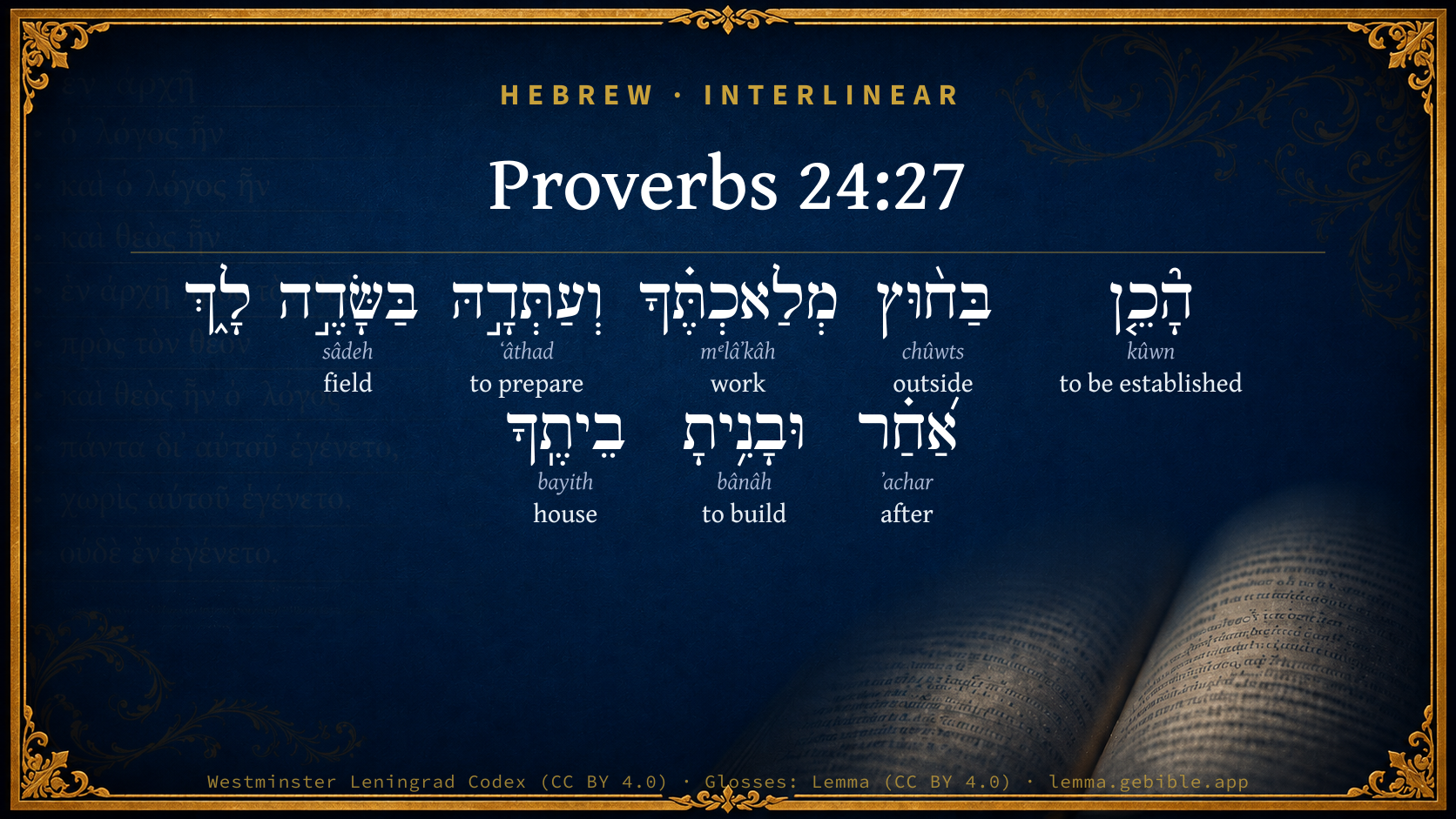
Proverbs 24:27

Hebrew (Westminster Leningrad Codex) Proverbs 24:27 appears in the Hebrew Old Testament. The text above is from the Westminster Leningrad Codex. Each word links to its Strong’s number, a concise gloss, and parsing drawn from the Open Scriptures Hebrew Bible morphology. Click any word for its full Brown-Driver-Briggs (BDB) entry.
Download image
Cite this verse

Proverbs 24:27 (World English Bible). Public Domain. Lemma interlinear Bible study tool, https://lemma.gebible.app/v/proverbs/24/27.

Show BibTeX & RIS
BibTeX
RIS
English Translation
Prepare your work outside, And get your fields ready. Afterwards, build your house.
World English Bible · Public Domain
Download a study sheet

One document with this verse’s original text, its word-by-word gloss line, the meaning frame, cross-references with their text, attributed commentary, and full source and license credits — printable, and it pastes into notes with its structure intact.

This verse Autodidact and up

Study sheet (.html) Plain text (.txt)

A passage Seminary Student

Up to 50 verses in one chapter. A passage sheet keeps up to 6 commentary sources and 12 cross-references per verse, in the order this page ranks them, and says so on the sheet whenever that leaves anything out. Ask for a single verse and you get the Autodidact verse sheet above.

Everything on this page stays free to read, with no account — the sheet is a download of what is already on screen, not access to it.

Want to remove ads? Support Godless Engineer
Compare translations 3

The same verse in 3 English versions, stacked beneath the original-language interlinear above. Click any original word for its lexicon entry.

Each is an independent rendering of the whole verse — the interlinear is not word-aligned to these translations.

Highlighted words mark where these versions differ — a whole-verse word diff, not a word-by-word alignment.

  • World English Bible Public Domain
    Prepare your work outside, And get your fields ready. Afterwards, build your house.
  • King James Version Public Domain
    Prepare thy work without, and make it fit for thyself in the field; and afterwards build thine house.
  • unfoldingWord Literal Text CC BY-SA 4.0
    Prepare your work in the outdoors, and make it ready for yourself in the field, and after, you will build your house.

unfoldingWord Literal Text — © unfoldingWord, licensed CC BY-SA 4.0. Word-aligned USFM3 via Door43 (git.door43.org/unfoldingWord/en_ult).

Versions to compare (up to 4)

3 of 4 selected

Show all 18 translations

Every available English version of this verse, each an independent rendering of the whole verse.

  • World English Bible Public Domain
    Prepare your work outside, And get your fields ready. Afterwards, build your house.
  • Berean Standard Bible Public Domain
    Complete your outdoor work and prepare your field; after that, you may build your house.
  • Majority Standard Bible Public Domain
    Complete your outdoor work and prepare your field; after that, you may build your house.
  • King James Version Public Domain
    Prepare thy work without, and make it fit for thyself in the field; and afterwards build thine house.
  • American Standard Version (1901) Public Domain
    Prepare thy work without, And make it ready for thee in the field; And afterwards build thy house.
  • Revised Version (1885) Public Domain
    Prepare thy work without, and make it ready for thee in the field; and afterwards build thine house.
  • Geneva Bible (1599) Public Domain
    Prepare thy worke without, and make readie thy thinges in the fielde, and after, builde thine house.
  • Douay-Rheims (1899) Public Domain
    Prepare thy work without, and diligently till thy ground: that afterward thou mayst build thy house.
  • Young's Literal Translation Public Domain
    Prepare in an out-place thy work, And make it ready in the field -- go afterwards, Then thou hast built thy house.
  • Literal Standard Version CC BY-SA 4.0
    Prepare your work in an out-place, || And make it ready in the field—go afterward, || Then you have built your house.
  • Unlocked Literal Bible CC BY-SA 4.0
    Prepare your outdoor work, and make everything ready for yourself in the field; after that, build your house.
  • unfoldingWord Literal Text CC BY-SA 4.0
    Prepare your work in the outdoors, and make it ready for yourself in the field, and after, you will build your house.
  • Darby Bible Public Domain
    Prepare thy work without, and put thy field in order, and afterwards build thy house.
  • World Messianic Bible Public Domain
    Prepare your work outside, and get your fields ready. Afterwards, build your house.
  • Webster's Bible Public Domain
    Prepare thy work without, and make it fit for thyself in the field; and afterwards build thy house.
  • Free Bible Version CC BY-SA 4.0
    Do the work you need to do outside first, then prepare and sow your fields, and only after that start building your house.
  • Bible in Basic English Public Domain
    Put your work in order outside, and make it ready in the field; and after that, see to the building of your house.
  • JPS Tanakh (1917) Public Domain
    Prepare thy work without, and make it fit for thyself in the field; and afterwards build thy house.

Literal Standard Version (2020), Covenant Press — licensed CC BY-SA 4.0. Text via the HelloAO Bible API (eBible.org). Unlocked Literal Bible (unfoldingWord) — licensed CC BY-SA 4.0. Text via the HelloAO Bible API (eBible.org). unfoldingWord Literal Text — © unfoldingWord, licensed CC BY-SA 4.0. Word-aligned USFM3 via Door43 (git.door43.org/unfoldingWord/en_ult). Free Bible Version, Dr. Jonathan Gallagher — licensed CC BY-SA 4.0. Text via the HelloAO Bible API (eBible.org).

Word by word

More ways to search: Search by grammar → Find every occurrence → Compare this word →

Practice this passage: Drill this verse → Learn its vocabulary →

וְעַתְּדָ֣הּ
ʻâthad
H6257
“and · prepare · her”
Conjunction + Verb, Piel, Imperative, 2nd Person, Masculine, Singular + Suffix, Personal, 3rd Person, Feminine, Singular
Part of Speech
Conjunction + Verb
Stem
Piel
Form
Imperative
Person
2nd Person
Gender
Masculine
Number
Singular
Full BDB Definition

Origin: a primitive root

TWOT: 1719

to be ready, make ready, prepare - (Piel) to make ready - (Hithpael) to be prepared
  1. הָ֘כֵ֤ן kûwn H3559 “be established” Verb, Hiphil, Imperative, 2nd Person, Masculine, Singular
  2. בַּח֨וּץ chûwts H2351 “in/at the · outside” Preposition, Determined + Noun, Common, Masculine, Singular, Absolute
  3. מְלַאכְתֶּ֗ךָ mᵉlâʼkâh H4399 “work · your” Noun, Common, Feminine, Singular, Construct + Suffix, Personal, 2nd Person, Masculine, Singular
  4. בַּשָּׂדֶ֣ה sâdeh H7704 “in/at the · field” Preposition, Determined + Noun, Common, Masculine, Singular, Absolute
  5. אַ֝חַ֗ר ʼachar H310 “after” Preposition
  6. וּבָנִ֥יתָ bânâh H1129 “and · to build” Conjunction + Verb, Qal, Sequential Perfect, 2nd Person, Masculine, Singular
  7. בֵיתֶֽךָ bayith H1004 “house · your” Noun, Common, Masculine, Singular, Construct + Suffix, Personal, 2nd Person, Masculine, Singular

About this verse

These counts appear in no published source. They are computed here, from the morphology-tagged text and Lemma’s own curated glosses. What Lemma adds →

9
words
8
distinct lemmas
Wisdom
section

Notable vocabulary

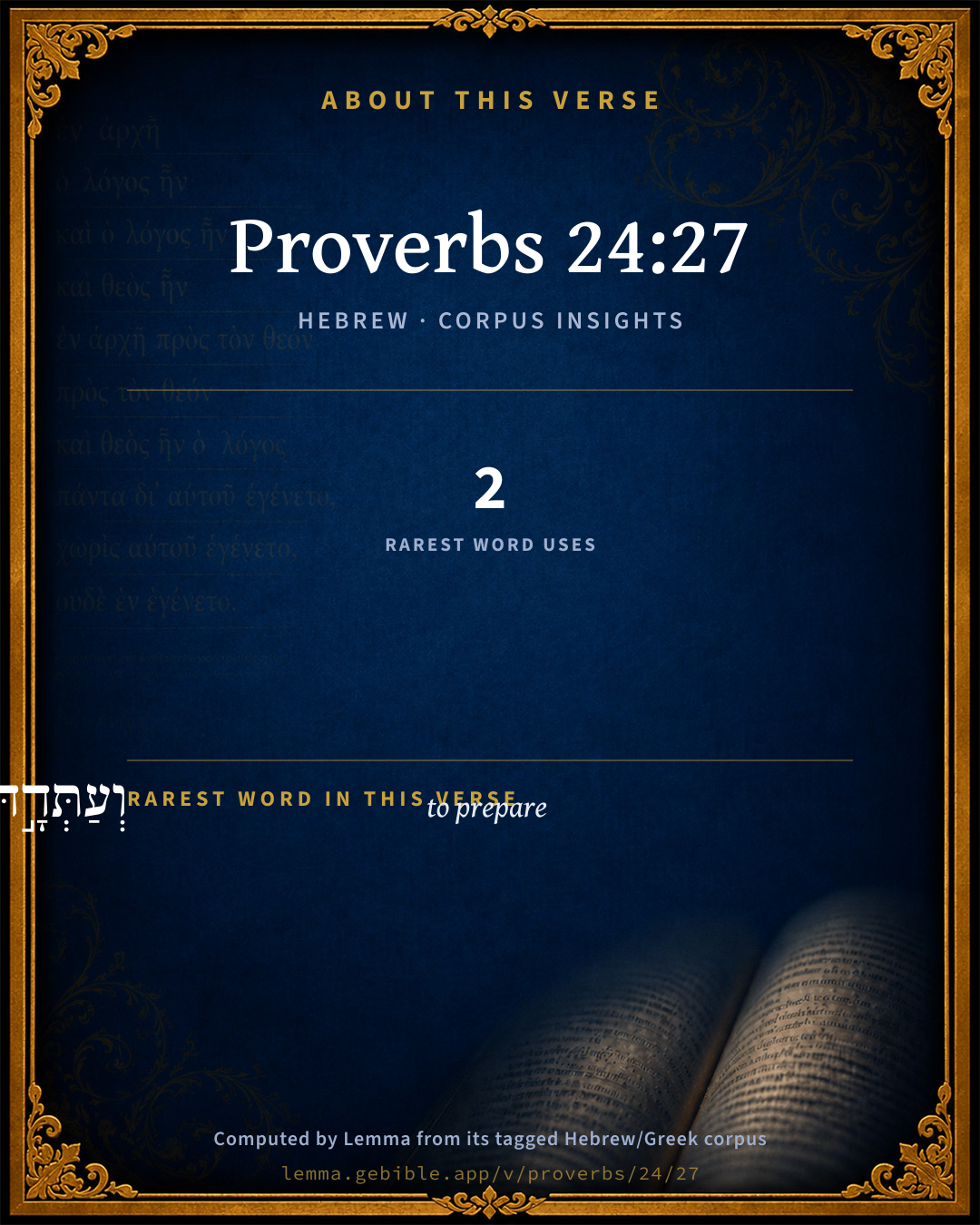
The rarest word here is וְעַתְּדָ֣הּ to prepare H6257 — appearing just 2 times in the whole Hebrew Bible.

Shared distinctive vocabulary

וְעַתְּדָ֣הּ to prepare H6257 occurs in 2 verses of the Hebrew Bible. Also found in:

Grammatical profile

  • 3 verbs
  • 4 nouns
  • 2 prepositions

Verb forms

  • הָ֘כֵ֤ן Hiphil · Imperative
  • וְעַתְּדָ֣הּ Piel · Imperative
  • וּבָנִ֥יתָ Qal · Sequential Perfect

Hebrew & Septuagint length

In English translation the verse runs 13 words from the Hebrew and 23 from the Septuagint (LXX English) — the Septuagint runs noticeably longer here. See the side-by-side →

A rough comparison of the two English renderings, which tokenize alike — not a word-level alignment.

Word counts can differ between the Hebrew and the Greek without any difference in meaning — e.g. the Hebrew direct-object marker אֵת has no separate Greek word, and Greek often adds the article ὁ.

Cross-references

3

Topical passages linked to Proverbs 24:27 in the Treasury of Scripture Knowledge — connected by theme and wording, ordered by reader-vote popularity; previews shown in the World English Bible.

  • Luke 14:28–30 For which of you, desiring to build a tower, doesn't first sit down and count the cost, to see if he has enough to complete it?
  • 1 Kings 5:17–18 The king commanded, and they hewed out great stones, costly stones, to lay the foundation of the house with worked stone.
  • 1 Kings 6:7 The house, when it was in building, was built of stone made ready at the quarry; and there was neither hammer nor axe nor any tool of iron heard in the house, while it was in building.

Cross-references courtesy of OpenBible.info (CC BY 4.0).

Hebrew and Greek witnesses Masoretic Hebrew ↔ Greek Septuagint

The same verse in the two great witnesses to the Old Testament, shown verse-for-verse.

Here the Septuagint runs noticeably longer than the Hebrew — LXX2012 (modern English Septuagint) 23 words vs World English Bible 13. A rough length comparison of the two English translations, not a word-level alignment — read both below.

These are two independent witnesses, not word-aligned to each other, and the Septuagint is shown in lemma (dictionary) form.

Hebrew Proverbs 24:27 Masoretic · Westminster Leningrad Codex

הָ֘כֵ֤ן בַּח֨וּץ מְלַאכְתֶּ֗ךָ וְעַתְּדָ֣הּ בַּשָּׂדֶ֣ה לָ֑ךְ אַ֝חַ֗ר וּבָנִ֥יתָ בֵיתֶֽךָ

Prepare your work outside, And get your fields ready. Afterwards, build your house.

World English Bible · Public Domain

Greek LXX Proverbs 24:27 Septuagint · lemma form

ἑτοιμάζω εἰς ὁ ἔξοδος ὁ ἔργον σύ καί παρασκευάζω εἰς ὁ ἀγρός καί πορεύομαι κατόπισθεν ἐγώ καί ἀναοἰκοδομέω ὁ οἶκος σύ

Prepare your works for your going forth, and prepare yourself for the field; and come after me, and you shall rebuild your house.

LXX2012 (modern English Septuagint) · Public Domain

On this verse, The Pulpit Commentary discusses the Septuagint’s reading. Read the note in Commentary ↓

Hebrew: Westminster Leningrad Codex (CC BY 4.0). Greek: Septuagint (public domain); English from LXX2012 (modern English Septuagint) (Public Domain). How the Septuagint differs from the Hebrew →

Commentary

Notes on Proverbs 24:27 from classic Christian and Jewish commentators (each source and its license shown beneath its notes). The classic Christian expositions comment on the surrounding passage and are grouped to its opening verse, so a note may address several verses; the Jewish commentaries on the Tanakh (Rashi and others) are per-verse, so they appear only where the commentator wrote on this verse.

Lemma curates 59 commentaries, every one of them public domain or Creative Commons licensed, each selected and text-cleaned for this edition rather than reprinted as found. About our sources →

Trapp's Complete Commentary

John Trapp

Pro 24:27 Prepare thy work without, and make it fit for thyself in the field; and afterwards build thine house.

Ver. 27. Prepare thy work without, &c.] God would have all his to be not good men only, but good husbands too; to order their affairs with discretion, and to take their fittest opportunities for despatch of household businesses. Pliny {a} hath a saying to like sense with this: Aedificandum, saith he, consito agro, et tunc quoque cunctanter, - Let building alone till thy field be tilled, vined, planted, &c.

{a} Lib, xviii, cap. 1.

John Trapp, A Commentary or Exposition upon All the Books of the Old and New Testament (1647–1656) — public domain. Text from a community e-Sword module.

The Biblical Illustrator

Joseph S. Exell

Pro_24:27

Prepare thy work without, and make it fit for thyself in the field; and afterwards build thine house.

Preparation; its nature, obligation, and blessings

God loves preparations. God gives little but to preparations. All His own great works He has done preparedly. Creation was not done without great forethought (Pro_8:27-31). And redemption was no sudden after-thought, for before the foundation of the earth was laid redemption was cast in the mind of God. And every event that happens to every man, it was planned ages before the man was born. And the children of Israel did not enter Canaan till they had gone through a preparatory discipline. Neither did prophets, nor apostles, nor Jesus Himself, begin work without an interval of solitude and discipline for perfect readiness. The preparation of Jesus was marvellous. Ten-elevenths of that life, of which every moment was gold--ten-elevenths given to preparation. Rightly viewed, everything this side heaven, and perhaps we need not draw the limit line even there--everything is preparation. Within the compass of this present world everything is placed in the state and order that it is, to fit us for another thing which is coming afterwards. Just as in a good education every rule leads up to a higher rule, and every new piece of knowledge is the basis of another piece, so that the mind is always being made ready for something beyond it, so it is in Gods dispensations. A joy may be a prelude to a sorrow, or a sorrow may be a prelude to a joy, or a joy to a higher joy, or a sorrow to a still deeper sorrow. Nothing is isolated. It is not isolated joy; it is not isolated sorrow. The great thing we have to do is to be careful that we treat everything as preparatively. We should always be asking, when joy and sorrow comes, Of what is this the precursor? what is God going to do with me next? You cannot always be doing duties, but you can always be preparing for them. And remember, preparations are the long things; works are the short things. Let the preparation suit what you are going to do--a general preparation for general duty--but a special preparation for things special. The materials you gather in the field must be suited to the particular house which you are going to build. Always make a stop upon the eve, and search into your own heart, and say, Am I ready? has God given me a true preparation? If not, as far as you can, stop a little longer before you take another step. Whatever else you do, secure preparation before you begin. There is a frame of mind which is a continual preparedness. It is the Here I am! of the patriarchs. It is a high, blessed state. (J. Vaughan, M.A.)

Preparation for lifes duties, sorrows, and joys

I should place first among preparations--the Sunday. A Sunday will be a preparation, if you view it as preparatory. It does not much matter whether you look upon it as the day for laying in the minds food for the week, or as the day for raising the mind to its true tone and level for the week, or as the day to hallow anything to which you are looking, by bringing it out especially before God that day. It is a very good thing to use the Sunday for laying before God, and so solemnly consecrating, and obtaining strength and wisdom for, anything that you are planning or expecting in the course of the coming week. But if you will thus spend your Sunday as a ground, apart from the world, and in loftier ranges of thought, you are preparing your work without, and making it fit for yourself in the field; and afterwards build thine house. What is true of the Sunday is certainly true also of all private exercises of the soul; and most of all, our morning devotions. Our morning devotions should have a distinct, preparatory character. You will find it a good rule never to open your Bible without a little secret prayer. Certainly, whatever it is worth while for a Christian to do at all, it is worth while to do measuredly and deliberately. Better to do a few things so than multitudes lightly. And the God of order and of forethought will Himself bless what most honours Him, by holy premeditation and religious accuracy, in which He sees, therefore, the most of His own image. Map your day before you go out; plan carefully; lay all beginnings in God: Prepare thy work without, and make it fit for thyself in the field; and afterwards build thine house. But you say, What is this preparation? I cannot so prepare. Then what does that show, but that before the beginning there is another beginning, and that the preparation itself needs to be prepared? But if you ask, What is the right preparation for sorrow? I answer, first, not to anticipate sorrow, for that is not filial nor childlike, but to have it well laid in your mind that sorrow must come, and to know its nature, what it is. For the danger of sorrow is, lest it come upon us overwhelmingly, and paralyse our powers. Therefore, be in a state of mind which cannot be surprised--not ignorant of what sorrow is when it comes. Is not it a needful discipline? To prepare for joys the rule is opposite. The preparation there lies in the fact of the anticipation. You cannot expect too much. For one of the perils of a joy is its throwing the mind from its equilibrium by the rush of its novelty. But he who has dealt much with the great undertakings of Gods love and promise will scarcely be surprised at any happiness that ever comes. Is he not loved? So the joy will not come disturbingly to the mind. (J. Vaughan, M.A.)

The Biblical Illustrator, edited by Joseph S. Exell (c. 1880s–1900s) — public domain. Text from a community e-Sword module.

Joseph Benson's Commentary

Pro 24:27. Prepare thy work without — Use both industry and prudence in the management of thy concerns, and do every thing in the proper order. First, mind those things which are most necessary, cultivating the ground, and furnishing thyself with cattle, and the fruits of the field, which are needful for thy subsistence; and after that thou mayest procure such things as are for ornament and comfort, such as the building of a convenient house. Some, by the house here, understand a family, and consider this to be a direction respecting engaging in marriage, interpreting the verse thus: “Begin with cultivating thy land, and thou wilt be enabled to feed thy family; and after this, if thou wilt, thou mayest think of marrying.” — See Calmet.

Joseph Benson's Commentary on the Old and New Testaments (1811–1818) — public domain. Text from a community e-Sword module.

The Preacher's Complete Homiletical Commentary

Joseph S. Exell (gen. ed.)

CRITICAL NOTES.—

Pro_24:27. House. This word may mean here as it does in Exo_1:21, Rth_4:11, 2Sa_7:27 etc., the family—the household interests.

MAIN HOMILETICS OF Pro_24:27

PLAN AND PATIENCE

I. Here is a lesson in working with method. In all undertakings it is necessary to consider what is the most important and indispensable element of success, and to make sure of that first. In the building of a house in the literal sense, the first thing to be done is to have a well-considered plan, and to gather and prepare suitable and sufficient materials. If, when the building is half finished, it is found that some great difficulty has been overlooked, or that the materials and the means to procure them are inadequate, failure and disgrace are the result, and all the time and money hitherto spent upon the work is thrown away. So in any other undertaking. If a man desires a certain position in life for which special qualifications are needed, he must first endeavour to know exactly what the requirements are, and then make sure that he is able to fulfil them. If he makes a start without well considering these things he may waste much precious time and energy, and ruin his prospects for life. The same principle may be applied to any philanthropic enterprise. These often fail, because they are entered upon without any just conception of the difficulties to be encountered, or of the resources which will be required to carry them on to a successful issue.

II. A lesson in working with patience. The proverb seems to warn men not to be in too great a hurry to realise the fulfilment of their desires; not to be impatient to reap the harvest before the crop has had time to ripen. Men are sometimes so eager to obtain a certain good which to them appears desirable that they make a desperate and reckless attempt to gain it by some other road than that of patient perseverance. A man makes up his mind that he must live in a certain style, and keep up a certain appearance before the world, and he sets out to build a stately mansion without waiting until he has acquired the means whereby he can do it honestly. Men often desire to be at the beginning of their career where they can only be after days and years of toil, and if they act under the inspiration of this spirit of impatience they often most effectually shut themselves out entirely from the realisation of their desires.

OUTLINES AND SUGGESTIVE COMMENTS

This wisdom the very little bees do practise and show us, who first get honey and bring it into their hives, and afterwards make their seats and honeycombs. Against this rule here set down divers sorts of people offend, yea, all that take a preposterous course, whether in the matters of this life, or in those things that are spiritual. Some enter into the state of marriage before either they have wit, or have provided and gotten by their labour sufficient food or wealth to maintain them. Others lay out much on banquets, buildings, pastimes, or apparel, before they have a good stock or large comings in. Others meddle with hard points of controversy before they have learned the plain principles of religion. Others first and especially seek after the goods of this world, and, in the second place, at their leisure, and very slowly, they follow after the kingdom of God.—Muffet.

Possibly a spiritual meaning here, as elsewhere, lies beneath the prudential maxim. The “field” may be the man’s outer common work, the “house” the dwelling-place of his higher life. He must do the former faithfully in order to attain the latter.—Plumptre.

The Preacher's Complete Homiletical Commentary (gen. ed. Joseph S. Exell; Funk & Wagnalls, c. 1892) — public domain (pre-1929). A full-Bible homiletical/sermon-outline anthology covering 65 of 66 books (2 John is absent from the source module). Text from a community e-Sword module.

Tyndale Open Study Notes

Tyndale Open Resources

24:27 Saying 3: A wise person establishes a source of income before spending money on himself.

Tyndale Open Study Notes — © Tyndale Open Resources, licensed CC BY-SA 4.0. Text via the HelloAO Bible API.

Geneva Bible (1599)

Geneva Bible translators

Be sure of the means how to compass it, before thou take any enterprise in hand.

Geneva Bible (1599) marginal notes — public domain. Text via Bolls.life.

Matthew Henry's Commentary

This is a rule of prudence in the management of household affairs; for all good men should be good husbands, and manage with discretion, which would prevent a great deal of sin, and trouble, and disgrace to their profession. 1. We must prefer necessaries before conveniences, and not lay that out for show which should be expended for the support of the family. We must be contented with a mean cottage for a habitation, rather than want, or go in debt for, food convenient. 2. We must not think of building till we can afford it: "First apply thyself to thy work without in the field; let thy ground be put into good order; look after thy husbandry, for it is that by which thou must get; and, when thou hast got well by that, then, and not till then, thou mayest think of rebuilding and beautifying thy house, for that is it upon which, and in which, thou wilt have occasion to spend." Many have ruined their estates and families by laying out money on that which brings nothing in, beginning to build when they were not able to finish. Some understand it as advice to young men not to marry (for by that the house is built) till they have set up in the world, and not wherewith to maintain a wife and children comfortably. 3. When we have any great design on foot it is wisdom to take it before us, and make the necessary preparations, before we fall to work, that, when it is begun, it may not stand still for want of materials. Solomon observed this rule himself in building the house of God; all was made ready before it was brought to the ground, Kg1 6:7.

Matthew Henry's Commentary on the Whole Bible (1708–1710) — public domain (CC PDM 1.0). Text via the HelloAO Bible API.

Jamieson, Fausset & Brown

Robert Jamieson, A. R. Fausset & David Brown

Prepare . . . in the field--Secure, by diligence, a proper support, and then build; provide necessaries, then comforts, to which a house rather pertained, in a mild climate, permitting the use of tents.

Jamieson, Fausset & Brown — Commentary Critical and Explanatory on the Whole Bible (1871) — public domain (CC PDM 1.0). Text via the HelloAO Bible API.

Adam Clarke's Commentary

Verse 27. Prepare thy work without] Do nothing without a plan. In winter prepare seed, implements, tackle, geers, &c., for seed-time and harvest.

Adam Clarke's Commentary on the Bible (1810–1826) — public domain. Text from a community e-Sword/MySword module.

Ellicott's Commentary for English Readers

(27) Prepare thy work without . . .—Method in work is here advised; first till the ground, and then build the house which will be maintained by the produce of the field. In the spiritual life, too, we should seek to “perceive and know what things we ought to do,” if we are not to waste time and energy upon unsuitable and unattainable objects.

A Bible Commentary for English Readers, edited by Charles John Ellicott (1878–1897) — public domain. Text from a community e-Sword module.

The Cambridge Bible for Schools and Colleges

gen. ed. J. J. S. Perowne

27. thy work] viz. the work required for building thy house. Follow the course pursued in the erection of the Temple, 1Ki_6:7. Comp. 1Ch_28:2, I had made ready (the same Heb. word as is here rendered prepare) for the building.

Such preparing and making ready includes mental as well as material preparation, prudent “counting the cost,” as well as careful selection of materials. When this is understood, the proverb which has been obscured by supposing it to mean, “first till thy field and then build thy house,” or, “first make provision for a family and then found one,” is plain and forcible, and lends itself readily to moral and spiritual applications.

The Cambridge Bible for Schools and Colleges (gen. ed. J. J. S. Perowne; Cambridge University Press, 1878–1918) — public domain. Text from a community e-Sword module.

John Gill's Exposition

Say not, I will do so to him as he hath done to me,.... He has falsely accused and reproached me, and bore a false testimony, or suborned false witnesses against me, and I will do the same to him, now an opportunity serves; but as private revenge itself is sinful, so especially when it is pursued in a wicked way;

I will render to the man according to his work; this should be left to the Lord, whose prerogative it is; see Pro 24:19.

John Gill's Exposition of the Whole Bible (1746–1763) — public domain (CC PDM 1.0). Text via the HelloAO Bible API.

Albert Barnes' Notes on the Bible

i. e., Get an estate into good order before erecting a house on it. To “build a house” may, however, be equivalent (compare Exo 1:21; Deu 25:9; Rth 4:11) to “founding a family;” and the words a warning against a hasty and imprudent marriage. The young man is taught to cultivate his land before he has to bear the burdens of a family. Further, in a spiritual sense, the “field” may be the man’s outer common work, the “house” the dwelling-place of his higher life. He must do the former faithfully in order to attain the latter. Neglect in one is fatal to the other. Compare Luk 16:10-11.

Albert Barnes' Notes on the Bible (1834–1885) — public domain. Text from a community e-Sword/MySword module.

Haydock's Catholic Bible Commentary

House, and support thy family. Before building, great deliberation is requisite, Luke xiv. 28. Those who attempt to instruct others, must first set good example.

George Leo Haydock (1774–1849), Haydock's Catholic Family Bible and Commentary, 1859 edition — public domain. Excludes Psalms (Douay-Rheims chapter numbering differs from Protestant) and Deuterocanonical books (Catholic canon only).

Matthew Poole's English Annotations

This is a domestical precept, requiring both industry and prudence in the management of a man’s concerns, that he take care in the first place to furnish himself with cattle and the fruits of the field, which are necessary for his subsistence, and after that he may procure such things as are for ornament and comfort, such as the building of a convenient house is.

Matthew Poole's English Annotations on the Holy Bible (1683–1685) — public domain. Text from a community e-Sword/MySword module.

Whedon's Commentary on the Bible

Daniel D. Whedon

27. Prepare thy work without… afterwards build thine house — The sense is, first sustenance, then accommodation. The proverb is better adapted to a climate like that of parts of Palestine than to many others, though it has a qualified application in most countries. In some climates, however, a house comes in among the prime necessities. But it is a great error in a man of moderate circumstances to expend his slender capital upon an expensive house. The proverb may refer, as some suppose, to the founding or building of a house in a metaphorical sense, that is, a family. Thus it may be a warning against hasty and imprudent marriage. A young man should cultivate his land and have the means of living before he takes the burdens of a family. So Speaker’s Commentary.

Daniel D. Whedon (gen. ed.), Commentary on the Old and New Testaments (1874–1909) — public domain. Text from a community e-Sword module.

The Pulpit Commentary

Prepare thy work without. The proverb enjoins a man to look well to his resources before he undertakes to build a house or to establish a family. "Without" (chuts); (Pro_7:12 Pro_8:26) in the fields. Put in due order all immediate work in thy farm. And make it fit for thyself in the field; and get ready for what has to come next. That is, in short, steadily and with due foresight cultivate your land; provide abundant means of subsistence before you attempt to build up your house. A suitor had, as it were, to purchase his bride from her relations by making considerable presents; it was therefore necessary to provide a certain amount of wealth before contemplating matrimony. And afterwards build thy house. This is, indeed, the meaning of the passage; but the Hebrew makes a difficulty, as it is literally, "afterwards and thou shalt build." Some have supposed that some words have dropped out of the text (Cheyne, "Job and Solomon"). But vav in tynibW, coming after a date or notification of time, as here after rha, (comp. Gen_3:5) "has the future signification of a perfect consecutive" (Delitzsch), equivalent to "after that, then, thou mayest build." Septuagint, "Prepare thy works for thy going forth (eiv thn exodon ), and get ready for the field, and come after me, and thou shalt build up thine house." In a spiritual sense, the heart must be first cleared of thorns, and opened to genial influences, before the man can build up the fabric of virtuous habits, and thus arrive at the virtuous character.

The prudence and policy of industry.

I ALL LABOUR IS ROOTED IN THE TILLAGE OF THE EARTH. "Tis thus that bread was first wrung from her by universal field labour. Our ancestors were all agricultural labourers. All other industry must be fruitless and stop without the action of this spring. It is therefore the part of all prudent and good men to encourage cultivation, to improve the condition of the labourer and the farmer. All honour to the great statesmen of our time who have wrought in this cause. It is edifying to recollect that God has made Mother Earth the eternal mediator and minister to us of material blessings which lie at the foundation of all our life.

II DOMESTIC COMFORT AND INDEPENDENCE REST UPON LABOUR. It is the "prudence of a higher strain" than that which begins and ends with mere sensual comfort that is taught in this book. It is attention to law, it is unbelief in luck, which constitutes its principle. Self-command, unslothful habits, constant exertion, put the bread a man eats at his own disposal, so that he stands not in bitter and False relations to other men. J.

The Pulpit Commentary (1880–1919), ed. H.D.M. Spence-Jones & Joseph S. Exell — public domain. Text from a community e-Sword module.

Keil & Delitzsch

C. F. Keil & F. Delitzsch

Warning against the establishing of a household where the previous conditions are wanting:

Set in order thy work without,

And make it ready for thyself beforehand in the fields, -

After that then mayest thou build thine house.

The interchange of בּחוּץ and בּשּׂדה shows that by מלאכת השּׂדה field-labour, Ch1 27:26, is meant. הכין, used of arrangement, procuring, here with מלאכה, signifies the setting in order of the word, viz., the cultivation of the field. In the parallel member, עתּדה, carrying also its object, in itself is admissible: make preparations (lxx, Syr.); but the punctuation עתּדהּ (Targ., Venet.; on the other hand, Jerome and Luther translate as if the words were ועתדה השּׂדה) is not worthy of being contended against: set it (the work) in the fields in readiness, i.e., on the one hand set forward the present necessary work, and on the other hand prepare for that which next follows; thus: do completely and circumspectly what thy calling as a husbandman requires of thee - then mayest thou go to the building and building up of thy house (vid., at Pro 24:3, Pro 14:1), to which not only the building and setting in order of a convenient dwelling, but also the bringing home of a housewife and the whole setting up of a household belongs; prosperity at home is conditioned by this - one fulfils his duty without in the fields actively and faithfully. One begins at the wrong end when he begins with the building of his house, which is much rather the result and goal of an intelligent discharge of duty within the sphere of one's calling. The perf., with ו after a date, such as אחר, עוד מעט, and the like, when things that will or should be done are spoken of, has the fut. signification of a perf. consec., Gen 3:5; Exo 16:6., Pro 17:4; Ewald, 344b.

Keil & Delitzsch — Biblical Commentary on the Old Testament (1861–1891) — public domain (CC PDM 1.0). Text via the HelloAO Bible API. (Old Testament only.)

Bridges on Proverbs

Charles Bridges

This rule of prudence applies to all worldly matters. Religion, so far from forbidding, inculcates care and forethought. Much of our domestic comfort hangs upon it. Much inconvenience and suffering flow from its neglect. Acting upon this useful direction, the wise builder first prepares his work without. He collects his materials, calculates upon the quantity required; then he makes his work fit by shaping and bringing them into their place; and afterwards, having all things in readiness, he builds his house. The work was thus prepared for Solomon’s magnificent temple, before the house was built. (1Ki 5:18 ; 1Ki 6:7 ) The spiritual house is similarly raised of materials prepared and fitted; and thus it "groweth unto an holy temple in the Lord." (Eph 2:21-22 .)

But ponder well the care, with which the great work should be prepared. Count the cost anxiously. Consider whether the profession will stand the storms. (Luk 14:28-30 .) Lay the foundation deep upon the Rock. (Luk 6:48 .) Be much in prayer for divine strength. Avoid that outward display, which shames the inconsiderate builder, who begins to build his house, without having thoroughly prepared his work.

Has not the minister of the Gospel special need of preparing his work? An unfurnished minister cannot be "a wise master builder." Even when the foundation is laid, "Let every man take heed how he buildeth thereupon." Let him look well to the day at hand. (1Co 3:10-15 .) And let all the Lord’s servants weigh deeply their responsibility. Indigested haste, and crude judgment, have blasted many a Christian project. Let us be guided by the well-considered wisdom of experienced men (Mat 18:17-18 ), and collect our materials from their prudence, forethought, and sound-judging energy. A house will thus be built to the honor of our God, and for the service of his Church.

Charles Bridges, An Exposition of the Book of Proverbs (1846) — public domain. Text from a community e-Sword module.

Kretzmann's Popular Commentary

Paul E. Kretzmann

v. 27. Prepare thy work without and make it fit for thyself in the field, by tilling the soil and laboring for a plentiful harvest first; and afterwards build thine house, which includes the establishment of a family and household, the summary being: Provide necessaries first, then comforts.

Paul E. Kretzmann, Popular Commentary of the Bible (1921–1924) — public domain. Text from a community e-Sword module.

Rashi

Rabbi Shlomo Yitzchaki (Rashi)

Prepare...outside This refers to Scripture.

and make it fit in the field This is Mishnah.

afterwards you shall build your house This is Talmud (Sotah 44a). Another explanation according to its apparent meaning: In the beginning, buy yourself fields and vineyards, and afterwards make it fit, ועתדה, an expression concerning goats (עתודים). Stock your field with livestock, and afterwards you shall build a house, meaning that you shall take a wife.

Rashi on the Tanakh — English translations: “The Judaica Press complete Tanach with Rashi, translated by A. J. Rosenberg” (CC BY 4.0); “Pentateuch with Rashi's commentary by M. Rosenbaum and A.M. Silbermann, 1929-1934” (public domain); “The Metsudah Tanach series, Lakewood, N.J” (CC BY 4.0); and “The Book of Joshua, Metsudah Publications, 1997” (CC BY 4.0). Text via Sefaria.

Lesson kit

Teaching starters — assembled from the data on this page, not authored interpretation. Every prompt links to the verse data it draws on. Edit before teaching.

Proverbs, in the Wisdom, opens this verse with 9 words (8 distinct Hebrew lemmas). Its most distinctive word is ʻâthad (“to prepare”). The Greek Septuagint runs longer here. A historical commentator’s framing appears above. Read the whole chapter for the surrounding context.

Discussion questions

  1. The word ʻâthad carries the sense “to prepare.” How does it shape the verse?
  2. Job 15:28 shares the word «to prepare» with this verse. How do the two illuminate each other?
  3. Compared with the Hebrew, the Septuagint runs longer here. What questions does that raise?
  4. The translations on this page render this verse differently — a whole-verse word diff, not a word-by-word alignment. What might account for the different wordings?
  5. The verb «הָ֘כֵ֤ן» is Hiphil Imperative. How does its form color the action?
  6. Reading how Trapp's Complete Commentary and The Biblical Illustrator read this verse, where do the two commentators agree and where do they part?

Things to notice

Reading settings

Reading text

Shown beneath each verse's original-language words.

Old Testament
Old Testament edition

Read the OT as the Masoretic Hebrew (MT) or the Greek Septuagint (LXX).

English shown for the Greek Septuagint (in the Hebrew ↔ Greek comparison).

Comparing translations? Open the Compare panel on any verse page to stack up to four side by side.