
1 Chronicles 27:25

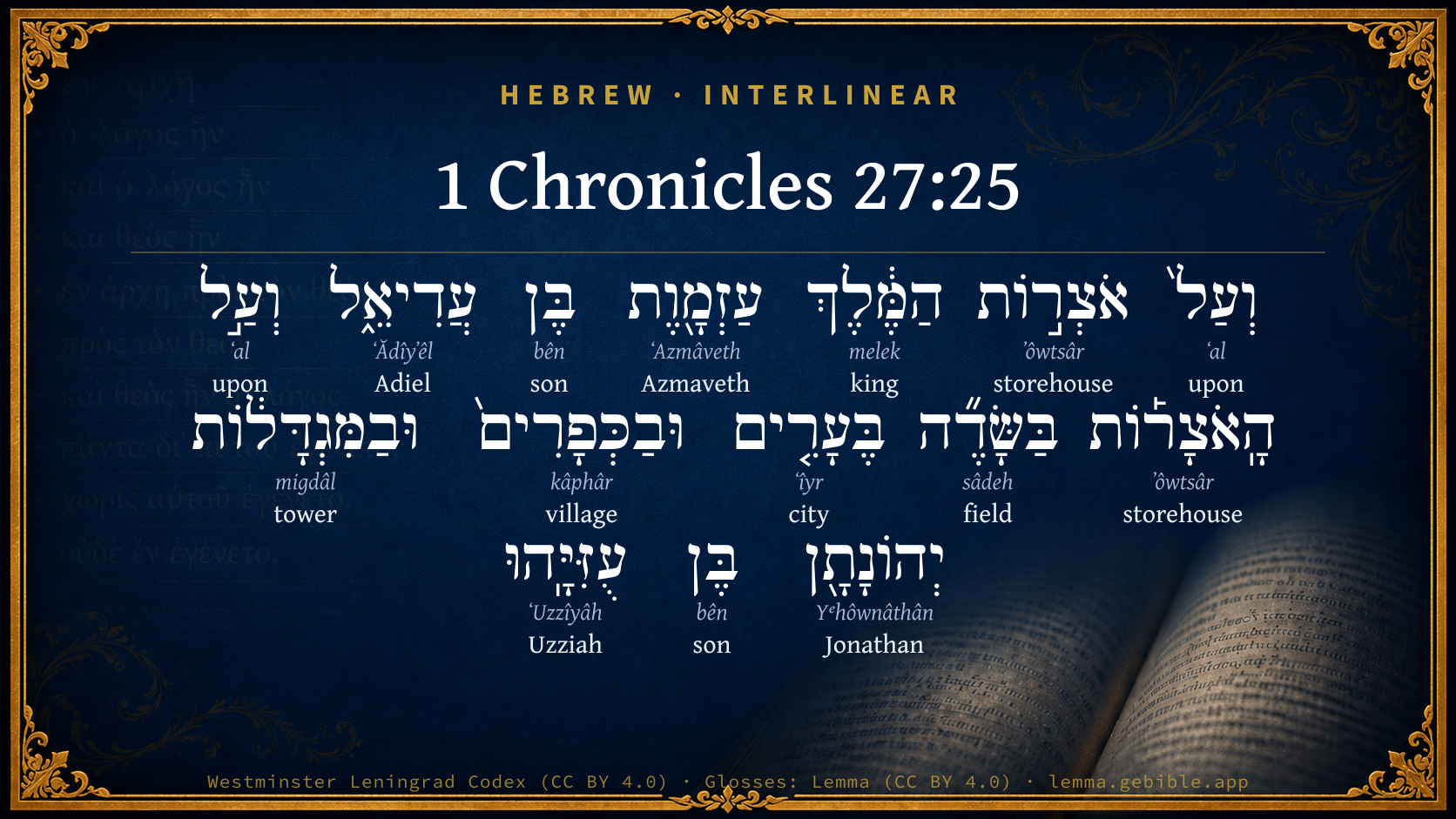
Hebrew (Westminster Leningrad Codex) 1 Chronicles 27:25 appears in the Hebrew Old Testament. The text above is from the Westminster Leningrad Codex. Each word links to its Strong’s number, a concise gloss, and parsing drawn from the Open Scriptures Hebrew Bible morphology. Click any word for its full Brown-Driver-Briggs (BDB) entry.
Download image
Cite this verse

1 Chronicles 27:25 (World English Bible). Public Domain. Lemma interlinear Bible study tool, https://lemma.gebible.app/v/1-chronicles/27/25.

Show BibTeX & RIS
BibTeX
RIS
English Translation
Over the king's treasures was Azmaveth the son of Adiel: and over the treasures in the fields, in the cities, and in the villages, and in the towers, was Jonathan the son of Uzziah:
World English Bible · Public Domain
Highlights
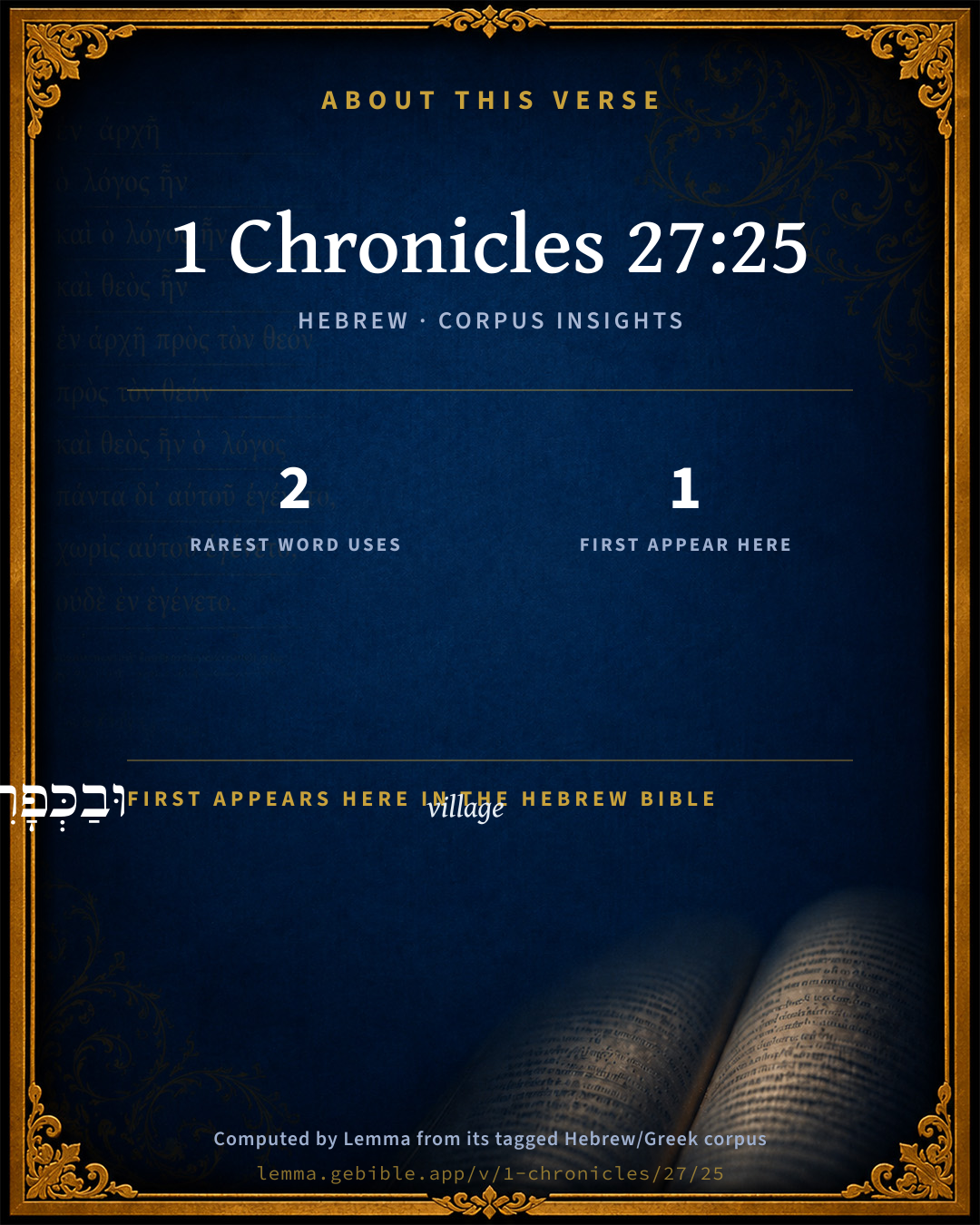
  • 1 first appearance in the Hebrew Bible
Full analysis ↓
Download a study sheet

One document with this verse’s original text, its word-by-word gloss line, the meaning frame, cross-references with their text, attributed commentary, and full source and license credits — printable, and it pastes into notes with its structure intact.

This verse Autodidact and up

Study sheet (.html) Plain text (.txt)

A passage Seminary Student

Up to 50 verses in one chapter. A passage sheet keeps up to 6 commentary sources and 12 cross-references per verse, in the order this page ranks them, and says so on the sheet whenever that leaves anything out. Ask for a single verse and you get the Autodidact verse sheet above.

Everything on this page stays free to read, with no account — the sheet is a download of what is already on screen, not access to it.

Want to remove ads? Support Godless Engineer
Compare translations 3

The same verse in 3 English versions, stacked beneath the original-language interlinear above. Click any original word for its lexicon entry.

Each is an independent rendering of the whole verse — the interlinear is not word-aligned to these translations.

Highlighted words mark where these versions differ — a whole-verse word diff, not a word-by-word alignment.

  • World English Bible Public Domain
    Over the king's treasures was Azmaveth the son of Adiel: and over the treasures in the fields, in the cities, and in the villages, and in the towers, was Jonathan the son of Uzziah:
  • King James Version Public Domain
    And over the king's treasures was Azmaveth the son of Adiel: and over the storehouses in the fields, in the cities, and in the villages, and in the castles, was Jehonathan the son of Uzziah:
  • unfoldingWord Literal Text CC BY-SA 4.0
    And over the treasuries of the king Azmaveth, the son of Adiel. And over the treasuries in the field, in the cities, and in the villages, and in the towers Jonathan, the son of Uzziah.

unfoldingWord Literal Text — © unfoldingWord, licensed CC BY-SA 4.0. Word-aligned USFM3 via Door43 (git.door43.org/unfoldingWord/en_ult).

Versions to compare (up to 4)

3 of 4 selected

Show all 18 translations

Every available English version of this verse, each an independent rendering of the whole verse.

  • World English Bible Public Domain
    Over the king's treasures was Azmaveth the son of Adiel: and over the treasures in the fields, in the cities, and in the villages, and in the towers, was Jonathan the son of Uzziah:
  • Berean Standard Bible Public Domain
    Azmaveth son of Adiel was in charge of the royal storehouses. Jonathan son of Uzziah was in charge of the storehouses in the country, in the cities, in the villages, and in the fortresses.
  • Majority Standard Bible Public Domain
    Azmaveth son of Adiel was in charge of the royal storehouses. Jonathan son of Uzziah was in charge of the storehouses in the country, in the cities, in the villages, and in the fortresses.
  • King James Version Public Domain
    And over the king's treasures was Azmaveth the son of Adiel: and over the storehouses in the fields, in the cities, and in the villages, and in the castles, was Jehonathan the son of Uzziah:
  • American Standard Version (1901) Public Domain
    And over the king's treasures was Azmaveth the son of Adiel: and over the treasures in the fields, in the cities, and in the villages, and in the castles, was Jonathan the son of Uzziah:
  • Revised Version (1885) Public Domain
    And over the king’s treasuries was Azmaveth the son of Adiel: and over the treasuries in the fields, in the cities, and in the villages, and in the castles, was Jonathan the son of Uzziah:
  • Geneva Bible (1599) Public Domain
    And ouer the Kings treasures was Azmaueth the sonne of Adiel: and ouer the treasures in the fieldes, in the cities and in the villages and in the towers was Iehonathan the sonne of Vzziah:
  • Douay-Rheims (1899) Public Domain
    And over the king's treasures was Azmoth the son of Adiel: and over those stores which were in the cities, and is the villages, and in the castles, was Jonathan the son of Ozias.
  • Young's Literal Translation Public Domain
    And over the treasures of the king `is' Azmaveth son of Adiel; and over the treasures in the field, in the cities, and in the villages, and in the towers, `is' Jehonathan son of Uzziah;
  • Literal Standard Version CC BY-SA 4.0
    And Azmaveth son of Adiel [is] over the treasures of the king; and Jonathan son of Uzziah [is] over the treasures in the field, in the cities, and in the villages, and in the towers;
  • Unlocked Literal Bible CC BY-SA 4.0
    Azmaveth son of Adiel was in charge of the king's treasuries. Jonathan son of Uzziah was over the storehouses in the fields, in the cities, and in the villages, and in the fortified towers.
  • unfoldingWord Literal Text CC BY-SA 4.0
    And over the treasuries of the king Azmaveth, the son of Adiel. And over the treasuries in the field, in the cities, and in the villages, and in the towers Jonathan, the son of Uzziah.
  • Darby Bible Public Domain
    And over the king's treasures was Azmaveth the son of Adiel; and over the storehouses in the country, in the cities, and in the villages, and in the towers was Jonathan the son of Uzziah.
  • World Messianic Bible Public Domain
    Over the king’s treasures was Azmaveth the son of Adiel. Over the treasures in the fields, in the cities, in the villages, and in the towers was Jonathan the son of Uzziah;
  • Webster's Bible Public Domain
    And over the king's treasures was Azmaveth the son of Adiel: and over the store-houses in the fields, in the cities, and in the villages, and in the castles, was Jehonathan the son of Uzziah:
  • Free Bible Version CC BY-SA 4.0
    Azmaveth, son of Adiel, was in charge of the king's storehouses, while Jonathan, son of Uzziah, was in charge of those in the country, towns, villages, and watchtowers.
  • Bible in Basic English Public Domain
    And Azmaveth, the son of Adiel, was controller of the king's property; Jonathan, the son of Uzziah, had control of all store-houses in country places and in the towns and little towns and strong places;
  • JPS Tanakh (1917) Public Domain
    And over the king's treasuries was Azmaveth the son of Adiel; and over the treasuries in the fields, in the cities, and in the villages, and in the towers, was Jonathan the son of Uzziah;

Literal Standard Version (2020), Covenant Press — licensed CC BY-SA 4.0. Text via the HelloAO Bible API (eBible.org). Unlocked Literal Bible (unfoldingWord) — licensed CC BY-SA 4.0. Text via the HelloAO Bible API (eBible.org). unfoldingWord Literal Text — © unfoldingWord, licensed CC BY-SA 4.0. Word-aligned USFM3 via Door43 (git.door43.org/unfoldingWord/en_ult). Free Bible Version, Dr. Jonathan Gallagher — licensed CC BY-SA 4.0. Text via the HelloAO Bible API (eBible.org).

Word by word

More ways to search: Search by grammar → Find every occurrence → Compare this word →

Practice this passage: Drill this verse → Learn its vocabulary →

וּבַכְּפָרִים֙
kâphâr
H3723
“and · in/at the · villages”
Conjunction + Preposition, Determined + Noun, Common, Masculine, Plural, Absolute
Part of Speech
Conjunction + Preposition + Noun
Type
Common
Gender
Masculine
Number
Plural
State
Absolute
Full BDB Definition

Origin: from H3722

TWOT: 1025c

village
  1. וְעַל֙ ʻal H5921 “and · upon” Conjunction + Preposition
  2. אֹצְר֣וֹת ʼôwtsâr H214 “storehouses of” Noun, Common, Masculine, Plural, Construct
  3. הַמֶּ֔לֶךְ melek H4428 “the · king” Particle, Definite Article + Noun, Common, Masculine, Singular, Absolute
  4. עַזְמָ֖וֶת ʻAzmâveth H5820 “Azmaveth” Noun, Proper
  5. בֶּן bên H1121 “son of” Noun, Common, Masculine, Singular, Construct
  6. עֲדִיאֵ֑ל ʻĂdîyʼêl H5717 “Adiel” Noun, Proper
  7. וְעַ֣ל ʻal H5921 “and · upon” Conjunction + Preposition
  8. הָֽאֹצָר֡וֹת ʼôwtsâr H214 “the · storehouses” Particle, Definite Article + Noun, Common, Masculine, Plural, Absolute
  9. בַּשָּׂדֶ֞ה sâdeh H7704 “in/at the · field” Preposition, Determined + Noun, Common, Masculine, Singular, Absolute
  10. בֶּעָרִ֤ים ʻîyr H5892 “in/at the · cities” Preposition, Determined + Noun, Common, Feminine, Plural, Absolute
  11. וּבַמִּגְדָּל֔וֹת migdâl H4026 “and · in/at the · towers” Conjunction + Preposition, Determined + Noun, Common, Both, Plural, Absolute
  12. יְהוֹנָתָ֖ן Yᵉhôwnâthân H3083 “Jonathan” Noun, Proper
  13. בֶּן bên H1121 “son of” Noun, Common, Masculine, Singular, Construct
  14. עֻזִּיָּֽהוּ ʻUzzîyâh H5818 “Uzziah” Noun, Proper

About this verse

These counts appear in no published source. They are computed here, from the morphology-tagged text and Lemma’s own curated glosses. What Lemma adds →

15
words
12
distinct lemmas
Historical
section

Notable vocabulary

The rarest word here is וּבַכְּפָרִים֙ village H3723 — appearing just 2 times in the whole Hebrew Bible.

First appearance in Scripture

This word makes its first canonical appearance in the Hebrew Bible here:

  • וּבַכְּפָרִים֙ village H3723

Shared distinctive vocabulary

וּבַכְּפָרִים֙ village H3723 occurs in 2 verses of the Hebrew Bible. Also found in:

Grammatical profile

  • 13 nouns
  • 2 prepositions

Repetition

Words recur within this verse — often emphatic in Hebrew:

  • וְעַל֙ upon H5921 ×2
  • אֹצְר֣וֹת storehouse H214 ×2
  • בֶּן son H1121 ×2

Hebrew & Septuagint length

In English translation the verse runs 34 words from the Hebrew and 36 from the Septuagint (LXX English) — closely comparable.

A rough comparison of the two English renderings, which tokenize alike — not a word-level alignment.

Word counts can differ between the Hebrew and the Greek without any difference in meaning — e.g. the Hebrew direct-object marker אֵת has no separate Greek word, and Greek often adds the article ὁ.

Cross-references

6

Topical passages linked to 1 Chronicles 27:25 in the Treasury of Scripture Knowledge — connected by theme and wording, ordered by reader-vote popularity; previews shown in the World English Bible.

  • Genesis 41:48 He gathered up all the food of the seven years which were in the land of Egypt, and laid up the food in the cities: the food of the field, which was round about every city, he laid up in the same.
  • Exodus 1:11 Therefore they set taskmasters over them to afflict them with their burdens. They built storage cities for Pharaoh: Pithom and Raamses.
  • 2 Kings 18:15 Hezekiah gave [him] all the silver that was found in the house of Yahweh, and in the treasures of the king's house.
  • 2 Chronicles 16:2 Then Asa brought out silver and gold out of the treasures of the house of Yahweh and of the king's house, and sent to Ben Hadad king of Syria, who lived at Damascus, saying,
  • 2 Chronicles 26:10 He built towers in the wilderness, and hewed out many cisterns, for he had much cattle; in the lowland also, and in the plain: [and he had] farmers and vineyard keepers in the mountains and in the fruitful fields; for he loved farming.
  • Jeremiah 41:8 But ten men were found among those who said to Ishmael, Don't kill us; for we have stores hidden in the field, of wheat, and of barley, and of oil, and of honey. So he stopped, and didn't kill them among their brothers.

Cross-references courtesy of OpenBible.info (CC BY 4.0).

Hebrew and Greek witnesses Masoretic Hebrew ↔ Greek Septuagint

The same verse in the two great witnesses to the Old Testament, shown verse-for-verse.

These are two independent witnesses, not word-aligned to each other, and the Septuagint is shown in lemma (dictionary) form.

Hebrew 1 Chronicles 27:25 Masoretic · Westminster Leningrad Codex

וְעַל֙ אֹצְר֣וֹת הַמֶּ֔לֶךְ עַזְמָ֖וֶת בֶּן עֲדִיאֵ֑ל וְעַ֣ל הָֽאֹצָר֡וֹת בַּשָּׂדֶ֞ה בֶּעָרִ֤ים וּבַכְּפָרִים֙ וּבַמִּגְדָּל֔וֹת יְהוֹנָתָ֖ן בֶּן עֻזִּיָּֽהוּ

Over the king's treasures was Azmaveth the son of Adiel: and over the treasures in the fields, in the cities, and in the villages, and in the towers, was Jonathan the son of Uzziah:

World English Bible · Public Domain

Greek LXX 1 Chronicles 27:25 Septuagint · lemma form

καί ἐπί ὁ θησαυρός ὁ βασιλεύς ασμωθ ὁ ὁ ωδιηλ καί ἐπί ὁ θησαυρός ὁ ἐν ἀγρός καί ἐν ὁ κώμη καί ἐν ὁ ἐποίκιον καί ἐν ὁ πύργος ιωναθαν ὁ ὁ οζιου

And over the king's treasures was Asmoth the son of Odiel; and over the treasures in the country, and in the towns, and in the villages, and in the towers, was Jonathan the son of Ozia.

LXX2012 (modern English Septuagint) · Public Domain

On this verse, Haydock's Catholic Bible Commentary discusses the Septuagint’s reading. Read the note in Commentary ↓

Hebrew: Westminster Leningrad Codex (CC BY 4.0). Greek: Septuagint (public domain); English from LXX2012 (modern English Septuagint) (Public Domain). How the Septuagint differs from the Hebrew →

Commentary

Notes on 1 Chronicles 27:25 from classic Christian and Jewish commentators (each source and its license shown beneath its notes). The classic Christian expositions comment on the surrounding passage and are grouped to its opening verse, so a note may address several verses; the Jewish commentaries on the Tanakh (Rashi and others) are per-verse, so they appear only where the commentator wrote on this verse.

Lemma curates 59 commentaries, every one of them public domain or Creative Commons licensed, each selected and text-cleaned for this edition rather than reprinted as found. About our sources →

Ellicott's Commentary for English Readers

III.—THE TWELVE OVERSEERS OF THE ROYAL ESTATES AND PROPERTY (1Ch_27:25-31).

The number of these officers is noticeable, twelve being a normal number in Israelite institutions.

(25) And over the king’s treasures.—That is, those of the palace on Zion.

And over the storehouses.—The Hebrew has the same word “treasures.” The treasures “in the fields” (sâdèh), or the country, in the cities, the villages and the “castles” (migdâlîm), or towers (2Ch_26:10; Mic_4:8), include all that belonged to David outside the walls of Jerusalem.

Jehonathan was comptroller-general of the revenues from these sources.

A Bible Commentary for English Readers, edited by Charles John Ellicott (1878–1897) — public domain. Text from a community e-Sword module.

Trapp's Complete Commentary

John Trapp

1Ch 27:25 And over the king’s treasures [was] Azmaveth the son of Adiel: and over the storehouses in the fields, in the cities, and in the villages, and in the castles, [was] Jehonathan the son of Uzziah:

Ver. 25. And over the king’s treasures.] Rich men are but God’s treasurers; and to him they must be accountable.

John Trapp, A Commentary or Exposition upon All the Books of the Old and New Testament (1647–1656) — public domain. Text from a community e-Sword module.

Albert Barnes' Notes on the Bible

This section is important as showing that David, the younger son of a not very opulent family 1Sa 16:11, 1Sa 16:20, had now become a large landed proprietor, as well as a capitalist, possessed of much moveable wealth. We may perhaps see the sources of both these kinds of property, in the successful wars which he had waged 1Sa 27:8-9; 1Sa 30:20; 2Sa 8:4, 2Sa 8:7-8, 2Sa 8:12; in the revenue derived from subject kings 1Sa 8:2, 1Sa 8:14; 1Sa 10:19; and in the purchase and occupation of lands in different places. Further, he enjoyed, of course, the usual rights of a Jewish king over the landed property of his subjects, and was thus entitled to receive a tithe of the produce in tithes (1Sa 8:15, 1Sa 8:17) and in “benevolences.” Compare 1Sa 10:27; 1Sa 16:20, etc.

1Ch 27:25

The castles - Probably the watchtowers in the border districts, exposed to raids from the plundering tribes of the desert 2Ch 26:10; 2Ch 27:4.

1Ch 27:28

In the low plains - Rather, “in the Shephelah,” the proper name of the low tract between the hill country of Judaea and the Mediterranean.

Albert Barnes' Notes on the Bible (1834–1885) — public domain. Text from a community e-Sword/MySword module.

Joseph Benson's Commentary

1Ch 27:25. Over the king’s treasures — Of gold, or silver, or other things of great price, which, for greater security, were kept in Jerusalem, and in the king’s palace; and thither the tribute-money also was sent, and committed to Azmaveth’s care. Over the store-houses in the fields — Of the fruits of the earth, or that share of them which belonged to the king, which were laid up in the fields, or cities, or villages, or castles, as there was convenience and occasion.

Joseph Benson's Commentary on the Old and New Testaments (1811–1818) — public domain. Text from a community e-Sword module.

Tyndale Open Study Notes

Tyndale Open Resources

27:25-31 Ancient kings, including David, acquired large amounts of property for themselves. This list records various aspects of David’s estate, including storehouses in Jerusalem and the provinces, property used for agricultural purposes, and various types of livestock.

Tyndale Open Study Notes — © Tyndale Open Resources, licensed CC BY-SA 4.0. Text via the HelloAO Bible API.

Jamieson, Fausset & Brown

Robert Jamieson, A. R. Fausset & David Brown

over the king's treasures--Those treasures consisted of gold, silver, precious stones, cedar-wood, &c.; those which he had in Jerusalem as distinguished from others without the city.

the storehouses in the fields--Grain covered over with layers of straw is frequently preserved in the fields under little earthen mounds, like our potato pits.

Jamieson, Fausset & Brown — Commentary Critical and Explanatory on the Whole Bible (1871) — public domain (CC PDM 1.0). Text via the HelloAO Bible API.

Adam Clarke's Commentary

Verse 25. - 31. Over the king's treasures] We see from these verses in what the personal property of David consisted: -

1. Treasures, gold, silver, &c.

2. Goods and grain in castles, cities villages, and in the fields.

3. Vineyards and their produce.

4. Olive-trees and their produce.

5. Neat cattle, in different districts.

6. Camels and asses: they had no horses.

7. Flocks, sheep, goats, &c.

Adam Clarke's Commentary on the Bible (1810–1826) — public domain. Text from a community e-Sword/MySword module.

The Cambridge Bible for Schools and Colleges

gen. ed. J. J. S. Perowne

25–31. Various Officers of the King

Twelve different officers are named here who acted as stewards of king David’s property.

25. treasures … storehouses] R.V. treasuries … treasuries (the same Heb. word is repeated).

castles] Lit. towers; cp. 2Ch_26:10; 2Ch_27:4.

Jehonathan] R.V. Jonathan.

The Cambridge Bible for Schools and Colleges (gen. ed. J. J. S. Perowne; Cambridge University Press, 1878–1918) — public domain. Text from a community e-Sword module.

John Gill's Exposition

And over the king's treasures was Azmaveth the son of Adiel,.... The historian here proceeds to relate who were employed in the economical and civil affairs of David; and the first mentioned is the lord of his treasury, who had the care of his gold and silver brought into his exchequer, either by a levy on his own people, or by the tribute of others: Jehonathan the son of Uzziah had the care of the storehouses, in which were laid up what the fields, cities, villages, and castles that belonged to the king produced, whether by fruits gathered in, or by rents collected: Ezri the son of Chelub looked after his workmen in the fields, employed in the tillage of the ground: Shimei of Ramath, in the tribe of Benjamin, had the care of the vineyards, to see that they were dressed and pruned, and kept in good order: Zabdi of Shepham, Num 34:10 had the charge of the wine squeezed out of the grapes, both in the presses and in the cellars: Baalhanan of Gedor, in the tribe of Judah, Jos 15:36 was over the olive and sycamore trees, to see that they were well taken care of: and Joash was entrusted with the cellars where the oil was deposited: Shitrai the Sharonite had the herds of cattle fed in Sharon committed to his trust; whether in Sharon beyond Jordan, or that about Lydda and Joppa, near the Mediterranean sea, both affording fruitful pastures for herds; and this man, being of Sharon, was a fit man to be employed in such service: and Shaphat the son of Adlai was over those herds that were in the valleys, where were good pastures for them; such officers Pharaoh king of Egypt had, Gen 47:6 and as early as the times of Ninus king of Assyria, one named Simma was master of the king's cattle (l), as Faustulus was to Amulius king of the Latines (m); and so Tyrrhus in Virgil (n) had the command of all the king's cattle; and Cicero mentions another in the same office (o): Obil the Ishmaelite (an Arab, as the Targum) had the care of the camels; and a very proper person he was, who must know the nature of them, and how to manage them, Arabia, or the land of the Ishmaelites, abounding with them. This man was so called, either because he was an Ishmaelite by birth, and was proselyted to the Jewish religion; or he was an Israelite that had dwelt some time in the land of Ishmael, and therefore so called. Bochart (p) thinks he had his name of Obil from his office, the word in the Arabic language signifying a keeper of camels. Jehdeiah the Meronothite was over the asses, which were employed in ploughing and carrying burdens; and Jaziz the Hagarite was over the flocks of sheep, the chief shepherd, who had the command of all the under shepherds, and a very proper person, being an Hagarite, or Arab; for such dwelt in tents for the sake of pasturage for their flocks, as Jarchi notes: these were the principal men that had the care of David's personal substance; so, in later times, the Roman Caesars (q) had such sort of servants to take care of their farms, fields, fruit, cattle, &c. the rest that follow were David's courtiers. Jonathan, or to whom David was uncle, the son of Shimea, his brother being a wise and learned man, was his counsellor, see Sa2 21:21 and Jehiel the Hachmonite was preceptor, or tutor to the king's sons, that brought them up, and took care of their education; Ahithophel was his counsellor until the conspiracy and rebellion of Absalom; and Hushai the Archite was his companion, friend, and favourite, with whom he conversed at leisure hours. After the death of Ahithophel, Jehoiada the son of Benaiah, and Abiathar, were his counsellors, and Joab the general of his army.

(l) Diodor. Sicul. l. 2. p. 93. (m) Liv. Hist. Decad. 1. l. 1. p. 5. (n) Aeneid. l. 7. Tyrrhusque pater, &c. ver. 485. (o) Apud Servium, in ib. (p) Hierozoic. par. 1. l. 2. c. col. 77. (q) Vid. Pignorium de Servis, p. 548.

Next: 1 Chronicles Chapter 28

John Gill's Exposition of the Whole Bible (1746–1763) — public domain (CC PDM 1.0). Text via the HelloAO Bible API.

Haydock's Catholic Bible Commentary

Treasures of gold, &c., as those of provisions had other officers. (Calmet) --- Were in. Hebrew and Septuagint add, "the fields, in the cities," &c. (Haydock) --- This must be understood of corn; wine is mentioned afterwards. Nothing could give us a higher opinion of David’s wisdom than these details.

George Leo Haydock (1774–1849), Haydock's Catholic Family Bible and Commentary, 1859 edition — public domain. Excludes Psalms (Douay-Rheims chapter numbering differs from Protestant) and Deuterocanonical books (Catholic canon only).

Matthew Poole's English Annotations

Over the king’s treasures; of gold or silver, or other things of great price, which for greater security were kept in Jerusalem, and in the king’s palace; and thither the tribute money also was sent and committed to his care.

Over the storehouses of the fruits of the earth, or that share of them which belonged to the king, which were laid up in the fields, or cities, or villages, or castles, as there was conveniency and occasion.

Matthew Poole's English Annotations on the Holy Bible (1683–1685) — public domain. Text from a community e-Sword/MySword module.

Whedon's Commentary on the Bible

Daniel D. Whedon

OFFICERS OF THE KING’S REVENUE, 25-31.

This section is interesting as showing the various kinds and sources of David’s royal revenue. Precious metals, grains, fruits, wine, oil, flocks, and herds, furnished each their measure “of the substance which was King David’s.” A stone tablet containing the amount of information here given of any heathen king of David’s time would be gladly bought by the payment of thousands of dollars; and many a sceptic, who treats the Bible with comparative scorn, would be ready to extol the heathen tablet to the skies.

Daniel D. Whedon (gen. ed.), Commentary on the Old and New Testaments (1874–1909) — public domain. Text from a community e-Sword module.

The Pulpit Commentary

Vers. 25-31. These verses have for their primary object, not to give an exhaustive summary of the wealth of David and the sources thereof, but to give the names of those persons who were charged with the care, or the management and care, of" it. The classification, however, is interesting, and may be naturally expected to be tolerably complete. We do not find any distinction made between such property as might have belonged to David as private property, and such as belonged to him as king probably because there was none worth making.

For storehouses, read, as in former clause, treasures. The suggestion of the second half of this verse in comparison with the first is that Azmaveth"s charge was over treasures in Jerusalem. For the castles, 2Ch_17:12 2Ch_27:4. The word rx; wOa, though the same in both clauses, may probably enough cover precious treasure, as of gold, silver, costly raiment, etc., (1Ki_14:26 1Ki_15:18) more particularly in the first clause, and grain, fruit, etc., (2Ch_11:11) in the latter, for the word has distinctly this double application. (See for some illustration of this verse also, Sallust., "De Belle Jugurth.," 12.)

Vers. 25-31.

Earth"s produce.

David was a man of war, and it is not surprising that these historical books are largely occupied with an enumeration of his armies, catalogues of his mighty men of valour, and records of his military exploits. But it is interesting and instructive to observe that the chronicler does not pass unnoticed matters which give an aspect of peace and prosperity to David"s reign. The king was not only a commander and a judge, but also an administrator and an economist. The chronicler, in referring as he does in this place to the accumulation of wealth and to material prosperity generally, indicates that in his judgment a nation"s greatness does not consist simply in the number of its warriors or the brilliance of its feats of arms.

I THE PRODUCE OF THE EARTH IS FROM THE LORD. There are here enumerated the stores of corn, the vineyards and the oliveyards, the flocks, the camels, and the herds which largely constituted David"s wealth. "The earth is the Lord"s, and the fulness thereof.

II THE GIFTS OF GOD"S BOUNTY ARE TO BE RECEIVED WITH GRATITUDE. The Creator has made all things for man"s use and comfort.

hath put all things under his feet, all sheep and oxen, all beasts of the field." To him daily thanks are due.

III THE GIFTS OF GOD ARE TO BE ENJOYED WITH TEMPERANCE AND SOBRIETY. When the creature is abused, the Creator is dishonoured; but a just and temperate use of material wealth is improving to man and honourable to God.

IV THE POSSESSOR OF MATERIAL WEALTH SHOULD CONSECRATE ALL TO THE GIVER. Christians especially, who are "not their own," are bound to regard and to use all their property as God"s. So used, it will not minister to pride, but will become a means of grace. In this certainly David has set us an example worthy of imitation. T.

Vers. 25-31.

The trust of riches,

In these verses some of David"s wealth is enumerated, especially that portion which consisted in estates, herds, and flocks. Accepting life on the earth as the sphere of our "probation," or "moral training," we need to see that all things which bear their influence upon us may be, and indeed are, used by God as agencies in this gracious work over which he presides. Riches, therefore, may be a Divine trust committed to some men with a distinct view to their culture through this trust; and it is precise]y this view of riches which needs to be more generally taught and apprehended, so that it may become a most solemn thing for any man to have this trust, and all who have it may be much more impressed with the responsibility of it than with the advantage and privilege of it. We easily take up with two imperfect notions.

1. We say that riches are tokens of Divine favour. But this may not be assumed as a universal fact. Riches may be a token of Divine wrath and judgment, and the very agency of a man"s punishment. And riches may be a sign of God"s anxiety about our moral state, and the need for subjecting us to some severe moral testing. To some natures no more searching test could be found than the trust of prosperity and wealth.

2. Or we say that riches are the rewards of virtue, and assume that men must be acceptable to God because they are rich, and that others must be out of acceptance, seeing that they are poor. But then we must face the difficulty which the Psalmist Asaph felt so bitterly (Ps 73) the wicked are often the rich, and the righteous are among the down-trodden poor. It is evident that no general rule will fit all cases, and that, in wise Divine orderings, wealth and poverty are arranged for the highest good of the individual and the permanent good of the whole. Did we know all, we should never envy those to whom God entrusts the riches. Neither of these conceptions is sufficiently true to be accepted without due consideration of certain other and important representations, such as

(1) that riches may be Divine judgments;

(2) that riches may be Divine trials;

(3) that riches always are Divine trusts, of which due account will presently be required.

Then attention needs to be directed to three things in relation to our riches:

(1) The wise care of them, as not ours, but God"s;

(2) the faithful use of them, as not given to us for our sake, but for the sake of others, whom we may bless by means of them; and

(3) the watchful culture of the souls life while in the enjoyment of them, seeing that the precise peril of them is that they tend to nourish a self-confidence which is fatally injurious to the soul"s health and life.

Illustrate from the parable of the farmer who was getting over-rich, and had no storehouses large enough for his harvests, but who was not rich toward God. And see the counsels given to the rich by the Apostle James.

R.T.

The Pulpit Commentary (1880–1919), ed. H.D.M. Spence-Jones & Joseph S. Exell — public domain. Text from a community e-Sword module.

Keil & Delitzsch

C. F. Keil & F. Delitzsch

And over the king's treasures was Azmaveth the son of Adiel,.... The historian here proceeds to relate who were employed in the economical and civil affairs of David; and the first mentioned is the lord of his treasury, who had the care of his gold and silver brought into his exchequer, either by a levy on his own people, or by the tribute of others: Jehonathan the son of Uzziah had the care of the storehouses, in which were laid up what the fields, cities, villages, and castles that belonged to the king produced, whether by fruits gathered in, or by rents collected: Ezri the son of Chelub looked after his workmen in the fields, employed in the tillage of the ground: Shimei of Ramath, in the tribe of Benjamin, had the care of the vineyards, to see that they were dressed and pruned, and kept in good order: Zabdi of Shepham, Num 34:10 had the charge of the wine squeezed out of the grapes, both in the presses and in the cellars: Baalhanan of Gedor, in the tribe of Judah, Jos 15:36 was over the olive and sycamore trees, to see that they were well taken care of: and Joash was entrusted with the cellars where the oil was deposited: Shitrai the Sharonite had the herds of cattle fed in Sharon committed to his trust; whether in Sharon beyond Jordan, or that about Lydda and Joppa, near the Mediterranean sea, both affording fruitful pastures for herds; and this man, being of Sharon, was a fit man to be employed in such service: and Shaphat the son of Adlai was over those herds that were in the valleys, where were good pastures for them; such officers Pharaoh king of Egypt had, Gen 47:6 and as early as the times of Ninus king of Assyria, one named Simma was master of the king's cattle (l), as Faustulus was to Amulius king of the Latines (m); and so Tyrrhus in Virgil (n) had the command of all the king's cattle; and Cicero mentions another in the same office (o): Obil the Ishmaelite (an Arab, as the Targum) had the care of the camels; and a very proper person he was, who must know the nature of them, and how to manage them, Arabia, or the land of the Ishmaelites, abounding with them. This man was so called, either because he was an Ishmaelite by birth, and was proselyted to the Jewish religion; or he was an Israelite that had dwelt some time in the land of Ishmael, and therefore so called. Bochart (p) thinks he had his name of Obil from his office, the word in the Arabic language signifying a keeper of camels. Jehdeiah the Meronothite was over the asses, which were employed in ploughing and carrying burdens; and Jaziz the Hagarite was over the flocks of sheep, the chief shepherd, who had the command of all the under shepherds, and a very proper person, being an Hagarite, or Arab; for such dwelt in tents for the sake of pasturage for their flocks, as Jarchi notes: these were the principal men that had the care of David's personal substance; so, in later times, the Roman Caesars (q) had such sort of servants to take care of their farms, fields, fruit, cattle, &c. the rest that follow were David's courtiers. Jonathan, or to whom David was uncle, the son of Shimea, his brother being a wise and learned man, was his counsellor, see Sa2 21:21 and Jehiel the Hachmonite was preceptor, or tutor to the king's sons, that brought them up, and took care of their education; Ahithophel was his counsellor until the conspiracy and rebellion of Absalom; and Hushai the Archite was his companion, friend, and favourite, with whom he conversed at leisure hours. After the death of Ahithophel, Jehoiada the son of Benaiah, and Abiathar, were his counsellors, and Joab the general of his army.

(l) Diodor. Sicul. l. 2. p. 93. (m) Liv. Hist. Decad. 1. l. 1. p. 5. (n) Aeneid. l. 7. Tyrrhusque pater, &c. ver. 485. (o) Apud Servium, in ib. (p) Hierozoic. par. 1. l. 2. c. col. 77. (q) Vid. Pignorium de Servis, p. 548.

Next: 1 Chronicles Chapter 28

Keil & Delitzsch — Biblical Commentary on the Old Testament (1861–1891) — public domain (CC PDM 1.0). Text via the HelloAO Bible API. (Old Testament only.)

unfoldingWord translationNotes

Door43 World Missions Community

Azmaveth ... Adiel ... Jonathan ... Uzziah ... Ezri ... Kelub ... Zabdi

These are names of men. (See: How to Translate Names)

in charge of

"responsible for guarding"

was over

This is an idiom. AT: "was in charge of"

fortified towers

"strong towers"

plowed the land

This means to dig into or break up the dirt before planting.

Ramathite

This is the name of a person from the city of Ramah. (See: How to Translate Names)

Shiphmite

This is the name of a person from the city of Shepham. (See: How to Translate Names)

wine cellars

These are the parts of a building that are below the ground and used to store wine.

translationWords

storehouse

watchtower

Shimei

Ramah

vineyard

wine

unfoldingWord translationNotes — © Distant Shores Media and the Door43 World Missions Community, licensed CC BY-SA 4.0. Source: git.door43.org/Door43/en_tn.

Rashi

Rabbi Shlomo Yitzchaki (Rashi)

And over the treasuries of the king the treasuries of silver and gold. All this he proceeds to relate for David’s greatness, and even the one who was appointed over his she-donkeys.

and over the storehouses in the field and over what grew in the field: grains, wine, and oil, and all kinds of foods and drinks.

in the cities to supply the cities and to supply the cities of the king and his towers.

Rashi on the Tanakh — English translations: “The Judaica Press complete Tanach with Rashi, translated by A. J. Rosenberg” (CC BY 4.0); “Pentateuch with Rashi's commentary by M. Rosenbaum and A.M. Silbermann, 1929-1934” (public domain); “The Metsudah Tanach series, Lakewood, N.J” (CC BY 4.0); and “The Book of Joshua, Metsudah Publications, 1997” (CC BY 4.0). Text via Sefaria.

Lesson kit

Teaching starters — assembled from the data on this page, not authored interpretation. Every prompt links to the verse data it draws on. Edit before teaching.

1 Chronicles, in the Historical, opens this verse with 15 words (12 distinct Hebrew lemmas). Its most distinctive word is kâphâr (“village”). A historical commentator’s framing appears above. Read the whole chapter for the surrounding context.

Discussion questions

  1. What does “village” (kâphâr) contribute to the verse as a whole?
  2. This is the first place “village” appears in Scripture (first appears here). What does its debut here establish?
  3. How does Song of Solomon 7:11, which shares the word «village», read alongside this verse?
  4. What does the repetition of “upon” (2× in this one verse) do in this verse?
  5. The translations on this page render this verse differently — a whole-verse word diff, not a word-by-word alignment. What might account for the different wordings?
  6. Compare how Ellicott's Commentary for English Readers and Trapp's Complete Commentary read this verse. Where do they agree or differ?

Things to notice

  • 1 word makes its first canonical appearance in Scripture here.
  • These translations choose different wording for 11 words in this verse.
  • “upon” occurs 2× in this single verse.
  • 12 distinct Hebrew lemmas span 15 words in this verse.

Reading settings

Reading text

Shown beneath each verse's original-language words.

Old Testament
Old Testament edition

Read the OT as the Masoretic Hebrew (MT) or the Greek Septuagint (LXX).

English shown for the Greek Septuagint (in the Hebrew ↔ Greek comparison).

Comparing translations? Open the Compare panel on any verse page to stack up to four side by side.