Ruth 4:3

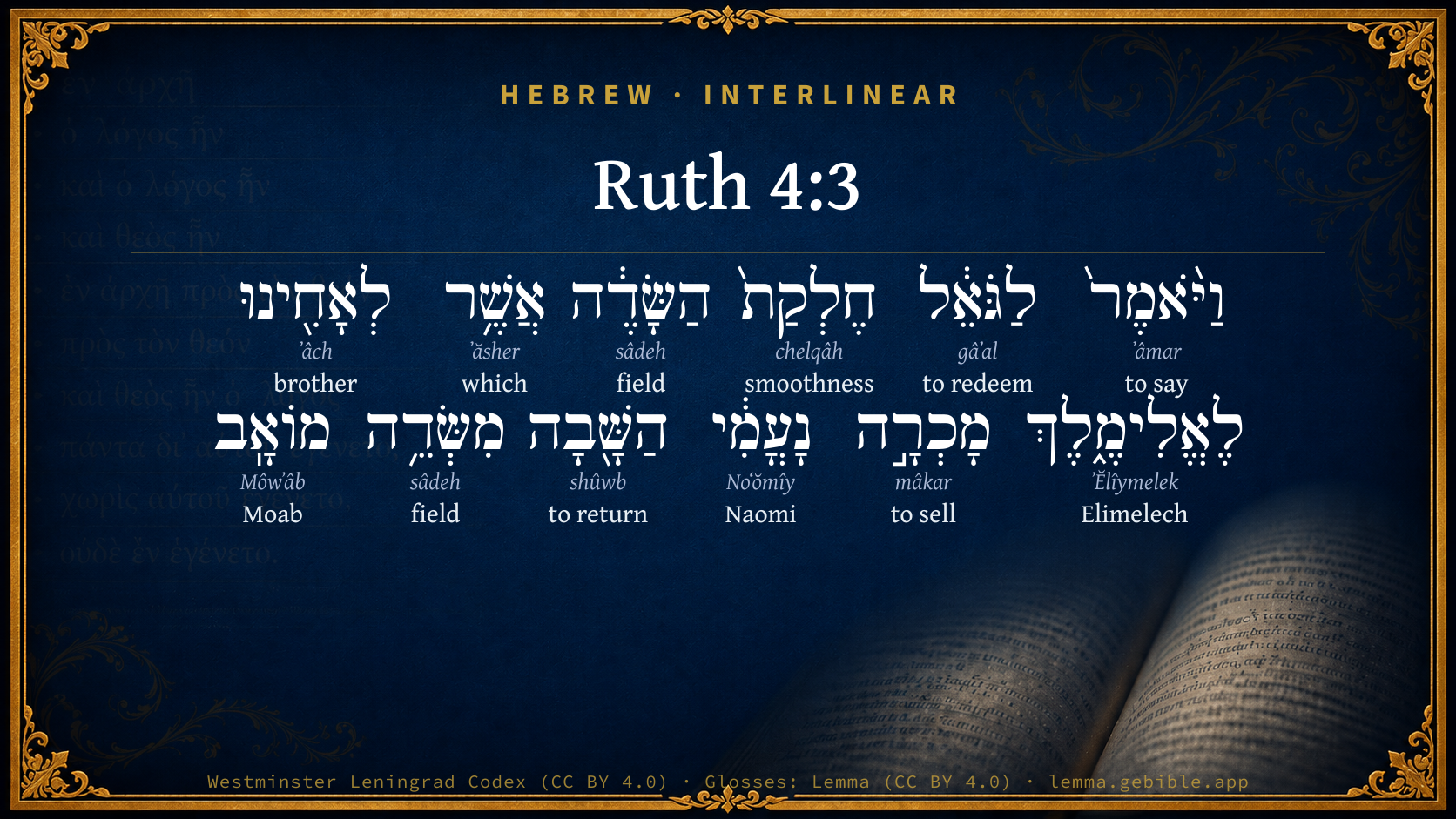
Hebrew (Westminster Leningrad Codex) Ruth 4:3 appears in the Hebrew Old Testament. The text above is from the Westminster Leningrad Codex. Each word links to its Strong’s number, a concise gloss, and parsing drawn from the Open Scriptures Hebrew Bible morphology. Click any word for its full Brown-Driver-Briggs (BDB) entry.
Download image
Cite this verse

Ruth 4:3 (World English Bible). Public Domain. Lemma interlinear Bible study tool, https://lemma.gebible.app/v/ruth/4/3.

Show BibTeX & RIS
BibTeX
RIS
English Translation
He said to the near kinsman, Naomi, who has come back out of the country of Moab, is selling the parcel of land, which was our brother Elimelech's:
World English Bible · Public Domain
Download a study sheet

One document with this verse’s original text, its word-by-word gloss line, the meaning frame, cross-references with their text, attributed commentary, and full source and license credits — printable, and it pastes into notes with its structure intact.

This verse Autodidact and up

Study sheet (.html) Plain text (.txt)

A passage Seminary Student

Up to 50 verses in one chapter. A passage sheet keeps up to 6 commentary sources and 12 cross-references per verse, in the order this page ranks them, and says so on the sheet whenever that leaves anything out. Ask for a single verse and you get the Autodidact verse sheet above.

Everything on this page stays free to read, with no account — the sheet is a download of what is already on screen, not access to it.

Want to remove ads? Support Godless Engineer
Compare translations 3

The same verse in 3 English versions, stacked beneath the original-language interlinear above. Click any original word for its lexicon entry.

Each is an independent rendering of the whole verse — the interlinear is not word-aligned to these translations.

Highlighted words mark where these versions differ — a whole-verse word diff, not a word-by-word alignment.

  • World English Bible Public Domain
    He said to the near kinsman, Naomi, who has come back out of the country of Moab, is selling the parcel of land, which was our brother Elimelech's:
  • King James Version Public Domain
    And he said unto the kinsman, Naomi, that is come again out of the country of Moab, selleth a parcel of land, which was our brother Elimelech's:
  • unfoldingWord Literal Text CC BY-SA 4.0
    Then he said to the kinsman-redeemer, “Naomi, the woman who has returned from the fields of Moab, is selling the portion of the field that belonged to our brother Elimelek.

unfoldingWord Literal Text — © unfoldingWord, licensed CC BY-SA 4.0. Word-aligned USFM3 via Door43 (git.door43.org/unfoldingWord/en_ult).

Versions to compare (up to 4)

3 of 4 selected

Show all 18 translations

Every available English version of this verse, each an independent rendering of the whole verse.

  • World English Bible Public Domain
    He said to the near kinsman, Naomi, who has come back out of the country of Moab, is selling the parcel of land, which was our brother Elimelech's:
  • Berean Standard Bible Public Domain
    And he said to the kinsman-redeemer, “Naomi, who has returned from the land of Moab, is selling the piece of land that belonged to our brother Elimelech.
  • Majority Standard Bible Public Domain
    And he said to the kinsman-redeemer, “Naomi, who has returned from the land of Moab, is selling the piece of land that belonged to our brother Elimelech.
  • King James Version Public Domain
    And he said unto the kinsman, Naomi, that is come again out of the country of Moab, selleth a parcel of land, which was our brother Elimelech's:
  • American Standard Version (1901) Public Domain
    And he said unto the near kinsman, Naomi, that is come again out of the country of Moab, selleth the parcel of land, which was our brother Elimelech's:
  • Revised Version (1885) Public Domain
    And he said unto the near kinsman, Naomi, that is come again out of the country of Moab, selleth the parcel of land, which was our brother Elimelech’s:
  • Geneva Bible (1599) Public Domain
    And he said vnto ye kinsman, Naomi, that is come againe out of ye countrey of Moab, wil sell a parcel of land, which was our brother Elimelechs.
  • Douay-Rheims (1899) Public Domain
    They sat down, and he spoke to the kinsman: Noemi, who is returned from the country of Moab, will sell a parcel of land that belonged to our brother Elimelech.
  • Young's Literal Translation Public Domain
    And he saith to the redeemer, `A portion of the field which `is' to our brother, to Elimelech, hath Naomi sold, who hath come back from the fields of Moab;
  • Literal Standard Version CC BY-SA 4.0
    And he says to the redeemer, “A portion of the field which [is] to our brother, to Elimelech, has Naomi sold, who has come back from the fields of Moab;
  • Unlocked Literal Bible CC BY-SA 4.0
    Boaz said to the near kinsman, “Naomi, who has returned from the country of Moab, is selling the parcel of land that was our brother Elimelek's.
  • unfoldingWord Literal Text CC BY-SA 4.0
    Then he said to the kinsman-redeemer, “Naomi, the woman who has returned from the fields of Moab, is selling the portion of the field that belonged to our brother Elimelek.
  • Darby Bible Public Domain
    And he said to him that had the right of redemption: Naomi, who is come back out of the country of Moab, sells the allotment that was our brother Elimelech's.
  • World Messianic Bible Public Domain
    He said to the near kinsman, “Naomi, who has come back out of the country of Moab, is selling the parcel of land, which was our brother Elimelech’s.
  • Webster's Bible Public Domain
    And he said to the kinsman, Naomi, that has come again out of the country of Moab, selleth a parcel of land, which was our brother Elimelech's:
  • Free Bible Version CC BY-SA 4.0
    Boaz said to the family redeemer, “Naomi who has returned from the country of Moab is selling the piece of land that belonged to Elimelech, our relative.
  • Bible in Basic English Public Domain
    Then he said to the near relation, Naomi, who has come back from the country of Moab, is offering for a price that bit of land which was our brother Elimelech's:
  • JPS Tanakh (1917) Public Domain
    And he said unto the near kinsman: 'Naomi, that is come back out of the field of Moab, selleth the parcel of land, which was our brother Elimelech's;

Literal Standard Version (2020), Covenant Press — licensed CC BY-SA 4.0. Text via the HelloAO Bible API (eBible.org). Unlocked Literal Bible (unfoldingWord) — licensed CC BY-SA 4.0. Text via the HelloAO Bible API (eBible.org). unfoldingWord Literal Text — © unfoldingWord, licensed CC BY-SA 4.0. Word-aligned USFM3 via Door43 (git.door43.org/unfoldingWord/en_ult). Free Bible Version, Dr. Jonathan Gallagher — licensed CC BY-SA 4.0. Text via the HelloAO Bible API (eBible.org).

Word by word

More ways to search: Search by grammar → Find every occurrence → Compare this word →

Practice this passage: Drill this verse → Learn its vocabulary →

לֶאֱלִימֶ֑לֶךְ
ʼĔlîymelek
H458
“to/for · Elimelech”
Preposition + Noun, Proper
Part of Speech
Preposition + Noun
Type
Proper
Full BDB Definition

Origin: from H410 and H4428

TWOT: None

Elimelech = "my God is king" - Naomi's husband
  1. וַיֹּ֨אמֶר֙ ʼâmar H559 “and · to say” Conjunction + Verb, Qal, Sequential Imperfect, 3rd Person, Masculine, Singular
  2. לַגֹּאֵ֔ל gâʼal H1350 “to/for the · redeeming” Preposition, Determined + Verb, Qal, Participle Active, Masculine, Singular, Absolute
  3. חֶלְקַת֙ chelqâh H2513 “smoothness of” Noun, Common, Feminine, Singular, Construct
  4. הַשָּׂדֶ֔ה sâdeh H7704 “the · field” Particle, Definite Article + Noun, Common, Masculine, Singular, Absolute
  5. אֲשֶׁ֥ר ʼăsher H834 “which” Particle, Relative
  6. לְאָחִ֖ינוּ ʼâch H251 “to/for · brother · our” Preposition + Noun, Common, Masculine, Singular, Construct + Suffix, Personal, 1st Person, Common, Plural
  7. מָכְרָ֣ה mâkar H4376 “to sell” Verb, Qal, Perfect, 3rd Person, Feminine, Singular
  8. נָעֳמִ֔י Noʻŏmîy H5281 “Naomi” Noun, Proper
  9. הַשָּׁ֖בָה shûwb H7725 “the · to return” Particle, Definite Article + Verb, Qal, Perfect, 3rd Person, Feminine, Singular
  10. מִשְּׂדֵ֥ה sâdeh H7704 “from · field of” Preposition + Noun, Common, Masculine, Singular, Construct
  11. מוֹאָֽב Môwʼâb H4124 “Moab” Noun, Proper

About this verse

These counts appear in no published source. They are computed here, from the morphology-tagged text and Lemma’s own curated glosses. What Lemma adds →

12
words
11
distinct lemmas
Historical
section

Notable vocabulary

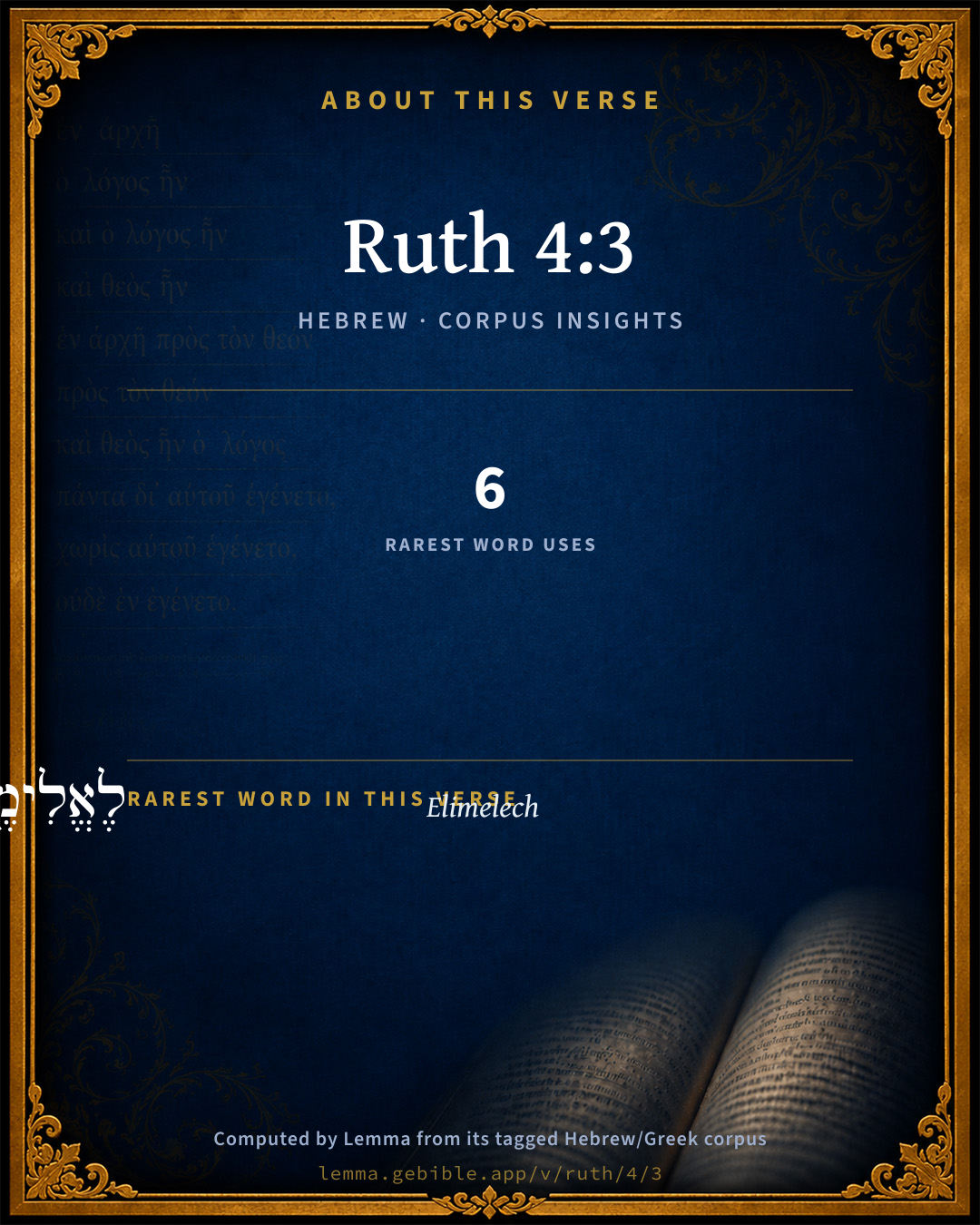
The rarest word here is לֶאֱלִימֶ֑לֶךְ Elimelech H458 — appearing just 6 times in the whole Hebrew Bible.

Shared distinctive vocabulary

לֶאֱלִימֶ֑לֶךְ Elimelech H458 occurs in 6 verses of the Hebrew Bible. Also found in:

Grammatical profile

  • 4 verbs
  • 7 nouns
  • 1 particle

Verb forms

  • וַיֹּ֨אמֶר֙ Qal · Sequential Imperfect
  • לַגֹּאֵ֔ל Qal · Participle Active
  • מָכְרָ֣ה Qal · Perfect
  • הַשָּׁ֖בָה Qal · Perfect

Repetition

A word recurs within this verse — often emphatic in Hebrew:

  • הַשָּׂדֶ֔ה field H7704 ×2

Hebrew & Septuagint length

In English translation the verse runs 28 words from the Hebrew and 32 from the Septuagint (LXX English) — closely comparable.

A rough comparison of the two English renderings, which tokenize alike — not a word-level alignment.

Word counts can differ between the Hebrew and the Greek without any difference in meaning — e.g. the Hebrew direct-object marker אֵת has no separate Greek word, and Greek often adds the article ὁ.

Cross-references

2

Topical passages linked to Ruth 4:3 in the Treasury of Scripture Knowledge — connected by theme and wording, ordered by reader-vote popularity; previews shown in the World English Bible.

  • Psalms 112:5 It is well with the man who deals graciously and lends. He will maintain his cause in judgment.
  • Proverbs 13:10 Pride only breeds quarrels, But with ones who take advice is wisdom.

Cross-references courtesy of OpenBible.info (CC BY 4.0).

Hebrew and Greek witnesses Masoretic Hebrew ↔ Greek Septuagint

The same verse in the two great witnesses to the Old Testament, shown verse-for-verse.

These are two independent witnesses, not word-aligned to each other, and the Septuagint is shown in lemma (dictionary) form.

Hebrew Ruth 4:3 Masoretic · Westminster Leningrad Codex

וַיֹּ֨אמֶר֙ לַגֹּאֵ֔ל חֶלְקַת֙ הַשָּׂדֶ֔ה אֲשֶׁ֥ר לְאָחִ֖ינוּ לֶאֱלִימֶ֑לֶךְ מָכְרָ֣ה נָעֳמִ֔י הַשָּׁ֖בָה מִשְּׂדֵ֥ה מוֹאָֽב

He said to the near kinsman, Naomi, who has come back out of the country of Moab, is selling the parcel of land, which was our brother Elimelech's:

World English Bible · Public Domain

Greek LXX Ruth 4:3 Septuagint · lemma form

καί εἶπον βοος ὁ ἀγχιστεύς ὁ μερίς ὁ ἀγρός ὅς εἰμί ὁ ἀδελφός ἐγώ ὁ αβιμελεχ ὅς δίδωμι νωεμιν ὁ ἐπιστρέφω ἐκ ἀγρός μωαβ

And Booz said to the relative, The matter regards the portion of the field which was our brother Elimelech's which was given to Noemin, now returning out of the land of Moab;

LXX2012 (modern English Septuagint) · Public Domain

Hebrew: Westminster Leningrad Codex (CC BY 4.0). Greek: Septuagint (public domain); English from LXX2012 (modern English Septuagint) (Public Domain). How the Septuagint differs from the Hebrew →

Commentary

Notes on Ruth 4:3 from classic Christian and Jewish commentators (each source and its license shown beneath its notes). The classic Christian expositions comment on the surrounding passage and are grouped to its opening verse, so a note may address several verses; the Jewish commentaries on the Tanakh (Rashi and others) are per-verse, so they appear only where the commentator wrote on this verse.

Lemma curates 59 commentaries, every one of them public domain or Creative Commons licensed, each selected and text-cleaned for this edition rather than reprinted as found. About our sources →

Trapp's Complete Commentary

John Trapp

Rth 4:3 And he said unto the kinsman, Naomi, that is come again out of the country of Moab, selleth a parcel of land, which [was] our brother Elimelech’s:

Ver. 3. And he said unto the kinsman.] Without a pleader, without preface or passion, in few and fit words he propounds the cause and brings it to an issue. Men should not go lightly to law, or spin out their suits to that length they do.

Naomi, that is come again, … selleth a parcel of land.] Boaz, having to do with a wily worldling, dealeth warily with him for prevention of further strife; telling him first of the land, and then of the wife that must go along with it. How forcible are right words!

John Trapp, A Commentary or Exposition upon All the Books of the Old and New Testament (1647–1656) — public domain. Text from a community e-Sword module.

Joseph Benson's Commentary

Rth 4:3. Naomi — Both Naomi and Ruth had an interest in this land during their lives, but he mentions only Naomi, because all was done by her direction; lest the mention of Ruth should raise a suspicion of the necessity of his marrying Ruth, before he had given his answer to the first proposition. Which was our brother Elimelech’s — He calls him their brother, because he was near of kin to them. And he mentions Naomi’s return out of the country of Moab, to intimate that her poverty constrained her to sell her estate which her husband left her.

Joseph Benson's Commentary on the Old and New Testaments (1811–1818) — public domain. Text from a community e-Sword module.

The Pulpit Commentary

And he said to the kinsman, Naomi, who has returned from the land of Moab, has resolved to sell the portion of land which belonged to our brother Elimelech. Boaz, it is evident, had talked over with Ruth the entire details of Naomi"s plans, and could thus speak authoritatively. Naomi, we must suppose, had previously taken Ruth into full confidence, so that Boaz could learn at second-hand what in other circumstances he would have learned from Naomi herself. The verb which we have rendered "has resolved to sell," is literally "has sold," and has been so rendered by many expositors, inclusive of Riegler and Wright. The Syriac translator gives the expression thus, "has sold to me." The subsequent context, however, makes it evident that the property had not been sold to any one, and consequently not to Boaz. The perfect verb is to be accounted for on the principle explained by Driver when he says, "The perfect is employed to indicate actions, the accomplishment of which lies indeed in the future, but is regarded as dependent upon such an unalterable determination of the will that it may be spoken of as having actually taken place: thus a resolution, promise, or decree, especially a Divine one, is very frequently announced in the perfect tense. A striking instance is afforded by (Rth_4:3) when Boaz, speaking of Naomi"s determination to sell her land, says ymin hrkm, literally, "has sold" (has resolved to sell. The English idiom would be "is selling")" ("Treatise on the Use of the Tenses in Hebrew," pp. 13, 14). In King James"s English version the verb is thus freely rendered selleth." Luther"s version is equivalent beut feil, offers for sale;" or, as Coverdale renders it, offereth to sell." Vatable freely renders it as we have done, "has determined to sell" (vendere decrepit) so Drusius (vendere instituit). The kind family feeling of Boaz, shining out m the expression, "our brother Ehmelech," is noteworthy. "Brother" was to him a homely and gracious term for "near kinsman.

Vers. 3-8. The goel.

Every nation has its own domestic and social usages. Among those prevalent in Israel was the relationship of the goel. He was the redeemer, or the next kinsman of one deceased, whose duty it was to purchase an inheritance in danger of lapsing, or to redeem one lapsed. The duties were defined in the Levitical law. According to the custom and regulation known as Levirate, he was expected to marry the widow of the deceased, and to raise up seed unto the dead, in case no issue were left of the marriage dissolved by death. From this Book of Ruth it is clear that the two duties, that with regard to property and that respecting marriage, centered in the same person. Failing the unnamed kinsman, it fell to the lot of Boaz to act the part of the near relative of Ruth"s deceased husband. Usages and laws differ, but the fact of kindred remains, and involves many duties.

I HUMAN KINDRED IS A DIVINE APPOINTMENT.

II AND IS BOTH SUGGESTIVE AND ILLUSTRATIVE OF RELIGIOUS, OF CHRISTIAN TRUTH. E.g. of the fatherhood of God; of the brotherhood of man; based upon that of Christ.

III KINDRED IS AT THE FOUNDATION OF HUMAN LIFE, AS SOCIAL AND POLITICAL.

IV KINDRED INVOLVES CONSIDERATION AND REGARD.

V AND, WHERE CIRCUMSTANCES RENDER IT EXPEDIENT, PRACTICAL HELP.

Appeal: Do we recognize the just claims of kindred? If we de not, is not our failure traceable to an imperfect apprehension of spiritual relationships? T.

The Pulpit Commentary (1880–1919), ed. H.D.M. Spence-Jones & Joseph S. Exell — public domain. Text from a community e-Sword module.

Tyndale Open Study Notes

Tyndale Open Resources

4:3 Naomi . . . is selling the land: Naomi probably did not have control of Elimelech’s ancestral land, though she did have legal title. She was selling the right to redeem it, or buy it back, from whoever was currently using it.

Tyndale Open Study Notes — © Tyndale Open Resources, licensed CC BY-SA 4.0. Text via the HelloAO Bible API.

Jamieson, Fausset & Brown

Robert Jamieson, A. R. Fausset & David Brown

Naomi . . . selleth a parcel of land--that is, entertains the idea of selling. In her circumstances she was at liberty to part with it (Lev 25:25). Both Naomi and Ruth had an interest in the land during their lives; but Naomi alone was mentioned, not only because she directed all the negotiations, but because the introduction of Ruth's name would awaken a suspicion of the necessity of marrying her, before the first proposition was answered.

Jamieson, Fausset & Brown — Commentary Critical and Explanatory on the Whole Bible (1871) — public domain (CC PDM 1.0). Text via the HelloAO Bible API.

Adam Clarke's Commentary

Verse 3. Naomi - selleth a parcel of land] She was reduced to want; the immediate inheritors were extinct, and it was now open for the next heir to purchase the land, and thus preserve the inheritance in the family according to the custom of Israel.

Adam Clarke's Commentary on the Bible (1810–1826) — public domain. Text from a community e-Sword/MySword module.

Ellicott's Commentary for English Readers

(3) Naomi selleth . . .—Rather, the portion of land, which belonged to our brother Elimelech. has Naomi sold. The present tense of the English Version seems to suggest that the sale is taking place at this particular time, but the meaning clearly is that Naomi, as the representative of the dead Elimelech had, so far as it was possible for an Israelite to part with a family estate, sold the land to obtain in some sort the means of living. In the year of Jubilee, the property would return to the family, on which it was, so to speak, settled, but Boaz proposes to the Goel that he should redeem the property at once. We might perhaps compare this to the owner of a freehold buying from a leaseholder under him the residue of his lease, so that he may occupy his own estate.

A Bible Commentary for English Readers, edited by Charles John Ellicott (1878–1897) — public domain. Text from a community e-Sword module.

The Cambridge Bible for Schools and Colleges

gen. ed. J. J. S. Perowne

3. selleth] The tense is perfect, and implies is resolved to sell; the sale does not take place till Rth_4:9. Cf. Gen_23:11; Gen_23:13, for the same idiomatic use of the perfect. Naomi came into possession of her husband’s property after his death, see Rth_4:9 n.; this was not in accordance with Pentateuchal law, which says nothing about the inheritance of widows.

our brother] in the wider sense of member of a family or race; cf. Exo_2:11, Lev_19:17, Jdg_14:3 etc.

The Cambridge Bible for Schools and Colleges (gen. ed. J. J. S. Perowne; Cambridge University Press, 1878–1918) — public domain. Text from a community e-Sword module.

John Gill's Exposition

And he said unto the kinsman,.... That is, Boaz said to the kinsman he called to, and who sat down by him before the ten elders that were present:

Naomi, that is come again out of the land of Moab, selleth a parcel of land; meaning, that she was determined upon it, and was about to do it, and would do it quickly, and he had it in commission to propose it to a purchaser:

which was our brother Elimelech's; not in a strict sense, but being akin to the kinsman and himself, and having been a neighbour of them all, and an inhabitant of the place, he is called their brother; though some Jewish writers (f) say, that he was in a strict sense a brother of Boaz and this kinsman, and that Tob, Elimelech, and Boaz, were brethren, and so Tob was reckoned the nearest kinsman, and had the first right to redeem, because he was the elder brother but this does not seem likely; See Gill on Rut 3:13.

(f) Midrash Ruth, fol. 34. 2.

John Gill's Exposition of the Whole Bible (1746–1763) — public domain (CC PDM 1.0). Text via the HelloAO Bible API.

Albert Barnes' Notes on the Bible

According to the law Lev 25:25-28, if any Israelite, through poverty, would sell his possession, the next of kin (the גאל gā'al) had a right to redeem it by paying the value of the number of years remaining until the jubilee (see the marginal reference). This right Boaz advertises the גאל gā'al of, so as to give him the option which the law secured to him of redeeming “our brother Elimelech’s” land, i. e. our kinsman’s, according to the common use of the term brother, for near relation (see Gen 13:8; Gen 24:27; Lev 25:25; Num 27:4; Jdg 9:1).

Albert Barnes' Notes on the Bible (1834–1885) — public domain. Text from a community e-Sword/MySword module.

Haydock's Catholic Bible Commentary

Will sell. Some Latin copies read, "sells, or has sold." But the sequel shews that she was only now disposed to do it. But what right had Noemi or Ruth to the land, since women could not inherit? The latter might indeed retain her title, as long as she continued unmarried. But Noemi only acted in her behalf. Selden thinks that their respective husbands had made them a present of some land. Josephus (ver. 11) asserts, that the person whom Booz addressed had already possession, and that he resigned his claim, as he would not take au other wife. (Calmet) --- Our brother. He was his nephew, and calls him brother, as Abraham did Lot. (Worthington)

George Leo Haydock (1774–1849), Haydock's Catholic Family Bible and Commentary, 1859 edition — public domain. Excludes Psalms (Douay-Rheims chapter numbering differs from Protestant) and Deuterocanonical books (Catholic canon only).

Matthew Poole's English Annotations

Both Naomi and Ruth had an interest in this land during their lives, but he mentions only Naomi, partly because all was done by her direction, to which Ruth wholly submitted herself; and partly lest the mention of Ruth should raise a suspicion of the necessity of his marrying Ruth, before he had given his answer to the first proposition.

Selleth a parcel of land; which she might do because of her poverty, Lev 25:25.

Matthew Poole's English Annotations on the Holy Bible (1683–1685) — public domain. Text from a community e-Sword/MySword module.

Whedon's Commentary on the Bible

Daniel D. Whedon

3. Naomi… selleth a parcel of land — According to the law, (Num_27:8-11,) when a man died and left no son, his property passed to his daughter; if he had no daughter, it passed to his brethren; if he had no brethren, it passed to his father’s brethren; and in case his father had no brethren, it passed to his next nearest kinsman. In no case did it pass to the wife of the deceased. Hence comes the question, What right had Naomi to sell Elimelech’s property? The solution of the difficulty is probably this, that, as the law did not designate the time when the proper heirs took possession of the inheritance, custom did not allow it to pass to them while the widow of the deceased was living. Naomi therefore would have the control of Elimelech’s property as long as she lived, and the selling of it was, as we have shown in the note at the head of this chapter, not a permanent disposal, but an annual renting of it till the year of jubilee.

Daniel D. Whedon (gen. ed.), Commentary on the Old and New Testaments (1874–1909) — public domain. Text from a community e-Sword module.

John Wesley's Explanatory Notes

Naomi - Both Naomi and Ruth had an interest in this land during their lives, but he mentions only Naomi, because all was done by her direction; lest the mention of Ruth should raise a suspicion of the necessity of his marrying Ruth, before he had given his answer to the first proposition.

John Wesley, Explanatory Notes Upon the Whole Bible (1754–1765) — public domain. Text via the GEBible commentary corpus.

unfoldingWord translationNotes

Door43 World Missions Community

Naomi ... is selling the parcel of land

It was the responsibility of the kinsman to buy back his relative's land and to care for his family. In this case, it meant the man must buy Naomi's land, marry Ruth, and care for Naomi.

in the presence of

This would make the transaction legal and binding.

redeem it

This meant to buy the land to keep it within their family.

I am after you

Boaz was the next kinsman in line to redeem the land.

translationWords

kin

Moab

elder

people group

redeem

unfoldingWord translationNotes — © Distant Shores Media and the Door43 World Missions Community, licensed CC BY-SA 4.0. Source: git.door43.org/Door43/en_tn.

Ibn Ezra

Rabbi Abraham ibn Ezra

"The parcel of land." It is possible that the field was large, and a portion of it belonged to Elimelech.

Ibn Ezra on the Tanakh — English translations: “Sefaria Community Translation” (CC0 1.0 (public-domain dedication)); “Yalkut, Sifsei Chachomim Chumash, Metsudah Publications, 2009” (CC BY 4.0); and “Commentary of Ibn Ezra on Isaiah - trans. by M. Friedlander, 1873” (public domain). Text via Sefaria.

Lesson kit

Teaching starters — assembled from the data on this page, not authored interpretation. Every prompt links to the verse data it draws on. Edit before teaching.

Ruth, in the Historical, opens this verse with 12 words (11 distinct Hebrew lemmas). Its most distinctive word is ʼĔlîymelek (“Elimelech”). A historical commentator’s framing appears above. Read the whole chapter for the surrounding context.

Discussion questions

  1. How does “Elimelech” (ʼĔlîymelek) shape what this verse is saying?
  2. Ruth 1:2 shares the word «Elimelech» with this verse. How do the two illuminate each other?
  3. “field” occurs 2× in this one verse. What is the effect of the repetition?
  4. These translations render this verse differently; the difference is in the English rendering, not the original. What questions does that raise?
  5. The verb «וַיֹּ֨אמֶר֙» is Qal Sequential Imperfect. How does its form color the action?
  6. Reading how Trapp's Complete Commentary and Joseph Benson's Commentary read this verse, where do the two commentators agree and where do they part?

Things to notice

Reading settings

Reading text

Shown beneath each verse's original-language words.

Old Testament
Old Testament edition

Read the OT as the Masoretic Hebrew (MT) or the Greek Septuagint (LXX).

English shown for the Greek Septuagint (in the Hebrew ↔ Greek comparison).

Comparing translations? Open the Compare panel on any verse page to stack up to four side by side.