Ruth 2:17

Hebrew (Westminster Leningrad Codex) Ruth 2:17 appears in the Hebrew Old Testament. The text above is from the Westminster Leningrad Codex. Each word links to its Strong’s number, a concise gloss, and parsing drawn from the Open Scriptures Hebrew Bible morphology. Click any word for its full Brown-Driver-Briggs (BDB) entry.
Download image
Cite this verse

Ruth 2:17 (World English Bible). Public Domain. Lemma interlinear Bible study tool, https://lemma.gebible.app/v/ruth/2/17.

Show BibTeX & RIS
BibTeX
RIS
English Translation
So she gleaned in the field until even; and she beat out that which she had gleaned, and it was about an ephah of barley.
World English Bible · Public Domain
Download a study sheet

One document with this verse’s original text, its word-by-word gloss line, the meaning frame, cross-references with their text, attributed commentary, and full source and license credits — printable, and it pastes into notes with its structure intact.

This verse Autodidact and up

Study sheet (.html) Plain text (.txt)

A passage Seminary Student

Up to 50 verses in one chapter. A passage sheet keeps up to 6 commentary sources and 12 cross-references per verse, in the order this page ranks them, and says so on the sheet whenever that leaves anything out. Ask for a single verse and you get the Autodidact verse sheet above.

Everything on this page stays free to read, with no account — the sheet is a download of what is already on screen, not access to it.

Want to remove ads? Support Godless Engineer
Compare translations 3

The same verse in 3 English versions, stacked beneath the original-language interlinear above. Click any original word for its lexicon entry.

Each is an independent rendering of the whole verse — the interlinear is not word-aligned to these translations.

Highlighted words mark where these versions differ — a whole-verse word diff, not a word-by-word alignment.

  • World English Bible Public Domain
    So she gleaned in the field until even; and she beat out that which she had gleaned, and it was about an ephah of barley.
  • King James Version Public Domain
    So she gleaned in the field until even, and beat out that she had gleaned: and it was about an ephah of barley.
  • unfoldingWord Literal Text CC BY-SA 4.0
    So she gleaned in the field until the evening. Then she beat out what she had gleaned, and it was about an ephah of barley.

unfoldingWord Literal Text — © unfoldingWord, licensed CC BY-SA 4.0. Word-aligned USFM3 via Door43 (git.door43.org/unfoldingWord/en_ult).

Versions to compare (up to 4)

3 of 4 selected

Show all 18 translations

Every available English version of this verse, each an independent rendering of the whole verse.

  • World English Bible Public Domain
    So she gleaned in the field until even; and she beat out that which she had gleaned, and it was about an ephah of barley.
  • Berean Standard Bible Public Domain
    So Ruth gathered grain in the field until evening. And when she beat out what she had gleaned, it was about an ephah of barley.
  • Majority Standard Bible Public Domain
    So Ruth gathered grain in the field until evening. And when she beat out what she had gleaned, it was about an ephah of barley.
  • King James Version Public Domain
    So she gleaned in the field until even, and beat out that she had gleaned: and it was about an ephah of barley.
  • American Standard Version (1901) Public Domain
    So she gleaned in the field until even; and she beat out that which she had gleaned, and it was about an ephah of barley.
  • Revised Version (1885) Public Domain
    So she gleaned in the field until even; and she beat out that she had gleaned, and it was about an ephah of barley.
  • Geneva Bible (1599) Public Domain
    So she gleaned in the fielde vntill euening, and she thresshed that shee had gathered, and it was about an Ephah of barly.
  • Douay-Rheims (1899) Public Domain
    She gleaned therefore in the field till evening: and beating out with a rod and threshing what she had gleaned, she found about the measure of an ephi of barley, that is, three bushels:
  • Young's Literal Translation Public Domain
    And she gleaneth in the field till the evening, and beateth out that which she hath gleaned, and it is about an ephah of barley;
  • Literal Standard Version CC BY-SA 4.0
    And she gleans in the field until the evening, and beats out that which she has gleaned, and it is about an ephah of barley;
  • Unlocked Literal Bible CC BY-SA 4.0
    So she gleaned in the field until evening. Then she beat out the ears of grain that she had gathered, and the grain was about an ephah of barley.
  • unfoldingWord Literal Text CC BY-SA 4.0
    So she gleaned in the field until the evening. Then she beat out what she had gleaned, and it was about an ephah of barley.
  • Darby Bible Public Domain
    And she gleaned in the field until even, and beat out what she had gleaned; and it was about an ephah of barley.
  • World Messianic Bible Public Domain
    So she gleaned in the field until evening; and she beat out that which she had gleaned, and it was about an efah of barley.
  • Webster's Bible Public Domain
    So she gleaned in the field until evening, and beat out that which she had gleaned: and it was about an ephah of barley.
  • Free Bible Version CC BY-SA 4.0
    Ruth worked in the field until the evening. When she beat out the grain that she had picked up it was a large amount.
  • Bible in Basic English Public Domain
    So she went on getting together the heads of grain till evening; and after crushing out the seed it came to about an ephah of grain.
  • JPS Tanakh (1917) Public Domain
    So she gleaned in the field until even; and she beat out that which she had gleaned, and it was about an ephah of barley.

Literal Standard Version (2020), Covenant Press — licensed CC BY-SA 4.0. Text via the HelloAO Bible API (eBible.org). Unlocked Literal Bible (unfoldingWord) — licensed CC BY-SA 4.0. Text via the HelloAO Bible API (eBible.org). unfoldingWord Literal Text — © unfoldingWord, licensed CC BY-SA 4.0. Word-aligned USFM3 via Door43 (git.door43.org/unfoldingWord/en_ult). Free Bible Version, Dr. Jonathan Gallagher — licensed CC BY-SA 4.0. Text via the HelloAO Bible API (eBible.org).

Word by word

More ways to search: Search by grammar → Find every occurrence → Compare this word →

Practice this passage: Drill this verse → Learn its vocabulary →

וַתַּחְבֹּט֙
châbaṭ
H2251
“and · to thresh”
Conjunction + Verb, Qal, Sequential Imperfect, 3rd Person, Feminine, Singular
Part of Speech
Conjunction + Verb
Stem
Qal
Form
Sequential Imperfect
Person
3rd Person
Gender
Feminine
Number
Singular
Full BDB Definition

Origin: a primitive root

TWOT: 591

to beat, beat out, beat off, thresh - (Qal) - to beat out - to beat off - (Niphal) to be beaten out
  1. וַתְּלַקֵּ֥ט lâqaṭ H3950 “and · to gather” Conjunction + Verb, Piel, Sequential Imperfect, 3rd Person, Feminine, Singular
  2. בַּשָּׂדֶ֖ה sâdeh H7704 “in/at the · field” Preposition, Determined + Noun, Common, Masculine, Singular, Absolute
  3. עַד ʻad H5704 “until” Preposition
  4. הָעָ֑רֶב ʻereb H6153 “the · evening” Particle, Definite Article + Noun, Common, Masculine, Singular, Absolute
  5. אֵ֣ת ʼêth H853 “-” Particle, Direct Object
  6. אֲשֶׁר ʼăsher H834 “which” Particle, Relative
  7. לִקֵּ֔טָה lâqaṭ H3950 “to gather” Verb, Piel, Perfect, 3rd Person, Feminine, Singular
  8. וַיְהִ֖י hâyâh H1961 “and · to be” Conjunction + Verb, Qal, Sequential Imperfect, 3rd Person, Masculine, Singular
  9. כְּאֵיפָ֥ה ʼêyphâh H374 “like/as · ephah” Preposition + Noun, Common, Feminine, Singular, Absolute
  10. שְׂעֹרִֽים sᵉʻôrâh H8184 “barley” Noun, Common, Feminine, Plural, Absolute

About this verse

These counts appear in no published source. They are computed here, from the morphology-tagged text and Lemma’s own curated glosses. What Lemma adds →

11
words
10
distinct lemmas
Historical
section

Notable vocabulary

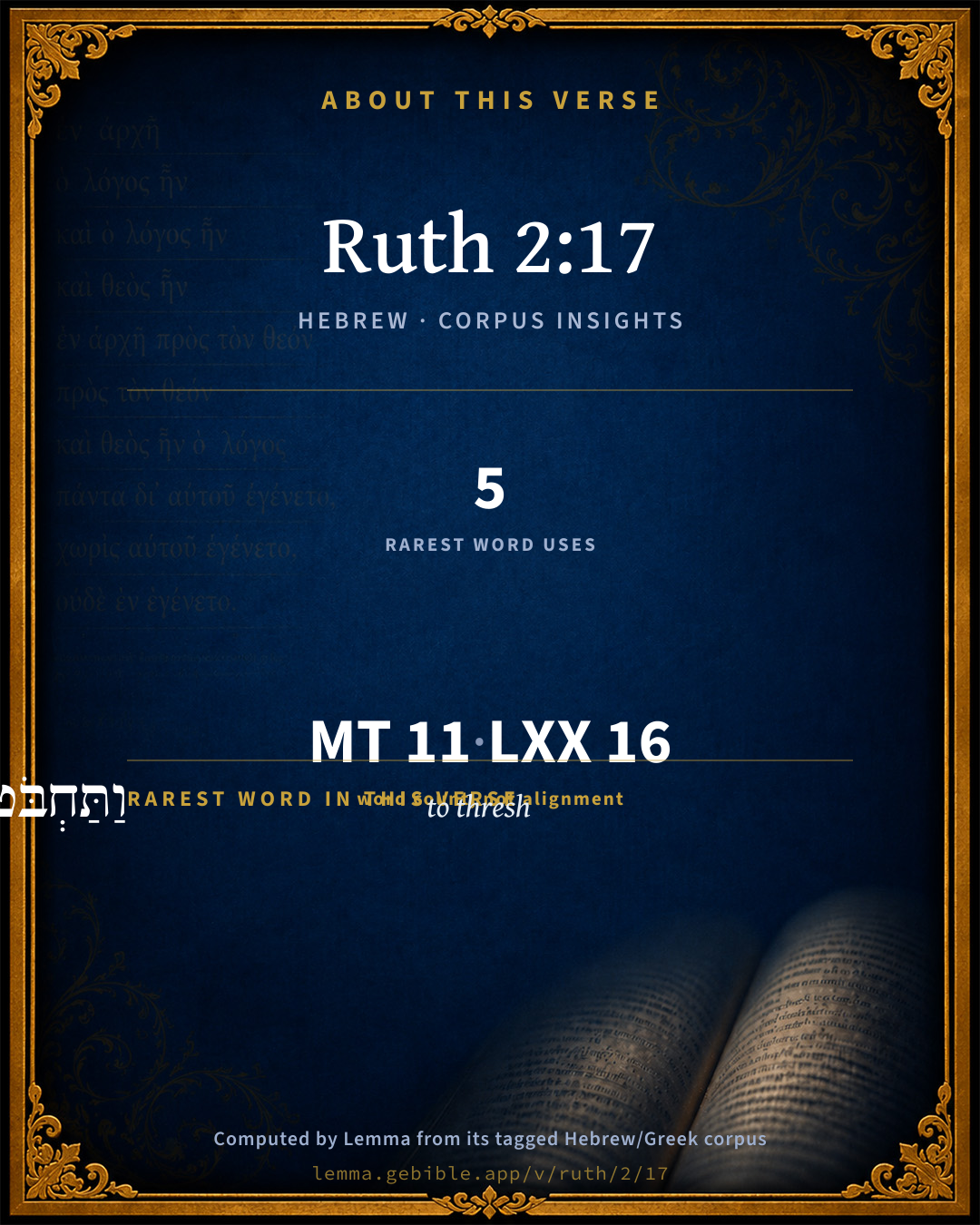
The rarest word here is וַתַּחְבֹּט֙ to thresh H2251 — appearing just 5 times in the whole Hebrew Bible.

Shared distinctive vocabulary

וַתַּחְבֹּט֙ to thresh H2251 occurs in 5 verses of the Hebrew Bible. Also found in:

Grammatical profile

  • 4 verbs
  • 4 nouns
  • 1 preposition
  • 2 particles

Verb forms

  • וַתְּלַקֵּ֥ט Piel · Sequential Imperfect
  • וַתַּחְבֹּט֙ Qal · Sequential Imperfect
  • לִקֵּ֔טָה Piel · Perfect
  • וַיְהִ֖י Qal · Sequential Imperfect

Repetition

A word recurs within this verse — often emphatic in Hebrew:

  • וַתְּלַקֵּ֥ט to gather H3950 ×2

Hebrew & Septuagint length

In English translation the verse runs 25 words from the Hebrew and 23 from the Septuagint (LXX English) — closely comparable.

A rough comparison of the two English renderings, which tokenize alike — not a word-level alignment.

Word counts can differ between the Hebrew and the Greek without any difference in meaning — e.g. the Hebrew direct-object marker אֵת has no separate Greek word, and Greek often adds the article ὁ.

In the original languages it is 11 Hebrew tokens and 16 Greek tokens — but the two are counted differently (Hebrew bundles its prefixes and suffixes into one token; the Greek is in lemma form), so that isn’t a like-for-like length.

Cross-references

3

Topical passages linked to Ruth 2:17 in the Treasury of Scripture Knowledge — connected by theme and wording, ordered by reader-vote popularity; previews shown in the World English Bible.

  • Proverbs 31:27 She looks well to the ways of her household, And doesn't eat the bread of idleness.
  • Ezekiel 45:11–12 The ephah and the bath shall be of one measure, that the bath may contain the tenth part of a homer, and the ephah the tenth part of a homer: the measure of it shall be after the homer.
  • Exodus 16:36 Now an omer is the tenth part of an ephah.

Cross-references courtesy of OpenBible.info (CC BY 4.0).

Hebrew and Greek witnesses Masoretic Hebrew ↔ Greek Septuagint

The same verse in the two great witnesses to the Old Testament, shown verse-for-verse.

These are two independent witnesses, not word-aligned to each other, and the Septuagint is shown in lemma (dictionary) form.

Hebrew Ruth 2:17 Masoretic · Westminster Leningrad Codex

וַתְּלַקֵּ֥ט בַּשָּׂדֶ֖ה עַד הָעָ֑רֶב וַתַּחְבֹּט֙ אֵ֣ת אֲשֶׁר לִקֵּ֔טָה וַיְהִ֖י כְּאֵיפָ֥ה שְׂעֹרִֽים

So she gleaned in the field until even; and she beat out that which she had gleaned, and it was about an ephah of barley.

World English Bible · Public Domain

Greek LXX Ruth 2:17 Septuagint · lemma form

καί συνλέγω ἐν ὁ ἀγρός ἕως ἑσπέρα καί ραβδίζω ὅς συνλέγω καί γίγνομαι ὡς οἰφί κριθή

So she gleaned in the field till evening, and beat out that she had gleaned, and it was about an ephah of barely.

LXX2012 (modern English Septuagint) · Public Domain

Hebrew: Westminster Leningrad Codex (CC BY 4.0). Greek: Septuagint (public domain); English from LXX2012 (modern English Septuagint) (Public Domain). How the Septuagint differs from the Hebrew →

Commentary

Notes on Ruth 2:17 from classic Christian and Jewish commentators (each source and its license shown beneath its notes). The classic Christian expositions comment on the surrounding passage and are grouped to its opening verse, so a note may address several verses; the Jewish commentaries on the Tanakh (Rashi and others) are per-verse, so they appear only where the commentator wrote on this verse.

Lemma curates 59 commentaries, every one of them public domain or Creative Commons licensed, each selected and text-cleaned for this edition rather than reprinted as found. About our sources →

Matthew Henry's Commentary

Here, I. Ruth finishes her day's work, Rut 2:17. 1. She took care not to lose time, for she gleaned until evening. We must not be weary of well-doing, because in due season we shall reap. She did not make an excuse to sit still, or go home, till the evening. Let us work the works of him that sent us, while it is day. She scarcely used, much less did she abuse, the kindness of Boaz; for, though he ordered his servants to leave handfuls for her, she continued to glean the scattered ears. 2. She took care not to lose what she had gathered, but threshed it herself, that she might the more easily carry it home, and might have it ready for use. The slothful man roasteth not that which he took in hunting, and so loseth the benefit of it, but the substance of a diligent man is precious, Pro 12:27. Ruth had gathered it ear by ear, but, when she had put it all together, it was an ephah of barley, about four pecks. Many a little makes a great deal. It is an encouragement to industry that in all labour, even that of gleaning, there is profit, but the talk of the lips tendeth only to penury. When she had got her corn into as little compass as she could, she took it up herself, and carried it into the city, though, had she asked them, it is likely some of Boaz's servants would have done that for her. We should study to be as little as possible troublesome to those that are kind to us. She did not think it either too hard or too mean a service to carry her corn herself into the city, but was rather pleased with what she had gotten by her own industry, and careful to secure it; and let us thus take care that we lose not those things which we have wrought, which we have gained, Jo2 1:8.

II. She paid her respects to her mother-in-law, went straight home to her and did not go to converse with Boaz's servants, showed her what she had gleaned, that she might see she had not been idle.

1. She entertained her with what she had left of the good dinner Boaz had given her. She gave to her what she had reserved, after she was sufficed (Rut 2:18), which refers to Rut 2:14. If she had any thing better than another, her mother should have part with her. Thus, having shown industry abroad, she showed piety at home; so children's maintaining their parents is called (Ti1 5:4), and it is part of the honour due to them by the fifth commandment, Mat 15:6.

2. She gave her an account of her day's work, and how a kind providence had favoured her in it, which made it very comfortable to her; for the gleanings that a righteous man hath are better than the harvests of many wicked, Psa 37:16. (1.) Naomi asked her where she had been: Where hast thou gleaned today? Note, Parents should take care to enquire into the ways of their children, how, and where, and in what company they spend their time. This may prevent many extravagancies which children, left to themselves, run into, by which they bring both themselves and their parents to shame. If we are not our brethren's, yet surely we are our children's keepers: and we know what a son Adonijah proved, that had never been chidden. Parents should examine their children, not to frighten nor discourage them, not so as to make them hate home or tempt them to tell a lie, but to commend them if they have done well, and with mildness to reprove and caution them if they have done otherwise. It is a good question for us to ask ourselves in the close of every day, "Where have I gleaned today? What improvements have I made in knowledge and grace? What have I done or obtained that will turn to a good account?" (2.) Ruth gave her a particular account of the kindness she had received from Boaz (Rut 2:19) and the hopes she had of further kindness from him, he having ordered her to attend his servants throughout all the harvest, Rut 2:21. Note, Children should look upon themselves as accountable to their parents and to those that are over them, and not think it a disparagement to them to be examined; let them do that which is good, and they shall have praise of the same. Ruth told her mother what kindness Boaz had shown her, that she might take some occasion or another to acknowledge it and return him thanks; but she did not tell her how Boaz had commended her, v. 11. Humility teaches us, not only not to praise ourselves, but not to be forward to publish others' praises of us. (3.) We are here told what Naomi said to it. [1.] She prayed heartily for him that had been her daughter's benefactor, even before she knew who it was (Rut 2:19): Blessed be he, whoever he was, that did take knowledge of thee, shooting the arrow of prayer at a venture. But more particularly when she was told who it was (Rut 2:20): Blessed be he of the Lord. Note, The poor must pray for those that are kind and liberal to them, and thus requite them, when they are not capable of making them any other requital. Let the loins of the poor bless those that refresh them, Job 29:13; Job 31:20. And he that hears the cries of the poor against their oppressors (Exo 22:27), it may be hoped, will hear the prayers of the poor for their benefactors. She now remembered the former kindnesses Boaz had shown to her husband and sons, and joins those to this: he has not left off his kindness to the living and to the dead. If we generously show kindness even to those that seem to have forgotten our former favours, perhaps it may help to revive the remembrance even of those which seem buried. [2.] She acquainted Ruth with the relation their family was in to Boaz: The man is near of kin to us. It should seem she had been so long in Moab that she had forgotten her kindred in the land of Israel, till by this providence God brought it to her mind. At least she had not told Ruth of it, though it might have been some encouragement to a young proselyte. Unlike to humble Naomi are many, who, though fallen into decay themselves, are continually boasting of their great relations. Nay, Observe the chain of thought here, and in it a chain of providences, bringing about what was designed concerning Ruth. Ruth names Boaz as one that had been kind to her. Naomi bethinks herself who that should be, and presently recollects herself: "The man is near of kin to us; now that I hear his name, I remember him very well." This thought brings in another: "He is our next kinsman, our goel, that has the right to redeem our estate that was mortgaged, and therefore from him we may expect further kindness. He is the likeliest man in all Bethlehem to set us up." Thus God brings things to our mind, sometimes on a sudden, that prove to have a wonderful tendency to our good. [3.] She appointed Ruth to continue her attendance in the fields of Boaz (Rut 2:22): "Let them not meet thee in any other field, for that will be construed a contempt of his courtesy." Our blessed Saviour is our Goel; it is he that has a right to redeem. If we expect to receive benefit by him, let us closely adhere to him, and his fields, and his family; let us not go to the world and its fields for that which is to be had with him only, and which he has encouraged us to expect from him. Has the Lord dealt bountifully with us? Let us not be found in any other field, nor seek for happiness and satisfaction in the creature. Tradesmen take it ill if those that are in their books go to another shop. We lose divine favours if we slight them. Some think Naomi gave her daughter-in-law a tacit rebuke; she had spoken (Rut 2:21) of keeping fast by the young men. "Nay," said Naomi (Rut 2:22), "It is good that thou go out with his maidens; they are fitter company for thee than the young men." But they are too critical. Ruth spoke of the young men because they were the principal labourers, and to them Boaz had given directions concerning her; and Naomi takes it for granted that, while she attended the young men, her society would be with the maidens, as was fit. Ruth dutifully observed her mother's directions; she continued to glean, to the end, not only of barley-harvest, but of the wheat-harvest, which followed it, that she might gather food in harvest to serve for winter, Pro 6:6-8. She also kept fast by the maidens of Boaz, with whom she afterwards cultivated an acquaintance, which might do her service, Rut 2:23. But she constantly came to her mother at night in due time, as became a virtuous woman, that was for working days, and not for merry nights. And when the harvest was ended (as bishop Patrick expounds it) she did not gad abroad, but kept her aged mother company at home. Dinah went out to see the daughters of the land, and we know what a disgrace her vanity ended in. Ruth kept at home, and helped to maintain her mother, and went out on no other errand than to get provision for her, and we shall find afterwards what preferment her humility and industry ended in. Seest thou a man diligent in his business? Honour is before him.

Matthew Henry's Commentary on the Whole Bible (1708–1710) — public domain (CC PDM 1.0). Text via the HelloAO Bible API.

Trapp's Complete Commentary

John Trapp

Rth 2:17 So she gleaned in the field until even, and beat out that she had gleaned: and it was about an ephah of barley.

Ver. 17. Until even.] Strengthening herself to her labour, as that good housewife, {Pro 31:17} and laying her bones to work.

About an ephah.] Almost a bushel, her back burden.

John Trapp, A Commentary or Exposition upon All the Books of the Old and New Testament (1647–1656) — public domain. Text from a community e-Sword module.

The Biblical Illustrator

Joseph S. Exell

Rth_2:17

So she gleaned in the field until even.

Persevering labour

1. Gleaners in gospel-fields should continue in their gleaning work from morning to evening. How many are but half Sabbath folk, that can spare to spend a morning in Sabbath service, but are for their pastimes after that! Ruth was none of those lazy gleaners.

2. Though God be very bountiful to us, yet will He have us to use all the means in a way of subserviency to His bounty. God will give us at the second-hand what He would not give us at first-hand; He will give us grace and knowledge by the use of the means, which He gives not immediately from Himself. God sells all for labour, saith Hesiod. (C. Ness.)

Labour

I. no labour is too insignificant for love. So she gleaned. She was of a good family, accustomed to a life of ease and plenty. That which she does now is anything but dignified.

1. A work for the commonest powers.

2. A work for the commonest people.

3. A work whose results bear no comparison to the expenditure of labour.

4. A work in which is redone that which has been considered as done.

Men measure the worth of work by its conspicuousness. The real worth of work lies in meeting the necessity for its existence, and the motive which inspires it. Two lives depend upon her toil--then her work has worth; she loves the woman for whom she toils--then her work has dignity. Her love consecrates lowest means for highest ends.

II. no results of labour are too insignificant for care. She beat out that she had gleaned.(S. B. Rees.)

The successful gleaner

1. Ruth was a gleaner; and so should we be. The Bible is that field. Search the Scriptures; glean there. Pick up every grain, for it contains precious nourishment. No matter how many gleaners; there is food enough for all.

2. Alas, how many careless ones there are, who never glean at all! They loiter all the day of their life idle. And so, when night comes, they sink into eternity with nothing done.

3. Others, again, begin when Ruth leaves off, at even. All the bright and sunny portion of their lives they give to the world.

4. Ruth began gleaning in the morning. She felt that every hour must be employed; that every moment was precious. She laboured diligently. May we make Gods Word our daily study! (Bp. Oxenden.)

The Biblical Illustrator, edited by Joseph S. Exell (c. 1880s–1900s) — public domain. Text from a community e-Sword module.

Joseph Benson's Commentary

Rth 2:17-18. An ephah — About a bushel of our measure. Gave to her what she had reserved — At dinner, after she had eaten, and was sufficed — Or satisfied. This shows Ruth’s care of her mother-in-law, whom she had in her mind when she was feasted with the reapers with more than she could eat, and therefore brought what she left home for her refreshment.

Joseph Benson's Commentary on the Old and New Testaments (1811–1818) — public domain. Text from a community e-Sword module.

Jamieson, Fausset & Brown

Robert Jamieson, A. R. Fausset & David Brown

and beat out that she had gleaned--When the quantity of grain was small, it was beat out by means of a stick.

an ephah--supposed to contain about a bushel.

Jamieson, Fausset & Brown — Commentary Critical and Explanatory on the Whole Bible (1871) — public domain (CC PDM 1.0). Text via the HelloAO Bible API.

Adam Clarke's Commentary

Verse 17. An ephah of barley.] Not less than seven gallons and a half; a good day's work. On Hebrew measures of capacity, See Clarke on Ex 16:16.

Adam Clarke's Commentary on the Bible (1810–1826) — public domain. Text from a community e-Sword/MySword module.

Ellicott's Commentary for English Readers

(17) Beat out.—That is, she threshed it herself, so as to save the labour of carrying away the straw. She then found she had an ephah, that is, rather more than four pecks.

A Bible Commentary for English Readers, edited by Charles John Ellicott (1878–1897) — public domain. Text from a community e-Sword module.

The Cambridge Bible for Schools and Colleges

gen. ed. J. J. S. Perowne

17. she beat out] Cf. Jdg_6:11.

an ephah] Approximately equivalent to our bushel.

The Cambridge Bible for Schools and Colleges (gen. ed. J. J. S. Perowne; Cambridge University Press, 1878–1918) — public domain. Text from a community e-Sword module.

John Gill's Exposition

So she gleaned in the field until even,.... An instance of her great diligence and industry, attending to this mean employment constantly from morning tonight:

and beat out that she had gleaned: she did not bind up her gleanings in a bundle, and carry it home on her head, as gleaners with us do, but she beat it out with a staff in the field, where she gleaned it, and winnowed it, very probably in the threshingfloor of Boaz; by which means what she had gleaned was brought into a lesser size and weight, and was a lighter burden to carry home:

and it was an ephah of barley; or three seahs of barley, as the Targum; which, according to Bishop Cumberland (i), was six gallons, and three pints, and three solid inches: an omer is said to be the tenth part of an ephah, and, made into bread, was as much as a man could eat in one day, Exo 16:16, so that Ruth got enough in one day, for herself and her mother-in-law, which would last five days at least. This was a great deal for one woman to pick up, ear by ear, in one day; and must be accounted for, not only by her diligence and industry, but by the favour shown her by the reapers, under the direction of Boaz, who suffered her to glean among the sheaves, and let fall handfuls for her to pick up.

(i) Of Scripture Weights and Measures, ch. 3. p. 64.

John Gill's Exposition of the Whole Bible (1746–1763) — public domain (CC PDM 1.0). Text via the HelloAO Bible API.

Albert Barnes' Notes on the Bible

And beat out that she had gleaned - Namely, with a stick, as the word implies (compare Deu 24:20; Isa 27:12). This method is still commonly practiced. Ruth gleaned enough to support herself and her mother-in-law for five days Exo 16:16.

Albert Barnes' Notes on the Bible (1834–1885) — public domain. Text from a community e-Sword/MySword module.

Haydock's Catholic Bible Commentary

Rod, as Gedeon had done, Judges vi. 11. --- That is, &c., an explanation of the Vulgate. (Calmet)-The ephi contained three pecks and three pints. (Arbuthnot) --- Alcazar and Cornelius a Lapide say 960 ounces. (Menochius)

George Leo Haydock (1774–1849), Haydock's Catholic Family Bible and Commentary, 1859 edition — public domain. Excludes Psalms (Douay-Rheims chapter numbering differs from Protestant) and Deuterocanonical books (Catholic canon only).

Matthew Poole's English Annotations

An ephah is thought to contain about a bushel. See Exo 16:36; Lev 5:11.

Matthew Poole's English Annotations on the Holy Bible (1683–1685) — public domain. Text from a community e-Sword/MySword module.

Whedon's Commentary on the Bible

Daniel D. Whedon

17. Beat out… had gleaned — This process is often witnessed by the modern traveller in the East. In passing a harvest field near Gaza, Robinson observes: “Several women were beating out with a stick handfuls of the grain which they seemed to have gleaned.” About an ephah — About a bushel and a half, a large amount for a gleaner to gather in a single day.

Daniel D. Whedon (gen. ed.), Commentary on the Old and New Testaments (1874–1909) — public domain. Text from a community e-Sword module.

The Pulpit Commentary

And she gleaned in the field until the evening, and beat out what she had gleaned, and it was about an ephah of barley.

Gathering together her various sheaves, lots, or bundles (see ver. 7), she threshed them with some suitable rod or simple "flail" (flagellum), which she had either brought with her in the morning, as part of her equipment as a gleaner, or had obtained at the hut; or perhaps, like many others, she would make use of a convenient stone. Speaking of the village of Huj, near Gaza, Robinson says, "We found the lazy inhabitants still engaged in treading out the barley harvest, which their neighbors had completed long before. Several women were beating out with a stick handfuls of the grain which they seemed to have gleaned. One female was grinding with a hand mill, turning the mill with one hand, and occasionally dropping in the grain with the other" ("Researches," vol. 2. p. 385). "In the evening," says Dr. W. M. Thomson, "you might see some poor woman or maiden, that had been permitted to glean on her own account, sitting by the roadside, and beating out with a stick or a stone what she had gathered, as Ruth did. I have often watched this process in various parts of the country" ("The Land and the, Book," p. 647). The diligent gleaner on Boaz"s field found, after threshing, that she had nearly an ephah of barley. It would be a considerable load for a female to curry about a bushel. Josephus mentions incidentally, in his "Antiquities" (15:9, 2), that the Hebrew cot or homer was equivalent to ten Attic medimnoi. But as the ephah was exactly the tenth part of a cor or homer, it follows that the Hebrew ephah was equivalent to the Attic medimnov . Moreover, just as the ephah was the tenth part of a homer, so the omer was the tenth part of an ephah; (Exo_16:36) and thus, if an omer of barley would be somewhat equivalent for nutritive purposes to an omer of manna, it would be a sufficient daily allowance for a man. (see Exo_16:16) Hence Ruth would take home with her what would suffice for several days" sustenance to Naomi and herself.

The Pulpit Commentary (1880–1919), ed. H.D.M. Spence-Jones & Joseph S. Exell — public domain. Text from a community e-Sword module.

John Wesley's Explanatory Notes

An Ephah - About a bushel.

John Wesley, Explanatory Notes Upon the Whole Bible (1754–1765) — public domain. Text via the GEBible commentary corpus.

Keil & Delitzsch

C. F. Keil & F. Delitzsch

Thus Ruth gleaned till the evening in the field; and when she knocked out the ears, she had about an ephah (about 20-25 lbs.) of barley.

Rut 2:18

This she brought to her mother-in-law in the city, and "drew out (sc., from her pocket, as the Chaldee has correctly supplied) what she had left from her sufficiency," i.e., of the parched corn which Boaz had reached her (Rut 2:14).

Rut 2:19-20

The mother inquired, "where hast thou gleaned to-day, and where wroughtest thou?" and praised the benefactor, who, as she conjecture from the quantity of barley collected and the food brought home, had taken notice of Ruth: "blessed be he that did take knowledge of thee!" When she heard the name of the man, Boaz, she saw that this relative of her husband had been chosen by God to be a benefactor of herself and Ruth, and exclaimed, "Blessed be he of the Lord, that he has not left off (withdrawn) his favour towards the living and the dead!" On חסדּו עזב see Gen 24:27. This verb is construed with a double accusative here; for את cannot be a preposition, as in that case מאת would be used like מעם in Gen. l.c. "The living," etc., forms a second object: as regards (with regard to) the living and the dead, in which Naomi thought of herself and Ruth, and of her husband and sons, to whom God still showed himself gracious, even after their death, through His care for their widows. In order to enlighten Ruth still further upon the matter, she added, "The man (Boaz) is our relative, and one of our redeemers." He "stands near to us," sc., by relationship. גּאלנוּ, a defective form for גּאלינוּ, which is found in several MSS and editions. On the significance of the gol, or redeemer, see at Lev 25:26, Lev 25:48-49, and the introduction to Ruth 3.

Rut 2:21

Ruth proceeded to inform her of his kindness: כּי גּם, "also (know) that he said to me, Keep with my people, till the harvest is all ended." The masculine הנּערים, for which we should rather expect the feminine נערות in accordance with Rut 2:8, Rut 2:22, Rut 2:23, is quite in place as the more comprehensive gender, as a designation of the reapers generally, both male and female; and the expression לי אשׁר in this connection in the sense of my is more exact than the possessive pronoun: the people who belong to my house, as distinguished from the people of other masters.

Rut 2:22

Naomi declared herself fully satisfied with this, because Ruth would be thereby secured from insults, which she might receive when gleaning in strange fields. "That they meet thee not," lit. "that they do not fall upon thee." בּ פּגע signifies to fall upon a person, to smite and ill-treat him.

Rut 2:23

After this Ruth kept with the maidens of Boaz during the whole of the barley and wheat harvests gleaning ears of corn, and lived with her mother-in-law, sc., when she returned in the evening from the field. In this last remark there is a tacit allusion to the fact that a change took place for Ruth when the harvest was over.

Keil & Delitzsch — Biblical Commentary on the Old Testament (1861–1891) — public domain (CC PDM 1.0). Text via the HelloAO Bible API. (Old Testament only.)

unfoldingWord translationNotes

Door43 World Missions Community

beat out

She separated the edible part of the grain from the hull and stalk, which is thrown away.

ears of grain

This refers to the eatable part of the grain. (See: Idiom)

about an ephah of barley

An ephah is a unit of measurement equal to about 22 liters. AT: "about 22 liters of barley" (See: Biblical Volume)

She lifted it up and went into the city

It is implied that Ruth carried the grain home. (See: Assumed Knowledge and Implicit Information)

her mother-in-law saw

"Naomi saw"

translationWords

glean

grain

Ruth

unfoldingWord translationNotes — © Distant Shores Media and the Door43 World Missions Community, licensed CC BY-SA 4.0. Source: git.door43.org/Door43/en_tn.

Ibn Ezra

Rabbi Abraham ibn Ezra

And it was about an ephah of barley. Once a man asked me, what is the significance of 'an ephah of barley'. I told him there is no point to the question because the text simply reports what happened. I appeared foolish in his eyes, and he told me there was indeed a meaning, but I remained silent and did not ask him. Then, one day he came and told me that there are many reasons.

One reason is that Ruth saw prophetically that one of her descendants would establish a pillar in the name of her husband, and the term 'ephah' - alludes to the 166 pomegranates that were on the pillar, which in gematria (numerical value) equals 'ephah', and 'barley' as in 'measures' like 'measure of his life'. Another reason, 'and it was' - these two words, one in Aramaic and one in Hebrew. It signifies when she saw that Absalom, one of her descendants, would be hanged, and the letters 'kaf' and 'aleph' hint at the years of Absalom's life until his death. And then 'an ephah of barley' - in plural form, because it was a heavy burden for him. Another reason is that the initial letters of 'ephah' and 'barley' together make 'Jesse' in gematria, who was a complete righteous man. Then he rejoiced and his heart settled within him.

Ibn Ezra on the Tanakh — English translations: “Sefaria Community Translation” (CC0 1.0 (public-domain dedication)); “Yalkut, Sifsei Chachomim Chumash, Metsudah Publications, 2009” (CC BY 4.0); and “Commentary of Ibn Ezra on Isaiah - trans. by M. Friedlander, 1873” (public domain). Text via Sefaria.

Lesson kit

Teaching starters — assembled from the data on this page, not authored interpretation. Every prompt links to the verse data it draws on. Edit before teaching.

Ruth, in the Historical, opens this verse with 11 words (10 distinct Hebrew lemmas). Its most distinctive word is châbaṭ (“to thresh”). A historical commentator’s framing appears above. Read the whole chapter for the surrounding context.

Discussion questions

  1. How does “to thresh” (châbaṭ) shape what this verse is saying?
  2. How does Deuteronomy 24:20, which shares the word «to thresh», read alongside this verse?
  3. What does the repetition of “to gather” (2× in this one verse) do in this verse?
  4. These translations render this verse differently; the difference is in the English rendering, not the original. What questions does that raise?
  5. «וַתְּלַקֵּ֥ט» is a Piel Sequential Imperfect verb. How does that grammatical form shape the action described?
  6. Compare how Matthew Henry's Commentary and Trapp's Complete Commentary read this verse. Where do they agree or differ?

Things to notice

Reading settings

Reading text

Shown beneath each verse's original-language words.

Old Testament
Old Testament edition

Read the OT as the Masoretic Hebrew (MT) or the Greek Septuagint (LXX).

English shown for the Greek Septuagint (in the Hebrew ↔ Greek comparison).

Comparing translations? Open the Compare panel on any verse page to stack up to four side by side.