
Job 5:23

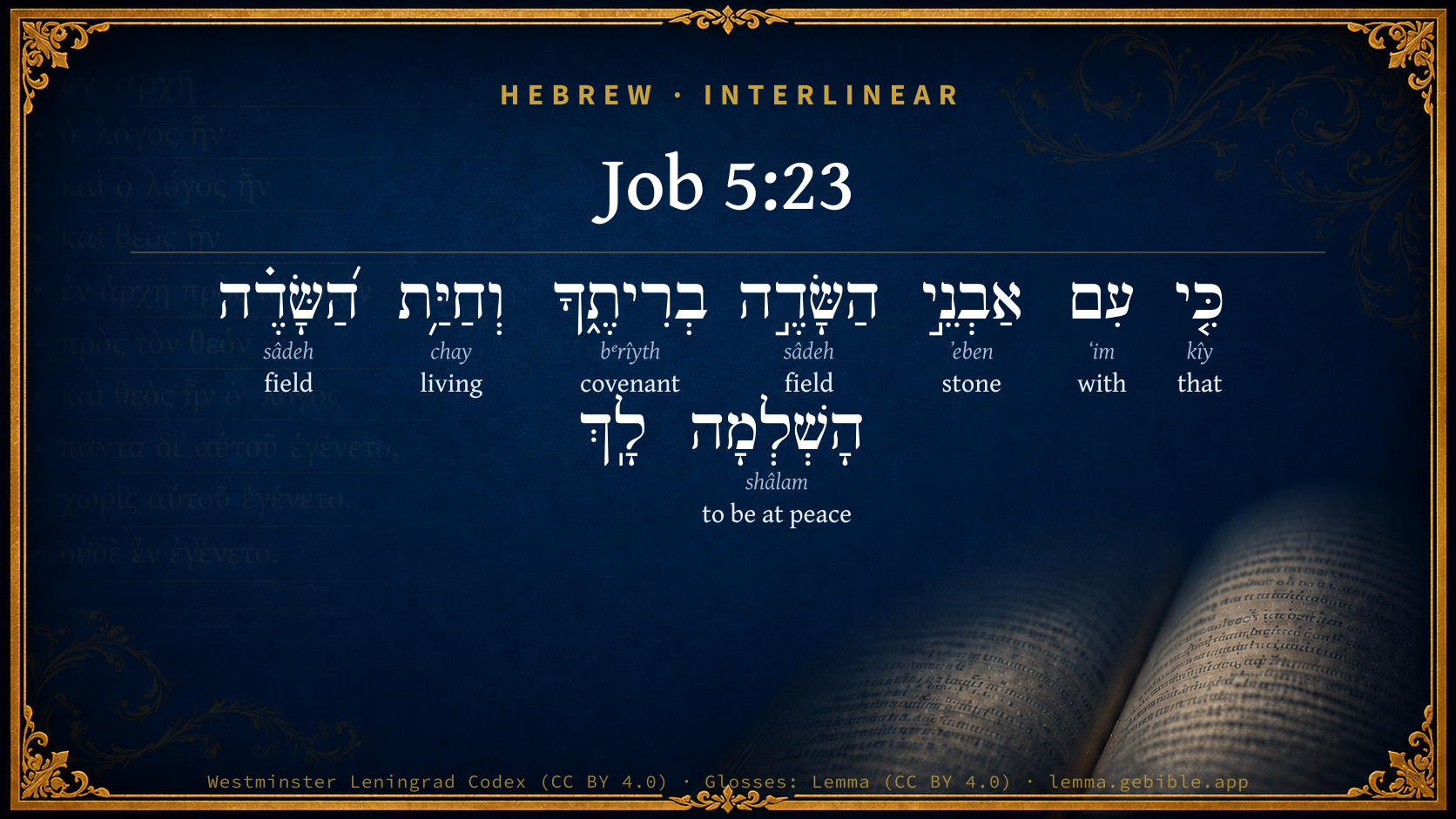
Hebrew (Westminster Leningrad Codex) Job 5:23 appears in the Hebrew Old Testament. The text above is from the Westminster Leningrad Codex. Each word links to its Strong’s number, a concise gloss, and parsing drawn from the Open Scriptures Hebrew Bible morphology. Click any word for its full Brown-Driver-Briggs (BDB) entry.
Download image
Cite this verse

Job 5:23 (World English Bible). Public Domain. Lemma interlinear Bible study tool, https://lemma.gebible.app/v/job/5/23.

Show BibTeX & RIS
BibTeX
RIS
English Translation
For you shall be in league with the stones of the field. The animals of the field shall be at peace with you.
World English Bible · Public Domain
Download a study sheet

One document with this verse’s original text, its word-by-word gloss line, the meaning frame, cross-references with their text, attributed commentary, and full source and license credits — printable, and it pastes into notes with its structure intact.

This verse Autodidact and up

Study sheet (.html) Plain text (.txt)

A passage Seminary Student

Up to 50 verses in one chapter. A passage sheet keeps up to 6 commentary sources and 12 cross-references per verse, in the order this page ranks them, and says so on the sheet whenever that leaves anything out. Ask for a single verse and you get the Autodidact verse sheet above.

Everything on this page stays free to read, with no account — the sheet is a download of what is already on screen, not access to it.

Want to remove ads? Support Godless Engineer
Compare translations 3

The same verse in 3 English versions, stacked beneath the original-language interlinear above. Click any original word for its lexicon entry.

Each is an independent rendering of the whole verse — the interlinear is not word-aligned to these translations.

Highlighted words mark where these versions differ — a whole-verse word diff, not a word-by-word alignment.

  • World English Bible Public Domain
    For you shall be in league with the stones of the field. The animals of the field shall be at peace with you.
  • King James Version Public Domain
    For thou shalt be in league with the stones of the field: and the beasts of the field shall be at peace with thee.
  • unfoldingWord Literal Text CC BY-SA 4.0
    For with the stones of the field your covenant, and the beast of the field will be made peaceable to you.

unfoldingWord Literal Text — © unfoldingWord, licensed CC BY-SA 4.0. Word-aligned USFM3 via Door43 (git.door43.org/unfoldingWord/en_ult).

Versions to compare (up to 4)

3 of 4 selected

Show all 18 translations

Every available English version of this verse, each an independent rendering of the whole verse.

  • World English Bible Public Domain
    For you shall be in league with the stones of the field. The animals of the field shall be at peace with you.
  • Berean Standard Bible Public Domain
    For you will have a covenant with the stones of the field, and the wild animals will be at peace with you.
  • Majority Standard Bible Public Domain
    For you will have a covenant with the stones of the field, and the wild animals will be at peace with you.
  • King James Version Public Domain
    For thou shalt be in league with the stones of the field: and the beasts of the field shall be at peace with thee.
  • American Standard Version (1901) Public Domain
    For thou shalt be in league with the stones of the field; And the beasts of the field shall be at peace with thee.
  • Revised Version (1885) Public Domain
    For thou shalt be in league with the stones of the field; and the beasts of the field shall be at peace with thee.
  • Geneva Bible (1599) Public Domain
    For the stones of the fielde shall be in league with thee, and the beastes of the field shall be at peace with thee.
  • Douay-Rheims (1899) Public Domain
    But thou shalt have a covenant with the stones of the lands, and the beasts of the earth shall be at pence with thee.
  • Young's Literal Translation Public Domain
    (For with sons of the field `is' thy covenant, And the beast of the field Hath been at peace with thee.)
  • Literal Standard Version CC BY-SA 4.0
    (For with sons of the field [is] your covenant, || And the beast of the field || Has been at peace with you.)
  • Unlocked Literal Bible CC BY-SA 4.0
    For you will have a covenant with the stones in your field, and the beasts of the field will be at peace with you.
  • unfoldingWord Literal Text CC BY-SA 4.0
    For with the stones of the field your covenant, and the beast of the field will be made peaceable to you.
  • Darby Bible Public Domain
    For thou shalt be in league with the stones of the field, and the beasts of the field shall be at peace with thee.
  • World Messianic Bible Public Domain
    For you will be allied with the stones of the field. The animals of the field will be at peace with you.
  • Webster's Bible Public Domain
    For thou shalt be in league with the stones of the field: and the beasts of the field shall be at peace with thee.
  • Free Bible Version CC BY-SA 4.0
    for you will be at peace with the stones of the field and the wild animals will be at peace with you.
  • Bible in Basic English Public Domain
    For you will be in agreement with the stones of the earth, and the beasts of the field will be at peace with you.
  • JPS Tanakh (1917) Public Domain
    For thou shalt be in league with the stones of the field; and the beasts of the field shall be at peace with thee.

Literal Standard Version (2020), Covenant Press — licensed CC BY-SA 4.0. Text via the HelloAO Bible API (eBible.org). Unlocked Literal Bible (unfoldingWord) — licensed CC BY-SA 4.0. Text via the HelloAO Bible API (eBible.org). unfoldingWord Literal Text — © unfoldingWord, licensed CC BY-SA 4.0. Word-aligned USFM3 via Door43 (git.door43.org/unfoldingWord/en_ult). Free Bible Version, Dr. Jonathan Gallagher — licensed CC BY-SA 4.0. Text via the HelloAO Bible API (eBible.org).

Word by word

More ways to search: Search by grammar → Find every occurrence → Compare this word →

Practice this passage: Drill this verse → Learn its vocabulary →

הָשְׁלְמָה
shâlam
H7999
“to be at peace”
Verb, Hophal, Perfect, 3rd Person, Feminine, Singular
Part of Speech
Verb
Stem
Hophal
Form
Perfect
Person
3rd Person
Gender
Feminine
Number
Singular
Full BDB Definition

Origin: a primitive root

TWOT: 2401c

to be in a covenant of peace, be at peace - (Qal) - to be at peace - peaceful one (participle) - (Pual) one in covenant of peace (participle) - (Hiphil) - to make peace with - to cause to be at peace - (Hophal) to live in peace - to be complete, be sound - (Qal) - to be complete, be finished, be ended - to be sound, be uninjured - (Piel) - to complete, finish - to make safe - to make whole or good, restore, make compensation - to make good, pay - to requite, recompense, reward - (Pual) - to be performed - to be repaid, be requited - (Hiphil) - to complete, perform - to make an end of
  1. כִּ֤י kîy H3588 “that” Conjunction
  2. עִם ʻim H5973 “with” Preposition
  3. אַבְנֵ֣י ʼeben H68 “stones of” Noun, Common, Feminine, Plural, Construct
  4. הַשָּׂדֶ֣ה sâdeh H7704 “the · field” Particle, Definite Article + Noun, Common, Masculine, Singular, Absolute
  5. בְרִיתֶ֑ךָ bᵉrîyth H1285 “covenant · your” Noun, Common, Feminine, Singular, Construct + Suffix, Personal, 2nd Person, Masculine, Singular
  6. וְחַיַּ֥ת chay H2416 “and · living of” Conjunction + Noun, Common, Feminine, Singular, Construct
  7. הַ֝שָּׂדֶ֗ה sâdeh H7704 “the · field” Particle, Definite Article + Noun, Common, Masculine, Singular, Absolute

About this verse

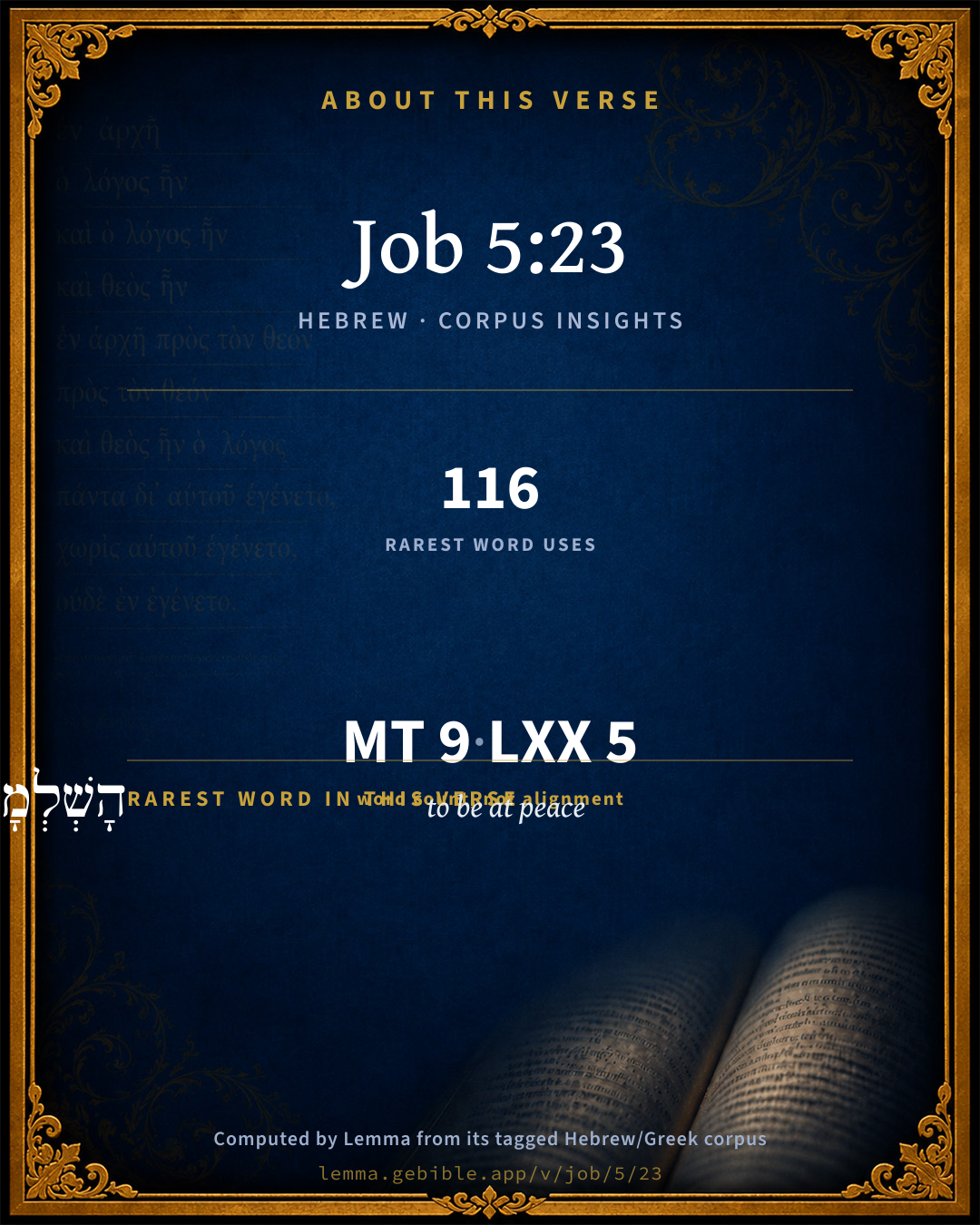
These counts appear in no published source. They are computed here, from the morphology-tagged text and Lemma’s own curated glosses. What Lemma adds →

9
words
7
distinct lemmas
Wisdom
section

Grammatical profile

  • 1 verb
  • 5 nouns
  • 2 prepositions
  • 1 conjunction

Verb forms

  • הָשְׁלְמָה Hophal · Perfect

Repetition

A word recurs within this verse — often emphatic in Hebrew:

  • הַשָּׂדֶ֣ה field H7704 ×2

Hebrew & Septuagint length

In English translation the verse runs 23 words from the Hebrew and 13 from the Septuagint (LXX English) — the Septuagint runs noticeably shorter here. See the side-by-side →

A rough comparison of the two English renderings, which tokenize alike — not a word-level alignment.

Word counts can differ between the Hebrew and the Greek without any difference in meaning — e.g. the Hebrew direct-object marker אֵת has no separate Greek word, and Greek often adds the article ὁ.

In the original languages it is 9 Hebrew tokens and 5 Greek tokens — but the two are counted differently (Hebrew bundles its prefixes and suffixes into one token; the Greek is in lemma form), so that isn’t a like-for-like length.

Cross-references

7

Topical passages linked to Job 5:23 in the Treasury of Scripture Knowledge — connected by theme and wording, ordered by reader-vote popularity; previews shown in the World English Bible.

  • Leviticus 26:6 "'I will give peace in the land, and you shall lie down, and no one will make you afraid; and I will remove evil animals out of the land, neither shall the sword go through your land.
  • Daniel 6:22 My God has sent his angel, and has shut the lions' mouths, and they have not hurt me; because as before him innocence was found in me; and also before you, O king, have I done no hurt.
  • Psalms 91:12–13 They will bear you up in their hands, So that you won't dash your foot against a stone.
  • Isaiah 11:6–9 The wolf shall dwell with the lamb, and the leopard shall lie down with the kid; and the calf and the young lion and the fattened calf together; and a little child shall lead them.
  • Hosea 2:18 In that day I will make a covenant for them with the animals of the field, And with the birds of the sky, And with the creeping things of the ground. I will break the bow, the sword, and the battle out of the land, And will make them lie down safely.
  • Ezekiel 14:15–16 If I cause evil animals to pass through the land, and they ravage it, and it be made desolate, so that no man may pass through because of the animals;
  • Romans 8:38–39 For I am persuaded, that neither death, nor life, nor angels, nor principalities, nor things present, nor things to come, nor powers,

Cross-references courtesy of OpenBible.info (CC BY 4.0).

Hebrew and Greek witnesses Masoretic Hebrew ↔ Greek Septuagint

The same verse in the two great witnesses to the Old Testament, shown verse-for-verse.

Here the Septuagint runs noticeably shorter than the Hebrew — LXX2012 (modern English Septuagint) 13 words vs World English Bible 23. A rough length comparison of the two English translations, not a word-level alignment — read both below.

These are two independent witnesses, not word-aligned to each other, and the Septuagint is shown in lemma (dictionary) form.

Hebrew Job 5:23 Masoretic · Westminster Leningrad Codex

כִּ֤י עִם אַבְנֵ֣י הַשָּׂדֶ֣ה בְרִיתֶ֑ךָ וְחַיַּ֥ת הַ֝שָּׂדֶ֗ה הָשְׁלְמָה לָֽךְ

For you shall be in league with the stones of the field. The animals of the field shall be at peace with you.

World English Bible · Public Domain

Greek LXX Job 5:23 Septuagint · lemma form

θήρ γάρ ἄγριος εἰρηνεύω σύ

For the wild beasts of the field shall be at peace with you.

LXX2012 (modern English Septuagint) · Public Domain

Hebrew: Westminster Leningrad Codex (CC BY 4.0). Greek: Septuagint (public domain); English from LXX2012 (modern English Septuagint) (Public Domain). How the Septuagint differs from the Hebrew →

Commentary

Notes on Job 5:23 from classic Christian and Jewish commentators (each source and its license shown beneath its notes). The classic Christian expositions comment on the surrounding passage and are grouped to its opening verse, so a note may address several verses; the Jewish commentaries on the Tanakh (Rashi and others) are per-verse, so they appear only where the commentator wrote on this verse.

Lemma curates 59 commentaries, every one of them public domain or Creative Commons licensed, each selected and text-cleaned for this edition rather than reprinted as found. About our sources →

Trapp's Complete Commentary

John Trapp

Job 5:23 For thou shalt be in league with the stones of the field: and the beasts of the field shall be at peace with thee.

Ver. 23. For thou shall be in league with the stones of the field] Thou shall not dash thy foot against them (the Latins call a stone lapidem a laedendo pede, from hurting the foot that hitteth against them, Psa 91:1-2.) They were wont of old to go barefoot (as Vatablus here noteth). And our chronicler telleth us of King Henry II, that, for a penance, going to Canterbury to the shrine of Thomas Becket, his bare feet with the hard stones were forced to yield bloody tokens of his devotion on the way. Or thus, the stones of the field shall not hinder thy harvest, as Mat 13:6. Or being piled up for a mound, or wall, they shall not fall upon thee, and brain thee, as the stones of the wall of Aphek did the blasphemous Syrians, 1Ki 20:33; as the town house did the insulting Philistines, Jdg 16:30; as the house did Job’s children, &c.; or, the stones out of the wall shall not cry out against thee, as Hab 2:11, but all creatures shall be thy confederates; not only not hurting, but helping thee, all that may be. For as they are all armed against the wicked as rebels and traitors to the Divine majesty; so God hath promised to make a covenant for his saints with the beasts of the field, and with the fowls of heaven, &c., Rebellis facta est; quia homo numini, creatura homini (Aug.), Hos 2:18. {See Trapp on "Hos 2:18"}

And the beasts of the field shall be at peace with thee] The tame beasts shall not only not mischieve thee (as some they have done: Euripides the poet was torn in pieces with dogs; horses have been the death of many, &c.), but shall be serviceable and profitable unto thee; some alive, not dead, as the dog, horse; some dead, not alive, as the hog; some both, as the ox, sheep, &c. Ambrose hath a very strange story of a man slain at Antioch by night, by a soldier, in hope of spoil; this man’s dog would not leave his master’s dead corpse, but lay howling by it till daylight; many came in the morning to see that sad sight, and the murderer among the rest came, that he might be the less suspected. The dog no sooner saw this soldier but he ran fiercely at him, and would never stop barking and baiting at him till he saw him apprehended and carried to prison, where he confessed the fact and was for the same deservedly executed (Amb. in Hexaem.).

John Trapp, A Commentary or Exposition upon All the Books of the Old and New Testament (1647–1656) — public domain. Text from a community e-Sword module.

Matthew Poole's English Annotations

Thou shalt be free from any annoyance by stones, either in thy walking or other postures, or in thy ploughing, as if they had made an inviolable league with thee. Stones may be, and in these stony countries were, hurtful to men many ways; either by bruising or hurting their feet when they walked barefoot, as the manner then was; or by giving them occasion of stumbling, or slipping, and falling; or by falling upon a man from a rock, or higher ground, as sometimes it hath happened; or filling his grounds, so as to hinder his ploughing, and make his lands unfruitful. Nay, the stones shall not only cease to be hurtful, but they shall be useful and beneficial to thee; they shall, as it were, present themselves to thee when thou hast occasion, either to sling them at thine enemies, as then was usual, Jdg 20:16; 2Ch 26:14, or to make fences to thy ground, or to build a house. This is a bold metaphor, but such are frequent, as in other authors, so also in Scripture, as Isa 28:15; Hos 2:18.

The beasts of the field; either,

1. The wild beasts; and then this is an addition to the former privilege; they shall not hurt thee, Job 5:22; nay, they shall befriend thee, as being at peace with thee, here, Job 5:23. Or,

2. The tame beasts, who otherwise may be refractory and hurtful to a man, many having been killed by them.

Matthew Poole's English Annotations on the Holy Bible (1683–1685) — public domain. Text from a community e-Sword/MySword module.

Joseph Benson's Commentary

Job 5:23. Thou shalt be in league with the stones of the field — Thou shalt be free from any annoyance thereby, as if they had made an inviolable league with thee. It is a bold metaphor, but such are frequent in the Scriptures, as also in other authors. And the beasts of the field shall be at peace with thee — This is an addition to the former privilege; they shall not hurt thee, Job 5:22. Nay, they shall befriend thee, as being at peace with thee. Our covenant with God is a covenant with all the creatures, that they shall do us no hurt, but serve and be ready to do us good.

Joseph Benson's Commentary on the Old and New Testaments (1811–1818) — public domain. Text from a community e-Sword module.

Whedon's Commentary on the Bible

Daniel D. Whedon

23. For thou shalt be in league with the stones of the field — Literally, For with the stones of the field (is) thy covenant. “Isaiah (Isa_28:15) speaks of ‘a covenant with death;’ that is, death is far from us, and will not injure us. Such, also, is the meaning here: thy field will be free from stones, which would make it barren.” — Rosenmuller. In like manner Lucan says (Phar., 9:394) —

Pax illis cum morte data est, Peace with death to them is given, in the sense of security from death. Dr. Shaw thus alludes to this text: “The feet being thus unguarded, (that is, being bare, or only protected with slippers,) were every moment liable to be hurt and injured; and from thence perhaps the danger, without the divine assistance, which ever protects us from the smallest misfortunes, of dashing them against a stone, (Psa_91:12;) which, perhaps, will illustrate that difficult text (Job_5:23) of being in league with the stones of the field.” Compare 2Ki_3:25. “The stones are personified: they conclude a treaty with the reformed Job, and promise not to injure him.” — Hengstenberg.

Beasts… field — In Eze_14:21, “noisome beasts” constitute a fourth calamitous judgment which God threatens against Israel. What is here promised to the pious man is in like figure prophesied of the Messianic times; Isa_11:6-10. The good man is protected against the animate and inanimate creation. Each of the three following verses is crowned with a promise especially pleasing to the Oriental mind: first, domestic bliss; second, numerous posterity; third, long life.

Daniel D. Whedon (gen. ed.), Commentary on the Old and New Testaments (1874–1909) — public domain. Text from a community e-Sword module.

MacLaren's Expositions of Holy Scripture

Alexander MacLaren

Job

THE PEACEABLE FRUITS OF SORROWS RIGHTLY BORNE

‘ALL THINGS ARE YOURS’

Jdg 5:20. - Job 5:23.

These two poetical fragments present the same truth on opposite sides. The first of them comes from Deborah’s triumphant chant. The singer identifies God with the cause of Israel, and declares that heaven itself fought against those who fought against God’s people. There may be an allusion to the tempest which Jewish tradition tells us burst over the ranks of the enemy, or there may be some trace of ancient astrological notions, or the words may simply be an elevated way of saying that Heaven fought for Israel. The silent stars, as they swept on their paths through the sky, advanced like an avenging host embattled against the foes of Israel and of God. All things fight against the man who fights against God.

The other text gives the other side of the same truth. One of Job’s friends is rubbing salt into his wounds by insisting on the commonplace, which needs a great many explanations and limitations before it can be accepted as true, that sin is the cause of sorrow, and that righteousness brings happiness; and in the course of trying to establish this heartless thesis to a heavy heart he breaks into a strain of the loftiest poetry in describing the blessedness of the righteous. All things, animate and inanimate, are upon his side. The ground, which Genesis tells us is ‘cursed for his sake,’ becomes his ally, and the very creatures whom man’s sin set at enmity against him are at peace with him. All things are the friends and servants of him who is the friend and servant of God.

I. So, putting these two texts together, we have first the great conviction to which religion clings, that God being on our side all things are for us, and not against us.

Now, that is the standing faith of the Old Testament, which no doubt was more easily held in those days, because, if we accept its teaching, we shall recognise that Israel lived under a system in so far supernatural as that moral goodness and material prosperity were a great deal more closely and indissolubly connected than they are to-day. So, many a psalmist and many a prophet breaks out into apostrophes, warranted by the whole history of Israel, and declaring how blessed are the men who, apart from all other defences and sources of prosperity, have God for their help and Him for their hope.

But we are not to dismiss this conviction as belonging only to a system where the supernatural comes in, as it does in the Old Testament history, and as antiquated under a dispensation such as that in which we live. For the New Testament is not a whit behind the Old in insisting upon this truth. ‘All things work together for good to them that love God.’ ‘All things are yours, and ye are Christ’s, and Christ is God’s.’ ‘Who is he that will harm you if ye be followers of that which is good?’ The New Testament is committed to the same conviction as that to which the faith of Old Testament saints clung as the sheet anchor of their lives.

That conviction cannot be struck out of the creed of any man, who believes in the God to whom the Old and the New Testament alike bear witness. For it rests upon this plain principle, that all this great universe is not a chaos, but a cosmos, that all these forces and creatures are not a rabble, but an ordered host.

What is the meaning of that great Name by which, from of old, God in His relations to the whole universe has been described-the ‘Lord of Hosts’? Who are the ‘hosts’ of which He is ‘the Lord,’ and to whom, as the centurion said, He says to this one, ‘Go!’ and he goeth; and to another, ‘Come!’ and he cometh; and to another, ‘Do this!’ and he doeth it? Who are ‘the hosts’? Not only these beings who are dimly revealed to us as rational and intelligent, who ‘excel in strength,’ because they ‘hearken to the voice of His word’, but in the ranks of that great army are also embattled all the forces of the universe, and all things living or dead. ‘All are Thy servants; they continue this day’-angels, stars, creatures of earth-’ according to Thine ordinances.’

And if it be true that the All is an ordered whole, which is obedient to the touch and to the will of that divine Commander, then all His servants must be on the same side, and cannot turn their arms against each other. As an old hymn says with another reference-

‘All the servants of our King

In heaven and earth are one,’

and none of them can injure, wound, or slay a fellow-servant. If all are travelling in the same direction there can be no collision. If all are enlisted under the same standard they can never turn their weapons against each other. If God sways all things, then all things which God sways must be on the side of the men that are on the side of God. ‘Thou shalt make a league with the stones of the field: and the beasts of the field shall be at peace with thee.’

II. Note the difficulties arising from experience, in the way of holding fast by this conviction of faith.

The grim facts of the world, seen from their lowest level, seem to shatter it to atoms. Talk about ‘the stars in their courses fighting’ for or against anybody! In one aspect it is superstition, in another aspect it is a dream and an illusion. The prose truth is that they shine down silent, pitiless, cold, indifferent, on battlefields or on peaceful homes; and the moonlight is as pure when it falls upon broken hearts as when it falls upon glad ones. Nature is utterly indifferent to the moral or the religious character of its victims. It goes on its way unswerving and pitiless; and whether the man who stands in its path is good or bad matters not. If he gets into a typhoon he will be wrecked; if he tumbles over Niagara he will be drowned. And what becomes of all the talk about an embattled universe on the side of goodness, in the face of the plain facts of life-of nature’s indifference, nature’s cruelty which has led some men to believe in two sovereign powers, one beneficent and one malicious, and has led others to say, ‘God is a superfluous hypothesis, and to believe in Him brings more enigmas than it solves,’ and has led still others to say, ‘Why, if there is a God, does it look as if either He was not all-powerful, or was not all-merciful?’ Nature has but ambiguous evidence to give in support of this conviction.

Then, if we turn to what we call Providence and its mysteries, the very book of Job, from which my second text is taken, is one of the earliest attempts to grapple with the difficulty and to untie the knot; and I suppose everybody will admit that, whatever may be the solution which is suggested by that enigmatical book, the solution is by no means a complete one, though it is as complete as the state of religious knowledge at the time at which the book was written made possible to be attained. The seventy-third psalm shows that even in that old time when, as I have said, supernatural sanctions were introduced into the ordinary dealings of life, the difficulties that cropped up were great enough to bring a devout heart to a stand, and to make the Psalmist say, ‘My feet were almost gone; my steps had well-nigh slipped.’ Providence, with all its depths and mysteries, often to our aching hearts seems in our own lives to contradict the conviction, and when we look out over the sadness of humanity, still more does it seem impossible for us to hold fast by the faith ‘that all which we behold is full of blessings.’

I doubt not that there are many of ourselves whose lives, shadowed, darkened, hemmed in, perplexed, or made solitary for ever, seem to them to be hard to reconcile with this cheerful faith upon which I am trying to insist. Brethren, cling to it even in the darkness. Be sure of this, that amongst all our mercies there are none more truly merciful than those which come to us shrouded in dark garments, and in questionable shapes. Let nothing rob us of the confidence that ‘all things work together for good.’

III. I come, lastly, to consider the higher form in which this conviction is true for ever.

I have said that the facts of life seem often to us, and are felt often by some of us, to shatter it to atoms; to riddle it through and through with shot. But, if we bring the Pattern-life to bear upon the illumination of all life, and if we learn the lessons of the Cradle and the Cross, and rise to the view of human life which emerges from the example of Jesus Christ, then we get back the old conviction, transfigured indeed, but firmer than ever. We have to alter the point of view. Everything always depends on the point of view. We have to alter one or two definitions. Definitions come first in geometry and in everything else. Get them right, and you will get your theorems and problems right.

So, looking at life in the light of Christ, we have to give new contents to the two words ‘good’ and ‘evil,’ and a new meaning to the two words ‘for’ and ‘against.’ And when we do that, then the difficulties straighten themselves out, and there are not any more knots, but all is plain; and the old faith of the Old Testament, which reposed very largely upon abnormal and extraordinary conditions of life, comes back in a still nobler form, as possible to be held by us amidst the commonplace of our daily existence.

For everything is my friend, is for me and not against me, that helps me nearer to God. To live for Him, to live with Him, to be conscious ever of communion with Himself, to feel the touch of His hand on my hand, and the pressure of His breast against mine, at all moments of my life, is my true and the highest good. And if it is true that the ‘river of the water of life’ which ‘flows from the Throne of God’ is the only draught that can ever satisfy the immortal thirst of a soul, then whatever drives me away from the cisterns and to the fountain, is on my side. Better to dwell in a ‘dry and thirsty land, where no water is,’ if it makes me long for the water that rises at the gate of the true Bethlehem-the house of bread-than to dwell in a land flowing with milk and honey, and well watered in every part! If the cup that I would fain lift to my lips has poison in it, or if its sweetness is making me lose my relish for the pure and tasteless river that flows from the Throne of God, there can be no truer friend than that calamity, as men call it, which strikes the cup from my hands, and shivers the glass before I have raised it to my lips. Everything is my friend that helps me towards God.

Everything is my friend that leads me to submission and obedience. The joy of life, and the perfection of human nature, is an absolutely submitted will, identified with the divine, both in regard to doing and to enduring. And whatever tends to make my will flexible, so that it corresponds to all the sinuosities, so to speak, of the divine will, and fits into all its bends and turns, is a blessing to me. Raw hides, stiff with dirt and blood, are put into a bath of bitter infusion of oak-bark. What for? For the same end as, when they are taken out, they are scraped with sharp steels,-that they may become flexible. When that is done the useless hide is worth something.

‘Our wills are ours, we know not how;

Our wills are ours, to make them Thine.’

And whatever helps me to that is my friend.

Everything is a friend to the man that loves God, in a far sweeter and deeper sense than it can ever be to any other. Like a sudden burst of sunshine upon a gloomy landscape, the light of union with God and friendship with Him flooding my daily life flashes it all up into brightness. The dark ribbon of the river that went creeping through the black copses, when the sun glints upon it, gleams up into links of silver, and the trees by its bank blaze out into green and gold. Brethren! ‘Who follows pleasure follows pain’; who follows God finds pleasure following him. There can be no surer way to set the world against me than to try to make it for me, and to make it my all They tell us that if you want to count those stars that ‘like a swarm of fire-flies tangled in a silver braid’ make up the Pleiades, the surest way to see the greatest number of them is to look a little on one side of them. Look away from the joys and friendships of creatural things right up to God, and you will see these sparkling and dancing in the skies, as you never see them when you gaze at them only. Make them second and they are good and on your side. Make them first, and they will turn to be your enemies and fight against you.

This conviction will be established still more irrefragably and wonderfully in that future. Nothing lasts but goodness. ‘He that doeth the will of God abideth for ever.’ To oppose it is like stretching a piece of pack-thread across the rails before the express comes; or putting up some thin wooden partition on the beach on one of the Western Hebrides, exposed to the whole roll of the Atlantic, which will be battered into ruin by the first winter’s storm. Such is the end of all those who set themselves against God.

But there comes a future in which, as dim hints tell us, these texts of ours shall receive a fulfilment beyond that realised in the present condition of things. ‘Then comes the statelier Eden back to man,’ and in a renewed and redeemed earth ‘they shall not hurt nor destroy in all My holy mountain’; and the ancient story will be repeated in higher form. The servants shall be like the Lord who, when He had conquered temptation, ‘was with the wild beasts’ that forgot their enmity, and ‘angels ministered unto Him.’ That scene in the desert may serve as a prophecy of the future when, under conditions of which we know nothing, all God’s servants shall, even more markedly and manifestly than here, help each other; and every man that loves God will find a friend in every creature.

If we take Him for our Commander, and enlist ourselves in that embattled host, then all weathers will be good; ‘stormy winds, fulfilling His word,’ will blow us to our port; ‘the wilderness will rejoice and blossom as the rose’; and the whole universe will be radiant with the light of His presence, and ringing with the music of His voice. But if we elect to join the other army-for there is another army, and men have wills that enable them to lift themselves up against God, the Ruler of all things-then the old story, from which my first text is taken, will fulfil itself again in regard to us-’the stars in their courses will fight against’ us; and Sisera, lying stiff and stark, with Jael’s tent-peg through his temples, and the swollen corpses being swirled down to the stormy sea by ‘that ancient river, the river Kishon,’ will be a grim parable of the end of the men that set themselves against God, and so have the universe against them. ‘Choose ye this day whom ye will serve.’

Alexander MacLaren, Expositions of Holy Scripture (1904–1910) — public domain. Text from a community e-Sword module.

Geneva Bible (1599)

Geneva Bible translators

When we are in God’s favor, all creatures shall serve us.

Geneva Bible (1599) marginal notes — public domain. Text via Bolls.life.

Jamieson, Fausset & Brown

Robert Jamieson, A. R. Fausset & David Brown

in league with the stones of the field--They shall not hurt the fertility of thy soil; nor the wild beasts thy fruits; spoken in Arabia-Deserta, where stones abounded. Arabia, derived from Arabah--a desert plain. The first clause of this verse answers to the first clause of Job 5:22; and the last of this verse to the last of that verse. The full realization of this is yet future (Isa 65:23, Isa 65:25; Hos 2:18).

Jamieson, Fausset & Brown — Commentary Critical and Explanatory on the Whole Bible (1871) — public domain (CC PDM 1.0). Text via the HelloAO Bible API.

Adam Clarke's Commentary

Verse 23. Thou shalt be in league with the stones of the field] Instead of אבני abney, stones, Mr. Good reads beney, sons, or produce; but this reading is not supported by any ancient version, nor, as far as I know, by any MS. yet collated. We must, therefore, take up the text as we find it, and make the best we can of the present reading.

The Chaldee gives a plausible sense: Thou needest not to fear, "because thy covenant is on tables of stone, which are publicly erected in the field; and the Canaanites, which are compared to the beasts of the field, have made peace with thee."

Perhaps the reference is to those rocks or strong holds, where banditti secured themselves and their prey, or where the emirs or neighbouring chiefs had their ordinary residence. Eliphaz may be understood as saying: Instead, then, of taking advantage of thee, as the Sabeans have done, the circumjacent chieftains will be confederate with thee; and the very beasts of the field will not be permitted to harm thy flocks.

Coverdale seems to have had an idea of this kind, as we find he translates the verse thus: -

But the castels in the londe shall be confederate with the,

And the beastes of the felde shall give the peace.

I believe the above to be the meaning of the place. See the next verse.

Adam Clarke's Commentary on the Bible (1810–1826) — public domain. Text from a community e-Sword/MySword module.

Ellicott's Commentary for English Readers

(23) For thou shalt be in league.—Literally, for with the stones of the field shall thy covenant be, and the beasts of the field shall be made to be at peace with thee.

A Bible Commentary for English Readers, edited by Charles John Ellicott (1878–1897) — public domain. Text from a community e-Sword module.

The Cambridge Bible for Schools and Colleges

gen. ed. J. J. S. Perowne

23. When man is at peace with God he is at peace with all God’s creation, he has a league with all nature and every creature: “We know that all things work together for good to them that love God,” Rom_8:28.

The Cambridge Bible for Schools and Colleges (gen. ed. J. J. S. Perowne; Cambridge University Press, 1878–1918) — public domain. Text from a community e-Sword module.

John Gill's Exposition

For thou shalt be in league with the stones of the field,.... So as to receive no hurt from them, by walking among them, and even barefoot, which was usual in the eastern countries, see Psa 91:12; or by their being in the field, so as to hinder the increase of them; but on the contrary, even from such fields as were stony ground, a large crop has been produced, and so rather receive benefit by them, as men do from those with whom they are in league; and may therefore likewise signify, that these stones should be useful in being boundaries or fences about their fields, and landmarks in them, which should not be removed: many interpreters take notice of a sense that Pineda gives of these words, and which Cocceius calls an ingenious one, that it refers to a custom in Arabia, which may be called Scopelism, and was this; a man's enemies would lay stones in his field, and these signified, that if any attempted to till and manure those grounds where they were laid, some evil would befall him by the means of those persons who laid the stones there; and which stones were thought to be ominous and formidable; something like it is in Kg2 3:19; and so the sense is, that a good man had nothing to fear from such stones, he being in league with them; and this malicious practice is thought to have had its origin in Arabia Petraea (i); but the first sense seems best:

and the beasts of the field shall be at peace with thee; a covenant being made with them, as in Hos 2:18; meaning either literally, the beasts of the field; and these either the same as before, wild beasts, or beasts of prey; or rather, in distinction from them, tame beasts, as cows and horses, which should be so far from doing any harm, as sometimes is done by these tame creatures, that they should be very serviceable in tilling fields and drawing carriages, and the like: or else figuratively, men comparable to such creatures; and so the sense may be, that when a man's ways please the Lord, and he behaves according to his mind and will, particularly under afflictions, even his enemies are made to be at peace with him; Pro 16:7; the Targum interprets this of the Canaanites, comparable to the beasts of the field.

(i) See Egmont and Heyman's Travels, vol. 2. p. 156.

John Gill's Exposition of the Whole Bible (1746–1763) — public domain (CC PDM 1.0). Text via the HelloAO Bible API.

Albert Barnes' Notes on the Bible

For thou shalt be in league with the stones of the field - In the Hebrew, “There shall be a covenant between thee and the stones of the field.” The sense is, they shall not harm thee. They are here spoken of as enemies that were made to be at peace, and that would not annoy or injure. It is to be remembered that this was spoken in Arabia, where rocks and stones abounded, and where traveling, from that cause, was difficult and dangerous. The sense here is, as I understand it, that he would be permitted to make his way in ease and safety. Tindal renders it:

But the castels in the land shall be confederate with thee;

The beastes of the fealde shall give thee peace.

Some have supposed that the meaning is, that the land would be free from stones that rendered it barren, and would be rendered fertile if the favor of God was sought. Shaw, in his Travels, supposes that it refers to the custom of walking over stones, in which the feet are liable to be injured every moment, and that the meaning is, that that danger would be averted by the divine interposition. By others it has been conjectured that the allusion is to a custom which is known as skopelism, of which Egmont and Heyman (Reisen, II. Th. S. 156), give the following account: “that in Arabia, if anyone is living at variance with another he places on his land stones as a warning that no one should dare to plow it, as by doing it he would expose himself to the danger of being punished by him who had placed the stones there.” This custom is also referred to by Ulpian (L. ix. de officio Proconsulis), and in the Greek Pandects, Lib. lx. Tit. xxii. Leg. 9. It may be doubted, however, whether this custom was as early as the time of Job, or was so common then as to make it probable that the allusion is to it. Rosenmuller supposes the meaning to be, “Thy field shall be free from stones, which would render it unfruitful.” Alte u. neue Morgenland, in loc. Other explanations may be seen in Rosenmuller (Commentary), but it seems to me that the view presented above, that traveling would be rendered safe and pleasant, is the true one. Such a promise would be among the rich blessings in a country like Arabia.

Albert Barnes' Notes on the Bible (1834–1885) — public domain. Text from a community e-Sword/MySword module.

Haydock's Catholic Bible Commentary

Stones, so as not to stumble; or, the rocks will be a retreat for thee.

George Leo Haydock (1774–1849), Haydock's Catholic Family Bible and Commentary, 1859 edition — public domain. Excludes Psalms (Douay-Rheims chapter numbering differs from Protestant) and Deuterocanonical books (Catholic canon only).

The Pulpit Commentary

For thou shalt be in league with the stones of the field; i.e. there shall be peace between thee and all the rest of God"s creation, even "the stones of the field," against which thou shalt not dash thy foot; (Psa_91:12) and if the senseless stones am thus in league with thee, and refrain from doing thee hurt, much more mayest thou be sure that the beasts of the field shall be at peace with thee. For they are not altogether senseless, and will in some sort understand that thou art under God"s protection, and not to be molested by them. (comp. Hos_2:18, where God promises to make a covenant between his people and "the beasts of the field, the fowls of heaven, and the creeping things of the ground," that so they may "lie down safely A misplaced ingenuity seeks to find either six or seven forms of calamity in the enumeration of vers. 20-23; but there appear to be really only five:

(1) famine;

(2) war;

(3) calumny;

(4) devastation; and

(5) noisome beasts.

The expression used in ver. 19 yea, seven means, as already explained, an indefinite number.

In league with nature.

Eliphaz argues that, if Job will but submit himself to the ordinances of God, nature itself will be his ally, and the very stones that obstruct his plough, and even the beasts that ravage his flocks, will become his auxiliaries. Here the seer of visions has touched on a great truth. To be in harmony with the Lord of nature is to be in league with nature.

I WE ARE NOT NATURALLY IN LEAGUE WITH NATURE. This is a paradox in form, yet it is a transcript of experience. The experience is peculiar to man. All other things find their habitat congenial to them. Man alone discovers himself to be as an alien among foes stones, weeds, vermin, beasts of prey, cruel winds, tempests, earthquakes, frustrating his designs. Two very different causes may account for this discord.

1. Our natural greatness. We are a part of nature, yet we are above nature. In our higher self we cannot be content to take our share with the beasts that perish. Our aspirations lift us out of agreement with the life that is lived by plants and animals.

2. Our sinful fall. We are meant to be above nature, ruling over it. By sin we have fallen below nature, and it has trampled on us. The master has become the slave and victim of his servant.

II IT IS GOOD TO BE IN LEAGUE WITH NATURE. So Eliphaz implies by his promise to Job of this condition as a reward for contrite submission. The Bible nowhere teaches a Manichaean horror of nature. All God"s works are good and deserve to be appreciated by us. Neither do we learn from Scripture to entertain a monkish horror of nature. The inherent innocence of every natural power and action is suggested by the biblical description of creation. Therefore we shall make a great mistake if we think we are to escape from the tyranny of nature either by flight or by warfare. We cannot escape from nature if we would. Though we crushed our nature, it would arise and reassert itself. But, supposing our flight or

III WE CANNOT FORM A SUCCESSFUL LEAGUE WITH NATURE BY DESCENDING TO THE LIFE OF NATURE. The sophistry of so-called naturalism tells us that we can. But it is deceptive, christening bestiality with the name of nature. The nature to be imitated is Wordsworth"s nature, not Zola"s. But Wordsworth"s nature is the type and prophecy of the spiritual that is higher than nature. Merely to follow natural impulses is to become swinish, not human, partly because the lower impulses of nature are the most violent, and partly because we have aggravated those impulses by sin.

IV SUBMISSION TO GOD MAKES NATURE IN LEAGUE WITH US. God is the Master of nature, and as we learn to do God"s will, nature, which also ultimately does his will, turns to aid us. Physically, the forces of nature work for those who obey the laws of God in nature, and it is to be noted that to obey those laws is a very different thing from being a slave to natural impulses; e.g. the laws of health do not agree with the indulgence of appetite. Spiritually, our obedient submission to God compels the adverse forces of nature to work for our good as instruments of discipline. This was not sufficiently clear to Eliphaz, who made too much of temporal prosperity, and thought that to be the invariable lot of the good man. But the Book of Job reveals it. Thus nature ministers to man when man serves God. W.F.A.

The Pulpit Commentary (1880–1919), ed. H.D.M. Spence-Jones & Joseph S. Exell — public domain. Text from a community e-Sword module.

John Wesley's Explanatory Notes

League - Thou shalt be free from annoyance thereby, as if they had made an inviolable league with thee. This is a bold metaphor, but such as are frequent both in scripture and other authors. This is an addition to the former privilege; they shall not hurt thee, ver. 22, nay, they shall befriend thee, as being at peace with thee. Our covenant with God is a covenant with all the creatures, that they shall do us no hurt, but serve and be ready to do us good.

John Wesley, Explanatory Notes Upon the Whole Bible (1754–1765) — public domain. Text via the GEBible commentary corpus.

unfoldingWord translationNotes

Door43 World Missions Community

General Information:

The writer continues to use parallelism in each of these verses, conveying a single idea using two different statements to emphasize security with regard to the natural world, the homestead, and one's descendants. (See: Parallelism)

you will have a covenant with the stones in your field

Here the stones in farmers' fields are spoken of as if they were people that someone could have a covenant with. AT: "the stones in your fields will be like people who promise that they will not make any trouble for you" (See: Metaphor)

the beasts of the field

This refers to dangerous wild animals. (See: Idiom)

You will know that your tent is in safety

Here "tent" represents a person's family, household, and all his possessions. AT: "You will know that your family, servants, and everything you own are safe" (See: Metaphor)

you will visit your sheepfold and you will not miss anything

"when you visit where your flock stays at night, you will find all your sheep there"

your seed will be great

Here "seed" represents a person's descendants. AT: "your descendants will be many" (See: Metaphor)

your offspring will be like the grass on the ground

Here "offspring" are spoken of as if they were as many as blades of grass, and probably as thriving, too. AT: "your descendants will be as many and as alive as the grass that grows" (See: Simile)

translationWords

covenant

stone

peace

tent

offspring

unfoldingWord translationNotes — © Distant Shores Media and the Door43 World Missions Community, licensed CC BY-SA 4.0. Source: git.door43.org/Door43/en_tn.

Rashi

Rabbi Shlomo Yitzchaki (Rashi)

the stones of the field They are: 6) a type of man.

and the beasts of the field That is what is known as grouse(?) in Old French, and this is actually a beast of the field. In the language of the Mishnah in Torath Kohanim, they are called “adnei hasadeh.”

made peace with you will have peace with you.

Rashi on the Tanakh — English translations: “The Judaica Press complete Tanach with Rashi, translated by A. J. Rosenberg” (CC BY 4.0); “Pentateuch with Rashi's commentary by M. Rosenbaum and A.M. Silbermann, 1929-1934” (public domain); “The Metsudah Tanach series, Lakewood, N.J” (CC BY 4.0); and “The Book of Joshua, Metsudah Publications, 1997” (CC BY 4.0). Text via Sefaria.

Lesson kit

Teaching starters — assembled from the data on this page, not authored interpretation. Every prompt links to the verse data it draws on. Edit before teaching.

Job, in the Wisdom, opens this verse with 9 words (7 distinct Hebrew lemmas). Its most distinctive word is shâlam (“to be at peace”). The Greek Septuagint runs shorter here. A historical commentator’s framing appears above. Read the whole chapter for the surrounding context.

Discussion questions

  1. The word shâlam carries the sense “to be at peace.” How does it shape the verse?
  2. How does Leviticus 26:6, which shares this passage’s theme, read alongside this verse?
  3. What does the repetition of “field” (2× in this one verse) do in this verse?
  4. The Septuagint runs shorter here than the Hebrew. What might account for the difference?
  5. These translations render this verse differently; the difference is in the English rendering, not the original. What questions does that raise?
  6. «הָשְׁלְמָה» is a Hophal Perfect verb. How does that grammatical form shape the action described?
  7. Compare how Trapp's Complete Commentary and Matthew Poole's English Annotations read this verse. Where do they agree or differ?

Things to notice

Reading settings

Reading text

Shown beneath each verse's original-language words.

Old Testament
Old Testament edition

Read the OT as the Masoretic Hebrew (MT) or the Greek Septuagint (LXX).

English shown for the Greek Septuagint (in the Hebrew ↔ Greek comparison).

Comparing translations? Open the Compare panel on any verse page to stack up to four side by side.