
Exodus 9:25

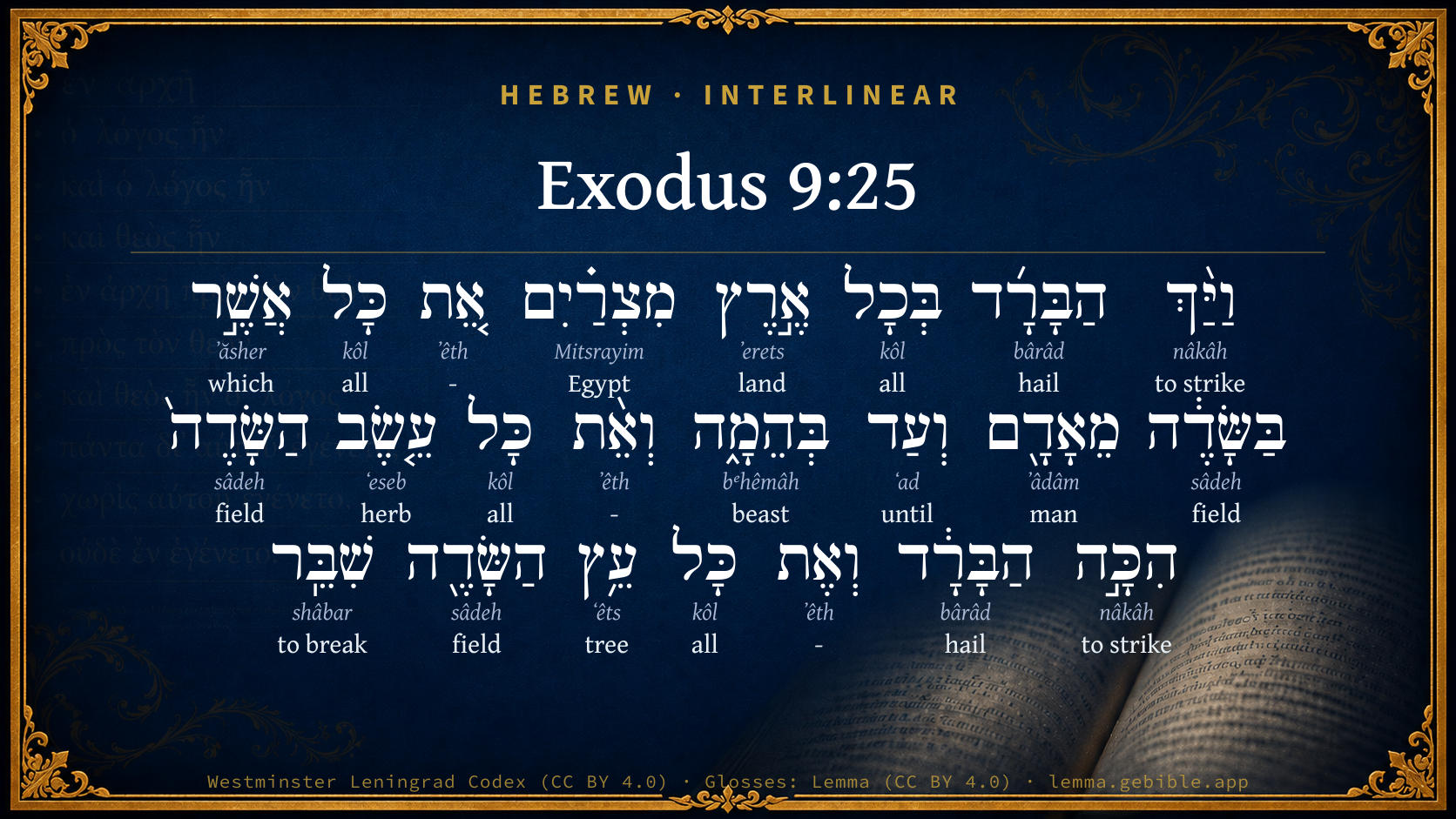
Hebrew (Westminster Leningrad Codex) Exodus 9:25 appears in the Hebrew Old Testament. The text above is from the Westminster Leningrad Codex. Each word links to its Strong’s number, a concise gloss, and parsing drawn from the Open Scriptures Hebrew Bible morphology. Click any word for its full Brown-Driver-Briggs (BDB) entry.
Download image
Cite this verse

Exodus 9:25 (World English Bible). Public Domain. Lemma interlinear Bible study tool, https://lemma.gebible.app/v/exodus/9/25.

Show BibTeX & RIS
BibTeX
RIS
English Translation
The hail struck throughout all the land of Egypt all that was in the field, both man and animal; and the hail struck every herb of the field, and broke every tree of the field.
World English Bible · Public Domain
Download a study sheet

One document with this verse’s original text, its word-by-word gloss line, the meaning frame, cross-references with their text, attributed commentary, and full source and license credits — printable, and it pastes into notes with its structure intact.

This verse Autodidact and up

Study sheet (.html) Plain text (.txt)

A passage Seminary Student

Up to 50 verses in one chapter. A passage sheet keeps up to 6 commentary sources and 12 cross-references per verse, in the order this page ranks them, and says so on the sheet whenever that leaves anything out. Ask for a single verse and you get the Autodidact verse sheet above.

Everything on this page stays free to read, with no account — the sheet is a download of what is already on screen, not access to it.

Want to remove ads? Support Godless Engineer
Compare translations 3

The same verse in 3 English versions, stacked beneath the original-language interlinear above. Click any original word for its lexicon entry.

Each is an independent rendering of the whole verse — the interlinear is not word-aligned to these translations.

Highlighted words mark where these versions differ — a whole-verse word diff, not a word-by-word alignment.

  • World English Bible Public Domain
    The hail struck throughout all the land of Egypt all that was in the field, both man and animal; and the hail struck every herb of the field, and broke every tree of the field.
  • King James Version Public Domain
    And the hail smote throughout all the land of Egypt all that was in the field, both man and beast; and the hail smote every herb of the field, and brake every tree of the field.
  • unfoldingWord Literal Text CC BY-SA 4.0
    And the hail hit everything in the land of Egypt, everything which was in the field, from man to beast. And the hail struck every plant of the field, and it broke every tree of the field.

unfoldingWord Literal Text — © unfoldingWord, licensed CC BY-SA 4.0. Word-aligned USFM3 via Door43 (git.door43.org/unfoldingWord/en_ult).

Versions to compare (up to 4)

3 of 4 selected

Show all 18 translations

Every available English version of this verse, each an independent rendering of the whole verse.

  • World English Bible Public Domain
    The hail struck throughout all the land of Egypt all that was in the field, both man and animal; and the hail struck every herb of the field, and broke every tree of the field.
  • Berean Standard Bible Public Domain
    Throughout the land of Egypt, the hail struck down everything in the field, both man and beast; it beat down every plant of the field and stripped every tree.
  • Majority Standard Bible Public Domain
    Throughout the land of Egypt, the hail struck down everything in the field, both man and beast; it beat down every plant of the field and stripped every tree.
  • King James Version Public Domain
    And the hail smote throughout all the land of Egypt all that was in the field, both man and beast; and the hail smote every herb of the field, and brake every tree of the field.
  • American Standard Version (1901) Public Domain
    And the hail smote throughout all the land of Egypt all that was in the field, both man and beast; and the hail smote every herb of the field, and brake every tree of the field.
  • Revised Version (1885) Public Domain
    And the hail smote throughout all the land of Egypt all that was in the field, both man and beast; and the hail smote every herb of the field, and brake every tree of the field.
  • Geneva Bible (1599) Public Domain
    And the haile smote throughout al ye land of Egypt all that was in the fielde, both man and beast: also ye haile smote all the herbes of ye field, and brake to pieces all the trees of the fielde.
  • Douay-Rheims (1899) Public Domain
    And the hail destroyed through all the land of Egypt all things that were in the fields, both man and beast: and the hail smote every herb of the field, and it broke every tree of the country.
  • Young's Literal Translation Public Domain
    And the hail smiteth in all the land of Egypt all that `is' in the field, from man even unto beast, and every herb of the field hath the hail smitten, and every tree of the field it hath broken;
  • Literal Standard Version CC BY-SA 4.0
    And the hail strikes all that [is] in the field in all the land of Egypt, from man even to beast, and the hail has struck every herb of the field, and it has broken every tree of the field;
  • Unlocked Literal Bible CC BY-SA 4.0
    Throughout all the land of Egypt, the hail struck everything in the fields, both people and animals. It struck every plant in the fields and broke every tree.
  • unfoldingWord Literal Text CC BY-SA 4.0
    And the hail hit everything in the land of Egypt, everything which was in the field, from man to beast. And the hail struck every plant of the field, and it broke every tree of the field.
  • Darby Bible Public Domain
    And the hail smote throughout the land of Egypt all that was in the field, both men and cattle; and the hail smote every herb of the field, and broke every tree of the field.
  • World Messianic Bible Public Domain
    The hail struck throughout all the land of Egypt all that was in the field, both man and animal; and the hail struck every herb of the field, and broke every tree of the field.
  • Webster's Bible Public Domain
    And the hail smote, throughout all the land of Egypt, all that was in the field, both man and beast, and the hail smote every herb of the field and broke every tree of the field.
  • Free Bible Version CC BY-SA 4.0
    All across Egypt hail hit everything in the fields, both people and animals. It knocked down everything growing in the fields, and stripped every tree bare.
  • Bible in Basic English Public Domain
    And through all the land of Egypt the ice-storm came down on everything which was in the fields, on man and on beast; and every green plant was crushed and every tree of the field broken.
  • JPS Tanakh (1917) Public Domain
    And the hail smote throughout all the land of Egypt all that was in the field, both man and beast; and the hail smote every herb of the field, and broke every tree of the field.

Literal Standard Version (2020), Covenant Press — licensed CC BY-SA 4.0. Text via the HelloAO Bible API (eBible.org). Unlocked Literal Bible (unfoldingWord) — licensed CC BY-SA 4.0. Text via the HelloAO Bible API (eBible.org). unfoldingWord Literal Text — © unfoldingWord, licensed CC BY-SA 4.0. Word-aligned USFM3 via Door43 (git.door43.org/unfoldingWord/en_ult). Free Bible Version, Dr. Jonathan Gallagher — licensed CC BY-SA 4.0. Text via the HelloAO Bible API (eBible.org).

Word by word

More ways to search: Search by grammar → Find every occurrence → Compare this word →

Practice this passage: Drill this verse → Learn its vocabulary →

הַבָּרָ֜ד
bârâd
H1259
“the · hail”
Particle, Definite Article + Noun, Common, Masculine, Singular, Absolute
Part of Speech
Particle + Noun
Type
Common
Gender
Masculine
Number
Singular
State
Absolute
Full BDB Definition

Origin: from H1258

TWOT: 280a

hail - of God's judgment (figuratively)
  1. וַיַּ֨ךְ nâkâh H5221 “and · to strike” Conjunction + Verb, Hiphil, Sequential Imperfect, 3rd Person, Masculine, Singular
  2. בְּכָל kôl H3605 “in/at · all of” Preposition + Noun, Common, Masculine, Singular, Construct
  3. אֶ֣רֶץ ʼerets H776 “land of” Noun, Common, Both, Singular, Construct
  4. מִצְרַ֗יִם Mitsrayim H4714 “Egypt” Noun, Proper
  5. אֵ֚ת ʼêth H853 “-” Particle, Direct Object
  6. כָּל kôl H3605 “all of” Noun, Common, Masculine, Singular, Construct
  7. אֲשֶׁ֣ר ʼăsher H834 “which” Particle, Relative
  8. בַּשָּׂדֶ֔ה sâdeh H7704 “in/at the · field” Preposition, Determined + Noun, Common, Masculine, Singular, Absolute
  9. מֵאָדָ֖ם ʼâdâm H120 “from · man” Preposition + Noun, Common, Masculine, Singular, Absolute
  10. וְעַד ʻad H5704 “and · until” Conjunction + Preposition
  11. בְּהֵמָ֑ה bᵉhêmâh H929 “beast” Noun, Common, Feminine, Singular, Absolute
  12. וְאֵ֨ת ʼêth H853 “and · -” Conjunction + Particle, Direct Object
  13. כָּל kôl H3605 “all of” Noun, Common, Masculine, Singular, Construct
  14. עֵ֤שֶׂב ʻeseb H6212 “herb of” Noun, Common, Masculine, Singular, Construct
  15. הַשָּׂדֶה֙ sâdeh H7704 “the · field” Particle, Definite Article + Noun, Common, Masculine, Singular, Absolute
  16. הִכָּ֣ה nâkâh H5221 “to strike” Verb, Hiphil, Perfect, 3rd Person, Masculine, Singular
  17. הַבָּרָ֔ד bârâd H1259 “the · hail” Particle, Definite Article + Noun, Common, Masculine, Singular, Absolute
  18. וְאֶת ʼêth H853 “and · -” Conjunction + Particle, Direct Object
  19. כָּל kôl H3605 “all of” Noun, Common, Masculine, Singular, Construct
  20. עֵ֥ץ ʻêts H6086 “tree of” Noun, Common, Masculine, Singular, Construct
  21. הַשָּׂדֶ֖ה sâdeh H7704 “the · field” Particle, Definite Article + Noun, Common, Masculine, Singular, Absolute
  22. שִׁבֵּֽר shâbar H7665 “to break” Verb, Piel, Perfect, 3rd Person, Masculine, Singular

About this verse

These counts appear in no published source. They are computed here, from the morphology-tagged text and Lemma’s own curated glosses. What Lemma adds →

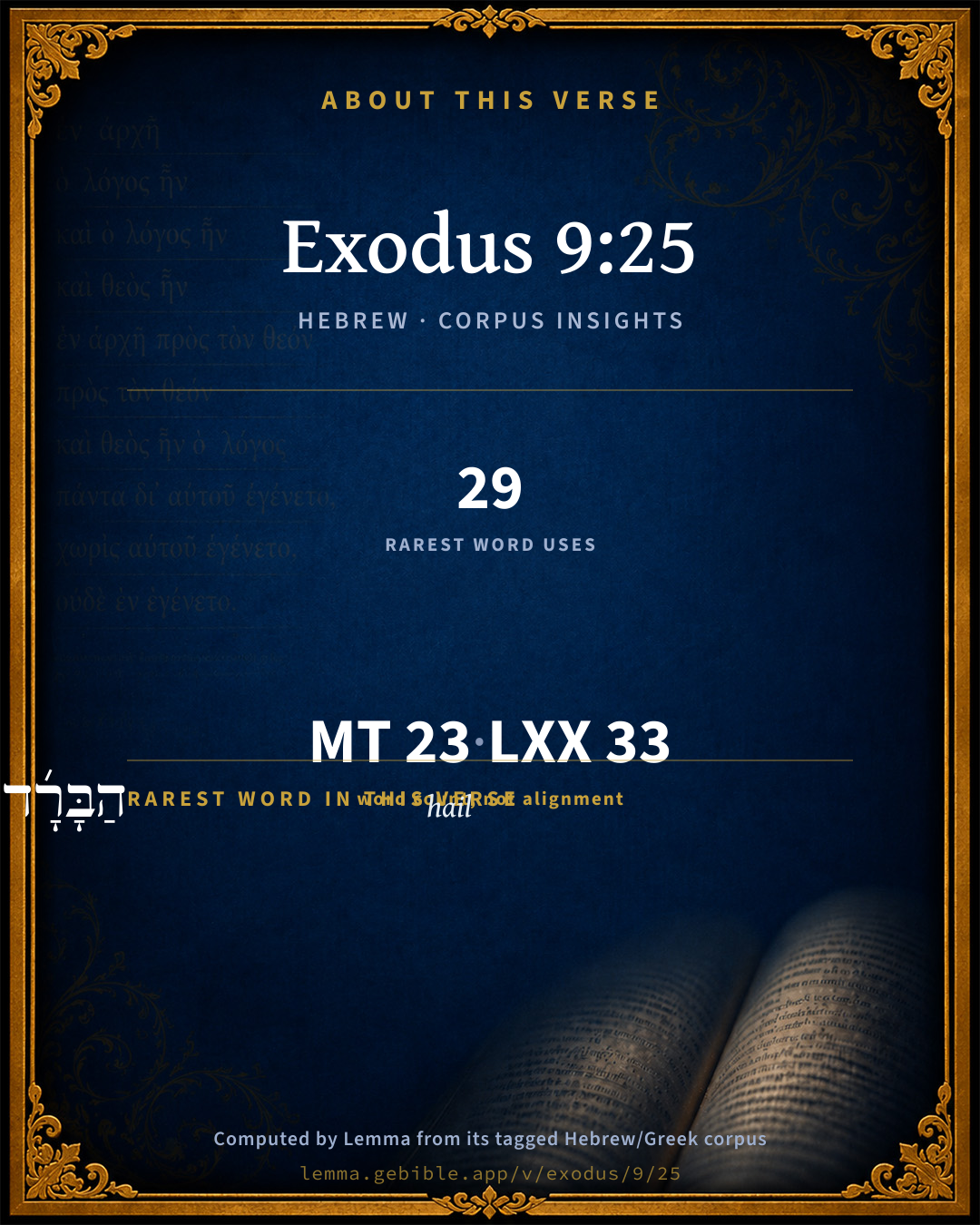
23
words
14
distinct lemmas
Pentateuch
section

Shared distinctive vocabulary

הַבָּרָ֜ד hail H1259 occurs in 26 verses of the Hebrew Bible. Also found in:

Grammatical profile

  • 3 verbs
  • 15 nouns
  • 1 preposition
  • 4 particles

Verb forms

  • וַיַּ֨ךְ Hiphil · Sequential Imperfect
  • הִכָּ֣ה Hiphil · Perfect
  • שִׁבֵּֽר Piel · Perfect

Repetition

Words recur within this verse — often emphatic in Hebrew:

  • בְּכָל all H3605 ×4
  • בַּשָּׂדֶ֔ה field H7704 ×3
  • וַיַּ֨ךְ to strike H5221 ×2
  • הַבָּרָ֜ד hail H1259 ×2

Hebrew & Septuagint length

In English translation the verse runs 35 words from the Hebrew and 36 from the Septuagint (LXX English) — closely comparable.

A rough comparison of the two English renderings, which tokenize alike — not a word-level alignment.

Word counts can differ between the Hebrew and the Greek without any difference in meaning — e.g. the Hebrew direct-object marker אֵת has no separate Greek word, and Greek often adds the article ὁ.

In the original languages it is 23 Hebrew tokens and 33 Greek tokens — but the two are counted differently (Hebrew bundles its prefixes and suffixes into one token; the Greek is in lemma form), so that isn’t a like-for-like length.

Cross-references

2

Topical passages linked to Exodus 9:25 in the Treasury of Scripture Knowledge — connected by theme and wording, ordered by reader-vote popularity; previews shown in the World English Bible.

  • Psalms 78:47 He destroyed their vines with hail, Their sycamore-fig trees with frost.
  • Psalms 105:32–33 He gave them hail for rain, With lightning in their land.

Cross-references courtesy of OpenBible.info (CC BY 4.0).

Hebrew and Greek witnesses Masoretic Hebrew ↔ Greek Septuagint

The same verse in the two great witnesses to the Old Testament, shown verse-for-verse.

These are two independent witnesses, not word-aligned to each other, and the Septuagint is shown in lemma (dictionary) form.

Hebrew Exodus 9:25 Masoretic · Westminster Leningrad Codex

וַיַּ֨ךְ הַבָּרָ֜ד בְּכָל אֶ֣רֶץ מִצְרַ֗יִם אֵ֚ת כָּל אֲשֶׁ֣ר בַּשָּׂדֶ֔ה מֵאָדָ֖ם וְעַד בְּהֵמָ֑ה וְאֵ֨ת כָּל עֵ֤שֶׂב הַשָּׂדֶה֙ הִכָּ֣ה הַבָּרָ֔ד וְאֶת כָּל עֵ֥ץ הַשָּׂדֶ֖ה שִׁבֵּֽר

The hail struck throughout all the land of Egypt all that was in the field, both man and animal; and the hail struck every herb of the field, and broke every tree of the field.

World English Bible · Public Domain

Greek LXX Exodus 9:25 Septuagint · lemma form

πατάσσω δέ ὁ χάλαζα ἐν πᾶς γῆ αἴγυπτος ἀπό ἄνθρωπος ἕως κτῆνος καί πᾶς βοτάνη ὁ ἐν ὁ πεδίον πατάσσω ὁ χάλαζα καί πᾶς ὁ ξύλον ὁ ἐν ὁ πεδίον συντρίβω ὁ χάλαζα

And the hail struck in all the land of Egypt both man and beast, and the hail struck all the grass in the field, and the hail broke in pieces all the trees in the field.

LXX2012 (modern English Septuagint) · Public Domain

Hebrew: Westminster Leningrad Codex (CC BY 4.0). Greek: Septuagint (public domain); English from LXX2012 (modern English Septuagint) (Public Domain). How the Septuagint differs from the Hebrew →

Targum (Aramaic paraphrase)

2

The Targum is the ancient Jewish Aramaic paraphrase of the Hebrew Scriptures — an interpretive translation, not the Hebrew text itself. Onkelos (literal) and Pseudo-Jonathan (expansive) render the Torah, and Jonathan the Prophets. Coverage is partial: where no permissively-licensed English translation exists for a verse, only the Aramaic is shown. This is verse-level text, not a word-by-word alignment to the Hebrew.

  1. Targum Onkelos Torah (Genesis–Deuteronomy)
    וּמְחָא בַרְדָא בְּכָל אַרְעָא דְמִצְרַיִם יָת כָּל דִי בְחַקְלָא מֵאֲנָשָׁא וְעַד בְּעִירָא וְיָת כָּל עֶסְבָּא דְחַקְלָא מְחָא בַרְדָא וְיָת כָּל אִילַן דִבְחַקְלָא תְּבַר:

    (no public-domain English translation for this verse)

    Targum Onkelos — Aramaic: “Onkelos Genesis” (public domain); “Onkelos Exodus” (public domain); “Onkelos Leviticus” (public domain); “Onkelos Numbers” (public domain); “Onkelos Deuteronomy” (public domain). English: “Sefaria Community Translation” (CC0 1.0 (public-domain dedication)); “J.W. Etheridge. The Targums of Onkelos and Jonathan Ben Uzziel on the Pentateuch. London: Longmans, Green, 1862” (public domain). Text via Sefaria.

  2. Targum Pseudo-Jonathan Torah (Genesis–Deuteronomy)
    וּמְחָא בַרְדָא בְּכָל אַרְעָא דְמִצְרַיִם יַת כָּל דִבְחַקְלָא מֵאֵינָשָׁא וְעַד בְּעִירָא וְיַת כָּל עִסְבָּא דְחַקְלָא מְחָא בַרְדָא וְיַת כָּל אִילָנָא דְחַקְלָא תְּבִיר וְשַׁרִישׁ

    And the hail smote in all the land of Mizraim whatsoever was in the field, of men and of cattle, and all the herbage of the field the hail smote, and every tree of the field it shattered and uprooted.

    Targum Pseudo-Jonathan — Aramaic: “Targum Jonathan on Genesis” (public domain); “Targum Jonathan on Exodus” (public domain); “Targum Jonathan on Leviticus” (public domain); “Targum Jonathan on Numbers” (public domain); “Targum Jonathan on Deuteronomy” (public domain). English: “The Targum of Jonathan ben Uzziel, trans. J. W. Etheridge, London, 1862” (public domain). Text via Sefaria.

Commentary

Notes on Exodus 9:25 from classic Christian and Jewish commentators (each source and its license shown beneath its notes). The classic Christian expositions comment on the surrounding passage and are grouped to its opening verse, so a note may address several verses; the Jewish commentaries on the Tanakh (Rashi and others) are per-verse, so they appear only where the commentator wrote on this verse.

Lemma curates 59 commentaries, every one of them public domain or Creative Commons licensed, each selected and text-cleaned for this edition rather than reprinted as found. About our sources →

Trapp's Complete Commentary

John Trapp

Exo 9:25 And the hail smote throughout all the land of Egypt all that [was] in the field, both man and beast; and the hail smote every herb of the field, and brake every tree of the field.

Ver. 25. And break every tree of the fleld.] Here was strages et clades horrenda; yet Pharaoh’s heart is not broken, but remains obdurate. Perdidistis fructum afflictionis, was a heavy charge. {a} Ducklings stoop and dive at any little stone thrown by a man at them; yet shrink not at the heaven’s great thunder.

{a} August.

John Trapp, A Commentary or Exposition upon All the Books of the Old and New Testament (1647–1656) — public domain. Text from a community e-Sword module.

Joseph Benson's Commentary

Exo 9:25. Every herb of the field: every tree — That is, most of them, or herbs and trees of all sorts, as appears from Exo 10:12; Exo 10:15.

Joseph Benson's Commentary on the Old and New Testaments (1811–1818) — public domain. Text from a community e-Sword module.

Ellicott's Commentary for English Readers

(25) The hail . . . brake every tree of the field.—What is meant is, not that the hail “brake the mightiest trees to fragments” (Millington, Plagues of Egypt, p. 135), but that it broke off the small boughs and twigs, so damaging the trees and, if they were fruit-trees, destroying the prospect of fruit.

A Bible Commentary for English Readers, edited by Charles John Ellicott (1878–1897) — public domain. Text from a community e-Sword module.

The Cambridge Bible for Schools and Colleges

gen. ed. J. J. S. Perowne

25. The destruction wrought by the hail.

The Cambridge Bible for Schools and Colleges (gen. ed. J. J. S. Perowne; Cambridge University Press, 1878–1918) — public domain. Text from a community e-Sword module.

John Gill's Exposition

And the hail smote throughout all the land of Egypt,.... It was in all the land, and it smote and did mischief in all parts of it, only in Goshen, after excepted:

all that was in the field, both man and beast; which they that neglected the word of the Lord took no care to fetch home, these were all smitten and destroyed by the hail: and the hail smote every herb of the field; that is, the greatest part of them, for some were left, which the locusts afterwards ate, Exo 10:15, and brake every tree of the field; and the vines and fig trees, Psa 78:47.

John Gill's Exposition of the Whole Bible (1746–1763) — public domain (CC PDM 1.0). Text via the HelloAO Bible API.

Matthew Poole's English Annotations

i.e. Most of them; or herbs and trees of all sorts, as appears from Exo 10:12,15. See Poole "Exo 9:6".

Matthew Poole's English Annotations on the Holy Bible (1683–1685) — public domain. Text from a community e-Sword/MySword module.

The Pulpit Commentary

The hall smote. It is to the hail and not to the lightning that the great destruction of men and beasts is attributed. Such lightning, however, as is spoken of, would probably kill some. All that was in the field. According to the warning given (ver. 19), the herdsmen and cattle left in the open air and not brought into the sheds were killed. The hail emote every herb of the field. Even in our own temperate climate, which is free from all atmospheric extremes, hailstorms occasionally do so much damage to crops that it has been found desirable to organise a special insurance against loss from this cause. Such hail as that described in the text would greatly injure every crop that was many inches above the soil, and entirely destroy such as had gone to ear. (See below, ver. 31.) Broke every treei.e. , damaged the smaller branches and twigs, thus destroying the prospect of fruit.

The Pulpit Commentary (1880–1919), ed. H.D.M. Spence-Jones & Joseph S. Exell — public domain. Text from a community e-Sword module.

Keil & Delitzsch

C. F. Keil & F. Delitzsch

The expressions, "every herb," and "every tree," are not to be taken absolutely, just as in Exo 9:6, as we may see from Exo 10:5. Storms are not common in Lower or Middle Egypt, but they occur most frequently between the months of December and April; and hail sometimes accompanies them, though not with great severity. In themselves, therefore, thunder, lightning, and hail were not unheard of. They also came at the time of year when they usually occur, namely, when the cattle were in the field, i.e., between January and April, the only period in which cattle are turned out for pasture (for proofs, see Hengstenberg, Egypt and the Books of Moses). The supernatural character of this plague was manifested, not only in its being predicted by Moses, and in the exemption of the land of Goshen, but more especially in the terrible fury of the hail-storm, which made a stronger impression upon Pharaoh than all the previous plagues. For he sent for Moses and Aaron, and confessed to them, "I have sinned this time: Jehovah is righteous; I and my people are the sinners" (Exo 9:27.). But the very limitation "this time" showed that his repentance did not go very deep, and that his confession was far more the effect of terror caused by the majesty of God, which was manifested in the fearful thunder and lightning, than a genuine acknowledgment of his guilt. This is apparent also from the words which follow: "Pray to Jehovah for me, and let it be enough (רב satis, as in Gen 45:28) of the being (מהית) of the voices of God and of the hail;" i.e., there has been enough thunder and hail, they may cease now.

Keil & Delitzsch — Biblical Commentary on the Old Testament (1861–1891) — public domain (CC PDM 1.0). Text via the HelloAO Bible API. (Old Testament only.)

unfoldingWord translationNotes

Door43 World Missions Community

translationWords

Egypt

Goshen

Israel

unfoldingWord translationNotes — © Distant Shores Media and the Door43 World Missions Community, licensed CC BY-SA 4.0. Source: git.door43.org/Door43/en_tn.

Lesson kit

Teaching starters — assembled from the data on this page, not authored interpretation. Every prompt links to the verse data it draws on. Edit before teaching.

Exodus, in the Pentateuch, opens this verse with 23 words (14 distinct Hebrew lemmas). Its most distinctive word is bârâd (“hail”). A historical commentator’s framing appears above. Read the whole chapter for the surrounding context.

Discussion questions

  1. The word bârâd carries the sense “hail.” How does it shape the verse?
  2. Exodus 9:18 shares the word «hail» with this verse. How do the two illuminate each other?
  3. “all” occurs 4× in this one verse. What is the effect of the repetition?
  4. The translations on this page render this verse differently — a whole-verse word diff, not a word-by-word alignment. What might account for the different wordings?
  5. The verb «וַיַּ֨ךְ» is Hiphil Sequential Imperfect. How does its form color the action?
  6. Reading how Trapp's Complete Commentary and Joseph Benson's Commentary read this verse, where do the two commentators agree and where do they part?

Things to notice

Reading settings

Reading text

Shown beneath each verse's original-language words.

Old Testament
Old Testament edition

Read the OT as the Masoretic Hebrew (MT) or the Greek Septuagint (LXX).

English shown for the Greek Septuagint (in the Hebrew ↔ Greek comparison).

Comparing translations? Open the Compare panel on any verse page to stack up to four side by side.