
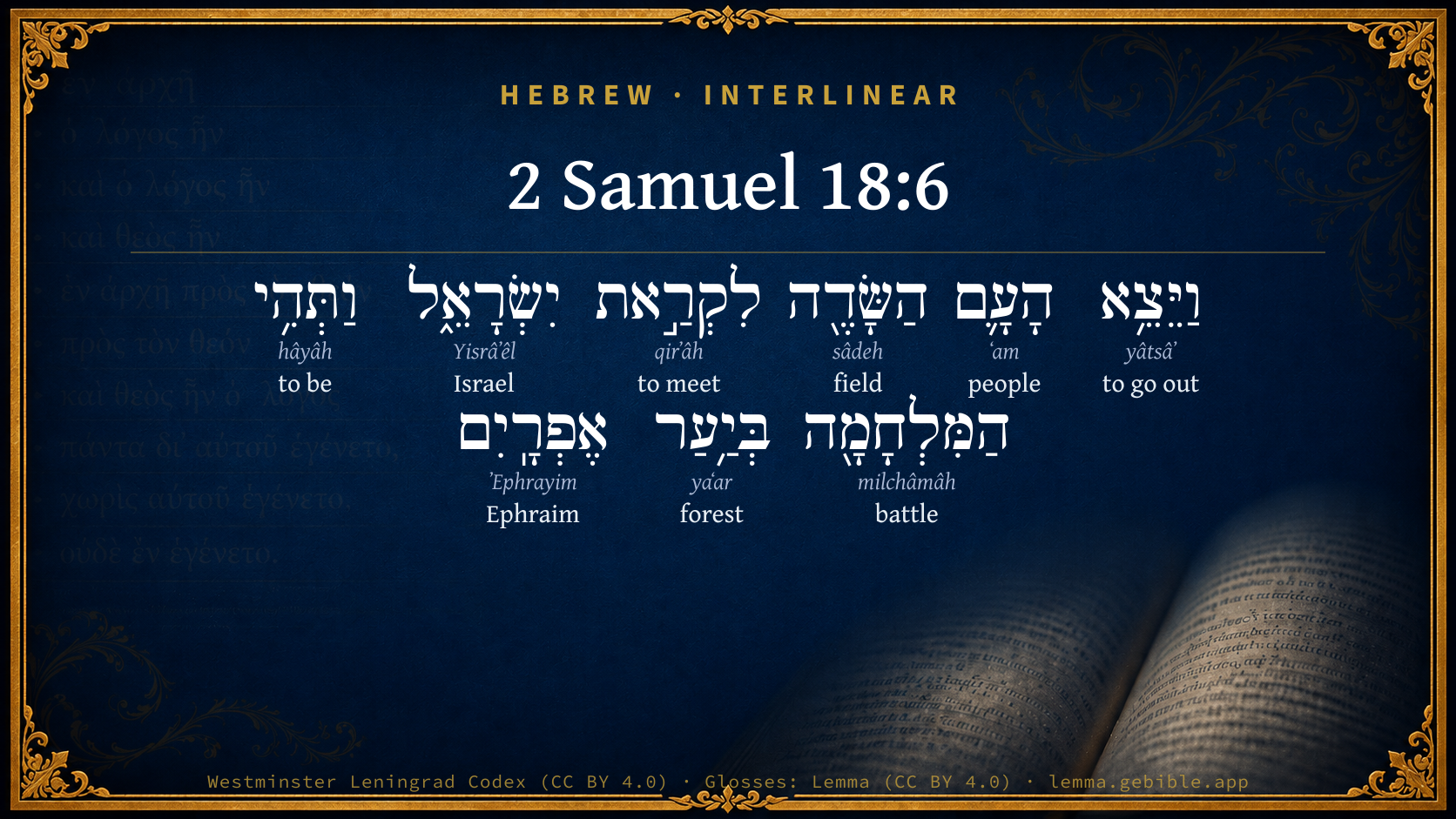
2 Samuel 18:6

Hebrew (Westminster Leningrad Codex) 2 Samuel 18:6 appears in the Hebrew Old Testament. The text above is from the Westminster Leningrad Codex. Each word links to its Strong’s number, a concise gloss, and parsing drawn from the Open Scriptures Hebrew Bible morphology. Click any word for its full Brown-Driver-Briggs (BDB) entry.
Download image
Cite this verse

2 Samuel 18:6 (World English Bible). Public Domain. Lemma interlinear Bible study tool, https://lemma.gebible.app/v/2-samuel/18/6.

Show BibTeX & RIS
BibTeX
RIS
English Translation
So the people went out into the field against Israel: and the battle was in the forest of Ephraim.
World English Bible · Public Domain
Download a study sheet

One document with this verse’s original text, its word-by-word gloss line, the meaning frame, cross-references with their text, attributed commentary, and full source and license credits — printable, and it pastes into notes with its structure intact.

This verse Autodidact and up

Study sheet (.html) Plain text (.txt)

A passage Seminary Student

Up to 50 verses in one chapter. A passage sheet keeps up to 6 commentary sources and 12 cross-references per verse, in the order this page ranks them, and says so on the sheet whenever that leaves anything out. Ask for a single verse and you get the Autodidact verse sheet above.

Everything on this page stays free to read, with no account — the sheet is a download of what is already on screen, not access to it.

Want to remove ads? Support Godless Engineer
Compare translations 3

The same verse in 3 English versions, stacked beneath the original-language interlinear above. Click any original word for its lexicon entry.

Each is an independent rendering of the whole verse — the interlinear is not word-aligned to these translations.

Highlighted words mark where these versions differ — a whole-verse word diff, not a word-by-word alignment.

  • World English Bible Public Domain
    So the people went out into the field against Israel: and the battle was in the forest of Ephraim.
  • King James Version Public Domain
    So the people went out into the field against Israel: and the battle was in the wood of Ephraim;
  • unfoldingWord Literal Text CC BY-SA 4.0
    And the people went out the field to meet Israel, and the battle was in the Forest of Ephraim.

unfoldingWord Literal Text — © unfoldingWord, licensed CC BY-SA 4.0. Word-aligned USFM3 via Door43 (git.door43.org/unfoldingWord/en_ult).

Versions to compare (up to 4)

3 of 4 selected

Show all 18 translations

Every available English version of this verse, each an independent rendering of the whole verse.

  • World English Bible Public Domain
    So the people went out into the field against Israel: and the battle was in the forest of Ephraim.
  • Berean Standard Bible Public Domain
    So David’s army marched into the field to engage Israel in the battle, which took place in the forest of Ephraim.
  • Majority Standard Bible Public Domain
    So David’s army marched into the field to engage Israel, and the battle took place in the forest of Ephraim.
  • King James Version Public Domain
    So the people went out into the field against Israel: and the battle was in the wood of Ephraim;
  • American Standard Version (1901) Public Domain
    So the people went out into the field against Israel: and the battle was in the forest of Ephraim.
  • Revised Version (1885) Public Domain
    So the people went out into the field against Israel: and the battle was in the forest of Ephraim.
  • Geneva Bible (1599) Public Domain
    So the people went out into the fielde to meete Israel, and the battell was in the wood of Ephraim:
  • Douay-Rheims (1899) Public Domain
    So the people went out into the field against Israel and the battle was fought in the forest of Ephraim.
  • Young's Literal Translation Public Domain
    And the people goeth out into the field to meet Israel, and the battle is in a forest of Ephraim;
  • Literal Standard Version CC BY-SA 4.0
    And the people go out into the field to meet Israel, and the battle is in a forest of Ephraim;
  • Unlocked Literal Bible CC BY-SA 4.0
    So the army went out into the countryside against Israel; the battle spread into the forest of Ephraim.
  • unfoldingWord Literal Text CC BY-SA 4.0
    And the people went out the field to meet Israel, and the battle was in the Forest of Ephraim.
  • Darby Bible Public Domain
    And the people went out into the field against Israel; and the battle was in the forest of Ephraim.
  • World Messianic Bible Public Domain
    So the people went out into the field against Israel; and the battle was in the forest of Ephraim.
  • Webster's Bible Public Domain
    So the people went out into the field against Israel: and the battle was in the wood of Ephraim;
  • Free Bible Version CC BY-SA 4.0
    David's army marched out to face the Israelites in battle, which was fought in the forest of Ephraim.
  • Bible in Basic English Public Domain
    So the people went out into the field against Israel, and the fight took place in the woods of Ephraim.
  • JPS Tanakh (1917) Public Domain
    So the people went out into the field against Israel; and the battle was in the forest of Ephraim.

Literal Standard Version (2020), Covenant Press — licensed CC BY-SA 4.0. Text via the HelloAO Bible API (eBible.org). Unlocked Literal Bible (unfoldingWord) — licensed CC BY-SA 4.0. Text via the HelloAO Bible API (eBible.org). unfoldingWord Literal Text — © unfoldingWord, licensed CC BY-SA 4.0. Word-aligned USFM3 via Door43 (git.door43.org/unfoldingWord/en_ult). Free Bible Version, Dr. Jonathan Gallagher — licensed CC BY-SA 4.0. Text via the HelloAO Bible API (eBible.org).

Word by word

More ways to search: Search by grammar → Find every occurrence → Compare this word →

Practice this passage: Drill this verse → Learn its vocabulary →

בְּיַ֥עַר
yaʻar
H3293
“in/at · forest of”
Preposition + Noun, Common, Masculine, Singular, Construct
Part of Speech
Preposition + Noun
Type
Common
Gender
Masculine
Number
Singular
State
Construct
Full BDB Definition

Origin: from an unused root probably meaning to thicken with verdure

TWOT: 888 , 889

forest, wood, thicket, wooded height
  1. וַיֵּצֵ֥א yâtsâʼ H3318 “and · to go out” Conjunction + Verb, Qal, Sequential Imperfect, 3rd Person, Masculine, Singular
  2. הָעָ֛ם ʻam H5971 “the · people” Particle, Definite Article + Noun, Common, Masculine, Singular, Absolute
  3. הַשָּׂדֶ֖ה sâdeh H7704 “the · field” Particle, Definite Article + Noun, Common, Masculine, Singular, Absolute
  4. לִקְרַ֣את qirʼâh H7125 “to meet” Preposition + Verb, Qal, Infinitive Construct
  5. יִשְׂרָאֵ֑ל Yisrâʼêl H3478 “Israel” Noun, Proper
  6. וַתְּהִ֥י hâyâh H1961 “and · to be” Conjunction + Verb, Qal, Sequential Imperfect, 3rd Person, Feminine, Singular
  7. הַמִּלְחָמָ֖ה milchâmâh H4421 “the · battle” Particle, Definite Article + Noun, Common, Feminine, Singular, Absolute
  8. אֶפְרָֽיִם ʼEphrayim H669 “Ephraim” Noun, Proper

About this verse

These counts appear in no published source. They are computed here, from the morphology-tagged text and Lemma’s own curated glosses. What Lemma adds →

9
words
9
distinct lemmas
Historical
section

Shared distinctive vocabulary

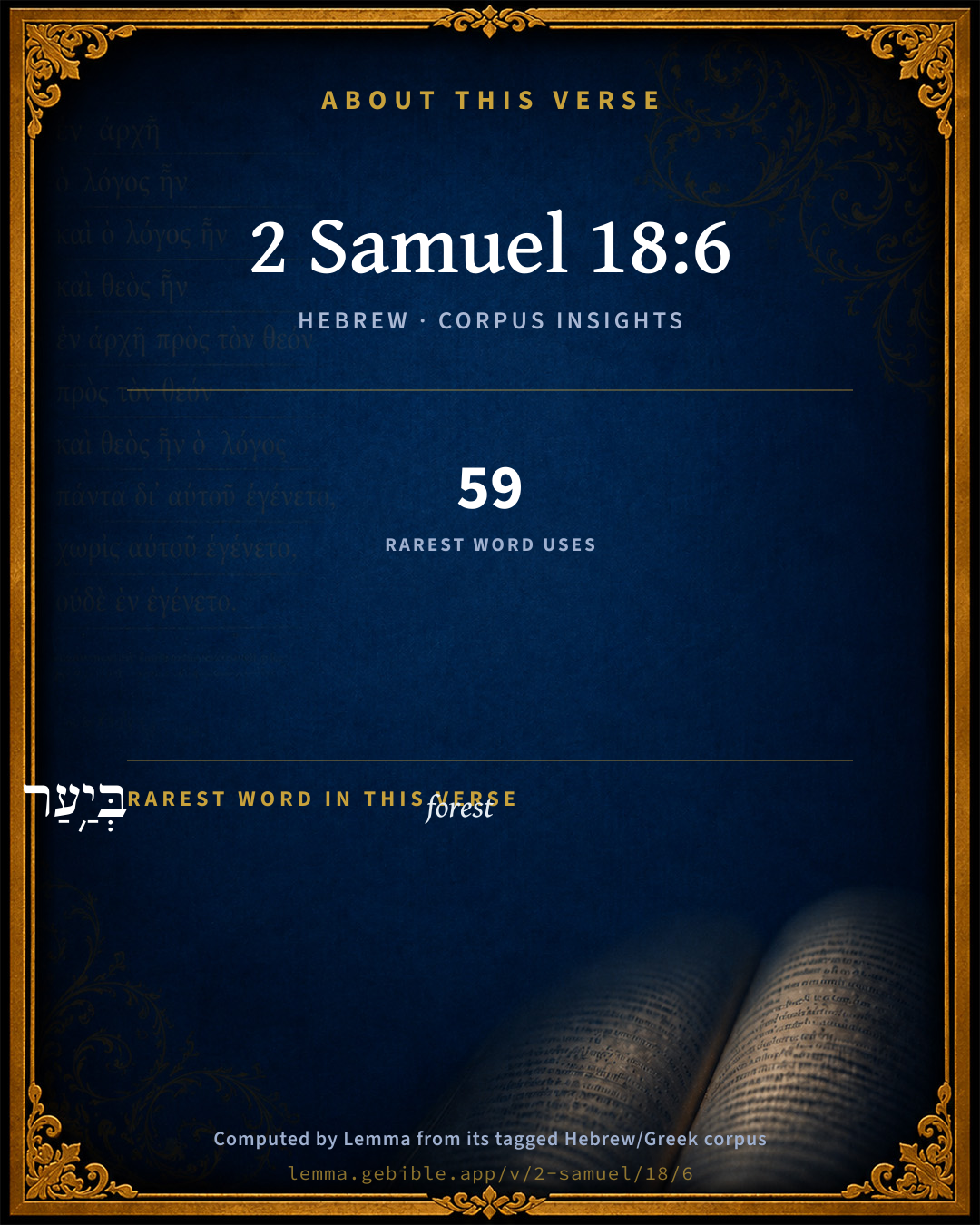
בְּיַ֥עַר forest H3293 occurs in 59 verses of the Hebrew Bible. Also found in:

Grammatical profile

  • 3 verbs
  • 6 nouns

Verb forms

  • וַיֵּצֵ֥א Qal · Sequential Imperfect
  • לִקְרַ֣את Qal · Infinitive Construct
  • וַתְּהִ֥י Qal · Sequential Imperfect

Hebrew & Septuagint length

In English translation the verse runs 19 words from the Hebrew and 20 from the Septuagint (LXX English) — closely comparable.

A rough comparison of the two English renderings, which tokenize alike — not a word-level alignment.

Word counts can differ between the Hebrew and the Greek without any difference in meaning — e.g. the Hebrew direct-object marker אֵת has no separate Greek word, and Greek often adds the article ὁ.

Cross-references

3

Topical passages linked to 2 Samuel 18:6 in the Treasury of Scripture Knowledge — connected by theme and wording, ordered by reader-vote popularity; previews shown in the World English Bible.

  • Joshua 17:18 but the hill-country shall be yours; for though it is a forest, you shall cut it down, and the goings out of it shall be yours; for you shall drive out the Canaanites, though they have chariots of iron, and though they are strong.
  • Joshua 17:15 Joshua said to them, If you are a great people, go up to the forest, and cut down for yourself there in the land of the Perizzites and of the Rephaim; since the hill-country of Ephraim is too narrow for you.
  • Judges 12:4–6 Then Jephthah gathered together all the men of Gilead, and fought with Ephraim; and the men of Gilead struck Ephraim, because they said, You are fugitives of Ephraim, you Gileadites, in the midst of Ephraim, [and] in the midst of Manasseh.

Cross-references courtesy of OpenBible.info (CC BY 4.0).

Hebrew and Greek witnesses Masoretic Hebrew ↔ Greek Septuagint

The same verse in the two great witnesses to the Old Testament, shown verse-for-verse.

These are two independent witnesses, not word-aligned to each other, and the Septuagint is shown in lemma (dictionary) form.

Hebrew 2 Samuel 18:6 Masoretic · Westminster Leningrad Codex

וַיֵּצֵ֥א הָעָ֛ם הַשָּׂדֶ֖ה לִקְרַ֣את יִשְׂרָאֵ֑ל וַתְּהִ֥י הַמִּלְחָמָ֖ה בְּיַ֥עַר אֶפְרָֽיִם

So the people went out into the field against Israel: and the battle was in the forest of Ephraim.

World English Bible · Public Domain

Greek LXX 2 Samuel 18:6 Septuagint · lemma form

καί ἐκἔρχομαι πᾶς ὁ λαός εἰς ὁ δρυμός ἐκ ἐναντίος ἰσραήλ καί γίγνομαι ὁ πόλεμος ἐν ὁ δρυμός ἐφράιμ

And all the people went out into the wood against Israel; and the battle was in the wood of Ephraim.

LXX2012 (modern English Septuagint) · Public Domain

Hebrew: Westminster Leningrad Codex (CC BY 4.0). Greek: Septuagint (public domain); English from LXX2012 (modern English Septuagint) (Public Domain). How the Septuagint differs from the Hebrew →

Targum (Aramaic paraphrase)

1

The Targum is the ancient Jewish Aramaic paraphrase of the Hebrew Scriptures — an interpretive translation, not the Hebrew text itself. Onkelos (literal) and Pseudo-Jonathan (expansive) render the Torah, and Jonathan the Prophets. Coverage is partial: where no permissively-licensed English translation exists for a verse, only the Aramaic is shown. This is verse-level text, not a word-by-word alignment to the Hebrew.

  1. Targum Jonathan Prophets (Joshua–Malachi)
    וּנְפַק עַמָא לְחַקְלָא לִקֳדָמוּת יִשְׂרָאֵל וַהֲוַת קְרָבָא בְּחוּרְשָׁא דְבֵית אֶפְרָיִם:

    (no public-domain English translation for this verse)

    Targum Jonathan — Aramaic: “Mikraot Gedolot” (public domain). English: “Sefaria Community Translation” (CC0 1.0 (public-domain dedication)); “London "Chaldee Paraphrase," 1871” (public domain). Text via Sefaria.

Commentary

Notes on 2 Samuel 18:6 from classic Christian and Jewish commentators (each source and its license shown beneath its notes). The classic Christian expositions comment on the surrounding passage and are grouped to its opening verse, so a note may address several verses; the Jewish commentaries on the Tanakh (Rashi and others) are per-verse, so they appear only where the commentator wrote on this verse.

Lemma curates 59 commentaries, every one of them public domain or Creative Commons licensed, each selected and text-cleaned for this edition rather than reprinted as found. About our sources →

Trapp's Complete Commentary

John Trapp

2Sa 18:6 So the people went out into the field against Israel: and the battle was in the wood of Ephraim;

Ver. 6. And the battle was in the wood of Ephraim.] So called, because it was opposite Ephraim; or because forty-two thousand Ephraimites there once lost their lives. {Jdg 12:5-6}

John Trapp, A Commentary or Exposition upon All the Books of the Old and New Testament (1647–1656) — public domain. Text from a community e-Sword module.

Keil & Delitzsch

C. F. Keil & F. Delitzsch

Battle in the wood of Ephraim, and death of Absalom. - Sa2 18:6, Sa2 18:7. When the people, i.e., David's army, had advanced into the field against Israel (those who followed Absalom), a battle was fought "in the wood of Ephraim," when Israel was smitten by David's warriors and sustained a loss of 20,000 men. The question, where the "wood of Ephraim" was situated, is a disputed one. But both the name and the fact that, according to Jos 17:15-16, the tribe-land of Ephraim abounded in forests, favour the idea that it was a wood in the inheritance of Ephraim, on this side of the Jordan; and this is in perfect harmony with the statement in Sa2 18:23, that Ahimaaz took the way of the Jordan valley to bring the news of the victory to David, who was staying behind in Mahanaim. Nevertheless the majority of commentators have supposed that the place alluded to was a woody region on the other side of the Jordan, which had received the name of "wood Ephraim" probably after the defeat of the Ephraimites in the time of Jephthah (Jdg 12:1-5). The reasons assigned are, first, that according to Sa2 17:26, Absalom had encamped in Gilead, and it is not stated that he had crossed the Jordan again; secondly, that Sa2 18:3 ("that thou succour us out of the city") presupposes that the battle took place in the neighbourhood of Mahanaim (Thenius); and thirdly, that after the victory the army returned to Mahanaim; whereas if the battle had been fought on this side of the Jordan, it would evidently have been much better for it to remain there and occupy Jerusalem (Ewald, Gesch. iii. p. 237). But neither of these reasons is decisive, and there is no force in the other arguments employed by Thenius. There was no necessity for an immediate occupation of Jerusalem by David's victorious army, since all Israel fled to their tents after the fall of Absalom and the defeat of his army (Sa2 18:17 and Sa2 19:9); that is to say, such of Absalom's followers as had not fallen in or after the battle, broke up and returned home, and therefore the revolution was at an end. Consequently there was nothing left for David's army to do but to return to its king at Mahanaim, and fetch him back to Jerusalem, and reinstate him in his kingdom. The other two reasons might have some force in them, if the history before us contained a complete account of the whole course of the war. But even Ewald admits that it is restricted to a notice of the principal battle, which completely crushed the rebellion. There can be no doubt, however, that this was preceded, if not by other battles, yet by such military operations as accompany every war. This is clearly indicated in Sa2 18:6, where it is stated that the army advanced into the field against Israel (Sa2 18:6), which evidently refers to such an advance on the part of David's army as might compel Absalom to draw back from Gilead across the Jordan, until at length a decisive battle was fought, which ended in the complete destruction of his army and his own death. Ewald observes still further, that "it seems impossible, at any rate so far as the name is concerned, to assume that the wood of Ephraim was on the other side of the Jordan, whilst according to Sa2 18:23, the messenger who reported the victory went from the field of battle towards the Jordan valley in order to get to David." But the way in which Ewald tries to set aside this important point, as bearing upon the conclusion that the battle took place on this side of the Jordan, - namely, by adopting this rendering of Sa2 18:23, "he ran after the manner of Kikkar, running, and therefore overtook Kushi," - is far too unnatural to meet with acceptance. Under all these circumstances, therefore, we decide in favour of the assumption that the wood of Ephraim is to be sought for in the tribe-territory of Ephraim.

The nature of the ground contributed a great deal to the utter defeat of Absalom.

Keil & Delitzsch — Biblical Commentary on the Old Testament (1861–1891) — public domain (CC PDM 1.0). Text via the HelloAO Bible API. (Old Testament only.)

Tyndale Open Study Notes

Tyndale Open Resources

18:6 The forest of Ephraim was an area east of the Jordan settled by the tribe of Ephraim.

Tyndale Open Study Notes — © Tyndale Open Resources, licensed CC BY-SA 4.0. Text via the HelloAO Bible API.

Geneva Bible (1599)

Geneva Bible translators

So called, because the Ephraimites (as some say) fed their cattle beyond Jordan in this wood.

Geneva Bible (1599) marginal notes — public domain. Text via Bolls.life.

Jamieson, Fausset & Brown

Robert Jamieson, A. R. Fausset & David Brown

wood of Ephraim--This wood, of course, was on the east of Jordan. Its name was derived, according to some, from the slaughter of the Ephraimites by Jephthah--according to others, from the connection of blood with the trans-jordanic Manasseh.

Jamieson, Fausset & Brown — Commentary Critical and Explanatory on the Whole Bible (1871) — public domain (CC PDM 1.0). Text via the HelloAO Bible API.

Ellicott's Commentary for English Readers

(6) The wood of Ephraim.—No wood of Ephraim on the eastern side of the Jordan happens to be elsewhere mentioned in Scripture. Yet it is plain that the battle must have been on that side of the river for the following reasons: (1) both armies were on that side beforehand, and there is no mention of their crossing; (2) David remained in Mahanaim (2Sa_18:3-4) with the reserves, for the purpose of succouring the army in case of need; (3) he there received the news of Absalom’s death (2Sa_18:24-33); (4) the army returned thither after the battle (2Sa_19:3); and (5) David was obliged to cross the Jordan on his final return to Jerusalem, and was met at the crossing by the tribes (2Sa_18:15, &c.). There is really no difficulty but such as arises from our ignorance of local names. The narrative clearly implies that there was a “wood of Ephraim,” otherwise unknown, on the east of the Jordan.

A Bible Commentary for English Readers, edited by Charles John Ellicott (1878–1897) — public domain. Text from a community e-Sword module.

The Cambridge Bible for Schools and Colleges

gen. ed. J. J. S. Perowne

6. in the wood of Ephraim] “The forest of Ephraim” might naturally be expected to mean the great forest covering the high lands of central Palestine in which the tribe of Ephraim settled (Jos_17:15-18). But all the circumstances are in favour of supposing the battle to have been fought on the eastern side of the Jordan. (a) Absalom marched into Gilead and encamped there (ch. 2Sa_17:26); David was at Mahanaim; and there is not the slightest hint that either army crossed the Jordan. (b) It is implied beforehand that the battle would be in the neighbourhood of Mahanaim (ch. 2Sa_18:3). (c) The return of the army to Mahanaim on the same day (ch. 2Sa_19:2-5), would scarcely have been possible, had the battle been fought on the west of the Jordan. These considerations make it all but certain that “the wood of Ephraim” was some part of the great forests of Gilead. The origin of the name can only be conjectured. It may possibly have been derived from the connexion of Ephraim with the trans-Jordanic Manasseh, or from some incident such as the slaughter of the Ephraimites by Jephthah (Jdg_12:6).

The Cambridge Bible for Schools and Colleges (gen. ed. J. J. S. Perowne; Cambridge University Press, 1878–1918) — public domain. Text from a community e-Sword module.

John Gill's Exposition

So the people went out into the field against Israel,.... Josephus (e) calls it a great field, with a wood behind it:

and the battle was in the wood of Ephraim; or near it (f) rather; not in a wood in the tribe of Ephraim, which lay on this side Jordan; whereas this battle was fought on the other side Jordan, in the land of Gilead, not far from Mahanaim, where was this wood; and which was so called, either from the slaughter of the Ephraimites here in the times of Jephthah, Jdg 12:4; or from the Ephraimites feeding their cattle here and near it; for the Jews say (g), that Joshua gave them a grant to feed their cattle in any wood in any of the tribes of Israel; and lying near Jordan, they used to drive their cattle over to this place, from whence it had its name.

(e) Ut supra, (Antiqu. l. 7. c. 10.) sect. 2. (f) "ad sylvam", Junius & Tremellius; "prope sylvam", Piscator. (g) In Jarchi, Kimchi, & Abarbinel, in loc.

John Gill's Exposition of the Whole Bible (1746–1763) — public domain (CC PDM 1.0). Text via the HelloAO Bible API.

Albert Barnes' Notes on the Bible

Against Israel - Implying that the revolt was in a great measure that of the ten tribes, Saul’s party, against the kingdom.

The wood of Ephraim - This would naturally be sought in the west of Jordan (marginal reference). But on the other hand it seems certain that the scene of this battle was on the east of Jordan. It seems therefore inevitable to conclude that some portion of the thick wood of oaks and terebinths which still runs down to the Jordan on the east side was for some reason called “the wood of Ephraim,” either because it was a continuation on the east side of the great Ephraimitic forests on the west, or because of some transaction there in which Ephraim had taken part, such as the slaughter of the Midianites Jdg 7:24-25, or their own slaughter Jdg 12:6.

Albert Barnes' Notes on the Bible (1834–1885) — public domain. Text from a community e-Sword/MySword module.

Haydock's Catholic Bible Commentary

Ephraim, where the men of that tribe had formerly signalized themselves, Judges vii., and viii., and xii. (Calmet)

George Leo Haydock (1774–1849), Haydock's Catholic Family Bible and Commentary, 1859 edition — public domain. Excludes Psalms (Douay-Rheims chapter numbering differs from Protestant) and Deuterocanonical books (Catholic canon only).

Matthew Poole's English Annotations

So called, not from its situation in the tribe of Ephraim, which was on the other side Jordan, as is evident; but from some memorable action or occurrent of the Ephraimites beyond, Jordan; whether it was their killing of Oreb and Zeeb there, Jdg 7:25; 8:3, or their slaughter by Jephthah, Jdg 12:5,6, or some other not mentioned in sacred Scripture.

Matthew Poole's English Annotations on the Holy Bible (1683–1685) — public domain. Text from a community e-Sword/MySword module.

Whedon's Commentary on the Bible

Daniel D. Whedon

6. Against Israel — Alas! It was Israel against Israel. But it had come to pass that strong prejudices were manifest between the people of Israel and the men of Judah.

The wood of Ephraim — A forest evidently not far from Mahanaim, and probably near the Jordan, but its exact locality and the origin of its name are now unknown. Grotius conjectured that it took its name from the great slaughter of the Ephraimites recorded Jdg_12:1-6; and the Jews have a tradition that Joshua, who was an Ephraimite, permitted the people of his tribe to pasture their flocks in this forest. Keil argues that it was on the west of the Jordan in the tribe-land of Ephraim, which, according to Jos_17:15, abounded in wood. But as David was at Mahanaim, and Absalom in Gilead, (2Sa_17:20,) this battle doubtless took place on the east of the Jordan.

Daniel D. Whedon (gen. ed.), Commentary on the Old and New Testaments (1874–1909) — public domain. Text from a community e-Sword module.

The Pulpit Commentary

The wood of Ephraim. There is a diversity of opinion as to the locality thus described. It might mean the large forest tract in the highlands of Ephraim; but if so, the battle must have been fought on the west of the Jordan, whereas the general tenor of the narrative makes it plain that it took place on the eastern side, near Mahanaim. It is true that no wood of Ephraim is ever mentioned elsewhere in the Bible as situated in Gilead, and those who cannot believe in such a wood except within the borders of the tribe, argue that, after the three divisions had marched out to battle, there was long skirmishing, in which Absalom drew David"s men across the Jordan, and there gave battle. But Absalom"s army was evidently surprised, and as we are told that "he pitched in the land of Gilead", (2Sa_17:26) for him to have retired would have been a confession of weakness; and Joab, after seeing him cross the Jordan, would not have followed him, but let this retrograde movement have its effect upon his followers. Such a movement is absolutely incredible on the part of an army at least three times as numerous as those whom they attacked, and confident of victory. Moreover, armies in those days were not composed of men receiving pay, and bound to remain with their colours, but of yeomen unwilling to be kept long absent from their farms, and liable, therefore, rapidly to melt away. A quick decision was plainly necessary for Absalom, while David could afford to wait. But besides this, when his forces moved out of Mahanaim, David took his post at the gate with the reserves, and he was still there, sitting "between the two gates," when news was brought him of the victory (ver. 24). The only real argument in support of the view that the battle was fought on the west of the Jordan is that "Ahimaaz ran by the way of the plain" (ver. 23), Hebrew, the kikkar a name specially given to the valley of the Jordan near Jericho. But then Cushi must also have run through the same valley, and it is evident that his route was in this very respect different from that taken by Ahimaaz. Really, kikkar, which in Hebrew means "circuit," may be used of the country round any city, and is applied in Neh_12:28 to the environs of Jerusalem. Here the meaning probably is that, while the Cushite took the route back over the battlefield through the wood, Ahimaaz went to the left of it, over the more level ground, nearer the Jordan. And though the name is chiefly used of that part near Jericho, it was probably applied popularly to every stretch of level ground near the river. This argument, therefore, is inconclusive; while, on the other side, it is plain that David"s army returned that same day to Mahanaim, that they knew at once of his distress, and that they were beginning to steal away home when Joab made David come forth to thank them, and encourage them to remain with him. The most probable explanation of the difficulty is that "the wood of Ephraim" was so called because it was the spot where Jephthah defeated the Ephraimites when they invaded Gilead to punish him for daring to go to war without their consent, they being then the dominant tribe, to whose arbitrament belonged all imperial matters. (Jud 12:4-6)

The Pulpit Commentary (1880–1919), ed. H.D.M. Spence-Jones & Joseph S. Exell — public domain. Text from a community e-Sword module.

unfoldingWord translationNotes

Door43 World Missions Community

went out into the countryside against Israel

This means that they went out and fought against them in battle. AT: "went out into the countryside and fought against Israel" (See: Assumed Knowledge and Implicit Information)

against Israel

Here "Israel" refers to their soldiers, not all of the Israelites. AT: "against the Israelite soldiers" (See: Synecdoche)

The army of Israel was defeated there before the soldiers of David

This can be stated in active form. AT: "There the soldiers of David defeated the army of Israel" (See: Active or Passive)

a great slaughter

an event where many people are brutally killed

twenty thousand men

"20,000 men" (See: Numbers)

more men were consumed by the forest than by the sword

Here "the forest" is described as if it were alive and could act. "The sword" refers to David's soldiers who fought with swords. AT: "dangerous things in the forest killed more men than David's soldiers killed with their swords" (See: Personification and Metonymy)

translationWords

Israel

Ephraim

consume

sword

unfoldingWord translationNotes — © Distant Shores Media and the Door43 World Missions Community, licensed CC BY-SA 4.0. Source: git.door43.org/Door43/en_tn.

Rashi

Rabbi Shlomo Yitzchaki (Rashi)

In the forest of Ephraim. How did Ephraim get possession of a forest on the eastern side of the Yardein, no one had a portion there except for the people of Gad, Reuvein and Menashe? Yehoshua [partitioned Israel] conditionally that all the tribes could [have their cattle] graze in any forest. This forest was near Ephraim's portion except that the Yardein was in between, and the people of Ephraim had their cattle graze there. [Thus] it was called Ephraim's forest

Rashi on the Tanakh — English translations: “The Judaica Press complete Tanach with Rashi, translated by A. J. Rosenberg” (CC BY 4.0); “Pentateuch with Rashi's commentary by M. Rosenbaum and A.M. Silbermann, 1929-1934” (public domain); “The Metsudah Tanach series, Lakewood, N.J” (CC BY 4.0); and “The Book of Joshua, Metsudah Publications, 1997” (CC BY 4.0). Text via Sefaria.

Lesson kit

Teaching starters — assembled from the data on this page, not authored interpretation. Every prompt links to the verse data it draws on. Edit before teaching.

2 Samuel, in the Historical, opens this verse with 9 words (9 distinct Hebrew lemmas). Its most distinctive word is yaʻar (“forest”). A historical commentator’s framing appears above. Read the whole chapter for the surrounding context.

Discussion questions

  1. How does “forest” (yaʻar) shape what this verse is saying?
  2. Deuteronomy 19:5 shares the word «forest» with this verse. How do the two illuminate each other?
  3. These translations render this verse differently. What is at stake in choosing one wording over another?
  4. The verb «וַיֵּצֵ֥א» is Qal Sequential Imperfect. How does its form color the action?
  5. Reading how Trapp's Complete Commentary and Keil & Delitzsch read this verse, where do the two commentators agree and where do they part?

Things to notice

Reading settings

Reading text

Shown beneath each verse's original-language words.

Old Testament
Old Testament edition

Read the OT as the Masoretic Hebrew (MT) or the Greek Septuagint (LXX).

English shown for the Greek Septuagint (in the Hebrew ↔ Greek comparison).

Comparing translations? Open the Compare panel on any verse page to stack up to four side by side.