
Numbers 21:22

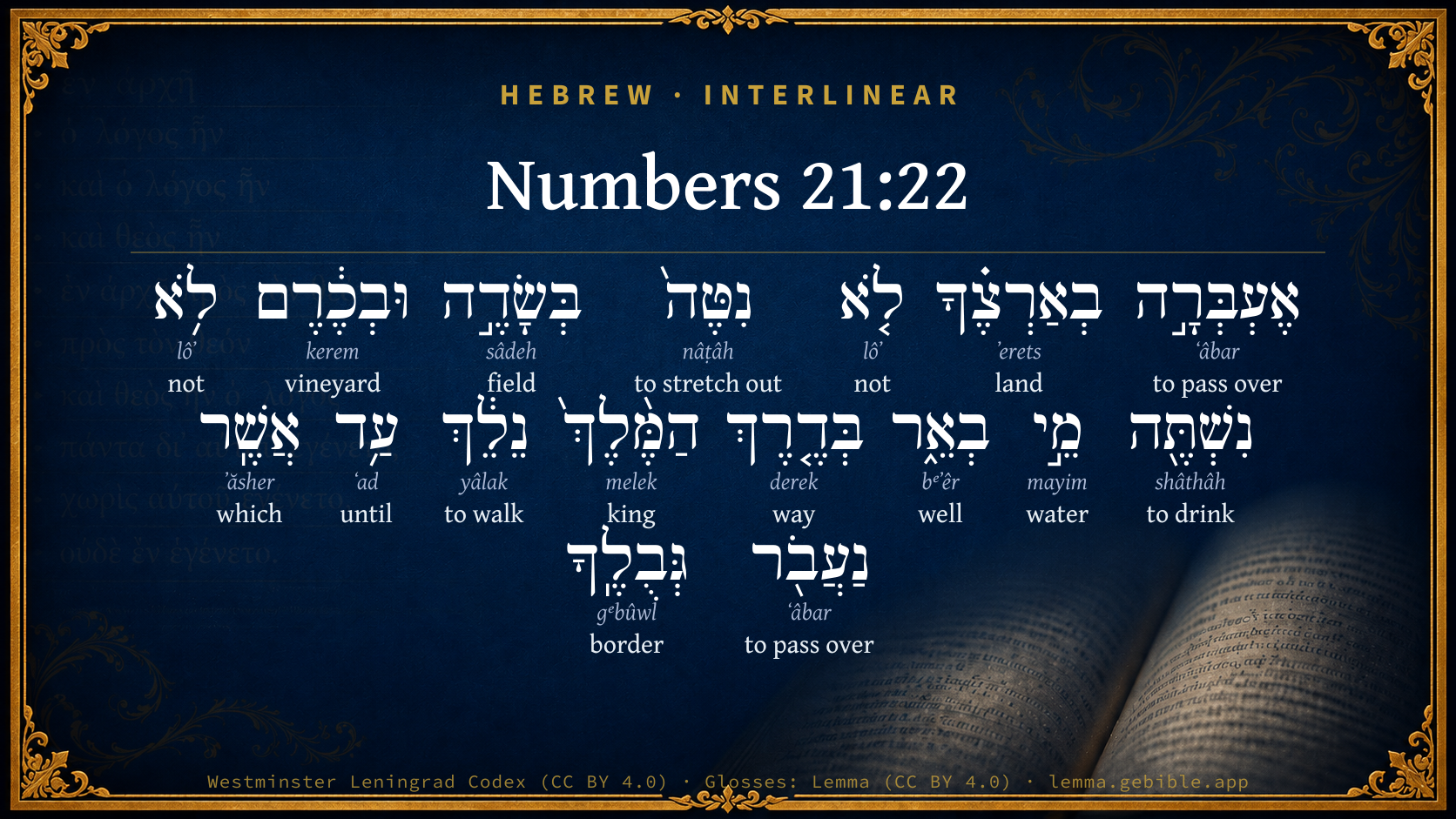
Hebrew (Westminster Leningrad Codex) Numbers 21:22 appears in the Hebrew Old Testament. The text above is from the Westminster Leningrad Codex. Each word links to its Strong’s number, a concise gloss, and parsing drawn from the Open Scriptures Hebrew Bible morphology. Click any word for its full Brown-Driver-Briggs (BDB) entry.
Download image
Cite this verse

Numbers 21:22 (World English Bible). Public Domain. Lemma interlinear Bible study tool, https://lemma.gebible.app/v/numbers/21/22.

Show BibTeX & RIS
BibTeX
RIS
English Translation
Let me pass through your land: we will not turn aside into field, or into vineyard; we will not drink of the water of the wells: we will go by the king's highway, until we have passed your border.
World English Bible · Public Domain
Download a study sheet

One document with this verse’s original text, its word-by-word gloss line, the meaning frame, cross-references with their text, attributed commentary, and full source and license credits — printable, and it pastes into notes with its structure intact.

This verse Autodidact and up

Study sheet (.html) Plain text (.txt)

A passage Seminary Student

Up to 50 verses in one chapter. A passage sheet keeps up to 6 commentary sources and 12 cross-references per verse, in the order this page ranks them, and says so on the sheet whenever that leaves anything out. Ask for a single verse and you get the Autodidact verse sheet above.

Everything on this page stays free to read, with no account — the sheet is a download of what is already on screen, not access to it.

Want to remove ads? Support Godless Engineer
Compare translations 3

The same verse in 3 English versions, stacked beneath the original-language interlinear above. Click any original word for its lexicon entry.

Each is an independent rendering of the whole verse — the interlinear is not word-aligned to these translations.

Highlighted words mark where these versions differ — a whole-verse word diff, not a word-by-word alignment.

  • World English Bible Public Domain
    Let me pass through your land: we will not turn aside into field, or into vineyard; we will not drink of the water of the wells: we will go by the king's highway, until we have passed your border.
  • King James Version Public Domain
    Let me pass through thy land: we will not turn into the fields, or into the vineyards; we will not drink of the waters of the well: but we will go along by the king's high way, until we be past thy borders.
  • unfoldingWord Literal Text CC BY-SA 4.0
    “Let me pass through your land. We will not turn into a field or into a vineyard. We will not drink water of a well. We will go by the way of the king until we pass through your border.”

unfoldingWord Literal Text — © unfoldingWord, licensed CC BY-SA 4.0. Word-aligned USFM3 via Door43 (git.door43.org/unfoldingWord/en_ult).

Versions to compare (up to 4)

3 of 4 selected

Show all 18 translations

Every available English version of this verse, each an independent rendering of the whole verse.

  • World English Bible Public Domain
    Let me pass through your land: we will not turn aside into field, or into vineyard; we will not drink of the water of the wells: we will go by the king's highway, until we have passed your border.
  • Berean Standard Bible Public Domain
    “Let us pass through your land. We will not cut through any field or vineyard, or drink water from any well. We will stay on the King’s Highway until we have passed through your territory.”
  • Majority Standard Bible Public Domain
    “Let us pass through your land. We will not turn aside into any field or vineyard, or drink water from any well. We will stay on the King’s Highway until we have passed through your territory.”
  • King James Version Public Domain
    Let me pass through thy land: we will not turn into the fields, or into the vineyards; we will not drink of the waters of the well: but we will go along by the king's high way, until we be past thy borders.
  • American Standard Version (1901) Public Domain
    Let me pass through thy land: we will not turn aside into field, or into vineyard; we will not drink of the water of the wells: we will go by the king's highway, until we have passed thy border.
  • Revised Version (1885) Public Domain
    Let me pass through thy land: we will not turn aside into field, or into vineyard; we will not drink of the water of the wells: we will go by the king’s high way, until we have passed thy border.
  • Geneva Bible (1599) Public Domain
    Let me goe through thy land: we wil not turne aside into the fieldes, nor into the vineyardes, neither drinke of the waters of ye welles: we will goe by the kings way, vntill we be past thy countrey.
  • Douay-Rheims (1899) Public Domain
    I beseech thee that I may have leave to pass through thy land: we will not go aside into the fields or the vineyards, we will not drink waters of the wells, we will go the king's highway, till we be past thy borders.
  • Young's Literal Translation Public Domain
    `Let me pass through thy land, we do not turn aside into a field, or into a vineyard, we do not drink waters of a well; in the king's way we go, till that we pass over thy border.'
  • Literal Standard Version CC BY-SA 4.0
    “Let me pass through your land, we do not turn aside into a field or into a vineyard; we do not drink waters of a well; we go in the king’s way until we pass over your border.”
  • Unlocked Literal Bible CC BY-SA 4.0
    “Let us pass through your land. We will not turn into any field or vineyard. We will not drink the water from your wells. We will travel by the king's highway until we have crossed your border.”
  • unfoldingWord Literal Text CC BY-SA 4.0
    “Let me pass through your land. We will not turn into a field or into a vineyard. We will not drink water of a well. We will go by the way of the king until we pass through your border.”
  • Darby Bible Public Domain
    Let us pass through thy land; we will not turn into the fields, or into the vineyards; we will not drink water out of the wells; on the king's road will we go until we have passed thy border.
  • World Messianic Bible Public Domain
    “Let me pass through your land. We will not turn away into field or vineyard. We will not drink of the water of the wells. We will go by the king’s highway, until we have passed your border.”
  • Webster's Bible Public Domain
    Let me pass through thy land: we will not turn into the fields, or into the vineyards; we will not drink of the waters of the well: but we will go along by the king's high-way, until we have past thy borders.
  • Free Bible Version CC BY-SA 4.0
    “Please allow us to travel through your country. We won't cross any of your fields or vineyards, or drink water from any of your wells. We will stay on the King's Highway until we have passed through your country.”
  • Bible in Basic English Public Domain
    Let me go through your land: we will not go into field or vine-garden, or take the water of the springs; we will go by the highway till we have gone past the limits of your land.
  • JPS Tanakh (1917) Public Domain
    'Let me pass through thy land; we will not turn aside into field, or into vineyard; we will not drink of the water of the wells; we will go by the king's highway, until we have passed thy border.'

Literal Standard Version (2020), Covenant Press — licensed CC BY-SA 4.0. Text via the HelloAO Bible API (eBible.org). Unlocked Literal Bible (unfoldingWord) — licensed CC BY-SA 4.0. Text via the HelloAO Bible API (eBible.org). unfoldingWord Literal Text — © unfoldingWord, licensed CC BY-SA 4.0. Word-aligned USFM3 via Door43 (git.door43.org/unfoldingWord/en_ult). Free Bible Version, Dr. Jonathan Gallagher — licensed CC BY-SA 4.0. Text via the HelloAO Bible API (eBible.org).

Word by word

More ways to search: Search by grammar → Find every occurrence → Compare this word →

Practice this passage: Drill this verse → Learn its vocabulary →

בְאֵ֑ר
bᵉʼêr
H875
“well”
Noun, Common, Feminine, Singular, Absolute
Part of Speech
Noun
Type
Common
Gender
Feminine
Number
Singular
State
Absolute
Full BDB Definition

Origin: from H874

TWOT: 194a

well, pit, spring
  1. אֶעְבְּרָ֣ה ʻâbar H5674 “to pass over” Verb, Qal, Cohortative, 1st Person, Common, Singular
  2. בְאַרְצֶ֗ךָ ʼerets H776 “in/at · land · your” Preposition + Noun, Common, Both, Singular, Construct + Suffix, Personal, 2nd Person, Masculine, Singular
  3. לֹ֤א lôʼ H3808 “not” Particle, Negative
  4. נִטֶּה֙ nâṭâh H5186 “to stretch out” Verb, Qal, Imperfect, 1st Person, Common, Plural
  5. בְּשָׂדֶ֣ה sâdeh H7704 “in/at · field” Preposition + Noun, Common, Masculine, Singular, Absolute
  6. וּבְכֶ֔רֶם kerem H3754 “and · in/at · vineyard” Conjunction + Preposition + Noun, Common, Both, Singular, Absolute
  7. לֹ֥א lôʼ H3808 “not” Particle, Negative
  8. נִשְׁתֶּ֖ה shâthâh H8354 “to drink” Verb, Qal, Imperfect, 1st Person, Common, Plural
  9. מֵ֣י mayim H4325 “water(s) of” Noun, Common, Masculine, Plural, Construct
  10. בְּדֶ֤רֶךְ derek H1870 “in/at · way of” Preposition + Noun, Common, Both, Singular, Construct
  11. הַמֶּ֨לֶךְ֙ melek H4428 “the · king” Particle, Definite Article + Noun, Common, Masculine, Singular, Absolute
  12. נֵלֵ֔ךְ yâlak H3212 “to walk” Verb, Qal, Imperfect, 1st Person, Common, Plural
  13. עַ֥ד ʻad H5704 “until” Preposition
  14. אֲשֶֽׁר ʼăsher H834 “which” Particle, Relative
  15. נַעֲבֹ֖ר ʻâbar H5674 “to pass over” Verb, Qal, Imperfect, 1st Person, Common, Plural
  16. גְּבֻלֶֽךָ gᵉbûwl H1366 “border · your” Noun, Common, Masculine, Singular, Construct + Suffix, Personal, 2nd Person, Masculine, Singular

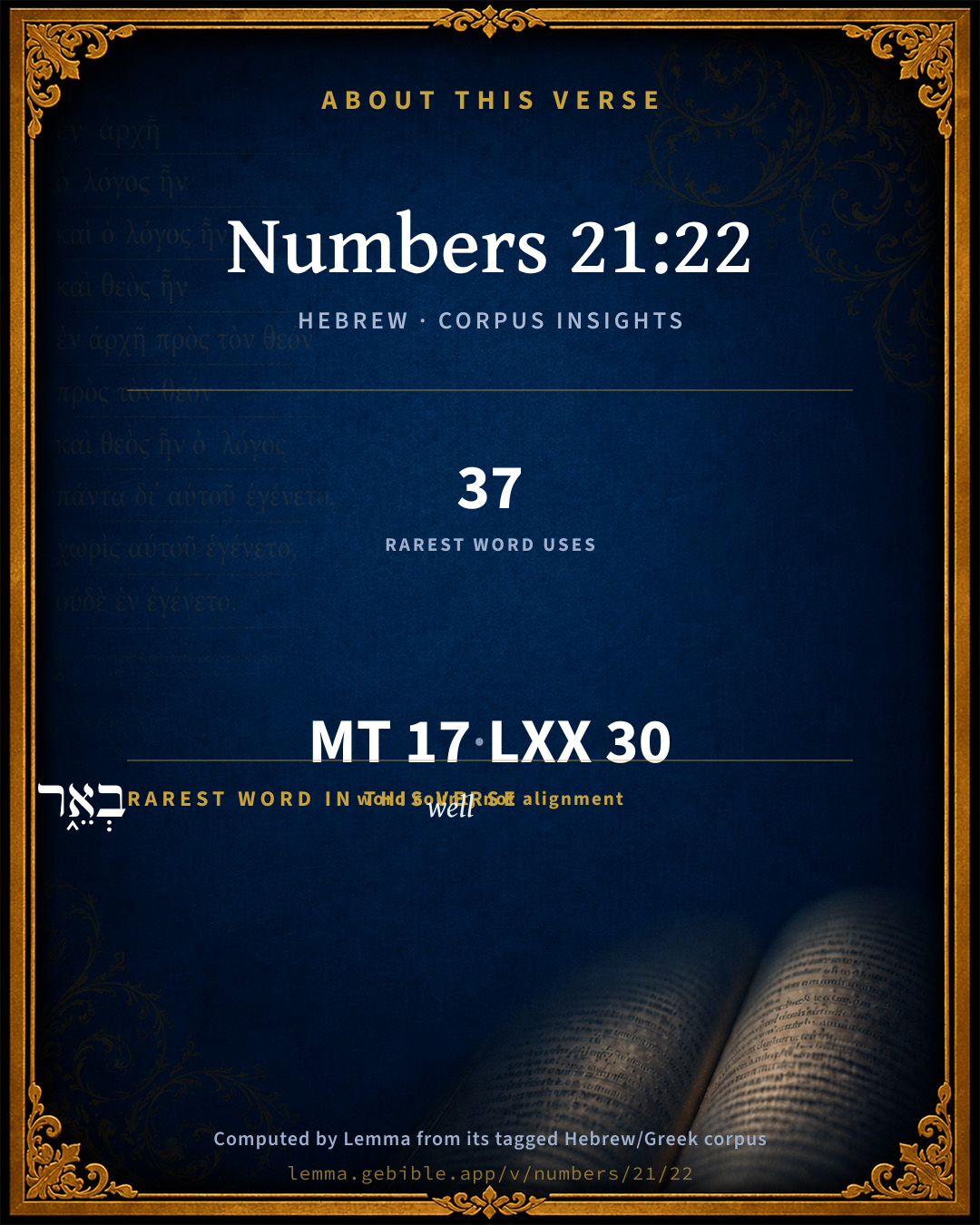
About this verse

These counts appear in no published source. They are computed here, from the morphology-tagged text and Lemma’s own curated glosses. What Lemma adds →

17
words
15
distinct lemmas
Pentateuch
section

Shared distinctive vocabulary

בְאֵ֑ר well H875 occurs in 33 verses of the Hebrew Bible. Also found in:

Grammatical profile

  • 5 verbs
  • 8 nouns
  • 1 preposition
  • 3 particles

Verb forms

  • אֶעְבְּרָ֣ה Qal · Cohortative
  • נִטֶּה֙ Qal · Imperfect
  • נִשְׁתֶּ֖ה Qal · Imperfect
  • נֵלֵ֔ךְ Qal · Imperfect
  • נַעֲבֹ֖ר Qal · Imperfect

Repetition

Words recur within this verse — often emphatic in Hebrew:

  • אֶעְבְּרָ֣ה to pass over H5674 ×2
  • לֹ֤א not H3808 ×2

Hebrew & Septuagint length

In English translation the verse runs 39 words from the Hebrew and 22 from the Septuagint (LXX English) — the Septuagint runs noticeably shorter here. See the side-by-side →

A rough comparison of the two English renderings, which tokenize alike — not a word-level alignment.

Word counts can differ between the Hebrew and the Greek without any difference in meaning — e.g. the Hebrew direct-object marker אֵת has no separate Greek word, and Greek often adds the article ὁ.

In the original languages it is 17 Hebrew tokens and 30 Greek tokens — but the two are counted differently (Hebrew bundles its prefixes and suffixes into one token; the Greek is in lemma form), so that isn’t a like-for-like length.

Cross-references

1

Topical passages linked to Numbers 21:22 in the Treasury of Scripture Knowledge — connected by theme and wording, ordered by reader-vote popularity; previews shown in the World English Bible.

  • Numbers 20:17 Please let us pass through your land: we will not pass through field or through vineyard, neither will we drink of the water of the wells: we will go along the king's highway; we will not turn aside to the right hand nor to the left, until we have passed your border.

Cross-references courtesy of OpenBible.info (CC BY 4.0).

Hebrew and Greek witnesses Masoretic Hebrew ↔ Greek Septuagint

The same verse in the two great witnesses to the Old Testament, shown verse-for-verse.

Here the Septuagint runs noticeably shorter than the Hebrew — LXX2012 (modern English Septuagint) 22 words vs World English Bible 39. A rough length comparison of the two English translations, not a word-level alignment — read both below.

These are two independent witnesses, not word-aligned to each other, and the Septuagint is shown in lemma (dictionary) form.

Hebrew Numbers 21:22 Masoretic · Westminster Leningrad Codex

אֶעְבְּרָ֣ה בְאַרְצֶ֗ךָ לֹ֤א נִטֶּה֙ בְּשָׂדֶ֣ה וּבְכֶ֔רֶם לֹ֥א נִשְׁתֶּ֖ה מֵ֣י בְאֵ֑ר בְּדֶ֤רֶךְ הַמֶּ֨לֶךְ֙ נֵלֵ֔ךְ עַ֥ד אֲשֶֽׁר נַעֲבֹ֖ר גְּבֻלֶֽךָ

Let me pass through your land: we will not turn aside into field, or into vineyard; we will not drink of the water of the wells: we will go by the king's highway, until we have passed your border.

World English Bible · Public Domain

Greek LXX Numbers 21:22 Septuagint · lemma form

παραἔρχομαι διά ὁ γῆ σύ ὁ ὁδός πορεύομαι οὐ ἐκκλίνω οὔτε εἰς ἀγρός οὔτε εἰς ἀμπελών οὐ πίνω ὕδωρ ἐκ φρέαρ σύ ὁδός βασιλικός πορεύομαι ἕως παραἔρχομαι ὁ ὅριον σύ

We will not drink water out of your well; we will go by the king's highway, until we have past your boundaries.

LXX2012 (modern English Septuagint) · Public Domain

Hebrew: Westminster Leningrad Codex (CC BY 4.0). Greek: Septuagint (public domain); English from LXX2012 (modern English Septuagint) (Public Domain). How the Septuagint differs from the Hebrew →

Targum (Aramaic paraphrase)

2

The Targum is the ancient Jewish Aramaic paraphrase of the Hebrew Scriptures — an interpretive translation, not the Hebrew text itself. Onkelos (literal) and Pseudo-Jonathan (expansive) render the Torah, and Jonathan the Prophets. Coverage is partial: where no permissively-licensed English translation exists for a verse, only the Aramaic is shown. This is verse-level text, not a word-by-word alignment to the Hebrew.

  1. Targum Onkelos Torah (Genesis–Deuteronomy)
    אֵעִיבַּר בְּאַרְעָךְ לָא נִסְטֵי בַּחֲקַל וּבִכְרַם לָא נִשְׁתֵּי מֵי גוֹב בְּאֹרַח מַלְכָּא נֵיזֵיל עַד דִי נְעִבַּר תְּחוּמָךְ

    (no public-domain English translation for this verse)

    Targum Onkelos — Aramaic: “Onkelos Genesis” (public domain); “Onkelos Exodus” (public domain); “Onkelos Leviticus” (public domain); “Onkelos Numbers” (public domain); “Onkelos Deuteronomy” (public domain). English: “Sefaria Community Translation” (CC0 1.0 (public-domain dedication)); “J.W. Etheridge. The Targums of Onkelos and Jonathan Ben Uzziel on the Pentateuch. London: Longmans, Green, 1862” (public domain). Text via Sefaria.

  2. Targum Pseudo-Jonathan Torah (Genesis–Deuteronomy)
    אֲעִיבַּר בְּאַרְעָךְ לָא נְאַנוֹס אֲרִיסַן וְלָא נְשַׁרְגָן בְּתוּלָן וְלָא נִבְעוֹל נְשֵׁי גוּבְרִין אוֹרַח מַלְכָּא דְבִשְׁמַיָא נֵזֵיל עַד דְנֵיעִיבַר תְּחוּמָךְ

    I would pass through thy country. We will not carry off the betrothed, nor seduce virgins, nor have to do with the wives of men; by the highway of the King who is in the heavens we will go, until we have passed through thy border.

    Targum Pseudo-Jonathan — Aramaic: “Targum Jonathan on Genesis” (public domain); “Targum Jonathan on Exodus” (public domain); “Targum Jonathan on Leviticus” (public domain); “Targum Jonathan on Numbers” (public domain); “Targum Jonathan on Deuteronomy” (public domain). English: “The Targum of Jonathan ben Uzziel, trans. J. W. Etheridge, London, 1862” (public domain). Text via Sefaria.

Commentary

Notes on Numbers 21:22 from classic Christian and Jewish commentators (each source and its license shown beneath its notes). The classic Christian expositions comment on the surrounding passage and are grouped to its opening verse, so a note may address several verses; the Jewish commentaries on the Tanakh (Rashi and others) are per-verse, so they appear only where the commentator wrote on this verse.

Lemma curates 59 commentaries, every one of them public domain or Creative Commons licensed, each selected and text-cleaned for this edition rather than reprinted as found. About our sources →

Trapp's Complete Commentary

John Trapp

Num 21:22 Let me pass through thy land: we will not turn into the fields, or into the vineyards; we will not drink [of] the waters of the well: [but] we will go along by the king’s [high] way, until we be past thy borders.

Ver. 22. Let me pass.] {See Trapp on "Num 20:17"}

John Trapp, A Commentary or Exposition upon All the Books of the Old and New Testament (1647–1656) — public domain. Text from a community e-Sword module.

The Cambridge Bible for Schools and Colleges

gen. ed. J. J. S. Perowne

22. the king’s way] See on Num_20:17.

until we have passed through thy territory] And similarly in the next verse.

The Cambridge Bible for Schools and Colleges (gen. ed. J. J. S. Perowne; Cambridge University Press, 1878–1918) — public domain. Text from a community e-Sword module.

John Gill's Exposition

And Israel took all these cities,.... Which lay between the rivers Arnon and Jabbok; their particular names may be seen in Num 32:3,

and Israel dwelt in all the cities of the Amorites; being given to the Reubenites and Gadites, who inhabited them, as their possession and inheritance, Num 32:2,

in Heshbon, and in all the villages thereof; or "daughters thereof" (q). Heshbon was the metropolis or mother city, and all the towns and villages adjacent were as daughters to it; of which city more is said in the following verses; see Gill on Isa 15:4.

(q) "filiabus ejus", Montanus, Munster, Fagius, Grotius.

John Gill's Exposition of the Whole Bible (1746–1763) — public domain (CC PDM 1.0). Text via the HelloAO Bible API.

Haydock's Catholic Bible Commentary

Wells. We shall content ourselves with the torrents. They had only to travel about thirty miles. (Calmet)

George Leo Haydock (1774–1849), Haydock's Catholic Family Bible and Commentary, 1859 edition — public domain. Excludes Psalms (Douay-Rheims chapter numbering differs from Protestant) and Deuterocanonical books (Catholic canon only).

Matthew Poole's English Annotations

They spoke what they seriously intended and would have done, if he had given them quiet passage; but withal they knew that Sihon would not do it, and that he would withstand them, and that they should subdue him and take his land, as God had told them before they sent this message, as appears from Deu 2:21,26,27; and accordingly God hardened his spirit, and made his heart obstinate, for this end, that he might deliver him into Israel’s hand there, Num 21:31. And no wonder, for he and his people were Amorites, and therefore devoted to destruction, as all that people were.

Matthew Poole's English Annotations on the Holy Bible (1683–1685) — public domain. Text from a community e-Sword/MySword module.

The Pulpit Commentary

Let me pass through thy land. Cf. Num_20:17. Israel was not commanded to spare the Amorites, indeed he was under orders to smite them, (Deu_2:24) but that did not prevent his approaching them in the first instance with words of peace. If Sihon had hearkened, no doubt Israel would have passed directly on to Jordan, and he would at least have been spared for the present.

The Pulpit Commentary (1880–1919), ed. H.D.M. Spence-Jones & Joseph S. Exell — public domain. Text from a community e-Sword module.

John Wesley's Explanatory Notes

Let me pass - They spoke what they seriously intended and would have done, if he had given them quiet passage.

John Wesley, Explanatory Notes Upon the Whole Bible (1754–1765) — public domain. Text via the GEBible commentary corpus.

Rashi

Rabbi Shlomo Yitzchaki (Rashi)

אעברה בארצך LET ME PASS THROUGH THY LAND — Although they had not been bidden to open the negotiations with them by an offer of peace yet they first sought peace of them (cf. Midrash Tanchuma, Chukat 22).

Rashi on the Tanakh — English translations: “The Judaica Press complete Tanach with Rashi, translated by A. J. Rosenberg” (CC BY 4.0); “Pentateuch with Rashi's commentary by M. Rosenbaum and A.M. Silbermann, 1929-1934” (public domain); “The Metsudah Tanach series, Lakewood, N.J” (CC BY 4.0); and “The Book of Joshua, Metsudah Publications, 1997” (CC BY 4.0). Text via Sefaria.

Lesson kit

Teaching starters — assembled from the data on this page, not authored interpretation. Every prompt links to the verse data it draws on. Edit before teaching.

Numbers, in the Pentateuch, opens this verse with 17 words (15 distinct Hebrew lemmas). Its most distinctive word is bᵉʼêr (“well”). The Greek Septuagint runs shorter here. A historical commentator’s framing appears above. Read the whole chapter for the surrounding context.

Discussion questions

  1. What does “well” (bᵉʼêr) contribute to the verse as a whole?
  2. How does Genesis 14:10, which shares the word «well», read alongside this verse?
  3. What does the repetition of “to pass over” (2× in this one verse) do in this verse?
  4. The Septuagint runs shorter here than the Hebrew. What might account for the difference?
  5. These translations render this verse differently; the difference is in the English rendering, not the original. What questions does that raise?
  6. «אֶעְבְּרָ֣ה» is a Qal Cohortative verb. How does that grammatical form shape the action described?
  7. Compare how Trapp's Complete Commentary and The Cambridge Bible for Schools and Colleges read this verse. Where do they agree or differ?

Things to notice

Reading settings

Reading text

Shown beneath each verse's original-language words.

Old Testament
Old Testament edition

Read the OT as the Masoretic Hebrew (MT) or the Greek Septuagint (LXX).

English shown for the Greek Septuagint (in the Hebrew ↔ Greek comparison).

Comparing translations? Open the Compare panel on any verse page to stack up to four side by side.