
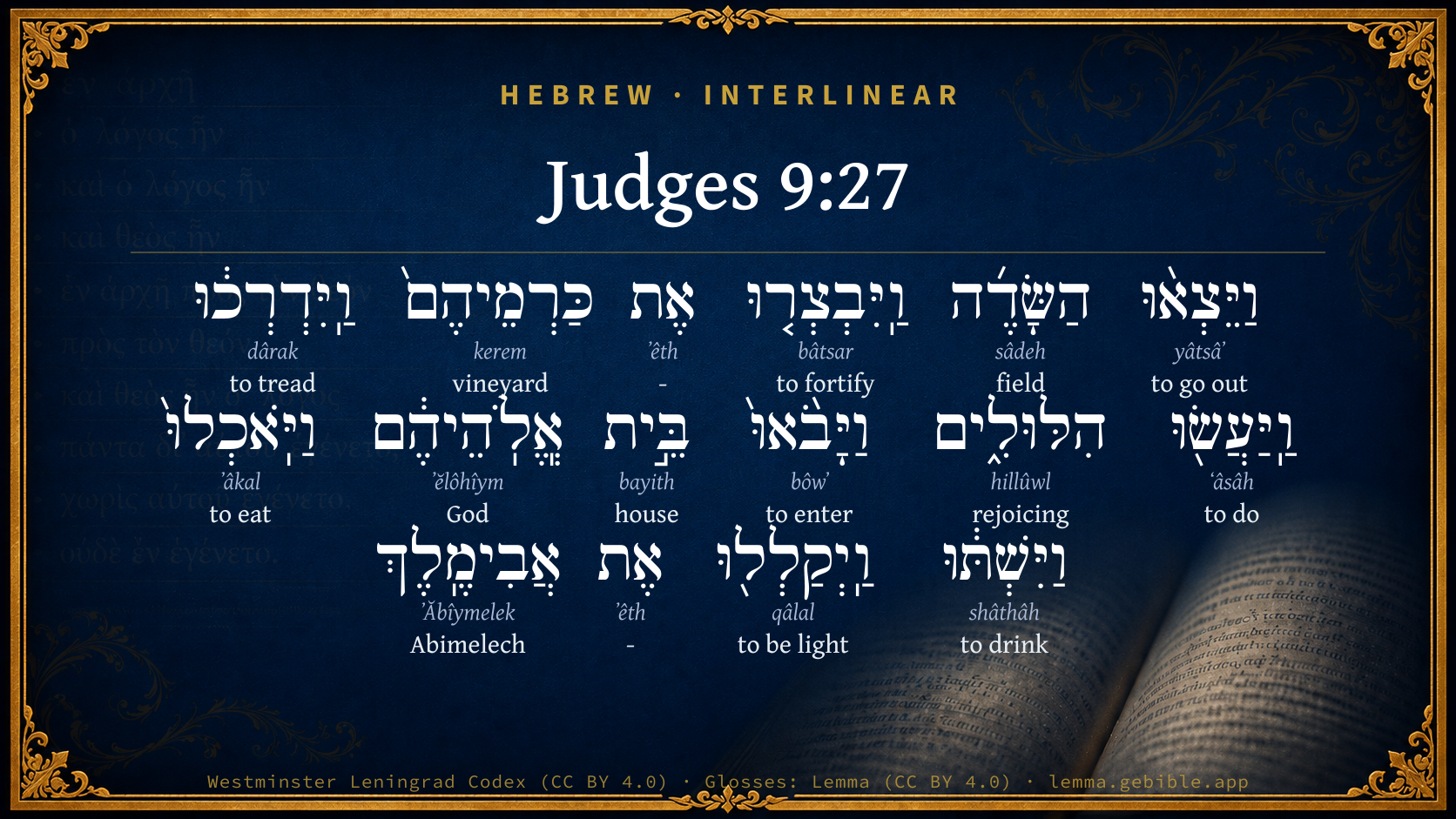
Judges 9:27

Hebrew (Westminster Leningrad Codex) Judges 9:27 appears in the Hebrew Old Testament. The text above is from the Westminster Leningrad Codex. Each word links to its Strong’s number, a concise gloss, and parsing drawn from the Open Scriptures Hebrew Bible morphology. Click any word for its full Brown-Driver-Briggs (BDB) entry.
Download image
Cite this verse

Judges 9:27 (World English Bible). Public Domain. Lemma interlinear Bible study tool, https://lemma.gebible.app/v/judges/9/27.

Show BibTeX & RIS
BibTeX
RIS
English Translation
They went out into the field, and gathered their vineyards, and trod [the grapes], and held festival, and went into the house of their god, and did eat and drink, and cursed Abimelech.
World English Bible · Public Domain
Download a study sheet

One document with this verse’s original text, its word-by-word gloss line, the meaning frame, cross-references with their text, attributed commentary, and full source and license credits — printable, and it pastes into notes with its structure intact.

This verse Autodidact and up

Study sheet (.html) Plain text (.txt)

A passage Seminary Student

Up to 50 verses in one chapter. A passage sheet keeps up to 6 commentary sources and 12 cross-references per verse, in the order this page ranks them, and says so on the sheet whenever that leaves anything out. Ask for a single verse and you get the Autodidact verse sheet above.

Everything on this page stays free to read, with no account — the sheet is a download of what is already on screen, not access to it.

Want to remove ads? Support Godless Engineer
Compare translations 3

The same verse in 3 English versions, stacked beneath the original-language interlinear above. Click any original word for its lexicon entry.

Each is an independent rendering of the whole verse — the interlinear is not word-aligned to these translations.

Highlighted words mark where these versions differ — a whole-verse word diff, not a word-by-word alignment.

  • World English Bible Public Domain
    They went out into the field, and gathered their vineyards, and trod [the grapes], and held festival, and went into the house of their god, and did eat and drink, and cursed Abimelech.
  • King James Version Public Domain
    And they went out into the fields, and gathered their vineyards, and trode the grapes, and made merry, and went into the house of their god, and did eat and drink, and cursed Abimelech.
  • unfoldingWord Literal Text CC BY-SA 4.0
    And they went out the field and cut off their vineyards and trod, and they made offerings and went the house of their god, and they ate and drank and cursed Abimelech.

unfoldingWord Literal Text — © unfoldingWord, licensed CC BY-SA 4.0. Word-aligned USFM3 via Door43 (git.door43.org/unfoldingWord/en_ult).

Versions to compare (up to 4)

3 of 4 selected

Show all 18 translations

Every available English version of this verse, each an independent rendering of the whole verse.

  • World English Bible Public Domain
    They went out into the field, and gathered their vineyards, and trod [the grapes], and held festival, and went into the house of their god, and did eat and drink, and cursed Abimelech.
  • Berean Standard Bible Public Domain
    And after they had gone out into the fields, gathered grapes from their vineyards, and trodden them, they held a festival and went into the house of their god; and as they ate and drank, they cursed Abimelech.
  • Majority Standard Bible Public Domain
    And after they had gone out into the fields, gathered grapes from their vineyards, and trodden them, they held a festival and went into the house of their god; and as they ate and drank, they cursed Abimelech.
  • King James Version Public Domain
    And they went out into the fields, and gathered their vineyards, and trode the grapes, and made merry, and went into the house of their god, and did eat and drink, and cursed Abimelech.
  • American Standard Version (1901) Public Domain
    And they went out into the field, and gathered their vineyards, and trod `the grapes', and held festival, and went into the house of their god, and did eat and drink, and cursed Abimelech.
  • Revised Version (1885) Public Domain
    And they went out into the field, and gathered their vineyards, and trode the grapes, and held festival, and went into the house of their god, and did eat and drink, and cursed Abimelech.
  • Geneva Bible (1599) Public Domain
    Therefore they went out into the field, and gathered in their grapes and troade them, and made merie, and went into the house of their gods, and did eate and drinke, and cursed Abimelech.
  • Douay-Rheims (1899) Public Domain
    Went out into the fields, wasting the vineyards, and treading down the grapes: and singing and dancing they went into the temple of their god, and in their banquets and cups they cursed Abimelech.
  • Young's Literal Translation Public Domain
    and go out into the field, and gather their vineyards, and tread, and make praises, and go into the house of their god, and eat and drink, and revile Abimelech.
  • Literal Standard Version CC BY-SA 4.0
    and go out into the field, and gather their vineyards, and tread, and make praises, and go into the house of their god, and eat and drink, and revile Abimelech.
  • Unlocked Literal Bible CC BY-SA 4.0
    They went out into the field and gathered grapes from the vineyards, and they trampled on them. They held a festival in the house of their god, where they ate and drank, and they cursed Abimelech.
  • unfoldingWord Literal Text CC BY-SA 4.0
    And they went out the field and cut off their vineyards and trod, and they made offerings and went the house of their god, and they ate and drank and cursed Abimelech.
  • Darby Bible Public Domain
    And they went out into the field, and gathered the grapes from their vineyards and trod them, and held festival, and went into the house of their god, and ate and drank and reviled Abim'elech.
  • World Messianic Bible Public Domain
    They went out into the field, harvested their vineyards, trod the grapes, celebrated, and went into the house of their god and ate and drank, and cursed Abimelech.
  • Webster's Bible Public Domain
    And they went out into the fields, and gathered their vineyards, and trod the grapes, and made merry, and went into the house of their god, and ate and drank, and cursed Abimelech.
  • Free Bible Version CC BY-SA 4.0
    At harvest-time they went out into the countryside and gathered the grapes from their vineyards and trod them. They celebrated by having a festival in the temple of their god, where they ate and drank, and cursed Abimelech.
  • Bible in Basic English Public Domain
    And they went out into their fields and got in the fruit of their vines, and when the grapes had been crushed, they made a holy feast and went into the house of their god, and over their food and drink they were cursing Abimelech.
  • JPS Tanakh (1917) Public Domain
    And they went out into the field, and gathered their vineyards, and trod the grapes, and held festival, and went into the house of their god, and did eat and drink, and cursed Abimelech.

Literal Standard Version (2020), Covenant Press — licensed CC BY-SA 4.0. Text via the HelloAO Bible API (eBible.org). Unlocked Literal Bible (unfoldingWord) — licensed CC BY-SA 4.0. Text via the HelloAO Bible API (eBible.org). unfoldingWord Literal Text — © unfoldingWord, licensed CC BY-SA 4.0. Word-aligned USFM3 via Door43 (git.door43.org/unfoldingWord/en_ult). Free Bible Version, Dr. Jonathan Gallagher — licensed CC BY-SA 4.0. Text via the HelloAO Bible API (eBible.org).

Word by word

More ways to search: Search by grammar → Find every occurrence → Compare this word →

Practice this passage: Drill this verse → Learn its vocabulary →

הִלּוּלִ֑ים
hillûwl
H1974
“rejoicing”
Noun, Common, Masculine, Plural, Absolute
Part of Speech
Noun
Type
Common
Gender
Masculine
Number
Plural
State
Absolute
Full BDB Definition

Origin: from H1984 (in the sense of rejoicing)

TWOT: 500a

rejoicing, praise - rejoicing - praise
  1. וַיֵּצְא֨וּ yâtsâʼ H3318 “and · to go out” Conjunction + Verb, Qal, Sequential Imperfect, 3rd Person, Masculine, Plural
  2. הַשָּׂדֶ֜ה sâdeh H7704 “the · field” Particle, Definite Article + Noun, Common, Masculine, Singular, Absolute
  3. וַֽיִּבְצְר֤וּ bâtsar H1219 “and · to fortify” Conjunction + Verb, Qal, Sequential Imperfect, 3rd Person, Masculine, Plural
  4. אֶת ʼêth H853 “-” Particle, Direct Object
  5. כַּרְמֵיהֶם֙ kerem H3754 “vineyards · their” Noun, Common, Both, Plural, Construct + Suffix, Personal, 3rd Person, Masculine, Plural
  6. וַֽיִּדְרְכ֔וּ dârak H1869 “and · to tread” Conjunction + Verb, Qal, Sequential Imperfect, 3rd Person, Masculine, Plural
  7. וַֽיַּעֲשׂ֖וּ ʻâsâh H6213 “and · to do” Conjunction + Verb, Qal, Sequential Imperfect, 3rd Person, Masculine, Plural
  8. וַיָּבֹ֨אוּ֙ bôwʼ H935 “and · to enter” Conjunction + Verb, Qal, Sequential Imperfect, 3rd Person, Masculine, Plural
  9. בֵּ֣ית bayith H1004 “house of” Noun, Common, Masculine, Singular, Construct
  10. אֱֽלֹֽהֵיהֶ֔ם ʼĕlôhîym H430 “God(s) · their” Noun, Common, Masculine, Plural, Construct + Suffix, Personal, 3rd Person, Masculine, Plural
  11. וַיֹּֽאכְלוּ֙ ʼâkal H398 “and · to eat” Conjunction + Verb, Qal, Sequential Imperfect, 3rd Person, Masculine, Plural
  12. וַיִּשְׁתּ֔וּ shâthâh H8354 “and · to drink” Conjunction + Verb, Qal, Sequential Imperfect, 3rd Person, Masculine, Plural
  13. וַֽיְקַלְל֖וּ qâlal H7043 “and · to be light” Conjunction + Verb, Piel, Sequential Imperfect, 3rd Person, Masculine, Plural
  14. אֶת ʼêth H853 “-” Particle, Direct Object
  15. אֲבִימֶֽלֶךְ ʼĂbîymelek H40 “Abimelech” Noun, Proper

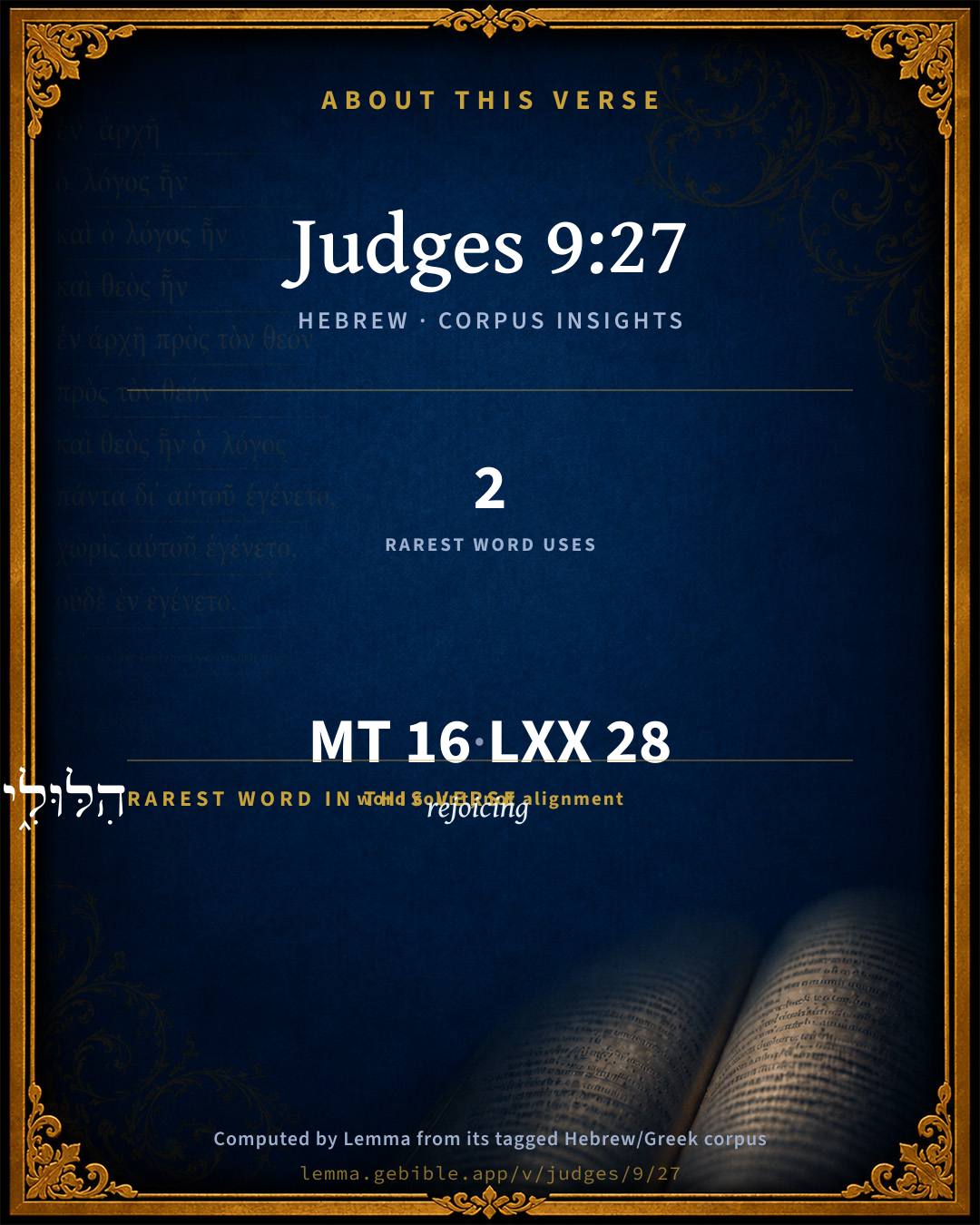
About this verse

These counts appear in no published source. They are computed here, from the morphology-tagged text and Lemma’s own curated glosses. What Lemma adds →

16
words
15
distinct lemmas
Historical
section

Notable vocabulary

The rarest word here is הִלּוּלִ֑ים rejoicing H1974 — appearing just 2 times in the whole Hebrew Bible.

Shared distinctive vocabulary

הִלּוּלִ֑ים rejoicing H1974 occurs in 2 verses of the Hebrew Bible. Also found in:

Grammatical profile

  • 8 verbs
  • 6 nouns
  • 2 particles

Verb forms

  • וַיֵּצְא֨וּ Qal · Sequential Imperfect
  • וַֽיִּבְצְר֤וּ Qal · Sequential Imperfect
  • וַֽיִּדְרְכ֔וּ Qal · Sequential Imperfect
  • וַֽיַּעֲשׂ֖וּ Qal · Sequential Imperfect
  • וַיָּבֹ֨אוּ֙ Qal · Sequential Imperfect
  • וַיֹּֽאכְלוּ֙ Qal · Sequential Imperfect
  • וַיִּשְׁתּ֔וּ Qal · Sequential Imperfect
  • וַֽיְקַלְל֖וּ Piel · Sequential Imperfect

Hebrew & Septuagint length

In English translation the verse runs 33 words from the Hebrew and 35 from the Septuagint (LXX English) — closely comparable.

A rough comparison of the two English renderings, which tokenize alike — not a word-level alignment.

Word counts can differ between the Hebrew and the Greek without any difference in meaning — e.g. the Hebrew direct-object marker אֵת has no separate Greek word, and Greek often adds the article ὁ.

In the original languages it is 16 Hebrew tokens and 28 Greek tokens — but the two are counted differently (Hebrew bundles its prefixes and suffixes into one token; the Greek is in lemma form), so that isn’t a like-for-like length.

Cross-references

18

Topical passages linked to Judges 9:27 in the Treasury of Scripture Knowledge — connected by theme and wording, ordered by reader-vote popularity; previews shown in the World English Bible.

  • Judges 9:4 They gave him seventy [pieces] of silver out of the house of Baal Berith, with which Abimelech hired vain and light fellows, who followed him.
  • Luke 17:26–29 As it happened in the days of Noah, even so will it be also in the days of the Son of Man.
  • Exodus 32:6 They rose up early on the next day, and offered burnt offerings, and brought peace-offerings; and the people sat down to eat and to drink, and rose up to play.
  • Exodus 32:19 It happened, as soon as he came near to the camp, that he saw the calf and the dancing: and Moses' anger grew hot, and he threw the tablets out of his hands, and broke them beneath the mountain.
  • Leviticus 24:11 The son of the Israelite woman blasphemed the Name, and cursed; and they brought him to Moses. His mother's name was Shelomith, the daughter of Dibri, of the tribe of Dan.
  • Judges 8:33 It happened, as soon as Gideon was dead, that the children of Israel turned again, and played the prostitute after the Baals, and made Baal Berith their god.
  • Judges 9:46 When all the men of the tower of Shechem heard of it, they entered into the stronghold of the house of Elberith.
  • Judges 16:23 The lords of the Philistines gathered them together to offer a great sacrifice to Dagon their god, and to rejoice; for they said, Our god has delivered Samson our enemy into our hand.
  • 1 Samuel 17:43 The Philistine said to David, Am I a dog, that you come to me with sticks? The Philistine cursed David by his gods.
  • Psalms 109:17 Yes, he loved cursing, and it came to him. He didn't delight in blessing, and it was far from him.
  • Isaiah 16:9–10 Therefore I will weep with the weeping of Jazer for the vine of Sibmah; I will water you with my tears, Heshbon, and Elealeh: for on your summer fruits and on your harvest the [battle] shout is fallen.
  • Isaiah 22:12–14 In that day did the Lord, Yahweh of Hosts, call to weeping, and to mourning, and to baldness, and to girding with sackcloth:
  • Isaiah 24:7–9 The new wine mourns, the vine languishes, all the merry-hearted do sigh.
  • Jeremiah 25:30 Therefore prophesy you against them all these words, and tell them, Yahweh will roar from on high, and utter his voice from his holy habitation; he will mightily roar against his fold; he will give a shout, as those who tread [the grapes], against all the inhabitants of the earth.
  • Daniel 5:1–4 Belshazzar the king made a great feast to a thousand of his lords, and drank wine before the thousand.
  • Daniel 5:23 but have lifted up yourself against the Lord of heaven; and they have brought the vessels of his house before you, and you and your lords, your wives and your concubines, have drunk wine from them; and you have praised the gods of silver and gold, of brass, iron, wood, and stone, which don't see, nor hear, nor know; and the God in whose hand your breath is, and whose are all your ways, you have not glorified.
  • Amos 6:3–6 Those who put far away the evil day, And cause the seat of violence to come near;
  • Luke 12:19–20 I will tell my soul, "Soul, you have many goods laid up for many years. Take your ease, eat, drink, be merry."'

Cross-references courtesy of OpenBible.info (CC BY 4.0).

Hebrew and Greek witnesses Masoretic Hebrew ↔ Greek Septuagint

The same verse in the two great witnesses to the Old Testament, shown verse-for-verse.

These are two independent witnesses, not word-aligned to each other, and the Septuagint is shown in lemma (dictionary) form.

Hebrew Judges 9:27 Masoretic · Westminster Leningrad Codex

וַיֵּצְא֨וּ הַשָּׂדֶ֜ה וַֽיִּבְצְר֤וּ אֶת כַּרְמֵיהֶם֙ וַֽיִּדְרְכ֔וּ וַֽיַּעֲשׂ֖וּ הִלּוּלִ֑ים וַיָּבֹ֨אוּ֙ בֵּ֣ית אֱֽלֹֽהֵיהֶ֔ם וַיֹּֽאכְלוּ֙ וַיִּשְׁתּ֔וּ וַֽיְקַלְל֖וּ אֶת אֲבִימֶֽלֶךְ

They went out into the field, and gathered their vineyards, and trod [the grapes], and held festival, and went into the house of their god, and did eat and drink, and cursed Abimelech.

World English Bible · Public Domain

Greek LXX Judges 9:27 Septuagint · lemma form

καί ἐκἔρχομαι εἰς ἀγρός καί τρυγάω ὁ ἀμπελών αὐτός καί πατέω καί ποιέω ελλουλιμ καί εἰςφέρω εἰς οἶκος θεός αὐτός καί ἐσθίω καί πίνω καί καταἀράομαι ὁ αβιμελεχ

And they went out into the field, and gathered their grapes, and trod them, and made merry; and they brought the grapes into the house of their god, and ate and drank, and cursed Abimelech.

LXX2012 (modern English Septuagint) · Public Domain

On this verse, Trapp's Complete Commentary discusses the Septuagint’s reading. Read the note in Commentary ↓

Hebrew: Westminster Leningrad Codex (CC BY 4.0). Greek: Septuagint (public domain); English from LXX2012 (modern English Septuagint) (Public Domain). How the Septuagint differs from the Hebrew →

Targum (Aramaic paraphrase)

1

The Targum is the ancient Jewish Aramaic paraphrase of the Hebrew Scriptures — an interpretive translation, not the Hebrew text itself. Onkelos (literal) and Pseudo-Jonathan (expansive) render the Torah, and Jonathan the Prophets. Coverage is partial: where no permissively-licensed English translation exists for a verse, only the Aramaic is shown. This is verse-level text, not a word-by-word alignment to the Hebrew.

  1. Targum Jonathan Prophets (Joshua–Malachi)
    וּנְפַקוּ לְחַקְלָא וּקְטַפוּ יַת כַּרְמֵיהוֹן וַעֲצָרוּ וַעֲבַדוּ חִנְגִין וַעֲלוּ לְבֵית טַעֲוַתְהוֹן וַאֲכַלוּ וּשְׁתִיאוּ וּלְטִיטוּ יַת אֲבִימֶלֶךְ:

    (no public-domain English translation for this verse)

    Targum Jonathan — Aramaic: “Mikraot Gedolot” (public domain). English: “Sefaria Community Translation” (CC0 1.0 (public-domain dedication)); “London "Chaldee Paraphrase," 1871” (public domain). Text via Sefaria.

Commentary

Notes on Judges 9:27 from classic Christian and Jewish commentators (each source and its license shown beneath its notes). The classic Christian expositions comment on the surrounding passage and are grouped to its opening verse, so a note may address several verses; the Jewish commentaries on the Tanakh (Rashi and others) are per-verse, so they appear only where the commentator wrote on this verse.

Lemma curates 59 commentaries, every one of them public domain or Creative Commons licensed, each selected and text-cleaned for this edition rather than reprinted as found. About our sources →

Trapp's Complete Commentary

John Trapp

Jdg 9:27 And they went out into the fields, and gathered their vineyards, and trode [the grapes], and made merry, and went into the house of their god, and did eat and drink, and cursed Abimelech.

Ver. 27. And they went out into their vineyards.] Which till Gaal came they durst not do, belike, for fear of Abimelech, who was Hannibal ad portas.

And made merry.] Or, Made songs. See Isa 16:10. The Septuagint renders it εποιησαν χορους, they danced; little thinking how soon that merry dance would end in a miserable downfall The Hebrew is, praises: for at first God was thereby praised.

And cursed Abimelech.] Which they ought not to have done, since they had made him ruler of the people. {Exo 22:28} So Dr Story cursed Queen Elizabeth in his daily grace before eating, and was worthily executed at Tyburn: Sanders railed bitterly against her, calling her Lupam Anglicanam, &c., and had his mouth stopped with famine in Ireland.

John Trapp, A Commentary or Exposition upon All the Books of the Old and New Testament (1647–1656) — public domain. Text from a community e-Sword module.

Albert Barnes' Notes on the Bible

Seditious and lawless acts Jdg 9:25-26 now broke out into open rebellion. It was at an idolatrous feast in the house of Baal-berith, on occasion of the vintage, and when they were excited with wine, that the rebellion was matured. Those present began to “curse Abimelech,” to speak insultingly of him, and to revile him (compare Lev 20:9; 2Sa 19:21; Isa 8:21). Gaal, the son of Ebed, who was watching the opportunity, immediately incited them to revolt from the dominion of Abimelech, offering himself to be their captain; adding a message of defiance to Abimelech, addressed, probably, to Zebul, who was present but too weak to resent it on the spot.

Jdg 9:27

Made merry - The word translated “merry” occurs only here and in Lev 19:24. Its etymology gives the sense of “praises”, “thanksgivings”; and its use in these two passages rather indicates that the fruits themselves which were brought to the House of God with songs of praise, and eaten or drunken with religious service, were so called. The thank-offerings would be a portion of the new wine of the vintage which they had just gathered in.

Jdg 9:28

Shechem is another designation of Abimelech. Sheehem means the son and heir of Sheehem, Abimelech’s mother being a Canaanite Jdg 9:18.

Albert Barnes' Notes on the Bible (1834–1885) — public domain. Text from a community e-Sword/MySword module.

Joseph Benson's Commentary

Jdg 9:27. They went out into the fields — Which, till his coming, they durst not do, for fear of Abimelech. Made merry — Both from the custom of rejoicing, and singing songs in vintage time, and for the hopes of their redemption from Abimelech’s tyranny. Went into the house of their god — Baal-berith, (Jdg 9:4,) either to beg his help against Abimelech, or to give him thanks for the hopes of recovering their liberty. And did eat and drink — To the honour of their idol, and out of the oblations made to him, as they used to do to the honour of Jehovah, and out of his sacrifices. And cursed Abimelech — Either by reviling him after their manner, or, rather, in a more solemn and religious manner, cursing him by their god, as Goliah did David.

Joseph Benson's Commentary on the Old and New Testaments (1811–1818) — public domain. Text from a community e-Sword module.

Geneva Bible (1599)

Geneva Bible translators

Before they were afraid of Abimelech’s power, and durst not go out of the city.

Geneva Bible (1599) marginal notes — public domain. Text via Bolls.life.

Ellicott's Commentary for English Readers

(27) And made merry.—The vintage was the most joyous festival of the year (Isa_16:9-10; Jer_25:30). The word rendered “merry” is hillûlim, and occurs only here and in Lev_19:24, where it is rendered “praise.” Some render it “offered thank-offerings.” The Chaldee renders it “dances,” and the Vulg. “choirs of singers.” The word evidently involves the notion of triumphant songs (LXX., elloulim and chorous).

Of their god.—Baal-berith.

Did eat and drink.—In some public feast, such as often took place in idol temples (Jdg_16:23; 2Ki_19:37; 1Co_8:10). It is evident that this was a sort of heathen analogue of the Feast of Ingathering. The apostasy would be facilitated by a transference of customs of worship from Elohim to Baal.

Cursed Abimelech.—Rather, abused. This seems to have been the first outburst of rebellion among the general population, and Gaal took advantage of it.

A Bible Commentary for English Readers, edited by Charles John Ellicott (1878–1897) — public domain. Text from a community e-Sword module.

The Cambridge Bible for Schools and Colleges

gen. ed. J. J. S. Perowne

27. held festival] held a merry-making. The marg. offered a praise offering is based upon the special sense of the word in Lev_19:24; here, more generally, a vintage feast like the one described in Jdg_21:19 ff. Cf. the orgiastic feasts held by the Carthaginians, no doubt in the temples; North-Sem. lnscr., p. 121 f.

The Cambridge Bible for Schools and Colleges (gen. ed. J. J. S. Perowne; Cambridge University Press, 1878–1918) — public domain. Text from a community e-Sword module.

John Gill's Exposition

And Gaal the son of Ebed said,.... As they were then making merry, drinking and carousing:

who is Abimelech, and who is Shechem, that we should serve him? who is this Abimelech the Shechemite? or who is he more than Shechem, the old prince of this place, long ago dispossessed of it? the one is no better than the other, nor has a better title to rule and government than the other, that we should serve him; nay, of the two, the descendants of the old Shechem have the best title:

is not he the son of Jerubbaal? that pleaded against Baal, and threw down his altar, the god you now serve:

and Zebul his officer? has he not set him over you? not content to rule you himself, he has set up another as an officer over you under him, and thus you are like to be governed in a tyrannical manner, and oppressed:

serve the men of Hamor--for why should we serve him? that is, rather serve them than him; which was speaking very contemptuously of his government, preferring the descendants of Hamor, the old Canaanitish prince, that ruled in this place, to Abimelech; and if Gaal was a descendant of his, he spoke in good earnest, and thought this a proper opportunity to get the government of the city restored to him and his family, since their old religion and idolatry were established among them; and if they had received the one, why not the other?

John Gill's Exposition of the Whole Bible (1746–1763) — public domain (CC PDM 1.0). Text via the HelloAO Bible API.

Haydock's Catholic Bible Commentary

Cups. Such revellings were common in the days of vintage; (Isaias xvi. 10., and Jeremias xlviii. 33,) and they generally accompanied the heathenish sacrifices, chap. xvi. 24. They went to give thanks to their god, for having delivered them, (Calmet) as they thought, from the power of Abimelech. (Haydock)

George Leo Haydock (1774–1849), Haydock's Catholic Family Bible and Commentary, 1859 edition — public domain. Excludes Psalms (Douay-Rheims chapter numbering differs from Protestant) and Deuterocanonical books (Catholic canon only).

Matthew Poole's English Annotations

They went out into the fields, which, till his coming, they durst not do, for fear of Abimelech; but now took confidence to do so, in contempt of him.

Made merry; partly from the custom of rejoicing and singing songs in vintage time, Lev 19:24; Isa 16:10; Jer 25:30; and partly for the hopes of their redemption from Abimelech’s tyranny.

The house of their god, Baal-berith, Jdg 9:4; either to beg his help against Abimelech, or to give him thanks, either for the fruits of the earth now received, or for the hopes of recovering their former and lost liberty.

Did eat and drink, to the honour of their idols, and out of the oblations made to them, as they used to do to the honour of Jehovah, and out of his sacrifices.

Cursed Abimelech; either by reviling and reproaching him after their manner; or rather in a more solemn and religious manner, cursing him by their god, as Goliath did David, 1Sa 17:43; or calling upon their god to ratify their curses pronounced against him.

Matthew Poole's English Annotations on the Holy Bible (1683–1685) — public domain. Text from a community e-Sword/MySword module.

Whedon's Commentary on the Bible

Daniel D. Whedon

27. Went out into the fields — To gather the vintage, as the context shows.

Made merry — Rather, made a thanksgiving festival, as was the common custom at the time of the harvest.

House of their god — The temple of Baal-berith. Jdg_9:4. They honoured their god with thanksgivings similar to those which the law prescribed for the praise of Jehovah. Lev_19:24.

Daniel D. Whedon (gen. ed.), Commentary on the Old and New Testaments (1874–1909) — public domain. Text from a community e-Sword module.

The Pulpit Commentary

And they went out, etc. The next step forward in the rebellion was taken at the time of the vintage, probably when they were inflamed with wine; for, after they had gathered in and trodden the grapes, they kept high festival in the temple of Baal-berith, on occasion of offering to their god the solemn thank offering for the vintage. And then, speaking freely under the influence of wine, they cursed Abimelech. The whole talk of the company was of his misdeeds, and seditious and rebellious words were freely uttered on all sides. Made merry. Rather, offered their thank offerings. The same word is used in Lev_19:24: "In the fourth year all the fruit thereof (i.e. of the vineyard) shall be holy to praise the Lord withal literally, praise offerings to the Lord. These offerings were made by the Shechemites to Baal instead of to God.

The Pulpit Commentary (1880–1919), ed. H.D.M. Spence-Jones & Joseph S. Exell — public domain. Text from a community e-Sword module.

John Wesley's Explanatory Notes

Went out - Which, 'till his coming they durst not do, for fear of Abimelech. Made merry - Both from the custom of rejoicing, and singing songs in vintage time, and for the hopes of their redemption from Abimelech's tyranny. Their goals-Baal-berith, ver. 4, either to beg his help against Abimelech, or to give him thanks for the hopes of recovering their liberty. Eat and drink - To the honour of their idols, and out of the oblations made to them, as they used to do to the honour of Jehovah, and out of his sacrifices. Cursed - Either by reviling him after their manner, or, rather in a more solemn and religious manner, cursing him by their God, as Goliath did David.

John Wesley, Explanatory Notes Upon the Whole Bible (1754–1765) — public domain. Text via the GEBible commentary corpus.

Rashi

Rabbi Shlomo Yitzchaki (Rashi)

Indulged in carousals. Performed dances.

Rashi on the Tanakh — English translations: “The Judaica Press complete Tanach with Rashi, translated by A. J. Rosenberg” (CC BY 4.0); “Pentateuch with Rashi's commentary by M. Rosenbaum and A.M. Silbermann, 1929-1934” (public domain); “The Metsudah Tanach series, Lakewood, N.J” (CC BY 4.0); and “The Book of Joshua, Metsudah Publications, 1997” (CC BY 4.0). Text via Sefaria.

Lesson kit

Teaching starters — assembled from the data on this page, not authored interpretation. Every prompt links to the verse data it draws on. Edit before teaching.

Judges, in the Historical, opens this verse with 16 words (15 distinct Hebrew lemmas). Its most distinctive word is hillûwl (“rejoicing”). A historical commentator’s framing appears above. Read the whole chapter for the surrounding context.

Discussion questions

  1. What does “rejoicing” (hillûwl) contribute to the verse as a whole?
  2. Leviticus 19:24 shares the word «rejoicing» with this verse. How do the two illuminate each other?
  3. These translations render this verse differently; the difference is in the English rendering, not the original. What questions does that raise?
  4. The verb «וַיֵּצְא֨וּ» is Qal Sequential Imperfect. How does its form color the action?
  5. Reading how Trapp's Complete Commentary and Albert Barnes' Notes on the Bible read this verse, where do the two commentators agree and where do they part?

Things to notice

Reading settings

Reading text

Shown beneath each verse's original-language words.

Old Testament
Old Testament edition

Read the OT as the Masoretic Hebrew (MT) or the Greek Septuagint (LXX).

English shown for the Greek Septuagint (in the Hebrew ↔ Greek comparison).

Comparing translations? Open the Compare panel on any verse page to stack up to four side by side.