Numbers 21:20

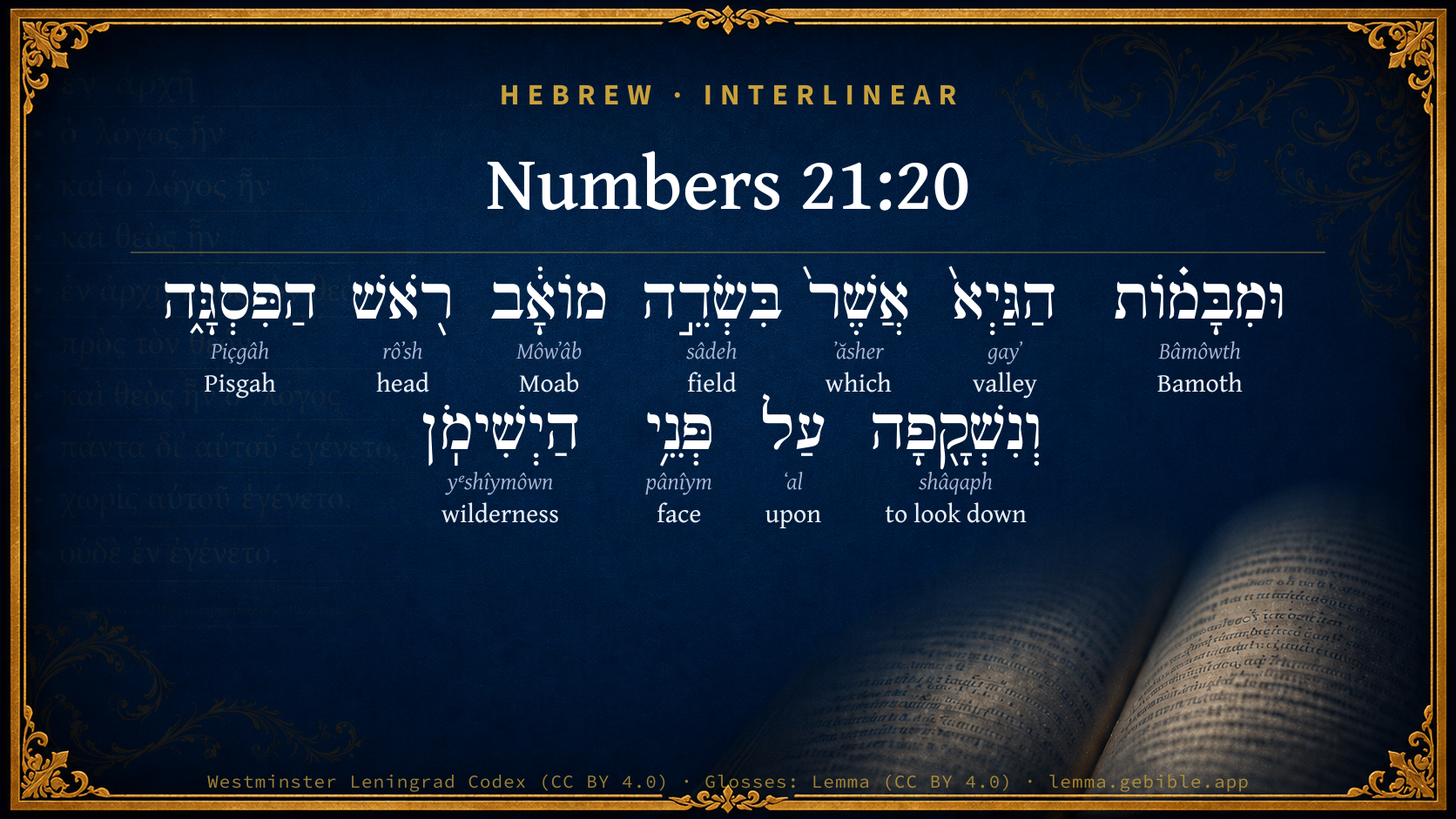
Hebrew (Westminster Leningrad Codex) Numbers 21:20 appears in the Hebrew Old Testament. The text above is from the Westminster Leningrad Codex. Each word links to its Strong’s number, a concise gloss, and parsing drawn from the Open Scriptures Hebrew Bible morphology. Click any word for its full Brown-Driver-Briggs (BDB) entry.
Download image
Cite this verse

Numbers 21:20 (World English Bible). Public Domain. Lemma interlinear Bible study tool, https://lemma.gebible.app/v/numbers/21/20.

Show BibTeX & RIS
BibTeX
RIS
English Translation
and from Bamoth to the valley that is in the field of Moab, to the top of Pisgah, which looks down on the desert.
World English Bible · Public Domain
Highlights Full analysis ↓
Download a study sheet

One document with this verse’s original text, its word-by-word gloss line, the meaning frame, cross-references with their text, attributed commentary, and full source and license credits — printable, and it pastes into notes with its structure intact.

This verse Autodidact and up

Study sheet (.html) Plain text (.txt)

A passage Seminary Student

Up to 50 verses in one chapter. A passage sheet keeps up to 6 commentary sources and 12 cross-references per verse, in the order this page ranks them, and says so on the sheet whenever that leaves anything out. Ask for a single verse and you get the Autodidact verse sheet above.

Everything on this page stays free to read, with no account — the sheet is a download of what is already on screen, not access to it.

Want to remove ads? Support Godless Engineer
Compare translations 3

The same verse in 3 English versions, stacked beneath the original-language interlinear above. Click any original word for its lexicon entry.

Each is an independent rendering of the whole verse — the interlinear is not word-aligned to these translations.

Highlighted words mark where these versions differ — a whole-verse word diff, not a word-by-word alignment.

  • World English Bible Public Domain
    and from Bamoth to the valley that is in the field of Moab, to the top of Pisgah, which looks down on the desert.
  • King James Version Public Domain
    And from Bamoth in the valley, that is in the country of Moab, to the top of Pisgah, which looketh toward Jeshimon.
  • unfoldingWord Literal Text CC BY-SA 4.0
    and from Bamoth the valley that in the field of Moab, the head of Pisgah, and it looks down over the face of the wasteland.

unfoldingWord Literal Text — © unfoldingWord, licensed CC BY-SA 4.0. Word-aligned USFM3 via Door43 (git.door43.org/unfoldingWord/en_ult).

Versions to compare (up to 4)

3 of 4 selected

Show all 18 translations

Every available English version of this verse, each an independent rendering of the whole verse.

  • World English Bible Public Domain
    and from Bamoth to the valley that is in the field of Moab, to the top of Pisgah, which looks down on the desert.
  • Berean Standard Bible Public Domain
    and from Bamoth to the valley in Moab where the top of Pisgah overlooks the wasteland.
  • Majority Standard Bible Public Domain
    and from Bamoth to the valley in Moab where the top of Pisgah overlooks the wasteland.
  • King James Version Public Domain
    And from Bamoth in the valley, that is in the country of Moab, to the top of Pisgah, which looketh toward Jeshimon.
  • American Standard Version (1901) Public Domain
    and from Bamoth to the valley that is in the field of Moab, to the top of Pisgah, which looketh down upon the desert.
  • Revised Version (1885) Public Domain
    and from Bamoth to the valley that is in the field of Moab, to the top of Pisgah, which looketh down upon the desert.
  • Geneva Bible (1599) Public Domain
    And from Bamoth in the valley, that is in the plaine of Moab, to the top of Pisgah that looketh toward Ieshimon.
  • Douay-Rheims (1899) Public Domain
    From Bamoth, is a valley in the country of Moab, to the top of Phasga, which looked towards the desert.
  • Young's Literal Translation Public Domain
    and from Bamoth in the valley which `is' in the field of Moab `to' the top of Pisgah, which hath looked on the front of the wilderness.
  • Literal Standard Version CC BY-SA 4.0
    and from Bamoth, in the valley which [is] in the field of Moab, [to] the top of Pisgah, which has looked on the front of the wilderness.
  • Unlocked Literal Bible CC BY-SA 4.0
    and from Bamoth to a valley in the land of Moab. That is where the top of Mount Pisgah looks down on the wilderness.
  • unfoldingWord Literal Text CC BY-SA 4.0
    and from Bamoth the valley that in the field of Moab, the head of Pisgah, and it looks down over the face of the wasteland.
  • Darby Bible Public Domain
    and from Bamoth to the valley that is in the fields of Moab, to the top of Pisgah, which looks over the surface of the waste.
  • World Messianic Bible Public Domain
    and from Bamoth to the valley that is in the field of Moab, to the top of Pisgah, which looks down on the desert.
  • Webster's Bible Public Domain
    And from Bamoth in the valley, that is in the country of Moab, to the top of Pisgah, which looketh towards Jeshimon.
  • Free Bible Version CC BY-SA 4.0
    and from Bamoth to the valley in the territory of Moab where the top of Mount Pisgah looks down on the wastelands.
  • Bible in Basic English Public Domain
    And from Bamoth to the valley in the open country of Moab, and to the top of Pisgah looking over Jeshimon.
  • JPS Tanakh (1917) Public Domain
    and from Bamoth to the valley that is in the field of Moab, by the top of Pisgah, which looketh down upon the desert.

Literal Standard Version (2020), Covenant Press — licensed CC BY-SA 4.0. Text via the HelloAO Bible API (eBible.org). Unlocked Literal Bible (unfoldingWord) — licensed CC BY-SA 4.0. Text via the HelloAO Bible API (eBible.org). unfoldingWord Literal Text — © unfoldingWord, licensed CC BY-SA 4.0. Word-aligned USFM3 via Door43 (git.door43.org/unfoldingWord/en_ult). Free Bible Version, Dr. Jonathan Gallagher — licensed CC BY-SA 4.0. Text via the HelloAO Bible API (eBible.org).

Word by word

More ways to search: Search by grammar → Find every occurrence → Compare this word →

Practice this passage: Drill this verse → Learn its vocabulary →

וּמִבָּמ֗וֹת
Bâmôwth
H1120
“and · from · Bamoth”
Conjunction + Preposition + Noun, Proper
Part of Speech
Conjunction + Preposition + Noun
Type
Proper
Full BDB Definition

Origin: plural of H1116

TWOT: None

Bamoth = "high places" or " great high place" - a town on the river Arnon in Moab
  1. הַגַּיְא֙ gayʼ H1516 “the · valley” Particle, Definite Article + Noun, Common, Both, Singular, Absolute
  2. אֲשֶׁר֙ ʼăsher H834 “which” Particle, Relative
  3. בִּשְׂדֵ֣ה sâdeh H7704 “in/at · field of” Preposition + Noun, Common, Masculine, Singular, Construct
  4. מוֹאָ֔ב Môwʼâb H4124 “Moab” Noun, Proper
  5. רֹ֖אשׁ rôʼsh H7218 “head of” Noun, Common, Masculine, Singular, Construct
  6. הַפִּסְגָּ֑ה Piçgâh H6449 “the · Pisgah” Particle, Definite Article + Noun, Proper
  7. וְנִשְׁקָ֖פָה shâqaph H8259 “and · looking down” Conjunction + Verb, Niphal, Participle Active, Feminine, Singular, Absolute
  8. עַל ʻal H5921 “upon” Preposition
  9. פְּנֵ֥י pânîym H6440 “face(s) of” Noun, Common, Both, Plural, Construct
  10. הַיְשִׁימֹֽן yᵉshîymôwn H3452 “the · wilderness” Particle, Definite Article + Noun, Common, Masculine, Singular, Absolute

About this verse

These counts appear in no published source. They are computed here, from the morphology-tagged text and Lemma’s own curated glosses. What Lemma adds →

11
words
11
distinct lemmas
Pentateuch
section

Notable vocabulary

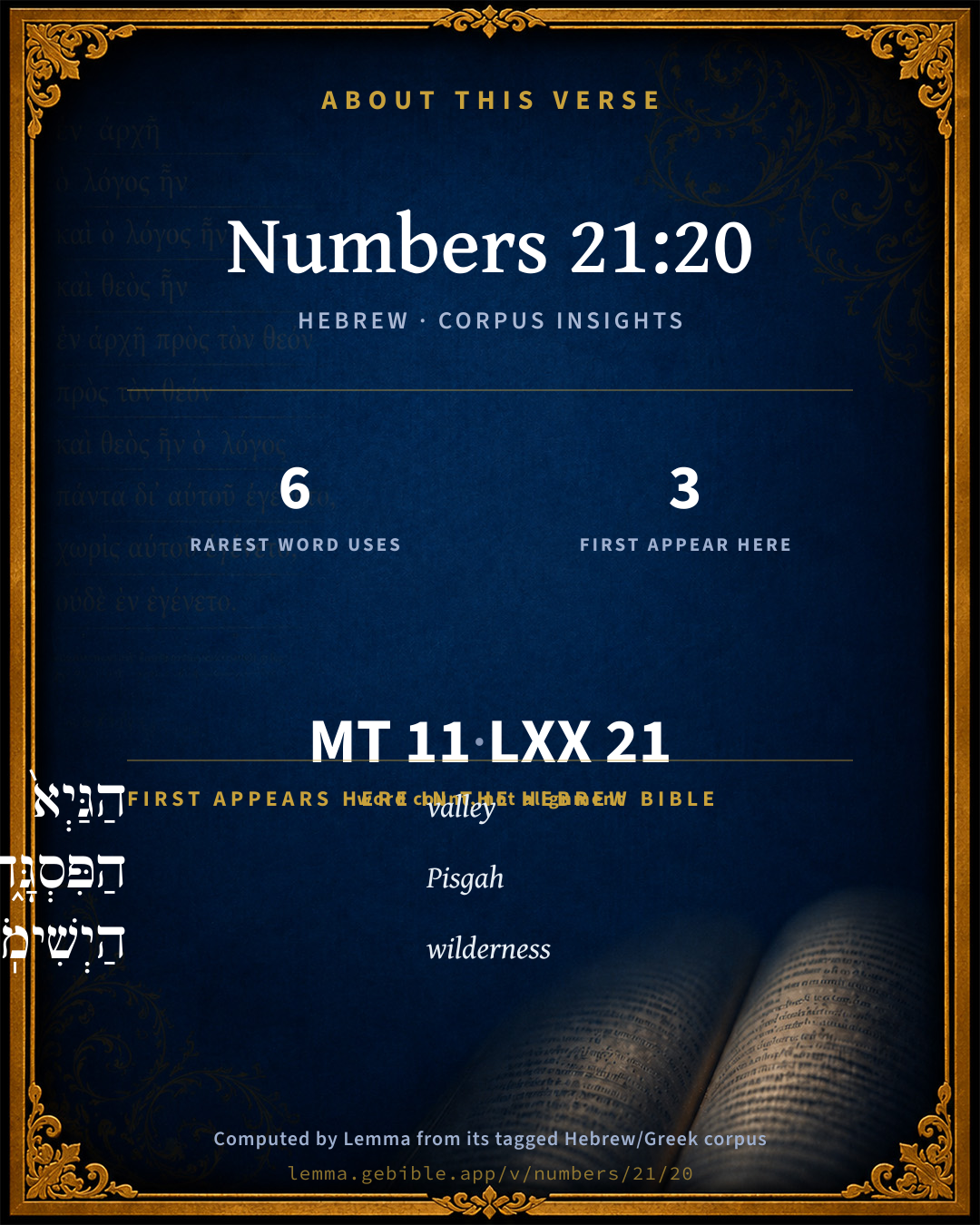
The rarest word here is וּמִבָּמ֗וֹת Bamoth H1120 — appearing just 6 times in the whole Hebrew Bible.

First appearance in Scripture

These words make their first canonical appearance in the Hebrew Bible here:

  • הַגַּיְא֙ valley H1516
  • הַפִּסְגָּ֑ה Pisgah H6449
  • הַיְשִׁימֹֽן wilderness H3452

Shared distinctive vocabulary

וּמִבָּמ֗וֹת Bamoth H1120 occurs in 4 verses of the Hebrew Bible. Also found in:

Grammatical profile

  • 1 verb
  • 8 nouns
  • 1 preposition
  • 1 particle

Verb forms

  • וְנִשְׁקָ֖פָה Niphal · Participle Active

Hebrew & Septuagint length

In English translation the verse runs 24 words from the Hebrew and 14 from the Septuagint (LXX English) — the Septuagint runs noticeably shorter here. See the side-by-side →

A rough comparison of the two English renderings, which tokenize alike — not a word-level alignment.

Word counts can differ between the Hebrew and the Greek without any difference in meaning — e.g. the Hebrew direct-object marker אֵת has no separate Greek word, and Greek often adds the article ὁ.

In the original languages it is 11 Hebrew tokens and 21 Greek tokens — but the two are counted differently (Hebrew bundles its prefixes and suffixes into one token; the Greek is in lemma form), so that isn’t a like-for-like length.

Cross-references

9

Topical passages linked to Numbers 21:20 in the Treasury of Scripture Knowledge — connected by theme and wording, ordered by reader-vote popularity; previews shown in the World English Bible.

  • Numbers 23:28 Balak took Balaam to the top of Peor, that looks down on the desert.
  • Numbers 22:1 The children of Israel traveled, and encamped in the plains of Moab beyond the Jordan at Jericho.
  • Numbers 23:14 He took him into the field of Zophim, to the top of Pisgah, and built seven altars, and offered up a bull and a ram on every altar.
  • Numbers 26:63 These are those who were numbered by Moses and Eleazar the priest, who numbered the children of Israel in the plains of Moab by the Jordan at Jericho.
  • Numbers 33:49–50 They encamped by the Jordan, from Beth-jeshimoth even to Abel Shittim in the plains of Moab.
  • Deuteronomy 1:5 Beyond the Jordan, in the land of Moab, began Moses to declare this law, saying,
  • Deuteronomy 3:27 Go up to the top of Pisgah, and lift up your eyes westward, and northward, and southward, and eastward, and see with your eyes: for you shall not go over this Jordan.
  • Deuteronomy 4:49 and all the Arabah beyond the Jordan eastward, even to the sea of the Arabah, under the slopes of Pisgah.
  • Deuteronomy 34:1 Moses went up from the plains of Moab to Mount Nebo, to the top of Pisgah, that is over against Jericho. Yahweh shown him all the land of Gilead, to Dan,

Cross-references courtesy of OpenBible.info (CC BY 4.0).

Hebrew and Greek witnesses Masoretic Hebrew ↔ Greek Septuagint

The same verse in the two great witnesses to the Old Testament, shown verse-for-verse.

Here the Septuagint runs noticeably shorter than the Hebrew — LXX2012 (modern English Septuagint) 14 words vs World English Bible 24. A rough length comparison of the two English translations, not a word-level alignment — read both below.

These are two independent witnesses, not word-aligned to each other, and the Septuagint is shown in lemma (dictionary) form.

Hebrew Numbers 21:20 Masoretic · Westminster Leningrad Codex

וּמִבָּמ֗וֹת הַגַּיְא֙ אֲשֶׁר֙ בִּשְׂדֵ֣ה מוֹאָ֔ב רֹ֖אשׁ הַפִּסְגָּ֑ה וְנִשְׁקָ֖פָה עַל פְּנֵ֥י הַיְשִׁימֹֽן

and from Bamoth to the valley that is in the field of Moab, to the top of Pisgah, which looks down on the desert.

World English Bible · Public Domain

Greek LXX Numbers 21:20 Septuagint · lemma form

καί ἀπό βαμωθ εἰς νάπη ὅς εἰμί ἐν ὁ πεδίον μωαβ ἀπό κορυφή ὁ λαξεύω ὁ βλέπω κατά πρόσωπον ὁ ἔρημος

And Moses sent ambassadors to Seon king of the Amorites, with peaceful words, saying,

LXX2012 (modern English Septuagint) · Public Domain

On this verse, The Pulpit Commentary discusses the Septuagint’s reading. Read the note in Commentary ↓

Hebrew: Westminster Leningrad Codex (CC BY 4.0). Greek: Septuagint (public domain); English from LXX2012 (modern English Septuagint) (Public Domain). How the Septuagint differs from the Hebrew →

Targum (Aramaic paraphrase)

2

The Targum is the ancient Jewish Aramaic paraphrase of the Hebrew Scriptures — an interpretive translation, not the Hebrew text itself. Onkelos (literal) and Pseudo-Jonathan (expansive) render the Torah, and Jonathan the Prophets. Coverage is partial: where no permissively-licensed English translation exists for a verse, only the Aramaic is shown. This is verse-level text, not a word-by-word alignment to the Hebrew.

  1. Targum Onkelos Torah (Genesis–Deuteronomy)
    וּמֵרָמָתָא לְחֵילַיָא דִי בְּחַקְלֵי מוֹאָב רֵישׁ רָמָתָא וּמִסְתַּכְיָא עַל אַפֵּי בֵּית יְשִׁימוֹן

    (no public-domain English translation for this verse)

    Targum Onkelos — Aramaic: “Onkelos Genesis” (public domain); “Onkelos Exodus” (public domain); “Onkelos Leviticus” (public domain); “Onkelos Numbers” (public domain); “Onkelos Deuteronomy” (public domain). English: “Sefaria Community Translation” (CC0 1.0 (public-domain dedication)); “J.W. Etheridge. The Targums of Onkelos and Jonathan Ben Uzziel on the Pentateuch. London: Longmans, Green, 1862” (public domain). Text via Sefaria.

  2. Targum Pseudo-Jonathan Torah (Genesis–Deuteronomy)
    וּמִטַוְרַיָא רָמַיָא נַחְתָא עִמְהוֹן לִגְלִימָתָא עֲמִיקְתָא וְאִתְגְנִיזַת עִמְהוֹן בִּתְחוּמֵיהוֹן דְמוֹאֲבָאֵי רֵישׁ רָמָתָא דִמְדִיקָא כָּל קֳבֵיל בֵּית יְשִׁימוֹן מְטוֹל פִּתְגָמֵי אוֹרַיְיתָא

    And from the high mountains it descended with them to the lower hills, but was hidden from them on the borders of Moab, at the summit of the hill looking toward Bethjeshimon, because there they neglected the words of the Law.

    Targum Pseudo-Jonathan — Aramaic: “Targum Jonathan on Genesis” (public domain); “Targum Jonathan on Exodus” (public domain); “Targum Jonathan on Leviticus” (public domain); “Targum Jonathan on Numbers” (public domain); “Targum Jonathan on Deuteronomy” (public domain). English: “The Targum of Jonathan ben Uzziel, trans. J. W. Etheridge, London, 1862” (public domain). Text via Sefaria.

Commentary

Notes on Numbers 21:20 from classic Christian and Jewish commentators (each source and its license shown beneath its notes). The classic Christian expositions comment on the surrounding passage and are grouped to its opening verse, so a note may address several verses; the Jewish commentaries on the Tanakh (Rashi and others) are per-verse, so they appear only where the commentator wrote on this verse.

Lemma curates 59 commentaries, every one of them public domain or Creative Commons licensed, each selected and text-cleaned for this edition rather than reprinted as found. About our sources →

Joseph Benson's Commentary

Num 21:20. Pisgah — This was the top of those high hills of Abarim.

Joseph Benson's Commentary on the Old and New Testaments (1811–1818) — public domain. Text from a community e-Sword module.

Ellicott's Commentary for English Readers

(20) And from Bamoth in the valley.—Better, and from Bamoth to the valley that is . . . The country (or, rather, field) of Moab was a portion of the table-land which stretches from Rabbath Ammân to the Arnon. The valley in this table-land was upon the height of Pisgah—i.e., the northern part of the mountains of Abarim.

Toward Jeshimon.—Or, across the waste (or, desert).

A Bible Commentary for English Readers, edited by Charles John Ellicott (1878–1897) — public domain. Text from a community e-Sword module.

The Cambridge Bible for Schools and Colleges

gen. ed. J. J. S. Perowne

20. the valley that is in the region of Moab, [om. to] the top of the Pisgah] The two expressions are placed somewhat awkwardly in apposition; but they appear to mean: the valley which is in that part of the region of Moab known as the top of the Pisgah.

the valley] was a glen (gay’, distinct from naḥal, Num_21:14) which cut through the hills and emerged at the Jordan, perhaps the present Wâdy ‘Ayûn Mûsa (‘Moses’ springs’) which runs into the Jordan valley some four or five miles north of the northern end of the Dead Sea, the torrent then flowing with a south-westerly curve into the Sea.

the region of Moab] denotes the region which properly belonged to Moab, but of which the Amorites were in possession at the moment.

the top of the Pisgah] ‘The Pisgah’ seems to have been the name applied to the broken edge of the Moabite plateau where it falls steeply to the Dead Sea and the Jordan valley; and ‘the top, or head, of the Pisgah’ (Num_23:14, Deu_3:27; Deu_34:1) is a collective term for the projections or promontories slightly lower than the main plateau and standing out from the western slopes. The word is derived from a root which in Aram. and late Heb. signifies ‘to cleave’; and it may describe the appearance of the range as seen from the west, standing out in a series of separate peaks.

which looketh down upon the Jeshimon] The name, which denotes ‘arid or desert land,’ is used of the deserts through which Israel passed in their journey from Egypt (Deu_32:10, Psa_68:7 &c.), and of the waste land on the east of Judah, north of the Dead Sea (1Sa_23:19; 1Sa_23:24; 1Sa_26:1; 1Sa_26:3 marg.). But here the verb ‘looketh down,’ which is chiefly used of men looking down from a window (Gen_26:8, 2Sa_24:20, Son_6:10), or of God looking down out of heaven (Psa_102:19), seems to point to a district more immediately below the Pisgah, which must be the barren tract north of the Dead Sea and east of the Jordan (see G. A. Smith, H. G. [Note: . G. Historical Geography of the Holy Land.] 564 note).

The Cambridge Bible for Schools and Colleges (gen. ed. J. J. S. Perowne; Cambridge University Press, 1878–1918) — public domain. Text from a community e-Sword module.

John Gill's Exposition

Let me pass through thy land,.... Through some part of it, which would have been a shorter way to the river Jordan, over which Israel was to pass into the land of Canaan; the terms proposed, or things to be observed in their passage, which they would bind themselves strictly to, are the same that were made to the king of Edom. See Gill on Num 20:17.

.

Numbers 21:23

num 21:23

num 21:23

num 21:23And Sihon would not suffer Israel to pass through his border,.... Because he could not trust them, and confide in the promises they made, and thought it not safe to let such a body of people into any part of his dominions, Jdg 11:20 and chiefly because his heart was hardened by the Lord, that he might be delivered into the hands of Israel, as was determined, Deu 2:30,

but Sihon gathered all his people together; all that were able to bear arms out of his cities, and which made no doubt a very numerous and powerful army; but then these being defeated, as they were, it became more easy to the Israelites to take their cities, where there were none left but women and children:

and went out against Israel into the wilderness; the wilderness of Kedemoth; not content to reject a peaceable message, he went out in an hostile manner against Israel, even out of his own dominions; so that he was the aggressor and unprovoked, which made his ruin appear the more just, and the children of Israel to have a better claim to his country conquered by them:

and he came to Jahaz; a frontier town in the land of Moab, see Isa 15:4 and which, according to Bunting (p), was sixteen miles from Abarim:

and fought against Israel; at the above place, where they had a pitched battle.

(p) Travels of the Patriarchs, p. 83.

John Gill's Exposition of the Whole Bible (1746–1763) — public domain (CC PDM 1.0). Text via the HelloAO Bible API.

Albert Barnes' Notes on the Bible

In the country of Moab - Rather, in the field of Moab: the upland pastures, or flat downs, intersected by the ravine of Wady Waleh.

Pisgah, which looketh toward Jeshimon - Or, “toward the waste.” See Num 33:47. Pisgah was a ridge of the Abarim mountains, westward from Heshbon. From the summit the Israelites gained their first view of the wastes of the Dead Sea and of the valley of the Jordan: and Moses again ascended it, to view, before his death, the land of promise. The interest attaching to the spot, and the need of a convenient name for it, has led Christians often to designate it as “Nebo,” rather than as “the mountain of, or near to, Nebo;” but the latter is the more correct: Nebo denoted the town Isa 15:2; Jer 48:1, Jer 48:22 on the western slope of the ridge.

Albert Barnes' Notes on the Bible (1834–1885) — public domain. Text from a community e-Sword/MySword module.

Haydock's Catholic Bible Commentary

Desert. Hebrew and Chaldean, "Yeshimon," (Josue xiii. 28; Ezechiel xxv. 9,) a city of the Moabites.

George Leo Haydock (1774–1849), Haydock's Catholic Family Bible and Commentary, 1859 edition — public domain. Excludes Psalms (Douay-Rheims chapter numbering differs from Protestant) and Deuterocanonical books (Catholic canon only).

Matthew Poole's English Annotations

In the valley; or, the valley, which might be called Bamoth, not because it was a place naturally high, but from divers other reasons, which may be easily guessed. Or, to the valley, or to that valley, that famous or rather infamous valley, to wit, of Abel-shittim, Num 33:49, where they committed those foul abominations recorded Num 25

Pisgah was the top of these high hills of Abarim; of which see Deu 3:17,27; 32:49; 34:1,6.

Matthew Poole's English Annotations on the Holy Bible (1683–1685) — public domain. Text from a community e-Sword/MySword module.

Whedon's Commentary on the Bible

Daniel D. Whedon

20. In the valley — Rather, to the valley, which is in the fields of Moab upon the top of Pisgah. The height of Pisgah is in grammatical apposition with the field of Moab, a portion of the perfectly treeless table-land stretching from Rabbath Ammon to the Arnon. Among biblical problems on the east of the Jordan the solution of none has enlisted deeper interest than the identification of long-lost Pisgah. The great mistake for ages was in the attempt to find some peak higher than the general level of the table-land of Moab, from which all the Land of Promise can be seen. But Dr. J.L. Porter, on the south bank of Wady Hesban, about seven miles west of Heshbon, recently noticed some projecting swells of the range, not higher than others, but shooting out farther west, so as to command the Jordan Valley, and suggested that one of these might be Nebo. Professor Paine, in the third statement of the Palestine Exploration Society, in 1873, in an elaborate monograph of nearly ninety pages, entitled, The Identification of Pisgah, cogently argues, after a month’s investigation of all the district, that a double peaked hill or swell called Jebel Siaghah is the true Pisgah. The view from the southwest peak, 2,360 feet above the sea, extending from Dan on the north to the far distant Negeb, fulfils every requisite of the view which Moses beheld from Pisgah, unless it be all Judah unto the Mediterranean Sea, for which there is no peak east of the Jordan high enough. See Bibliotheca Sacra, Jan., 1876. Dr. Ridgaway dissents from the conclusion of Professor Paine, and sides with Tristram and M. de Saulcy, in the identification of Jebel Neba as the true Pisgah, chiefly because this affords an eastward view, which Jebel Siaghah does not. See Deu_3:27. “My own impression is, that Abarim was the name of the whole cluster of hills immediately overlooking the Jordan in this region, as the term signifies ‘borders;’ that Nebo was the title of a particular mountain, with one or more peaks, and that Pisgah was the special summit of Nebo. I remember very clearly that its top looked, as we rode by, just like a hill, and seemed relatively so little elevated, as we approached from the east, that we hardly thought it worth while to go on to it. Taking the itinerary of Israel, as given in Num_33:46-48, nothing can seem more natural.” — Ridgaway.

Jeshimon — Literally, the wilderness. It is doubtful whether it is a proper or a common noun.

Edersheim says that it is the tract of land which extends to the northeastern shore of the Dead Sea. Tristram identifies it with “the barren plain of the Ghor,” about the mouth of the Jordan. But Professor Paine, from every mention of the place, comes to the following conclusion: “So Jeshimon is the wilderness where a line drawn to the north from Maon (1Sa_23:24) intersects another drawn west from Pisgah, and just there is a region every way worthy of the name.”

Daniel D. Whedon (gen. ed.), Commentary on the Old and New Testaments (1874–1909) — public domain. Text from a community e-Sword module.

The Pulpit Commentary

And from Bamoth in the valley, that is in the country of Moab, to the top of Pisgah. The original runs simply thus: "And from Bamoth the valley which in the field Moab the top Pisgah." It may therefore be read, "And from the heights to the valley that is in the field of Moab, viz., the top of Pisgah." The "field" of Moab (Septuagint, en tw pediw ) was no doubt the open, treeless expanse north of Arnon, drained by the Wady Waleh, which had formerly belonged to Moab. Pisgah ("the ridge") was a part of the Abarim ranges west of Heshbon, from the summit of which the first view is gained of the valley of Jordan and the hills of Palestine. (cf. Num_33:47 Deu_3:27 Deu_34:1) Which looketh toward Jeshimon. Jeshimon, or "the waste," seems to mean here that desert plain on the north-east side of the Salt Sea now called the Ghor el Belka, which included in its barren desolation the southernmost portion of the Jordan valley.

The Pulpit Commentary (1880–1919), ed. H.D.M. Spence-Jones & Joseph S. Exell — public domain. Text from a community e-Sword module.

John Wesley's Explanatory Notes

Pisgah - This was the top of those high hills of Abarim.

John Wesley, Explanatory Notes Upon the Whole Bible (1754–1765) — public domain. Text via the GEBible commentary corpus.

Rashi

Rabbi Shlomo Yitzchaki (Rashi)

ומבמות הגיא אשר בשדי מואב AND FROM THE HEIGHTS (it descended finally) INTO THE VALLEY THAT IS IN THE FIELD OF MOAB, for there Moses died, and there the well finally ceased to flow. Another explanation is: כרוה נדיבי עם THE NOBLES OF THE PEOPLE HOLLOWED IT — each prince of the tribes when they encamped took his staff and drew a line on the ground from the well to his banner and encampment, and the waters of the well ran by way of that mark and came before the camping place of each tribe (Midrash Tanchuma, Chukat 21).

במחקק THROUGH THE LAWGIVER — by command of Moses who is called the מחוקק, the Lawgiver, as it is said, (Deuteronomy 33:21) “for there is the portion of the lawgiver (Moses’ grave) concealed”. But why is Moses not expressly mentioned by name in this song? Because he was punished through the well! And since Moses’ name is not mentioned, the name of the Holy One, blessed be He, is also not mentioned. A parable! It may be compared to the case of a king whom his subjects invited to a feast. He said: If my friend will be there, I, too, will be there, but if not, I will not go (Midrash Tanchuma, Chukat 21).

ראש הפסגה — Understand this as the Targum has it: to the top of the height.

פסגה denotes “high”, just as (Psalms 48:14) פסגו ארמנותיה, which means “make high its palaces”.

ונשקפה AND IT LOOKS — this height looks towards the place whose name is ישימון, which word describes the wilderness because that is waste (שמם with which the word ישימון may be linguistically associated). Another explanation is: ונשקפה AND IT LOOKS — the well looks על פני ישימון towards the front of ישימון, the wilderness, for it was hid (emptied) itself in the sea of Tiberias, and anyone who stood by the wilderness may look and see a kind of sieve in the sea, and that was the well!. Thus did R. Tanchuma (Midrash Tanchuma, Chukat 21) expound this passage.

Rashi on the Tanakh — English translations: “The Judaica Press complete Tanach with Rashi, translated by A. J. Rosenberg” (CC BY 4.0); “Pentateuch with Rashi's commentary by M. Rosenbaum and A.M. Silbermann, 1929-1934” (public domain); “The Metsudah Tanach series, Lakewood, N.J” (CC BY 4.0); and “The Book of Joshua, Metsudah Publications, 1997” (CC BY 4.0). Text via Sefaria.

Lesson kit

Teaching starters — assembled from the data on this page, not authored interpretation. Every prompt links to the verse data it draws on. Edit before teaching.

Numbers, in the Pentateuch, opens this verse with 11 words (11 distinct Hebrew lemmas). Its most distinctive word is Bâmôwth (“Bamoth”). The Greek Septuagint runs shorter here. A historical commentator’s framing appears above. Read the whole chapter for the surrounding context.

Discussion questions

  1. How does “Bamoth” (Bâmôwth) shape what this verse is saying?
  2. 3 words make their first appearance in Scripture here. What does this debut establish?
  3. How does Numbers 21:19, which shares the word «Bamoth», read alongside this verse?
  4. The Septuagint runs shorter here than the Hebrew. What might account for the difference?
  5. These translations render this verse differently; the difference is in the English rendering, not the original. What questions does that raise?
  6. «וְנִשְׁקָ֖פָה» is a Niphal Participle Active verb. How does that grammatical form shape the action described?
  7. Compare how Joseph Benson's Commentary and Ellicott's Commentary for English Readers read this verse. Where do they agree or differ?

Things to notice

Reading settings

Reading text

Shown beneath each verse's original-language words.

Old Testament
Old Testament edition

Read the OT as the Masoretic Hebrew (MT) or the Greek Septuagint (LXX).

English shown for the Greek Septuagint (in the Hebrew ↔ Greek comparison).

Comparing translations? Open the Compare panel on any verse page to stack up to four side by side.