
Genesis 50:13

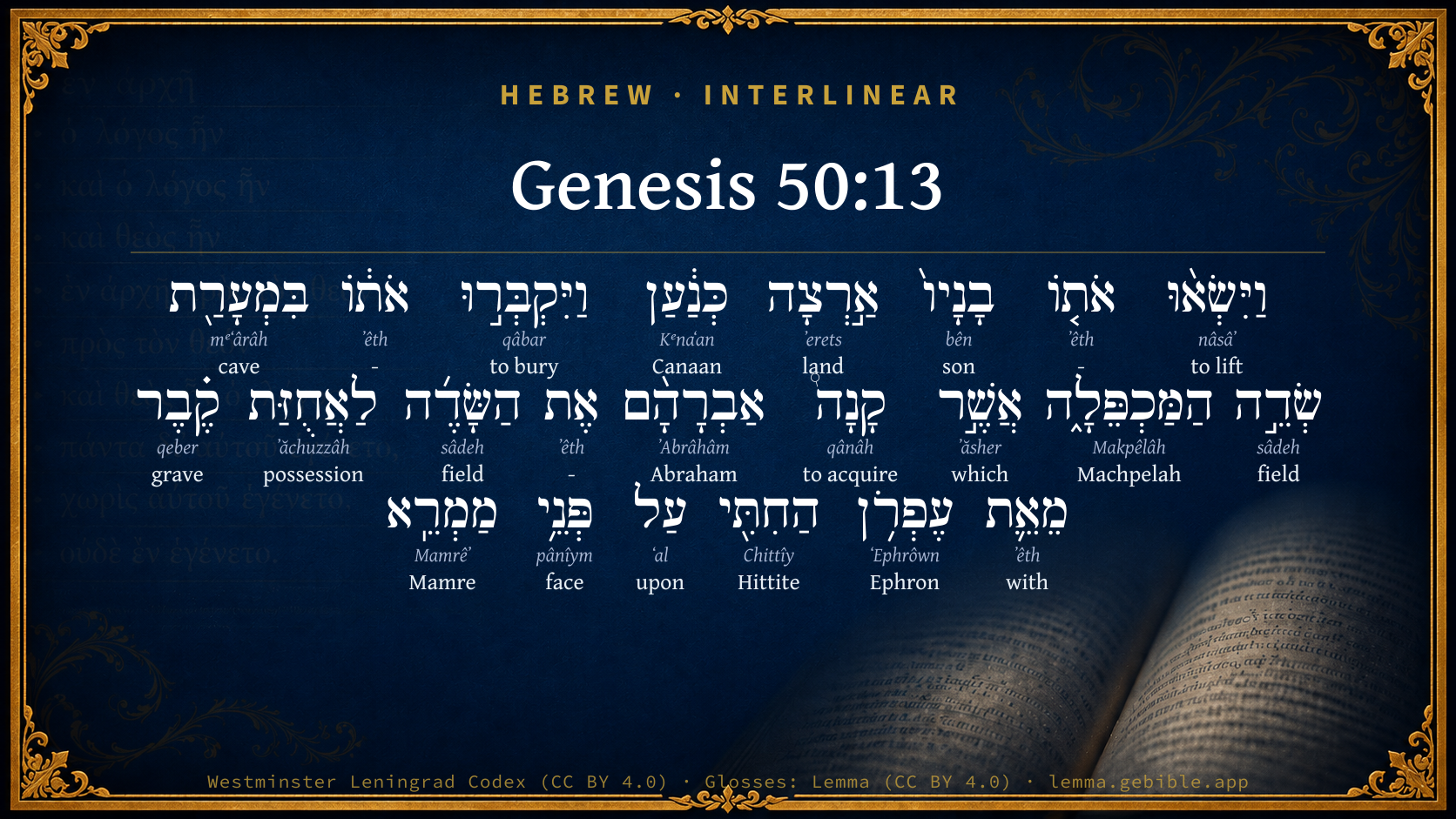
Hebrew (Westminster Leningrad Codex) Genesis 50:13 appears in the Hebrew Old Testament. The text above is from the Westminster Leningrad Codex. Each word links to its Strong’s number, a concise gloss, and parsing drawn from the Open Scriptures Hebrew Bible morphology. Click any word for its full Brown-Driver-Briggs (BDB) entry.
Download image
Cite this verse

Genesis 50:13 (World English Bible). Public Domain. Lemma interlinear Bible study tool, https://lemma.gebible.app/v/genesis/50/13.

Show BibTeX & RIS
BibTeX
RIS
English Translation
for his sons carried him into the land of Canaan, and buried him in the cave of the field of Machpelah, which Abraham bought with the field, for a possession of a burying-place, from Ephron the Hittite, before Mamre.
World English Bible · Public Domain
Download a study sheet

One document with this verse’s original text, its word-by-word gloss line, the meaning frame, cross-references with their text, attributed commentary, and full source and license credits — printable, and it pastes into notes with its structure intact.

This verse Autodidact and up

Study sheet (.html) Plain text (.txt)

A passage Seminary Student

Up to 50 verses in one chapter. A passage sheet keeps up to 6 commentary sources and 12 cross-references per verse, in the order this page ranks them, and says so on the sheet whenever that leaves anything out. Ask for a single verse and you get the Autodidact verse sheet above.

Everything on this page stays free to read, with no account — the sheet is a download of what is already on screen, not access to it.

Want to remove ads? Support Godless Engineer
Compare translations 3

The same verse in 3 English versions, stacked beneath the original-language interlinear above. Click any original word for its lexicon entry.

Each is an independent rendering of the whole verse — the interlinear is not word-aligned to these translations.

Highlighted words mark where these versions differ — a whole-verse word diff, not a word-by-word alignment.

  • World English Bible Public Domain
    for his sons carried him into the land of Canaan, and buried him in the cave of the field of Machpelah, which Abraham bought with the field, for a possession of a burying-place, from Ephron the Hittite, before Mamre.
  • King James Version Public Domain
    For his sons carried him into the land of Canaan, and buried him in the cave of the field of Machpelah, which Abraham bought with the field for a possession of a buryingplace of Ephron the Hittite, before Mamre.
  • unfoldingWord Literal Text CC BY-SA 4.0
    And his sons carried him to the land of Canaan and buried him in the cave of the field of Machpelah, which Abraham had bought with the field as property for a burial place from Ephron the Hittite, in front of Mamre.

unfoldingWord Literal Text — © unfoldingWord, licensed CC BY-SA 4.0. Word-aligned USFM3 via Door43 (git.door43.org/unfoldingWord/en_ult).

Versions to compare (up to 4)

3 of 4 selected

Show all 18 translations

Every available English version of this verse, each an independent rendering of the whole verse.

  • World English Bible Public Domain
    for his sons carried him into the land of Canaan, and buried him in the cave of the field of Machpelah, which Abraham bought with the field, for a possession of a burying-place, from Ephron the Hittite, before Mamre.
  • Berean Standard Bible Public Domain
    They carried him to the land of Canaan and buried him in the cave at Machpelah in the field near Mamre, which Abraham had purchased from Ephron the Hittite as a burial site.
  • Majority Standard Bible Public Domain
    They carried him to the land of Canaan and buried him in the cave at Machpelah in the field near Mamre, which Abraham had purchased from Ephron the Hittite as a burial site.
  • King James Version Public Domain
    For his sons carried him into the land of Canaan, and buried him in the cave of the field of Machpelah, which Abraham bought with the field for a possession of a buryingplace of Ephron the Hittite, before Mamre.
  • American Standard Version (1901) Public Domain
    for his sons carried him into the land of Canaan, and buried him in the cave of the field of Machpelah, which Abraham bought with the field, for a possession of a burying-place, of Ephron the Hittite, before Mamre.
  • Revised Version (1885) Public Domain
    for his sons carried him into the land of Canaan, and buried him in the cave of the field of Machpelah, which Abraham bought with the field, for a possession of a buryingplace, of Ephron the Hittite, before Mamre.
  • Geneva Bible (1599) Public Domain
    For his sonnes caried him into the lande of Canaan, and buried him in the caue of the fielde of Machpelah, which caue Abraham bought with the fielde, to be a place to bury in, of Ephron the Hittite besides Mamre.
  • Douay-Rheims (1899) Public Domain
    And carrying him into the land of Chanaan, they buried him in the double cave which Abraham had bought together with the held for a possession of a buryingplace, of Ephron the Hethite over against Mambre.
  • Young's Literal Translation Public Domain
    and his sons bear him away to the land of Canaan, and bury him in the cave of the field of Machpelah, which Abraham bought with the field for a possession of a burying-place, from Ephron the Hittite, on the front of Mamre.
  • Literal Standard Version CC BY-SA 4.0
    and his sons carry him away to the land of Canaan, and bury him in the cave of the field of Machpelah, which Abraham bought with the field for a possession of a burying-place, from Ephron the Hittite, on the front of Mamre.
  • Unlocked Literal Bible CC BY-SA 4.0
    His sons carried him to the land of Canaan and buried him in the cave in the field of Machpelah, near Mamre. Abraham had bought the cave with the field for a burial place. He had bought it from Ephron the Hittite.
  • unfoldingWord Literal Text CC BY-SA 4.0
    And his sons carried him to the land of Canaan and buried him in the cave of the field of Machpelah, which Abraham had bought with the field as property for a burial place from Ephron the Hittite, in front of Mamre.
  • Darby Bible Public Domain
    and his sons carried him into the land of Canaan, and buried him in the cave of the field of Machpelah which Abraham had bought along with the field, for a possession of a sepulchre, of Ephron the Hittite, opposite to Mamre.
  • World Messianic Bible Public Domain
    for his sons carried him into the land of Canaan, and buried him in the cave of the field of Machpelah, which Abraham bought with the field, as a possession for a burial site, from Ephron the Hittite, near Mamre.
  • Webster's Bible Public Domain
    For his sons carried him into the land of Canaan, and buried him in the cave of the field of Machpelah, which Abraham bought with the field for a possession of a burying-place of Ephron the Hittite, before Mamre.
  • Free Bible Version CC BY-SA 4.0
    They carried his body to Canaan and buried him in the cave at Machpelah in the field near Mamre, which Abraham had bought from Ephron the Hittite as a burial site.
  • Bible in Basic English Public Domain
    For they took him into the land of Canaan and put him to rest in the hollow rock in the field of Machpelah, which Abraham got with the field, for a resting-place, from Ephron the Hittite at Mamre.
  • JPS Tanakh (1917) Public Domain
    For his sons carried him into the land of Canaan, and buried him in the cave of the field of Machpelah, which Abraham bought with the field, for a possession of a burying-place, of Ephron the Hittite, in front of Mamre.

Literal Standard Version (2020), Covenant Press — licensed CC BY-SA 4.0. Text via the HelloAO Bible API (eBible.org). Unlocked Literal Bible (unfoldingWord) — licensed CC BY-SA 4.0. Text via the HelloAO Bible API (eBible.org). unfoldingWord Literal Text — © unfoldingWord, licensed CC BY-SA 4.0. Word-aligned USFM3 via Door43 (git.door43.org/unfoldingWord/en_ult). Free Bible Version, Dr. Jonathan Gallagher — licensed CC BY-SA 4.0. Text via the HelloAO Bible API (eBible.org).

Word by word

More ways to search: Search by grammar → Find every occurrence → Compare this word →

Practice this passage: Drill this verse → Learn its vocabulary →

הַמַּכְפֵּלָ֑ה
Makpêlâh
H4375
“the · Machpelah”
Particle, Definite Article + Noun, Proper
Part of Speech
Particle + Noun
Type
Proper
Full BDB Definition

Origin: from H3717

TWOT: 1019b

Machpelah = "double" or " portion" - the location of a burial cave for the patriarchs, near Hebron
  1. וַיִּשְׂא֨וּ nâsâʼ H5375 “and · to lift” Conjunction + Verb, Qal, Sequential Imperfect, 3rd Person, Masculine, Plural
  2. אֹת֤וֹ ʼêth H853 “- · him” Particle, Direct Object + Suffix, Personal, 3rd Person, Masculine, Singular
  3. בָנָיו֙ bên H1121 “sons · his” Noun, Common, Masculine, Plural, Construct + Suffix, Personal, 3rd Person, Masculine, Singular
  4. אַ֣רְצָה ʼerets H776 “land · toward” Noun, Common, Both, Singular, Construct + Suffix, Demonstrative
  5. כְּנַ֔עַן Kᵉnaʻan H3667 “Canaan” Noun, Proper
  6. וַיִּקְבְּר֣וּ qâbar H6912 “and · to bury” Conjunction + Verb, Qal, Sequential Imperfect, 3rd Person, Masculine, Plural
  7. אֹת֔וֹ ʼêth H853 “- · him” Particle, Direct Object + Suffix, Personal, 3rd Person, Masculine, Singular
  8. בִּמְעָרַ֖ת mᵉʻârâh H4631 “in/at · cave of” Preposition + Noun, Common, Feminine, Singular, Construct
  9. שְׂדֵ֣ה sâdeh H7704 “field of” Noun, Common, Masculine, Singular, Construct
  10. אֲשֶׁ֣ר ʼăsher H834 “which” Particle, Relative
  11. קָנָה֩ qânâh H7069 “to acquire” Verb, Qal, Perfect, 3rd Person, Masculine, Singular
  12. אַבְרָהָ֨ם ʼAbrâhâm H85 “Abraham” Noun, Proper
  13. אֶת ʼêth H853 “-” Particle, Direct Object
  14. הַשָּׂדֶ֜ה sâdeh H7704 “the · field” Particle, Definite Article + Noun, Common, Masculine, Singular, Absolute
  15. לַאֲחֻזַּת ʼăchuzzâh H272 “to/for · possession of” Preposition + Noun, Common, Feminine, Singular, Construct
  16. קֶ֗בֶר qeber H6913 “grave” Noun, Common, Masculine, Singular, Absolute
  17. מֵאֵ֛ת ʼêth H854 “from · with” Preposition + Preposition
  18. עֶפְרֹ֥ן ʻEphrôwn H6085 “Ephron” Noun, Proper
  19. הַחִתִּ֖י Chittîy H2850 “the · Hittite” Particle, Definite Article + Noun, Gentilic, Masculine, Singular, Absolute
  20. עַל ʻal H5921 “upon” Preposition
  21. פְּנֵ֥י pânîym H6440 “face(s) of” Noun, Common, Both, Plural, Construct
  22. מַמְרֵֽא Mamrêʼ H4471 “Mamre” Noun, Proper

About this verse

These counts appear in no published source. They are computed here, from the morphology-tagged text and Lemma’s own curated glosses. What Lemma adds →

23
words
20
distinct lemmas
Pentateuch
section

Notable vocabulary

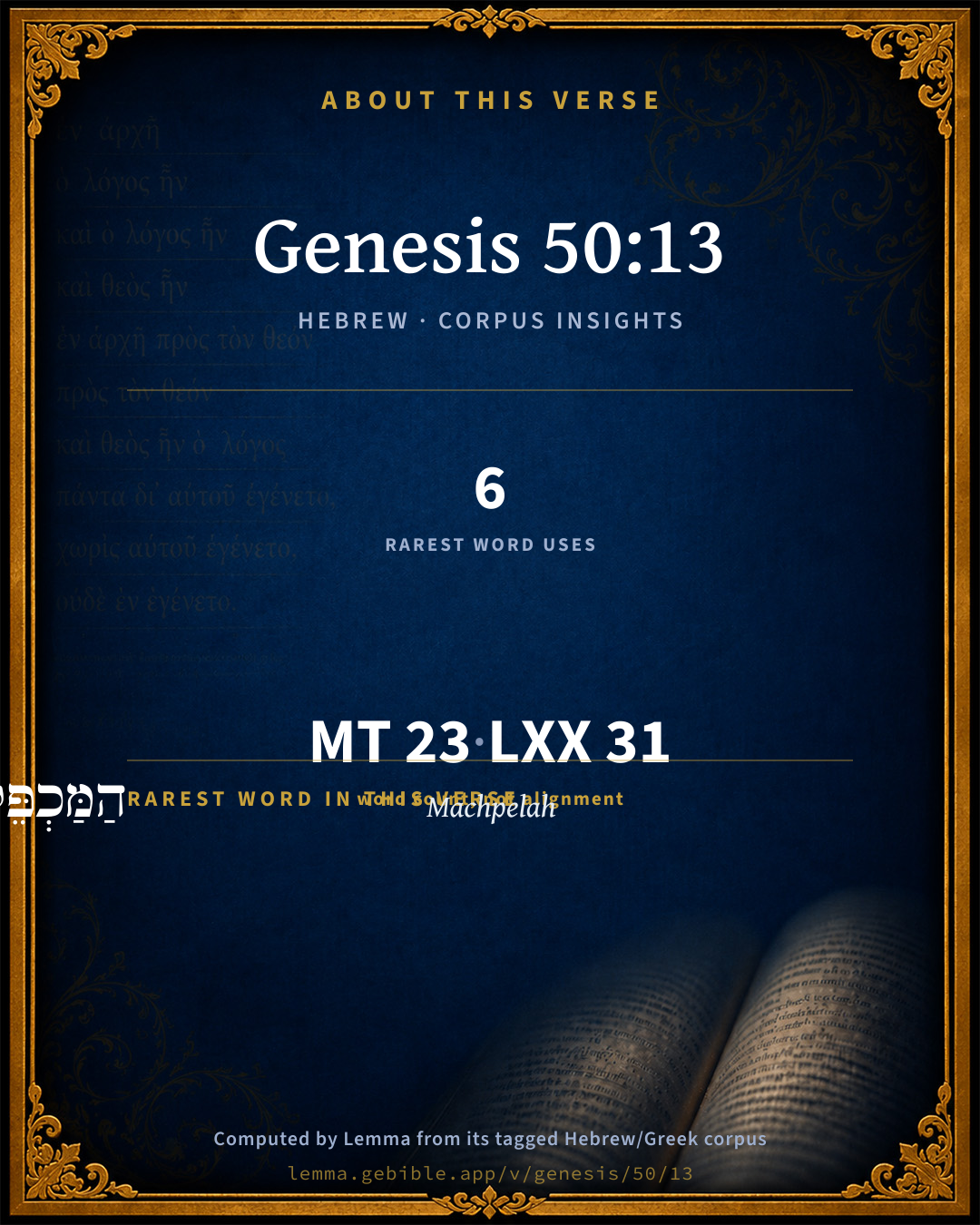
The rarest word here is הַמַּכְפֵּלָ֑ה Machpelah H4375 — appearing just 6 times in the whole Hebrew Bible.

Shared distinctive vocabulary

הַמַּכְפֵּלָ֑ה Machpelah H4375 occurs in 6 verses of the Hebrew Bible. Also found in:

Grammatical profile

  • 3 verbs
  • 14 nouns
  • 2 prepositions
  • 4 particles

Verb forms

  • וַיִּשְׂא֨וּ Qal · Sequential Imperfect
  • וַיִּקְבְּר֣וּ Qal · Sequential Imperfect
  • קָנָה֩ Qal · Perfect

Repetition

A word recurs within this verse — often emphatic in Hebrew:

  • שְׂדֵ֣ה field H7704 ×2

Hebrew & Septuagint length

In English translation the verse runs 39 words from the Hebrew and 34 from the Septuagint (LXX English) — closely comparable.

A rough comparison of the two English renderings, which tokenize alike — not a word-level alignment.

Word counts can differ between the Hebrew and the Greek without any difference in meaning — e.g. the Hebrew direct-object marker אֵת has no separate Greek word, and Greek often adds the article ὁ.

In the original languages it is 23 Hebrew tokens and 31 Greek tokens — but the two are counted differently (Hebrew bundles its prefixes and suffixes into one token; the Greek is in lemma form), so that isn’t a like-for-like length.

Cross-references

8

Topical passages linked to Genesis 50:13 in the Treasury of Scripture Knowledge — connected by theme and wording, ordered by reader-vote popularity; previews shown in the World English Bible.

  • Genesis 23:16–18 Abraham listened to Ephron. Abraham weighed to Ephron the silver which he had named in the audience of the children of Heth, four hundred shekels of silver, according to the current merchants' standard.
  • Genesis 49:29–31 He charged them, and said to them, "I am to be gathered to my people. Bury me with my fathers in the cave that is in the field of Ephron the Hittite,
  • Acts 7:16 and they were brought back to Shechem, and laid in the tomb that Abraham bought for a price in silver from the children of Hamor of Shechem.
  • Genesis 23:20 The field, and the cave that is therein, were made sure to Abraham for a possession of a burying place by the children of Heth.
  • Genesis 25:9 Isaac and Ishmael, his sons, buried him in the cave of Machpelah, in the field of Ephron, the son of Zohar the Hittite, which is before Mamre,
  • Genesis 35:27 Jacob came to Isaac his father, to Mamre, to Kiriath Arba (the same is Hebron), where Abraham and Isaac lived as foreigners.
  • Genesis 35:29 Isaac gave up the spirit, and died, and was gathered to his people, old and full of days. Esau and Jacob, his sons, buried him.
  • 2 Kings 21:18 Manasseh slept with his fathers, and was buried in the garden of his own house, in the garden of Uzza: and Amon his son reigned in his place.

Cross-references courtesy of OpenBible.info (CC BY 4.0).

Hebrew and Greek witnesses Masoretic Hebrew ↔ Greek Septuagint

The same verse in the two great witnesses to the Old Testament, shown verse-for-verse.

These are two independent witnesses, not word-aligned to each other, and the Septuagint is shown in lemma (dictionary) form.

Hebrew Genesis 50:13 Masoretic · Westminster Leningrad Codex

וַיִּשְׂא֨וּ אֹת֤וֹ בָנָיו֙ אַ֣רְצָה כְּנַ֔עַן וַיִּקְבְּר֣וּ אֹת֔וֹ בִּמְעָרַ֖ת שְׂדֵ֣ה הַמַּכְפֵּלָ֑ה אֲשֶׁ֣ר קָנָה֩ אַבְרָהָ֨ם אֶת הַשָּׂדֶ֜ה לַאֲחֻזַּת קֶ֗בֶר מֵאֵ֛ת עֶפְרֹ֥ן הַחִתִּ֖י עַל פְּנֵ֥י מַמְרֵֽא

for his sons carried him into the land of Canaan, and buried him in the cave of the field of Machpelah, which Abraham bought with the field, for a possession of a burying-place, from Ephron the Hittite, before Mamre.

World English Bible · Public Domain

Greek LXX Genesis 50:13 Septuagint · lemma form

καί ἀναλαμβάνω αὐτός ὁ υἱός αὐτός εἰς γῆ χανααν καί θάπτω αὐτός εἰς ὁ σπήλαιον ὁ διπλοῦς ὅς κτάομαι αβρααμ ὁ σπήλαιον ἐν κτῆσις μνημεῖον παρά εφρων ὁ χετταῖος κατέναντι μαμβρη

So his sons carried him up into the land of Chanaan, and buried him in the double cave, which cave Abraam bought for possession of a burying place, of Ephrom the Chettite, before Mambre.

LXX2012 (modern English Septuagint) · Public Domain

Hebrew: Westminster Leningrad Codex (CC BY 4.0). Greek: Septuagint (public domain); English from LXX2012 (modern English Septuagint) (Public Domain). How the Septuagint differs from the Hebrew →

Targum (Aramaic paraphrase)

2

The Targum is the ancient Jewish Aramaic paraphrase of the Hebrew Scriptures — an interpretive translation, not the Hebrew text itself. Onkelos (literal) and Pseudo-Jonathan (expansive) render the Torah, and Jonathan the Prophets. Coverage is partial: where no permissively-licensed English translation exists for a verse, only the Aramaic is shown. This is verse-level text, not a word-by-word alignment to the Hebrew.

  1. Targum Onkelos Torah (Genesis–Deuteronomy)
    וּנְטָלוּ יָתֵהּ בְּנוֹהִי לְאַרְעָא דִכְנַעַן וּקְבָרוּ יָתֵהּ בִּמְעָרַת חֲקַל כָּפֶלְתָּא דִי זְבַן אַבְרָהָם יָת חַקְלָא לְאַחֲסָנַת קְבוּרָא מִן עֶפְרֹן חִתָּאָה עַל אַפֵּי מַמְרֵא

    (no public-domain English translation for this verse)

    Targum Onkelos — Aramaic: “Onkelos Genesis” (public domain); “Onkelos Exodus” (public domain); “Onkelos Leviticus” (public domain); “Onkelos Numbers” (public domain); “Onkelos Deuteronomy” (public domain). English: “Sefaria Community Translation” (CC0 1.0 (public-domain dedication)); “J.W. Etheridge. The Targums of Onkelos and Jonathan Ben Uzziel on the Pentateuch. London: Longmans, Green, 1862” (public domain). Text via Sefaria.

  2. Targum Pseudo-Jonathan Torah (Genesis–Deuteronomy)
    וּנְטָלוּ יָתֵיהּ בְּנוֹי לְאַרְעָא דִכְנָעַן וּשְׁמִיעַ פִּתְגָמָא לְעֵשָו רַשִׁיעָא וּנְטַל מִן טוּרָא דְגַבְלָא בְּלִגְיוֹנִין סַגִיאִין וְאָתָא לְחֶבְרוֹן וְלָא הֲוָה שָׁבִיק לְיוֹסֵף לְמִיקְבּוֹר יַת אָבוּי בִּמְעָרַת כְּפֵילְתָּא מִן יַד אָזַל נַפְתָּלִי וְרָהַט וּנְחַת לְמִצְרַיִם וְאָתָא בְּהַהוּא יוֹמָא וְאַיְיתִי אוּנִיתָא דְכָתַב עֵשָו לְיַעֲקב אָחוּי עַל פַּלְגוּת מְעָרַת כָּפֵילְתָּא וּמִן יַד רָמַז לְחוּשִׁים בַּר דָן וְנָטַל סַיְיפָא וְקָטַע רֵישֵׁיהּ דְעֵשָו רַשִׁיעָא וַהֲוָה רֵישֵׁיהּ דְעֵשָו מִתְגַלְגַל עַד דְעַל לְגוֹ מְעַרְתָּא וְאַתְנַח בְּגוֹ עִיטְפֵיהּ דְיִצְחָק אָבוֹי וְגוּפֵיהּ קְבָרוּ בְּנוֹ דְעֵשָו בַּחֲקַל כְּפֵילְתָּא וּבָתַר כֵּן קְבָרוּ יָתֵיהּ בְּנוֹי לְיַעֲקב בִּמְעָרַת חֲקַל כָּפֵילְתָּא דִיזְבַן אַבְרָהָם יַת חַקְלָא לְאַחֲסָנַת קְבוּרְתָּא מִן עֶפְרוֹן חִתָּאָה עַל אַנְפֵּי מַמְרֵא

    But when his sons had brought him into the land of Kenaan, and the thing was heard by Esau the Wicked, he journeyed from the mountain of Gebala with many legions, and came to Hebron, and would not suffer Joseph to bury his father in the Double Cave. Then forthwith went Naphtali and ran, and went down to Mizraim, and came in that day, and brought the Instrument that Esau had written for Jakob his brother in the controversy of the Double Cave. And immediately he beckoned to Hushim the son of Dan, who unsheathed the sword and struck off the head of the Wicked Esau, and the head of Esau rolled into the midst of the cave, and rested upon the bosom of Izhak his father; and the sons of Esau buried his body in the double field, and afterward the sons of Jakob buried him in the cave of the double field; in the field which Abraham bought for an inheritance--sepulchre, of Ephron the Hitah, over against Mamre.

    Targum Pseudo-Jonathan — Aramaic: “Targum Jonathan on Genesis” (public domain); “Targum Jonathan on Exodus” (public domain); “Targum Jonathan on Leviticus” (public domain); “Targum Jonathan on Numbers” (public domain); “Targum Jonathan on Deuteronomy” (public domain). English: “The Targum of Jonathan ben Uzziel, trans. J. W. Etheridge, London, 1862” (public domain). Text via Sefaria.

Commentary

Notes on Genesis 50:13 from classic Christian and Jewish commentators (each source and its license shown beneath its notes). The classic Christian expositions comment on the surrounding passage and are grouped to its opening verse, so a note may address several verses; the Jewish commentaries on the Tanakh (Rashi and others) are per-verse, so they appear only where the commentator wrote on this verse.

Lemma curates 59 commentaries, every one of them public domain or Creative Commons licensed, each selected and text-cleaned for this edition rather than reprinted as found. About our sources →

Geneva Bible (1599)

Geneva Bible translators

Or, a possession.

Geneva Bible (1599) marginal notes — public domain. Text via Bolls.life.

John Gill's Exposition

And Joseph returned into Egypt,.... As he promised he would, Gen 50:5.

he and his brethren; the eleven sons of Jacob; for though they had not made the same promise, nor Joseph for them, yet they returned, having left their little ones, flocks and herds, in Egypt:

and all that went up with him to bury his father; the elders and great men of the land of Egypt, with their attendants:

after he had buried his father; in the land of Canaan, which, though given to the seed of Jacob, the time was not come for them to possess it, nor the time of their departure out of Egypt thither, which was to be a good while hence, and after another manner.

John Gill's Exposition of the Whole Bible (1746–1763) — public domain (CC PDM 1.0). Text via the HelloAO Bible API.

Whedon's Commentary on the Bible

Daniel D. Whedon

13. His sons carried him into the land of Canaan — This implies that the place of the seven days’ mourning was not in Canaan proper, though on its border, where the Canaanites (Gen_50:11) could observe their excessive lamentations. The Egyptian escort probably waited at Abel-mizraim, while the sons of the great patriarch carried him to the ancient tomb of Machpelah, (see on Gen_23:9,) and deposited his embalmed body by the dust of Abraham and Sarah, Isaac and Rebekah, where also he had buried Leah. Gen_49:31. And there, perhaps, that embalmed body still remains, and may be identified when Moslem fanaticism permits a careful and thorough examination of that ancient cave at Hebron.

FEARS OF JOSEPH’S BRETHREN, 15-21.

Daniel D. Whedon (gen. ed.), Commentary on the Old and New Testaments (1874–1909) — public domain. Text from a community e-Sword module.

Scofield Reference Notes

C. I. Scofield

buried

(See Scofield "Gen 23:4") .

The Scofield Reference Bible (1917 edition), notes by C. I. Scofield — public domain. Text from a community e-Sword module.

Rashi

Rabbi Shlomo Yitzchaki (Rashi)

וישאו אותו בניו AND HIS SONS BORE HIM — His sons and not his grandsons. For thus, indeed, he had commanded them: “My bier shall not be borne by an Egyptian, nor by one of your sons because they are children of Canaanite women, but you alone shall bear it He likewise assigned them their positions, namely, three on the east-side and an equal number on the other three sides of the bier. In the same order in which later on the camps marched through the wilderness bearing their several banners they were arranged here. But the 12 tribes that formed these four divisions did not include Levi or Joseph, for Jacob had said, “Levi shall not carry my bier because he is destined to carry the holy Ark; Joseph shall not carry it because he is a king, but Manasseh and Ephraim shall take their places”. And, it is to this that Scripture refers when it says, (Numbers 2:2) “every man [shall pitch] by his own banner according to the signs” — meaning according to the sign (i.e. indication of position) which their father individually gave them with regard to carrying his bier (Midrash Tanchuma, Bamidbar 12).

Rashi on the Tanakh — English translations: “The Judaica Press complete Tanach with Rashi, translated by A. J. Rosenberg” (CC BY 4.0); “Pentateuch with Rashi's commentary by M. Rosenbaum and A.M. Silbermann, 1929-1934” (public domain); “The Metsudah Tanach series, Lakewood, N.J” (CC BY 4.0); and “The Book of Joshua, Metsudah Publications, 1997” (CC BY 4.0). Text via Sefaria.

Lesson kit

Teaching starters — assembled from the data on this page, not authored interpretation. Every prompt links to the verse data it draws on. Edit before teaching.

Genesis, in the Pentateuch, opens this verse with 23 words (20 distinct Hebrew lemmas). Its most distinctive word is Makpêlâh (“Machpelah”). A historical commentator’s framing appears above. Read the whole chapter for the surrounding context.

Discussion questions

  1. What does “Machpelah” (Makpêlâh) contribute to the verse as a whole?
  2. How does Genesis 23:9, which shares the word «Machpelah», read alongside this verse?
  3. What does the repetition of “field” (2× in this one verse) do in this verse?
  4. These translations render this verse differently; the difference is in the English rendering, not the original. What questions does that raise?
  5. «וַיִּשְׂא֨וּ» is a Qal Sequential Imperfect verb. How does that grammatical form shape the action described?
  6. Compare how Geneva Bible (1599) and John Gill's Exposition read this verse. Where do they agree or differ?

Things to notice

Reading settings

Reading text

Shown beneath each verse's original-language words.

Old Testament
Old Testament edition

Read the OT as the Masoretic Hebrew (MT) or the Greek Septuagint (LXX).

English shown for the Greek Septuagint (in the Hebrew ↔ Greek comparison).

Comparing translations? Open the Compare panel on any verse page to stack up to four side by side.