
2 Kings 7:12

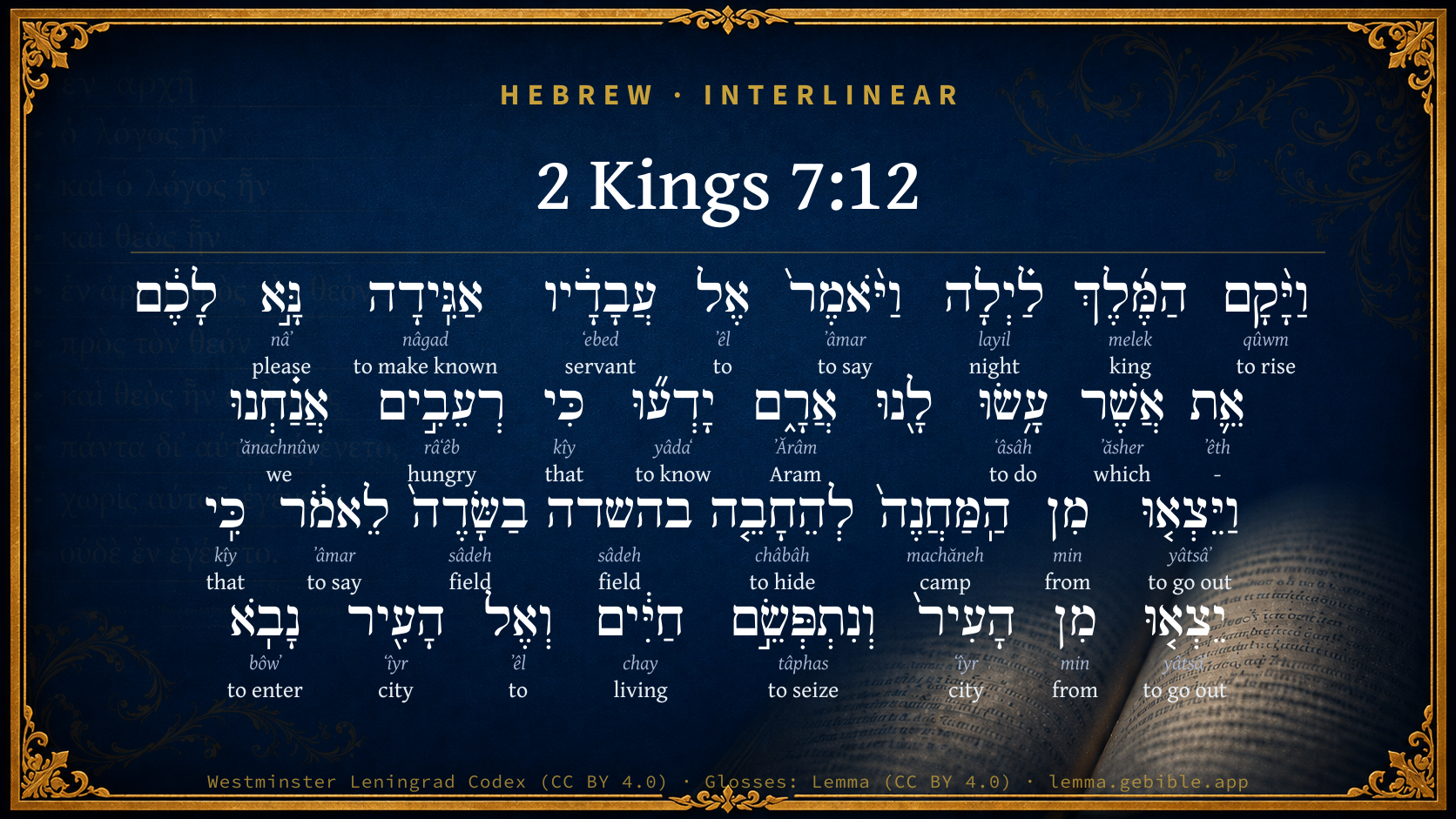
Hebrew (Westminster Leningrad Codex) 2 Kings 7:12 appears in the Hebrew Old Testament. The text above is from the Westminster Leningrad Codex. Each word links to its Strong’s number, a concise gloss, and parsing drawn from the Open Scriptures Hebrew Bible morphology. Click any word for its full Brown-Driver-Briggs (BDB) entry.
Download image
Cite this verse

2 Kings 7:12 (World English Bible). Public Domain. Lemma interlinear Bible study tool, https://lemma.gebible.app/v/2-kings/7/12.

Show BibTeX & RIS
BibTeX
RIS
English Translation
The king arose in the night, and said to his servants, I will now show you what the Syrians have done to us. They know that we are hungry; therefore are they gone out of the camp to hide themselves in the field, saying, When they come out of the city, we shall take them alive, and get into the city.
World English Bible · Public Domain
Download a study sheet

One document with this verse’s original text, its word-by-word gloss line, the meaning frame, cross-references with their text, attributed commentary, and full source and license credits — printable, and it pastes into notes with its structure intact.

This verse Autodidact and up

Study sheet (.html) Plain text (.txt)

A passage Seminary Student

Up to 50 verses in one chapter. A passage sheet keeps up to 6 commentary sources and 12 cross-references per verse, in the order this page ranks them, and says so on the sheet whenever that leaves anything out. Ask for a single verse and you get the Autodidact verse sheet above.

Everything on this page stays free to read, with no account — the sheet is a download of what is already on screen, not access to it.

Want to remove ads? Support Godless Engineer
Compare translations 3

The same verse in 3 English versions, stacked beneath the original-language interlinear above. Click any original word for its lexicon entry.

Each is an independent rendering of the whole verse — the interlinear is not word-aligned to these translations.

Highlighted words mark where these versions differ — a whole-verse word diff, not a word-by-word alignment.

  • World English Bible Public Domain
    The king arose in the night, and said to his servants, I will now show you what the Syrians have done to us. They know that we are hungry; therefore are they gone out of the camp to hide themselves in the field, saying, When they come out of the city, we shall take them alive, and get into the city.
  • King James Version Public Domain
    And the king arose in the night, and said unto his servants, I will now show you what the Syrians have done to us. They know that we be hungry; therefore are they gone out of the camp to hide themselves in the field, saying, When they come out of the city, we shall catch them alive, and get into the city.
  • unfoldingWord Literal Text CC BY-SA 4.0
    And the king arose night, and he said to his servants, “Please let me declare to you what Aram has done to us. They know that we hungry, and they have gone out from the camp to hide themselves in the field, saying, ‘For they will come out from the city, and we will capture them alive, and we will enter into the city.’”

unfoldingWord Literal Text — © unfoldingWord, licensed CC BY-SA 4.0. Word-aligned USFM3 via Door43 (git.door43.org/unfoldingWord/en_ult).

Versions to compare (up to 4)

3 of 4 selected

Show all 18 translations

Every available English version of this verse, each an independent rendering of the whole verse.

  • World English Bible Public Domain
    The king arose in the night, and said to his servants, I will now show you what the Syrians have done to us. They know that we are hungry; therefore are they gone out of the camp to hide themselves in the field, saying, When they come out of the city, we shall take them alive, and get into the city.
  • Berean Standard Bible Public Domain
    So the king got up in the night and said to his servants, “Let me tell you what the Arameans have done to us. They know we are starving, so they have left the camp to hide in the field, thinking, ‘When they come out of the city, we will take them alive and enter the city.’”
  • Majority Standard Bible Public Domain
    So the king got up in the night and said to his servants, “Let me tell you what the Arameans have done to us. They know we are starving, so they have left the camp to hide in the field, thinking, ‘When they come out of the city, we will take them alive and enter the city.’”
  • King James Version Public Domain
    And the king arose in the night, and said unto his servants, I will now show you what the Syrians have done to us. They know that we be hungry; therefore are they gone out of the camp to hide themselves in the field, saying, When they come out of the city, we shall catch them alive, and get into the city.
  • American Standard Version (1901) Public Domain
    And the king arose in the night, and said unto his servants, I will now show you what the Syrians have done to us. They know that we are hungry; therefore are they gone out of the camp to hide themselves in the field, saying, When they come out of the city, we shall take them alive, and get into the city.
  • Revised Version (1885) Public Domain
    And the king arose in the night, and said unto his servants, I will now shew you what the Syrians have done to us. They know that we be hungry; therefore are they gone out of the camp to hide themselves in the field, saying, When they come out of the city, we shall take them alive, and get into the city.
  • Geneva Bible (1599) Public Domain
    Then the King arose in the night, and saide vnto his seruants, I wil shew you now, what the Aramites haue done vnto vs. They know that we are affamished, therefore they are gone out of the campe to hide them selues in the fielde, saying, When they come out of the citie, we shall catch them aliue, and get into the citie.
  • Douay-Rheims (1899) Public Domain
    And he arose in the night and said to his servants: I tell you what the Syrians have done to us: They know that we suffer great famine, and therefore they are gone out of the camp, and lie hid in the fields, saying: When they come out of the city we shall take them alive, and then we may get into the city.
  • Young's Literal Translation Public Domain
    And the king riseth by night, and saith unto his servants, `Let me declare, I pray you, to you that which the Aramaeans have done to us; they have known that we are famished, and they are gone out from the camp to be hidden in the field, saying, When they come out from the city, then we catch them alive, and unto the city we enter.'
  • Literal Standard Version CC BY-SA 4.0
    And the king rises by night and says to his servants, “Now let me declare to you that which the Arameans have done to us; they have known that we are famished, and they go out from the camp to be hidden in the field, saying, When they come out from the city, then we catch them alive, and we enter into the city.”
  • Unlocked Literal Bible CC BY-SA 4.0
    Then the king arose at night and said to his servants, “I will tell you now what the Arameans have done to us. They know that we are hungry, so they have gone out of the camp to hide themselves in the fields. They are saying, 'When they come out of the city, we will take them alive, and get into the city.'”
  • unfoldingWord Literal Text CC BY-SA 4.0
    And the king arose night, and he said to his servants, “Please let me declare to you what Aram has done to us. They know that we hungry, and they have gone out from the camp to hide themselves in the field, saying, ‘For they will come out from the city, and we will capture them alive, and we will enter into the city.’”
  • Darby Bible Public Domain
    And the king rose up in the night and said to his servants, Let me tell you what the Syrians have done to us. They know that we are hungry, and they have gone out of the camp to hide themselves in the field, saying, When they come out of the city, we shall catch them alive, and get into the city.
  • World Messianic Bible Public Domain
    The king arose in the night, and said to his servants, “I will now show you what the Syrians have done to us. They know that we are hungry. Therefore they have gone out of the camp to hide themselves in the field, saying, ‘When they come out of the city, we shall take them alive, and get into the city.’”
  • Webster's Bible Public Domain
    And the king arose in the night, and said to his servants, I will now show you what the Syrians have done to us. They know that we are hungry; therefore they have gone out of the camp, to hide themselves in the field, saying, When they come out of the city, we shall take them alive, and get into the city.
  • Free Bible Version CC BY-SA 4.0
    The king got up in the night and said to his officers, “Let me tell you the trick the Arameans are trying to play on us. They know we're starving, so they have left the camp and hidden in the field, thinking, ‘When they leave the city, we'll take them alive and be able to enter the city.’”
  • Bible in Basic English Public Domain
    Then the king got up in the night and said to his servants, This is my idea of what the Aramaeans have done to us. They have knowledge that we are without food; and so they have gone out of their tents, and are waiting secretly in the open country, saying, When they come out of the town, we will take them living and get into the town.
  • JPS Tanakh (1917) Public Domain
    And the king arose in the night, and said unto his servants: 'I will now tell you what the Arameans have done to us. They know that we are hungry; therefore are they gone out of the camp to hide themselves in the field, saying: When they come out of the city, we shall take them alive, and get into the city.'

Literal Standard Version (2020), Covenant Press — licensed CC BY-SA 4.0. Text via the HelloAO Bible API (eBible.org). Unlocked Literal Bible (unfoldingWord) — licensed CC BY-SA 4.0. Text via the HelloAO Bible API (eBible.org). unfoldingWord Literal Text — © unfoldingWord, licensed CC BY-SA 4.0. Word-aligned USFM3 via Door43 (git.door43.org/unfoldingWord/en_ult). Free Bible Version, Dr. Jonathan Gallagher — licensed CC BY-SA 4.0. Text via the HelloAO Bible API (eBible.org).

Word by word

More ways to search: Search by grammar → Find every occurrence → Compare this word →

Practice this passage: Drill this verse → Learn its vocabulary →

לְהֵחָבֵ֤ה
châbâh
H2247
“to hide”
Preposition + Verb, Niphal, Infinitive Construct
Part of Speech
Preposition + Verb
Stem
Niphal
Form
Infinitive Construct
Full BDB Definition

Origin: a primitive root [compare H2245 ]

TWOT: 590

to withdraw, hide, hide oneself - (Qal) to withdraw - (Niphal) to hide oneself, remain hidden, withdraw
  1. וַיָּ֨קָם qûwm H6965 “and · to rise” Conjunction + Verb, Qal, Sequential Imperfect, 3rd Person, Masculine, Singular
  2. הַמֶּ֜לֶךְ melek H4428 “the · king” Particle, Definite Article + Noun, Common, Masculine, Singular, Absolute
  3. לַ֗יְלָה layil H3915 “night” Noun, Common, Masculine, Singular, Absolute
  4. וַיֹּ֨אמֶר֙ ʼâmar H559 “and · to say” Conjunction + Verb, Qal, Sequential Imperfect, 3rd Person, Masculine, Singular
  5. אֶל ʼêl H413 “to” Preposition
  6. עֲבָדָ֔יו ʻebed H5650 “servants · his” Noun, Common, Masculine, Plural, Construct + Suffix, Personal, 3rd Person, Masculine, Singular
  7. אַגִּֽידָה nâgad H5046 “to make known” Verb, Hiphil, Cohortative, 1st Person, Common, Singular
  8. נָּ֣א nâʼ H4994 “please” Particle, Interjection
  9. אֵ֛ת ʼêth H853 “-” Particle, Direct Object
  10. אֲשֶׁר ʼăsher H834 “which” Particle, Relative
  11. עָ֥שׂוּ ʻâsâh H6213 “to do” Verb, Qal, Perfect, 3rd Person, Common, Plural
  12. אֲרָ֑ם ʼĂrâm H758 “Aram” Noun, Proper
  13. יָדְע֞וּ yâdaʻ H3045 “to know” Verb, Qal, Perfect, 3rd Person, Common, Plural
  14. כִּי kîy H3588 “that” Conjunction
  15. רְעֵבִ֣ים râʻêb H7457 “hungry” Adjective, Adjective, Masculine, Plural, Absolute
  16. אֲנַ֗חְנוּ ʼănachnûw H587 “we” Pronoun, Personal, 1st Person, Common, Plural
  17. וַיֵּצְא֤וּ yâtsâʼ H3318 “and · to go out” Conjunction + Verb, Qal, Sequential Imperfect, 3rd Person, Masculine, Plural
  18. מִן min H4480 “from” Preposition
  19. הַֽמַּחֲנֶה֙ machăneh H4264 “the · camp” Particle, Definite Article + Noun, Common, Both, Singular, Absolute
  20. בהשדה sâdeh H7704 “in/at · the · field” Preposition + Particle, Definite Article + Noun, Common, Masculine, Singular, Absolute
  21. בַשָּׂדֶה֙ sâdeh H7704 “in/at the · field” Preposition, Determined + Noun, Common, Masculine, Singular, Absolute
  22. לֵאמֹ֔ר ʼâmar H559 “to say” Preposition + Verb, Qal, Infinitive Construct
  23. כִּֽי kîy H3588 “that” Conjunction
  24. יֵצְא֤וּ yâtsâʼ H3318 “to go out” Verb, Qal, Imperfect, 3rd Person, Masculine, Plural
  25. מִן min H4480 “from” Preposition
  26. הָעִיר֙ ʻîyr H5892 “the · city” Particle, Definite Article + Noun, Common, Feminine, Singular, Absolute
  27. וְנִתְפְּשֵׂ֣ם tâphas H8610 “and · to seize · them” Conjunction + Verb, Qal, Imperfect, 1st Person, Common, Plural + Suffix, Personal, 3rd Person, Masculine, Plural
  28. חַיִּ֔ים chay H2416 “living” Adjective, Adjective, Masculine, Plural, Absolute
  29. וְאֶל ʼêl H413 “and · to” Conjunction + Preposition
  30. הָעִ֖יר ʻîyr H5892 “the · city” Particle, Definite Article + Noun, Common, Feminine, Singular, Absolute
  31. נָבֹֽא bôwʼ H935 “to enter” Verb, Qal, Imperfect, 1st Person, Common, Plural

About this verse

These counts appear in no published source. They are computed here, from the morphology-tagged text and Lemma’s own curated glosses. What Lemma adds →

34
words
25
distinct lemmas
Historical
section

Notable vocabulary

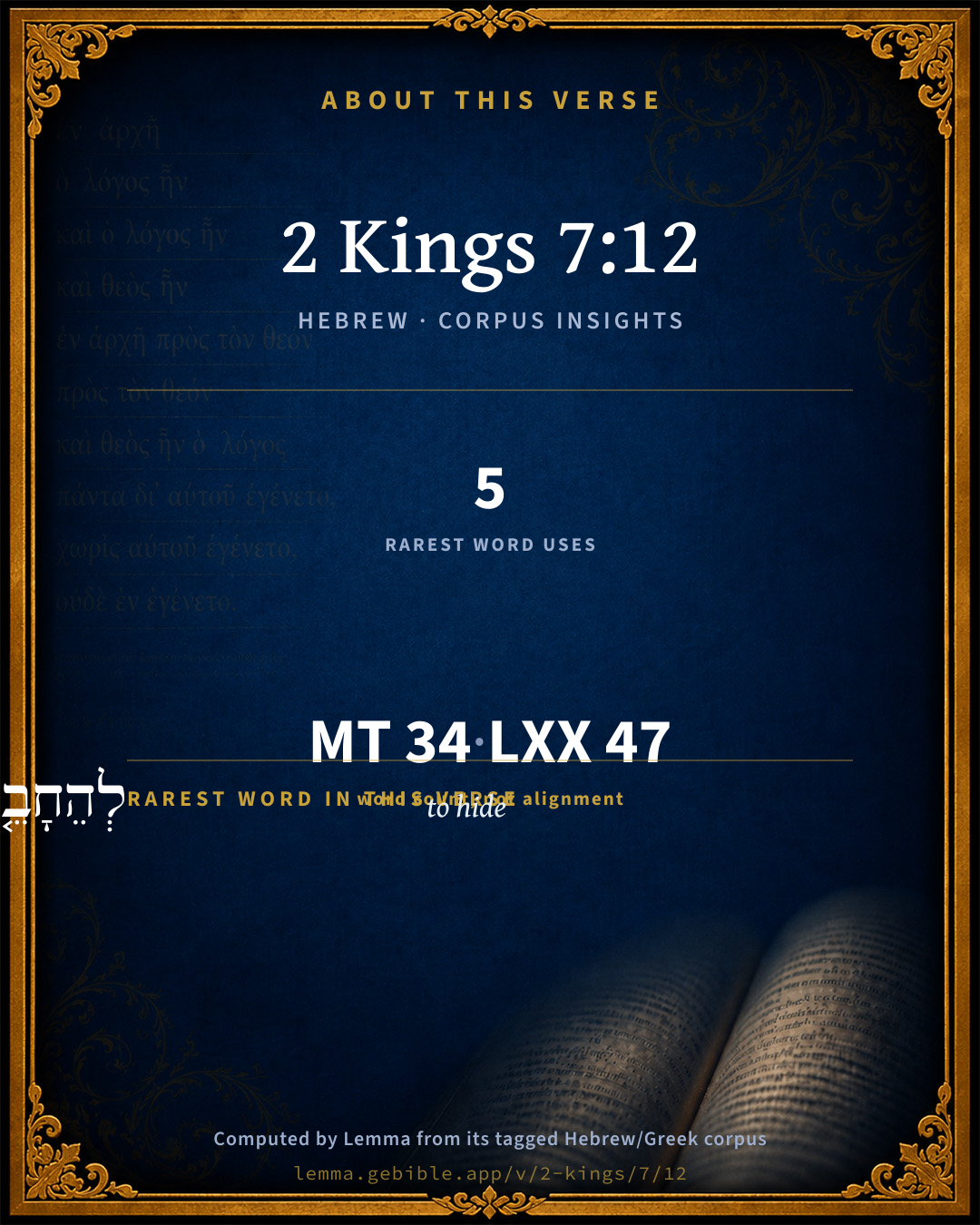
The rarest word here is לְהֵחָבֵ֤ה to hide H2247 — appearing just 5 times in the whole Hebrew Bible.

Shared distinctive vocabulary

לְהֵחָבֵ֤ה to hide H2247 occurs in 5 verses of the Hebrew Bible. Also found in:

Grammatical profile

  • 11 verbs
  • 9 nouns
  • 2 adjectives
  • 1 pronoun
  • 6 prepositions
  • 2 conjunctions
  • 3 particles

Verb forms

  • וַיָּ֨קָם Qal · Sequential Imperfect
  • וַיֹּ֨אמֶר֙ Qal · Sequential Imperfect
  • אַגִּֽידָה Hiphil · Cohortative
  • עָ֥שׂוּ Qal · Perfect
  • יָדְע֞וּ Qal · Perfect
  • וַיֵּצְא֤וּ Qal · Sequential Imperfect
  • לְהֵחָבֵ֤ה Niphal · Infinitive Construct
  • לֵאמֹ֔ר Qal · Infinitive Construct
  • יֵצְא֤וּ Qal · Imperfect
  • וְנִתְפְּשֵׂ֣ם Qal · Imperfect
  • נָבֹֽא Qal · Imperfect

Repetition

Words recur within this verse — often emphatic in Hebrew:

  • וַיֹּ֨אמֶר֙ to say H559 ×2
  • וַיֵּצְא֤וּ to go out H3318 ×2
  • בהשדה field H7704 ×2
  • הָעִיר֙ city H5892 ×2
  • אֶל to H413 ×2
  • כִּי that H3588 ×2
  • מִן from H4480 ×2

Hebrew & Septuagint length

In English translation the verse runs 61 words from the Hebrew and 63 from the Septuagint (LXX English) — closely comparable.

A rough comparison of the two English renderings, which tokenize alike — not a word-level alignment.

Word counts can differ between the Hebrew and the Greek without any difference in meaning — e.g. the Hebrew direct-object marker אֵת has no separate Greek word, and Greek often adds the article ὁ.

In the original languages it is 34 Hebrew tokens and 47 Greek tokens — but the two are counted differently (Hebrew bundles its prefixes and suffixes into one token; the Greek is in lemma form), so that isn’t a like-for-like length.

Cross-references

2

Topical passages linked to 2 Kings 7:12 in the Treasury of Scripture Knowledge — connected by theme and wording, ordered by reader-vote popularity; previews shown in the World English Bible.

  • Joshua 8:4 He commanded them, saying, Behold, you shall lie in ambush against the city, behind the city; don't go very far from the city, but be all ready:
  • 2 Kings 6:25–29 There was a great famine in Samaria: and, behold, they besieged it, until a donkey's head was sold for eighty [pieces] of silver, and the fourth part of a kab of dove's dung for five [pieces] of silver.

Cross-references courtesy of OpenBible.info (CC BY 4.0).

Hebrew and Greek witnesses Masoretic Hebrew ↔ Greek Septuagint

The same verse in the two great witnesses to the Old Testament, shown verse-for-verse.

These are two independent witnesses, not word-aligned to each other, and the Septuagint is shown in lemma (dictionary) form.

Hebrew 2 Kings 7:12 Masoretic · Westminster Leningrad Codex

וַיָּ֨קָם הַמֶּ֜לֶךְ לַ֗יְלָה וַיֹּ֨אמֶר֙ אֶל עֲבָדָ֔יו אַגִּֽידָה נָּ֣א לָכֶ֔ם אֵ֛ת אֲשֶׁר עָ֥שׂוּ לָ֖נוּ אֲרָ֑ם יָדְע֞וּ כִּי רְעֵבִ֣ים אֲנַ֗חְנוּ וַיֵּצְא֤וּ מִן הַֽמַּחֲנֶה֙ לְהֵחָבֵ֤ה בהשדה בַשָּׂדֶה֙ לֵאמֹ֔ר כִּֽי יֵצְא֤וּ מִן הָעִיר֙ וְנִתְפְּשֵׂ֣ם חַיִּ֔ים וְאֶל הָעִ֖יר נָבֹֽא

The king arose in the night, and said to his servants, I will now show you what the Syrians have done to us. They know that we are hungry; therefore are they gone out of the camp to hide themselves in the field, saying, When they come out of the city, we shall take them alive, and get into the city.

World English Bible · Public Domain

Greek LXX 2 Kings 7:12 Septuagint · lemma form

καί ἀναἵστημι ὁ βασιλεύς νύξ καί εἶπον πρός ὁ παῖς αὐτός ἀναἀγγέλλω δή σύ ὅς ποιέω ἐγώ συρία γιγνώσκω ὅτι πεινάω ἐγώ καί ἐκἔρχομαι ἐκ ὁ παρεμβολή καί κρύπτω ἐν ὁ ἀγρός λέγω ὅτι ἐκἔρχομαι ἐκ ὁ πόλις καί συνλαμβάνω αὐτός ζάω καί εἰς ὁ πόλις εἰςἔρχομαι

And the king rose up by night, and said to his servants, I will now tell you what the Syrians have done to us. They knew that we are hungry; and they have gone forth from the camp and hidden themselves in the field, saying, They will come out of the city, and we shall catch them alive, and go into the city.

LXX2012 (modern English Septuagint) · Public Domain

Hebrew: Westminster Leningrad Codex (CC BY 4.0). Greek: Septuagint (public domain); English from LXX2012 (modern English Septuagint) (Public Domain). How the Septuagint differs from the Hebrew →

Targum (Aramaic paraphrase)

1

The Targum is the ancient Jewish Aramaic paraphrase of the Hebrew Scriptures — an interpretive translation, not the Hebrew text itself. Onkelos (literal) and Pseudo-Jonathan (expansive) render the Torah, and Jonathan the Prophets. Coverage is partial: where no permissively-licensed English translation exists for a verse, only the Aramaic is shown. This is verse-level text, not a word-by-word alignment to the Hebrew.

  1. Targum Jonathan Prophets (Joshua–Malachi)
    וְקָם מַלְכָּא בְּלֵילְיָא וַאֲמַר לְעַבְדוֹהִי אֲחַוֵי כְעַן לְכוֹן יַת דַעֲבָדוּ לָנָא אֱנַשׁ אֲרָם יָדְעִין אֲרֵי כְפָנִין אֲנַחְנָא וּנְפַקוּ מִן מַשְׁרִיתָא לְאִטַמָרָא בְחַקְלָא לְמֵימַר אִם יַפְקוּן מִן קַרְתָּא וְנִיחוּדוּנוּן כַּד חַיִין וּלְקַרְתָּא נֵיעוֹל:

    (no public-domain English translation for this verse)

    Targum Jonathan — Aramaic: “Mikraot Gedolot” (public domain). English: “Sefaria Community Translation” (CC0 1.0 (public-domain dedication)); “London "Chaldee Paraphrase," 1871” (public domain). Text via Sefaria.

Commentary

Notes on 2 Kings 7:12 from classic Christian and Jewish commentators (each source and its license shown beneath its notes). The classic Christian expositions comment on the surrounding passage and are grouped to its opening verse, so a note may address several verses; the Jewish commentaries on the Tanakh (Rashi and others) are per-verse, so they appear only where the commentator wrote on this verse.

Lemma curates 59 commentaries, every one of them public domain or Creative Commons licensed, each selected and text-cleaned for this edition rather than reprinted as found. About our sources →

Matthew Henry's Commentary

Here we have,

I. The king's jealousy of a stratagem in the Syrian's retreat, Kg2 7:12. He feared that they had withdrawn into an ambush, to draw out the besieged, that they might fall on them with more advantage. he knew he had no reason to expect that God should appear thus wonderfully for him, having forfeited his favour by his unbelief and impatience. He knew no reason the Syrians had to fly, for it does not appear that he or any of this attendants heard the noise of the chariots which the Syrians were frightened at. Let not those who, like him, are unstable in all their ways, think to receive any thing from God; nay, a guilty conscience fears the worst and makes men suspicious.

II. The course they took for their satisfaction, and to prevent their falling into a snare. They sent out spies to see what had become of the Syrians, and found they had all fled indeed, commanders as well a common soldiers. They could track them by the garments which they threw off, and left by the way, for their greater expedition, Kg2 7:15. He that gave this advice seems to have been very sensible of the deplorable condition the people were in (Kg2 7:13); for speaking of the horses, many of which were dead and the rest ready to perish for hunger, he says, and repeats it, "They are as all the multitude of Israel. Israel used to glory in their multitude, but now they are diminished and brought low." He advised to send five horsemen, but, it should seem, there were only two horses fit to be sent, and those chariot-horses, Kg2 7:14. Now the Lord repented himself concerning his servants, when he saw that their strength was gone, Deu 32:36.

III. The plenty that was in Samaria, from the plunder of the camp of the Syrians, Kg2 7:16. Had the Syrians been governed by the modern policies of war, when they could not take their baggage and their tents with them they would rather have burnt them (as it is common to do with the forage of a country) than let them fall into their enemies' hands; but God determined that the besieging of Samaria, which was intended for its ruin, should turn to its advantage, and that Israel should now be enriched with the spoil of the Syrians as of old with that of the Egyptians. here see, 1. The wealth of the sinner laid up for the just (Job 27:16, Job 27:17) and the spoilers spoiled, Isa 33:1. 2. The wants of Israel supplied in a way that they little thought of, which should encourage us to depend upon the power and goodness of God in our greatest straits. 3. The word of Elisha fulfilled to a tittle: A measure of fine flour was sold for a shekel; those that spoiled the camp had not only enough to supply themselves with, but an overplus to sell at an easy rate for the benefit of others, and so even those that tarried at home did divide the spoil, Psa 68:12; Isa 33:23. God's promise may be safely relied on, for no word of his shall fall to the ground.

IV. The death of the unbelieving courtier, that questioned the truth of Elisha's word. Divine threatenings will as surely be accomplished as divine promises. He that believeth not shall be damned stands as firm as He that believeth shall be saved. This lord, 1. Was preferred by the king to the charge of the gate (Kg2 7:17), to keep the peace, and to see that there was no tumult or disorder in dividing and disposing of the spoil. So much trust did the king repose in him, in his prudence and gravity, and so much did he delight to honour him. He that will be great, let him serve the public. 2. Was trodden to death by the people in the gate, either by accident, the crowd being exceedingly great, and he in the thickest of it, or perhaps designedly, because he abused his power, and was imperious in restraining the people from satisfying their hunger. However it was, God's justice was glorified, and the word of Elisha was fulfilled. He saw the plenty, for the silencing and shaming of his unbelief, corn cheap without opening windows in heaven, and therein saw his own folly in prescribing to God; but he did not eat of the plenty he saw. When he was about to fill his belly God cast the fury of his wrath upon him (Job 20:23) and it came between the cup and the lip. Justly are those thus tantalized with the world's promises that think themselves tantalized with the promises of God. If believing shall not be seeing, seeing shall not be enjoying. This matter is repeated, and the event very particularly compared with the prediction (Kg2 7:18-20), that we might take special notice of it, and might learn, (1.) How deeply God resents out distrust of him, of his power, providence, and promise. When Israel said, Can God furnish a table? the Lord heard it and was wroth. Infinite wisdom will not be limited by our folly. God never promises the end without knowing where to provide the means. (2.) How uncertain life and the enjoyments of it are. Honour and power cannot secure men from sudden and inglorious deaths. He whom the king leaned upon the people trod upon; he who fancied himself the stay and support of the government was trampled under foot as the mire in the streets. Thus hath the pride of men's glory been often stained. (3.) How certain God's threatenings are, and how sure to alight on the guilty and obnoxious heads. Let all men fear before the great God, who treads upon princes as mortar and is terrible to the kings of the earth.

Matthew Henry's Commentary on the Whole Bible (1708–1710) — public domain (CC PDM 1.0). Text via the HelloAO Bible API.

Trapp's Complete Commentary

John Trapp

2Ki 7:12 And the king arose in the night, and said unto his servants, I will now shew you what the Syrians have done to us. They know that we [be] hungry; therefore are they gone out of the camp to hide themselves in the field, saying, When they come out of the city, we shall catch them alive, and get into the city.

Ver. 12. I will now show you what the Syrians have done to us.] This he saith, being nimium et intempestive meticulosus, more fearful than was fit; but he either believed not, or else had "forgotten the consolation" [παρακλησεως], as the apostle saith the Hebrews had, {Heb 4:6} the promise made him by the prophet. {2Ki 7:1}

They know that we be hungry, &c.] By such a stratagem as this here mentioned, Tomyris, the Scythian queen, circumvented and destroyed Cyrus and his Persians. {a} So when the Christians besieged Ptolemais, and were themselves at the same time besieged by Saladine, they were so hard bestead for victuals, that they were forced to beg and buy it of their enemies. This when Saladine perceived, he pretended to go his way, leaving his camp full fraught with plenty of all things: and when the hunger starved Christians fell upon the spoil in a confused way, he turning short again, slew a great sort of them. {b}

{a} Justin., lib. i.

{b} Funcc., Chron.

John Trapp, A Commentary or Exposition upon All the Books of the Old and New Testament (1647–1656) — public domain. Text from a community e-Sword module.

Joseph Benson's Commentary

2Ki 7:12. The king said, I will show you what the Syrians have done — He was jealous of a stratagem, and feared the Syrians had only retreated to be in ambush, and draw out the besieged, that they might fall upon them to more advantage. He knew he had no reason to expect that God should appear thus wonderfully for him, having forfeited his favour by his unbelief and impatience. And he knew no reason the Syrians had to flee; for it does not appear that either he, or any of his attendants, or, indeed, any in Samaria, had heard the noise of the chariots, &c., which had affrighted the Syrians.

Joseph Benson's Commentary on the Old and New Testaments (1811–1818) — public domain. Text from a community e-Sword module.

Geneva Bible (1599)

Geneva Bible translators

He mistrusted the Prophet’s words, and therefore could believe nothing, as they which are more politic than godly ever cast more perils than needeth.

Geneva Bible (1599) marginal notes — public domain. Text via Bolls.life.

Jamieson, Fausset & Brown

Robert Jamieson, A. R. Fausset & David Brown

the king . . . said unto his servants, I will now show you what the Syrians have done--Similar stratagems have been so often resorted to in the ancient and modern wars of the East that there is no wonder Jehoram's suspicions were awakened. But the scouts, whom he despatched, soon found unmistakable signs of the panic that had struck the enemy and led to a most precipitate flight.

Jamieson, Fausset & Brown — Commentary Critical and Explanatory on the Whole Bible (1871) — public domain (CC PDM 1.0). Text via the HelloAO Bible API.

Adam Clarke's Commentary

Verse 12. The king arose in the night] This king had made a noble defence; he seems to have shared in all the sufferings of the besieged, and to have been ever at his post. Even in vile Ahab there were some good things!

They know that we be hungry] This was a very natural conclusion; the Syrians by the closest blockade could not induce them to give up the city, but knowing that they were in a starving condition, they might make use of such a stratagem as that imagined by the king, in order to get possession of the city.

Adam Clarke's Commentary on the Bible (1810–1826) — public domain. Text from a community e-Sword/MySword module.

Ellicott's Commentary for English Readers

(12) I will now shew you.—“Suspicax est miseria” (Grotius). Such stratagems as Jehoram suspected are, however, common enough in warfare.

To hide themselves in the field.—Both expressions in the Hebrew follow the later modes of inflection. Such forms may be due to transcribers rather than to the original writer.

A Bible Commentary for English Readers, edited by Charles John Ellicott (1878–1897) — public domain. Text from a community e-Sword module.

The Cambridge Bible for Schools and Colleges

gen. ed. J. J. S. Perowne

12–16. The report of the Syrian flight found to be true. The consequent plenty in Samaria (Not in Chronicles)

12. the king arose in the night] The news was so important that though it was night-time, the messengers went with it to the king’s bedchamber, and he, though probably thinking the report much too good to be true, at once arose to take measures for investigating it.

what the Syrians have done to us] i.e. with the hope of entrapping us.

The Cambridge Bible for Schools and Colleges (gen. ed. J. J. S. Perowne; Cambridge University Press, 1878–1918) — public domain. Text from a community e-Sword module.

John Gill's Exposition

And the king arose in the night,.... Upon the report made to him:

and he said unto his servants, I will now show you what the Syrians have done to us; taking it to be a stratagem of theirs to decoy them:

they know that we be hungry; and would be glad to come out of the city to get some food:

therefore are they gone out of the camp to hide themselves in the field; to make us believe that they have broke up the siege, and have deserted the camp, and are gone, when they only lie in ambush:

saying, when they come out of the city; which they supposed they would do through hunger:

we shall catch them alive; take them captive at once:

and get into the city; being open to let them out, and receive them on their return.

John Gill's Exposition of the Whole Bible (1746–1763) — public domain (CC PDM 1.0). Text via the HelloAO Bible API.

Albert Barnes' Notes on the Bible

His servants - i. e., “high officers of the household,” not mere domestics.

I will shew you what the Syrians have done - Jehoram sees in the deserted camp a stratagem like that connected with the taking of Ai Josh. 8:3-19. The suspicion was a very natural one, since the Israelites knew of no reason why the Syrians should have raised the siege.

Albert Barnes' Notes on the Bible (1834–1885) — public domain. Text from a community e-Sword/MySword module.

The Pulpit Commentary

And the king arose in the night, and said unto his servants, I will now show you what the Syrians have done to us. They know that we be hungry; therefore are they gone out of the camp to hide themselves in the field. Jehoram, knowing of no reason for the flight of the Syrians, suspected a not uncommon stratagem. He supposed that the enemy had merely gone a little way from their camp, and placed themselves in ambush, ready to take ad- vantage of any rash movement which the Israelites might make. So Cyrus is said to have entrapped and slaughtered Spargapises, the son of Tomyris, together with a large detachment, in his last war against the Massagetae (Herod., 1:211). His supposition was not unreasonable. Saying, When they come out of the city, we shall catch them alive, and get into the city. A double advantage might be expected to follow those who quitted the town to plunder the camp would be surrounded and made prisoners, while the town itself, left without defenders, would be captured. Compare the capture of Ai by Joshua, (Jos_8:3-19) when the chief part of the garrison had been enticed out of it.

Vers. 12-15. Unseasonable distrust.

Humanly speaking, Jehoram"s distrust of the report of the lepers was not unreasonable. Such a stratagem as that which he suspected was often practiced in the wars of the ancient world, with great advantage to one side and great loss to the other. But his distrust, though not unreasonable, was unseasonable from the point of view of faith and belief in God. Elisha having just announced such an inversion of the actual state of things as could only be brought about in an extraordinary way, the occurrence of something extraordinary was to be expected. Jehoram ought to have been on the look out for some strange intelligence; and that which the lepers brought him was in such complete accordance with the tenor of Elisha"s prophecy, that a very moderate degree of faith would have sufficed to make him receive it gladly, joyfully, and without any mistrust. He would then have shortened the sufferings of his people by a day, which must have been lost by the dispatch of the two chariots to reconnoiter; and he might, perhaps, have saved the life of his "lord," whose dreadful death may have been caused by the impatience of a famished multitude too long restrained from sallying forth. Men are apt to be mistrustful; and it is generally just at the wrong time. They are sanguine and over-confident when it would have been well to suspect, suspicious and over-circumspect when there is no need of doubt or circumspection. God calls them to the kingdom that he has prepared for men, and bids them "come, buy and eat; yea, come, buy wine and milk without money and without price"; (Isa_55:1) and they hang back, hesitate, delay, as if they were about to be entrapped. A bold impostor invites them to adopt his shibboleth, and trust in it for salvation they listen eagerly, hang on his words, are persuaded, and join the Mormons or the Peculiar People. Rash youth boasts as it girds on its armor, and looks for an easy victory over sin and Satan, over the world, the flesh, and the devil. Timid old age faints and is weary, and despairs of winning through and "persevering to the end," though God has brought it so far upon its way. It is well to mistrust one"s self; it is faithless to mistrust God. He who has borne us up hitherto on eagles" wings will still bear us up. He "fainteth not, neither is weary." He "will not leave us, nor forsake us.

Vers. 12-16. The help that comes to distressed men from without.

the king arose in the night," etc. These verses suggest a few thoughts concerning the help that sometimes comes to distressed men from without. The best help that a man can get in any case is from within from a right working of his own faculties, independence on his Maker. Still, help from without is often most valuable. There are three kinds of human helpers without.

1. Those that help men by their will. These are men, the chosen of the race, who lay themselves out for philanthropic service.

2. Those that help men against their will. It often turns out, as in the case of Joseph"s brethren, that our enemies really serve us.

3. Those that help men irrespective of their will. We are helped in many ways by those who know and care nothing about us. We come into possession of their knowledge, inventions, property. The property of the men of the last age is ours today. Such is the kind of help which the Syrians now rendered the Israelites, and we offer three remarks concerning this help.

I IT WAS NEEDED. The men of Samaria were in the utmost distress, and the king arose in the night and sent forth two of his servants (ver. 12) in pursuit of the Syrians to see what had happened. As they approached the spot they found that the Syrians had departed, but had left their property behind. "And the way was full of garments and vessels, which the Syrians had cast away in their haste." Thus in the height of their distress they found relief. It is often so in passing through life; often so in individual as well as in social life. In the greatest extremity help appears. When the cloud is darkest a beam of light breaks on it.

II IT WAS UNDESERVED. Did these Samaritans deserve help? By no means. They were nearly all idolatrous and worthless people. They merited condign punishment, everlasting ruin. This is true of all men as sinners. Whatever help we receive is utterly undeserved. "It is of the Lord"s mercies that we are not consumed.

III IT WAS UNEXPECTED. They went forth longing for food, but quite uncertain whether they would find any. They found that the enemy had fled, and in their haste had left provisions behind. "So a measure of fine flour was sold for a shekel." Are not all men, in the providence of God, constantly receiving unexpected favors? The choicest blessings come when least expected. D.T.

Vers. 12-20. The good news verified.

The tidings brought by the lepers were so astounding that it was natural there should at first be some hesitation in acting on them.

I THE KING"S SUSPICIONS. Jehoram was roused in the night-time, but his mood was distrustful and desponding. He was convinced that the Syrians were but playing him a trick. Their apparent retreat was a piece of strategy to get the Israelites out into the plain. Then they would fall on them and destroy them. "I will now show you what the Syrians have done to us," etc.

1. Distrust of man. The suspicious disposition of the king accords with his general character. It has been noticed that Jehoram presents himself throughout the history as a man of moody, changeful, unreliable nature. "When the prophet leads the enemy into his hands without a blow, he becomes violent, and is eager to slaughter them all; then, however, he allows himself to be soothed, gives them entertainment, and permits them to depart in safety. At the siege of Samaria, the great distress of the city touches his heart. He puts on garments which are significant of grief and repentance, but then allows himself to be so overpowered by anger, that, instead of seeking the cause of the prevailing misery in his own apostasy and that of the nation, he swears to put to death, without delay, the man whom he had once addressed as "father." Yet this anger also is of short duration. He does not hear the promise of deliverance with scorn, as his officer does, but with hope and confidence. Then, again, when the promised deliverance is announced as actually present, he once more becomes doubtful and mistrustful, and his servants have to encourage him and push him on to a decision" (Bahr). It is shown by the present instance how a suspicious, distrustful disposition often outwits itself. One could not have blamed Jehoram for being cautious; but his habit of mind led him to go beyond caution, and to conclude for certain that the news brought was false, and that the Syrians were attempting a deception. Had he been left to himself, he would have rested in that conclusion, and inquired no further. Yet he was wrong, and the Syrians had actually fled. An excess of skepticism thus frequently leads those who indulge it astray. Jehoram was so accustomed to diplomacy, to intrigue, to strategy, that he thought of no other explanation of the facts related to him. By his moody unbelief he nearly missed the blessing.

2. Distrust of God. There was more than distrust of man in Jehoram"s suspicions; there was likewise distrust of God. Had his attitude to God"s promise, as conveyed through Elisha, been one of faith, he would at once have recognized that this which was told him was its fulfillment. He would have remembered Elisha"s word; he would have perceived how precisely this report fitted into it; he would at least, before dismissing the lepers" story, have felt it his duty to consult Elisha, and ask him for his guidance. It was his unbelief which gave the dark tinge to his reflections. Are we not often guilty of similar distrust? We offer prayers, and, when the answer comes, we are astonished, and can hardly believe. (Act_12:15, Act_12:16) Our unbelief darkens God"s providence to us, and prevents us from seeing his gracious hand.

II VERIFICATION OF THE FLIGHT.

1. The servantscounsel. The servants on this, as on other occasions, showed themselves wiser than their lord (Exo_10:7; 2Ki_5:13) One of them gave him sound advice. The report they had received was, surely, at least worth inquiring into. Let him send some of the chariot-horses that remained (they were very few, and, like the remnant of the people of Israel, wasted with starvation, so that, at the worst, no greater evil could befall them than already existed), and let the charioteers bring word of the true state of the case. How many rash criticisms, hasty condemnations, unwise delays, would be avoided, if men would but act upon the principle "go and see"! The practical instincts are often sounder in the common people than in their lordly superiors.

2. The king"s messengers. The king did as his servant suggested, and the chariots, two in number, were sent forth. The camp was found deserted, as the lepers had said, but, to make sure, the messengers continued their tour of inspection along the road leading to Jordan. The evidences of hasty flight were indubitable. "All the way was full of garments and vessels, which the Syrians had cast away in their haste." There was now no further doubt, so "the messengers returned, and told the king." They had seen, and believed: how much better had the king trusted the word of the Lord, and believed, though he had not seen! (Joh_20:29) When men are fleeing for their lives, they willingly leave all behind them. It should moderate our sense of the value of earthly treasures when we see how, in an emergency, they are so little recked of. A day will come when the proudest and haughtiest would gladly part with all they have for a single smile from thee face of him who sits upon the great white throne. (Rev_6:15, 16 20:11)

3. God"s word fulfilled. Thus it came about that, in a manner wholly unprecedented and unlooked for, the prediction of Elisha was fulfilled. The starving people found themselves set free from their besiegers, and, crowding out to the deserted tents, regaled themselves on the abundance of provision the Syrians had left. The store of the Syrian host was at their disposal, and a measure of fine flour was sold for a shekel, and two measures of barley for a shekel. "Wisdom is justified of her children". (Mat_11:19) Those are always found right at last who repose implicit trust in God"s Word. Worldly men may laugh at them; rationalists will mock them; the astute in this world"s affairs will count them harebrained and foolish; but the event justifies them. The principle of verification holds as true in religion as in science. What we now accept in faith will ultimately be verified by sight. The difference between religion and science is that the latter refuses to act till it has received the verification (though even this is subject to qualification); the former trusts God, acts, and awaits the verification.

III FATE OF THE MOCKER. There remained to be fulfilled the word which Elisha had spoken, that, though the king"s officer who had scoffed at the promise should see the predicted plenty, he would not eat thereof. This word also was verified in a remarkable, but seemingly accidental, way. This officer was appointed to superintend the sale of provisions in the gateway, but the pressure of the frantic crowd was so great that he was trodden underfoot and died. How simply, yet how accurately, was the prophet"s forecast fulfilled!

1. The incident is another evidence that even seeming "accidents" do not lie outside the providence of God.

2. It teaches men the folly and danger of mocking at God"s Word.

3. It shows the certainty of God"s threatenings being fulfilled.

4. It illustrates the end of the ungodly seeing the fulfillment of God"s promises of mercy, but not permitted to enjoy. J.O.

The Pulpit Commentary (1880–1919), ed. H.D.M. Spence-Jones & Joseph S. Exell — public domain. Text from a community e-Sword module.

Keil & Delitzsch

C. F. Keil & F. Delitzsch

The king imagined that the unexpected departure of the Syrians was only a ruse, namely, that they had left the camp and hidden themselves in the field, to entice the besieged out of the fortress, and then fall upon them and press into the city. בּהשּׂדה according to later usage for בּשּׂדה (vid., Ewald, 244, a). In order to make sure of the correctness or incorrectness of this conjecture, one of the king's servants (counsellors) gave this advice: "Let them take (the Vav before יקחוּ as in Kg2 4:41) five of the horses left in the city, that we may send and see how the matter stands." The words, "Behold they (the five horses) are as the whole multitude of Israel that are left in it (the city); behold they are as the whole multitude of Israel that are gone," have this meaning: The five horsemen (for horses stand for horsemen, as it is self-evident that it was men on horseback and not the horses themselves that were to be sent out as spies) can but share the fate of the rest of the people of Samaria, whether they return unhurt to meet death by starvation with the people that still remain, or fall into the hands of the enemy and are put to death, in which case they will only suffer the lot of those who have already perished. Five horses is an approximative small number, and is therefore not at variance with the following statement, that two pair of horses were sent out with chariots and men. The Chethb ההמון is not to be altered, since there are other instances in which the first noun is written with the article, though in the construct state (vid., Ewald, 290, e.); and the Keri is only conformed to the following כּכל־המון. Kg2 7:14, Kg2 7:15. They then sent out two chariots with horses, who pursued the flying enemy to the Jordan, and found the whole of the road full of traces of the hurried flight, consisting of clothes and vessels that had been thrown away. The Chethb בּהחפזם is the only correct reading, since it is only in the Niphal that חפז has the meaning to fly in great haste (cf. Sa1 23:26; Psa 48:6; Psa 104:7).

Keil & Delitzsch — Biblical Commentary on the Old Testament (1861–1891) — public domain (CC PDM 1.0). Text via the HelloAO Bible API. (Old Testament only.)

Kretzmann's Popular Commentary

Paul E. Kretzmann

The Great Plenty in Samaria

v. 12. And the king, having received the astounding news, arose in the night and said unto his servants, his attendants, the members of his council, I will now show you what the Syrians have done to us; he suspected a ruse. They know that we be hungry, therefore are they gone out of the camp to hide themselves in the field, saying, When they come out of the city, we shall catch them alive, for it would then be an easy matter to surprise and to overwhelm the defenders of the city, weakened as they were by hunger, and get into the city.

v. 13. And one of his servants, a member of his council, answered and said, Let some take, I pray thee, five of the horses that remain, which are left in the city, (behold, they are as all the multitude of Israel that are left in it; behold, I say, they are even as all the multitude of the Israelites that are consumed, that is, the scouts would either return safe to the city and share the fate of the others by suffering death by famine, or they would fall into the hands of the enemies and be slain, in which case they would be no worse off than those who had already fallen,) and let us send and see.

v. 14. They took therefore two chariot horses, two chariots with the necessary horses and probably a single horseman. And the king sent after the host of the Syrians, saying, Go and see.

v. 15. And they went after them unto Jordan, for it was an easy matter to follow the path of their flight; and, lo, all the way was full of garments and vessels, personal belongings of the fleeing soldiers, which the Syrians had cast away in their haste. And the messengers returned and told the king.

v. 16. And the people, who had undoubtedly awaited the return of the scouts with the greatest eagerness, went out, and spoiled the tents of the Syrians, loading themselves with booty. So a measure of fine flour was sold for a shekel and two measures of barley for a shekel, according to the word of the Lord, v. 1.

v. 17. And the king appointed the lord on whose hand he leaned, his adjutant, to have the charge of the gate, to maintain order and prevent accidents; and the people, overexcited as they were and unwilling to listen to his commands, trode upon him in the gate, roughly bearing him down and crushing him to death. And he died, as the man of God had said, who spake when the king came down to him.

v. 18. And it came to pass as the man of God had spoken to the king, saying, Two measures of barley for a shekel and a measure of fine flour for a shekel shall be tomorrow about this time in the gate of Samaria,

v. 19. and that lord answered the man of God and said, Now, behold, if the Lord should make windows in heaven, might such a thing be? And he said, Behold, thou shalt see it with thine eyes, but shalt not eat thereof.

v. 20. And so it fell out unto him; for the people trode upon him in the gate, and he died. The circumstantial repetition of this sad event serves to impress its lesson; for God will not be mocked, as many a blasphemer has found out to his sorrow, often, unfortunately, when it was too late.

Paul E. Kretzmann, Popular Commentary of the Bible (1921–1924) — public domain. Text from a community e-Sword module.

unfoldingWord translationNotes

Door43 World Missions Community

have done to us

"are planning to do to us" or "have done to deceive us"

take them alive

This means that they would capture the people and not kill them.

the horses that remain, which are left in the city

Many of the horses belonging to the Israelites had died because of the famine. The meaning of this can be made clear. AT: "the horses in the city that are still alive" (See: Assumed Knowledge and Implicit Information)

They are like all the rest of the population of Israel who are left

The men that would go to the Aramean camp would share the same fate as the rest of the Israelites who remained in the city. They would either die from starvation, or possibly be killed by the Arameans.

see

The implicit information about what he wanted to see may be expressed clearly. AT: "see if what these lepers have said is true" (See: Assumed Knowledge and Implicit Information)

translationWords

servant

life

horse

die

kingdom of Israel

send

unfoldingWord translationNotes — © Distant Shores Media and the Door43 World Missions Community, licensed CC BY-SA 4.0. Source: git.door43.org/Door43/en_tn.

Rashi

Rabbi Shlomo Yitzchaki (Rashi)

We are starving. And long to go out to the loot and to the food.

Rashi on the Tanakh — English translations: “The Judaica Press complete Tanach with Rashi, translated by A. J. Rosenberg” (CC BY 4.0); “Pentateuch with Rashi's commentary by M. Rosenbaum and A.M. Silbermann, 1929-1934” (public domain); “The Metsudah Tanach series, Lakewood, N.J” (CC BY 4.0); and “The Book of Joshua, Metsudah Publications, 1997” (CC BY 4.0). Text via Sefaria.

Lesson kit

Teaching starters — assembled from the data on this page, not authored interpretation. Every prompt links to the verse data it draws on. Edit before teaching.

2 Kings, in the Historical, opens this verse with 34 words (25 distinct Hebrew lemmas). Its most distinctive word is châbâh (“to hide”). A historical commentator’s framing appears above. Read the whole chapter for the surrounding context.

Discussion questions

  1. The word châbâh carries the sense “to hide.” How does it shape the verse?
  2. Joshua 2:16 shares the word «to hide» with this verse. How do the two illuminate each other?
  3. “to say” occurs 2× in this one verse. What is the effect of the repetition?
  4. The translations on this page render this verse differently — a whole-verse word diff, not a word-by-word alignment. What might account for the different wordings?
  5. The verb «וַיָּ֨קָם» is Qal Sequential Imperfect. How does its form color the action?
  6. Reading how Matthew Henry's Commentary and Trapp's Complete Commentary read this verse, where do the two commentators agree and where do they part?

Things to notice

Reading settings

Reading text

Shown beneath each verse's original-language words.

Old Testament
Old Testament edition

Read the OT as the Masoretic Hebrew (MT) or the Greek Septuagint (LXX).

English shown for the Greek Septuagint (in the Hebrew ↔ Greek comparison).

Comparing translations? Open the Compare panel on any verse page to stack up to four side by side.