
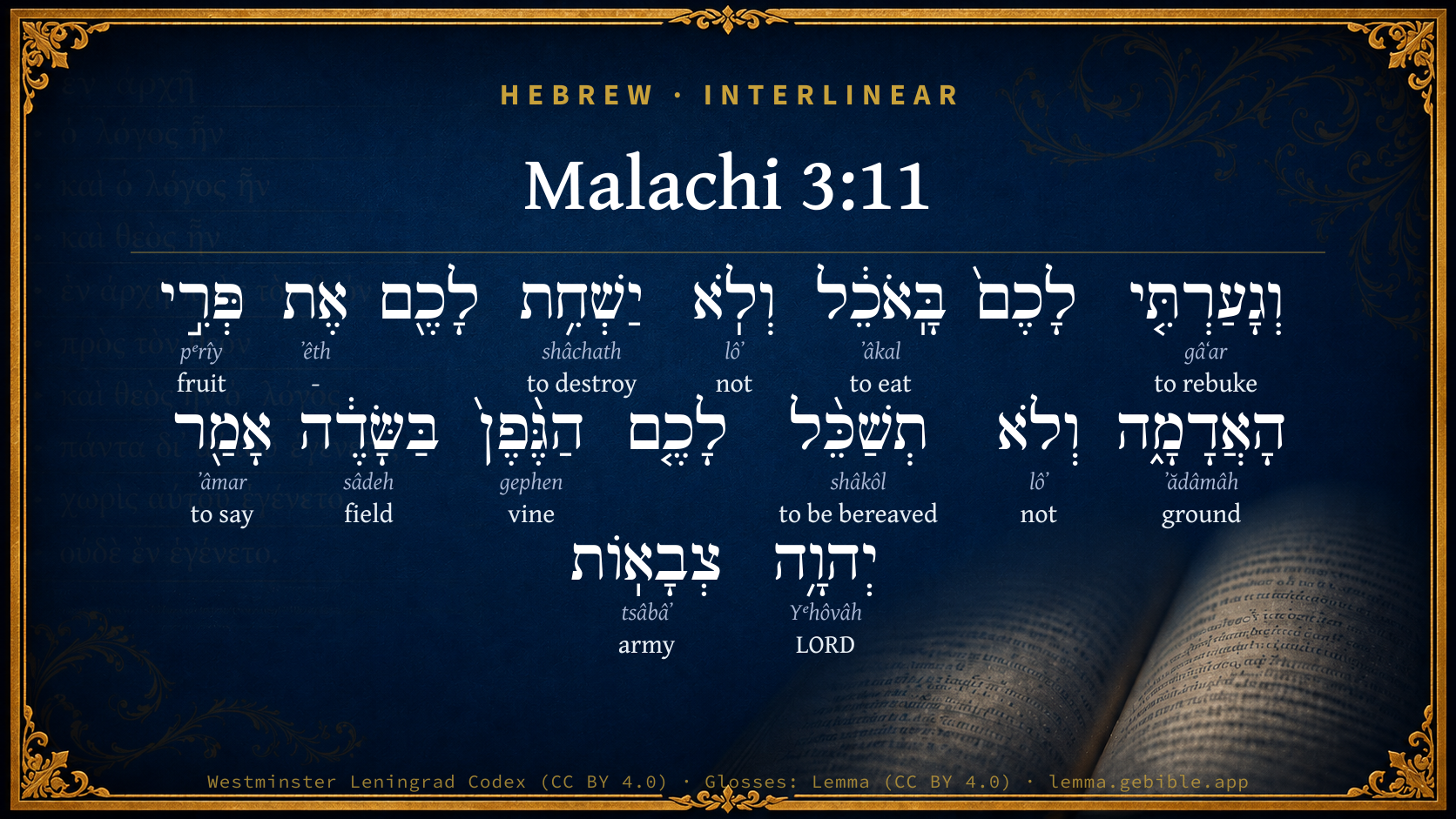
Malachi 3:11

Hebrew (Westminster Leningrad Codex) Malachi 3:11 appears in the Hebrew Old Testament. The text above is from the Westminster Leningrad Codex. Each word links to its Strong’s number, a concise gloss, and parsing drawn from the Open Scriptures Hebrew Bible morphology. Click any word for its full Brown-Driver-Briggs (BDB) entry.
Download image
Cite this verse

Malachi 3:11 (World English Bible). Public Domain. Lemma interlinear Bible study tool, https://lemma.gebible.app/v/malachi/3/11.

Show BibTeX & RIS
BibTeX
RIS
English Translation
I will rebuke the devourer for your sakes, and he shall not destroy the fruits of your ground; neither shall your vine cast its fruit before its time in the field," says Yahweh of Hosts.
World English Bible · Public Domain
Download a study sheet

One document with this verse’s original text, its word-by-word gloss line, the meaning frame, cross-references with their text, attributed commentary, and full source and license credits — printable, and it pastes into notes with its structure intact.

This verse Autodidact and up

Study sheet (.html) Plain text (.txt)

A passage Seminary Student

Up to 50 verses in one chapter. A passage sheet keeps up to 6 commentary sources and 12 cross-references per verse, in the order this page ranks them, and says so on the sheet whenever that leaves anything out. Ask for a single verse and you get the Autodidact verse sheet above.

Everything on this page stays free to read, with no account — the sheet is a download of what is already on screen, not access to it.

Want to remove ads? Support Godless Engineer
Compare translations 3

The same verse in 3 English versions, stacked beneath the original-language interlinear above. Click any original word for its lexicon entry.

Each is an independent rendering of the whole verse — the interlinear is not word-aligned to these translations.

Highlighted words mark where these versions differ — a whole-verse word diff, not a word-by-word alignment.

  • World English Bible Public Domain
    I will rebuke the devourer for your sakes, and he shall not destroy the fruits of your ground; neither shall your vine cast its fruit before its time in the field," says Yahweh of Hosts.
  • King James Version Public Domain
    And I will rebuke the devourer for your sakes, and he shall not destroy the fruits of your ground; neither shall your vine cast her fruit before the time in the field, saith the LORD of hosts.
  • unfoldingWord Literal Text CC BY-SA 4.0
    And I will rebuke the devourer for you, and it will not corrupt for you the fruit of the ground. And the vine in the field will not be barren for you,” says Yahweh of Armies.

unfoldingWord Literal Text — © unfoldingWord, licensed CC BY-SA 4.0. Word-aligned USFM3 via Door43 (git.door43.org/unfoldingWord/en_ult).

Versions to compare (up to 4)

3 of 4 selected

Show all 18 translations

Every available English version of this verse, each an independent rendering of the whole verse.

  • World English Bible Public Domain
    I will rebuke the devourer for your sakes, and he shall not destroy the fruits of your ground; neither shall your vine cast its fruit before its time in the field," says Yahweh of Hosts.
  • Berean Standard Bible Public Domain
    I will rebuke the devourer for you, so that it will not destroy the fruits of your land, and the vine in your field will not fail to produce fruit,” says the LORD of Hosts.
  • Majority Standard Bible Public Domain
    I will rebuke the devourer for you, so that it will not destroy the fruits of your land, and the vine in your field will not fail to produce fruit,” says the LORD of Hosts.
  • King James Version Public Domain
    And I will rebuke the devourer for your sakes, and he shall not destroy the fruits of your ground; neither shall your vine cast her fruit before the time in the field, saith the LORD of hosts.
  • American Standard Version (1901) Public Domain
    And I will rebuke the devourer for your sakes, and he shall not destroy the fruits of your ground; neither shall your vine cast its fruit before the time in the field, saith Jehovah of hosts.
  • Revised Version (1885) Public Domain
    And I will rebuke the devourer for your sakes, and he shall not destroy the fruits of your ground; neither shall your vine cast her fruit before the time in the field, saith the LORD of hosts.
  • Geneva Bible (1599) Public Domain
    And I will rebuke the deuourer for your sakes, and he shall not destroy the fruite of your grounde, neither shall your vine be baren in the fielde, sayeth the Lord of hostes.
  • Douay-Rheims (1899) Public Domain
    And I will rebuke for your sakes the devourer, and he shall not spoil the fruit of your land: neither shall the vine in the field be barren, saith the Lord of hosts.
  • Young's Literal Translation Public Domain
    And I have pushed for you against the consumer, And He doth not destroy to you the fruit of the ground, Nor miscarry to you doth the vine in the field, Said Jehovah of Hosts.
  • Literal Standard Version CC BY-SA 4.0
    And I have pushed against the consumer for you, || And He does not destroy the fruit of your ground, || Nor does the vine in the field miscarry to you,” said YHWH of Hosts.
  • Unlocked Literal Bible CC BY-SA 4.0
    I will speak against those who destroy your crops, so that they do not destroy the harvest of your land. Your vines in the fields will not lose their fruit,” says Yahweh of hosts.
  • unfoldingWord Literal Text CC BY-SA 4.0
    And I will rebuke the devourer for you, and it will not corrupt for you the fruit of the ground. And the vine in the field will not be barren for you,” says Yahweh of Armies.
  • Darby Bible Public Domain
    And I will rebuke the devourer for your sakes, and he shall not destroy the fruits of your ground; neither shall your vine cast its fruit before the time in the field, saith Jehovah of hosts.
  • World Messianic Bible Public Domain
    I will rebuke the devourer for your sakes, and he shall not destroy the fruits of your ground; neither shall your vine cast its fruit before its time in the field,” says the LORD of Hosts.
  • Webster's Bible Public Domain
    And I will rebuke the devourer for your sakes, and he shall not destroy the fruits of your ground; neither shall your vine cast her fruit before the time in the field, saith the LORD of hosts.
  • Free Bible Version CC BY-SA 4.0
    I will prevent locusts from destroying your crops, and your vineyards will not fail to bear fruit, says the Lord Almighty.
  • Bible in Basic English Public Domain
    And on your account I will keep back the locusts from wasting the fruits of your land; and the fruit of your vine will not be dropped on the field before its time, says the Lord of armies
  • JPS Tanakh (1917) Public Domain
    And I will rebuke the devourer for your good, and he shall not destroy the fruits of your land; neither shall your vine cast its fruit before the time in the field, saith the LORD of hosts.

Literal Standard Version (2020), Covenant Press — licensed CC BY-SA 4.0. Text via the HelloAO Bible API (eBible.org). Unlocked Literal Bible (unfoldingWord) — licensed CC BY-SA 4.0. Text via the HelloAO Bible API (eBible.org). unfoldingWord Literal Text — © unfoldingWord, licensed CC BY-SA 4.0. Word-aligned USFM3 via Door43 (git.door43.org/unfoldingWord/en_ult). Free Bible Version, Dr. Jonathan Gallagher — licensed CC BY-SA 4.0. Text via the HelloAO Bible API (eBible.org).

Word by word

More ways to search: Search by grammar → Find every occurrence → Compare this word →

Practice this passage: Drill this verse → Learn its vocabulary →

וְגָעַרְתִּ֤י
gâʻar
H1605
“and · to rebuke”
Conjunction + Verb, Qal, Sequential Perfect, 1st Person, Common, Singular
Part of Speech
Conjunction + Verb
Stem
Qal
Form
Sequential Perfect
Person
1st Person
Gender
Common
Number
Singular
Full BDB Definition

Origin: a primitive root

TWOT: 370

(Qal) to rebuke, reprove, corrupt
  1. בָּֽאֹכֵ֔ל ʼâkal H398 “in/at the · eating” Preposition, Determined + Verb, Qal, Participle Active, Masculine, Singular, Absolute
  2. וְלֹֽא lôʼ H3808 “and · not” Conjunction + Particle, Negative
  3. יַשְׁחִ֥ת shâchath H7843 “to destroy” Verb, Hiphil, Imperfect, 3rd Person, Masculine, Singular
  4. אֶת ʼêth H853 “-” Particle, Direct Object
  5. פְּרִ֣י pᵉrîy H6529 “fruit of” Noun, Common, Masculine, Singular, Construct
  6. הָאֲדָמָ֑ה ʼădâmâh H127 “the · ground” Particle, Definite Article + Noun, Common, Feminine, Singular, Absolute
  7. וְלֹא lôʼ H3808 “and · not” Conjunction + Particle, Negative
  8. תְשַׁכֵּ֨ל shâkôl H7921 “to be bereaved” Verb, Piel, Imperfect, 3rd Person, Feminine, Singular
  9. הַגֶּ֨פֶן֙ gephen H1612 “the · vine” Particle, Definite Article + Noun, Common, Both, Singular, Absolute
  10. בַּשָּׂדֶ֔ה sâdeh H7704 “in/at the · field” Preposition, Determined + Noun, Common, Masculine, Singular, Absolute
  11. אָמַ֖ר ʼâmar H559 “to say” Verb, Qal, Perfect, 3rd Person, Masculine, Singular
  12. יְהוָ֥ה Yᵉhôvâh H3068 “LORD” Noun, Proper
  13. צְבָאֽוֹת tsâbâʼ H6635 “armies” Noun, Common, Both, Plural, Absolute

About this verse

These counts appear in no published source. They are computed here, from the morphology-tagged text and Lemma’s own curated glosses. What Lemma adds →

17
words
13
distinct lemmas
Prophets
section

Notable vocabulary

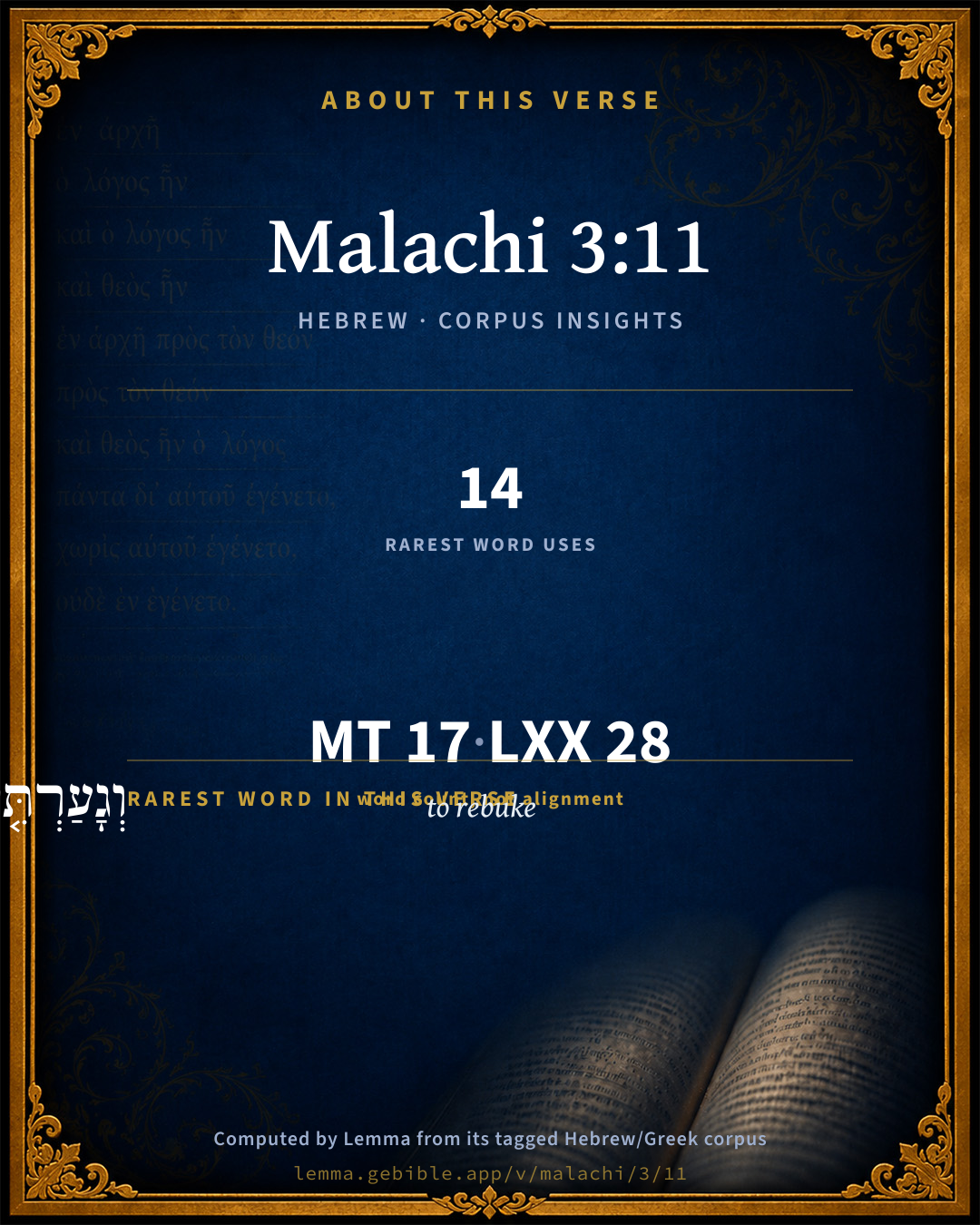
The rarest word here is וְגָעַרְתִּ֤י to rebuke H1605 — appearing just 14 times in the whole Hebrew Bible.

Shared distinctive vocabulary

וְגָעַרְתִּ֤י to rebuke H1605 occurs in 13 verses of the Hebrew Bible. Also found in:

Grammatical profile

  • 5 verbs
  • 6 nouns
  • 3 prepositions
  • 3 particles

Verb forms

  • וְגָעַרְתִּ֤י Qal · Sequential Perfect
  • בָּֽאֹכֵ֔ל Qal · Participle Active
  • יַשְׁחִ֥ת Hiphil · Imperfect
  • תְשַׁכֵּ֨ל Piel · Imperfect
  • אָמַ֖ר Qal · Perfect

Repetition

A word recurs within this verse — often emphatic in Hebrew:

  • וְלֹֽא not H3808 ×2

Hebrew & Septuagint length

In English translation the verse runs 35 words from the Hebrew and 30 from the Septuagint (LXX English) — closely comparable.

A rough comparison of the two English renderings, which tokenize alike — not a word-level alignment.

Word counts can differ between the Hebrew and the Greek without any difference in meaning — e.g. the Hebrew direct-object marker אֵת has no separate Greek word, and Greek often adds the article ὁ.

In the original languages it is 17 Hebrew tokens and 28 Greek tokens — but the two are counted differently (Hebrew bundles its prefixes and suffixes into one token; the Greek is in lemma form), so that isn’t a like-for-like length.

Cross-references

12

Topical passages linked to Malachi 3:11 in the Treasury of Scripture Knowledge — connected by theme and wording, ordered by reader-vote popularity; previews shown in the World English Bible.

  • Deuteronomy 11:14 that I will give the rain of your land in its season, the former rain and the latter rain, that you may gather in your grain, and your new wine, and your oil.
  • Joel 2:22 Don't be afraid, you animals of the field; For the pastures of the wilderness spring up, For the tree bears its fruit. The fig tree and the vine yield their strength.
  • Zechariah 8:12 "For the seed of peace and the vine will yield its fruit, and the ground will give its increase, and the heavens will give their dew; and I will cause the remnant of this people to inherit all these things.
  • Joel 1:4 What the swarming locust has left, the great locust has eaten. What the great locust has left, the grasshopper has eaten. What the grasshopper has left, the caterpillar has eaten.
  • Joel 2:20 But I will remove the northern army far away from you, And will drive it into a barren and desolate land, Its front into the eastern sea, And its back into the western sea; And its stench will come up, And its bad smell will rise." Surely he has done great things.
  • Amos 7:1–3 Thus the Lord Yahweh showed me: and, behold, he formed locusts in the beginning of the shooting up of the latter growth; and, behold, it was the latter growth after the king's harvest.
  • Jeremiah 8:13 I will utterly consume them, says Yahweh: there shall be no grapes on the vine, nor figs on the fig tree, and the leaf shall fade; and [the things that] I have given them shall pass away from them.
  • Amos 4:9 I struck you with blight and mildew many times in your gardens and your vineyards; And your fig trees and your olive trees have the swarming locust devoured: Yet you haven't returned to me," says Yahweh.
  • Joel 1:7 He has laid my vine waste, And stripped my fig tree. He has stripped its bark, and thrown it away. Its branches are made white.
  • Joel 1:12 The vine has dried up, and the fig tree withered; the pomegranate tree, the palm tree also, and the apple tree, Even all of the trees of the field are withered; For joy has withered away from the sons of men.
  • Habakkuk 3:17 For though the fig tree doesn't flourish, Nor fruit be in the vines; The labor of the olive fails, The fields yield no food; The flocks are cut off from the fold, And there is no herd in the stalls:
  • Haggai 2:17 I struck you with blight, mildew, and hail in all the work of your hands; yet you didn't turn to me,' says Yahweh.

Cross-references courtesy of OpenBible.info (CC BY 4.0).

Hebrew and Greek witnesses Masoretic Hebrew ↔ Greek Septuagint

The same verse in the two great witnesses to the Old Testament, shown verse-for-verse.

These are two independent witnesses, not word-aligned to each other, and the Septuagint is shown in lemma (dictionary) form.

Hebrew Malachi 3:11 Masoretic · Westminster Leningrad Codex

וְגָעַרְתִּ֤י לָכֶם֙ בָּֽאֹכֵ֔ל וְלֹֽא יַשְׁחִ֥ת לָכֶ֖ם אֶת פְּרִ֣י הָאֲדָמָ֑ה וְלֹא תְשַׁכֵּ֨ל לָכֶ֤ם הַגֶּ֨פֶן֙ בַּשָּׂדֶ֔ה אָמַ֖ר יְהוָ֥ה צְבָאֽוֹת

I will rebuke the devourer for your sakes, and he shall not destroy the fruits of your ground; neither shall your vine cast its fruit before its time in the field," says Yahweh of Hosts.

World English Bible · Public Domain

Greek LXX Malachi 3:11 Septuagint · lemma form

καί διαστέλλω σύ εἰς βρῶσις καί οὐ μή διαφθείρω σύ ὁ καρπός ὁ γῆ καί οὐ μή ἀσθενέω σύ ὁ ἄμπελος ὁ ἐν ὁ ἀγρός λέγω κύριος παντοκράτωρ

And I will appoint food for you, and I will not destroy the fruit of your land; and your vine in the field shall not fail, says the Lord Almighty.

LXX2012 (modern English Septuagint) · Public Domain

On this verse, The Pulpit Commentary discusses the Septuagint’s reading. Read the note in Commentary ↓

Hebrew: Westminster Leningrad Codex (CC BY 4.0). Greek: Septuagint (public domain); English from LXX2012 (modern English Septuagint) (Public Domain). How the Septuagint differs from the Hebrew →

Targum (Aramaic paraphrase)

1

The Targum is the ancient Jewish Aramaic paraphrase of the Hebrew Scriptures — an interpretive translation, not the Hebrew text itself. Onkelos (literal) and Pseudo-Jonathan (expansive) render the Torah, and Jonathan the Prophets. Coverage is partial: where no permissively-licensed English translation exists for a verse, only the Aramaic is shown. This is verse-level text, not a word-by-word alignment to the Hebrew.

  1. Targum Jonathan Prophets (Joshua–Malachi)
    וְאֶזוּף לְכוֹן בִּמְחַבְּלָא וְלָא יְחַבֵּל לְכוֹן יַת אִבָּא דְאַרְעָא וְלָא תַּתְכֵּיל לְכוֹן גוּפְנָא בְּחַקְלָא אֲמַר יְיָ צְבָאוֹת:

    (no public-domain English translation for this verse)

    Targum Jonathan — Aramaic: “Mikraot Gedolot” (public domain). English: “Sefaria Community Translation” (CC0 1.0 (public-domain dedication)); “London "Chaldee Paraphrase," 1871” (public domain). Text via Sefaria.

Commentary

Notes on Malachi 3:11 from classic Christian and Jewish commentators (each source and its license shown beneath its notes). The classic Christian expositions comment on the surrounding passage and are grouped to its opening verse, so a note may address several verses; the Jewish commentaries on the Tanakh (Rashi and others) are per-verse, so they appear only where the commentator wrote on this verse.

Lemma curates 59 commentaries, every one of them public domain or Creative Commons licensed, each selected and text-cleaned for this edition rather than reprinted as found. About our sources →

Trapp's Complete Commentary

John Trapp

Mal 3:11 And I will rebuke the devourer for your sakes, and he shall not destroy the fruits of your ground; neither shall your vine cast her fruit before the time in the field, saith the LORD of hosts.

Ver. 11. And I will rebuke the devourer for your sakes] Caterpillars, cankerworms, and such hurtful creatures. God’s terrible army, as they are notably set forth in their march and mischief, Joe 2:2-5; cf. Joe 1:4, to tame his rebels, to ease him of his adversaries, and to avenge him of his enemies, Isa 1:24. These he will rebuke (for every creature is at his beck and check), as he "rebuked the Red Sea and it was dried up," Psa 106:9, and as he rebuked the winds, Mat 8:26, the fever, Luk 4:39, the devil, Mat 7:18, he will say unto them, Abite actutum hinc, Get you hence, and that is enough, for they are all his servants, Psa 119:91. He is the great Centurion, or rather Lord of hosts, that saith to this creature, "Go, and he goeth," and to another, "Come, and he cometh," &c. If he do but say, Who is on my side, who? all creatures look out at their windows, as ready prest to do his pleasure; neither is there any so mean among them, or so despicable, that cannot, if set on by him, make the proudest on earth stoop, and say, "This is the finger of God." But of this see more in the 1st Doct. on Mal 3:18. Let all that look for God’s blessing, either upon their persons or possessions, make their peace with God (the genealogy of grain and wine is resolved into him, Hos 2:22), and bring him all his tithes into the storehouse, &c., lest he blast their fair hopes, cut off the meat from their mouths, take his own and be gone, take away his grain in the time thereof, and his wine in the season thereof, &c., Hos 2:9. The Jews in our Saviour’s time, suis malis edocti, were punctual in paying their tithes, even to a pot herb, Mat 23:23. And at this day, though not in their own country, nor have a Levitical priesthood, yet those of them that would be reputed religious do distribute, in lieu of tithes, the tenth of their increase unto the poor: being persuaded that God doth bless their increase the more: for their usual proverb is, Decima ut dives fiat, tithe and be rich. Of the young Lord Harrington (the last of that name) it is reported by Mr Stock, who preached his funeral, that he constantly gave the tenth of his yearly revenue to pious and charitable uses. And of reverend Mr. Whately, minister of Banbury, it is likewise recorded in his life, that he set apart and expended for many years before he died for good uses the tenth part of his yearly comings in, both out of his temporal and ecclesiastical means of maintenance; and that he never thrived in his outward estate till he took that course. Besides the sweet comfort that the spirits of his wealth thus distilled, as it were, brought to his conscience, both in life and at death; and the blessing of a good name left behind him, according to that which follows next in the text, "And all nations," &c.

John Trapp, A Commentary or Exposition upon All the Books of the Old and New Testament (1647–1656) — public domain. Text from a community e-Sword module.

Geneva Bible (1599)

Geneva Bible translators

Meaning, the caterpillar, and whatsoever destroyeth corn and fruits.

Geneva Bible (1599) marginal notes — public domain. Text via Bolls.life.

Jamieson, Fausset & Brown

Robert Jamieson, A. R. Fausset & David Brown

I will rebuke--(See on Mal 2:3). I will no longer "rebuke (English Version, 'corrupt') the seed," but will rebuke every agency that could hurt it (Amo 4:9).

Jamieson, Fausset & Brown — Commentary Critical and Explanatory on the Whole Bible (1871) — public domain (CC PDM 1.0). Text via the HelloAO Bible API.

Adam Clarke's Commentary

Verse 11. I will rebuke the devourer] The locusts, c., shall not come on your crops and those that are in the country I will disperse and destroy.

Neither shall your vine cast her fruit] Every blossom shall bear fruit, and every bunch of grapes come to maturity.

Adam Clarke's Commentary on the Bible (1810–1826) — public domain. Text from a community e-Sword/MySword module.

John Calvin's Commentaries

God now again confirms the truth, that he would not in one way only be bountiful to them. He might indeed distribute to us daily our food, as we know that he thus fed his people in the wilderness; but his will is that the seed should rot in the earth, that it should then germinate, and in course of time grow, until it shoots into ears of corn; but it is still in no small danger, nay the corn is subject to many evils before it be gathered into the garner; for the locusts, the worms, the mildew, and other things may destroy it. God therefore, in order to set forth his kindness to men, enumerates here the ways and the means by which food is preserved; for it would not be enough that the seed should germinate, and that there should appear evidences of a great produce, the ears being fine and abundant, but it is necessary that the ears of corn themselves, before they become ripe, should be preserved from above; for on the one hand the chafers, the locusts, the worms, and other grubs, may suddenly creep in and devour the corn while in the field, and on the other hand, storms, and hail, and mildew, and oilier pestilential things, as I have said, may prove ruinous to the corn.

Hence God shows here, that he takes constant care of us, and every day and every night performs the office of a good and careful head of a family, who always watches for its benefit.

In the word devourer, I include all the evils to which we see that corn is subject; he therefore says, he shall not destroy the fruit of the earth; nor bereaved shall be the vine for you in the fields. The verb שכל, shecal, properly means to bereave or to deprive; but as this version, “bereaved shall not be vine,” would be harsh, some have rendered the words thus, “Miscarry shall not vine,” which I do not disapprove: Miscarry then shall not the vine for you in the fields, saith Jehovah of hosts It follows —

John Calvin's Commentaries (1540-1563) — public domain. Text from the Calvin Translation Society English edition (1840s-50s) via the Christian Classics Ethereal Library (ccel.org). Calvin's coverage is partial (roughly two-thirds of the Bible); uncommented books and verses are honest gaps, never fabricated. The 19th-century editor's footnotes and remarks are omitted so the notes are faithfully Calvin's own voice.

Ellicott's Commentary for English Readers

(11) For your sakes.—The same word as in Mal_2:3 : here in a good sense, there in a bad.

The devourer—i.e., the locust, &c.

Rebuke.—Better, corrupt. The same word is used as in Mal_2:3, but in a different construction. (With this verse comp. Hag_1:6-11.)

A Bible Commentary for English Readers, edited by Charles John Ellicott (1878–1897) — public domain. Text from a community e-Sword module.

The Cambridge Bible for Schools and Colleges

gen. ed. J. J. S. Perowne

11. the devourer] lit. eater, i.e. any insect, especially the locust, that would devour the fruits of the earth. The same verb is used of the ravages of four insects, “probably different kinds of locusts, or locusts in different stages of growth” (R.V. marginal note), Joe_1:4.

The threatened curse was the “rebuke” (ch. Mal_2:3, note) of the seed: the promised blessing is the “rebuke” of the devourer.

cast her fruit before the time] lit. miscarry. Comp. “a miscarrying womb”, Hos_9:14; “miscarrying ground”, 2Ki_2:19; 2Ki_2:21. So Pliny speaks of “arborum abortus”. (Pusey after Gesen.) In Rev_6:13 we read: “the stars of the heaven fall unto the earth, as a fig tree casteth her unripe figs, when she is shaken of a great wind.”

The Cambridge Bible for Schools and Colleges (gen. ed. J. J. S. Perowne; Cambridge University Press, 1878–1918) — public domain. Text from a community e-Sword module.

John Gill's Exposition

And I will rebuke the devourer for your sakes,.... Or "eater" (m); the locust or caterpillar, or any such devouring creature, that eats up the herbage, corn, and fruits of trees; every such creature is under the restraint of Providence; and by a nod, a rebuke, they are easily prevented doing the mischief they otherwise would; these are the Lord's great army, which he can send and call off as he pleases, Joe 1:4,

and he shall not destroy the fruits of your ground; as he has done, by eating all green things, as the locust, caterpillar, and canker worm do, grass, corn, and trees:

neither shall your vine cast her fruit before the time in the field; which some understand of the devourer or locust, that that should not cause the vine to be abortive, or cast its fruit before its time, or bereave it of it; but it seems best to interpret it of the vine itself not casting its fruit, as an untimely birth, by blighting and blasting winds:

saith the Lord of hosts; who holds the winds in his fists, and will not suffer them when he pleases, any more than the locusts, to hurt the trees of the earth, Rev 7:1.

(m) "comedentem", Drusius, Cocceius; "eum qui comedit", Burkius.

John Gill's Exposition of the Whole Bible (1746–1763) — public domain (CC PDM 1.0). Text via the HelloAO Bible API.

Albert Barnes' Notes on the Bible

And I will rebuke the devourer - , the locust, caterpillar, or any like scourge of God. It might be, that when the rain watered the fields, the locust or caterpillar etc. might destroy the grain, so that the labors of man should perish; wherefore he adds, “I will rebuke the devourer. Neither shall your vine cast her fruit before the time,” holding out a fair promise, but cut off by the frost-wind or the hail; the blossoms or the unripe fruit strewing the earth, as a token of God’s displeasure.

Albert Barnes' Notes on the Bible (1834–1885) — public domain. Text from a community e-Sword/MySword module.

Haydock's Catholic Bible Commentary

Devour; locusts and other vermin. (Menochius) --- Malachias came later than Aggeus, and probably speaks of a different famine, to which the Jews were exposed for neglecting to pay tithes. (Calmet) --- How many now work on holydays, as if all depended on their labour and not on God’s blessing! (Haydock)

George Leo Haydock (1774–1849), Haydock's Catholic Family Bible and Commentary, 1859 edition — public domain. Excludes Psalms (Douay-Rheims chapter numbering differs from Protestant) and Deuterocanonical books (Catholic canon only).

Matthew Poole's English Annotations

I will rebuke; lay a restraint upon, or prohibit, and the prohibition shall be effectual; if God so check, no creature is or dares be deaf to it; such a check not only quiets the unruly sea, but can dry it up.

The devourer; all kinds of devourers, the locust, the canker-worm, caterpillar, &c., pests of those countries very often; though they are in mighty armies and incredible multitudes, yet a rebuke from God will check them all at once as if they were but one.

For your sakes; not for merit in you, but for good to you.

He shall not destroy; consume and eat it, as those vermin always did wherever they came.

The fruits of your ground; corn sown by your hand, and grass springing up of its own nature, both which these locusts devour wheresoever they come, and leave penury or famine behind them.

Neither shall your vine cast her fruit; no blasting or burning winds shall make them drop, no frosts or hails shall destroy your vines. This was once the plague of Egypt, Psa 105:33-36.

Before the time; your vines shall carry their fruit till they are fully ripe.

In the field; where they had large vineyards and oliveyards planted, and God will make them prosper if this people will return to him.

Matthew Poole's English Annotations on the Holy Bible (1683–1685) — public domain. Text from a community e-Sword/MySword module.

The Pulpit Commentary

The devourer. The locust (see Introduction to Joel, God would not only give a fruitful season, so that the crops sprang up well, but would guard them from everything that could injure them before they were gathered in. Septuagint, diastelw umin eiv brwsin , which perhaps means, as Schleusner thinks, "I will give a charge unto consumption for your good," though Jerome renders, "dividam vobis cibos."

The Pulpit Commentary (1880–1919), ed. H.D.M. Spence-Jones & Joseph S. Exell — public domain. Text from a community e-Sword module.

John Wesley's Explanatory Notes

The devourer - All kind of devourers, the locusts, the canker- worm, and the caterpillar, which though they are in incredible multitudes, yet a rebuke from God will check them all at once, as if they were but one. For your sakes - For your good. Your vine - Your vine shall carry their fruit 'till they are fully ripe.

John Wesley, Explanatory Notes Upon the Whole Bible (1754–1765) — public domain. Text via the GEBible commentary corpus.

Rashi

Rabbi Shlomo Yitzchaki (Rashi)

And I will rebuke the devourer for your sake The finishing locusts and the shearing locusts, which devour the grain of your field and your vines.

Rashi on the Tanakh — English translations: “The Judaica Press complete Tanach with Rashi, translated by A. J. Rosenberg” (CC BY 4.0); “Pentateuch with Rashi's commentary by M. Rosenbaum and A.M. Silbermann, 1929-1934” (public domain); “The Metsudah Tanach series, Lakewood, N.J” (CC BY 4.0); and “The Book of Joshua, Metsudah Publications, 1997” (CC BY 4.0). Text via Sefaria.

Radak

Rabbi David Kimhi (Radak)

I will rebuke, against the devourer. Against the locusts which devours the produce.

and will not miscarry for you the vines. The vines will not miscarry its produce. (here we see classic example of Semitic languages have a different syntax that Germanic / Roman / Slavic which have Subject-Verb-Object (SVO) while as Semitic languages have Verb-Subject-Object (VSO), so Radak is reminding us to first find the subject and only then to translate the verb, and he is adding the word ''its fruit'', to helping us to figure out hidden object in the sentence.)

Radak on the Tanakh — English translations: “Sefaria Community Translation” (CC0 1.0 (public-domain dedication)); “Eliyahu Munk, HaChut Hameshulash” (CC BY 4.0); “Rabbi Mike Feuer, Jerusalem Anthology” (CC BY 4.0); and “R. David Kimhi on the first book of Psalms, Translated by R.G. Finch, London, 1919” (public domain). Text via Sefaria.

Lesson kit

Teaching starters — assembled from the data on this page, not authored interpretation. Every prompt links to the verse data it draws on. Edit before teaching.

Malachi, in the Prophets, opens this verse with 17 words (13 distinct Hebrew lemmas). Its most distinctive word is gâʻar (“to rebuke”). A historical commentator’s framing appears above. Read the whole chapter for the surrounding context.

Discussion questions

  1. What does “to rebuke” (gâʻar) contribute to the verse as a whole?
  2. Genesis 37:10 shares the word «to rebuke» with this verse. How do the two illuminate each other?
  3. “not” occurs 2× in this one verse. What is the effect of the repetition?
  4. The translations on this page render this verse differently — a whole-verse word diff, not a word-by-word alignment. What might account for the different wordings?
  5. The verb «וְגָעַרְתִּ֤י» is Qal Sequential Perfect. How does its form color the action?
  6. Reading how Trapp's Complete Commentary and Geneva Bible (1599) read this verse, where do the two commentators agree and where do they part?

Things to notice

Reading settings

Reading text

Shown beneath each verse's original-language words.

Old Testament
Old Testament edition

Read the OT as the Masoretic Hebrew (MT) or the Greek Septuagint (LXX).

English shown for the Greek Septuagint (in the Hebrew ↔ Greek comparison).

Comparing translations? Open the Compare panel on any verse page to stack up to four side by side.