Hosea 10:4

Hebrew (Westminster Leningrad Codex) Hosea 10:4 appears in the Hebrew Old Testament. The text above is from the Westminster Leningrad Codex. Each word links to its Strong’s number, a concise gloss, and parsing drawn from the Open Scriptures Hebrew Bible morphology. Click any word for its full Brown-Driver-Briggs (BDB) entry.
Download image
Cite this verse

Hosea 10:4 (World English Bible). Public Domain. Lemma interlinear Bible study tool, https://lemma.gebible.app/v/hosea/10/4.

Show BibTeX & RIS
BibTeX
RIS
English Translation
They make promises, swearing falsely in making covenants. Therefore judgment springs up like poisonous weeds in the furrows of the field.
World English Bible · Public Domain
Download a study sheet

One document with this verse’s original text, its word-by-word gloss line, the meaning frame, cross-references with their text, attributed commentary, and full source and license credits — printable, and it pastes into notes with its structure intact.

This verse Autodidact and up

Study sheet (.html) Plain text (.txt)

A passage Seminary Student

Up to 50 verses in one chapter. A passage sheet keeps up to 6 commentary sources and 12 cross-references per verse, in the order this page ranks them, and says so on the sheet whenever that leaves anything out. Ask for a single verse and you get the Autodidact verse sheet above.

Everything on this page stays free to read, with no account — the sheet is a download of what is already on screen, not access to it.

Want to remove ads? Support Godless Engineer
Compare translations 3

The same verse in 3 English versions, stacked beneath the original-language interlinear above. Click any original word for its lexicon entry.

Each is an independent rendering of the whole verse — the interlinear is not word-aligned to these translations.

Highlighted words mark where these versions differ — a whole-verse word diff, not a word-by-word alignment.

  • World English Bible Public Domain
    They make promises, swearing falsely in making covenants. Therefore judgment springs up like poisonous weeds in the furrows of the field.
  • King James Version Public Domain
    They have spoken words, swearing falsely in making a covenant: thus judgment springeth up as hemlock in the furrows of the field.
  • unfoldingWord Literal Text CC BY-SA 4.0
    They have spoken words, swearing oaths of worthlessness, cutting a covenant, so judgment sprouts like a poisonous weed on the furrows of a field.

unfoldingWord Literal Text — © unfoldingWord, licensed CC BY-SA 4.0. Word-aligned USFM3 via Door43 (git.door43.org/unfoldingWord/en_ult).

Versions to compare (up to 4)

3 of 4 selected

Show all 18 translations

Every available English version of this verse, each an independent rendering of the whole verse.

  • World English Bible Public Domain
    They make promises, swearing falsely in making covenants. Therefore judgment springs up like poisonous weeds in the furrows of the field.
  • Berean Standard Bible Public Domain
    They speak mere words; with false oaths they make covenants. So judgment springs up like poisonous weeds in the furrows of a field.
  • Majority Standard Bible Public Domain
    They speak mere words; with false oaths they make covenants. So judgment springs up like poisonous weeds in the furrows of a field.
  • King James Version Public Domain
    They have spoken words, swearing falsely in making a covenant: thus judgment springeth up as hemlock in the furrows of the field.
  • American Standard Version (1901) Public Domain
    They speak `vain' words, swearing falsely in making covenants: therefore judgment springeth up as hemlock in the furrows of the field.
  • Revised Version (1885) Public Domain
    They speak vain words, swearing falsely in making covenants: therefore judgment springeth up as hemlock in the furrows of the field.
  • Geneva Bible (1599) Public Domain
    They haue spoken woordes, swearing falsly in making a couenant: thus iudgement groweth as wormewoode in the furrowes of the fielde.
  • Douay-Rheims (1899) Public Domain
    You speak words of an unprofitable vision, and you shall make a covenant: and judgment shall spring up as bitterness in the furrows of the field.
  • Young's Literal Translation Public Domain
    They have spoken words, To swear falsehood in making a covenant, And flourished as a poisonous herb hath judgment, on the furrows of a field.
  • Literal Standard Version CC BY-SA 4.0
    They have spoken words, || To swear falsehood in making a covenant, || And flourished as a poisonous herb has judgment, on the furrows of a field.
  • Unlocked Literal Bible CC BY-SA 4.0
    They speak empty words and make covenants by swearing falsely. So justice springs up like poisonous weeds in the furrows of a field.
  • unfoldingWord Literal Text CC BY-SA 4.0
    They have spoken words, swearing oaths of worthlessness, cutting a covenant, so judgment sprouts like a poisonous weed on the furrows of a field.
  • Darby Bible Public Domain
    They speak [mere] words, swearing falsely in making a covenant; therefore shall judgment spring up as hemlock in the furrows of the fields.
  • World Messianic Bible Public Domain
    They make promises, swearing falsely in making covenants. Therefore judgment springs up like poisonous weeds in the furrows of the field.
  • Webster's Bible Public Domain
    They have spoken words, swearing falsely in making a covenant: thus judgment springeth up as hemlock in the furrows of the field.
  • Free Bible Version CC BY-SA 4.0
    They speak empty words, swearing false promises to make a covenant. Their “justice” flourishes like poisonous weeds in the furrows of a field.
  • Bible in Basic English Public Domain
    Their words are foolish; they make agreements with false oaths, so punishment will come up like a poison-plant in a ploughed field.
  • JPS Tanakh (1917) Public Domain
    They speak words, they swear falsely, they make covenants; thus judgment springeth up as hemlock in the furrows of the field.

Literal Standard Version (2020), Covenant Press — licensed CC BY-SA 4.0. Text via the HelloAO Bible API (eBible.org). Unlocked Literal Bible (unfoldingWord) — licensed CC BY-SA 4.0. Text via the HelloAO Bible API (eBible.org). unfoldingWord Literal Text — © unfoldingWord, licensed CC BY-SA 4.0. Word-aligned USFM3 via Door43 (git.door43.org/unfoldingWord/en_ult). Free Bible Version, Dr. Jonathan Gallagher — licensed CC BY-SA 4.0. Text via the HelloAO Bible API (eBible.org).

Word by word

More ways to search: Search by grammar → Find every occurrence → Compare this word →

Practice this passage: Drill this verse → Learn its vocabulary →

תַּלְמֵ֥י
telem
H8525
“furrows of”
Noun, Common, Masculine, Plural, Construct
Part of Speech
Noun
Type
Common
Gender
Masculine
Number
Plural
State
Construct
Full BDB Definition

Origin: from an unused root meaning to accumulate

TWOT: 2515a

furrow
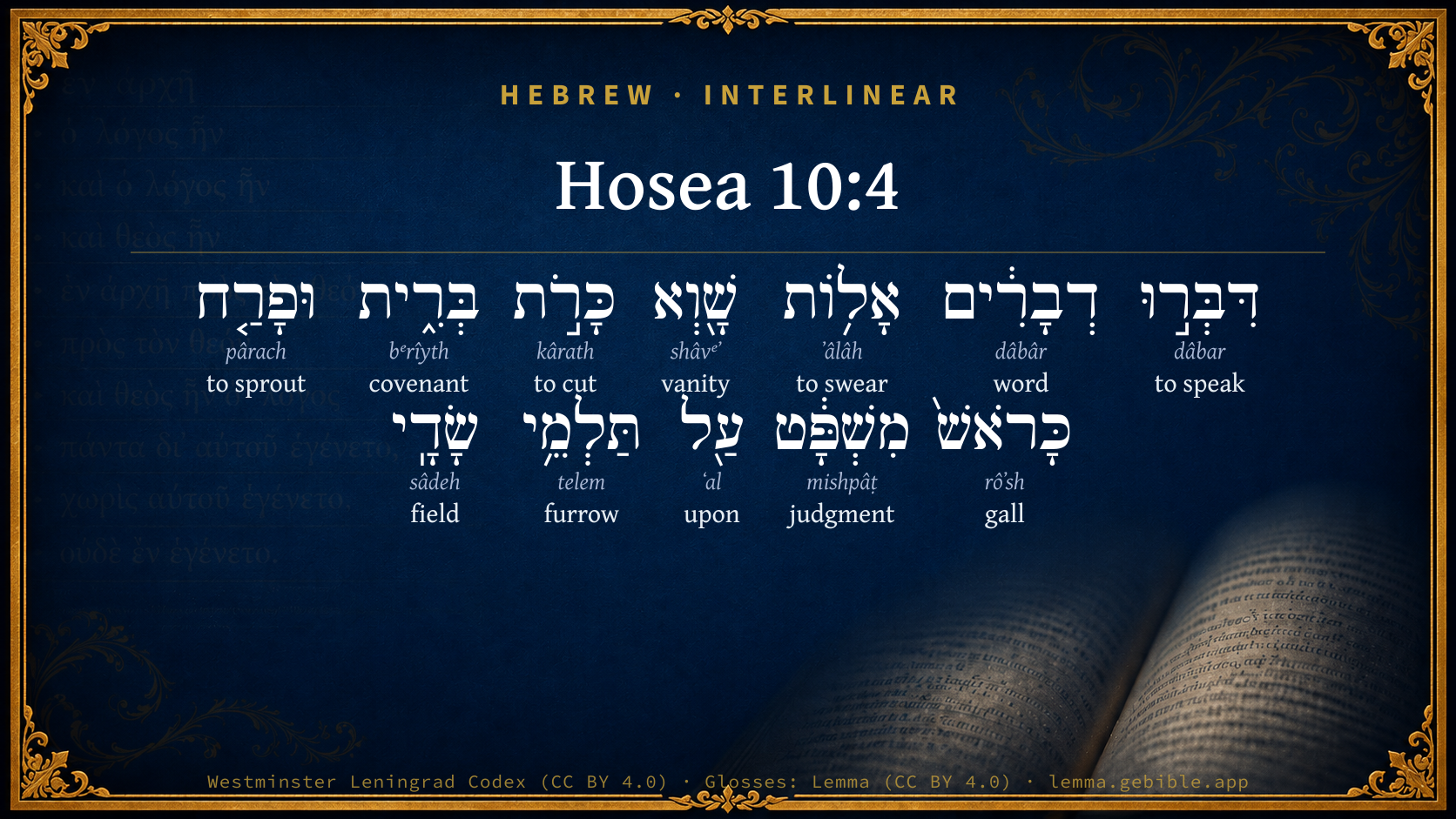
  1. דִּבְּר֣וּ dâbar H1696 “to speak” Verb, Piel, Perfect, 3rd Person, Common, Plural
  2. דְבָרִ֔ים dâbâr H1697 “words” Noun, Common, Masculine, Plural, Absolute
  3. אָל֥וֹת ʼâlâh H422 “to swear” Verb, Qal, Infinitive Absolute
  4. שָׁ֖וְא shâvᵉʼ H7723 “vanity” Noun, Common, Masculine, Singular, Absolute
  5. כָּרֹ֣ת kârath H3772 “to cut” Verb, Qal, Infinitive Absolute
  6. בְּרִ֑ית bᵉrîyth H1285 “covenant” Noun, Common, Feminine, Singular, Absolute
  7. וּפָרַ֤ח pârach H6524 “and · to sprout” Conjunction + Verb, Qal, Sequential Perfect, 3rd Person, Masculine, Singular
  8. כָּרֹאשׁ֙ rôʼsh H7219 “like/as the · gall” Preposition, Determined + Noun, Common, Masculine, Singular, Absolute
  9. מִשְׁפָּ֔ט mishpâṭ H4941 “judgment” Noun, Common, Masculine, Singular, Absolute
  10. עַ֖ל ʻal H5921 “upon” Preposition
  11. שָׂדָֽי sâdeh H7704 “field” Noun, Common, Masculine, Singular, Absolute

About this verse

These counts appear in no published source. They are computed here, from the morphology-tagged text and Lemma’s own curated glosses. What Lemma adds →

12
words
12
distinct lemmas
Prophets
section

Notable vocabulary

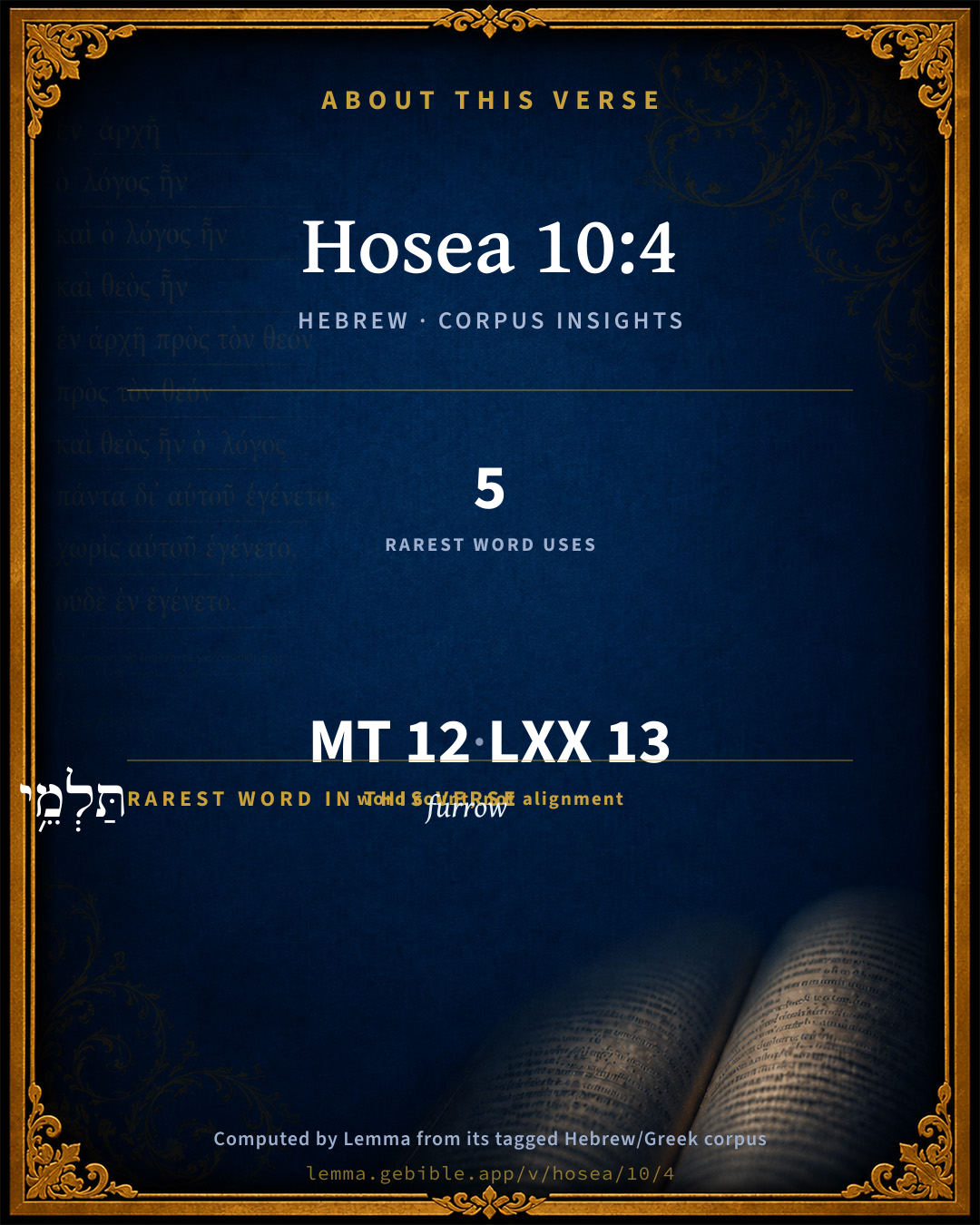
The rarest word here is תַּלְמֵ֥י furrow H8525 — appearing just 5 times in the whole Hebrew Bible.

Shared distinctive vocabulary

תַּלְמֵ֥י furrow H8525 occurs in 5 verses of the Hebrew Bible. Also found in:

Grammatical profile

  • 4 verbs
  • 7 nouns
  • 1 preposition

Verb forms

  • דִּבְּר֣וּ Piel · Perfect
  • אָל֥וֹת Qal · Infinitive Absolute
  • כָּרֹ֣ת Qal · Infinitive Absolute
  • וּפָרַ֤ח Qal · Sequential Perfect

Hebrew & Septuagint length

In English translation the verse runs 21 words from the Hebrew and 32 from the Septuagint (LXX English) — the Septuagint runs noticeably longer here. See the side-by-side →

A rough comparison of the two English renderings, which tokenize alike — not a word-level alignment.

Word counts can differ between the Hebrew and the Greek without any difference in meaning — e.g. the Hebrew direct-object marker אֵת has no separate Greek word, and Greek often adds the article ὁ.

In the original languages it is 12 Hebrew tokens and 13 Greek tokens — but the two are counted differently (Hebrew bundles its prefixes and suffixes into one token; the Greek is in lemma form), so that isn’t a like-for-like length.

Cross-references

14

Topical passages linked to Hosea 10:4 in the Treasury of Scripture Knowledge — connected by theme and wording, ordered by reader-vote popularity; previews shown in the World English Bible.

  • Hosea 4:2 There is cursing, lying, murder, stealing, and committing adultery; They break boundaries, and bloodshed causes bloodshed.
  • Amos 5:7 You who turn justice to wormwood, And cast down righteousness to the earth:
  • Amos 6:12 Do horses run on the rocky crags? Does one plow there with oxen? But you have turned justice into poison, And the fruit of righteousness into bitterness;
  • Deuteronomy 29:18 lest there should be among you man, or woman, or family, or tribe, whose heart turns away this day from Yahweh our God, to go to serve the gods of those nations; lest there should be among you a root that bears gall and wormwood;
  • 2 Kings 17:3–4 Against him came up Shalmaneser king of Assyria; and Hoshea became his servant, and brought him tribute.
  • Ezekiel 17:13–19 and he took of the seed royal, and made a covenant with him; he also brought him under an oath, and took away the mighty of the land;
  • Isaiah 5:7 For the vineyard of Yahweh of Hosts is the house of Israel, And the men of Judah his pleasant plant: And he looked for justice, but, behold, oppression; For righteousness, but, behold, a cry of distress.
  • Isaiah 59:13–15 transgressing and denying Yahweh, and turning away from following our God, speaking oppression and revolt, conceiving and uttering from the heart words of falsehood.
  • Hosea 6:7 But they, like Adam, have broken the covenant. They were unfaithful to me, there.
  • Acts 8:23 For I see that you are in the gall of bitterness and in the bondage of iniquity."
  • Romans 1:31 without understanding, covenant-breakers, without natural affection, unforgiving, unmerciful;
  • 2 Timothy 3:3 without natural affection, unforgiving, slanderers, without self-control, fierce, no lovers of good,
  • Hebrews 12:15 looking carefully lest there be any man who falls short of the grace of God; lest any root of bitterness springing up trouble you, and thereby the many be defiled;
  • Revelation 8:10–11 The third angel sounded, and a great star fell from the sky, burning like a torch, and it fell on one third of the rivers, and on the springs of the waters.

Cross-references courtesy of OpenBible.info (CC BY 4.0).

Hebrew and Greek witnesses Masoretic Hebrew ↔ Greek Septuagint

The same verse in the two great witnesses to the Old Testament, shown verse-for-verse.

Here the Septuagint runs noticeably longer than the Hebrew — LXX2012 (modern English Septuagint) 32 words vs World English Bible 21. A rough length comparison of the two English translations, not a word-level alignment — read both below.

These are two independent witnesses, not word-aligned to each other, and the Septuagint is shown in lemma (dictionary) form.

Hebrew Hosea 10:4 Masoretic · Westminster Leningrad Codex

דִּבְּר֣וּ דְבָרִ֔ים אָל֥וֹת שָׁ֖וְא כָּרֹ֣ת בְּרִ֑ית וּפָרַ֤ח כָּרֹאשׁ֙ מִשְׁפָּ֔ט עַ֖ל תַּלְמֵ֥י שָׂדָֽי

They make promises, swearing falsely in making covenants. Therefore judgment springs up like poisonous weeds in the furrows of the field.

World English Bible · Public Domain

Greek LXX Hosea 10:4 Septuagint · lemma form

λαλέω ῥῆμα πρόφασις ψευδής διατίθημι διαθήκη ἀνατέλλω ὡς ἄγρωστις κρίμα ἐπί χέρσος ἀγρός

and what should a king do for us, speaking false professions as his words? he will make a covenant: judgment shall spring up as a weed on the soil of the field.

LXX2012 (modern English Septuagint) · Public Domain

Hebrew: Westminster Leningrad Codex (CC BY 4.0). Greek: Septuagint (public domain); English from LXX2012 (modern English Septuagint) (Public Domain). How the Septuagint differs from the Hebrew →

Targum (Aramaic paraphrase)

1

The Targum is the ancient Jewish Aramaic paraphrase of the Hebrew Scriptures — an interpretive translation, not the Hebrew text itself. Onkelos (literal) and Pseudo-Jonathan (expansive) render the Torah, and Jonathan the Prophets. Coverage is partial: where no permissively-licensed English translation exists for a verse, only the Aramaic is shown. This is verse-level text, not a word-by-word alignment to the Hebrew.

  1. Targum Jonathan Prophets (Joshua–Malachi)
    מְמַלְלִין מִלִין דְאוֹנֶס יֵימָן לִשְׁקַר לִלְמָא גָזְרִין קְיַם כְּעַן אַיְתֵי עֲלֵיהוֹן כְּרֵישֵׁי חִוְיָן בִּישִׁין דִין שִׁקְרֵיהוֹן עַל תְּחוּמֵי חַקְלָן:

    (no public-domain English translation for this verse)

    Targum Jonathan — Aramaic: “Mikraot Gedolot” (public domain). English: “Sefaria Community Translation” (CC0 1.0 (public-domain dedication)); “London "Chaldee Paraphrase," 1871” (public domain). Text via Sefaria.

Commentary

Notes on Hosea 10:4 from classic Christian and Jewish commentators (each source and its license shown beneath its notes). The classic Christian expositions comment on the surrounding passage and are grouped to its opening verse, so a note may address several verses; the Jewish commentaries on the Tanakh (Rashi and others) are per-verse, so they appear only where the commentator wrote on this verse.

Lemma curates 59 commentaries, every one of them public domain or Creative Commons licensed, each selected and text-cleaned for this edition rather than reprinted as found. About our sources →

Trapp's Complete Commentary

John Trapp

Hos 10:4 They have spoken words, swearing falsely in making a covenant: thus judgment springeth up as hemlock in the furrows of the field.

Ver. 4. They have spoken words] Bubbles of words, great swelling words, {as 2Pe 2:18} thereby thinking to bear down and outface the prophets, and the godly party. They speak violent words (as the Chaldee hath it), robust words, as if they would yet carry it (though their king could not help them) by confederacies and covenants confirmed with oaths; holding that rule of the Priscillianists for gospel (as they say),

“ Iura, periura: secretum prodere noli: ”

and that maxim of Machiavel, that religion itself (in contracts and covenants) should not be cared for; but only the appearance, because the credit is a help, the use a cumber; but all these are but words, saith the prophet, and those but wind; they shall do them no good, because without God.

“ Quid nisus? risus; conamina? inania, vana:

Conventus? ventus; foedera? verba mera. ”

Swearing falsely in making a covenant] A foul business, whether it be understood of covenant with God (whereof before) or with the Assyrian, with whom they broke, to ingratiate with "So, king of Egypt," 2Ki 17:4. How God plagueth perjurers, &c., covenant breakers, see Zec 5:3 Mal 3:5. {See Trapp on "Zec 5:3} He will {See Trapp On"Mal 3:5} appoint the sword to avenge the quarrel of his covenant, Lev 26:25, as he did upon Jerusalem, not leaving there one stone upon another; upon those seven golden candlesticks, long since broken in pieces for their breach of covenant; upon Bohemia, that seat of the first open and authorized Reformation whatever will yet become of England.

Thus judgment springeth up as hemlock in the furrows of the field] Heb. of my field, where I have ploughed and made long furrows, fitted for good seed, wherein I "looked for judgment, but behold oppression; for righteousness, but behold a cry," Isa 5:7. This root of bitterness, these stalks of hemlock (that venomous weed, full of deadly poison), is bad anywhere, but worst of all when found in God’s field, noted for a habitation of justice and mountain of holiness, Jer 31:23. Where should a man look for justice, but where holiness is professed? since primo praecepto reliquorum omnium observantia praecipitur, the second table of the law is included in the first; yea, the keeping of all the ten is enjoined in the first commandment? Of Rome it was anciently said, that all the neighbouring cities were the better for her example of singular care to do justice. It should be so said of the city of God; where when judgment is turned into wormwood, and the fruit of righteousness into hemlock, as Amo 6:12, well, it may grow till it be ripe in the field, but God will not suffer it to shed, to grow again, but cuts it up by a just and seasonable vengeance.

John Trapp, A Commentary or Exposition upon All the Books of the Old and New Testament (1647–1656) — public domain. Text from a community e-Sword module.

The Biblical Illustrator

Joseph S. Exell

Hos_10:4

They have spoken words, swearing falsely in making a covenant: thus Judgment springeth up as hemlock in the furrows of a field.

Social sins and their result

I. Social sins.

1. Vain speech. They utter empty speeches. Not only are words of falsehood, blasphemy, and unchastity sinful, but empty words. How much idle language is there current in society!

2. False swearing. In judicial courts, in homes, in shops, in fields.

3. Unrighteous treaties. There is no harm in making covenants. Making a bad covenant is implied. The primal reference is to certain treaties Israel had formed with foreign nations. Untruthful as well as unrighteous bargains, are being struck every hour.

II. Results of social sins. Judgment springeth up as hemlock in the furrows of the field. Out of these social sins certain results appear. How do they come?

1. They come as a growth. Every sin is a seed from which a pestiferous plant must spring.

2. They come as a poison. Hemlock, or poppy, or darnel; poisonous productions.

3. They come in abundance. Very prolific is sin. See its plants growing in the ridges and furrows of life; in sick chambers, hospitals, workhouses, in prisons, in battlefields. (Homilist.)

Sin disturbing human relations

The sin of Israel is now contemplated in its effects on human relations. Before, it was regarded in relation to God. But men who are wrong with Him cannot be right with one another. Morality is rooted in religion, and, if we lie to God, we shall not be true to our brother. Hence, passing over all other sins for the present, Hosea fixes upon one, the prevalence of which strikes at the very foundation of society. What can be done with a community in which lying has become a national characteristic, and that even in formal agreements? Honeycombed with falsehood, it is only fit for burning. Sin is bound by an iron link to penalty. Therefore, says Hosea, Gods judgment springs up, like a bitter plant (the precise name of which is unknown) in the furrows, where the farmer did not know that its seeds lay. They little dreamed what they were sowing when they scattered abroad their lives, but this is the fruit of that. Whatsoever a man soweth, that shall he also reap; and whatever other crop we may hope to gather from our sins, we shall gather that bitter one, which we did not expect. The inevitable connection of sin and judgment, the bitterness of its results, the unexpectedness of them, are all here, and to be laid to heart by us. (A. Maclaren, D. D.)

Sin the cause of sorrow

There is a connection between sin and sorrow, between wickedness and calamity, between moral transgression and physical, social, political disaster. We may define sin negatively is impiety, iniquity, unspirituality; but Hosea speaks of it as a positive aggressive force, inflicting injury on the heart of the individual transgressor, and infecting also the external condition of the people. In emphasising the influence of sin on external conditions, the prophet teaches a profound truth, but not the whole truth. Jesus teaches that sin works disaster, even when the external condition is prosperous, and all that appears is respectable. Moral transgression is always followed by moral punishment. The connection between moral transgression and physical disaster is not constant and necessary. The prophet begins with a reference to Israels condition as blessed by God. Israel is a luxuriant vine. But he is found guilty. Here is the prophets charge against Israel on account of their sin.

1. It perverts prosperity. Prosperity itself is not sinful. It is far from the thought of the Hebrew prophet that misery is the normal condition of the servant of Jehovah. But sin perverts prosperity. It allows the material to eclipse the spiritual. It fails to use prosperity for the noblest ends. It fails to take account of the latent force of prosperity; it does not appreciate its value. Prosperity is to be valued as a condition of life, as a means of ministering to life more abundant.

2. It destroys religion, and takes away its inspiration. Sin does not at once do away with religion. It would fashion religion to its liking; but in this transformation the essence of religion evaporates. So it was at least in Israel. In perfunctory religion there is nothing to take hold of and mould the man.

3. It invalidates government. The deepest conditions of national prosperity are not of mans creation, not determined by human legislatures. The political intercourse of men is conditioned on eternal principles of right, and nations as well as men must act in truth.

4. It emasculates society. It is a pitiable picture which Amos and Hosea paint of society in Samaria. Appetite reigns, drunkenness abounds, licentiousness and cruelty follow in their train. The very indulgence which sin practises defeats its own object. The fibre of the muscle is relaxed, the vigour of the mind is gone, patience, courage, hope have fled with faith, and the people lie supine, weak, inert. The prophet has disclosed the disastrous consequences of sin, but his purpose is to establish righteousness. Gods aim is not to curse, but to bless. But alas! the prophet, like all spiritual teachers, speaks to heavy ears. The people have but little leisure for righteousness. They would none of Hoseas counsel, they despised all his reproof. (T. D. Anderson.)

The Biblical Illustrator, edited by Joseph S. Exell (c. 1880s–1900s) — public domain. Text from a community e-Sword module.

Joseph Benson's Commentary

Hos 10:4. They have spoken words — Mere empty words; swearing falsely in making a covenant — This may be spoken either of their breaking their solemn covenant with God, (see Hos 5:7,) or of their treachery toward their kings, against whom they had formed several conspiracies: see 2Ki 15:10; 2Ki 15:14; 2Ki 15:25; 2Ki 15:30. Thus judgment — Divine vengeance; springeth up as hemlock, &c. — Destructive calamities, inflicted by the righteous judgment of God, will necessarily abound, as hemlock does in the furrows of a field. Bishop Horsley renders the verse, Negotiate, (or, talk words,) swear false oaths, ratify a treaty; nevertheless judgment shall sprout up, like hemlock over the ridges of the field. Which version he paraphrases thus: “Negotiate alliances with one power after another; make a treaty with the Assyrians; bind yourselves to it with an oath; break your oath, and make a new alliance with the Egyptian. In spite of all measures of crooked policy, all acquisitions of foreign aid and support, judgment is springing up.”

Joseph Benson's Commentary on the Old and New Testaments (1811–1818) — public domain. Text from a community e-Sword module.

Keil & Delitzsch

C. F. Keil & F. Delitzsch

The thoughts of Hos 10:2, Hos 10:3 are carried out still further in Hos 10:4-7. Hos 10:4. "They have spoken words, sworn falsely, made treaties: thus right springs up like darnel in the furrows of the field. Hos 10:5. For the calves of Beth-aven the inhabitants of Samaria were afraid: yea, its people mourn over it, and its sacred ministers will tremble at it, at its glory, because it has strayed from them. Hos 10:6. Men will also carry it to Asshur, as a present for king Jareb: shame will seize upon Ephraim, and Israel will be put to shame for its counsel." The dissimulation of heart (Hos 10:3) manifested itself in their speaking words which were nothing but words, i.e., in vain talk (cf. Isa 58:13), in false swearing, and in the making of treaties. אלות, by virtue of the parallelism, is an infin. abs. for אלה, formed like כּרת, analogous to שׁתות (Isa 22:13; see Ewald, 240, b). כּרת בּרית, in connection with false swearing, must signify the making of a covenant without any truthfulness in it, i.e., the conclusion of treaties with foreign nations - for example, with Assyria - which they were inclined to observe only so long as they could promise themselves advantages from them. In consequence of this, right has become like a bitter plant growing luxuriantly (ראשׁ = רושׁ; see at Deu 29:17). Mishpât does not mean judgment here, or the punitive judgment of God (Chald. and many others), for this could hardly be compared with propriety to weeds running over everything, but right in its degeneracy into wrong, or right that men have turned into bitter fruit or poison (Amo 6:12). This spreads about in the kingdom, as weeds spread luxuriantly in the furrows of the field (שׂדי a poetical form for שׂדה, like Deu 32:13; Psa 8:8). Therefore the judgment cannot be delayed, and is already approaching in so threatening a manner, that the inhabitants of Samaria tremble for the golden calves. The plural ‛eglōth is used with indefinite generality, and gives no warrant, therefore, for the inference that there were several golden calves set up in Bethel. Moreover, this would be at variance with the fact, that in the sentences which follow we find "the (one) calf" spoken of. The feminine form ‛eglōth, which only occurs here, is also probably connected with the abstract use of the plural, inasmuch as the feminine is the proper form for abstracts. Bēth-'âven for Bēth-'ēl, as in Hos 4:15. Shâkhēn is construed with the plural, as an adjective used in a collective sense. כּי (Hos 4:5) is emphatic, and the suffixes attached to עמּו and כּמריו do not refer to Samaria, but to the idol, i.e., the calf, since the prophet distinctly calls Israel, which ought to have been the nation of Jehovah, the nation of its calf-idol, which mourned with its priests (kemârı̄m, the priests appointed in connection with the worship of the calves: see at Kg2 23:5) for the carrying away of the calf to Assyria. גּיל does not mean to exult or rejoice here, nor to tremble (applied to the leaping of the heart from fear, as it does from joy), but has the same meaning as חיל in Psa 96:9. עליו is still further defined by על־כּבודו, "for its glory," i.e., not for the temple-treasure at Bethel (Hitzig), nor the one glorious image of the calf, as the symbol of the state-god (Ewald, Umbreit), but the calf, to which the people attributed the glory of the true God. The perfect, gâlâh, is used prophetically of that which was as good as complete and certain (for the fut. exact., cf. Ewald, 343, a). The golden calf, the glory of the nation, will have to wander into exile. This cannot even save itself; it will be taken to Assyria, to king Jareb (see at Hos 5:13), as minchâh, a present of tribute (see Sa2 8:2, Sa2 8:6; Kg1 5:1). For the construing of the passive with את, see Ges. 143, 1, a. Then will Ephraim (= Israel) be seized by reproach and shame. Boshnâh, a word only met with here; it is formed from the masculine bōshen, which is not used at all (see Ewald, 163, 164).

Keil & Delitzsch — Biblical Commentary on the Old Testament (1861–1891) — public domain (CC PDM 1.0). Text via the HelloAO Bible API. (Old Testament only.)

Tyndale Open Study Notes

Tyndale Open Resources

10:4 The perversion of justice is like bitter, poisonous weeds (Amos 6:12).

Tyndale Open Study Notes — © Tyndale Open Resources, licensed CC BY-SA 4.0. Text via the HelloAO Bible API.

Geneva Bible (1599)

Geneva Bible translators

Thus their integrity and fidelity, which they pretended, was nothing but bitterness and grief.

In promising to be faithful toward God.

Geneva Bible (1599) marginal notes — public domain. Text via Bolls.life.

Jamieson, Fausset & Brown

Robert Jamieson, A. R. Fausset & David Brown

words--mere empty words.

swearing falsely in making a covenant--breaking their engagement to Shalmaneser (Kg2 17:4), and making a covenant with So, though covenants with foreigners were forbidden.

judgment . . . as hemlock--that is, divine judgment shall spring up as rank, and as deadly, as hemlock in the furrows (Deu 29:18; Amo 5:7; Amo 6:12). GESENIUS translates, "poppy." GROTIUS, "darnel."

Jamieson, Fausset & Brown — Commentary Critical and Explanatory on the Whole Bible (1871) — public domain (CC PDM 1.0). Text via the HelloAO Bible API.

Adam Clarke's Commentary

Verse 4. They have spoken words] Vain, empty, deceitful words.

Swearing falsely] This refers to the alliances made with strange powers, to whom they promised fidelity without intending to be faithful; and from whom they promised themselves protection and support, notwithstanding God was against them, and they knew it. All their words were vain, and in the end as bitter as gall.

Judgment springeth up as hemlock] As our land lies without cultivation, so that we have nothing but noxious weeds instead of crops; so we have no administration of justice. What is done in this way is a perversion of law, and is as hurtful to society as hemlock would be to animal life. All this may refer to the anarchy that was in the kingdom of Israel before Hoshea's reign, and which lasted, according to Archbishop Usher, nine years. They then, literally, "had no king."

Adam Clarke's Commentary on the Bible (1810–1826) — public domain. Text from a community e-Sword/MySword module.

John Calvin's Commentaries

They have spoken words, they have uttered words. Some give this explanation, that they daringly followed their own counsels, as the despisers of God are wont to settle and determine what comes to their minds according to their own will; for they deign not to inquire of God what is right. Thus they take the meaning to be; but I view it to be different, that is, that they spoke words, or very freely testified, that they would be the best and the most faithful worshipers of God. Then it follows, By swearing falsely. Some refer this to covenants. I will explain the words one by one; for I shall hereafter speak of the real meaning of the Prophet.

Then he says, that they swore falsely, that is, according to some because there was in them much levity and changeableness. And, indeed, I confess it to be true, that they procured for themselves grievous punishments by their perjuries; but the Prophet rather means those who swore falsely to the Lord. It then follows, By cutting a covenant, by making a covenant. Here again the Prophet no doubt reproves them for renewing their covenant with God perfidiously; for it was a mere dissimulation. But it follows, Judgement will germinate as wormwood Some render the word כראש, carash as gall; but the similitude is not suitable, since the Prophet speaks here of fields; for he adds, In the furrows of the field; that is, judgement will germinate in the furrows as wormwood or some other bitter plant.

I have thus briefly explained how some understand this verse, namely, that Israel was daring and haughty in their counsels, boldly determining whatever pleased them, as if it were not in the power of God to change what men resolve to do, — and then, that they implicated themselves in many compacts, that without any faith they violated them with this and that nation, and that at last they had nothing but bitterness. This is their exposition: but I rather think that the cause of God is here pleaded by the Prophet; that is, that the Israelites, as often as they promised some repentance, and gave some sign of it, only dissembled and lied to God. Hence he says They have spoken words, but they were only words; for they were never from a heart touched with any feeling as to God’s wrath, so as to abhor themselves for their vices. They therefore uttered words only.

He afterwards expresses the same deceitfulness in other words: They have sworn falsely, he says, and made a covenant; which means, that though they seemed to wish to return to God, it was yet a fallacious pretence; yea, a perjury. When they wished to prove themselves to be especially faithful, they then sinned more grievously by renewing their covenant.

Judgement shall therefore germinate as wormwood in the furrows of the field. Judgement is here to be taken as rectitude, as though the Prophet had said, “When they exhibit some appearance of religion, and give a colour to their impieties, it seems indeed to be judgement, there seems to be some justice; but it will be at last wormwood, and will germinate in the furrows of the field.”

Interpreters seem not to me to have understood the design of the Prophet. For why does he say, “in the furrows of the field,” rather than in the field? Even for this reason, because there is some preparation made, when the field is ploughed, for the good seed to grow. When therefore, noxious herbs grow on the furrows of the land, it is less to be endured than when they grow in dry and desert places; for this is what is wont naturally to happen. But when wormwood grows up instead of wheat in the furrows, that is, on lands well cultivated, it is a thing more strange and less to be endured. We now then apprehend what the Prophet meant. They indeed seemed at times to be touched with some feeling of piety, and promised much, and were very liberal in good words; they even swore, and seemed prepared to renew their covenant with God, — but what was all this? It was the same as if a husband man had prepared his field, and noxious herbs had grown up where he had bestowed much labour and toil. Such was their rectitude, — a disguised form or shadow of religion; it was nothing else, but like wormwood growing in well-cultivated land.

John Calvin's Commentaries (1540-1563) — public domain. Text from the Calvin Translation Society English edition (1840s-50s) via the Christian Classics Ethereal Library (ccel.org). Calvin's coverage is partial (roughly two-thirds of the Bible); uncommented books and verses are honest gaps, never fabricated. The 19th-century editor's footnotes and remarks are omitted so the notes are faithfully Calvin's own voice.

Ellicott's Commentary for English Readers

(4) Judgment—i.e., Divine judgments shall prevail not as a blessing, but as a curse; not as a precious harvest, but as a poisonous plant (poppy or hemlock) in the ridges of the field.

A Bible Commentary for English Readers, edited by Charles John Ellicott (1878–1897) — public domain. Text from a community e-Sword module.

The Cambridge Bible for Schools and Colleges

gen. ed. J. J. S. Perowne

4. They have spoken words] i.e. mere ‘words of the lips’ (Isa_36:5, comp. Isa_58:13), and, as the context shows, deliberate falsehoods (comp. Isa_29:21).

swearing falsely in making a covenant] Better, they swear falsely, they make covenants. The ‘covenants’ spoken of are those entered into with Assyria and Egypt (Hos_10:6, Hos_12:2), not those of everyday life, since it is the making of covenants, and not the breaking of them, which the prophet denounces.

thus judgment springeth up as hemlock, &c.] Rather, so judgment shall spring up as the poppy. Their sins are as it were the seed from which a plant is produced as bitter and as abundant as the poppy of the fields. The plant in question (Heb. rôsh) is often referred to, and cannot be identified with precision (see on Jer_8:14); most think it is some umbelliferous plant, rôsh being the common word for ‘head.’ Elsewhere its bitterness is the point of comparison (Deu_29:18; Jer_9:15; Lam_3:19); here its abundant growth as well. Hence some have been led to render, continuing the description of the immorality of Israel, ‘and justice springs up like the poppy’, i.e., understanding the passage ironically, acts of hurtful injustice are as luxuriantly abundant as that noxious weed, comp. Amo_6:12. But the universality of the divine judgment can be as well expressed by this figure as the universality of sin, and Hos_10:5 requires some previous reference to the punishment to explain it. The judgment began with the man who was foremost in those illegitimate covenants—with the prophet’s royal namesake (Hoshea); see 2Ki_17:4.

The Cambridge Bible for Schools and Colleges (gen. ed. J. J. S. Perowne; Cambridge University Press, 1878–1918) — public domain. Text from a community e-Sword module.

John Gill's Exposition

They have spoken words, swearing falsely in making a covenant,.... Those are other crimes they were guilty of, for which the wrath of God could not be awarded from them by a king, if they had one, or by any other. They had used vain and idle words in their common talk and conversation; and lying and deceitful ones to one another in trade and commerce, in contracts and promises; and so had deceived and overreached one another: they had belched out many "oaths of vanity" (u): or vain oaths and curses; their mouths had been full of cursing and bitterness; and they made covenants with God, and their king, and with other kings and princes, and with one another, and had not kept them; and now for these things God had a controversy with them:

thus judgment springeth up as hemlock in the furrows of the field; either the judgment of God, his wrath and vengeance for the above sins, rose up and spread itself in all their cities, towns, and villages; or rather the judgment and justice they pretended to execute, instead of being what it should have been, useful and beneficial to the people, like a wholesome herb, sprung up like hemlock, bitter and poisonous, and spread itself in all parts of the kingdom. Injustice is meant; see Amo 6:12.

(u) "execrationes vanitatis", Schmidt.

John Gill's Exposition of the Whole Bible (1746–1763) — public domain (CC PDM 1.0). Text via the HelloAO Bible API.

Albert Barnes' Notes on the Bible

They have spoken words - The words which they spoke were eminently “words;” they were mere “words,” which had no substance; “swearing falsely in making a covenant, literally, swearing falsely, making a covenant, and judgments springeth up as hemlock in the furrows of the field.” : “There is no truth in words, no sanctity in oaths, no faithfulness in keeping covenants, no justice in giving judgments.” Such is the result of all their oaths and covenants, that “judgment springeth up,” yea, flourisheth; but, what judgment? Judgment, bitter and poisonous as hemlock, flourishes, as hemlock would flourish on ground broken up and prepared for it. They break up the ground, make the “furrows.” They will not have any chance self-sown seed; they prepare the soil for harvest, full, abundant, regular, cleared of all besides. And what harvest? Not any wholesome plant, but poison. They cultivate injustice and wickedness, as if these were to be the fruits to be rendered to God from His own land. So Amos says, “Ye have turned judgment into gall or wormwood” Amo 6:12; Amo 5:7, and Habakkuk, “Judgment went forth perverted” Hab 1:4.

Albert Barnes' Notes on the Bible (1834–1885) — public domain. Text from a community e-Sword/MySword module.

Haydock's Catholic Bible Commentary

Covenant with Phul, who seeks only your destruction, 4 Kings xv. 19. (Calmet) --- Bitterness. Hebrew, "poison," (Haydock) or a bitter herb. (Calmet)

George Leo Haydock (1774–1849), Haydock's Catholic Family Bible and Commentary, 1859 edition — public domain. Excludes Psalms (Douay-Rheims chapter numbering differs from Protestant) and Deuterocanonical books (Catholic canon only).

Matthew Poole's English Annotations

They, the nobles and great men in Israel, the heads of the parties, or the counsellors of the kingdom,

have spoken words; have in long and repeated consultations and debates contrived and laid forth the designs most like to help us; but all in vain, all is but words; or thus they have deceived one another, and ruined all; and this latter seems exactly to suit with what follows.

Swearing falsely, by perjury deceiving those they treated with, in making a covenant; either among themselves, accepting a usurper, promising and swearing fealty to him; or with their allies, as with the Assyrian king, whose covenant they perjuriously broke, and, contrary to oath, sent to and confederated with Sun, or So, king of Egypt.

Judgment, i.e. Divine revenges, do so abound every where; or else unequal and sinful projects, counsels, and resolutions of their rulers are, instead of just, wholesome, and saving, turned into bitter, poisonous, and pernicious as hemlock.

As hemlock in the furrows of the field; a proverbial speech, expressing the greatness of this pernicious evil. So this will be explained by Amo 6:12, oppression, injustice, and all sins spread (as hemlock quickly overruns a field) over all the kingdom.

Matthew Poole's English Annotations on the Holy Bible (1683–1685) — public domain. Text from a community e-Sword/MySword module.

The Pulpit Commentary

God, by the prophet, had charged Israel with fruitlessness, or with bringing forth fruit to themselves; with perverting the bounties of his providence in promoting idolatry; with their division of heart, or deceitfulness of heart. He had also threatened to punish them for their sin, and to deprive them of the means of sinning by destroying the instruments thereof, and to prevent their obtaining any help from their king, proving to them the folly of depending on him. He now proceeds, in this and following verses (4-8), to point out their moral corruption, the usual consequence or concomitant of irreligion and of false religion, instancing their deceptive dealing in the common affairs of life and their perjury in public compacts or covenants, as also their general unrighteousness. He threatens to destroy their idols to the distress of their worshippers and ministering priests as well as of their chief city. He threatens further to cause their calf-idols to be carried into captivity, pouring shame and contempt on their enterprises; to cut off their king; to leave the places of their idol-worship desolate, filling the people with distress and despair because of all their sins. They have spoken words, swearing falsely in making a covenant. In this fourth verse the prophet deplores the absence of truth, faithfulness, and loyalty to duty. This expression, "they have spoken words," is generally understood to signify

(a) "empty words," "false words," only words and no more, like the Latin verba alicui dare. Thus their vain, deceitful, lying words in private transactions and common affairs of everyday life would correspond to their perjury in public treaties and covenants. Their words were deceitful and their oaths falsehood. In their ordinary business transactions they used words, empty words, words without truth, corresponding thereto; in international concerns they had pursued the same course of falsifying and covenant-breaking. After entering into an engagement with the Assyrian king Shalmaneser, they made a covenant with So King of Egypt, as we read in 2Ki_17:4, And the King of Assyria found conspiracy in Hoshea: for he had sent messengers to So King of Egypt, and brought no present to the King of Assyria, as he had done year by year." In this latter case they acted as covenant-breakers, and at the same time contravened the Divine command, which forbade them entering into covenants with foreigners. The first clause, however, is understood by some

(b) in the sense of "deliberating." Thus Kimchi understands it, erroneously referring it to Jeroboam and his countrymen; thus: Jeroboam and his companions took counsel what they should do in order to strengthen the government in his hand, and they deliberated (or held consultation) that the people should not go up to Jerusalem to the house of the sanctuary; and for this purpose they bound themselves by oath and made a covenant. But their oath was a vain one, because their oath was intended to frustrate the words of the Law and the command of God, and to make images for their worship." The words aw twoOla have been explained by some

(1) as oaths of vanity," that is, oaths by vanity or an idol, as an oath of Jehovah is an oath by Jehovah, twOla being taken for a noun in the plural;

(2) as predicate, while the following words supply the subject; thus: "their covenant contracts are oaths of vanity." This mistake of taking twOla; for a noun arose from the anomalous form of the word, which is really a verb. The form is explained by Aben Ezra, who calls it an irregular formation, as if it were compounded of the infinitive construct as indicated by the ending twOA, and the infinitive absolute as indicated by the qamets in the first syllable; it is in reality the infinitive absolute, and the irregularity is owing to the assonance with karoth thence resulting. As to the construction, it is that of the infinitive standing in place of the finite verb, of which Gesenius says, "This is frequent... in the expression of several successive acts or states, where only the first of the verbs employed takes the required form in respect to tense and person, the others being simply put in the infinitive with the same tense and person implied." The meaning of the clause is obviously that there was no longer any respect for the sanctity of an oath; while the treaties refer to those made with the Assyrian king, with the object of securing and upholding the government. Thus judgment springeth up as hemlock in the furrows of the field. The judgment here spoken of is understood

(1) by the Hebrew interpreters, following the Chaldee Version, as the judgment of God and consequent punishment of Israel because of sin; thus Kinchi: Therefore there springs up against them the judgment of chastisements and punishments like hemlock, which is a bitter herb that springs up on the furrows of the field." Some, again,

(2) explain it of the decree of the kings of Israel in reference to the worship of idols, which, like a bitter herb, was to issue in national ruin. We much prefer

(3) the more obvious sense of the clause which refers it to the perversion of judgment and justice. Thus Amos addresses them as those who "turn judgment to wormwood, and leave off righteous ness in the earth," and calls on them to establish judgment in the gate;" and Habakkuk writes, Wrong wrested judgment proceedeth." It is implied in the mention of furrows that there has been careful preparation for the intended crop. The seed they sow is injustice; and the plant that springs up from it is a poison-plant hemlock, bitter and noxious, and is everywhere rampant. Another

(4) explanation understands "judgment" in the sense of crime which calls on judgment for punishment. The field is that of the Israelitish nation; in all the furrows of that wide field judgment, that is, crime, springs up as luxuriantly and abundantly as hemlock. The multiplication of crime in Israel, like a luxurious noxious growth in some large field, is the idea thus conveyed. This explanation has the appearance at least of being somewhat strained and forced, though it yields a good sense.

Vers. 4-8. Israel"s sin, sorrow, shame, and suffering.

These verses exhibit them with marvelous conciseness and great impressiveness.

I ISRAEL"S SIN OF UNFAITHFULNESS. Israel"s unfaithfulness at the period of which the prophet speaks was of the most reckless kind. It took the form

(1) of idolatry with respect to God,

(2) of disloyalty to their sovereign, and

(3) of falsehood in their dealings with their fellow-men in general.

By their idolatry they renounced the covenant of their God, which had the seal of circumcision; their promises of reformation, when they made such, were falsified; the vows wrung from them in distress or otherwise they failed to pay. The most sacred bonds did not bind them; subjects violated their oath of allegiance, and sovereigns their coronation oath; alike in treaties with foreign powers as in contracts with their fellow-men, they made no conscience of keeping faith. Add to all this the perversion of justice and the misuse of judgment, and the picture is complete; perfidy, perjury, and the perversion of judgment being in the foreground, and untruthfulness the dark background of all. Such was the growth, prolific and pestiferous as hemlock, which at this period overspread the land of Israel as if in furrows specially prepared for it.

II ISRAEL"S SORROW IN CONSEQUENCE OF SIN. Men may be sure that their sin shall find them out, by detection, or punishment, or both; while sorrow follows in the wake of sin. The inhabitants of the northern capital, like the people of Bethel or Beth-area, being calf-worshippers, and therefore, called the people of the calf, would naturally be overwhelmed with consternation and alarm, when the news of an invading host approaching the provincial town, which was the chief seat of the calf-worship, reached them; still more so when that hostile host had actually entered it and carried off their idol. Their fear before the event would be succeeded by sorrow after it. Not only would the Samaritans sympathize with their coreligionists of Bethel in their calamity and loss, but tremble because of their own proximity to peril, not knowing how soon the tide of conquest should sweep over themselves. Both peoples, Samaritans and Beth-avenites, united in a common cause, and, involved in a common calamity or soon to be so, would mourn for the loss of their idol. This Scripture may well impress its lesson, and a most salutary one, on all idolaters, whether those who bow down to those idol vanities of wood, or stone, or metal, made by their own hands, or those spiritual idolaters whose hearts are swayed by some lust or passion, or any other object than God. Any earthly object that engrosses our affections, or usurps that place in our heart which belongs to God alone, is our god for the time being our idol, and that which commands our homage or adoration. And surely, as we set up any such object of spiritual idolatry in our heart and elevate it to the throne of our affections, we shall come to grief; we shall be disappointed in it while we possess it, or disappointed of it when we lose it. Bitterly shall we be made to feel and to mourn its loss; nor is this to be wondered at or complained of, for God is a jealous God, and will not give his glory to another. Matthew Henry has well observed that "whatever men make a god of, they will mourn for the loss of; and inordinate sorrow for the loss of any worldly good is a sign we made an idol of it." The idol-priests who derived their emolument and livelihood from idolatry were plunged in still greater mourning than the people for whom they ministered. The wages of sin do not last long, and do not satisfy the short time they do last. Thus it was with the priests when the source of their gain and the object of their glow departed.

III ISRAEL"S SHAME WAS ANOTHER CONCOMITANT, OR RATHER CONSEQUENCE, OF ISRAEL"S SIN. The shame was twofold; shame to see their idol thrown down and defaced, and yet more to see it, or at least the gold that adorned it, carried away in triumph as a present or peace offering to King Jareb. There was yet deeper cause of shame. It was not only that they gloried in their god of gold, and confided in it for protection, but that their policy was completely frustrated. The political sagacity on which, no doubt, they piqued themselves, as certain to keep Israel separate from Judah by detaching the former from the latter in worshipping at the national sanctuary in Jerusalem, resulted in Israel"s ruin. No wonder that Ephraim, the tribe with which this separation originated, received shame; while the remaining tribes of Israel, that with such facile compliance acquiesced in their counsel and followed their example, were put to shame. Thus the wise are often caught in their own craftiness. The sinners" hands do make the snares Wherewith themselves are caught.

IV SUFFERING IS ANOTHER RESULT OF SIN. Creature-confidences fail to succor; without Divine help and blessing, sovereign and subject are alike powerless and resource-less. The king, on the appointment of whom the people had so set their heart at first, and on whose power all along they continued to place such confidence, was too weak to help; and in utter impotence was himself cut off cut off ignominiously as foam on the face of the water, or chip carried headlong by the current. The scenes of their sin were so desolated, and left without a single worshipper, that thorns and thistles came up upon those altars where multitudes once had worshipped. So true it is that "if the grace of God prevail not to destroy the love of sin in us, it is just that the providence of God should destroy the food and fuel of sin about us." Sinners in general suffer sooner or later shame and contempt, disgrace and disappointment, poignant sorrow and mental anguish. To such an extent was this the case with the hapless idolaters, that their distress was so intolerable that, feeling life not worth living, they preferred death to life. Times there are so sad, and suffering, both bodily and mental, so acute, that death is more than welcome. To be swallowed in the yawning earth, or covered by the falling hill, or whelmed in the surging sea, was welcome to such sufferers. So with impenitent sinners in the day of judgment. (Rev_6:16) So with the Jews in their distressful circumstances at the siege of Jerusalem by the Romans. (Luk_23:30) This cry for death passed into a proverb; it was the offspring of despair.

V SUMMARY OF THIS SECTION. Such a summary is contained in vers. 7 and 8. Israel"s two chief sources of confidence were their king and their idolatry one civil or secular, the other ecclesiastical or sacred, both to the rejection and neglect of the true Source of hope and help. Neither of these is any longer available or any longer reliable. The king or head of their civil polity is cut off like foam on the surface of a stream a moment there, then gone forever. The high places of Avon, that is, Beth-aven, "house of vanity," the name given in contemptuous reproof of idolatry to Beth-el, once the "house of God these high places consecrated to idolatry, at once the occasions of sin to Israel, and places polluted by that people"s sin, are doomed to destruction, total destruction. The altars erected thereon are destined to be heaps of ruins, so forsaken and desolate, that where the whole burnt offering went up in smoke (hlO, whole burnt offering, from hl, to go up), the thorn and the thistle now go up (wly), and bear undisputed sway. The sin-laden people who had forsaken their own mercies and pursued their idolatrous practices on those hills and at those altars, are in the end so overwhelmed with calamity and so thoroughly miserable, that, as we have seen, they prefer death to life, reckoning a life so wretched not worth living. Hence arose their cry of desperation a cry that may have had its origin in the local situation of the people who uttered it. Situated on a hill as Samaria was, and surrounded by an amphitheatre of hills still higher, the intervening valley and narrow outlets being occupied by the enemy, those hills to which they once looked for safety, instead of helping, now hemmed them in, and the only help they could now afford was to fall on their devoted heads, to screen them from wrath and deliver them from misery.

Social sins and their result.

"They have spoken words, swearing falsely in making a covenant: thus judgment springeth up as hemlock in the furrows of the field.

I SOCIAL SINS. There are three sins referred to in this verse.

1. Vain speech. "They have spoken words." This means, according to Henderson, Elzas, and others, "They utter empty speeches." Not only are words of falsehood, blasphemy, and unchastity sinful, but empty words. For every "idle word" we shall have to give an account. How much idle language is there current in society! The chat of gossip, the formalities of etiquette, the vapid compliments of society, as well as those airy words of wit and humor which sometimes delude, sometimes pain, and sometimes please.

2. False swearing. False speech is bad enough, for it misrepresents facts, and often does serious mischief; but when backed by an oath its heinousness is intensified and blackened. How much false swearing there is in society! Not merely in judicial courts, but in homes, in shops, in fields, in general society.

3. Unrighteous treaties. "Making a covenant." The word "bad" is implied here, for there is no harm in making covenants. Making a bad covenant. The primal reference, perhaps, is to certain treaties Israel had formed with foreign nations. How much wicked contracting there is going on in society every day in commerce, in politics, as well as in private life. Untruthful as well as unrighteous bargains are being struck every hour in all circles. In truth, the sins here charged to Israel are not uncommon in England this day empty speech, false swearing, and making unrighteous treaties.

II RESULTS OF SOCIAL SINS. "Thus judgment springeth up as hemlock in the furrows of the field." It matters not to the sense of the passage whether you read "poppy" for "hemlock," or "ridges" for "furrows;" the idea is the same viz. that out of the social sins certain results appear. How do they come?

1. They come as a growth. They "spring up" or blossom. Sins bring with them their own punishment no positive infliction is required; every sin is a seed from which a pestiferous plant must spring.

2. They come as a poison. "Hemlock;" some read "poppy," and some "darnel," but all agree in the poisonousness of its production. In any case it is a "hemlock," a small decoction of which destroyed a Socrates. "Sin, when it is finished, bringeth forth death.

3. They come in abundance. "That springeth up as hemlock in the furrows of the field." Very prolific is sin. See its plants growing in the ridges and furrows of life; in sick-chambers, in hospitals, in workhouses, in prisons, in battlefields also! How thickly the hemlock grows! D.T.

Vers. 4-8. The end of calf-worship.

The people were preparing the way for their own punishment by their false dealing with Assyria. Vengeance would overtake them. The calf in which they trusted would be carried away captive. The kingdom would be overthrown. Their altars would grow up with thorns and thistles. They would be glad of death to relieve them of their misery. "Ephraim shall receive shame, and Israel shall be ashamed of his own counsel.

I A SOWING OF JUDGMENT. (Ver. 4) Israel"s overthrow was connected with:

1. Falsity to international engagements. "Swearing falsely in making a covenant." The allusion is probably to Hoshea"s false dealing with Shalmaneser, (2Ki_17:3, 2Ki_17:4; of Hos_12:1) which was the immediate occasion of the overthrow of Samaria. In international diplomacy there is too much of this "speaking words" and "swearing falsely." Engagements are entered into which neither side intends to keep longer than it suits. The result is breach of faith, and sometimes war.

2. Perversion of right at home. This, if we follow the analogy of Amo_5:7, Amo_6:12, is what is meant by judgment or justice" springing up as hemlock in the furrows of the field." Mal-administered justice is the most deadly and poisonous of all things. Another and, taken by itself, more natural interpretation of the words is, that judgment would spring up for woe to Israel in the track on the falsehoods of which the nation had been guilty. The sinner"s own hands make the furrows in which retribution springs up like deadly hemlock. His treacheries and duplicities recoil upon himself. Speaking false words is the sowing of dragon"s teeth.

II THE CAPTIVE CALF. (Vers. 5, 6)

1. Ephraim"s idol in danger. "The inhabitants of Samaria shall fear because of the calves of Beth-avert." What a picture of the folly of idolatry! The people tremble for the safety of the idol-god to whom they yet look to protect them. Have we not here an indication of the lurking consciousness there is in the idolater"s mind that after all his god is no god? Trembling for themselves, the inhabitants of Samaria are yet more afraid lest anything should happen to their deity. We read of idolaters beating their gods when they do not please them. Was Samaria"s conduct more rational in trembling for its god? Their trembling is a proof that they worshipped the calves, not because in their inmost hearts they thought an idol could help them, or was a right thing to have, but simply because, in defiance of God"s commandment ("his own counsel," per. 6), it pleased them better to have an idol.

2. Ephraim mourning for his idol. "The people thereof shall mourn over it," etc. Mark in this:

(1) How God separates himself from the image by which the people represented him (the calf), and also separates himself from the people. The place of the calf-worship is no longer Beth-el ("house of God"), but Bethaven ("house of vanity"). The people are not his people, but the people of the call its votaries, not his; he disowns them.

(2) How, when they see their calf ignominiously shorn of its glory, they mourn for it, both priests and people. The sinner"s idols will be taken from him, and their vanity exposed. This fills him with mourning. It is, however, his idols, not his sins, that he mourns for.

3. Ephraim ashamed of his idol. "It shall be also carried unto Assyria for a present to King Jareb: Ephraim shall receive shame," etc. What a burst bubble the worship of the calf now appeared! Unable to save itself, not to speak of others, it is now ignominiously carried off as a present to a heathen king. Yet Ephraim in his heart, no doubt, grieved for his calf, and would gladly, had he been permitted, have returned to its service. The sinner"s idols shall yet cover him with shame. What fruit had ye then in those things whereof ye are now ashamed? for the end of those things is death". (Rom_6:21)

III FINAL OVERTHROW. (Vers. 7, 8)

1. A destroyed kingdom. "Samaria is destroyed; her king is like a chip on the face of the water." Light, helpless, borne away by the impetuous current, submerged, and seen no more. Such would be Samaria"s king (of ver. 3) the same flood which swept him away destroying also the kingdom.

2. Desolate altars. "The high places also of Avert, the sin of Israel, shall be destroyed: the thorn and the thistle shall come upon their altars." The judgment would strike very specially the place of sin. The utter end of the false system of worship is figured in the thorn and thistle covered altars. Broken and disused, they are to stand as monuments of wrath.

3. Prayer for annihilation. "They shall say to the mountains, Cover us; and to the hills, Fall on us." This would be preferable to the awful misery of falling into the hands of the Assyrian foe. (ver. 14; Hos_13:16) The scene of judgment, with a like dreadful prayer, would be repeated at the destruction of Jerusalem by the Romans. (Luk_23:30) Yet these are but feeble prefigurations of the woe and consternation that shall prevail on the day of the "wrath of the Lamb". (Rev_6:16) Men shall pray for annihilation; but, it is noteworthy, this is a prayer which is not granted. J.O.

The Pulpit Commentary (1880–1919), ed. H.D.M. Spence-Jones & Joseph S. Exell — public domain. Text from a community e-Sword module.

John Wesley's Explanatory Notes

Words - Vain words. Swearing falsely - By perjury deceiving those they treated with. A covenant - With the Assyrian king. Judgment - Divine vengeance. As hemlock - A proverbial speech, expressing the greatness of this evil.

John Wesley, Explanatory Notes Upon the Whole Bible (1754–1765) — public domain. Text via the GEBible commentary corpus.

Rashi

Rabbi Shlomo Yitzchaki (Rashi)

swearing falsely Heb. אָלוֹת שָוְא, swearing falsely. אָלוֹת is, in construction, like כָּרֹת, a present tense. forming a covenant with pagan worship. Therefore, judgment of torments and retribution shall spring up upon them. like hemlock which is a bitter grass, springing up on the furrows of the field. And Jonathan renders: on the furrows of the field for the iniquity that they move back the boundaries of the field.

the furrows Heb. תַּלְמֵי. The furrow of a plowshare is called תֶּלֶם. Another explanation: on the furrows of the field where they erect their altars, as it is said (below 12:12): “like heaps on the furrows of the field.” There the judgment for their iniquity shall spring up on them. Another explanation: swearing falsely Every covenant they form with one another they break. and...shall spring up like hemlock which springs up on the furrows of the field, which is a bitter grass, so do their judgments spring up and bitterness grows for the poor and needy. Amos, too, says: (6:12) “For you have turned judgment into hemlock.”

Rashi on the Tanakh — English translations: “The Judaica Press complete Tanach with Rashi, translated by A. J. Rosenberg” (CC BY 4.0); “Pentateuch with Rashi's commentary by M. Rosenbaum and A.M. Silbermann, 1929-1934” (public domain); “The Metsudah Tanach series, Lakewood, N.J” (CC BY 4.0); and “The Book of Joshua, Metsudah Publications, 1997” (CC BY 4.0). Text via Sefaria.

Lesson kit

Teaching starters — assembled from the data on this page, not authored interpretation. Every prompt links to the verse data it draws on. Edit before teaching.

Hosea, in the Prophets, opens this verse with 12 words (12 distinct Hebrew lemmas). Its most distinctive word is telem (“furrow”). The Greek Septuagint runs longer here. A historical commentator’s framing appears above. Read the whole chapter for the surrounding context.

Discussion questions

  1. The word telem carries the sense “furrow.” How does it shape the verse?
  2. How does Job 31:38, which shares the word «furrow», read alongside this verse?
  3. The Septuagint runs longer here than the Hebrew. What might account for the difference?
  4. These translations render this verse differently; the difference is in the English rendering, not the original. What questions does that raise?
  5. «דִּבְּר֣וּ» is a Piel Perfect verb. How does that grammatical form shape the action described?
  6. Compare how Trapp's Complete Commentary and The Biblical Illustrator read this verse. Where do they agree or differ?

Things to notice

Reading settings

Reading text

Shown beneath each verse's original-language words.

Old Testament
Old Testament edition

Read the OT as the Masoretic Hebrew (MT) or the Greek Septuagint (LXX).

English shown for the Greek Septuagint (in the Hebrew ↔ Greek comparison).

Comparing translations? Open the Compare panel on any verse page to stack up to four side by side.