
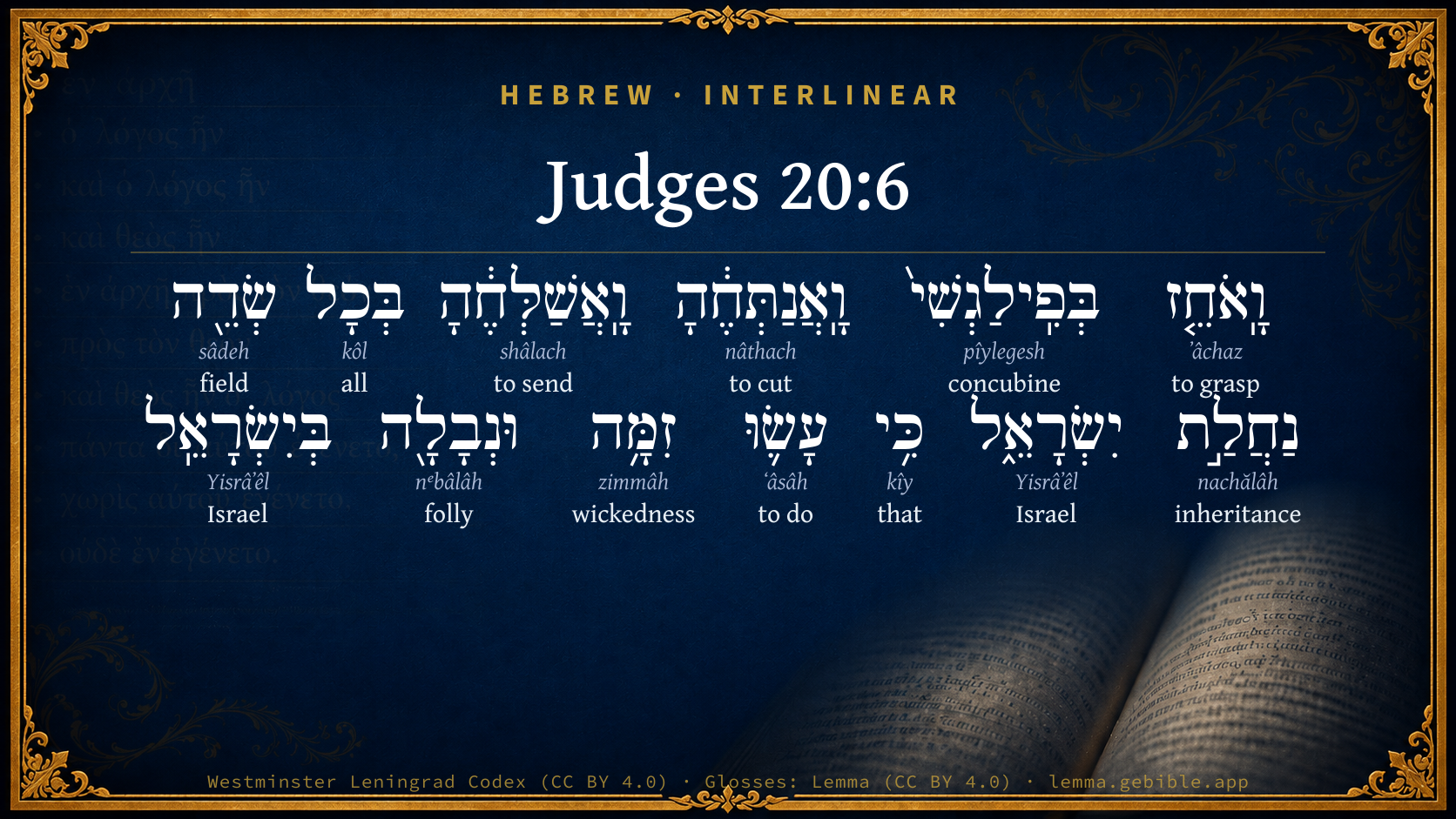
Judges 20:6

Hebrew (Westminster Leningrad Codex) Judges 20:6 appears in the Hebrew Old Testament. The text above is from the Westminster Leningrad Codex. Each word links to its Strong’s number, a concise gloss, and parsing drawn from the Open Scriptures Hebrew Bible morphology. Click any word for its full Brown-Driver-Briggs (BDB) entry.
Download image
Cite this verse

Judges 20:6 (World English Bible). Public Domain. Lemma interlinear Bible study tool, https://lemma.gebible.app/v/judges/20/6.

Show BibTeX & RIS
BibTeX
RIS
English Translation
I took my concubine, and cut her in pieces, and sent her throughout all the country of the inheritance of Israel; for they have committed lewdness and folly in Israel.
World English Bible · Public Domain
Download a study sheet

One document with this verse’s original text, its word-by-word gloss line, the meaning frame, cross-references with their text, attributed commentary, and full source and license credits — printable, and it pastes into notes with its structure intact.

This verse Autodidact and up

Study sheet (.html) Plain text (.txt)

A passage Seminary Student

Up to 50 verses in one chapter. A passage sheet keeps up to 6 commentary sources and 12 cross-references per verse, in the order this page ranks them, and says so on the sheet whenever that leaves anything out. Ask for a single verse and you get the Autodidact verse sheet above.

Everything on this page stays free to read, with no account — the sheet is a download of what is already on screen, not access to it.

Want to remove ads? Support Godless Engineer
Compare translations 3

The same verse in 3 English versions, stacked beneath the original-language interlinear above. Click any original word for its lexicon entry.

Each is an independent rendering of the whole verse — the interlinear is not word-aligned to these translations.

Highlighted words mark where these versions differ — a whole-verse word diff, not a word-by-word alignment.

  • World English Bible Public Domain
    I took my concubine, and cut her in pieces, and sent her throughout all the country of the inheritance of Israel; for they have committed lewdness and folly in Israel.
  • King James Version Public Domain
    And I took my concubine, and cut her in pieces, and sent her throughout all the country of the inheritance of Israel: for they have committed lewdness and folly in Israel.
  • unfoldingWord Literal Text CC BY-SA 4.0
    And I took back my concubine, and I cut her up, and I sent her into every field of the inheritance of Israel, because they have done lewdness and outrage in Israel.

unfoldingWord Literal Text — © unfoldingWord, licensed CC BY-SA 4.0. Word-aligned USFM3 via Door43 (git.door43.org/unfoldingWord/en_ult).

Versions to compare (up to 4)

3 of 4 selected

Show all 18 translations

Every available English version of this verse, each an independent rendering of the whole verse.

  • World English Bible Public Domain
    I took my concubine, and cut her in pieces, and sent her throughout all the country of the inheritance of Israel; for they have committed lewdness and folly in Israel.
  • Berean Standard Bible Public Domain
    Then I took my concubine, cut her into pieces, and sent her throughout the land of Israel’s inheritance, because they had committed a lewd and disgraceful act in Israel.
  • Majority Standard Bible Public Domain
    Then I took my concubine, cut her into pieces, and sent her throughout the land of Israel’s inheritance, because they had committed a lewd and disgraceful act in Israel.
  • King James Version Public Domain
    And I took my concubine, and cut her in pieces, and sent her throughout all the country of the inheritance of Israel: for they have committed lewdness and folly in Israel.
  • American Standard Version (1901) Public Domain
    And I took my concubine, and cut her in pieces, and sent her throughout all the country of the inheritance of Israel; for they have committed lewdness and folly in Israel.
  • Revised Version (1885) Public Domain
    And I took my concubine, and cut her in pieces, and sent her throughout all the country of the inheritance of Israel: for they have committed lewdness and folly in Israel.
  • Geneva Bible (1599) Public Domain
    Then I tooke my concubine, and cut her in pieces, and sent her throughout all the countrey of the inheritance of Israel: for they haue committed abomination and villenie in Israel.
  • Douay-Rheims (1899) Public Domain
    And I took her and cut her in pieces, and sent the, parts into all the borders of your possession: because there never was so heinous a crime, and so great an abomination committed in Israel.
  • Young's Literal Translation Public Domain
    and I lay hold on my concubine, and cut her in pieces, and send her into all the country of the inheritance of Israel; for they have done wickedness and folly in Israel;
  • Literal Standard Version CC BY-SA 4.0
    and I lay hold on my concubine, and cut her in pieces, and send her into all the country of the inheritance of Israel; for they have done wickedness and folly in Israel;
  • Unlocked Literal Bible CC BY-SA 4.0
    I took my concubine and cut her body into pieces, and sent them into each region of Israel's inheritance, because they have committed such wickedness and outrage in Israel.
  • unfoldingWord Literal Text CC BY-SA 4.0
    And I took back my concubine, and I cut her up, and I sent her into every field of the inheritance of Israel, because they have done lewdness and outrage in Israel.
  • Darby Bible Public Domain
    And I took my concubine and cut her in pieces, and sent her throughout all the country of the inheritance of Israel; for they have committed abomination and wantonness in Israel.
  • World Messianic Bible Public Domain
    I took my concubine and cut her in pieces, and sent her throughout all the country of the inheritance of Israel; for they have committed lewdness and folly in Israel.
  • Webster's Bible Public Domain
    And I took my concubine, and cut her in pieces, and sent her throughout all the country of the inheritance of Israel: for they have committed lewdness and folly in Israel.
  • Free Bible Version CC BY-SA 4.0
    I took my concubine and cut her into pieces, and I sent these pieces of her to every part of the country that had been given to Israel, because those men had done something shameful and disgusting in Israel.
  • Bible in Basic English Public Domain
    So I took her, cutting her into parts which I sent through all the country of the heritage of Israel: for they have done an act of shame in Israel.
  • JPS Tanakh (1917) Public Domain
    And I took my concubine, and cut her in pieces, and sent her throughout all the country of the inheritance of Israel; for they have committed lewdness and wantonness in Israel.

Literal Standard Version (2020), Covenant Press — licensed CC BY-SA 4.0. Text via the HelloAO Bible API (eBible.org). Unlocked Literal Bible (unfoldingWord) — licensed CC BY-SA 4.0. Text via the HelloAO Bible API (eBible.org). unfoldingWord Literal Text — © unfoldingWord, licensed CC BY-SA 4.0. Word-aligned USFM3 via Door43 (git.door43.org/unfoldingWord/en_ult). Free Bible Version, Dr. Jonathan Gallagher — licensed CC BY-SA 4.0. Text via the HelloAO Bible API (eBible.org).

Word by word

More ways to search: Search by grammar → Find every occurrence → Compare this word →

Practice this passage: Drill this verse → Learn its vocabulary →

וָֽאֲנַתְּחֶ֔הָ
nâthach
H5408
“and · to cut · her”
Conjunction + Verb, Piel, Sequential Imperfect, 1st Person, Common, Singular + Suffix, Personal, 3rd Person, Feminine, Singular
Part of Speech
Conjunction + Verb
Stem
Piel
Form
Sequential Imperfect
Person
1st Person
Gender
Common
Number
Singular
Full BDB Definition

Origin: a primitive root

TWOT: 1441

to cut, cut up, cut in pieces, divide - (Piel) to cut up, cut in pieces, divide by joints
  1. וָֽאֹחֵ֤ז ʼâchaz H270 “and · to grasp” Conjunction + Verb, Qal, Sequential Imperfect, 1st Person, Common, Singular
  2. בְּפִֽילַגְשִׁי֙ pîylegesh H6370 “in/at · concubine · my” Preposition + Noun, Common, Feminine, Singular, Construct + Suffix, Personal, 1st Person, Common, Singular
  3. וָֽאֲשַׁלְּחֶ֔הָ shâlach H7971 “and · to send · her” Conjunction + Verb, Piel, Sequential Imperfect, 1st Person, Common, Singular + Suffix, Personal, 3rd Person, Feminine, Singular
  4. בְּכָל kôl H3605 “in/at · all of” Preposition + Noun, Common, Masculine, Singular, Construct
  5. שְׂדֵ֖ה sâdeh H7704 “field of” Noun, Common, Masculine, Singular, Construct
  6. נַחֲלַ֣ת nachălâh H5159 “inheritance of” Noun, Common, Feminine, Singular, Construct
  7. יִשְׂרָאֵ֑ל Yisrâʼêl H3478 “Israel” Noun, Proper
  8. כִּ֥י kîy H3588 “that” Conjunction
  9. עָשׂ֛וּ ʻâsâh H6213 “to do” Verb, Qal, Perfect, 3rd Person, Common, Plural
  10. זִמָּ֥ה zimmâh H2154 “wickedness” Noun, Common, Feminine, Singular, Absolute
  11. וּנְבָלָ֖ה nᵉbâlâh H5039 “and · folly” Conjunction + Noun, Common, Feminine, Singular, Absolute
  12. בְּיִשְׂרָאֵֽל Yisrâʼêl H3478 “in/at · Israel” Preposition + Noun, Proper

About this verse

These counts appear in no published source. They are computed here, from the morphology-tagged text and Lemma’s own curated glosses. What Lemma adds →

13
words
12
distinct lemmas
Historical
section

Notable vocabulary

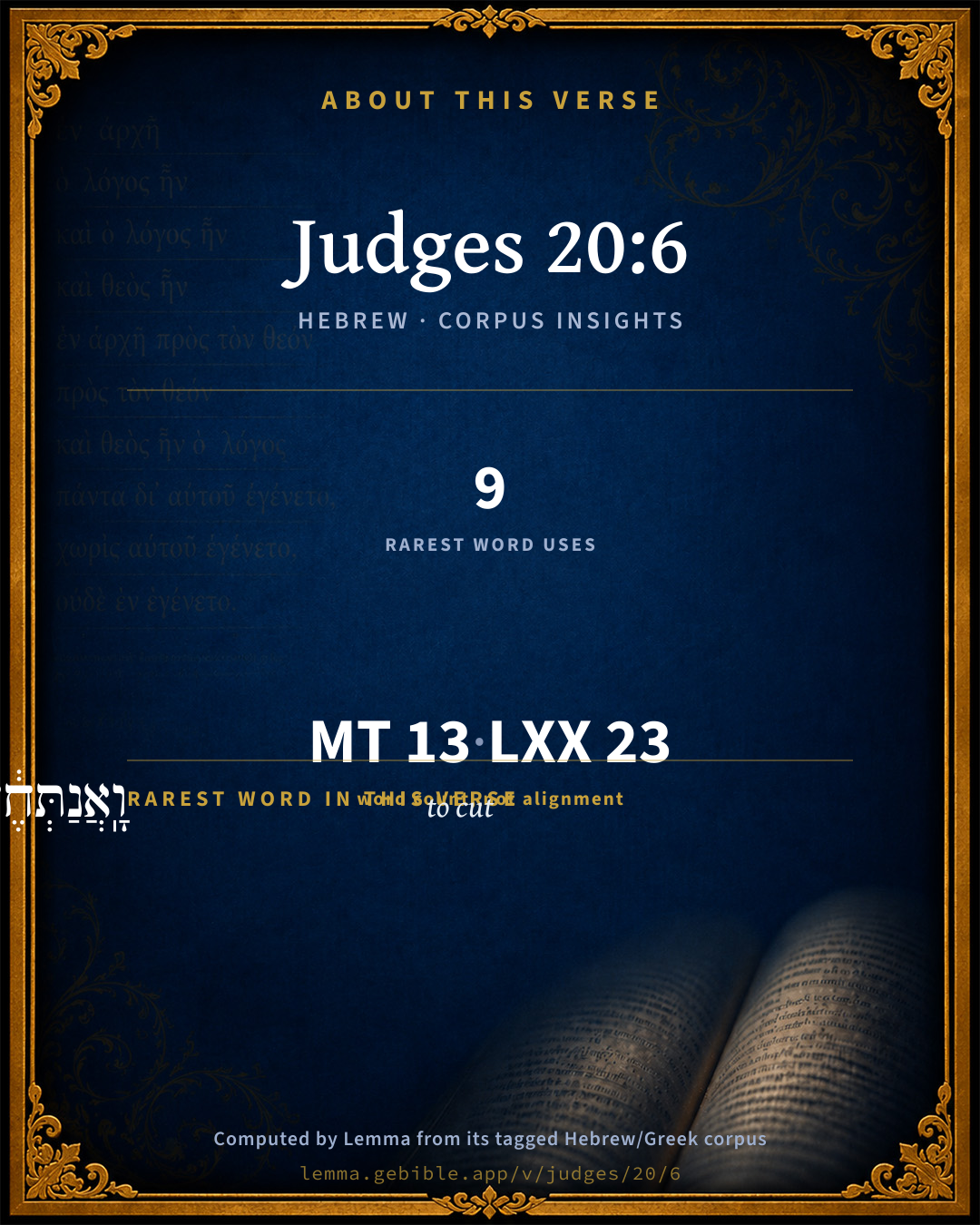
The rarest word here is וָֽאֲנַתְּחֶ֔הָ to cut H5408 — appearing just 9 times in the whole Hebrew Bible.

Shared distinctive vocabulary

וָֽאֲנַתְּחֶ֔הָ to cut H5408 occurs in 9 verses of the Hebrew Bible. Also found in:

Grammatical profile

  • 4 verbs
  • 8 nouns
  • 1 conjunction

Verb forms

  • וָֽאֹחֵ֤ז Qal · Sequential Imperfect
  • וָֽאֲנַתְּחֶ֔הָ Piel · Sequential Imperfect
  • וָֽאֲשַׁלְּחֶ֔הָ Piel · Sequential Imperfect
  • עָשׂ֛וּ Qal · Perfect

Repetition

A word recurs within this verse — often emphatic in Hebrew:

  • יִשְׂרָאֵ֑ל Israel H3478 ×2

Hebrew & Septuagint length

In English translation the verse runs 30 words from the Hebrew and 36 from the Septuagint (LXX English) — closely comparable.

A rough comparison of the two English renderings, which tokenize alike — not a word-level alignment.

Word counts can differ between the Hebrew and the Greek without any difference in meaning — e.g. the Hebrew direct-object marker אֵת has no separate Greek word, and Greek often adds the article ὁ.

In the original languages it is 13 Hebrew tokens and 23 Greek tokens — but the two are counted differently (Hebrew bundles its prefixes and suffixes into one token; the Greek is in lemma form), so that isn’t a like-for-like length.

Cross-references

6

Topical passages linked to Judges 20:6 in the Treasury of Scripture Knowledge — connected by theme and wording, ordered by reader-vote popularity; previews shown in the World English Bible.

  • Judges 19:29 When he was come into his house, he took a knife, and laid hold on his concubine, and divided her, limb by limb, into twelve pieces, and sent her throughout all the borders of Israel.
  • Joshua 7:15 It shall be, that he who is taken with the devoted thing shall be burnt with fire, he and all that he has; because he has transgressed the covenant of Yahweh, and because he has done folly in Israel.
  • Judges 19:23 The man, the master of the house, went out to them, and said to them, No, my brothers, please don't act so wickedly; seeing that this man is come into my house, don't do this folly.
  • Genesis 34:7 The sons of Jacob came in from the field when they heard it. The men were grieved, and they were very angry, because he had done folly in Israel in lying with Jacob's daughter; which thing ought not to be done.
  • Judges 20:10 and we will take ten men of one hundred throughout all the tribes of Israel, and one hundred of one thousand, and a thousand out of ten thousand, to get food for the people, that they may do, when they come to Gibeah of Benjamin, according to all the folly that they have worked in Israel.
  • 2 Samuel 13:12–13 She answered him, No, my brother, do not force me; for no such thing ought to be done in Israel. Don't you do this folly.

Cross-references courtesy of OpenBible.info (CC BY 4.0).

Hebrew and Greek witnesses Masoretic Hebrew ↔ Greek Septuagint

The same verse in the two great witnesses to the Old Testament, shown verse-for-verse.

These are two independent witnesses, not word-aligned to each other, and the Septuagint is shown in lemma (dictionary) form.

Hebrew Judges 20:6 Masoretic · Westminster Leningrad Codex

וָֽאֹחֵ֤ז בְּפִֽילַגְשִׁי֙ וָֽאֲנַתְּחֶ֔הָ וָֽאֲשַׁלְּחֶ֔הָ בְּכָל שְׂדֵ֖ה נַחֲלַ֣ת יִשְׂרָאֵ֑ל כִּ֥י עָשׂ֛וּ זִמָּ֥ה וּנְבָלָ֖ה בְּיִשְׂרָאֵֽל

I took my concubine, and cut her in pieces, and sent her throughout all the country of the inheritance of Israel; for they have committed lewdness and folly in Israel.

World English Bible · Public Domain

Greek LXX Judges 20:6 Septuagint · lemma form

καί κρατέω ὁ παλλακή ἐγώ καί μελίζω αὐτός καί ἀποστέλλω ἐν πᾶς ὅριον κληρονομία υἱός ἰσραήλ ὅτι ποιέω ζεμα καί ἀπόπτωμα ἐν ἰσραήλ

And I laid hold of my concubine, and divided her in pieces, and sent the parts into every coast of the inheritance of the children of Israel; for they have wrought lewdness and abomination in Israel.

LXX2012 (modern English Septuagint) · Public Domain

On this verse, The Cambridge Bible for Schools and Colleges discusses the Septuagint’s reading. Read the note in Commentary ↓

Hebrew: Westminster Leningrad Codex (CC BY 4.0). Greek: Septuagint (public domain); English from LXX2012 (modern English Septuagint) (Public Domain). How the Septuagint differs from the Hebrew →

Targum (Aramaic paraphrase)

1

The Targum is the ancient Jewish Aramaic paraphrase of the Hebrew Scriptures — an interpretive translation, not the Hebrew text itself. Onkelos (literal) and Pseudo-Jonathan (expansive) render the Torah, and Jonathan the Prophets. Coverage is partial: where no permissively-licensed English translation exists for a verse, only the Aramaic is shown. This is verse-level text, not a word-by-word alignment to the Hebrew.

  1. Targum Jonathan Prophets (Joshua–Malachi)
    וַאֲחָדִית בִּלְחֵינָתִי וְהַדְמִיתָהּ וּשְׁלַחְתָּהּ בְּכָל תְּחוּם אַחְסָנַת אַרְעָא דְיִשְׂרָאֵל אֲרֵי עֲבָדוּ עֵיצַת חֶטְאִין וּדְלָא כָשַׁר בְּיִשְׂרָאֵל:

    (no public-domain English translation for this verse)

    Targum Jonathan — Aramaic: “Mikraot Gedolot” (public domain). English: “Sefaria Community Translation” (CC0 1.0 (public-domain dedication)); “London "Chaldee Paraphrase," 1871” (public domain). Text via Sefaria.

Commentary

Notes on Judges 20:6 from classic Christian and Jewish commentators (each source and its license shown beneath its notes). The classic Christian expositions comment on the surrounding passage and are grouped to its opening verse, so a note may address several verses; the Jewish commentaries on the Tanakh (Rashi and others) are per-verse, so they appear only where the commentator wrote on this verse.

Lemma curates 59 commentaries, every one of them public domain or Creative Commons licensed, each selected and text-cleaned for this edition rather than reprinted as found. About our sources →

Trapp's Complete Commentary

John Trapp

Jdg 20:6 And I took my concubine, and cut her in pieces, and sent her throughout all the country of the inheritance of Israel: for they have committed lewdness and folly in Israel.

Ver. 6. For they have committed lewdness.] Wickedness with a witness: such as may not go unpunished.

John Trapp, A Commentary or Exposition upon All the Books of the Old and New Testament (1647–1656) — public domain. Text from a community e-Sword module.

Geneva Bible (1599)

Geneva Bible translators

That is, her pieces, to every tribe a piece, Judg. 19:29.

Geneva Bible (1599) marginal notes — public domain. Text via Bolls.life.

The Cambridge Bible for Schools and Colleges

gen. ed. J. J. S. Perowne

6. all the country of the inheritance of Israel] We hardly expect inheritance in plain prose; contrast Jdg_19:29. The word may be a later insertion.

they have committed lewdness] Similarly Hos_6:9, Eze_16:43; Eze_22:9; lit. evil purpose, i.e. unchastity; in this sense the word is frequent in the Law of Holiness and in Ezekiel (see Driver,

Introd, p. 49, No. 11). LXX. cod. A, Luc. omit lewdness and, perhaps rightly; the word may have been added to emphasize the iniquity.

The Cambridge Bible for Schools and Colleges (gen. ed. J. J. S. Perowne; Cambridge University Press, 1878–1918) — public domain. Text from a community e-Sword module.

John Gill's Exposition

And I took my concubine, and cut her in pieces,.... Lest it should be thought that these barbarous creatures, after they had used her in such a manner that occasioned her death, that they had committed this fact also; the Levite takes it to himself, and owns that he did that:

and sent her throughout all the country of the inheritance of Israel; to alarm them, and excite their attention to what had passed, and to raise their indignation against it:

for they have committed lewdness and folly in Israel; being guilty of adultery and murder, and would have committed the unnatural crime, if they could have had an opportunity of doing it.

John Gill's Exposition of the Whole Bible (1746–1763) — public domain (CC PDM 1.0). Text via the HelloAO Bible API.

Haydock's Catholic Bible Commentary

Because, &c. Hebrew and Septuagint, "for they have wrought (zimma, a word which the Septuagint (Alexandrian and Vatican) leave untranslated, others render dishonesty) lewdness and folly," or a most impious act of lust. (Haydock) --- They do not compare this crime with every other that had been committed, as idolatry, and other sins, which directly attack God, are greater. But this was the most atrocious injustice which could be done to a fellow creature. (Salien)

George Leo Haydock (1774–1849), Haydock's Catholic Family Bible and Commentary, 1859 edition — public domain. Excludes Psalms (Douay-Rheims chapter numbering differs from Protestant) and Deuterocanonical books (Catholic canon only).

Matthew Poole's English Annotations

i.e. A lewd folly; most ignominious and impudent wickedness.

Matthew Poole's English Annotations on the Holy Bible (1683–1685) — public domain. Text from a community e-Sword/MySword module.

John Wesley's Explanatory Notes

Folly - That is, a lewd folly; most ignominious and impudent wickedness.

John Wesley, Explanatory Notes Upon the Whole Bible (1754–1765) — public domain. Text via the GEBible commentary corpus.

Lesson kit

Teaching starters — assembled from the data on this page, not authored interpretation. Every prompt links to the verse data it draws on. Edit before teaching.

Judges, in the Historical, opens this verse with 13 words (12 distinct Hebrew lemmas). Its most distinctive word is nâthach (“to cut”). A historical commentator’s framing appears above. Read the whole chapter for the surrounding context.

Discussion questions

  1. What does “to cut” (nâthach) contribute to the verse as a whole?
  2. Exodus 29:17 shares the word «to cut» with this verse. How do the two illuminate each other?
  3. “Israel” occurs 2× in this one verse. What is the effect of the repetition?
  4. These translations render this verse differently. What is at stake in choosing one wording over another?
  5. The verb «וָֽאֹחֵ֤ז» is Qal Sequential Imperfect. How does its form color the action?
  6. Reading how Trapp's Complete Commentary and Geneva Bible (1599) read this verse, where do the two commentators agree and where do they part?

Things to notice

Reading settings

Reading text

Shown beneath each verse's original-language words.

Old Testament
Old Testament edition

Read the OT as the Masoretic Hebrew (MT) or the Greek Septuagint (LXX).

English shown for the Greek Septuagint (in the Hebrew ↔ Greek comparison).

Comparing translations? Open the Compare panel on any verse page to stack up to four side by side.