
Exodus 1:14

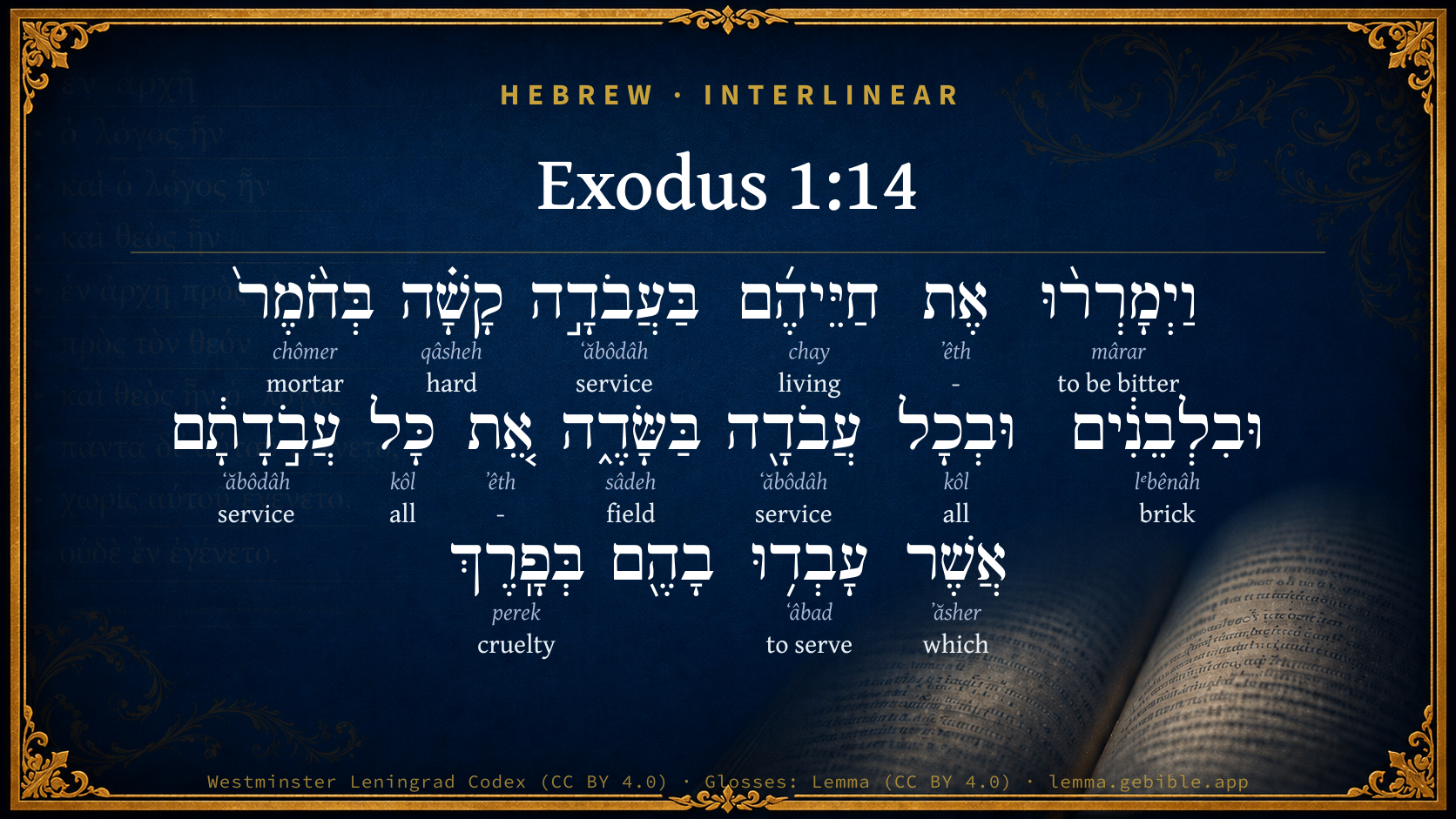
Hebrew (Westminster Leningrad Codex) Exodus 1:14 appears in the Hebrew Old Testament. The text above is from the Westminster Leningrad Codex. Each word links to its Strong’s number, a concise gloss, and parsing drawn from the Open Scriptures Hebrew Bible morphology. Click any word for its full Brown-Driver-Briggs (BDB) entry.
Download image
Cite this verse

Exodus 1:14 (World English Bible). Public Domain. Lemma interlinear Bible study tool, https://lemma.gebible.app/v/exodus/1/14.

Show BibTeX & RIS
BibTeX
RIS
English Translation
and they made their lives bitter with hard service, in mortar and in brick, and in all manner of service in the field, all their service, in which they ruthlessly made them serve.
World English Bible · Public Domain
Download a study sheet

One document with this verse’s original text, its word-by-word gloss line, the meaning frame, cross-references with their text, attributed commentary, and full source and license credits — printable, and it pastes into notes with its structure intact.

This verse Autodidact and up

Study sheet (.html) Plain text (.txt)

A passage Seminary Student

Up to 50 verses in one chapter. A passage sheet keeps up to 6 commentary sources and 12 cross-references per verse, in the order this page ranks them, and says so on the sheet whenever that leaves anything out. Ask for a single verse and you get the Autodidact verse sheet above.

Everything on this page stays free to read, with no account — the sheet is a download of what is already on screen, not access to it.

Want to remove ads? Support Godless Engineer
Compare translations 3

The same verse in 3 English versions, stacked beneath the original-language interlinear above. Click any original word for its lexicon entry.

Each is an independent rendering of the whole verse — the interlinear is not word-aligned to these translations.

Highlighted words mark where these versions differ — a whole-verse word diff, not a word-by-word alignment.

  • World English Bible Public Domain
    and they made their lives bitter with hard service, in mortar and in brick, and in all manner of service in the field, all their service, in which they ruthlessly made them serve.
  • King James Version Public Domain
    And they made their lives bitter with hard bondage, in mortar, and in brick, and in all manner of service in the field: all their service, wherein they made them serve, was with rigor.
  • unfoldingWord Literal Text CC BY-SA 4.0
    And they embittered their lives by hard slavery, by mortar and by bricks, and by all kinds of slave labor in the fields; all their work with which they worked for them was with rigor.

unfoldingWord Literal Text — © unfoldingWord, licensed CC BY-SA 4.0. Word-aligned USFM3 via Door43 (git.door43.org/unfoldingWord/en_ult).

Versions to compare (up to 4)

3 of 4 selected

Show all 18 translations

Every available English version of this verse, each an independent rendering of the whole verse.

  • World English Bible Public Domain
    and they made their lives bitter with hard service, in mortar and in brick, and in all manner of service in the field, all their service, in which they ruthlessly made them serve.
  • Berean Standard Bible Public Domain
    and made their lives bitter with hard labor in brick and mortar, and with all kinds of work in the fields. Every service they imposed was harsh.
  • Majority Standard Bible Public Domain
    and made their lives bitter with hard labor in brick and mortar, and with all kinds of work in the fields. Every service they imposed was harsh.
  • King James Version Public Domain
    And they made their lives bitter with hard bondage, in mortar, and in brick, and in all manner of service in the field: all their service, wherein they made them serve, was with rigor.
  • American Standard Version (1901) Public Domain
    and they made their lives bitter with hard service, in mortar and in brick, and in all manner of service in the field, all their service, wherein they made them serve with rigor.
  • Revised Version (1885) Public Domain
    and they made their lives bitter with hard service, in mortar and in brick, and in all manner of service in the field, all their service, wherein they made them serve with rigour.
  • Geneva Bible (1599) Public Domain
    Thus they made them weary of their liues by sore labour in clay and in bricke, and in al worke in the fielde, with all maner of bondage, which they layde vpon them most cruelly.
  • Douay-Rheims (1899) Public Domain
    And they made their life bitter with hard works in clay, and brick, and with all manner of service, wherewith they were overcharged in the works of the earth.
  • Young's Literal Translation Public Domain
    and make their lives bitter in hard service, in clay, and in brick, and in every `kind' of service in the field; all their service in which they have served `is' with rigour.
  • Literal Standard Version CC BY-SA 4.0
    and make their lives bitter in hard service, in clay, and in brick, and in every [kind] of service in the field; all their service in which they have served [is] with rigor.
  • Unlocked Literal Bible CC BY-SA 4.0
    They made their lives bitter with hard service with mortar and brick, and with all kinds of work in the fields. All their required work was hard.
  • unfoldingWord Literal Text CC BY-SA 4.0
    And they embittered their lives by hard slavery, by mortar and by bricks, and by all kinds of slave labor in the fields; all their work with which they worked for them was with rigor.
  • Darby Bible Public Domain
    and they embittered their life with hard labour in clay and bricks, and in all manner of labour in the field: all their labour with which they made them serve was with harshness.
  • World Messianic Bible Public Domain
    and they made their lives bitter with hard service in mortar and in brick, and in all kinds of service in the field, all their service, in which they ruthlessly made them serve.
  • Webster's Bible Public Domain
    And they made their lives bitter with hard bondage, in mortar, and in brick, and in all manner of service in the field: all their service in which they made them serve, was with rigor.
  • Free Bible Version CC BY-SA 4.0
    making their lives a misery. They made them do hard labor, building with mortar and brick, and all kinds of heavy work in the fields. In all of this hard labor they treated them brutally.
  • Bible in Basic English Public Domain
    And made their lives bitter with hard work, making building-material and bricks, and doing all sorts of work in the fields under the hardest conditions.
  • JPS Tanakh (1917) Public Domain
    And they made their lives bitter with hard service, in mortar and in brick, and in all manner of service in the field; in all their service, wherein they made them serve with rigour.

Literal Standard Version (2020), Covenant Press — licensed CC BY-SA 4.0. Text via the HelloAO Bible API (eBible.org). Unlocked Literal Bible (unfoldingWord) — licensed CC BY-SA 4.0. Text via the HelloAO Bible API (eBible.org). unfoldingWord Literal Text — © unfoldingWord, licensed CC BY-SA 4.0. Word-aligned USFM3 via Door43 (git.door43.org/unfoldingWord/en_ult). Free Bible Version, Dr. Jonathan Gallagher — licensed CC BY-SA 4.0. Text via the HelloAO Bible API (eBible.org).

Word by word

More ways to search: Search by grammar → Find every occurrence → Compare this word →

Practice this passage: Drill this verse → Learn its vocabulary →

בְּפָֽרֶךְ
perek
H6531
“in/at · cruelty”
Preposition + Noun, Common, Masculine, Singular, Absolute
Part of Speech
Preposition + Noun
Type
Common
Gender
Masculine
Number
Singular
State
Absolute
Full BDB Definition

Origin: from an unused root meaning to break apart

TWOT: 1817a

harshness, severity, cruelty
  1. וַיְמָרְר֨וּ mârar H4843 “and · to be bitter” Conjunction + Verb, Piel, Sequential Imperfect, 3rd Person, Masculine, Plural
  2. אֶת ʼêth H853 “-” Particle, Direct Object
  3. חַיֵּיהֶ֜ם chay H2416 “living things · their” Noun, Common, Masculine, Plural, Construct + Suffix, Personal, 3rd Person, Masculine, Plural
  4. בַּעֲבֹדָ֣ה ʻăbôdâh H5656 “in/at · service” Preposition + Noun, Common, Feminine, Singular, Absolute
  5. קָשָׁ֗ה qâsheh H7186 “hard” Adjective, Adjective, Feminine, Singular, Absolute
  6. בְּחֹ֨מֶר֙ chômer H2563 “in/at · mortar” Preposition + Noun, Common, Masculine, Singular, Absolute
  7. וּבִלְבֵנִ֔ים lᵉbênâh H3843 “and · in/at · bricks” Conjunction + Preposition + Noun, Common, Feminine, Plural, Absolute
  8. וּבְכָל kôl H3605 “and · in/at · all of” Conjunction + Preposition + Noun, Common, Masculine, Singular, Construct
  9. עֲבֹדָ֖ה ʻăbôdâh H5656 “service” Noun, Common, Feminine, Singular, Absolute
  10. בַּשָּׂדֶ֑ה sâdeh H7704 “in/at the · field” Preposition, Determined + Noun, Common, Masculine, Singular, Absolute
  11. אֵ֚ת ʼêth H853 “-” Particle, Direct Object
  12. כָּל kôl H3605 “all of” Noun, Common, Masculine, Singular, Construct
  13. עֲבֹ֣דָתָ֔ם ʻăbôdâh H5656 “service · their” Noun, Common, Feminine, Singular, Construct + Suffix, Personal, 3rd Person, Masculine, Plural
  14. אֲשֶׁר ʼăsher H834 “which” Particle, Relative
  15. עָבְד֥וּ ʻâbad H5647 “to serve” Verb, Qal, Perfect, 3rd Person, Common, Plural

About this verse

These counts appear in no published source. They are computed here, from the morphology-tagged text and Lemma’s own curated glosses. What Lemma adds →

17
words
12
distinct lemmas
Pentateuch
section

Notable vocabulary

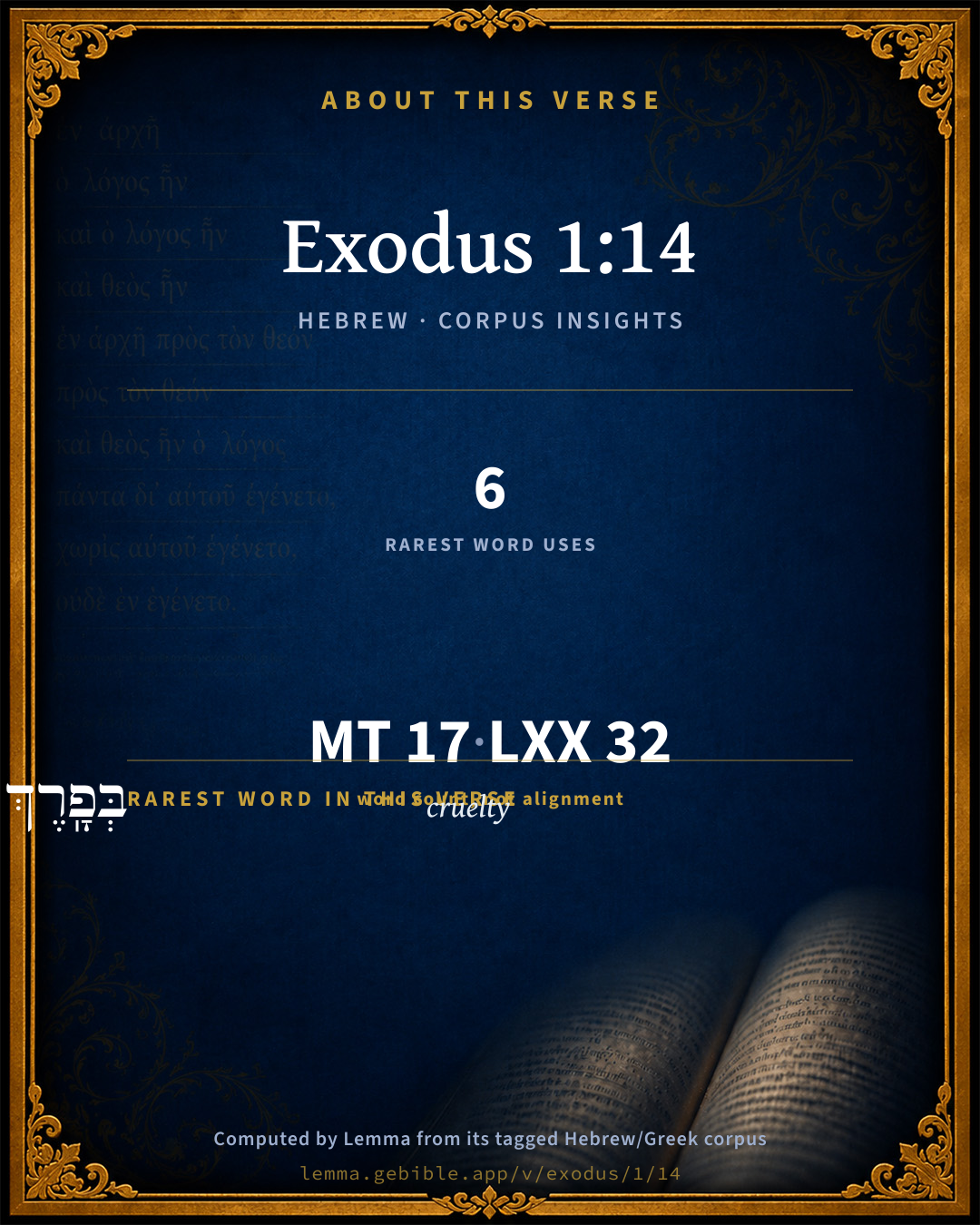
The rarest word here is בְּפָֽרֶךְ cruelty H6531 — appearing just 6 times in the whole Hebrew Bible.

Shared distinctive vocabulary

בְּפָֽרֶךְ cruelty H6531 occurs in 6 verses of the Hebrew Bible. Also found in:

Grammatical profile

  • 2 verbs
  • 10 nouns
  • 1 adjective
  • 1 preposition
  • 3 particles

Verb forms

  • וַיְמָרְר֨וּ Piel · Sequential Imperfect
  • עָבְד֥וּ Qal · Perfect

Repetition

Words recur within this verse — often emphatic in Hebrew:

  • בַּעֲבֹדָ֣ה service H5656 ×3
  • וּבְכָל all H3605 ×2

Hebrew & Septuagint length

In English translation the verse runs 33 words from the Hebrew and 34 from the Septuagint (LXX English) — closely comparable.

A rough comparison of the two English renderings, which tokenize alike — not a word-level alignment.

Word counts can differ between the Hebrew and the Greek without any difference in meaning — e.g. the Hebrew direct-object marker אֵת has no separate Greek word, and Greek often adds the article ὁ.

In the original languages it is 17 Hebrew tokens and 32 Greek tokens — but the two are counted differently (Hebrew bundles its prefixes and suffixes into one token; the Greek is in lemma form), so that isn’t a like-for-like length.

Cross-references

24

Topical passages linked to Exodus 1:14 in the Treasury of Scripture Knowledge — connected by theme and wording, ordered by reader-vote popularity; previews shown in the World English Bible.

  • Acts 7:19 The same took advantage of our race, and mistreated our fathers, and forced them to throw out their babies, so that they wouldn't stay alive.
  • Numbers 20:15 how our fathers went down into Egypt, and we lived in Egypt a long time; and the Egyptians dealt ill with us, and our fathers:
  • Exodus 2:23 It happened in the course of those many days, that the king of Egypt died, and the children of Israel sighed because of the bondage, and they cried, and their cry came up to God because of the bondage.
  • Exodus 6:9 Moses spoke so to the children of Israel, but they didn't listen to Moses for anguish of spirit, and for cruel bondage.
  • Psalms 81:6 "I removed his shoulder from the burden. His hands were freed from the basket.
  • Isaiah 58:6 Isn't this the fast that I have chosen: to loose the bonds of wickedness, to undo the bands of the yoke, and to let the oppressed go free, and that you break every yoke?
  • Acts 7:34 I have surely seen the affliction of my people that is in Egypt, and have heard their groaning. I have come down to deliver them. Now come, I will send you into Egypt.'
  • Genesis 15:13 He said to Abram, "Know for sure that your seed will live as foreigners in a land that is not theirs, and will serve them. They will afflict them four hundred years.
  • Exodus 1:13 The Egyptians ruthlessly made the children of Israel serve,
  • Exodus 5:7–21 "You shall no longer give the people straw to make brick, as before. Let them go and gather straw for themselves.
  • Exodus 20:2 "I am Yahweh your God, who brought you out of the land of Egypt, out of the house of bondage.
  • Leviticus 25:43 You shall not rule over him with harshness, but shall fear your God.
  • Leviticus 25:46 You may make them an inheritance for your children after you, to hold for a possession; of them may you take your slaves forever: but over your brothers the children of Israel you shall not rule, one over another, with harshness.
  • Leviticus 25:53 As a servant hired year by year shall he be with him: he shall not rule with harshness over him in your sight.
  • Deuteronomy 4:20 But Yahweh has taken you, and brought you forth out of the iron furnace, out of Egypt, to be to him a people of inheritance, as at this day.
  • Deuteronomy 26:6 The Egyptians dealt ill with us, and afflicted us, and laid on us hard bondage:
  • Ruth 1:20 She said to them, "Don't call me Naomi, call me Mara; for the Almighty has dealt very bitterly with me.
  • Psalms 68:13 While you sleep among the campfires, The wings of a dove sheathed with silver, Her feathers with shining gold.
  • Isaiah 14:6 who struck the peoples in wrath with a continual stroke, who ruled the nations in anger, with a persecution that none restrained.
  • Isaiah 51:23 and I will put it into the hand of those who afflict you, who have said to your soul, Bow down, that we may go over; and you have laid your back as the ground, and as the street, to those who go over.
  • Isaiah 52:5 Now therefore, what do I here, says Yahweh, seeing that my people is taken away for nothing? those who rule over them do howl, says Yahweh, and my name continually all the day is blasphemed.
  • Jeremiah 50:33–34 Thus says Yahweh of hosts: The children of Israel and the children of Judah are oppressed together; and all who took them captive hold them fast; they refuse to let them go.
  • Micah 3:3 Who also eat the flesh of my people, And flay their skin from off them, And break their bones, And chop them in pieces, as for the pot, And as flesh within the caldron.
  • Nahum 3:14 Draw water for the siege. Strengthen your fortresses. Go into the clay, and tread the mortar. Make the brick kiln strong.

Cross-references courtesy of OpenBible.info (CC BY 4.0).

Hebrew and Greek witnesses Masoretic Hebrew ↔ Greek Septuagint

The same verse in the two great witnesses to the Old Testament, shown verse-for-verse.

These are two independent witnesses, not word-aligned to each other, and the Septuagint is shown in lemma (dictionary) form.

Hebrew Exodus 1:14 Masoretic · Westminster Leningrad Codex

וַיְמָרְר֨וּ אֶת חַיֵּיהֶ֜ם בַּעֲבֹדָ֣ה קָשָׁ֗ה בְּחֹ֨מֶר֙ וּבִלְבֵנִ֔ים וּבְכָל עֲבֹדָ֖ה בַּשָּׂדֶ֑ה אֵ֚ת כָּל עֲבֹ֣דָתָ֔ם אֲשֶׁר עָבְד֥וּ בָהֶ֖ם בְּפָֽרֶךְ

and they made their lives bitter with hard service, in mortar and in brick, and in all manner of service in the field, all their service, in which they ruthlessly made them serve.

World English Bible · Public Domain

Greek LXX Exodus 1:14 Septuagint · lemma form

καί καταὀδυνάω αὐτός ὁ ζωή ἐν ὁ ἔργον ὁ σκληρός ὁ πηλός καί ὁ πλινθεία καί πᾶς ὁ ἔργον ὁ ἐν ὁ πεδίον κατά πᾶς ὁ ἔργον ὅς καταδουλόω αὐτός μετά βία

And they embittered their life by hard labors, in the clay and in brick-making, and all the works in the plains, according to all the works, wherein they caused them to serve with violence.

LXX2012 (modern English Septuagint) · Public Domain

Hebrew: Westminster Leningrad Codex (CC BY 4.0). Greek: Septuagint (public domain); English from LXX2012 (modern English Septuagint) (Public Domain). How the Septuagint differs from the Hebrew →

Targum (Aramaic paraphrase)

2

The Targum is the ancient Jewish Aramaic paraphrase of the Hebrew Scriptures — an interpretive translation, not the Hebrew text itself. Onkelos (literal) and Pseudo-Jonathan (expansive) render the Torah, and Jonathan the Prophets. Coverage is partial: where no permissively-licensed English translation exists for a verse, only the Aramaic is shown. This is verse-level text, not a word-by-word alignment to the Hebrew.

  1. Targum Onkelos Torah (Genesis–Deuteronomy)
    וְאַמְרָרוּ יָת חַיֵיהוֹן בְּפָלְחָנָא קָשְׁיָא בְּטִּינָא וּבְלִבְנִין וּבְכָל פָלְחָנָא בְּחַקְלָא יָת כָּל פָּלְחָנְהוֹן דְאַפְלָחוּ בְהוֹן בְּקַשְׁיוּ:

    (no public-domain English translation for this verse)

    Targum Onkelos — Aramaic: “Onkelos Genesis” (public domain); “Onkelos Exodus” (public domain); “Onkelos Leviticus” (public domain); “Onkelos Numbers” (public domain); “Onkelos Deuteronomy” (public domain). English: “Sefaria Community Translation” (CC0 1.0 (public-domain dedication)); “J.W. Etheridge. The Targums of Onkelos and Jonathan Ben Uzziel on the Pentateuch. London: Longmans, Green, 1862” (public domain). Text via Sefaria.

  2. Targum Pseudo-Jonathan Torah (Genesis–Deuteronomy)
    וְאַמְרָרוּ יַת חַיֵיהוֹן בְּפוּלְחָנָא קַשְׁיָא בְּטִינָא וּבְלִיבְנִין וּבְכָל פּוּלְחָנָא בְּאַנְפֵּי בָרָא יַת כָּל פּוּלְחַנְהוֹן הֲווֹן מְפַלְחִין בְּהוֹן בְּקַשְׁיוּ

    and made their lives bitter by hard service in clay and bricks, and all the labour of the face of the field; and in all the work which they made them do was hardness.

    Targum Pseudo-Jonathan — Aramaic: “Targum Jonathan on Genesis” (public domain); “Targum Jonathan on Exodus” (public domain); “Targum Jonathan on Leviticus” (public domain); “Targum Jonathan on Numbers” (public domain); “Targum Jonathan on Deuteronomy” (public domain). English: “The Targum of Jonathan ben Uzziel, trans. J. W. Etheridge, London, 1862” (public domain). Text via Sefaria.

Commentary

Notes on Exodus 1:14 from classic Christian and Jewish commentators (each source and its license shown beneath its notes). The classic Christian expositions comment on the surrounding passage and are grouped to its opening verse, so a note may address several verses; the Jewish commentaries on the Tanakh (Rashi and others) are per-verse, so they appear only where the commentator wrote on this verse.

Lemma curates 59 commentaries, every one of them public domain or Creative Commons licensed, each selected and text-cleaned for this edition rather than reprinted as found. About our sources →

Trapp's Complete Commentary

John Trapp

Exo 1:14 And they made their lives bitter with hard bondage, in morter, and in brick, and in all manner of service in the field: all their service, wherein they made them serve, [was] with rigour.

Ver. 14. Bitter with hard bondage.] Did we but live a while, saith one, {a} in Turkey, Persia, yea, or but in France, a dram of that liberty we yet enjoy would be as precious to us as a drop of cold water would have been to the rich man in hell, when he was so grievously tormented in those flames.

{a} Mercer.

John Trapp, A Commentary or Exposition upon All the Books of the Old and New Testament (1647–1656) — public domain. Text from a community e-Sword module.

Joseph Benson's Commentary

Exo 1:14. In mortar and brick — It has been supposed by many, that, besides the treasure-cities, mentioned Exo 1:11, and other similar works, the Israelites were employed in raising those enormous piles, termed pyramids, which remain to this day, and probably will remain to the end of the world; “monuments, not so much of the greatness and wisdom, as of the folly, caprice, exorbitant power, and cruel tyranny of the monarchs who projected them. It cannot indeed be denied, that the skill wherewith they were planned equals the vastness of the labour with which they were completed; but then it is evident they never could be useful in any degree adequate to the toil and expense with which they were erected. The supposition, however, is entirely groundless; for the Israelites were employed in making brick; while it is well known the pyramids were built of hewn stone.” — Scott. “The great pyramid,” says Herodotus, “was covered with polished stones, perfectly well joined, the smallest of which was thirty feet long. It was built in the form of steps, on each of which were placed wooden machines to raise the stones from one to another.” Diodorus adds, that “the stories were of very different workmanship, and of eternal duration. It is preserved to our days (the middle of the Augustan age) without being in the least injured. The marble was brought from the quarries of Arabia.” Pliny bears the same testimony: “It is formed of stone brought from the quarries of Arabia.” — Encycl. Brit. So that, it seems evident, the Israelites, who were employed in brick and mortar, had no hand in erecting the pyramids. All manner of service in the field — In cultivating the ground, and, according to Josephus, in cutting canals and trenches, to convey to different parts of the country the waters of the Nile, to raise up mounds, lest the waters overflowing should stagnate, and in other laborious services.

Joseph Benson's Commentary on the Old and New Testaments (1811–1818) — public domain. Text from a community e-Sword module.

Tyndale Open Study Notes

Tyndale Open Resources

1:14 The only stone that the Egyptians could obtain for building purposes came from the far south of the country. Therefore, in the north where the Hebrews were settled, only the most important state and religious buildings were made of stone. The rest were constructed with mortar and bricks made of durable clay with a binder such as seashells or straw mixed in. After being sun-dried in a form, these materials were surprisingly durable—especially in a land such as Egypt, where there was little rainfall or humidity.

Tyndale Open Study Notes — © Tyndale Open Resources, licensed CC BY-SA 4.0. Text via the HelloAO Bible API.

Geneva Bible (1599)

Geneva Bible translators

Hebrew, wherewith they served themselves of them by cruelty.

Geneva Bible (1599) marginal notes — public domain. Text via Bolls.life.

Adam Clarke's Commentary

Verse 14. They made their lives bitter] So that they became weary of life, through the severity of their servitude.

With hard bondage] בעבדה קשה baabodah kashah, with grievous servitude. This was the general character of their life in Egypt; it was a life of the most painful servitude, oppressive enough in itself, but made much more so by the cruel manner of their treatment while performing their tasks.

In mortar, and in brick] First, in digging the clay, kneading, and preparing it, and secondly, forming it into bricks, drying them in the sun, c.

Service in the field] Carrying these materials to the places where they were to be formed into buildings, and serving the builders while employed in those public works. Josephus says "The Egyptians contrived a variety of ways to afflict the Israelites for they enjoined them to cut a great number of channels for the river, and to build walls for their cities and ramparts, that they might restrain the river, and hinder its waters from stagnating upon its overrunning its own banks; they set them also to build pyramids, (πυραμιδας τε ανοικοδομουντες,) and wore them out, and forced them to learn all sorts of mechanic arts, and to accustom themselves to hard labour." - Antiq., lib. ii., cap. ix., sec. 1. Philo bears nearly the same testimony, p. 86, Edit. Mangey.

Adam Clarke's Commentary on the Bible (1810–1826) — public domain. Text from a community e-Sword/MySword module.

Ellicott's Commentary for English Readers

(14) In morter and in brick.—It has been questioned whether the Egyptians used brick as a material for building. No doubt temples, palaces, and pyramids were ordinarily of stone; but the employment of brick for walls, fortresses, and houses, especially in the Delta, is well attested. (See the Quarterly Statement of the Palestine Exploration Fund for July, 1880, pp. 137, 139, 143, &c.) Pyramids, too, were sometimes of brick (Herod. ii. 136). The manufacture of bricks by foreigners, employed (like the Israelites) as public slaves, is represented by the kings upon their monuments.

All manner of service in the field.—Josephus speaks of their being employed to dig canals (Ant. Jud. ii. 9, § 1), and there is a trace in Deu_11:10 of other labours connected with irrigation having been devolved on them. Such labours, under the hot sun of Egypt, are exhausting and dangerous to health.

And all their service . . . was with rigour. Rather, besides all their other service, which they made them serve with rigour.

A Bible Commentary for English Readers, edited by Charles John Ellicott (1878–1897) — public domain. Text from a community e-Sword module.

The Cambridge Bible for Schools and Colleges

gen. ed. J. J. S. Perowne

14. hard service] Exo_6:9 (P) Heb. (EVV. cruel bondage); also Deu_26:6 (EVV. hard bondage); 1Ki_12:4 (= 2Ch_10:4); Isa_14:3.

in mortar and in brick] for the Egyptian buildings: cf. Exo_5:7-8. The ‘mortar’ (lit. clay, Isa_29:16 al.), would be the black Nile-mud, which was used in ancient Egypt not only for bricks (see on Exo_5:6-9; Exo_5:19), but also (Erman, Anc. Egypt, p. 419) for mortar: in the latter case it was usually mixed with potsherds.

in the field] E.g. in constructing canals and dams for conveying water from the Nile to the fields, and in the actual work of irrigation (Deu_11:10). This was laborious; for the water had to be brought to the high-lying fields artificially, by a series of shadufs, or buckets attached to long poles, worked on axles, by which it was gradually raised from one elevation to another. ‘It is hard work to be the whole day raising and emptying the pail of the shaduf, in fact nothing is so tiring in the daily work of the Egyptians as this irrigation of the fields’ (Erman, p. 427). In ancient Egypt this and other agricultural operations were carried on by serfs, slaves, and captives taken in war. The shaduf, constructed exactly as in ancient times, is still a familiar sight on the banks of the Nile: see an illustration of both the ancient and the modern type in Erman, p. 426.

all their service, &c.] The sentence is loosely attached to what precedes, and the construction with ’çth (the mark of the accus.) is very anomalous: cf. however, in the later Heb., Eze_37:19, Zec_12:10.

The Cambridge Bible for Schools and Colleges (gen. ed. J. J. S. Perowne; Cambridge University Press, 1878–1918) — public domain. Text from a community e-Sword module.

John Gill's Exposition

And they made their lives bitter with hard bondage,.... So that they had no ease of body nor peace of mind; they had no comfort of life, their lives and mercies were embittered to them:

in mortar and in brick, and in all manner of service of the field; if Pelusium was one of the cities they built, that had its name from clay, the soil about it being clayish, and where the Israelites might be employed in making brick for the building of that and other cities: Josephus (d) says, they were ordered to part the river (Nile) into many canals, to build walls about cities, and raise up mounds, lest the water overflowing the banks should stagnate; and to build pyramids, obliging them to learn various arts, and inure themselves to labour: so Philo the Jew says (e), some worked in the clay, forming it into bricks, and others in carrying straw: some were appointed to build private houses, others the walls of cities, and to cut ditches and canals in the river, and obliged day and night to carry burdens, so that they had no rest, nor were they suffered to refresh themselves with sleep; and some say that they were not only employed in the fields in ploughing and sowing and the like, but in carrying of dung thither, and all manner of uncleanness: of their being employed in building of pyramids and canals; see Gill on Gen 47:11.

all their service wherein they made them serve was with rigour; they not only put them to hard work, but used them in a very churlish and barbarous manner, abusing them with their tongues, and beating them with their hands: Philo in the above place says, the king not only compelled them to servile works, but commanded them heavier things than they could bear, heaping labours one upon another; and if any, through weakness, withdrew himself, it was judged a capital crime, and the most merciless and cruel were set over them as taskmasters.

(d) Antiqu. l. 2. c. 9. sect. 1. (e) De Vita Mosis, l. 1. p. 608.

John Gill's Exposition of the Whole Bible (1746–1763) — public domain (CC PDM 1.0). Text via the HelloAO Bible API.

Albert Barnes' Notes on the Bible

The use of brick, at all times common in Egypt, was especially so under the 18th Dynasty. An exact representation of the whole process of brickmaking is given in a small temple at Thebes, erected by Tothmosis III, the fourth in descent from Amosis. Immense masses of brick are found at Belbeis, the modern capital of Sharkiya, i. e. Goshen, and in the adjoining district.

All manner of service in the field - Not merely agricultural labor, but probably the digging of canals and processes of irrigation which are peculiarly onerous and unhealthy.

Albert Barnes' Notes on the Bible (1834–1885) — public domain. Text from a community e-Sword/MySword module.

Haydock's Catholic Bible Commentary

Service. They were forced to till the land, reap, &c. (Menochius)

George Leo Haydock (1774–1849), Haydock's Catholic Family Bible and Commentary, 1859 edition — public domain. Excludes Psalms (Douay-Rheims chapter numbering differs from Protestant) and Deuterocanonical books (Catholic canon only).

Matthew Poole's English Annotations

Service in the field was the basest and most laborious of all their services.

Matthew Poole's English Annotations on the Holy Bible (1683–1685) — public domain. Text from a community e-Sword/MySword module.

The Pulpit Commentary

They made their lives bitter with hard bondage, in morter and in brick. While stone was the material chiefly employed by the Egyptians for their grand edifices, temples, palaces, treasuries, and the like, brick was also made use of to a large extent for inferior buildings, for tombs, dwelling-houses, walls of towns, forts, enclosures of temples, etc. There are examples of its employment in pyramids (Heb 2:136; Vyse, "Pyramids of Gizeh," vol. 3. pp. 57-71); but only at a time long anterior to the nineteenth and even to the eighteenth dynasty. If the Pharaoh of the present passage was Seti I, the bricks made may have been destined in the main for that great wall which he commenced, but did not live to complete, between Pelusium and Heliopolis, which was to secure his eastern frontier (Birch, "Egypt from the Earliest Times," p. 125). All manner of labour in the field. The Israelitish colony was originally employed to a large extent in tending the royal flocks and herds. (Gen_47:6) At a later date many of them were engaged in agricultural operations. (Deu_11:10) These, in Egypt, are in some respects light, e.g. preparing the land and ploughing, whence the remark of Herodotus (2:14); but in other respects exceedingly heavy. There is no country where care and labour are so constantly needed during the whole of the year. The inundation necessitates extreme watchfulness, to save cattle, to prevent the houses and the farmyards from being inundated, and the embankments from being washed away. The cultivation is continuous throughout the whole of the year; and success depends upon a system of irrigation that requires constant labour and unremitting attention. If the "labour in the field" included, as Josephus supposed (1.s.c.), the cutting of canals, their lives would indeed have been "made bitter." There is no such exhausting toil as that of working under the hot Egyptian sun, with the feet in water, in an open cutting, where there can be no shade, and scarcely a breath of air, from sunrise to sunset, as forced labourers are generally required in do. Me-hemet Ali lost 20, 000 labourers out of 150, 000 in the construction of the Alexandrian Canal towards the middle of the present century.

The Pulpit Commentary (1880–1919), ed. H.D.M. Spence-Jones & Joseph S. Exell — public domain. Text from a community e-Sword module.

Lesson kit

Teaching starters — assembled from the data on this page, not authored interpretation. Every prompt links to the verse data it draws on. Edit before teaching.

Exodus, in the Pentateuch, opens this verse with 17 words (12 distinct Hebrew lemmas). Its most distinctive word is perek (“cruelty”). A historical commentator’s framing appears above. Read the whole chapter for the surrounding context.

Discussion questions

  1. How does “cruelty” (perek) shape what this verse is saying?
  2. Exodus 1:13 shares the word «cruelty» with this verse. How do the two illuminate each other?
  3. “service” occurs 3× in this one verse. What is the effect of the repetition?
  4. These translations render this verse differently; the difference is in the English rendering, not the original. What questions does that raise?
  5. The verb «וַיְמָרְר֨וּ» is Piel Sequential Imperfect. How does its form color the action?
  6. Reading how Trapp's Complete Commentary and Joseph Benson's Commentary read this verse, where do the two commentators agree and where do they part?

Things to notice

Reading settings

Reading text

Shown beneath each verse's original-language words.

Old Testament
Old Testament edition

Read the OT as the Masoretic Hebrew (MT) or the Greek Septuagint (LXX).

English shown for the Greek Septuagint (in the Hebrew ↔ Greek comparison).

Comparing translations? Open the Compare panel on any verse page to stack up to four side by side.