Ruth 2:6

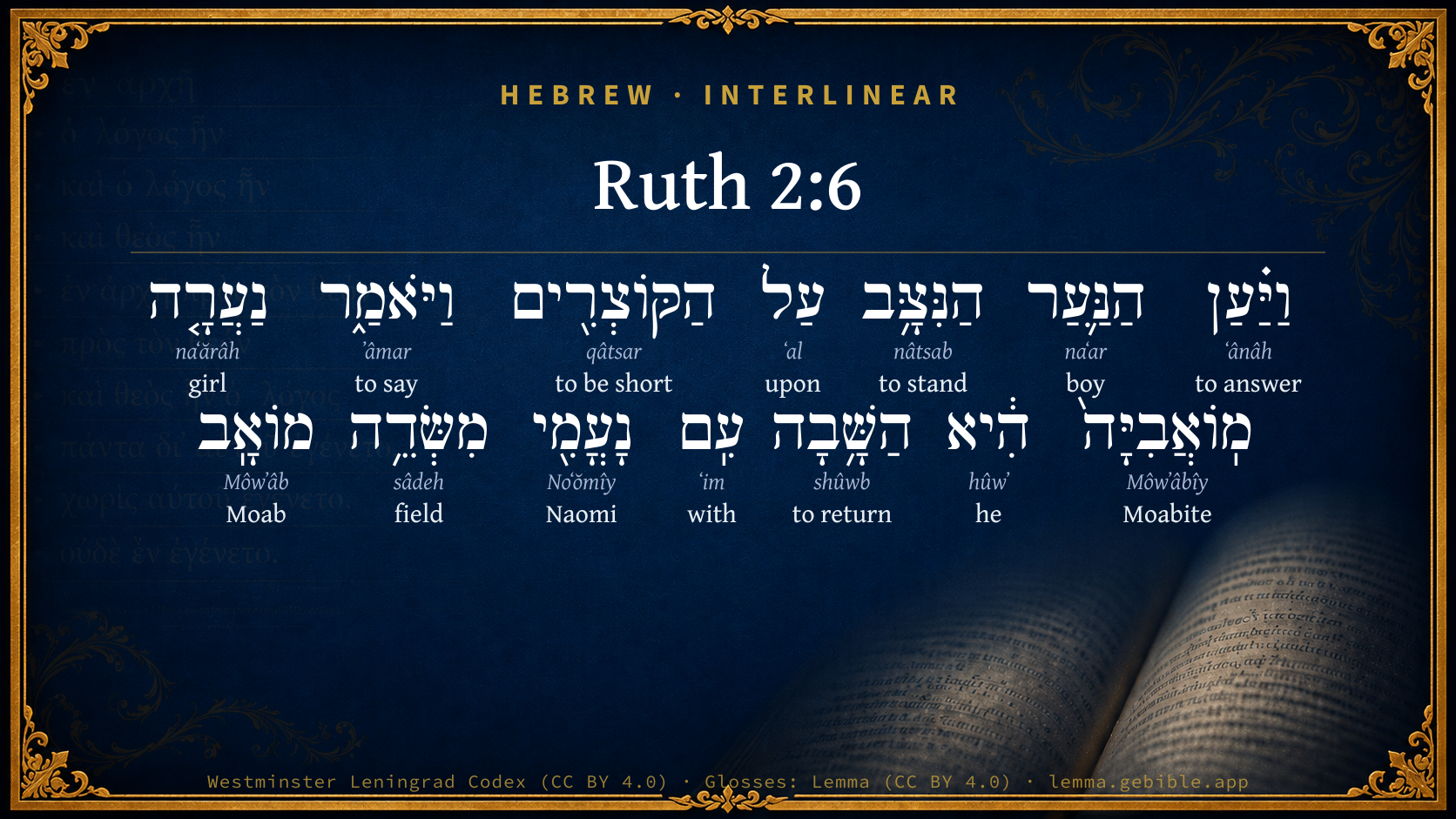
Hebrew (Westminster Leningrad Codex) Ruth 2:6 appears in the Hebrew Old Testament. The text above is from the Westminster Leningrad Codex. Each word links to its Strong’s number, a concise gloss, and parsing drawn from the Open Scriptures Hebrew Bible morphology. Click any word for its full Brown-Driver-Briggs (BDB) entry.
Download image
Cite this verse

Ruth 2:6 (World English Bible). Public Domain. Lemma interlinear Bible study tool, https://lemma.gebible.app/v/ruth/2/6.

Show BibTeX & RIS
BibTeX
RIS
English Translation
The servant who was set over the reapers answered, It is the Moabite lady who came back with Naomi out of the country of Moab:
World English Bible · Public Domain
Download a study sheet

One document with this verse’s original text, its word-by-word gloss line, the meaning frame, cross-references with their text, attributed commentary, and full source and license credits — printable, and it pastes into notes with its structure intact.

This verse Autodidact and up

Study sheet (.html) Plain text (.txt)

A passage Seminary Student

Up to 50 verses in one chapter. A passage sheet keeps up to 6 commentary sources and 12 cross-references per verse, in the order this page ranks them, and says so on the sheet whenever that leaves anything out. Ask for a single verse and you get the Autodidact verse sheet above.

Everything on this page stays free to read, with no account — the sheet is a download of what is already on screen, not access to it.

Want to remove ads? Support Godless Engineer
Compare translations 3

The same verse in 3 English versions, stacked beneath the original-language interlinear above. Click any original word for its lexicon entry.

Each is an independent rendering of the whole verse — the interlinear is not word-aligned to these translations.

Highlighted words mark where these versions differ — a whole-verse word diff, not a word-by-word alignment.

  • World English Bible Public Domain
    The servant who was set over the reapers answered, It is the Moabite lady who came back with Naomi out of the country of Moab:
  • King James Version Public Domain
    And the servant that was set over the reapers answered and said, It is the Moabitish damsel that came back with Naomi out of the country of Moab:
  • unfoldingWord Literal Text CC BY-SA 4.0
    Then the servant who was set over the reapers answered and said, “She is a young Moabite woman, the woman who came back with Naomi from the land of Moab.

unfoldingWord Literal Text — © unfoldingWord, licensed CC BY-SA 4.0. Word-aligned USFM3 via Door43 (git.door43.org/unfoldingWord/en_ult).

Versions to compare (up to 4)

3 of 4 selected

Show all 18 translations

Every available English version of this verse, each an independent rendering of the whole verse.

  • World English Bible Public Domain
    The servant who was set over the reapers answered, It is the Moabite lady who came back with Naomi out of the country of Moab:
  • Berean Standard Bible Public Domain
    The foreman answered, “She is the Moabitess who returned with Naomi from the land of Moab.
  • Majority Standard Bible Public Domain
    The foreman answered, “She is the Moabitess who returned with Naomi from the land of Moab.
  • King James Version Public Domain
    And the servant that was set over the reapers answered and said, It is the Moabitish damsel that came back with Naomi out of the country of Moab:
  • American Standard Version (1901) Public Domain
    And the servant that was set over the reapers answered and said, It is the Moabitish damsel that came back with Naomi out of the country of Moab:
  • Revised Version (1885) Public Domain
    And the servant that was set over the reapers answered and said, It is the Moabitish damsel that came back with Naomi out of the country of Moab:
  • Geneva Bible (1599) Public Domain
    And the seruant that was appointed ouer the reapers, answered, and said, It is the Moabitish maide, that came with Naomi out of the countrey of Moab:
  • Douay-Rheims (1899) Public Domain
    And he answered him: This is the Moabitess who came with Noemi, from the land of Moab,
  • Young's Literal Translation Public Domain
    And the young man who is set over the reapers answereth and saith, `A young woman -- Moabitess -- she `is', who came back with Naomi from the fields of Moab,
  • Literal Standard Version CC BY-SA 4.0
    And the young man who is set over the reapers answers and says, “A young woman—Moabitess—she [is], who came back with Naomi from the fields of Moab,
  • Unlocked Literal Bible CC BY-SA 4.0
    The servant supervising the reapers answered and said, “It is the young Moabite woman who came back with Naomi from the land of Moab.
  • unfoldingWord Literal Text CC BY-SA 4.0
    Then the servant who was set over the reapers answered and said, “She is a young Moabite woman, the woman who came back with Naomi from the land of Moab.
  • Darby Bible Public Domain
    And the servant that was set over the reapers answered and said, It is the Moabitish maiden who came back with Naomi out of the fields of Moab;
  • World Messianic Bible Public Domain
    The servant who was set over the reapers answered, “It is the Moabite lady who came back with Naomi out of the country of Moab.
  • Webster's Bible Public Domain
    And the servant that was set over the reapers answered and said, It is the Moabitish damsel that came back with Naomi from the country of Moab:
  • Free Bible Version CC BY-SA 4.0
    “The young woman is a Moabite who came back with Naomi from Moab,” the servant replied.
  • Bible in Basic English Public Domain
    And the servant who was in authority over the cutters said, It is a Moabite girl who came back with Naomi out of the country of Moab;
  • JPS Tanakh (1917) Public Domain
    And the servant that was set over the reapers answered and said: 'It is a Moabitish damsel that came back with Naomi out of the field of Moab;

Literal Standard Version (2020), Covenant Press — licensed CC BY-SA 4.0. Text via the HelloAO Bible API (eBible.org). Unlocked Literal Bible (unfoldingWord) — licensed CC BY-SA 4.0. Text via the HelloAO Bible API (eBible.org). unfoldingWord Literal Text — © unfoldingWord, licensed CC BY-SA 4.0. Word-aligned USFM3 via Door43 (git.door43.org/unfoldingWord/en_ult). Free Bible Version, Dr. Jonathan Gallagher — licensed CC BY-SA 4.0. Text via the HelloAO Bible API (eBible.org).

Word by word

More ways to search: Search by grammar → Find every occurrence → Compare this word →

Practice this passage: Drill this verse → Learn its vocabulary →

מֽוֹאֲבִיָּה֙
Môwʼâbîy
H4125
“Moabite”
Noun, Gentilic, Feminine, Singular, Absolute
Part of Speech
Noun
Type
Gentilic
Gender
Feminine
Number
Singular
State
Absolute
Full BDB Definition

Origin: patronymical from H4124

TWOT: 1155a

Moabite = "from father: what father?" - an citizen of Moab - an inhabitant of the land of Moab
  1. וַיַּ֗עַן ʻânâh H6030 “and · to answer” Conjunction + Verb, Qal, Sequential Imperfect, 3rd Person, Masculine, Singular
  2. הַנַּ֛עַר naʻar H5288 “the · boy” Particle, Definite Article + Noun, Common, Masculine, Singular, Absolute
  3. הַנִּצָּ֥ב nâtsab H5324 “the · standing” Particle, Definite Article + Verb, Niphal, Participle Active, Masculine, Singular, Absolute
  4. עַל ʻal H5921 “upon” Preposition
  5. הַקּוֹצְרִ֖ים qâtsar H7114 “the · being short” Particle, Definite Article + Verb, Qal, Participle Active, Masculine, Plural, Absolute
  6. וַיֹּאמַ֑ר ʼâmar H559 “and · to say” Conjunction + Verb, Qal, Sequential Imperfect, 3rd Person, Masculine, Singular
  7. נַעֲרָ֤ה naʻărâh H5291 “girl” Noun, Common, Feminine, Singular, Absolute
  8. הִ֔יא hûwʼ H1931 “he” Pronoun, Personal, 3rd Person, Feminine, Singular
  9. הַשָּׁ֥בָה shûwb H7725 “the · returning” Particle, Definite Article + Verb, Qal, Participle Active, Feminine, Singular, Absolute
  10. עִֽם ʻim H5973 “with” Preposition
  11. נָעֳמִ֖י Noʻŏmîy H5281 “Naomi” Noun, Proper
  12. מִשְּׂדֵ֥ה sâdeh H7704 “from · field of” Preposition + Noun, Common, Masculine, Singular, Construct
  13. מוֹאָֽב Môwʼâb H4124 “Moab” Noun, Proper

About this verse

These counts appear in no published source. They are computed here, from the morphology-tagged text and Lemma’s own curated glosses. What Lemma adds →

14
words
14
distinct lemmas
Historical
section

Notable vocabulary

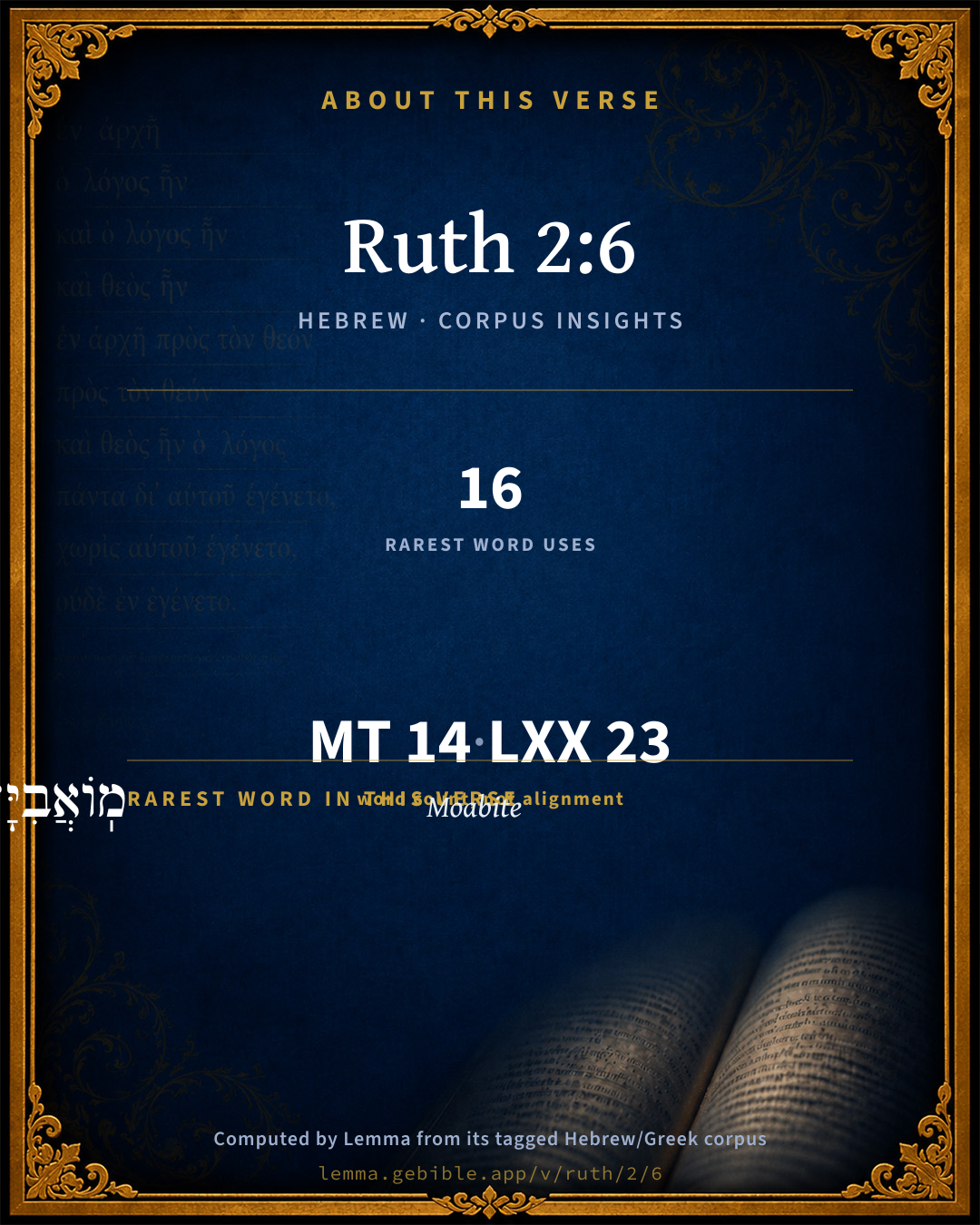
The rarest word here is מֽוֹאֲבִיָּה֙ Moabite H4125 — appearing just 16 times in the whole Hebrew Bible.

Shared distinctive vocabulary

מֽוֹאֲבִיָּה֙ Moabite H4125 occurs in 16 verses of the Hebrew Bible. Also found in:

Grammatical profile

  • 5 verbs
  • 6 nouns
  • 1 pronoun
  • 2 prepositions

Verb forms

  • וַיַּ֗עַן Qal · Sequential Imperfect
  • הַנִּצָּ֥ב Niphal · Participle Active
  • הַקּוֹצְרִ֖ים Qal · Participle Active
  • וַיֹּאמַ֑ר Qal · Sequential Imperfect
  • הַשָּׁ֥בָה Qal · Participle Active

Hebrew & Septuagint length

In English translation the verse runs 25 words from the Hebrew and 27 from the Septuagint (LXX English) — closely comparable.

A rough comparison of the two English renderings, which tokenize alike — not a word-level alignment.

Word counts can differ between the Hebrew and the Greek without any difference in meaning — e.g. the Hebrew direct-object marker אֵת has no separate Greek word, and Greek often adds the article ὁ.

In the original languages it is 14 Hebrew tokens and 23 Greek tokens — but the two are counted differently (Hebrew bundles its prefixes and suffixes into one token; the Greek is in lemma form), so that isn’t a like-for-like length.

Cross-references

8

Topical passages linked to Ruth 2:6 in the Treasury of Scripture Knowledge — connected by theme and wording, ordered by reader-vote popularity; previews shown in the World English Bible.

  • Ruth 1:22 So Naomi returned, and Ruth the Moabitess, her daughter-in-law, with her, who returned out of the country of Moab: and they came to Bethlehem in the beginning of barley harvest.
  • Matthew 24:45 "Who then is the faithful and wise servant, whom his lord has set over his household, to give them their food in due season?
  • Genesis 15:2 Abram said, "Lord Yahweh, what will you give me, seeing I go childless, and he who will inherit my estate is Eliezer of Damascus?"
  • Genesis 24:2 Abraham said to his servant, the elder of his house, who ruled over all that he had, "Please put your hand under my thigh.
  • Genesis 39:4 Joseph found favor in his sight. He ministered to him, and he made him overseer over his house, and all that he had he put into his hand.
  • Ruth 1:16 Ruth said, "Don't entreat me to leave you, and to return from following after you, for where you go, I will go; and where you lodge, I will lodge; your people shall be my people, and your God my God;
  • Ruth 1:19 So they two went until they came to Bethlehem. It happened, when they were come to Bethlehem, that all the city was moved about them, and [the women] said, Is this Naomi?
  • Matthew 20:8 When evening had come, the lord of the vineyard said to his steward, 'Call the laborers and pay them their wages, beginning from the last to the first.'

Cross-references courtesy of OpenBible.info (CC BY 4.0).

Hebrew and Greek witnesses Masoretic Hebrew ↔ Greek Septuagint

The same verse in the two great witnesses to the Old Testament, shown verse-for-verse.

These are two independent witnesses, not word-aligned to each other, and the Septuagint is shown in lemma (dictionary) form.

Hebrew Ruth 2:6 Masoretic · Westminster Leningrad Codex

וַיַּ֗עַן הַנַּ֛עַר הַנִּצָּ֥ב עַל הַקּוֹצְרִ֖ים וַיֹּאמַ֑ר נַעֲרָ֤ה מֽוֹאֲבִיָּה֙ הִ֔יא הַשָּׁ֥בָה עִֽם נָעֳמִ֖י מִשְּׂדֵ֥ה מוֹאָֽב

The servant who was set over the reapers answered, It is the Moabite lady who came back with Naomi out of the country of Moab:

World English Bible · Public Domain

Greek LXX Ruth 2:6 Septuagint · lemma form

καί ἀποκρίνω ὁ παιδάριον ὁ ἐπιἵστημι ἐπί ὁ θερίζω καί εἶπον ὁ παῖς ὁ μωαβῖτις εἰμί ὁ ἀποστρέφω μετά νωεμιν ἐκ ἀγρός μωαβ

And his servant who was set over the reapers answered and said, It is the Moabitish damsel who returned with Noemin out of the land of Moab.

LXX2012 (modern English Septuagint) · Public Domain

Hebrew: Westminster Leningrad Codex (CC BY 4.0). Greek: Septuagint (public domain); English from LXX2012 (modern English Septuagint) (Public Domain). How the Septuagint differs from the Hebrew →

Commentary

Notes on Ruth 2:6 from classic Christian and Jewish commentators (each source and its license shown beneath its notes). The classic Christian expositions comment on the surrounding passage and are grouped to its opening verse, so a note may address several verses; the Jewish commentaries on the Tanakh (Rashi and others) are per-verse, so they appear only where the commentator wrote on this verse.

Lemma curates 59 commentaries, every one of them public domain or Creative Commons licensed, each selected and text-cleaned for this edition rather than reprinted as found. About our sources →

Trapp's Complete Commentary

John Trapp

Rth 2:6 And the servant that was set over the reapers answered and said, It [is] the Moabitish damsel that came back with Naomi out of the country of Moab:

Ver. 6. And the servant.] He gives a ready answer, a good account, Rationem cum domino crebro putet, saith Cato {a} concerning a steward.

It is the Moabitish damsel.] He commendeth her for her virtues, little thinking that shortly she should be his mistress. This was fair, and not ordinary. Vituperant homines quam collaudant promptius. Malignity and morosity reigneth everywhere.

{a} De Re Rust, cap. v.

John Trapp, A Commentary or Exposition upon All the Books of the Old and New Testament (1647–1656) — public domain. Text from a community e-Sword module.

Ellicott's Commentary for English Readers

(6, 7) The steward gives a detailed account of Ruth. She is “the (rather “a”) Moabitish damsel,” she is a foreigner [as such she had a special claim to the gleaning, Lev_19:9-10]. She is the daughter-in-law of Naomi; and he adds that her behaviour has been praiseworthy, for she asked leave before beginning to glean, and she has worked hard all day, save for a short interval of rest. It would seem that Boaz’s visit to the field fell at the time when Ruth was thus resting: “This is her tarrying for a little in the house”; apparently, that is, some rude shelter from the heat set up in the field, like the lodge of Isa_1:8.

A Bible Commentary for English Readers, edited by Charles John Ellicott (1878–1897) — public domain. Text from a community e-Sword module.

John Gill's Exposition

And the servant that was set over the reapers answered and said,.... Who had taken a great deal of notice of Ruth, and had conversed with her, and so was capable of giving answers to his master's question:

it is the Moabitish damsel that came back with Naomi, out of the country of Moab; perhaps he had not got knowledge of her name, and therefore only describes her by the country from whence she came; and by her coming from thence along with Naomi, when she returned from Moab, with whose name Boaz was well acquainted, and of whose return he had been informed; and perhaps had seen her in person, and even Ruth also, though he might have forgot her; the Targum makes the servant to add, that she was become a proselytess.

John Gill's Exposition of the Whole Bible (1746–1763) — public domain (CC PDM 1.0). Text via the HelloAO Bible API.

Matthew Poole's English Annotations

i.e. That came with Naomi when she came back; for otherwise, as Ruth did not go from thence, so she could not properly be said to come back.

Matthew Poole's English Annotations on the Holy Bible (1683–1685) — public domain. Text from a community e-Sword/MySword module.

Whedon's Commentary on the Bible

Daniel D. Whedon

6. The Moabitish damsel — Boaz had heard of her, and had been much interested in her history, (Rth_2:11,) but he had not seen her before, so that this was their first meeting.

Daniel D. Whedon (gen. ed.), Commentary on the Old and New Testaments (1874–1909) — public domain. Text from a community e-Sword module.

The Pulpit Commentary

And the young man who was set over the reapers replied and said, She is a Moabitish young woman who returned with Naomi from the land of Moab. The young man had already received, no doubt from her own lips, particulars regarding the attractive stranger. Instead of the free definitive rendering of Luther and King James"s English version, the Moabitish damsel," it is better, with Michaelis, Wright, Raabe, to adhere to the original indefiniteness, "a Moabitish maiden." Note the Zeugmatic use of the word returned as applied here, as well as in Rth_1:22, not only to Naomi, but also to Ruth. It is thus used on the same Zeugmatic principle as the word die in Gen_47:19: "Wherefore shall we die before thine eyes, both we and our land?"

The Pulpit Commentary (1880–1919), ed. H.D.M. Spence-Jones & Joseph S. Exell — public domain. Text from a community e-Sword module.

Rashi

Rabbi Shlomo Yitzchaki (Rashi)

who returned with Naomi The accent is under the “shin” because it is the past tense, and not the present tense of the verb.

Rashi on the Tanakh — English translations: “The Judaica Press complete Tanach with Rashi, translated by A. J. Rosenberg” (CC BY 4.0); “Pentateuch with Rashi's commentary by M. Rosenbaum and A.M. Silbermann, 1929-1934” (public domain); “The Metsudah Tanach series, Lakewood, N.J” (CC BY 4.0); and “The Book of Joshua, Metsudah Publications, 1997” (CC BY 4.0). Text via Sefaria.

Lesson kit

Teaching starters — assembled from the data on this page, not authored interpretation. Every prompt links to the verse data it draws on. Edit before teaching.

Ruth, in the Historical, opens this verse with 14 words (14 distinct Hebrew lemmas). Its most distinctive word is Môwʼâbîy (“Moabite”). A historical commentator’s framing appears above. Read the whole chapter for the surrounding context.

Discussion questions

  1. How does “Moabite” (Môwʼâbîy) shape what this verse is saying?
  2. How does Deuteronomy 2:11, which shares the word «Moabite», read alongside this verse?
  3. The translations on this page render this verse differently — a whole-verse word diff, not a word-by-word alignment. What might account for the different wordings?
  4. «וַיַּ֗עַן» is a Qal Sequential Imperfect verb. How does that grammatical form shape the action described?
  5. Compare how Trapp's Complete Commentary and Ellicott's Commentary for English Readers read this verse. Where do they agree or differ?

Things to notice

Reading settings

Reading text

Shown beneath each verse's original-language words.

Old Testament
Old Testament edition

Read the OT as the Masoretic Hebrew (MT) or the Greek Septuagint (LXX).

English shown for the Greek Septuagint (in the Hebrew ↔ Greek comparison).

Comparing translations? Open the Compare panel on any verse page to stack up to four side by side.