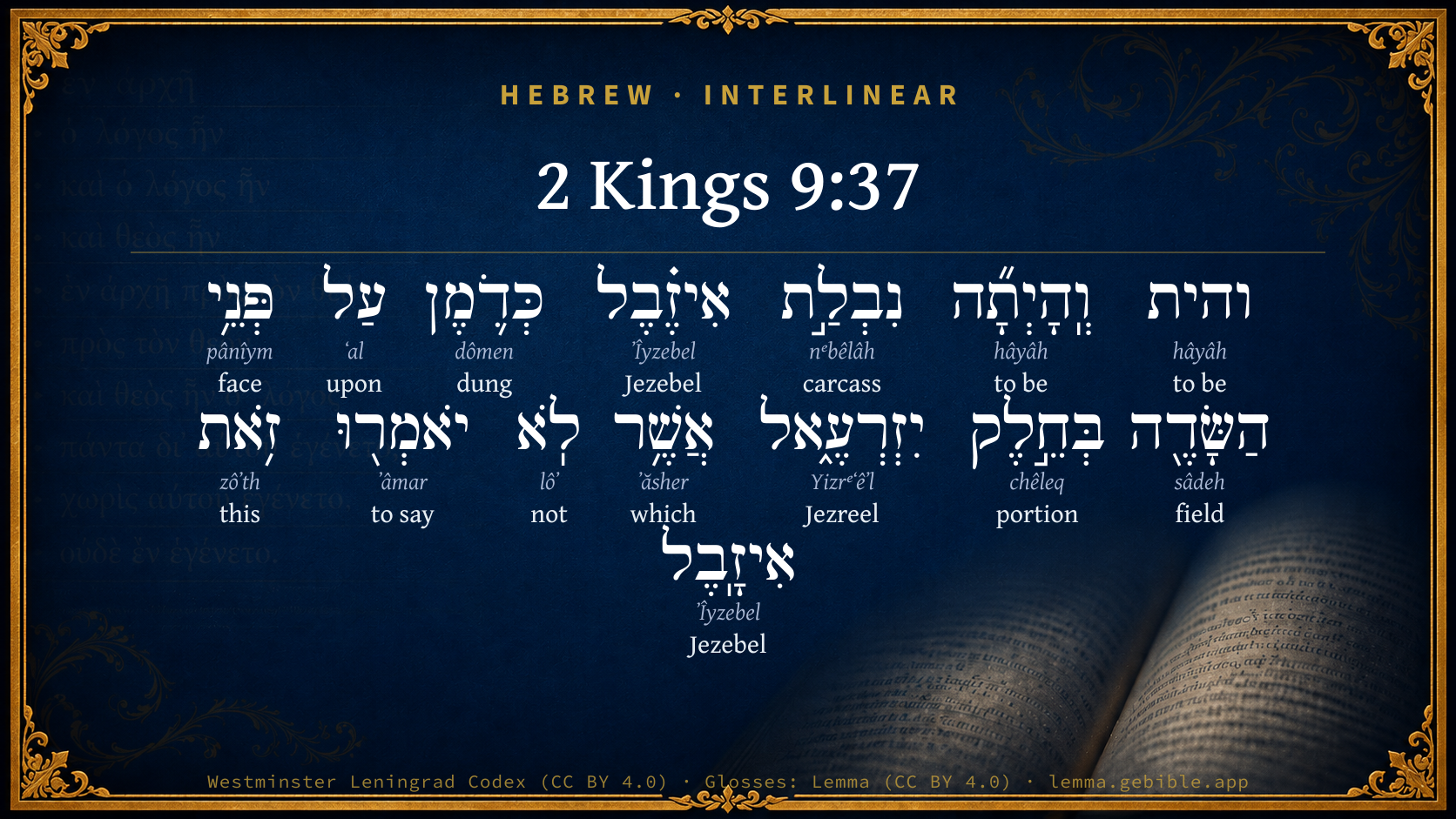
2 Kings 9:37

Hebrew (Westminster Leningrad Codex) 2 Kings 9:37 appears in the Hebrew Old Testament. The text above is from the Westminster Leningrad Codex. Each word links to its Strong’s number, a concise gloss, and parsing drawn from the Open Scriptures Hebrew Bible morphology. Click any word for its full Brown-Driver-Briggs (BDB) entry.
Download image
Cite this verse

2 Kings 9:37 (World English Bible). Public Domain. Lemma interlinear Bible study tool, https://lemma.gebible.app/v/2-kings/9/37.

Show BibTeX & RIS
BibTeX
RIS
English Translation
and the body of Jezebel shall be as dung on the face of the field in the portion of Jezreel, so that they shall not say, This is Jezebel.
World English Bible · Public Domain
Highlights
  • 1 first appearance in the Hebrew Bible
Full analysis ↓
Download a study sheet

One document with this verse’s original text, its word-by-word gloss line, the meaning frame, cross-references with their text, attributed commentary, and full source and license credits — printable, and it pastes into notes with its structure intact.

This verse Autodidact and up

Study sheet (.html) Plain text (.txt)

A passage Seminary Student

Up to 50 verses in one chapter. A passage sheet keeps up to 6 commentary sources and 12 cross-references per verse, in the order this page ranks them, and says so on the sheet whenever that leaves anything out. Ask for a single verse and you get the Autodidact verse sheet above.

Everything on this page stays free to read, with no account — the sheet is a download of what is already on screen, not access to it.

Want to remove ads? Support Godless Engineer
Compare translations 3

The same verse in 3 English versions, stacked beneath the original-language interlinear above. Click any original word for its lexicon entry.

Each is an independent rendering of the whole verse — the interlinear is not word-aligned to these translations.

Highlighted words mark where these versions differ — a whole-verse word diff, not a word-by-word alignment.

  • World English Bible Public Domain
    and the body of Jezebel shall be as dung on the face of the field in the portion of Jezreel, so that they shall not say, This is Jezebel.
  • King James Version Public Domain
    And the carcass of Jezebel shall be as dung upon the face of the field in the portion of Jezreel; so that they shall not say, This is Jezebel.
  • unfoldingWord Literal Text CC BY-SA 4.0
    and the corpse of Jezebel will be like dung on the face of a field in the portion of Jezreel, that they will not say, “This is Jezebel.”’”

unfoldingWord Literal Text — © unfoldingWord, licensed CC BY-SA 4.0. Word-aligned USFM3 via Door43 (git.door43.org/unfoldingWord/en_ult).

Versions to compare (up to 4)

3 of 4 selected

Show all 18 translations

Every available English version of this verse, each an independent rendering of the whole verse.

  • World English Bible Public Domain
    and the body of Jezebel shall be as dung on the face of the field in the portion of Jezreel, so that they shall not say, This is Jezebel.
  • Berean Standard Bible Public Domain
    And Jezebel’s body will lie like dung in the field on the plot of ground at Jezreel, so that no one can say: This is Jezebel.’”
  • Majority Standard Bible Public Domain
    And Jezebel’s body will lie like dung in the field on the plot of ground at Jezreel, so that no one can say: This is Jezebel.’”
  • King James Version Public Domain
    And the carcass of Jezebel shall be as dung upon the face of the field in the portion of Jezreel; so that they shall not say, This is Jezebel.
  • American Standard Version (1901) Public Domain
    and the body of Jezebel shall be as dung upon the face of the field in the portion of Jezreel, so that they shall not say, This is Jezebel.
  • Revised Version (1885) Public Domain
    and the carcase of Jezebel shall be as dung upon the face of the field in the portion of Jezreel; so that they shall not say, This is Jezebel.
  • Geneva Bible (1599) Public Domain
    And the carkeis of Iezebel shalbe as doung vpon the ground in the field of Izreel, so that none shall say, This is Iezebel.
  • Douay-Rheims (1899) Public Domain
    And the flesh of Jezabel shall be as dung upon the face of the earth in the field of Jezrahel, so that they who pass by shall say: Is this that same Jezabel?
  • Young's Literal Translation Public Domain
    and the carcase of Jezebel hath been as dung on the face of the field in the portion of Jezreel, that they say not, This `is' Jezebel.'
  • Literal Standard Version CC BY-SA 4.0
    and the carcass of Jezebel has been as dung on the face of the field in the portion of Jezreel, that they do not say, This [is] Jezebel.”
  • Unlocked Literal Bible CC BY-SA 4.0
    and the body of Jezebel will be like dung on the surface of the fields in the land at Jezreel, so that no one will be able to say, “This is Jezebel.”'”
  • unfoldingWord Literal Text CC BY-SA 4.0
    and the corpse of Jezebel will be like dung on the face of a field in the portion of Jezreel, that they will not say, “This is Jezebel.”’”
  • Darby Bible Public Domain
    and the carcase of Jezebel shall be as dung upon the open field in the plot of Jizreel, so that they shall not say, This is Jezebel.
  • World Messianic Bible Public Domain
    and the body of Jezebel will be as dung on the surface of the field on Jezreel’s land, so that they won’t say, “This is Jezebel.”’”
  • Webster's Bible Public Domain
    And the carcass of Jezebel shall be as dung upon the face of the field in the portion of Jezreel; so that they shall not say, This is Jezebel.
  • Free Bible Version CC BY-SA 4.0
    Jezebel's body will lie like manure in the field on the plot of ground at Jezreel, so that no one can say: This is where Jezebel is buried.’”
  • Bible in Basic English Public Domain
    And the dead body of Jezebel will be like waste dropped on the face of the earth in the heritage of Jezreel; so that they will not be able to say, This is Jezebel.
  • JPS Tanakh (1917) Public Domain
    and the carcass of Jezebel shall be as dung upon the face of the field in the portion of Jezreel; so that they shall not say: This is Jezebel.'

Literal Standard Version (2020), Covenant Press — licensed CC BY-SA 4.0. Text via the HelloAO Bible API (eBible.org). Unlocked Literal Bible (unfoldingWord) — licensed CC BY-SA 4.0. Text via the HelloAO Bible API (eBible.org). unfoldingWord Literal Text — © unfoldingWord, licensed CC BY-SA 4.0. Word-aligned USFM3 via Door43 (git.door43.org/unfoldingWord/en_ult). Free Bible Version, Dr. Jonathan Gallagher — licensed CC BY-SA 4.0. Text via the HelloAO Bible API (eBible.org).

Word by word

More ways to search: Search by grammar → Find every occurrence → Compare this word →

Practice this passage: Drill this verse → Learn its vocabulary →

כְּדֹ֛מֶן
dômen
H1828
“like/as · dung”
Preposition + Noun, Common, Masculine, Singular, Absolute
Part of Speech
Preposition + Noun
Type
Common
Gender
Masculine
Number
Singular
State
Absolute
Full BDB Definition

Origin: of uncertain derivation

TWOT: 441a

dung (always of corpses) (figuratively)
  1. והית hâyâh H1961 “and · to be” Conjunction + Verb, Qal, Sequential Perfect, 3rd Person, Feminine, Singular
  2. וְֽהָיְתָ֞ה hâyâh H1961 “and · to be” Conjunction + Verb, Qal, Sequential Perfect, 3rd Person, Feminine, Singular
  3. נִבְלַ֣ת nᵉbêlâh H5038 “carcass of” Noun, Common, Feminine, Singular, Construct
  4. אִיזֶ֗בֶל ʼÎyzebel H348 “Jezebel” Noun, Proper
  5. עַל ʻal H5921 “upon” Preposition
  6. פְּנֵ֥י pânîym H6440 “face(s) of” Noun, Common, Both, Plural, Construct
  7. הַשָּׂדֶ֖ה sâdeh H7704 “the · field” Particle, Definite Article + Noun, Common, Masculine, Singular, Absolute
  8. בְּחֵ֣לֶק chêleq H2506 “in/at · portion of” Preposition + Noun, Common, Masculine, Singular, Construct
  9. יִזְרְעֶ֑אל Yizrᵉʻêʼl H3157 “Jezreel” Noun, Proper
  10. אֲשֶׁ֥ר ʼăsher H834 “which” Particle, Relative
  11. לֹֽא lôʼ H3808 “not” Particle, Negative
  12. יֹאמְר֖וּ ʼâmar H559 “to say” Verb, Qal, Imperfect, 3rd Person, Masculine, Plural
  13. זֹ֥את zôʼth H2063 “this” Pronoun, Demonstrative, Feminine, Singular
  14. אִיזָֽבֶל ʼÎyzebel H348 “Jezebel” Noun, Proper

About this verse

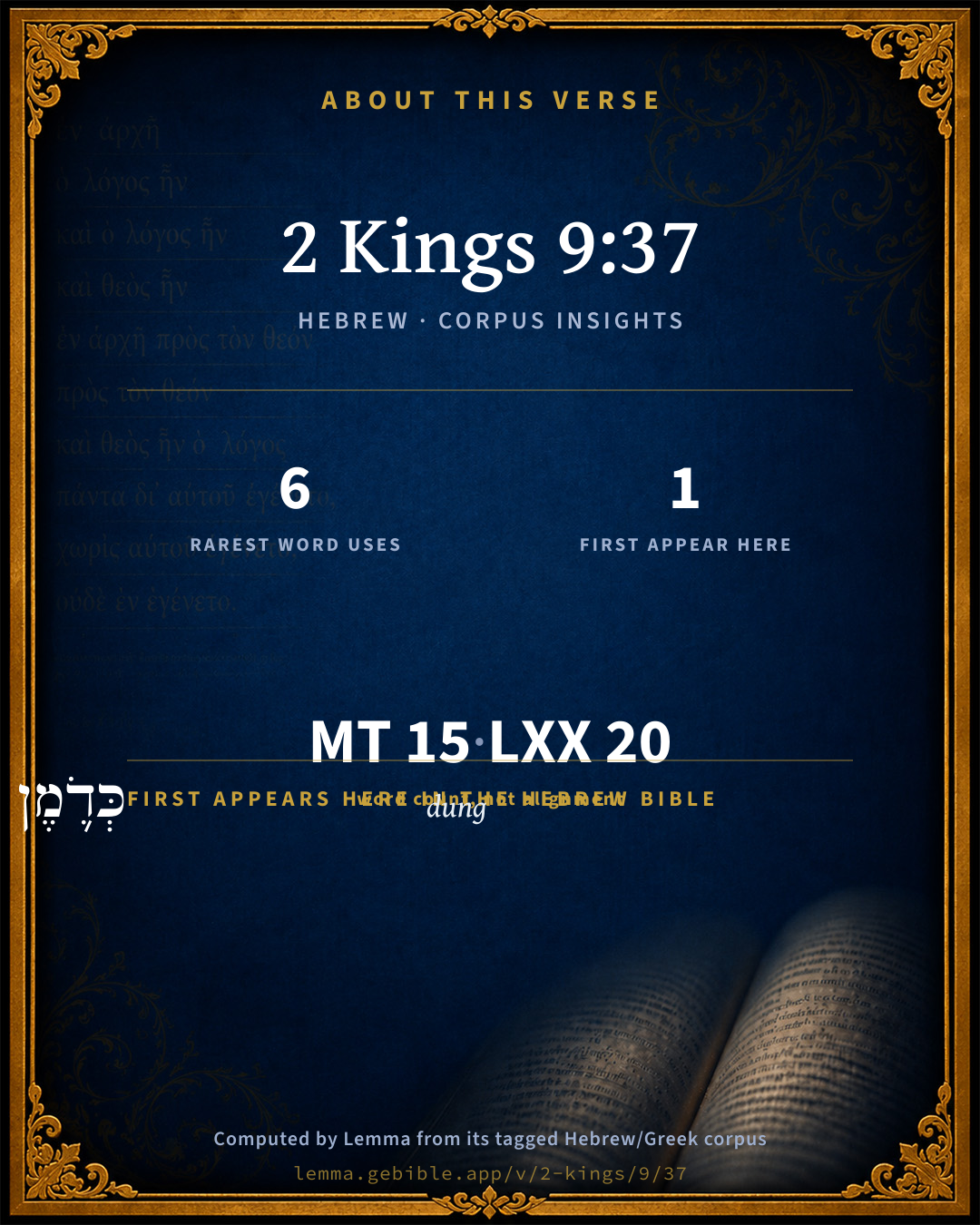
These counts appear in no published source. They are computed here, from the morphology-tagged text and Lemma’s own curated glosses. What Lemma adds →

15
words
13
distinct lemmas
Historical
section

Notable vocabulary

The rarest word here is כְּדֹ֛מֶן dung H1828 — appearing just 6 times in the whole Hebrew Bible.

First appearance in Scripture

This word makes its first canonical appearance in the Hebrew Bible here:

  • כְּדֹ֛מֶן dung H1828

Shared distinctive vocabulary

כְּדֹ֛מֶן dung H1828 occurs in 6 verses of the Hebrew Bible. Also found in:

Grammatical profile

  • 3 verbs
  • 8 nouns
  • 1 pronoun
  • 1 preposition
  • 2 particles

Verb forms

  • והית Qal · Sequential Perfect
  • וְֽהָיְתָ֞ה Qal · Sequential Perfect
  • יֹאמְר֖וּ Qal · Imperfect

Repetition

Words recur within this verse — often emphatic in Hebrew:

  • והית to be H1961 ×2
  • אִיזֶ֗בֶל Jezebel H348 ×2

Hebrew & Septuagint length

In English translation the verse runs 29 words from the Hebrew and 29 from the Septuagint (LXX English) — the same length.

A rough comparison of the two English renderings, which tokenize alike — not a word-level alignment.

Word counts can differ between the Hebrew and the Greek without any difference in meaning — e.g. the Hebrew direct-object marker אֵת has no separate Greek word, and Greek often adds the article ὁ.

In the original languages it is 15 Hebrew tokens and 20 Greek tokens — but the two are counted differently (Hebrew bundles its prefixes and suffixes into one token; the Greek is in lemma form), so that isn’t a like-for-like length.

Cross-references

10

Topical passages linked to 2 Kings 9:37 in the Treasury of Scripture Knowledge — connected by theme and wording, ordered by reader-vote popularity; previews shown in the World English Bible.

  • Jeremiah 8:2 and they shall spread them before the sun, and the moon, and all the host of the sky, which they have loved, and which they have served, and after which they have walked, and which they have sought, and which they have worshiped: they shall not be gathered, nor be buried, they shall be for dung on the surface of the earth.
  • Psalms 83:10 Who perished at Endor, Who became as dung for the earth.
  • Jeremiah 16:4 They shall die grievous deaths: they shall not be lamented, neither shall they be buried; they shall be as dung on the surface of the ground; and they shall be consumed by the sword, and by famine; and their dead bodies shall be food for the birds of the sky, and for the animals of the earth.
  • Ecclesiastes 6:3 If a man fathers a hundred children, and lives many years, so that the days of his years are many, but his soul is not filled with good, and moreover he has no burial; I say, that an untimely birth is better than he:
  • Isaiah 14:18–20 All the kings of the nations, all of them, sleep in glory, everyone in his own house.
  • Jeremiah 9:22 Speak, Thus says Yahweh, The dead bodies of men shall fall as dung on the open field, and as the handful after the harvester; and none shall gather [them].
  • Jeremiah 22:19 He shall be buried with the burial of a donkey, drawn and cast forth beyond the gates of Jerusalem.
  • Jeremiah 25:33 The slain of Yahweh shall be at that day from one end of the earth even to the other end of the earth: they shall not be lamented, neither gathered, nor buried; they shall be dung on the surface of the ground.
  • Jeremiah 36:20 They went in to the king into the court; but they had laid up the scroll in the chamber of Elishama the scribe; and they told all the words in the ears of the king.
  • Ezekiel 32:23–30 whose graves are set in the uttermost parts of the pit, and her company is round about her grave; all of them slain, fallen by the sword, who caused terror in the land of the living.

Cross-references courtesy of OpenBible.info (CC BY 4.0).

Hebrew and Greek witnesses Masoretic Hebrew ↔ Greek Septuagint

The same verse in the two great witnesses to the Old Testament, shown verse-for-verse.

These are two independent witnesses, not word-aligned to each other, and the Septuagint is shown in lemma (dictionary) form.

Hebrew 2 Kings 9:37 Masoretic · Westminster Leningrad Codex

והית וְֽהָיְתָ֞ה נִבְלַ֣ת אִיזֶ֗בֶל כְּדֹ֛מֶן עַל פְּנֵ֥י הַשָּׂדֶ֖ה בְּחֵ֣לֶק יִזְרְעֶ֑אל אֲשֶׁ֥ר לֹֽא יֹאמְר֖וּ זֹ֥את אִיזָֽבֶל

and the body of Jezebel shall be as dung on the face of the field in the portion of Jezreel, so that they shall not say, This is Jezebel.

World English Bible · Public Domain

Greek LXX 2 Kings 9:37 Septuagint · lemma form

καί εἰμί ὁ θνησιμαῖος ιεζαβελ ὡς κοπρία ἐπί πρόσωπον ὁ ἀγρός ἐν ὁ μερίς ιεζραελ ὥστε μή εἶπον αὐτός ιεζαβελ

And the carcass of Jezabel shall be as dung on the face of the field in the portion of Jezrael, so that they shall not say, This is Jezabel.

LXX2012 (modern English Septuagint) · Public Domain

On this verse, Haydock's Catholic Bible Commentary discusses the Septuagint’s reading. Read the note in Commentary ↓

Hebrew: Westminster Leningrad Codex (CC BY 4.0). Greek: Septuagint (public domain); English from LXX2012 (modern English Septuagint) (Public Domain). How the Septuagint differs from the Hebrew →

Targum (Aramaic paraphrase)

1

The Targum is the ancient Jewish Aramaic paraphrase of the Hebrew Scriptures — an interpretive translation, not the Hebrew text itself. Onkelos (literal) and Pseudo-Jonathan (expansive) render the Torah, and Jonathan the Prophets. Coverage is partial: where no permissively-licensed English translation exists for a verse, only the Aramaic is shown. This is verse-level text, not a word-by-word alignment to the Hebrew.

  1. Targum Jonathan Prophets (Joshua–Malachi)
    וּתְהֵי נְבֵילְתָּא דְאִיזֶבֶל כְּזֶבֶל מְבַדַר עַל אַפֵּי חַקְלָא בְּאַחֲסָנַת יִזְרְעֶאל דְלָא יֵימְרוּן דָא אִיזֶבֶל:

    (no public-domain English translation for this verse)

    Targum Jonathan — Aramaic: “Mikraot Gedolot” (public domain). English: “Sefaria Community Translation” (CC0 1.0 (public-domain dedication)); “London "Chaldee Paraphrase," 1871” (public domain). Text via Sefaria.

Commentary

Notes on 2 Kings 9:37 from classic Christian and Jewish commentators (each source and its license shown beneath its notes). The classic Christian expositions comment on the surrounding passage and are grouped to its opening verse, so a note may address several verses; the Jewish commentaries on the Tanakh (Rashi and others) are per-verse, so they appear only where the commentator wrote on this verse.

Lemma curates 59 commentaries, every one of them public domain or Creative Commons licensed, each selected and text-cleaned for this edition rather than reprinted as found. About our sources →

Trapp's Complete Commentary

John Trapp

2Ki 9:37 And the carcase of Jezebel shall be as dung upon the face of the field in the portion of Jezreel; [so] that they shall not say, This [is] Jezebel.

Ver. 37. Shall be as dung.] Here seemeth to be an allusion to the etymology of her name. Jezebel is the same with E-zebel, that is, where is the dung? or, Je-zebel, that is, the island of dung, or, woe to the dung. {a} The devil is from the same root called in the gospel Beelzebul, the lord of dung, or, a dunghill deity. Iezebel, idem est quod vanitatis profluvium, saith Ambrose, vel vana et vacua redundantia, the superfluity of naughtiness.

So that they shall not say, This is Jezebel.] Katherine de Medici, queen mother of France, after she had for thirty years’ space wonderfully troubled that kingdom, died ingloriously, and as wishedly as she had lived wickedly and dissolutely,

“ Plenaque fraudis anus. ”

{a} Pagnin.

John Trapp, A Commentary or Exposition upon All the Books of the Old and New Testament (1647–1656) — public domain. Text from a community e-Sword module.

The Biblical Illustrator

Joseph S. Exell

2Ki_9:37

And the carcase of Jezebel shall be as dung upon the face of the field.

The fruits of perfect sin

1. Jezebels is the character of one complete in evil. She enters the stage of human events in the fulness of her wickedness. She does not come before our notice till she has passed through all the stages of early conviction, strife with conscience, and sometimes of the warnings of a better nature. She is one whom savages would pronounce wicked, and from whom they would start as a dangerous member of even their social body. There are some who are brought before us in this way in life, as if the curtain were suddenly drawn up, and they were presented to the eye for the first time in their full development. We have been allowed to see none of the inward workings, none of the early struggle and strife. All this has gone on between themselves and God alone. His eye only has noticed, and His hand recorded the gages, challenges, and contests between the tempter and the sinner. We see but the end of the conflict. We perceive only the conqueror standing forward flushed with his success, and the ranks of the vanquished receding into the far distance on either side, like the forms of beautiful dreams scared by the breaking in of morning light. In the great portrait gallery of Holy Scripture no one is found exactly like her. She stands individually distinctive and terrible.

2. Here is her history. Ahab is mentioned as coming to the throne of Samaria nine hundred and eighteen years before Christ. The marriage with Jezebel is mentioned as a decided step in evil in Ahab, and is clearly connected with his idolatry. The next mention of her is her desire and effort to kill all the prophets of the Lord, and Obadiahs success in saving them. Then came the denunciation of God upon Jezebel, and the prophecy of her being eaten of dogs in the portion of Jezreel There is a pause in her history, and we hear no more of the queen-mother during the reign of Ahabs successor. The wicked king had sunk to his doomed grave. But she, the author and abettor of his sinfulness, lived on. Her end is the next and last circumstance of her life; very terrible. She comes out again with her old characteristic. The long pause in which she has been withdrawn from observation has made no change in her character save to stereotype all old failings, and gnarl into her form the sins of her earlier days. Shameless and barefaced in her iniquity, she looked out for admiration from the very man who was returning as a conqueror over her husbands race.

3. There are certain features which belong to the thoroughly wicked person, and the approach to those characteristics may always excite alarm and anxiety. The principal points about Jezebel are these. A woman holding an evil influence over her husband, and turning her pertinacity and vigour of practical energy and power into the pursuit of the line in which the man hesitated. The wicked woman has an energy of evil which makes her far worse than the man. Her persecution of God and good men. Her casting in her lot with the wicked and the profligate. Her unflinching and unhesitating profligacy in the destruction of Naboth. Her raillery of the king. Her vanity overcoming in the end of life all other feelings, natural or not.

(1) I mentioned the first which was visible in Jezebel. Her decided and unhesitating influence over Ahab. A firm grasp over the conduct of another shows a finish in the character of the person who uses it; still more so when it is complete in evil. No one can take a very decided course unless he have an unwavering trust in his own opinions, or have given himself over to utter indifference. Either a man must have a conscience void of offence, or no conscience at all, to proceed in a very vigorous manner to the attainment of a certain end. A double-minded man is unstable in all his ways. Most men are to a certain degree hesitating. An indecision with regard to faith in some one article or detail: an undetermined mind as to serving God or no; a state of sin or indulged infirmity still hindering the moral advances; all these make men oscillate in as many degrees and with as many variations as there are shades of character and distinctions between dispositions. Now he that can guide another fairly must necessarily have a firm and steady line himself. It is harder to gain this entire ascendancy over another individual mind, than it is to have it over the aim or end of a long course of action. The hesitating eye looks up to the guide either for good or evil. If it see a single swerve discouragements at once ensue: if it meet a firm, steady, unwavering gaze, reassurance comes, and a steady step is the consequence. It is a fearful thing to settle the swerving mind when that swerve is on the sand-bar which crosses the entrance to the harbour, and when the settled action given is to drive the vessel out again into the wide though easy deep. Better be among the rocks than float for ever away from shore and harbour. It is a tremendous thing for any one to influence anothers will, so that when he hesitates as to a doubtful step, the other with a cheering cry induces him to take it; it is a fearful thing to bid the poor trembler, who shuddered on the edge of the leap, to rush on, and to spring oneself across the chasm to give him encouragement. Fearful is it at any time, but far more so when the steady gaze is only assumed, when the firm tone of voice belies the condemning conscience, and when the daring act of final decision is even to him who takes the step taken in the dark. And yet how common a case, how common a character? The very fact of encouraging or urging on another tends to urge on self, and the voice which cheers on a companion in an evil way, or to take a false step, too often hushes the inward whisper of our own remonstrating conscience. We gain firmness by making others firm, and become determined moral speculators by the mere fact of endorsing anothers speculation. Few signs are more certain of far advance in evil than when a man commits himself to urge on another to a doubtful, sinful, or an uncertain course of moral action.

(2) But, again, Jezebel openly persecuted the good, killed the prophets of the Lord, and strove to get Elijah within her grasp. This, too, is a sign of advance in evil. Men do not persecute boldly till they have gone on far in their own sinful course. Persecution infers in the persecutor not so much the love of vengeance and the wish to inflict pain, as the desire to get rid if possible of the testimony and witness of the good. The object of the wicked is to suppress good; to show it to be an unreality, an imposition, a sham; to proclaim it false to its professed principles; to discover some flaw in the motive, or some failure in the act. He hath a devil, and is mad. He casteth out devils through the prince of the devils. This is the persecutors aim. Not so much revenge and simple hate for its own sake. The foundation of this feeling is the deep conviction in the persecutor himself, that he has no ground to stand on, save one of sin; has nothing in common with the good, and comes not into the congregation of the righteous. Yet he feels the truth of that ground, its power, its reality. He acknowledges its reality, but he dare not occupy it. He has forfeited his standing. Consequently, the more wicked a man is, the more he longs to drive the good from his ground and the more he persecutes.

(3) But more than this, Jezebel made the wicked her companions; the Baal prophets ate at her table. There is ever a step between persecuting the good and fraternising with the wicked. The latter is a step further in advance. It is positive, the other negative. To love wickedness is in one sense worse than to hate goodness. It is a harder transition for hate to blend into love, than for love to melt off into hate. We often see men not good, not holy, living without God, still hating sin and despising the wicked when brought before them, shrinking from what is mean and vile, shunning the false motive, yet not themselves holy. Positive goodness is a step further than the negative evil.

(4) But the next feature of Jezebels character is that of intrigue and calumny for the purpose of gaining her designs. No man ever stands still in the path of his moral nature. He advances or recedes, but he is in motion. When once the mind is steadily fixed upon evil, the next condition is sure to be one of tact, intrigue, and management to obtain the guilty object. Lies, untruthfulness, slander, meanness, and every kind of duplicity, crowd in and fill up the vacuum between the settled intention to do wrong, and the sinful object itself.

(5) Her end is significant. A long interval elapses in which we hear but one thing of her, that her whoredoms were many; and we are led up to that moment to imagine that either in seclusion she had become penitent, or that the sinful heart had exhausted its fire, and the inward volcano become extinct. But she appears again the very wreck of what she had been--an old woman, painted on the face and tired in the hair, leaning from the upper window to gaze down upon and attract the notice of the returning conqueror, whose sword was yet red with the blood of her husbands family. What a picture! Lost to every sense and touch of even natural feeling, the wretch is wrapped up in self; without God, and without an ultimate object. But such is the symptom of finished sin, it quenches the last spark of even natural feeling; it gnaws downwards from the bloom and stem of religion and morality, and eats away the very root of the original creation. It is a symptom of finished evil when surrounded by desolating calamity, brought on by their own wickedness, men compelled to withdraw for a little while from the stage of human action peer forth again from time to time spectral anatomies of what they were, and caricatures of even the monstrous features they originally presented. Such was Jezebel, and the incidents of her life suggest no insignificant tests of a character that is rapidly approximating to a condition of finished and hopeless iniquity. (E. Monro.)

.

The Biblical Illustrator, edited by Joseph S. Exell (c. 1880s–1900s) — public domain. Text from a community e-Sword module.

Geneva Bible (1599)

Geneva Bible translators

Thus God’s judgments appear even in this world against them that suppress his word and persecute his servants.

Geneva Bible (1599) marginal notes — public domain. Text via Bolls.life.

Adam Clarke's Commentary

Verse 37. And the carcass of Jezebel shall be as dung] As it was not buried under the earth, but was eaten by the dogs, this saying was also literally fulfilled.

They shall not say, This is Jezebel.] As she could not be buried, she could have no funeral monument. Though so great a woman by her birth, connections, and alliances, she had not the honour of a tomb! There was not even a solitary stone to say, Here lies Jezebel! not even a mound of earth to designate the place of her sepulture! Judgment is God's strange work; but when he contends, how terrible are his judgments! and when he ariseth to execute judgment, who shall stay his hand? How deep are his counsels, and how terrible are his workings!

Adam Clarke's Commentary on the Bible (1810–1826) — public domain. Text from a community e-Sword/MySword module.

Ellicott's Commentary for English Readers

(37) And the carcase of Jezebel.—This continuation of the prophecy is not given in 1Ki_21:23. It is probably original; not “a free expansion” by Jehu, as Keil asserts.

Shall be.—It is questionable whether the Hebrew text is to be read as a rare ancient form wehâyâth); or simply as an instance of defective writing (wehâyethâ). We prefer the second view.

As dung.—Comp. Psa_83:10.

So that they shall not say.—Comp. Gen_11:7 for the construction. The sense is, So that men will no longer be able to recognise her mangled remains.

A Bible Commentary for English Readers, edited by Charles John Ellicott (1878–1897) — public domain. Text from a community e-Sword module.

Haydock's Catholic Bible Commentary

Jezabel? So fallen (Menochius) and degraded, though once possessed of so much power and beauty! sic transit gloria mundi. Hebrew and Septuagint, "that they shall not say, This is Jezabel!" (Haydock) --- No monument shall recall her to the remembrance of men. (Calmet) --- Her body cannot be recognized. This will be the fate of the greatest mortal beauties, a few days after their departure. St. Francis Borgia durst not take an oath that the corpse which he had to attend, was that of the late beautiful empress Isabella: so much was it already disfigured. This sight was the beginning of his conversion, and of that eminent sanctity to which he attained, by despising all that the world can give or take away. (Haydock) --- The Spanish interpreters call Achab’s widow, Isabella: and she seems to have been the sister, or relation, of Dido, who founded Carthage about this time; (Tirinus) Salien says in the 16th year of Jehu, the year before Christ 887. (Haydock)

George Leo Haydock (1774–1849), Haydock's Catholic Family Bible and Commentary, 1859 edition — public domain. Excludes Psalms (Douay-Rheims chapter numbering differs from Protestant) and Deuterocanonical books (Catholic canon only).

Matthew Poole's English Annotations

These words are not extant in the place where this prophecy is first mentioned, 1Ki 21:23, but are here added, either by Jehu, by way of explication and amplification; or rather, because Elijah spoke them, though they be not there recorded, as being for the substance of them contained in the former words; it being usual to insert some passages in following writings which had been omitted in the former.

Matthew Poole's English Annotations on the Holy Bible (1683–1685) — public domain. Text from a community e-Sword/MySword module.

Whedon's Commentary on the Bible

Daniel D. Whedon

37. They shall not say, This is Jezebel — No person should ever be able to recognise her corpse or know her dust. “Though so great a woman by her birth, connexions, and alliances, she had not the honour of a tomb! There was not even a solitary stone to say, Here lies Jezebel! not even a mound of earth to designate the place of her sepulchre! Judgment is God’s strange work; but when he contends, how terrible are his judgments!”

Daniel D. Whedon (gen. ed.), Commentary on the Old and New Testaments (1874–1909) — public domain. Text from a community e-Sword module.

The Pulpit Commentary

And the carcass of Jezebel shall be as dung upon the face of the field. (comp. Psa_83:10; Zep_1:17; Jer_9:22; Jer_16:4, etc.) The expression was proverbial. In the portion of Jezreel (see the comment on the preceding verse); so that they shall not say, This is Jezebel. The fragments of the body were so scattered that there could be no collective tomb, no place whereat admirers could congregate and say, "Here lies the great queen here lies Jezebel." To rest in no tomb was viewed as a shame and a disgrace.

The Pulpit Commentary (1880–1919), ed. H.D.M. Spence-Jones & Joseph S. Exell — public domain. Text from a community e-Sword module.

Rashi

Rabbi Shlomo Yitzchaki (Rashi)

Like dung. [Targum Yonoson] renders כזבל [=as dung].

Rashi on the Tanakh — English translations: “The Judaica Press complete Tanach with Rashi, translated by A. J. Rosenberg” (CC BY 4.0); “Pentateuch with Rashi's commentary by M. Rosenbaum and A.M. Silbermann, 1929-1934” (public domain); “The Metsudah Tanach series, Lakewood, N.J” (CC BY 4.0); and “The Book of Joshua, Metsudah Publications, 1997” (CC BY 4.0). Text via Sefaria.

Lesson kit

Teaching starters — assembled from the data on this page, not authored interpretation. Every prompt links to the verse data it draws on. Edit before teaching.

2 Kings, in the Historical, opens this verse with 15 words (13 distinct Hebrew lemmas). Its most distinctive word is dômen (“dung”). A historical commentator’s framing appears above. Read the whole chapter for the surrounding context.

Discussion questions

  1. What does “dung” (dômen) contribute to the verse as a whole?
  2. This is the first place “dung” appears in Scripture (first appears here). What does its debut here establish?
  3. How does Psalms 83:10, which shares the word «dung», read alongside this verse?
  4. What does the repetition of “to be” (2× in this one verse) do in this verse?
  5. The translations on this page render this verse differently — a whole-verse word diff, not a word-by-word alignment. What might account for the different wordings?
  6. «והית» is a Qal Sequential Perfect verb. How does that grammatical form shape the action described?
  7. Compare how Trapp's Complete Commentary and The Biblical Illustrator read this verse. Where do they agree or differ?

Things to notice

Reading settings

Reading text

Shown beneath each verse's original-language words.

Old Testament
Old Testament edition

Read the OT as the Masoretic Hebrew (MT) or the Greek Septuagint (LXX).

English shown for the Greek Septuagint (in the Hebrew ↔ Greek comparison).

Comparing translations? Open the Compare panel on any verse page to stack up to four side by side.