
Leviticus 27:16

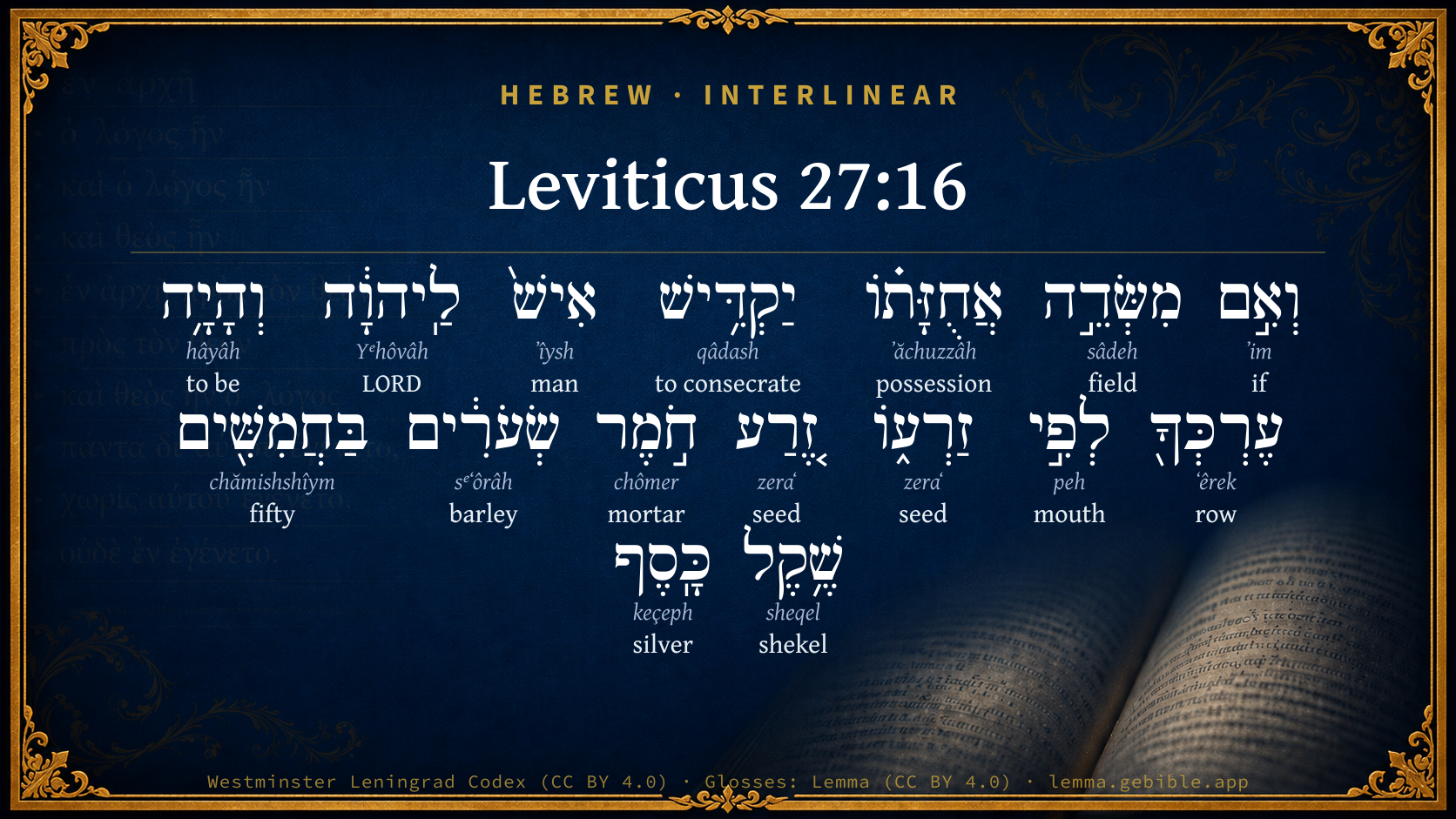
Hebrew (Westminster Leningrad Codex) Leviticus 27:16 appears in the Hebrew Old Testament. The text above is from the Westminster Leningrad Codex. Each word links to its Strong’s number, a concise gloss, and parsing drawn from the Open Scriptures Hebrew Bible morphology. Click any word for its full Brown-Driver-Briggs (BDB) entry.
Download image
Cite this verse

Leviticus 27:16 (World English Bible). Public Domain. Lemma interlinear Bible study tool, https://lemma.gebible.app/v/leviticus/27/16.

Show BibTeX & RIS
BibTeX
RIS
English Translation
"'If a man dedicates to Yahweh part of the field of his possession, then your valuation shall be according to the seed for it: the sowing of a homer of barley shall be valued at fifty shekels of silver.
World English Bible · Public Domain
Download a study sheet

One document with this verse’s original text, its word-by-word gloss line, the meaning frame, cross-references with their text, attributed commentary, and full source and license credits — printable, and it pastes into notes with its structure intact.

This verse Autodidact and up

Study sheet (.html) Plain text (.txt)

A passage Seminary Student

Up to 50 verses in one chapter. A passage sheet keeps up to 6 commentary sources and 12 cross-references per verse, in the order this page ranks them, and says so on the sheet whenever that leaves anything out. Ask for a single verse and you get the Autodidact verse sheet above.

Everything on this page stays free to read, with no account — the sheet is a download of what is already on screen, not access to it.

Want to remove ads? Support Godless Engineer
Compare translations 3

The same verse in 3 English versions, stacked beneath the original-language interlinear above. Click any original word for its lexicon entry.

Each is an independent rendering of the whole verse — the interlinear is not word-aligned to these translations.

Highlighted words mark where these versions differ — a whole-verse word diff, not a word-by-word alignment.

  • World English Bible Public Domain
    "'If a man dedicates to Yahweh part of the field of his possession, then your valuation shall be according to the seed for it: the sowing of a homer of barley shall be valued at fifty shekels of silver.
  • King James Version Public Domain
    And if a man shall sanctify unto the LORD some part of a field of his possession, then thy estimation shall be according to the seed thereof: an homer of barley seed shall be valued at fifty shekels of silver.
  • unfoldingWord Literal Text CC BY-SA 4.0
    And if from the field of his possession a man consecrates to Yahweh, then your valuation will be to the mouth of its seed, seed of a homer of barley at 50 shekels of silver.

unfoldingWord Literal Text — © unfoldingWord, licensed CC BY-SA 4.0. Word-aligned USFM3 via Door43 (git.door43.org/unfoldingWord/en_ult).

Versions to compare (up to 4)

3 of 4 selected

Show all 18 translations

Every available English version of this verse, each an independent rendering of the whole verse.

  • World English Bible Public Domain
    "'If a man dedicates to Yahweh part of the field of his possession, then your valuation shall be according to the seed for it: the sowing of a homer of barley shall be valued at fifty shekels of silver.
  • Berean Standard Bible Public Domain
    If a man consecrates to the LORD a parcel of his land, then your valuation shall be proportional to the seed required for it—fifty shekels of silver for every homer of barley seed.
  • Majority Standard Bible Public Domain
    If a man consecrates to the LORD a parcel of his land, then your valuation shall be proportional to the seed required for it—fifty shekels of silver for every homer of barley seed.
  • King James Version Public Domain
    And if a man shall sanctify unto the LORD some part of a field of his possession, then thy estimation shall be according to the seed thereof: an homer of barley seed shall be valued at fifty shekels of silver.
  • American Standard Version (1901) Public Domain
    And if a man shall sanctify unto Jehovah part of the field of his possession, then thy estimation shall be according to the sowing thereof: the sowing of a homer of barley `shall be valued' at fifty shekels of silver.
  • Revised Version (1885) Public Domain
    And if a man shall sanctify unto the LORD part of the field of his possession, then thy estimation shall be according to the sowing thereof: the sowing of a homer of barley shall be valued at fifty shekels of silver.
  • Geneva Bible (1599) Public Domain
    If also a man dedicate to the Lord any grounde of his inheritance, then shalt thou esteeme it according to the seede therof: an Homer of barlie seede shalbe at fiftie shekels of siluer.
  • Douay-Rheims (1899) Public Domain
    And if he vow the field of his possession, and consecrate it to the Lord, the price shall be rated according to the measure of the seed. If the ground be sowed with thirty bushels of barley, let it be sold for fifty sides of silver.
  • Young's Literal Translation Public Domain
    `And if of the field of his possession a man sanctify to Jehovah, then hath thy valuation been according to its seed; a homer of barley-seed at fifty shekels of silver;
  • Literal Standard Version CC BY-SA 4.0
    And if a man sanctifies to YHWH from a field of his possession, then your valuation has been according to its seed—a homer of barley-seed at fifty shekels of silver;
  • Unlocked Literal Bible CC BY-SA 4.0
    If a man sets apart some of his own land, then the valuation of it will be in proportion to the amount of seed required to plant it—a homer of barley will be valued at fifty shekels of silver.
  • unfoldingWord Literal Text CC BY-SA 4.0
    And if from the field of his possession a man consecrates to Yahweh, then your valuation will be to the mouth of its seed, seed of a homer of barley at 50 shekels of silver.
  • Darby Bible Public Domain
    And if a man hallow to Jehovah [part] of a field of his possession, thy valuation shall be according to what may be sown in it: the homer of barley seed at fifty shekels of silver.
  • World Messianic Bible Public Domain
    “‘If a man dedicates to the LORD part of the field of his possession, then your valuation shall be according to the seed for it. The sowing of a homer of barley shall be valued at fifty shekels of silver.
  • Webster's Bible Public Domain
    And if a man shall sanctify to the LORD some part of a field of his possession, then thy estimation shall be according to the seed of it: a homer of barley seed shall be valued at fifty shekels of silver.
  • Free Bible Version CC BY-SA 4.0
    If you dedicate some of your land to the Lord, then its value shall be determined by the amount of seed required to sow it: fifty shekels of silver for every homer of barley seed used.
  • Bible in Basic English Public Domain
    And if a man gives to the Lord part of the field which is his property, then let your value be in relation to the seed which is planted in it; a measure of barley grain will be valued at fifty shekels of silver.
  • JPS Tanakh (1917) Public Domain
    And if a man shall sanctify unto the LORD part of the field of his possession, then thy valuation shall be according to the sowing thereof; the sowing of a homer of barley shall be valued at fifty shekels of silver.

Literal Standard Version (2020), Covenant Press — licensed CC BY-SA 4.0. Text via the HelloAO Bible API (eBible.org). Unlocked Literal Bible (unfoldingWord) — licensed CC BY-SA 4.0. Text via the HelloAO Bible API (eBible.org). unfoldingWord Literal Text — © unfoldingWord, licensed CC BY-SA 4.0. Word-aligned USFM3 via Door43 (git.door43.org/unfoldingWord/en_ult). Free Bible Version, Dr. Jonathan Gallagher — licensed CC BY-SA 4.0. Text via the HelloAO Bible API (eBible.org).

Word by word

More ways to search: Search by grammar → Find every occurrence → Compare this word →

Practice this passage: Drill this verse → Learn its vocabulary →

חֹ֣מֶר
chômer
H2563
“mortar of”
Noun, Common, Masculine, Singular, Construct
Part of Speech
Noun
Type
Common
Gender
Masculine
Number
Singular
State
Construct
Full BDB Definition

Origin: from H2560

TWOT: TWOT- 683c

cement, mortar, clay - mortar, cement - clay - mire - heap - swelling, surging (of water) - homer - a unit of dry measure about 65 imperial gallons (300 liters)
  1. וְאִ֣ם ʼim H518 “and · if” Conjunction + Conjunction
  2. מִשְּׂדֵ֣ה sâdeh H7704 “from · field of” Preposition + Noun, Common, Masculine, Singular, Construct
  3. אֲחֻזָּת֗וֹ ʼăchuzzâh H272 “possession · his” Noun, Common, Feminine, Singular, Construct + Suffix, Personal, 3rd Person, Masculine, Singular
  4. יַקְדִּ֥ישׁ qâdash H6942 “to consecrate” Verb, Hiphil, Imperfect, 3rd Person, Masculine, Singular
  5. אִישׁ֙ ʼîysh H376 “man” Noun, Common, Masculine, Singular, Absolute
  6. לַֽיהוָ֔ה Yᵉhôvâh H3068 “to/for · LORD” Preposition + Noun, Proper
  7. וְהָיָ֥ה hâyâh H1961 “and · to be” Conjunction + Verb, Qal, Sequential Perfect, 3rd Person, Masculine, Singular
  8. עֶרְכְּךָ֖ ʻêrek H6187 “row · your” Noun, Common, Masculine, Singular, Construct + Suffix, Personal, 2nd Person, Masculine, Singular
  9. לְפִ֣י peh H6310 “to/for · mouth of” Preposition + Noun, Common, Masculine, Singular, Construct
  10. זַרְע֑וֹ zeraʻ H2233 “seed · his” Noun, Common, Masculine, Singular, Construct + Suffix, Personal, 3rd Person, Masculine, Singular
  11. זֶ֚רַע zeraʻ H2233 “seed of” Noun, Common, Masculine, Singular, Construct
  12. שְׂעֹרִ֔ים sᵉʻôrâh H8184 “barley” Noun, Common, Feminine, Plural, Absolute
  13. בַּחֲמִשִּׁ֖ים chămishshîym H2572 “in/at the · fifty” Preposition, Determined + Adjective, Cardinal number, Both, Plural, Absolute
  14. שֶׁ֥קֶל sheqel H8255 “shekel of” Noun, Common, Masculine, Singular, Construct
  15. כָּֽסֶף keçeph H3701 “silver” Noun, Common, Masculine, Singular, Absolute

About this verse

These counts appear in no published source. They are computed here, from the morphology-tagged text and Lemma’s own curated glosses. What Lemma adds →

16
words
15
distinct lemmas
Pentateuch
section

Shared distinctive vocabulary

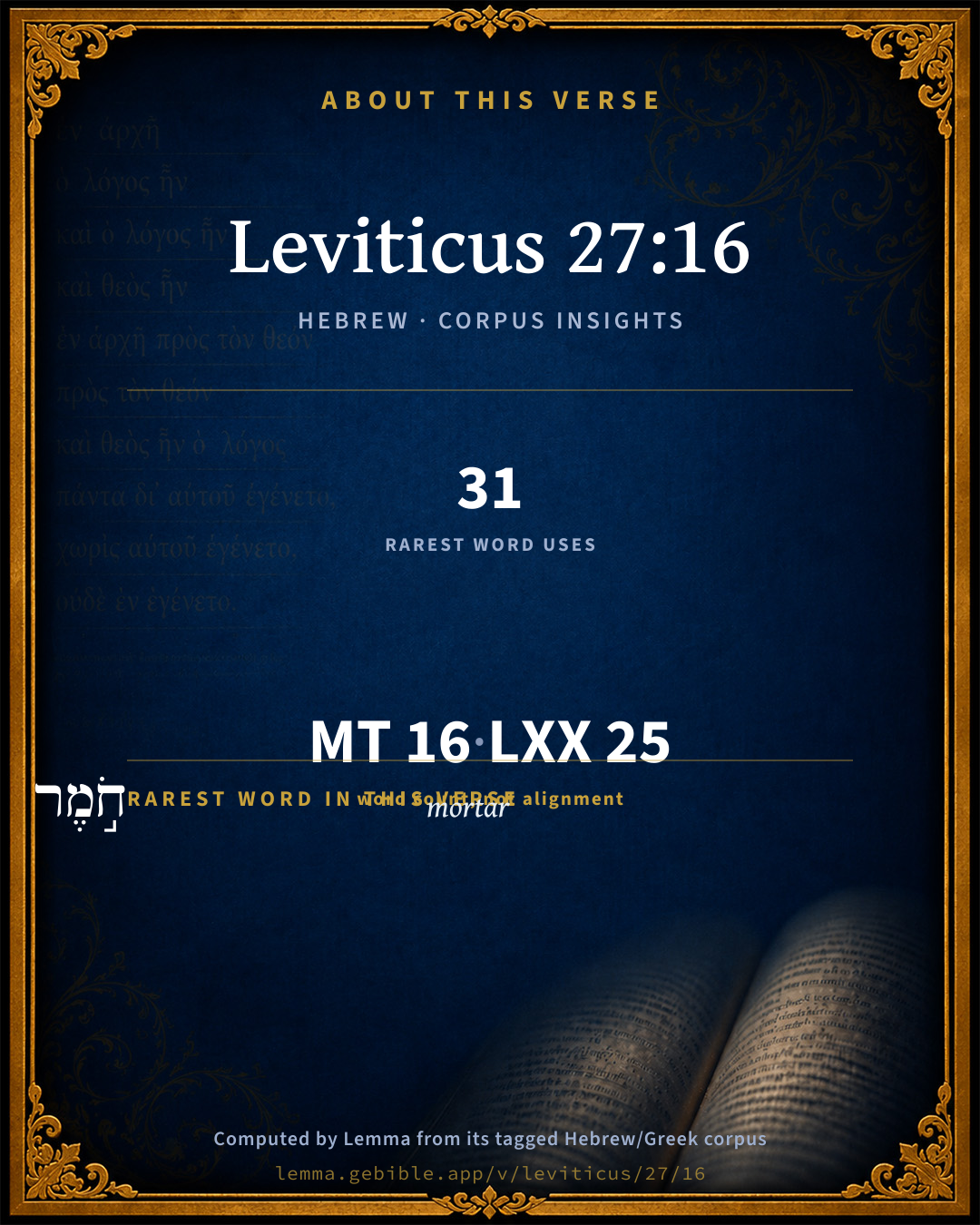
חֹ֣מֶר mortar H2563 occurs in 26 verses of the Hebrew Bible. Also found in:

Grammatical profile

  • 2 verbs
  • 12 nouns
  • 1 adjective
  • 1 conjunction

Verb forms

  • יַקְדִּ֥ישׁ Hiphil · Imperfect
  • וְהָיָ֥ה Qal · Sequential Perfect

Repetition

A word recurs within this verse — often emphatic in Hebrew:

  • זַרְע֑וֹ seed H2233 ×2

Hebrew & Septuagint length

In English translation the verse runs 39 words from the Hebrew and 35 from the Septuagint (LXX English) — closely comparable.

A rough comparison of the two English renderings, which tokenize alike — not a word-level alignment.

Word counts can differ between the Hebrew and the Greek without any difference in meaning — e.g. the Hebrew direct-object marker אֵת has no separate Greek word, and Greek often adds the article ὁ.

In the original languages it is 16 Hebrew tokens and 25 Greek tokens — but the two are counted differently (Hebrew bundles its prefixes and suffixes into one token; the Greek is in lemma form), so that isn’t a like-for-like length.

Cross-references

5

Topical passages linked to Leviticus 27:16 in the Treasury of Scripture Knowledge — connected by theme and wording, ordered by reader-vote popularity; previews shown in the World English Bible.

  • Isaiah 5:10 For ten acres of vineyard shall yield one bath, And a homer of seed shall yield an ephah."
  • Ezekiel 45:11–14 The ephah and the bath shall be of one measure, that the bath may contain the tenth part of a homer, and the ephah the tenth part of a homer: the measure of it shall be after the homer.
  • Hosea 3:2 So I bought her for myself for fifteen pieces of silver and a homer and a half of barley.
  • Acts 4:34–37 For neither was there among them any who lacked, for as many as were owners of lands or houses sold them, and brought the proceeds of the things that were sold,
  • Acts 5:4 While you kept it, didn't it remain your own? After it was sold, wasn't it in your power? How is it that you have conceived this thing in your heart? You haven't lied to men, but to God."

Cross-references courtesy of OpenBible.info (CC BY 4.0).

Hebrew and Greek witnesses Masoretic Hebrew ↔ Greek Septuagint

The same verse in the two great witnesses to the Old Testament, shown verse-for-verse.

These are two independent witnesses, not word-aligned to each other, and the Septuagint is shown in lemma (dictionary) form.

Hebrew Leviticus 27:16 Masoretic · Westminster Leningrad Codex

וְאִ֣ם מִשְּׂדֵ֣ה אֲחֻזָּת֗וֹ יַקְדִּ֥ישׁ אִישׁ֙ לַֽיהוָ֔ה וְהָיָ֥ה עֶרְכְּךָ֖ לְפִ֣י זַרְע֑וֹ זֶ֚רַע חֹ֣מֶר שְׂעֹרִ֔ים בַּחֲמִשִּׁ֖ים שֶׁ֥קֶל כָּֽסֶף

"'If a man dedicates to Yahweh part of the field of his possession, then your valuation shall be according to the seed for it: the sowing of a homer of barley shall be valued at fifty shekels of silver.

World English Bible · Public Domain

Greek LXX Leviticus 27:16 Septuagint · lemma form

ἐάν δέ ἀπό ὁ ἀγρός ὁ κατάσχεσις αὐτός ἁγιάζω ἄνθρωπος ὁ κύριος καί εἰμί ὁ τιμή κατά ὁ σπόρος αὐτός κόρος κριθή πεντήκοντα δίδραγμον ἀργύριον

And if a man should hallow to the Lord a part of the field of his possession, then the valuation shall be according to its seed, fifty didrachmas of silver for a homer of barley.

LXX2012 (modern English Septuagint) · Public Domain

Hebrew: Westminster Leningrad Codex (CC BY 4.0). Greek: Septuagint (public domain); English from LXX2012 (modern English Septuagint) (Public Domain). How the Septuagint differs from the Hebrew →

Targum (Aramaic paraphrase)

2

The Targum is the ancient Jewish Aramaic paraphrase of the Hebrew Scriptures — an interpretive translation, not the Hebrew text itself. Onkelos (literal) and Pseudo-Jonathan (expansive) render the Torah, and Jonathan the Prophets. Coverage is partial: where no permissively-licensed English translation exists for a verse, only the Aramaic is shown. This is verse-level text, not a word-by-word alignment to the Hebrew.

  1. Targum Onkelos Torah (Genesis–Deuteronomy)
    וְאִם מֵחֲקַל אַחֲסַנְתֵּהּ יַקְדִישׁ גְבַר קֳדָם יְיָ וִיהֵי פֻרְסָנֵהּ לְפוּם זַרְעֵהּ בַּר זְרַע כּוֹר שְׂעוֹרִין בְּחַמְשִׁין סִלְעִין דִכְסָף

    (no public-domain English translation for this verse)

    Targum Onkelos — Aramaic: “Onkelos Genesis” (public domain); “Onkelos Exodus” (public domain); “Onkelos Leviticus” (public domain); “Onkelos Numbers” (public domain); “Onkelos Deuteronomy” (public domain). English: “Sefaria Community Translation” (CC0 1.0 (public-domain dedication)); “J.W. Etheridge. The Targums of Onkelos and Jonathan Ben Uzziel on the Pentateuch. London: Longmans, Green, 1862” (public domain). Text via Sefaria.

  2. Targum Pseudo-Jonathan Torah (Genesis–Deuteronomy)
    וְאִין מִן חֲקַל אַחֲסַנְתֵּיהּ יִקְדַשׁ גְבַר קֳדָם יְיָ וִיהֵי עֲלוֹיֵיהּ כְּמִיסַת זַרְעֵיהּ אֲתַר דְמִזְרַע בֵּית כּוֹר שְעוֹרִין בְּחַמְשִׁין סַלְעִין דִכְסַף

    And if a man would dedicate (a portion) of the field of his inheritance before the Lord, the valuation of it shall be according to the measure of its seed: a space on which may be sown a kor (seventy-five and a half pints) of barley (shall be considered) worth fifty shekels of silver.

    Targum Pseudo-Jonathan — Aramaic: “Targum Jonathan on Genesis” (public domain); “Targum Jonathan on Exodus” (public domain); “Targum Jonathan on Leviticus” (public domain); “Targum Jonathan on Numbers” (public domain); “Targum Jonathan on Deuteronomy” (public domain). English: “The Targum of Jonathan ben Uzziel, trans. J. W. Etheridge, London, 1862” (public domain). Text via Sefaria.

Commentary

Notes on Leviticus 27:16 from classic Christian and Jewish commentators (each source and its license shown beneath its notes). The classic Christian expositions comment on the surrounding passage and are grouped to its opening verse, so a note may address several verses; the Jewish commentaries on the Tanakh (Rashi and others) are per-verse, so they appear only where the commentator wrote on this verse.

Lemma curates 59 commentaries, every one of them public domain or Creative Commons licensed, each selected and text-cleaned for this edition rather than reprinted as found. About our sources →

Joseph Benson's Commentary

Lev 27:16. Shall sanctify some part of his field — This intimates that it was not lawful for a man to vow his whole field or estate, because God would have no man’s family made beggars to enrich his sanctuary. The design of consecrating a part to God, was to procure his blessing upon the rest of their possessions. Thy estimation shall be according to the seed thereof — That is, it shall be valued according to the quantity of seed required to sow it. A homer of barley-seed shall be valued at fifty shekels — That is, so much land as a homer of barley would sow was to be rated at fifty shekels, or about five pounds seventeen shillings; and so, proportionably, for greater or less quantities of ground so devoted. There is a great difference between this measure and that which occurs Exo 16:16; this is written homer, and that ghomer. Now, a ghomer was but the tenth part of an ephah, as we learn from Exo 16:36; whereas the homer, which is the measure here spoken of, was ten ephahs, Eze 45:11. By this we may explain that threatening in Isa 5:10, The seed of a homer shall yield an ephah; that is, ten bushels shall yield but one.

Joseph Benson's Commentary on the Old and New Testaments (1811–1818) — public domain. Text from a community e-Sword module.

Keil & Delitzsch

C. F. Keil & F. Delitzsch

With regard to the vowing of land, a difference was made between a field inherited and one that had been purchased.

Lev 27:16

If any one sanctified to the Lord "of the field of his possession," i.e., a portion of his hereditary property, the valuation was to be made according to the measure of the seed sown; and an omer of barley was to be appraised at fifty shekels, so that a field sown with an omer of barley would be valued at fifty shekels. As an omer was equal to ten ephahs (Eze 45:11), and, according to the calculation made by Thenius, held about 225 lbs., the fifty shekels cannot have been the average value of the yearly produce of such a field, but must be understood, as it was by the Rabbins, as the value of the produce of a complete jubilee period of 49 or 50 years; so that whoever wished to redeem the field had to pay, according to Mishnah, Erachin vii. 1, a shekel and a fifth per annum.

Lev 27:17-19

If he sanctified his field from the year of jubilee, i.e., immediately after the expiration of that year, it was to "stand according to thy valuation," i.e., no alteration was to be made in the valuation. But if it took place after the year of jubilee, i.e., some time or some years after, the priest was to estimate the value according to the number of years to the next year of jubilee, and "it shall be abated from thy valuation," sc., praeteritum tempus, the time that has elapsed since the year of jubilee. Hence, for example, if the field was vowed ten years after the year of jubilee, the man who wished to redeem it had only forty shekels to pay for the forty years remaining up to the next year of jubilee, or, with the addition of the fifth, 48 shekels. The valuation was necessary in both cases, for the hereditary field was inalienable, and reverted to the original owner or his heirs in the year of jubilee without compensation (cf. Lev 27:21 and Lev 25:13, Lev 25:23.); so that, strictly speaking, it was not the field itself, but the produce of its harvests up to the next year of jubilee, that was vowed, whether the person making the vow left it to the sanctuary in natura till the year of jubilee, or wished to redeem it again by paying the valuation price. In the latter case, however, he had to put a fifth over and above the valuation price (Lev 27:19, like Lev 27:13 and Lev 27:15), that it might be left to him.

Lev 27:20-21

In case he did not redeem it, however, namely, before the commencement of the next year of jubilee, or sold it to another man, i.e., to a man not belonging to his family, he could no longer redeem it; but on its going out, i.e., becoming free in the year of jubilee (see Lev 25:28), it was to be holy to the Lord, like a field under the ban (see Lev 27:28), and to fall to the priests as their property. Hinc colligere est, redimendum fuisse ante Jubilaeum consecratum agrum, nisi quis vellet eum plane abalienari (Clericus). According to the distinct words of the text (observe the correspondence of ואם...ואם), the field, that had been vowed, fell to the sanctuary in the jubilee year not only when the owner had sold it in the meantime, but also when he had not previously redeemed it. The reason for selling the field at a time when he had vowed it to the sanctuary, need not be sought for in caprice and dishonesty, as it is by Knobel. If the field was vowed in this sense, that it was not handed over to the sanctuary (the priesthood) to be cultivated, but remained in the hands of the proprietor, so that every year he paid to the sanctuary simply the valuation price, - and this may have been the rule, as the priests whose duties lay at the sanctuary could not busy themselves about the cultivation of the field, but would be obliged either to sell the piece of land at once, or farm it, - the owner might sell the field up to the year of jubilee, to be saved the trouble of cultivating it, and the purchaser could not only live upon what it yielded over and above the price to be paid every year to the sanctuary, but might possibly realize something more. In such a case the fault of the seller, for which he had to make atonement by the forfeiture of his field to the sanctuary in the year of jubilee, consisted simply in the fact that he had looked upon the land which he vowed to the Lord as though it were his own property, still and entirely at his own disposal, and therefore had allowed himself to violate the rights of the Lord by the sale of his land. At any rate, it is quite inadmissible to supply a different subject to מכר from that of the parallel גּאל, viz., the priest.

Lev 27:22-24

If on the other hand any one dedicated to the Lord a "field of his purchase," i.e., a field that had been bought and did not belong to his patrimony, he was to give the amount of the valuation as estimated by the priest up to the year of jubilee "on that day," i.e., immediately, and all at once. This regulation warrants the conclusion, that on the dedication of hereditary fields, the amount was not paid all at once, but year by year. In the year of jubilee the field that had been vowed, if a field acquired by purchase, did not revert to the buyer, but to the hereditary owner from whom it had been bought, according to the law in Lev 25:23-28.

Lev 27:25

All valuations were to be made according to the shekel of the sanctuary.

Keil & Delitzsch — Biblical Commentary on the Old Testament (1861–1891) — public domain (CC PDM 1.0). Text via the HelloAO Bible API. (Old Testament only.)

Tyndale Open Study Notes

Tyndale Open Resources

27:16-21 The price for dedicating a field was determined by the number of years remaining until the next Year of Jubilee (see 25:24-28). If this property was not redeemed, it became the property of the priests to do with as they wished. The price of redeeming a field was 120 percent of the valuation (see 27:11-13). If a landowner dedicated his field without redeeming it, it did not revert to his family in the Year of Jubilee.

Tyndale Open Study Notes — © Tyndale Open Resources, licensed CC BY-SA 4.0. Text via the HelloAO Bible API.

Geneva Bible (1599)

Geneva Bible translators

Homer is a measure containing ten Ephahs, read of Ephah, Exod. 16:16, 36.

Valuing the price thereof according to the seed that is sown, or by the seed that it doth yield.

Geneva Bible (1599) marginal notes — public domain. Text via Bolls.life.

Jamieson, Fausset & Brown

Robert Jamieson, A. R. Fausset & David Brown

if a man shall sanctify unto the Lord some aprt of a field of his possession, &c.--In the case of acquired property in land, if not redeemed, it returned to the donor at the Jubilee; whereas the part of a hereditary estate, which had been vowed, did not revert to the owner, but remained attached in perpetuity to the sanctuary. The reason for this remarkable difference was to lay every man under an obligation to redeem the property, or stimulate his nearest kinsman to do it, in order to prevent a patrimonial inheritance going out from any family in Israel.

Jamieson, Fausset & Brown — Commentary Critical and Explanatory on the Whole Bible (1871) — public domain (CC PDM 1.0). Text via the HelloAO Bible API.

Adam Clarke's Commentary

Verse 16. Some part of a field] Though the preceding words are not in the text, yet it is generally allowed they should be supplied here, as it was not lawful for a man to vow his whole estate, and thus make his family beggars, in order to enrich the Lord's sanctuary: this God would not permit. The rabbins teach that the land or field, whether good or bad, was valued at forty-eight shekels, for all the years of the jubilee, provided the field was large enough to sow a homer of barley. The חמר chomer was different from the עמר omer: the latter held about three quarts, the former, seventy-five gallons three pints; See Clarke on Ex 16:16. Some suppose that the land was rated, not at fifty shekels for the whole of the years of the jubilee, for this would be but about 3s. per annum; but that it was rated according to its produce, fifty shekels for every homer of barley it produced.

Adam Clarke's Commentary on the Bible (1810–1826) — public domain. Text from a community e-Sword/MySword module.

Ellicott's Commentary for English Readers

(16) Some part of a field of his possession.—That is, if he consecrates by a vow to the service of the sanctuary a portion of a field which he inherits from his forefathers, and which, therefore, constitutes a part of his inalienable patrimony, thus distinguishing it from a field which he has acquired by his own purchase. (See Lev_27:22.) The words, some part which are in italics, are implied in the Hebrew construction of these words. No man was allowed to vow the whole of his estates to the sanctuary, as he would thereby impoverish his own family.

Thy estimation shall be according to the seed thereof.—Better, thy estimation shall be according to its seed, that is, he is not to part with the field thus vowed for the sanctuary, but the priest is to value the area according to the quantity of seed required for sowing it.

An homer of barley seed shall be valued at fifty shekels of silver.—That is, if the piece of land which he vowed could properly be cropped with one homer, or five bushels and a half of barley seed, he is to value it at £6 9s. 2d. (See Lev_27:3.) According to the authorities during the second Temple, these fifty shekels covered the value of the produce for the whole period of forty-nine years, that is, from one jubile year to another, so that a plot of land of the dimensions here described was estimated at a little more than one shekel per annum. The person who made the vow could, under these circumstances, always redeem it, as it would almost amount to a gift to let any stranger buy it at this price. The low value put upon it was evidently designed not to deprive the family of their means of subsistence, since the patrimonial estates were almost always the only source of their livelihood.

A Bible Commentary for English Readers, edited by Charles John Ellicott (1878–1897) — public domain. Text from a community e-Sword module.

The Cambridge Bible for Schools and Colleges

gen. ed. J. J. S. Perowne

16. fifty shekels of silver] meaning apparently that at the rate of one shekel a year this shall be the maximum amount of redemption payment. The standard in these cases was to be ‘the shekel of the sanctuary.’ See Driver, Exo_30:13 (where the same words are used), for discussion as to the meaning and value of the shekel thus denominated.

The Cambridge Bible for Schools and Colleges (gen. ed. J. J. S. Perowne; Cambridge University Press, 1878–1918) — public domain. Text from a community e-Sword module.

John Gill's Exposition

If he sanctify his field from the year of jubilee,.... The very year, as Aben Ezra, while it is current, or when it is past, and he immediately sanctifies it for an holy use, and one comes to redeem it, as Jarchi says, as soon as ever it is devoted, and a priest has valued it, and there is a purchaser of it:

according to thy estimation it shall stand; what price soever the priest set upon it, that it was to go at, and he that had a mind to purchase it might have it for it, unless it was he that devoted it, and then he was to give a fifth part more, as afterwards expressed.

John Gill's Exposition of the Whole Bible (1746–1763) — public domain (CC PDM 1.0). Text via the HelloAO Bible API.

Albert Barnes' Notes on the Bible

Some part of a field of his possession - Rather, a part of the land of his inheritance.

The seed thereof - i. e. the quantity of seed required to sow it properly. Thus the value of about 5 1/2 bushels (an homer) was about 6 pounds, 9 shillings, 2d. (50 shekels. See Exo 38:24.)

Albert Barnes' Notes on the Bible (1834–1885) — public domain. Text from a community e-Sword/MySword module.

Haydock's Catholic Bible Commentary

Possession, or inheritance. If he had only purchased the field, he could not, by his vow, transfer the property of it to the priests beyond the year of jubilee, ver. 22. --- Seed, not of the produce, which is uncertain. The goodness of the soil must also be considered. --- Silver: which rent must be paid every year, except on those of rest, when the earth was not cultivated. (Calmet)

George Leo Haydock (1774–1849), Haydock's Catholic Family Bible and Commentary, 1859 edition — public domain. Excludes Psalms (Douay-Rheims chapter numbering differs from Protestant) and Deuterocanonical books (Catholic canon only).

Matthew Poole's English Annotations

A field of his possession, i.e. which is his by inheritance, because particular direction is given about purchased lands, Lev 27:22. And he saith part of it, because it was unlawful to vow away all his possessions, because thereby he had disenabled himself from the performance of divers duties by way of sacrifice, almsgiving, &c., and made himself burdensome to his brethren.

According to the seed thereof, i.e. according to the quantity and quality of the land, which is known by the quantity of seed which it can receive and return.

Fifty shekels of silver, not to be paid yearly, till the year of jubilee, as some would have it, but once for all, as is most probable,

1. Because here is no mention of any yearly payment, but only of one payment, and we must not add to the text.

2. Because it is most probable that lands and all things were favourably and moderately valued, so that men might be rather encouraged to make such vows upon just occasions, than to be deterred from them by excessive impositions. But if this were yearly rent, it was an excessive rate, and much more than the land ordinarily yielded. For an omer is but the tenth part of an ephah, Exo 16:36, and therefore not above a pottle of our measure, which quantity of seed would not extend very far, and in some lands would yield but an inconsiderable crop, especially in barley, which was cheaper than wheat, and which for that reason, among others, may seem to be here mentioned rather than wheat.

Matthew Poole's English Annotations on the Holy Bible (1683–1685) — public domain. Text from a community e-Sword/MySword module.

Whedon's Commentary on the Bible

Daniel D. Whedon

16. Some part of a field — The words “some part,” in the authorized version, are in italics for no good reason, since they exactly express the meaning of the Hebrew partitive preposition min — of. It is generally allowed that it was not lawful for a man, under the high pressure of religious impulse, to alienate his whole patrimony and thus pauperize his own family.

According to the seed thereof — Since the quantity of seed usually sown upon an acre is quite uniform, this may be taken in lieu of the rods and roods of square measure.

A homer of barley — About five and a half bushels — enough to sow two or three acres. To redeem this amount of land fifty shekels of silver, $30 28, were demanded, and at this rate for any number of homers of seed. The average value of the yearly produce of this field was not estimated, but the value of the crops during the complete ante-jubilee period of forty-nine years. Hence the annual redemption was at the rate of about a shekel and a fifth, or seventy-two cents multiplied by the number of homers vowed.

Daniel D. Whedon (gen. ed.), Commentary on the Old and New Testaments (1874–1909) — public domain. Text from a community e-Sword module.

The Pulpit Commentary

Vers. 16-21. In case a man shall sanctify unto the Lord some part of a field of his possession, that is, of his hereditary lands, the redemption price is fixed by the quantity of seed required for sowing it. If it requires a homer, or five bushels and a half, of barley seed to crop it, the redemption price is fifty shekels, or f6 9s. 2d., plus one-fifth, that is, f7 15s., supposing that the vow had been made in the year succeeding the jubilee; but if the vow was made at any time after the jubilee, the value of the previous harvests was deducted from this sum. The amount does not seem to have been paid in a lump sum, but by annual installments of one shekel and one-fifth of a shekel, equal to 3s. 1 one-half signd., each year. In case he had sold his interest in the field up to the approaching jubilee before making his vow, then no redemption was allowed; he paid nothing, but the field passed from him to the sanctuary at the jubilee.

The Pulpit Commentary (1880–1919), ed. H.D.M. Spence-Jones & Joseph S. Exell — public domain. Text from a community e-Sword module.

John Wesley's Explanatory Notes

Of his possession - That is, which is his by inheritance, because particular direction is given about purchased lands, ver. 22. And he saith, part of it, for it was unlawful to vow away all his possessions, because thereby he disabled himself from the performance of divers duties, and made himself burdensome to his brethren. According to the seed - That is, according to the quantity and quality of the land, which is known by the quantity of seed which it can receive and return. Fifty-shekels - Not to be paid yearly, 'till the year of jubilee, but once for all, as is most probable,

1. Because here is no mention of any yearly payment, but only of one payment.

2. Because it is probable that lands were moderately valued, that men might be rather encouraged to make such vows, than deterred by excessive impositions. But if this were yearly rent, it was an excessive rate, and much more than the land ordinarily yielded. For an omer is but the tenth part of an ephah, about a pottle of our measure, which quantity of seed would not extend very far, and in some lands would yield but an inconsiderable crop, especially in barley, which was cheaper than wheat and which for that reason, among others, may be mentioned rather than wheat.

John Wesley, Explanatory Notes Upon the Whole Bible (1754–1765) — public domain. Text via the GEBible commentary corpus.

unfoldingWord translationNotes

Door43 World Missions Community

the amount of seed required to plant it

This can be stated in active form. AT: "the amount of seed a person would need to plant it" (See: Active or Passive)

a homer of barley will be valued at

Here "a homer of barley" represents a piece of land that would need one homer of barley in order to plant on all of it. AT: "a piece of land that requires one homer of barley in order to plant all of it will be valued at" or 'the value of land that requires one homer of barley will be" (See: Metonymy)

homer

A homer is 220 liters. (See: Biblical Volume)

fifty shekels of silver

If it is necessary to use modern weight units, here are two way of doing it. AT: "fifty pieces of silver, each of which weighs ten grams" or "five hundred grams of silver" (See: Biblical Weight and Numbers)

translationWords

set apart

seed

barley

unfoldingWord translationNotes — © Distant Shores Media and the Door43 World Missions Community, licensed CC BY-SA 4.0. Source: git.door43.org/Door43/en_tn.

Rashi

Rabbi Shlomo Yitzchaki (Rashi)

והיה ערכך לפי זרעו [AND IF A MAN SHALL SANCTIFY SOME OF THE FIELD OF HIS POSSESSION] THEN THE VALUATION SHALL BE ACCORDING TO THE SEED THEREOF (i. e., according to the quantity of seed that can be grown in it) — not according to its value; but whether it is a good field or a bad field the money for redeeming it from its holy state is the same: an area requiring a Khor of barley seed (the equivalent of a חמר שערים mentioned in the text) is redeemable by fifty shekels (in the case of other seed the area redeemable by this sum is different) (cf. Arakhin 14a). Such is the enactment of Scripture (God). But this is only in the case that he comes to redeem it at the beginning of the Jubilee-period, but if he comes to redeem it in the middle of it he has only to pay according to the reckoning of one Selah (shekel) and a pundion (one forty-eighth of a shekel) for each year remaining in that Jubilee-period (cf. Rashi on v. 18); because, after all, it is the property of the Temple treasury only for the number of years contained in the Jubilee-period from the time when he sold it, so that if it was redeemed by the owner at any time during this period, well and good (the Temple treasury suffered no loss), and if not, the treasurer can sell it for the very same price to another person, when it remains in the hands of the purchaser till the Jubilee just like any other field sold right out (cf. vv. 20, 21). When it leaves his possession in the Jubilee year, it does not return to the Treasury, but it passes into the possession of the priests of that “Mishmar” (shift officiating) during whose turn the Jubilee happens to fall and is divided amongst them. This, in brief, is the law concerning one who dedicates a field to the Temple Treasury; and now I shall explain it, following the order of the verses.

Rashi on the Tanakh — English translations: “The Judaica Press complete Tanach with Rashi, translated by A. J. Rosenberg” (CC BY 4.0); “Pentateuch with Rashi's commentary by M. Rosenbaum and A.M. Silbermann, 1929-1934” (public domain); “The Metsudah Tanach series, Lakewood, N.J” (CC BY 4.0); and “The Book of Joshua, Metsudah Publications, 1997” (CC BY 4.0). Text via Sefaria.

Lesson kit

Teaching starters — assembled from the data on this page, not authored interpretation. Every prompt links to the verse data it draws on. Edit before teaching.

Leviticus, in the Pentateuch, opens this verse with 16 words (15 distinct Hebrew lemmas). Its most distinctive word is chômer (“mortar”). A historical commentator’s framing appears above. Read the whole chapter for the surrounding context.

Discussion questions

  1. What does “mortar” (chômer) contribute to the verse as a whole?
  2. Genesis 11:3 shares the word «mortar» with this verse. How do the two illuminate each other?
  3. “seed” occurs 2× in this one verse. What is the effect of the repetition?
  4. These translations render this verse differently. What is at stake in choosing one wording over another?
  5. The verb «יַקְדִּ֥ישׁ» is Hiphil Imperfect. How does its form color the action?
  6. Reading how Joseph Benson's Commentary and Keil & Delitzsch read this verse, where do the two commentators agree and where do they part?

Things to notice

Reading settings

Reading text

Shown beneath each verse's original-language words.

Old Testament
Old Testament edition

Read the OT as the Masoretic Hebrew (MT) or the Greek Septuagint (LXX).

English shown for the Greek Septuagint (in the Hebrew ↔ Greek comparison).

Comparing translations? Open the Compare panel on any verse page to stack up to four side by side.