
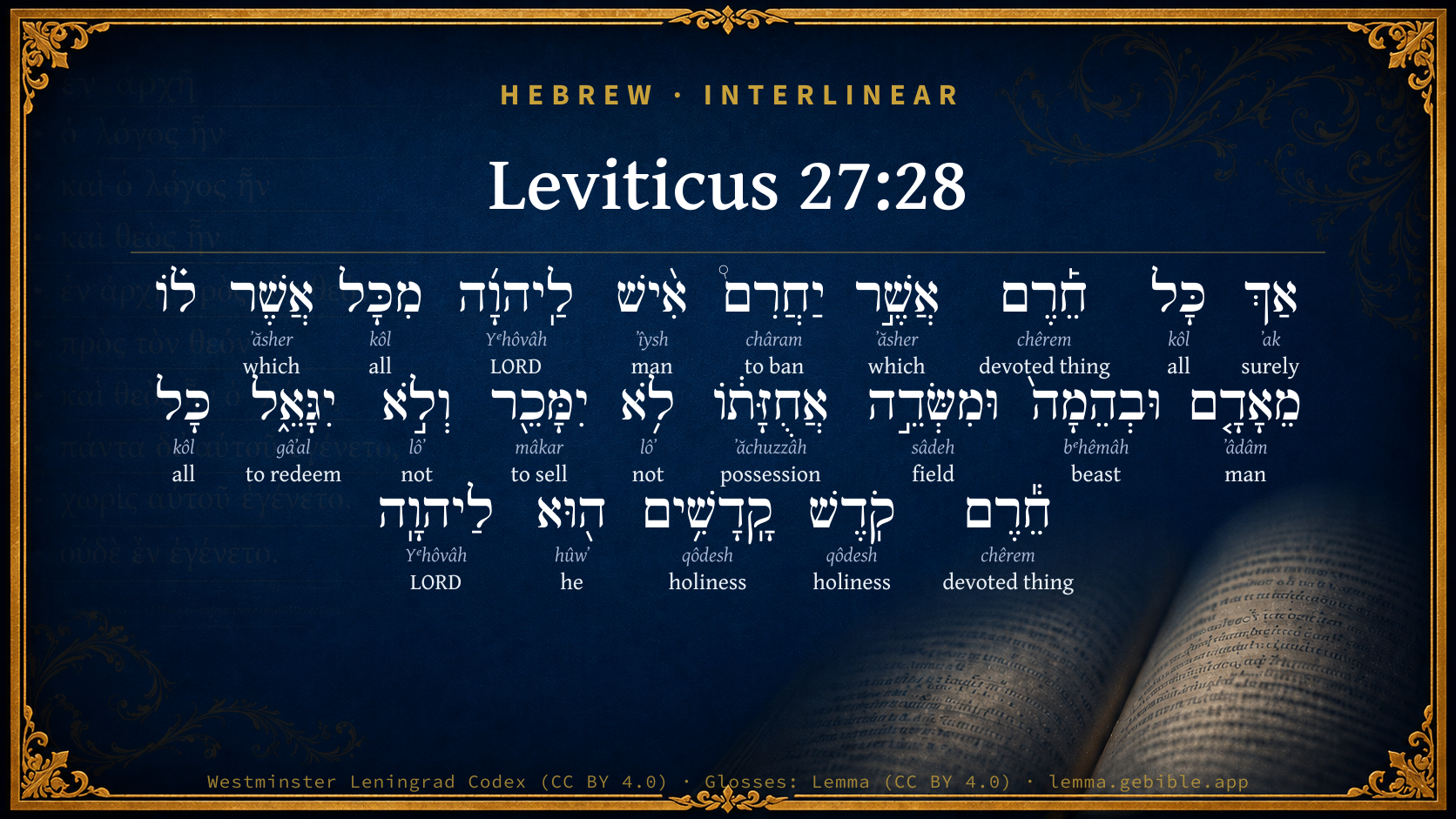
Leviticus 27:28

Hebrew (Westminster Leningrad Codex) Leviticus 27:28 appears in the Hebrew Old Testament. The text above is from the Westminster Leningrad Codex. Each word links to its Strong’s number, a concise gloss, and parsing drawn from the Open Scriptures Hebrew Bible morphology. Click any word for its full Brown-Driver-Briggs (BDB) entry.
Download image
Cite this verse

Leviticus 27:28 (World English Bible). Public Domain. Lemma interlinear Bible study tool, https://lemma.gebible.app/v/leviticus/27/28.

Show BibTeX & RIS
BibTeX
RIS
English Translation
"'Notwithstanding, no devoted thing, that a man shall devote to Yahweh of all that he has, whether of man or animal, or of the field of his possession, shall be sold or redeemed: every devoted thing is most holy to Yahweh.
World English Bible · Public Domain
Download a study sheet

One document with this verse’s original text, its word-by-word gloss line, the meaning frame, cross-references with their text, attributed commentary, and full source and license credits — printable, and it pastes into notes with its structure intact.

This verse Autodidact and up

Study sheet (.html) Plain text (.txt)

A passage Seminary Student

Up to 50 verses in one chapter. A passage sheet keeps up to 6 commentary sources and 12 cross-references per verse, in the order this page ranks them, and says so on the sheet whenever that leaves anything out. Ask for a single verse and you get the Autodidact verse sheet above.

Everything on this page stays free to read, with no account — the sheet is a download of what is already on screen, not access to it.

Want to remove ads? Support Godless Engineer
Compare translations 3

The same verse in 3 English versions, stacked beneath the original-language interlinear above. Click any original word for its lexicon entry.

Each is an independent rendering of the whole verse — the interlinear is not word-aligned to these translations.

Highlighted words mark where these versions differ — a whole-verse word diff, not a word-by-word alignment.

  • World English Bible Public Domain
    "'Notwithstanding, no devoted thing, that a man shall devote to Yahweh of all that he has, whether of man or animal, or of the field of his possession, shall be sold or redeemed: every devoted thing is most holy to Yahweh.
  • King James Version Public Domain
    Notwithstanding no devoted thing, that a man shall devote unto the LORD of all that he hath, both of man and beast, and of the field of his possession, shall be sold or redeemed: every devoted thing is most holy unto the LORD.
  • unfoldingWord Literal Text CC BY-SA 4.0
    However, any devoted thing which a man will devote to Yahweh from all which to him, from man and animal and from field of his possession, it shall not be sold and it shall not be redeemed. Every devoted thing, it a holy thing of holy things to Yahweh.

unfoldingWord Literal Text — © unfoldingWord, licensed CC BY-SA 4.0. Word-aligned USFM3 via Door43 (git.door43.org/unfoldingWord/en_ult).

Versions to compare (up to 4)

3 of 4 selected

Show all 18 translations

Every available English version of this verse, each an independent rendering of the whole verse.

  • World English Bible Public Domain
    "'Notwithstanding, no devoted thing, that a man shall devote to Yahweh of all that he has, whether of man or animal, or of the field of his possession, shall be sold or redeemed: every devoted thing is most holy to Yahweh.
  • Berean Standard Bible Public Domain
    Nothing that a man sets apart to the LORD from all he owns—whether a man, an animal, or his inherited land—can be sold or redeemed; everything so devoted is most holy to the LORD.
  • Majority Standard Bible Public Domain
    Nothing that a man sets apart to the LORD from all he owns—whether a man, an animal, or his inherited land—can be sold or redeemed; everything so devoted is most holy to the LORD.
  • King James Version Public Domain
    Notwithstanding no devoted thing, that a man shall devote unto the LORD of all that he hath, both of man and beast, and of the field of his possession, shall be sold or redeemed: every devoted thing is most holy unto the LORD.
  • American Standard Version (1901) Public Domain
    Notwithstanding, no devoted thing, that a man shall devote unto Jehovah of all that he hath, whether of man or beast, or of the field of his possession, shall be sold or redeemed: every devoted thing is most holy unto Jehovah.
  • Revised Version (1885) Public Domain
    Notwithstanding, no devoted thing, that a man shall devote unto the LORD of all that he hath, whether of man or beast, or of the field of his possession, shall be sold or redeemed: every devoted thing is most holy unto the LORD.
  • Geneva Bible (1599) Public Domain
    Notwithstanding, nothing separate from the common vse that a man doeth separate vnto the Lord of all that he hath (whether it bee man or beast, or lande of his inheritance) may be solde nor redeemed: for euery thing separate from the common vse is most holy vnto the Lord.
  • Douay-Rheims (1899) Public Domain
    Any thing that is devoted to the Lord, whether it be man, or beast, or field, shall not be sold, neither may it be redeemed. Whatsoever is once consecrated shall be holy of holies to the Lord.
  • Young's Literal Translation Public Domain
    `Only, no devoted thing which a man devoteth to Jehovah, of all that he hath, of man, and beast, and of the field of his possession, is sold or redeemed; every devoted thing is most holy to Jehovah.
  • Literal Standard Version CC BY-SA 4.0
    Only, no devoted thing which a man devotes to YHWH of all that he has, of man, and beast, and of the field of his possession, is sold or redeemed; every devoted thing is most holy to YHWH.
  • Unlocked Literal Bible CC BY-SA 4.0
    But nothing that a man devotes to Yahweh, from all that he has, whether human or animal, or his family land, may be sold or redeemed. Everything that is devoted is very holy to Yahweh.
  • unfoldingWord Literal Text CC BY-SA 4.0
    However, any devoted thing which a man will devote to Yahweh from all which to him, from man and animal and from field of his possession, it shall not be sold and it shall not be redeemed. Every devoted thing, it a holy thing of holy things to Yahweh.
  • Darby Bible Public Domain
    Notwithstanding, no devoted thing that a man hath devoted to Jehovah of all that he hath, of man or beast, or of the field of his possession, shall be sold or redeemed: every devoted thing is most holy to Jehovah.
  • World Messianic Bible Public Domain
    “‘Notwithstanding, no devoted thing that a man devotes to the LORD of all that he has, whether of man or animal, or of the field of his possession, shall be sold or redeemed. Everything that is permanently devoted is most holy to the LORD.
  • Webster's Bible Public Domain
    Notwithstanding, no devoted thing that a man shall devote to the LORD of all that he hath, both of man and beast, and of the field of his possession, shall be sold or redeemed: every devoted thing is most holy to the LORD.
  • Free Bible Version CC BY-SA 4.0
    Anything that you specially dedicate to the Lord from what you own, whether it's a person, an animal, or your land, can't be sold or bought back. Anything specially dedicated is most holy to the Lord.
  • Bible in Basic English Public Domain
    But nothing which a man has given completely to the Lord, out of all his property, of man or beast, or of the land which is his heritage, may be given away or got back in exchange for money; anything completely given is most holy to the Lord.
  • JPS Tanakh (1917) Public Domain
    Notwithstanding, no devoted thing, that a man may devote unto the LORD of all that he hath, whether of man or beast, or of the field of his possession, shall be sold or redeemed; every devoted thing is most holy unto the LORD.

Literal Standard Version (2020), Covenant Press — licensed CC BY-SA 4.0. Text via the HelloAO Bible API (eBible.org). Unlocked Literal Bible (unfoldingWord) — licensed CC BY-SA 4.0. Text via the HelloAO Bible API (eBible.org). unfoldingWord Literal Text — © unfoldingWord, licensed CC BY-SA 4.0. Word-aligned USFM3 via Door43 (git.door43.org/unfoldingWord/en_ult). Free Bible Version, Dr. Jonathan Gallagher — licensed CC BY-SA 4.0. Text via the HelloAO Bible API (eBible.org).

Word by word

More ways to search: Search by grammar → Find every occurrence → Compare this word →

Practice this passage: Drill this verse → Learn its vocabulary →

חֵ֡רֶם
chêrem
H2764
“devoted thing”
Noun, Common, Masculine, Singular, Absolute
Part of Speech
Noun
Type
Common
Gender
Masculine
Number
Singular
State
Absolute
Full BDB Definition

Origin: from H2763

TWOT: 744a , 745a

a thing devoted, thing dedicated, ban, devotion - a net, thing perforated - have been utterly destroyed, (appointed to) utter destruction
  1. אַךְ ʼak H389 “surely” Particle, Accusative
  2. כָּל kôl H3605 “all of” Noun, Common, Masculine, Singular, Construct
  3. אֲשֶׁ֣ר ʼăsher H834 “which” Particle, Relative
  4. יַחֲרִם֩ châram H2763 “to ban” Verb, Hiphil, Imperfect, 3rd Person, Masculine, Singular
  5. אִ֨ישׁ ʼîysh H376 “man” Noun, Common, Masculine, Singular, Absolute
  6. לַֽיהוָ֜ה Yᵉhôvâh H3068 “to/for · LORD” Preposition + Noun, Proper
  7. מִכָּל kôl H3605 “from · all of” Preposition + Noun, Common, Masculine, Singular, Construct
  8. אֲשֶׁר ʼăsher H834 “which” Particle, Relative
  9. מֵאָדָ֤ם ʼâdâm H120 “from · man” Preposition + Noun, Common, Masculine, Singular, Absolute
  10. וּבְהֵמָה֙ bᵉhêmâh H929 “and · beast” Conjunction + Noun, Common, Feminine, Singular, Absolute
  11. וּמִשְּׂדֵ֣ה sâdeh H7704 “and · from · field of” Conjunction + Preposition + Noun, Common, Masculine, Singular, Construct
  12. אֲחֻזָּת֔וֹ ʼăchuzzâh H272 “possession · his” Noun, Common, Feminine, Singular, Construct + Suffix, Personal, 3rd Person, Masculine, Singular
  13. לֹ֥א lôʼ H3808 “not” Particle, Negative
  14. יִמָּכֵ֖ר mâkar H4376 “to sell” Verb, Niphal, Imperfect, 3rd Person, Masculine, Singular
  15. וְלֹ֣א lôʼ H3808 “and · not” Conjunction + Particle, Negative
  16. יִגָּאֵ֑ל gâʼal H1350 “to redeem” Verb, Niphal, Imperfect, 3rd Person, Masculine, Singular
  17. כָּל kôl H3605 “all of” Noun, Common, Masculine, Singular, Construct
  18. חֵ֕רֶם chêrem H2764 “devoted thing” Noun, Common, Masculine, Singular, Absolute
  19. קֹֽדֶשׁ qôdesh H6944 “holiness of” Noun, Common, Masculine, Singular, Construct
  20. קָֽדָשִׁ֥ים qôdesh H6944 “holy things” Noun, Common, Masculine, Plural, Absolute
  21. ה֖וּא hûwʼ H1931 “he” Pronoun, Personal, 3rd Person, Masculine, Singular
  22. לַיהוָֽה Yᵉhôvâh H3068 “to/for · LORD” Preposition + Noun, Proper

About this verse

These counts appear in no published source. They are computed here, from the morphology-tagged text and Lemma’s own curated glosses. What Lemma adds →

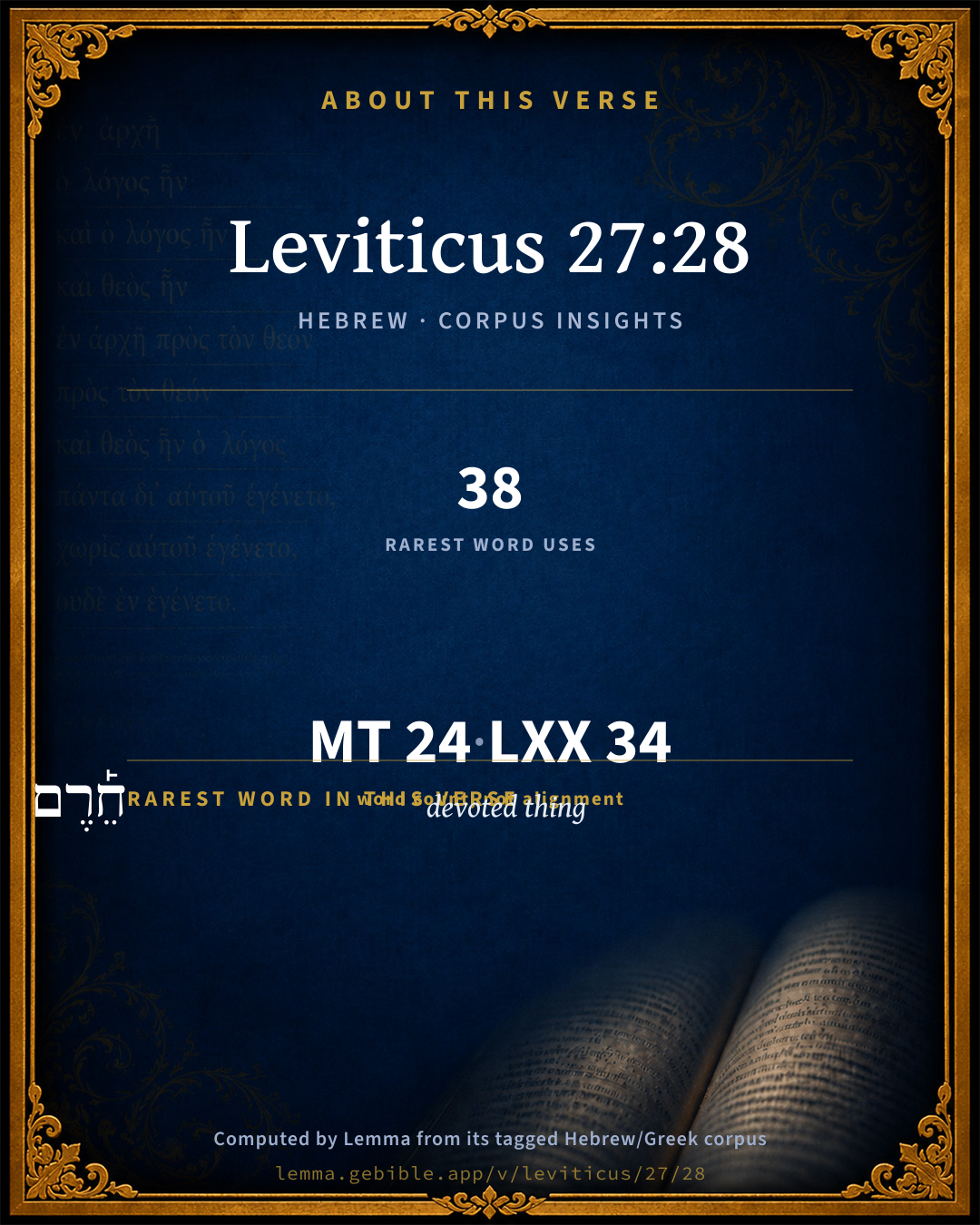
24
words
16
distinct lemmas
Pentateuch
section

Shared distinctive vocabulary

חֵ֡רֶם devoted thing H2764 occurs in 31 verses of the Hebrew Bible. Also found in:

Grammatical profile

  • 3 verbs
  • 14 nouns
  • 1 pronoun
  • 1 preposition
  • 5 particles

Verb forms

  • יַחֲרִם֩ Hiphil · Imperfect
  • יִמָּכֵ֖ר Niphal · Imperfect
  • יִגָּאֵ֑ל Niphal · Imperfect

Repetition

Words recur within this verse — often emphatic in Hebrew:

  • כָּל all H3605 ×3
  • חֵ֡רֶם devoted thing H2764 ×2
  • לַֽיהוָ֜ה LORD H3068 ×2
  • קֹֽדֶשׁ holiness H6944 ×2
  • אֲשֶׁ֣ר which H834 ×2
  • לֹ֥א not H3808 ×2

Hebrew & Septuagint length

In English translation the verse runs 41 words from the Hebrew and 46 from the Septuagint (LXX English) — closely comparable.

A rough comparison of the two English renderings, which tokenize alike — not a word-level alignment.

Word counts can differ between the Hebrew and the Greek without any difference in meaning — e.g. the Hebrew direct-object marker אֵת has no separate Greek word, and Greek often adds the article ὁ.

In the original languages it is 24 Hebrew tokens and 34 Greek tokens — but the two are counted differently (Hebrew bundles its prefixes and suffixes into one token; the Greek is in lemma form), so that isn’t a like-for-like length.

Cross-references

28

Topical passages linked to Leviticus 27:28 in the Treasury of Scripture Knowledge — connected by theme and wording, ordered by reader-vote popularity; previews shown in the World English Bible.

  • Joshua 6:17–19 The city shall be devoted, even it and all that is therein, to Yahweh: only Rahab the prostitute shall live, she and all who are with her in the house, because she hid the messengers that we sent.
  • Exodus 22:20 "He who sacrifices to any god, except to Yahweh only, shall be utterly destroyed.
  • Leviticus 27:21 but the field, when it goes out in the Jubilee, shall be holy to Yahweh, as a field devoted; it shall be owned by the priests.
  • Deuteronomy 20:16–17 But of the cities of these peoples, that Yahweh your God gives you for an inheritance, you shall save alive nothing that breathes;
  • Deuteronomy 25:19 Therefore it shall be, when Yahweh your God has given you rest from all your enemies round about, in the land which Yahweh your God gives you for an inheritance to possess it, that you shall blot out the memory of Amalek from under the sky; you shall not forget.
  • Numbers 18:14 Everything devoted in Israel shall be yours.
  • Numbers 21:2–3 Israel vowed a vow to Yahweh, and said, If you will indeed deliver this people into my hand, then I will utterly destroy their cities.
  • Deuteronomy 7:1–2 When Yahweh your God shall bring you into the land where you go to possess it, and shall cast out many nations before you, the Hittite, and the Girgashite, and the Amorite, and the Canaanite, and the Perizzite, and the Hivite, and the Jebusite, seven nations greater and mightier than you;
  • Deuteronomy 13:15–16 you shall surely strike the inhabitants of that city with the edge of the sword, destroying it utterly, and all that is therein and the cattle of it, with the edge of the sword.
  • Joshua 6:26 Joshua charged them with an oath at that time, saying, Cursed be the man before Yahweh, that rises up and builds this city Jericho: with the loss of his firstborn shall he lay the foundation of it, and with the loss of his youngest son shall he set up the gates of it.
  • Joshua 7:1 But the children of Israel committed a trespass in the devoted thing; for Achan, the son of Carmi, the son of Zabdi, the son of Zerah, of the tribe of Judah, took of the devoted thing: and the anger of Yahweh was kindled against the children of Israel.
  • Joshua 7:11–13 Israel has sinned; yes, they have even transgressed my covenant which I commanded them: yes, they have even taken of the devoted thing, and have also stolen, and dissembled also; and they have even put it among their own stuff.
  • Judges 11:30–31 Jephthah vowed a vow to Yahweh, and said, If you will indeed deliver the children of Ammon into my hand,
  • 1 Samuel 15:18 and Yahweh sent you on a journey, and said, 'Go, and utterly destroy the sinners the Amalekites, and fight against them until they are consumed.'
  • Acts 23:12–14 When it was day, some of the Jews banded together, and bound themselves under a curse, saying that they would neither eat nor drink until they had killed Paul.
  • Joshua 7:25 Joshua said, Why have you troubled us? Yahweh shall trouble you this day. All Israel stoned him with stones; and they burned them with fire, and stoned them with stones.
  • Judges 21:5 The children of Israel said, Who is there among all the tribes of Israel who didn't come up in the assembly to Yahweh? For they had made a great oath concerning him who didn't come up to Yahweh to Mizpah, saying, He shall surely be put to death.
  • Judges 21:11 This is the thing that you shall do: you shall utterly destroy every male, and every woman who has lain by man.
  • Judges 21:18 However we may not give them wives of our daughters, for the children of Israel had sworn, saying, Cursed be he who gives a wife to Benjamin.
  • 1 Samuel 14:24–28 The men of Israel were distressed that day; for Saul had adjured the people, saying, Cursed be the man who eats any food until it be evening, and I be avenged on my enemies. So none of the people tasted food.
  • 1 Samuel 14:38–45 Saul said, Draw near here, all you chiefs of the people; and know and see in which this sin has been this day.
  • 1 Samuel 15:3 Now go and strike Amalek, and utterly destroy all that they have, and don't spare them; but kill both man and woman, infant and suckling, ox and sheep, camel and donkey.
  • 1 Samuel 15:32–33 Then said Samuel, Bring you here to me Agag the king of the Amalekites. Agag came to him cheerfully. Agag said, Surely the bitterness of death is past.
  • Matthew 25:41 Then he will say also to those on the left hand, 'Depart from me, you cursed, into the eternal fire which is prepared for the devil and his angels;
  • Romans 9:3 For I could wish that I myself were accursed from Christ for my brothers' sake, my relatives according to the flesh,
  • 1 Corinthians 16:22 If any man doesn't love the Lord Jesus Christ, let him be accursed. Come, Lord!
  • Galatians 3:10 For as many as are of the works of the law are under a curse. For it is written, "Cursed is everyone who doesn't continue in all things that are written in the book of the law, to do them."
  • Galatians 3:13 Christ redeemed us from the curse of the law, having become a curse for us. For it is written, "Cursed is everyone who hangs on a tree,"

Cross-references courtesy of OpenBible.info (CC BY 4.0).

Hebrew and Greek witnesses Masoretic Hebrew ↔ Greek Septuagint

The same verse in the two great witnesses to the Old Testament, shown verse-for-verse.

These are two independent witnesses, not word-aligned to each other, and the Septuagint is shown in lemma (dictionary) form.

Hebrew Leviticus 27:28 Masoretic · Westminster Leningrad Codex

אַךְ כָּל חֵ֡רֶם אֲשֶׁ֣ר יַחֲרִם֩ אִ֨ישׁ לַֽיהוָ֜ה מִכָּל אֲשֶׁר ל֗וֹ מֵאָדָ֤ם וּבְהֵמָה֙ וּמִשְּׂדֵ֣ה אֲחֻזָּת֔וֹ לֹ֥א יִמָּכֵ֖ר וְלֹ֣א יִגָּאֵ֑ל כָּל חֵ֕רֶם קֹֽדֶשׁ קָֽדָשִׁ֥ים ה֖וּא לַיהוָֽה

"'Notwithstanding, no devoted thing, that a man shall devote to Yahweh of all that he has, whether of man or animal, or of the field of his possession, shall be sold or redeemed: every devoted thing is most holy to Yahweh.

World English Bible · Public Domain

Greek LXX Leviticus 27:28 Septuagint · lemma form

πᾶς δέ ἀνάθεμα ὅς ἐάν ἀνατίθημι ἄνθρωπος ὁ κύριος ἀπό πᾶς ὅσος αὐτός εἰμί ἀπό ἄνθρωπος ἕως κτῆνος καί ἀπό ἀγρός κατάσχεσις αὐτός οὐ ἀποδίδωμι οὐδέ λυτρόω πᾶς ἀνάθεμα ἅγιος ἅγιος εἰμί ὁ κύριος

And every dedicated thing which a man shall dedicate to the Lord of all that he has, whether man or beast, or of the field of his possession, he shall not sell it, nor redeem it: every devoted thing shall be most holy to the Lord.

LXX2012 (modern English Septuagint) · Public Domain

Hebrew: Westminster Leningrad Codex (CC BY 4.0). Greek: Septuagint (public domain); English from LXX2012 (modern English Septuagint) (Public Domain). How the Septuagint differs from the Hebrew →

Targum (Aramaic paraphrase)

2

The Targum is the ancient Jewish Aramaic paraphrase of the Hebrew Scriptures — an interpretive translation, not the Hebrew text itself. Onkelos (literal) and Pseudo-Jonathan (expansive) render the Torah, and Jonathan the Prophets. Coverage is partial: where no permissively-licensed English translation exists for a verse, only the Aramaic is shown. This is verse-level text, not a word-by-word alignment to the Hebrew.

  1. Targum Onkelos Torah (Genesis–Deuteronomy)
    בְּרַם כָּל חֶרְמָא דִי יַחְרֵם גְבַר קֳדָם יְיָ מִכָּל דִי לֵהּ מֵאֲנָשָׁא וּבְעִירָא וּמֵחֲקַל אַחֲסַנְתֵּהּ לָא יִזְדַבַּן וְלָא יִתְפָּרָק כָּל חֶרְמָא קֹדֶשׁ קוּדְשִׁין הוּא קֳדָם יְיָ

    (no public-domain English translation for this verse)

    Targum Onkelos — Aramaic: “Onkelos Genesis” (public domain); “Onkelos Exodus” (public domain); “Onkelos Leviticus” (public domain); “Onkelos Numbers” (public domain); “Onkelos Deuteronomy” (public domain). English: “Sefaria Community Translation” (CC0 1.0 (public-domain dedication)); “J.W. Etheridge. The Targums of Onkelos and Jonathan Ben Uzziel on the Pentateuch. London: Longmans, Green, 1862” (public domain). Text via Sefaria.

  2. Targum Pseudo-Jonathan Torah (Genesis–Deuteronomy)
    בְּרַם כָּל אַפְרָשָׁא דִי יַפְרֵישׁ גְבַר קֳדָם יְיָ מִן כָּל דְאִית לֵיהּ מֵאֱנָשָׁא וּבְעִירָא וּמֵחֲקַל אַחֲסַנְתֵּיהּ לָא יִזְדַבֵּן וְלָא יִתְפְּרֵק כָּל אַפְרָשָׁא קוֹדֶשׁ קוּדְשִׁין הוּא קֳדָם יְיָ

    Nevertheless, no devoted thing which a man shall separate before the Lord of anything that is his, of man, or beast, or of his inheritance, shall be sold or redeemed; every (devoted) separation is most sacred before the Lord.

    Targum Pseudo-Jonathan — Aramaic: “Targum Jonathan on Genesis” (public domain); “Targum Jonathan on Exodus” (public domain); “Targum Jonathan on Leviticus” (public domain); “Targum Jonathan on Numbers” (public domain); “Targum Jonathan on Deuteronomy” (public domain). English: “The Targum of Jonathan ben Uzziel, trans. J. W. Etheridge, London, 1862” (public domain). Text via Sefaria.

Commentary

Notes on Leviticus 27:28 from classic Christian and Jewish commentators (each source and its license shown beneath its notes). The classic Christian expositions comment on the surrounding passage and are grouped to its opening verse, so a note may address several verses; the Jewish commentaries on the Tanakh (Rashi and others) are per-verse, so they appear only where the commentator wrote on this verse.

Lemma curates 59 commentaries, every one of them public domain or Creative Commons licensed, each selected and text-cleaned for this edition rather than reprinted as found. About our sources →

Trapp's Complete Commentary

John Trapp

Lev 27:28 Notwithstanding no devoted thing, that a man shall devote unto the LORD of all that he hath, [both] of man and beast, and of the field of his possession, shall be sold or redeemed: every devoted thing [is] most holy unto the LORD.

Ver. 28. Notwithstanding no devoted.] Hitherto of things consecrate; now of things execrate, whereof see a command, {Deu 13:15; Deu 13:17} an example. {Num 21:2} These could not be sold, nor redeemed, but must remain with the priest: if it were a beast, then to be put to death.

No devoted thing.] No anathema: so the offerings of the temple were called. {Luk 21:5}

John Trapp, A Commentary or Exposition upon All the Books of the Old and New Testament (1647–1656) — public domain. Text from a community e-Sword module.

Joseph Benson's Commentary

Lev 27:28. No devoted thing — That is, nothing which is absolutely devoted to God with a curse upon themselves or others if they disposed not of it according to their vow; as the Hebrew word implies. Most holy — That is, only to be touched or employed by the priests, and by no other persons; no, not by their own families, for that was the state of the most holy things.

Joseph Benson's Commentary on the Old and New Testaments (1811–1818) — public domain. Text from a community e-Sword module.

Whedon's Commentary on the Bible

Daniel D. Whedon

THINGS UNDER THE BAN AND TITHES, Lev_27:28-34.

28. No devoted thing — Nothing put under the ban to the Lord, either of property or persons, was to be redeemed or sold, because it was most holy.

Lev_2:3, note. The Hebrew word for “devoted” is cherem, a much stronger term than it is translated by in our version. It differs from the neder, or ordinary vow, in the imprecations and execrations invoked for its non-fulfilment. There may have been other differences which are not in the Mosaic record. That this form of a vow was solemn in the highest degree, and absolutely irrevocable, and, in this respect, an exception to the vows in the preceding verses, is evident from the Hebrew particle at the beginning of the verse, ak, nevertheless.

Of man and beast — “The man thus devoted was to be put to death,” says Keil. But Saalschutz discusses the question whether private persons could devote human beings to death, and rightly decides in the negative. In later times menservants and maidservants belonged to the sanctuary. Num_31:47; Jos_9:3; Jos_9:26-27; 1Sa_2:22, note. On the whole, Mosaism does not favour votive dedications, hence we find no very exact specifications respecting them. The cherem, or ban, denotes that which is removed from the use or abuse of men and irrecoverably devoted to God, human beings being killed, while sacrificial animals and the precious metals were either given up to the sanctuary forever or destroyed for the glory of Jehovah. See Jos_6:17; Jos_6:21, notes. This was the punishment denounced against incorrigible idolatry. Deu_13:13-18. “It follows from this, however, that the vow of banning could only be made in connexion with persons who obstinately resisted that sanctification of life which was binding upon them; and that an individual was not at liberty to devote a human being to the ban simply at his own will and pleasure, otherwise the ban might have been abused to purposes of ungodliness, and have amounted to a breach of the law, which prohibited the killing of a man, even though he were a slave.

Exo_21:20. The owner of cattle and fields was allowed to put them under the ban only when they had been either desecrated by idolatry or abused to unholy purposes. For there can be no doubt that the idea which lay at the foundation of the ban was that of a compulsory dedication of something which resisted or impeded sanctification, so that in all cases in which it was carried into execution by the community or the magistracy it was an act of the judicial holiness of God.” — Keil and Delitzsch.

Most holy — The devoted thing could be eaten by the priests only, or, if inedible, it could be employed only for the service of Jehovah. It was sacrilege for the giver to put forth his hand to retake it. He might have made the cherem very grudgingly and half-heartedly, but, having made it, the object was forever removed from his control. It was not the intention of the giver that made it holy, but the holiness of the Receiver. An offering once laid upon the altar from that moment belonged to the Lord. This law throws floods of light upon the subject of Christian consecration and sanctification. Having solemnly surrendered our entire being to Christ, we are henceforth to reckon ourselves dead indeed unto sin, but alive unto God as most holy sacrifices, which it would be sacrilege to take from the altar.

Daniel D. Whedon (gen. ed.), Commentary on the Old and New Testaments (1874–1909) — public domain. Text from a community e-Sword module.

Keil & Delitzsch

C. F. Keil & F. Delitzsch

Moreover, nothing put under the ban, nothing that a man had devoted (banned) to the Lord of his property, of man, beast, or the field of his possession, was to be sold or redeemed, because it was most holy (see at Lev 2:3). The man laid under the ban was to be put to death. According to the words of Lev 27:28, the individual Israelite was quite at liberty to ban, not only his cattle and field, but also men who belonged to him, that is to say, slaves and children. החרים signifies to dedicate something to the Lord in an unredeemable manner, as cherum, i.e., ban, or banned. חרם (to devote, or ban), judging from the cognate words in the Arabic, signifying prohibere, vetare, illicitum facere, illicitum, sacrum, has the primary signification "to cut off," and denotes that which is taken away from use and abuse on the part of men, and surrendered to God in an irrevocable and unredeemable manner, viz., human beings by being put to death, cattle and inanimate objects by being either given up to the sanctuary for ever or destroyed for the glory of the Lord. The latter took place, no doubt, only with the property of idolaters; at all events, it is commanded simply for the infliction of punishment on idolatrous towns (Deu 13:13.). It follows from this, however, that the vow of banning could only be made in connection with persons who obstinately resisted that sanctification of life which was binding upon them; and that an individual was not at liberty to devote a human being to the ban simply at his own will and pleasure, otherwise the ban might have been abused to purposes of ungodliness, and have amounted to a breach of the law, which prohibited the killing of any man, even though he were a slave (Exo 21:20). In a manner analogous to this, too, the owner of cattle and fields was only allowed to put them under the ban when they had been either desecrated by idolatry or abused to unholy purposes. For there can be no doubt that the idea which lay at the foundation of the ban was that of a compulsory dedication of something which resisted or impeded sanctification; so that in all cases in which it was carried into execution by the community or the magistracy, it was an act of the judicial holiness of God manifesting itself in righteousness and judgment.

Keil & Delitzsch — Biblical Commentary on the Old Testament (1861–1891) — public domain (CC PDM 1.0). Text via the HelloAO Bible API. (Old Testament only.)

The Expositor's Bible

THE LAW OF THE BAN

Lev_27:28-29

"Notwithstanding, no devoted thing, that a man shall devote unto the Lord of all that he hath, whether of man or beast, or of the field of his possession, shall be sold or redeemed: every devoted thing is most holy unto the Lord. None devoted, which shall be devoted of men, shall be ransomed; he shall surely be put to death."

Neither could any "devoted thing" be given to the Lord by a vow, and for the same reason-that it belonged to Him already. But it is added that, unlike that which has been vowed, the Lords firstlings and the tithes, that which has been devoted may neither be sold nor redeemed. If it be a person which is thus "devoted," "he shall surely be put to death" (Lev_27:29). The reason of this law is found in the nature of the herem or ban. It devoted to the Lord only such persons and things as were in a condition of irreformable hostility and irreconcilable antagonism to the kingdom of God. By the ban such were turned over to God, in order to the total nullification of their power for evil; by destroying whatever was capable of destruction, as the persons and all living things that belonged to them; and by devoting to the Lords service in the sanctuary and priesthood such of their property as, like silver, gold, and land, was in its nature incapable of destruction. In such devoted persons or things no man therefore was allowed to assert any personal claim or interest, such as the right of sale or of redemption would imply. Elsewhere the Israelite is forbidden even to desire the silver or gold that was on the idols in devoted cities, {Deu_7:25} or to bring it into his house or tent, on penalty of being himself banned or devoted like them; a threat which was carried out in the case of Achan, {Joshua 7} who, for appropriating a wedge of gold and a garment which had been devoted, according to the law here and elsewhere declared, was summarily put to death.

This is not the place to enter fully into a discussion of the very grave questions which arise in connection with this law of the ban, in which it is ordered that "none devoted," "whether of man or beast," "shall be ransomed," but "shall be surely put to death." The most familiar instance of its application is furnished by the case of the Canaanitish cities, which Joshua, in accordance with this law of Lev_27:28-29, utterly destroyed, with their inhabitants and every living thing that was in them. There are many sincere believers in Christ who find it almost impossible to believe that it can be true that God commanded such a slaughter as this; and the difficulty well deserves a brief consideration. It may not indeed be possible wholly to remove it from every mind; but one may well call attention, in connection with these verses, to certain considerations which should at least suffice very greatly to relieve its stress.

In the first place, it is imperative to remember that, if we accent the teaching of Scripture, we have before us in this history, not the government of man, but the government of God, a true theocracy. Now it is obvious that if even fallible men may be rightly granted power to condemn men to death, for the sake of the public good, much more must this right be conceded, and that without any limitation, to the infinitely righteous and infallible King of kings, if, in accord with the Scripture declarations, He was, literally and really, the political Head (if we may be allowed the expression) of the Israelitish nation. Further, if this absolute right of God in matters of life and death be admitted, as it must be; it is plain that He may rightly delegate the execution of His decrees to human agents. If this right is granted to one of our fellow men, as to a king or a magistrate, much more to God.

Granting that the theocratic government of Israel was a historical fact, the only question then remaining as to the right of the ban, concerns the justice of its application in particular cases. With regard to this, we may concede that it was quite possible that men might sometimes apply this law without Divine authority; but we are not required to defend such cases, if any be shown, any more than to excuse the infliction of capital punishment in America sometimes by lynch law. These cases furnish no argument against its infliction after due legal process, and by legitimate governmental authority. As to the terrible execution of this law of the ban, in the destruction of the inhabitants of the Canaantish cities, if the fact of the theocratic authority be granted, it is not so difficult to justify this as some have imagined. Nor, conversely, when the actual facts are thoroughly known, can the truth of the statement of the Scripture that God commanded this terrible destruction, be regarded as irreconcilable with those moral perfections which Scripture and reason alike attribute to the Supreme Being.

The researches and discoveries of recent years have let in a flood of light upon the state of society prevailing among those Canaanitish tribes at the date of their destruction; and they warrant us in saying that in the whole history of our race it would be hard to point to any civilised community which has sunken to such a depth of wickedness and moral pollution. As we have already seen, the book of Leviticus gives many dark hints of unnamable horrors among the Canaanitish races: the fearful cruelties of the worship of Molech, and the unmentionable impurities of the cult of Ashtoreth; the prohibition among some of these of female chastity, requiring that all be morally sacrificed- one cannot go into these things. And when now we read in Holy Scripture that the infinitely pure, holy and righteous God commanded that these utterly depraved and abandoned communities should be extirpated from the face of the earth, is it, after all, so hard to believe that this should be true? Nay, may we not rather with abundant reason say that it would have been far more difficult to reconcile with the character of God it He had suffered them any longer to exist?

Nor have we yet fully stated the case. For we must, in addition, recall the fact that these corrupt communities, which by this law of the ban were devoted to utter destruction, were in no out-of-the-way corner of the world, but on one of its chief highways. The Phoenicians, for instance, more than any people of that time, were the navigators and travellers of the age; so that from Canaan as a center this horrible moral pestilence was inevitably carried by them hither and thither, a worse than the "black death," to the very extremities of the known world. Have we then so certainly good reason to call in question the righteousness of the law which here ordains that no person thus devoted should be ransomed, but be surely put to death? Rather are we inclined to see in this law of the theocratic kingdom. and its execution in Canaan-so often held up as an illustration of the awful cruelty of the old theocratic regime-not only a conspicuous vindication of the righteousness and justice of God, but a no less illustrious manifestation of his mercy; -of His mercy, not merely to Israel, but to the whole human race of that age, who because of this deadly infection of moral evil had otherwise again everywhere sunk to such unimaginable depths of depravity as to have required a second flood for the cleansing of the world. This certainly was the way in which the Psalmist regarded it, {Psa_136:17-22} he praised Jehovah as One who "smote great kings, and slew famous kings, and gave their land for a heritage, even a heritage unto Israel His servant: for HIS MERCY endureth forever"; a thought which is again more formally expressed {Psa_62:12} in the words: "Unto Thee, O Lord, belongeth mercy: for Thou tenderest to every man according to his work."

Nor can we leave this law of the ban without noting the very solemn suggestion which it contains that there may be in the universe persons who, despite the great redemption, are morally irredeemable, hopelessly obdurate; for whom, under the government of a God infinitely righteous and merciful, nothing remains but the execution of the ban-the "eternal fire which is prepared for the devil and his angels"; {Mat_25:41} "a fierceness of fire which shall devour the adversaries". {Heb_10:27} And this, not merely although, but BECAUSE Gods "mercy endureth forever."

William Robertson Nicoll, ed., The Expositor's Bible (London: Hodder & Stoughton, 1887–1910) — public domain. 65 of 66 books (1 Corinthians is not separately keyed, as that volume carries no machine-parseable verse references); section-level commentary keyed to the opening verse. Introductory and overview sections not keyed to a specific passage are excluded.

Tyndale Open Study Notes

Tyndale Open Resources

27:28 specially set apart (Hebrew kherem): Such an act of devotion was irrevocable. The person, animal, or property devoted this way was dedicated to the service of the sanctuary in a manner defined by the priest.

Tyndale Open Study Notes — © Tyndale Open Resources, licensed CC BY-SA 4.0. Text via the HelloAO Bible API.

Jamieson, Fausset & Brown

Robert Jamieson, A. R. Fausset & David Brown

no devoted thing, that a man shall devote unto the Lord of all that he hath, . . . shall be sold or redeemed--This relates to vows of the most solemn kind--the devotee accompanying his vow with a solemn imprecation on himself not to fail in accomplishing his declared purpose.

Jamieson, Fausset & Brown — Commentary Critical and Explanatory on the Whole Bible (1871) — public domain (CC PDM 1.0). Text via the HelloAO Bible API.

Adam Clarke's Commentary

Verse 28. No devoted thing - shall be sold or redeemed] This is the חרם cherem, which always meant an absolute unredeemable grant to God.

Adam Clarke's Commentary on the Bible (1810–1826) — public domain. Text from a community e-Sword/MySword module.

Ellicott's Commentary for English Readers

(28) Notwithstanding no devoted thing.—Better, Nevertheless, no banned thing (see Lev_27:26), that is, unlike those things consecrated to God by the vow hitherto spoken of, anything which the vower devoted to God under a solemn ban cannot be redeemed.

Both of man and beast, and of the field of his possession.—This shows the extent to which a man may go in exercising his power to devote things to God in this manner. He was perfectly at liberty to ban not only his cattle and his otherwise inalienable inherited land, but also those human beings over whom he had control—his children and slaves.

Every devoted thing is most holy unto the Lord.—Being most holy, any thing or person thus devoted to the Lord could neither be sold by the officials of the sanctuary nor be redeemed by the vower who had in this manner banned the objects of his vow. All gifts devoted under the ban became the property of the priests. (See Lev_27:17; Num_18:14; Eze_44:29.)

A Bible Commentary for English Readers, edited by Charles John Ellicott (1878–1897) — public domain. Text from a community e-Sword module.

The Cambridge Bible for Schools and Colleges

gen. ed. J. J. S. Perowne

28. no devoted thing] The word lit. means set apart, separated (Arab. harama, whence harem, the occupants of the women’s portion of a Mohammedan house, or the apartments themselves). See on Exo_22:20 for examples of its application, and for the superiority of R.V. over A.V. in the English rendering. For the different species of separation in this sense see HDB., Art. Ban (Kennedy), where a distinction is drawn between objects set apart for God by individuals (the ‘private ban’) referred to in this v., and those persons, such as the idolater or blasphemer, who were subjected to a judicial sentence by the authorities. The latter are those meant in Lev_27:29

The Cambridge Bible for Schools and Colleges (gen. ed. J. J. S. Perowne; Cambridge University Press, 1878–1918) — public domain. Text from a community e-Sword module.

John Gill's Exposition

None devoted, which shall be devoted of men, shall be redeemed,.... This is said, not of such men as are devoted to the Lord, as in the preceding verse; for it is not said here as there, "none devoted unto the Lord", but of such as are devoted to ruin and destruction, for whom there was no redemption, but they must die; nor is it said, "which is devoted by men, but of men", or from among men; whether they be devoted by God himself, as all idolaters, and particularly the seven nations of the land of Canaan, and especially the Amalekites, who therefore were not to be spared on any account, but to be put to death, Exo 22:20. So in the Talmud (o), this is interpreted of Canaanitish servants and handmaids; or whether devoted by men to destruction, either by the people of Israel, as their avowed enemies they should take in war, whom, and their cities, they vowed to the Lord they would utterly destroy, Num 21:2; and of such Aben Ezra interprets the words of the text; or such as were doomed by the civil magistrates to die for capital crimes, by stoning, burning, strangling, and slaying with the sword. And this sense is given into by many; because the judges kill with many kinds of death, therefore, says Chaskuni, it is said "every devoted thing", as if he should say, with whatsoever of the four kinds of death the judges pass sentence of destruction on a man, he must die that death; so Jarchi and Ben Melech interpret it of such as go out to be slain, i.e. by the decree of the judges; and if one says, his estimation, or the price of him be upon me, he says nothing, it is of no avail:

but shall surely be put to death; as the same writer observes, lo, he goes forth to die, he shall not be redeemed, neither by price nor estimation. The Targum of Jonathan is,"he shall not he redeemed with silver, but with burnt offerings, and holy sacrifices, and petitions of mercy, because he is condemned by a sentence to be slain.''And of either, or of all of these, may the words be understood, and not as they are by some, as if Jewish parents and masters had such a power over their children and servants to devote them to death, or in such a manner devote them, that they were obliged to put them to death; for though they had power in some cases to sell, yet had no power over their lives to take them away, or to devote them to death, which would be a breach of the sixth command, and punishable with death; even a master that accidentally killed his servant did not escape punishment; nay, if he did him any injury, by smiting out an eye, or a tooth, he was obliged to give him his freedom, and much less had he power to take away his life, or devote him to destruction. Some have thought, that it was through a mistaken sense of this law, that Jephthah having made a rash vow sacrificed his daughter, Jdg 11:30; but it is a question whether he did or not.

(o) T. Bab. Gittin, fol. 38. 2.

John Gill's Exposition of the Whole Bible (1746–1763) — public domain (CC PDM 1.0). Text via the HelloAO Bible API.

Albert Barnes' Notes on the Bible

Devoted thing - The primary meaning of the Heb. word חרם chērem is something cut off, or shut up. Its specific meaning in the Law is, that which is cut off from common use and given up in some sense to Yahweh, without the right of recal or commutation. It is applied to a field wholly appropriated to the sanctuary Lev 27:21, and to whatever was doomed to destruction 1Sa 15:21; 1Ki 20:42. Our translators have often rendered the word by “cursed,” or “a curse,” which in some places may convey the right sense, but it should be remembered that the terms are not identical in their compass of meaning (Deu 7:26; Jos 6:17-18; Jos 7:1; Isa 34:5; Isa 43:28, etc. Compare Gal 3:13).

Of man and beast - This passage does not permit human sacrifices. Man is elsewhere clearly recognized as one of the creatures which were not to be offered in sacrifice Exo 13:13; Exo 34:20; Num 18:15.

Therefore the application of the word חרם chērem to man is made exclusively in reference to one rightly doomed to death and, in that sense alone, given up to Yahweh. The man who, in a right spirit, either carries out a sentence of just doom on an offender, or who, with a single eye to duty, slays an enemy in battle, must regard himself as God’s servant rendering up a life to the claim of the divine justice (compare Rom 13:4). It was in this way that Israel was required to destroy the Canaanites at Hormah (Num 21:2-3; compare Deu 13:12-18), and that Samuel hewed Agag in pieces before the Lord 1Sa 15:33. In all such instances, a moral obligation rests upon him whose office it is to take the life: he has to look upon the object of his stroke as under a ban to the Lord (compare Deu 20:4; Gal 3:13). Therefore, there can be neither redemption nor commutation.

It is evident that the righteousness of this law is not involved in the sin of rash or foolish vows, such as Saul’s 1Sa 14:24 or Jephthah’s Jdg 11:30.

And it seems hardly needful to add that sacrifice, as it is represented both in the Law and in the usage of the patriarchs, is something very different from consecration under a ban, though a tiring to be sacrificed might come under the designation of חרם chērem in its wider sense. The sacrifice was always the offering up of the innocent life of a creature chosen, approved, and without spot or blemish.

Albert Barnes' Notes on the Bible (1834–1885) — public domain. Text from a community e-Sword/MySword module.

Haydock's Catholic Bible Commentary

Devoted. Hebrew, "anathema," different from the other vows. In this case all that had life was slain, (or consecrated to God; Haydock) houses were demolished, the land belonged to the priests for ever, so that they could only let it out to laymen for a certain rent. Moses thus devoted the Amalecites to destruction; (Exodus xvii. 14) and Saul had orders to put in execution what he had denounced, 1 Kings xv. It is doubtful whether people could thus devote their children and slaves. Most authors suppose, that it was necessary that God or the nation at large should pronounce such a sentence, as was done with respect to Achan, Josue viii. See Numbers xxi. 2., and Judges xi. 31. (Calmet)

George Leo Haydock (1774–1849), Haydock's Catholic Family Bible and Commentary, 1859 edition — public domain. Excludes Psalms (Douay-Rheims chapter numbering differs from Protestant) and Deuterocanonical books (Catholic canon only).

Matthew Poole's English Annotations

No devoted thing, i.e. nothing which is absolutely devoted to God, with a curse upon themselves or others if they disposed not of it according to their vow; as the Hebrew word implies.

Of all that he hath, to wit, in his power or possession.

Is most holy unto the Lord, i.e. only to be touched or employed by the priests, and by no other persons; no, not by their own families, for that was the state of the

most holy things.

Matthew Poole's English Annotations on the Holy Bible (1683–1685) — public domain. Text from a community e-Sword/MySword module.

The Pulpit Commentary

Vers. 28, 29. Whatever is already cherem (a word here first used as a term well understood), that is, devoted to God, whether devoted for the purpose of destruction or of entire surrender to him, may be neither redeemed nor sold. Whether it be of man, like the Canaanites at Hormah, (Num_21:2) or of beast, as the sheep and oxen of the Amalekites, (1Sa_15:21) or of the field, as referred to in verse 21, or of other inanimate objects, as the cities of Hormah, (Num_21:2) it is either to be put to death or given up without reserve or commutation to God"s ministers. In the case of men they must be put to death. "This provision would have applied only to the devoting of those who were already manifestly under the ban of Jehovah those guilty of such outrageous and flagrant violation of the fundamental law of the covenant that they manifestly came under the penalty of death. Such persons, instead of being tried and condemned, might be at once devoted and put to death" (Gardiner). "To this it may be added that the devotion by ban (cherem) of any object or person was not to be done by private persons, at their own will, but was performed by the civil magistrates, under known conditions and laws; e.g. the cities of idolaters, such as Jericho, were so devoted, and the inhabitants, by the command of God himself, who made his people to be the executioners of his judgments against inveterate idolatry" (see Deu_13:13Jo Deu_6:17) (Wordsworth).

The Pulpit Commentary (1880–1919), ed. H.D.M. Spence-Jones & Joseph S. Exell — public domain. Text from a community e-Sword module.

John Wesley's Explanatory Notes

No devoted thing - That is, nothing which is absolutely devoted to God with a curse upon themselves or others, if they disposed not of it according to their vow; as the Hebrew word implies. Most holy - That is, only to be touched or employed by the priests, and by no other persons; no not by their own families, for that was the state of the most holy things.

John Wesley, Explanatory Notes Upon the Whole Bible (1754–1765) — public domain. Text via the GEBible commentary corpus.

Scofield Reference Notes

C. I. Scofield

redeemed

Heb. "goel," Redemp. (Kinsman type). (See Scofield "Isa 59:20").

The Scofield Reference Bible (1917 edition), notes by C. I. Scofield — public domain. Text from a community e-Sword module.

unfoldingWord translationNotes

Door43 World Missions Community

nothing that a man devotes to Yahweh, from all that he has, whether human or animal, or his family land, may be sold or redeemed

This can be stated in active form. AT: "No one may sell or redeem anything a man has devoted to Yahweh, from all that he has, whether it is a human, an animal, or his family land" or "If a man devotes to Yahweh anything he has, whether human or animal, or his family land, no one may sell or redeem it" (See: Active or Passive)

Everything that is devoted is very holy to Yahweh

"Everything that anyone devotes to Yahweh is very holy to Yahweh"

No ransom may be paid

This can be stated in active form. "No one may pay a ransom" (See: Active or Passive)

for the person who is devoted for destruction

This can be stated in active form. AT: "for any person whom Yahweh has devoted to destruction" (See: Active or Passive)

for the person who is devoted for destruction

Why a person would be devoted to destruction can be stated clearly. AT: "for any person whom Yahweh has determined should die because of his sin" (See: Assumed Knowledge and Implicit Information)

That person must be put to death

This can be stated in active form. AT: "you must put that person to death" or "you must kill that person" (See: Active or Passive)

translationWords

Yahweh

holy

ransom

die

unfoldingWord translationNotes — © Distant Shores Media and the Door43 World Missions Community, licensed CC BY-SA 4.0. Source: git.door43.org/Door43/en_tn.

Rashi

Rabbi Shlomo Yitzchaki (Rashi)

אך כל חרם NOTWITHSTANDING NO DOOMED THING… [SHALL BE SOLD OR REDEEMED] — Our Rabbis are of different opinions regarding this matter (i. e. regarding the explanation of the word חרם used in this section). Some say: “All things declared doomed without any statement as to their purpose”, go to the Temple treasury. And if you ask, “But how then can I explain the text addressed to Aaron (Numbers 18:14) “every חרם in Israel shall be thine” (i. e. the priest’s)? Then I reply that I explain it to refer to חרמים expressly made for priests, i. e. that the donor expressly said, “this shall be a doomed thing for the priests” (so that it is not a סתם חרם). Others, however, say, that all things declared doomed without any statement as to their purpose go to the priests (in accordance with Numbers 18:14) (Arakhin 28b).

לא ימכר ולא יגאל IT SHALL NOT BE SOLD NOR REDEEMED but shall be given to the priest. Now, according to him who holds that “doomed things not specially assigned” go to the priests, this verse must be explained as referring to such “unassigned doomed things”. He, however, who holds that “unassigned doomed things” go for the Temple repair, explains this verse as referring to such “doomed things” that were expressly declared to be for the priests, since all agree that such doomed things intended for the priests cannot be redeemed before they came into the possession of the priest (when the priest may do whatever he likes with them, because they are חולין; Scripture is thus right in stating 'לא ימכר וכו‎), whilst doomed things intended for the Most High (i. e. for the Sanctuary) are redeemable (Arakhin 29b).

כל חרם קדש קדשים הוא EVERY DOOMED THING IS MOST HOLY — He who holds that “unassigned doomed things” go to the Temple repair produces evidence from here that his assertion is correct, whilst he who holds that “unassigned doomed things” go to the priests explains the words: 'כל חרם קדש קדשים הוא לה as meaning: every doomed thing of that which is most holy (חרם is construct!) shall be the Lord’s and as intended to teach that חרמים made for the priests are applicable to objects holy in the highest degree (e. g. if one says, "This burnt-offering shall be doomed to the priests”) and to subjects holy in a minor degree (e. g. a firstborn animal) and he gives its value to the priest, as we learn in Treatise Arakhin 28b: If it is a נדר (cf. for this term Leviticus 22:18) he pays the full value of it, and if it is a נדבה (Leviticus 22:18) he only pays the value of the gratification he might have of it.

מאדם [NO DOOMED THING…] OF MAN […SHALL BE SOLD OR REDEEMED] — for instance, in the case that he has declared as חרם his Canaanite man-servants or maid-servants (Arakhin 28a).

Rashi on the Tanakh — English translations: “The Judaica Press complete Tanach with Rashi, translated by A. J. Rosenberg” (CC BY 4.0); “Pentateuch with Rashi's commentary by M. Rosenbaum and A.M. Silbermann, 1929-1934” (public domain); “The Metsudah Tanach series, Lakewood, N.J” (CC BY 4.0); and “The Book of Joshua, Metsudah Publications, 1997” (CC BY 4.0). Text via Sefaria.

Lesson kit

Teaching starters — assembled from the data on this page, not authored interpretation. Every prompt links to the verse data it draws on. Edit before teaching.

Leviticus, in the Pentateuch, opens this verse with 24 words (16 distinct Hebrew lemmas). Its most distinctive word is chêrem (“devoted thing”). A historical commentator’s framing appears above. Read the whole chapter for the surrounding context.

Discussion questions

  1. What does “devoted thing” (chêrem) contribute to the verse as a whole?
  2. How does Leviticus 27:21, which shares the word «devoted thing», read alongside this verse?
  3. What does the repetition of “all” (3× in this one verse) do in this verse?
  4. These translations render this verse differently. What is at stake in choosing one wording over another?
  5. «יַחֲרִם֩» is a Hiphil Imperfect verb. How does that grammatical form shape the action described?
  6. Compare how Trapp's Complete Commentary and Joseph Benson's Commentary read this verse. Where do they agree or differ?

Things to notice

Reading settings

Reading text

Shown beneath each verse's original-language words.

Old Testament
Old Testament edition

Read the OT as the Masoretic Hebrew (MT) or the Greek Septuagint (LXX).

English shown for the Greek Septuagint (in the Hebrew ↔ Greek comparison).

Comparing translations? Open the Compare panel on any verse page to stack up to four side by side.