Leviticus 27:20

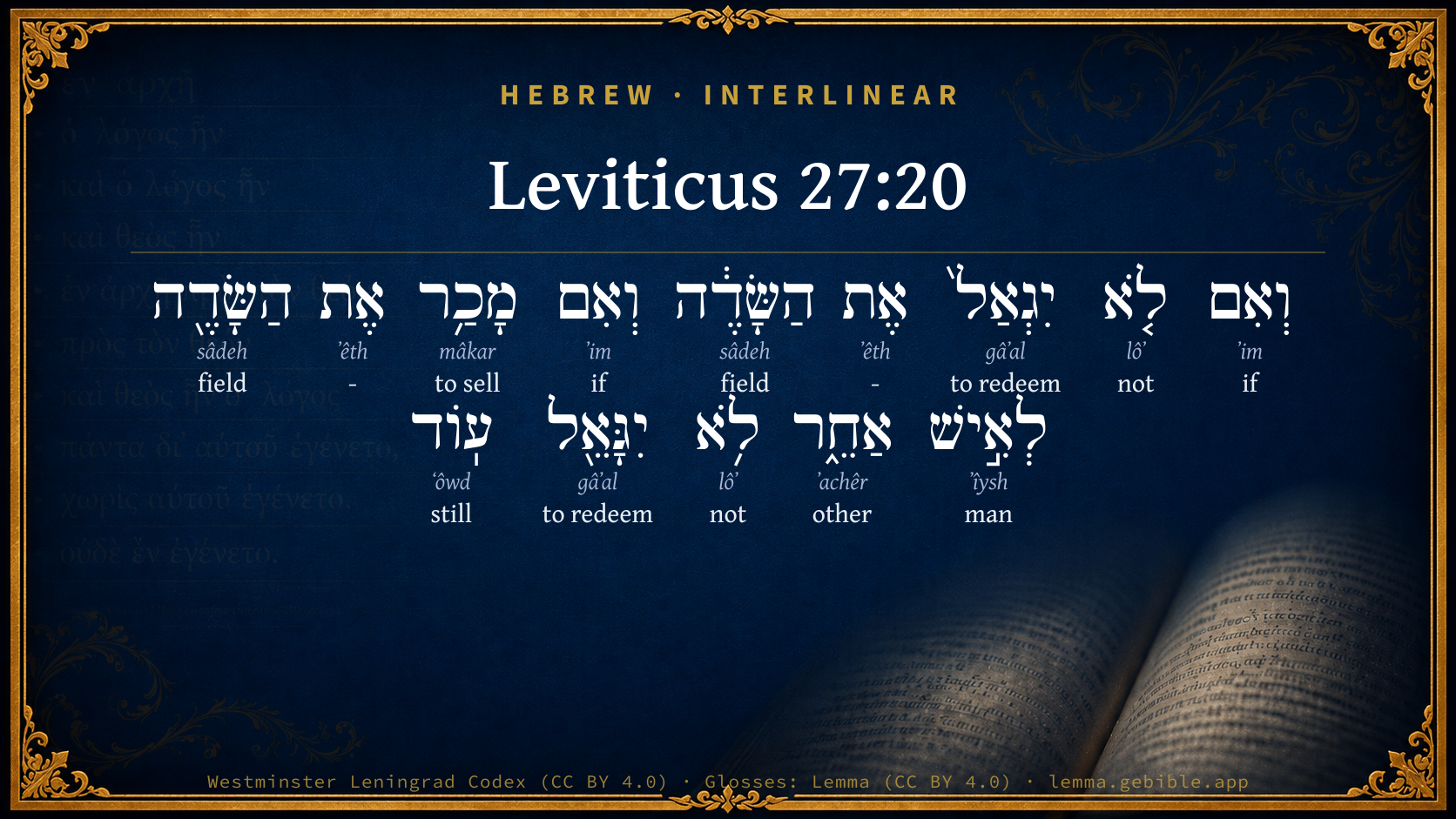
Hebrew (Westminster Leningrad Codex) Leviticus 27:20 appears in the Hebrew Old Testament. The text above is from the Westminster Leningrad Codex. Each word links to its Strong’s number, a concise gloss, and parsing drawn from the Open Scriptures Hebrew Bible morphology. Click any word for its full Brown-Driver-Briggs (BDB) entry.
Download image
Cite this verse

Leviticus 27:20 (World English Bible). Public Domain. Lemma interlinear Bible study tool, https://lemma.gebible.app/v/leviticus/27/20.

Show BibTeX & RIS
BibTeX
RIS
English Translation
If he will not redeem the field, or if he has sold the field to another man, it shall not be redeemed any more;
World English Bible · Public Domain
Download a study sheet

One document with this verse’s original text, its word-by-word gloss line, the meaning frame, cross-references with their text, attributed commentary, and full source and license credits — printable, and it pastes into notes with its structure intact.

This verse Autodidact and up

Study sheet (.html) Plain text (.txt)

A passage Seminary Student

Up to 50 verses in one chapter. A passage sheet keeps up to 6 commentary sources and 12 cross-references per verse, in the order this page ranks them, and says so on the sheet whenever that leaves anything out. Ask for a single verse and you get the Autodidact verse sheet above.

Everything on this page stays free to read, with no account — the sheet is a download of what is already on screen, not access to it.

Want to remove ads? Support Godless Engineer
Compare translations 3

The same verse in 3 English versions, stacked beneath the original-language interlinear above. Click any original word for its lexicon entry.

Each is an independent rendering of the whole verse — the interlinear is not word-aligned to these translations.

Highlighted words mark where these versions differ — a whole-verse word diff, not a word-by-word alignment.

  • World English Bible Public Domain
    If he will not redeem the field, or if he has sold the field to another man, it shall not be redeemed any more;
  • King James Version Public Domain
    And if he will not redeem the field, or if he have sold the field to another man, it shall not be redeemed any more.
  • unfoldingWord Literal Text CC BY-SA 4.0
    And if he does not redeem the field, and if he sells the field to another man, it shall not be redeemed again.

unfoldingWord Literal Text — © unfoldingWord, licensed CC BY-SA 4.0. Word-aligned USFM3 via Door43 (git.door43.org/unfoldingWord/en_ult).

Versions to compare (up to 4)

3 of 4 selected

Show all 18 translations

Every available English version of this verse, each an independent rendering of the whole verse.

  • World English Bible Public Domain
    If he will not redeem the field, or if he has sold the field to another man, it shall not be redeemed any more;
  • Berean Standard Bible Public Domain
    If, however, he does not redeem the field, or if he has sold it to another man, it may no longer be redeemed.
  • Majority Standard Bible Public Domain
    If, however, he does not redeem the field, or if he has sold it to another man, it may no longer be redeemed.
  • King James Version Public Domain
    And if he will not redeem the field, or if he have sold the field to another man, it shall not be redeemed any more.
  • American Standard Version (1901) Public Domain
    And if he will not redeem the field, or if he have sold the field to another man, it shall not be redeemed any more:
  • Revised Version (1885) Public Domain
    And if he will not redeem the field, or if he have sold the field to another man, it shall not be redeemed any more:
  • Geneva Bible (1599) Public Domain
    And if he will not redeeme the fielde, but the Priest sell the fielde to another man, it shalbe redeemed no more.
  • Douay-Rheims (1899) Public Domain
    And if he will not redeem it, but it be sold to any other man, he that vowed it, may not redeem it any more:
  • Young's Literal Translation Public Domain
    and if he do not redeem the field, or if he hath sold the field to another man, it is not redeemed any more;
  • Literal Standard Version CC BY-SA 4.0
    and if he does not redeem the field, or if he has sold the field to another man, it is not redeemed anymore;
  • Unlocked Literal Bible CC BY-SA 4.0
    If he does not redeem the field, or if he has sold the field to another man, it cannot be redeemed any more.
  • unfoldingWord Literal Text CC BY-SA 4.0
    And if he does not redeem the field, and if he sells the field to another man, it shall not be redeemed again.
  • Darby Bible Public Domain
    but if he do not redeem the field, or if he sell the field to another man, it cannot be redeemed any more;
  • World Messianic Bible Public Domain
    If he will not redeem the field, or if he has sold the field to another man, it shall not be redeemed any more;
  • Webster's Bible Public Domain
    And if he will not redeem the field, or if he shall have sold the field to another man, it shall not be redeemed any more.
  • Free Bible Version CC BY-SA 4.0
    But if you don't buy the field back, or if you've already sold it to someone else, it can't ever be bought back.
  • Bible in Basic English Public Domain
    But if he has no desire to get it back, or if he has given it for a price to another man, it may not be got back again.
  • JPS Tanakh (1917) Public Domain
    And if he will not redeem the field, or if he have sold the field to another man, it shall not be redeemed any more.

Literal Standard Version (2020), Covenant Press — licensed CC BY-SA 4.0. Text via the HelloAO Bible API (eBible.org). Unlocked Literal Bible (unfoldingWord) — licensed CC BY-SA 4.0. Text via the HelloAO Bible API (eBible.org). unfoldingWord Literal Text — © unfoldingWord, licensed CC BY-SA 4.0. Word-aligned USFM3 via Door43 (git.door43.org/unfoldingWord/en_ult). Free Bible Version, Dr. Jonathan Gallagher — licensed CC BY-SA 4.0. Text via the HelloAO Bible API (eBible.org).

Word by word

More ways to search: Search by grammar → Find every occurrence → Compare this word →

Practice this passage: Drill this verse → Learn its vocabulary →

מָכַ֥ר
mâkar
H4376
“to sell”
Verb, Qal, Perfect, 3rd Person, Masculine, Singular
Part of Speech
Verb
Stem
Qal
Form
Perfect
Person
3rd Person
Gender
Masculine
Number
Singular
Full BDB Definition

Origin: a primitive root

TWOT: 1194

to sell - (Qal) - to sell - seller (participle) - (Niphal) - to be sold - to sell oneself - to be given over to death - (Hithpael) to sell oneself
  1. וְאִם ʼim H518 “and · if” Conjunction + Conjunction
  2. לֹ֤א lôʼ H3808 “not” Particle, Negative
  3. יִגְאַל֙ gâʼal H1350 “to redeem” Verb, Qal, Imperfect, 3rd Person, Masculine, Singular
  4. אֶת ʼêth H853 “-” Particle, Direct Object
  5. הַשָּׂדֶ֔ה sâdeh H7704 “the · field” Particle, Definite Article + Noun, Common, Masculine, Singular, Absolute
  6. וְאִם ʼim H518 “and · if” Conjunction + Conjunction
  7. אֶת ʼêth H853 “-” Particle, Direct Object
  8. הַשָּׂדֶ֖ה sâdeh H7704 “the · field” Particle, Definite Article + Noun, Common, Masculine, Singular, Absolute
  9. לְאִ֣ישׁ ʼîysh H376 “to/for · man” Preposition + Noun, Common, Masculine, Singular, Absolute
  10. אַחֵ֑ר ʼachêr H312 “other” Adjective, Adjective, Masculine, Singular, Absolute
  11. לֹ֥א lôʼ H3808 “not” Particle, Negative
  12. יִגָּאֵ֖ל gâʼal H1350 “to redeem” Verb, Niphal, Imperfect, 3rd Person, Masculine, Singular
  13. עֽוֹד ʻôwd H5750 “still” Adverb

About this verse

These counts appear in no published source. They are computed here, from the morphology-tagged text and Lemma’s own curated glosses. What Lemma adds →

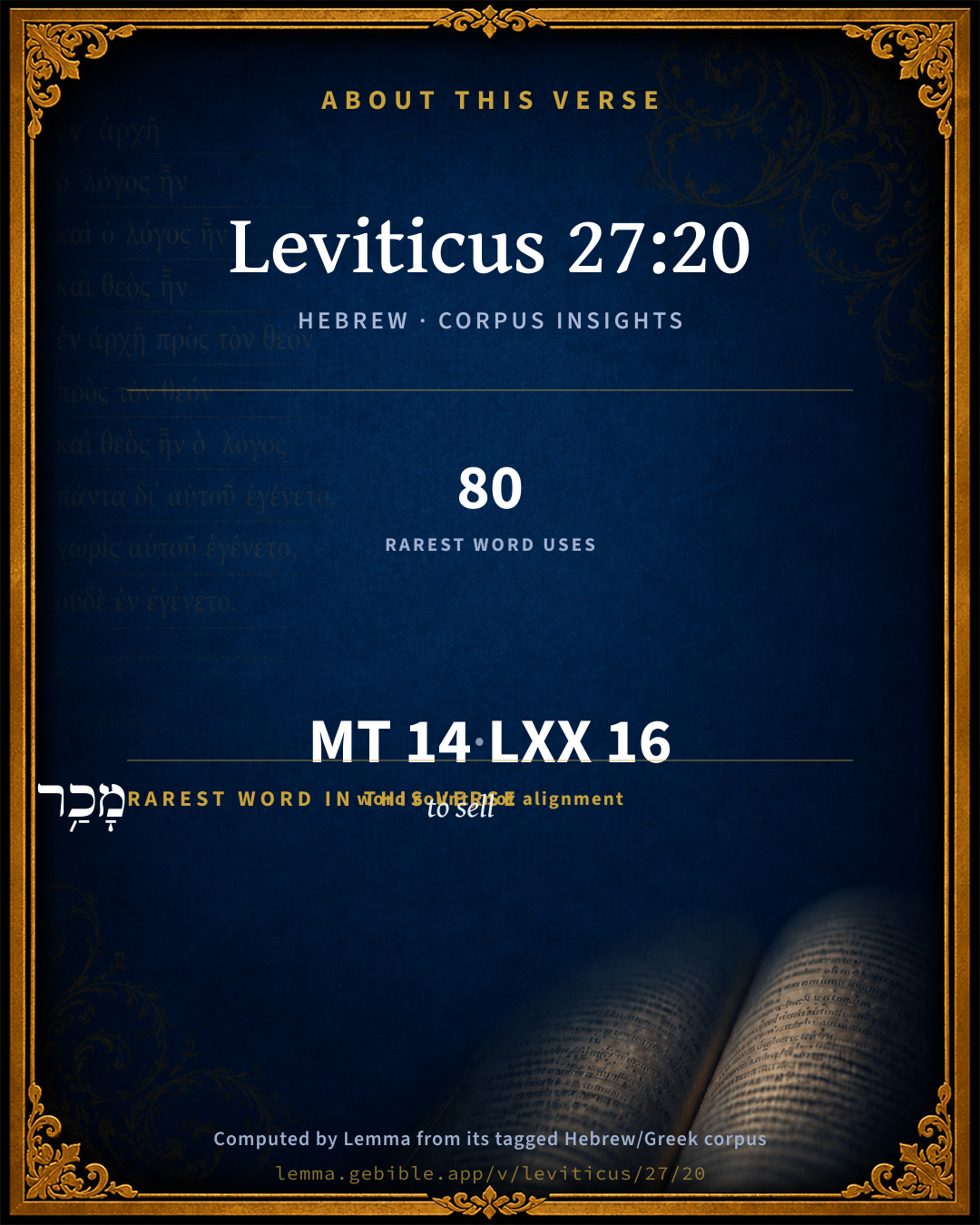
14
words
9
distinct lemmas
Pentateuch
section

Grammatical profile

  • 3 verbs
  • 3 nouns
  • 1 adjective
  • 2 conjunctions
  • 1 adverb
  • 4 particles

Verb forms

  • יִגְאַל֙ Qal · Imperfect
  • מָכַ֥ר Qal · Perfect
  • יִגָּאֵ֖ל Niphal · Imperfect

Repetition

Words recur within this verse — often emphatic in Hebrew:

  • יִגְאַל֙ to redeem H1350 ×2
  • הַשָּׂדֶ֔ה field H7704 ×2
  • וְאִם if H518 ×2
  • לֹ֤א not H3808 ×2

Hebrew & Septuagint length

In English translation the verse runs 24 words from the Hebrew and 22 from the Septuagint (LXX English) — closely comparable.

A rough comparison of the two English renderings, which tokenize alike — not a word-level alignment.

Word counts can differ between the Hebrew and the Greek without any difference in meaning — e.g. the Hebrew direct-object marker אֵת has no separate Greek word, and Greek often adds the article ὁ.

In the original languages it is 14 Hebrew tokens and 16 Greek tokens — but the two are counted differently (Hebrew bundles its prefixes and suffixes into one token; the Greek is in lemma form), so that isn’t a like-for-like length.

Hebrew and Greek witnesses Masoretic Hebrew ↔ Greek Septuagint

The same verse in the two great witnesses to the Old Testament, shown verse-for-verse.

These are two independent witnesses, not word-aligned to each other, and the Septuagint is shown in lemma (dictionary) form.

Hebrew Leviticus 27:20 Masoretic · Westminster Leningrad Codex

וְאִם לֹ֤א יִגְאַל֙ אֶת הַשָּׂדֶ֔ה וְאִם מָכַ֥ר אֶת הַשָּׂדֶ֖ה לְאִ֣ישׁ אַחֵ֑ר לֹ֥א יִגָּאֵ֖ל עֽוֹד

If he will not redeem the field, or if he has sold the field to another man, it shall not be redeemed any more;

World English Bible · Public Domain

Greek LXX Leviticus 27:20 Septuagint · lemma form

ἐάν δέ μή λυτρόω ὁ ἀγρός καί ἀποδίδωμι ὁ ἀγρός ἄνθρωπος ἕτερος οὐκέτι μή λυτρόω αὐτός

And if he do not redeem the field, but should sell the field to another man, he shall not after redeem it.

LXX2012 (modern English Septuagint) · Public Domain

Hebrew: Westminster Leningrad Codex (CC BY 4.0). Greek: Septuagint (public domain); English from LXX2012 (modern English Septuagint) (Public Domain). How the Septuagint differs from the Hebrew →

Targum (Aramaic paraphrase)

2

The Targum is the ancient Jewish Aramaic paraphrase of the Hebrew Scriptures — an interpretive translation, not the Hebrew text itself. Onkelos (literal) and Pseudo-Jonathan (expansive) render the Torah, and Jonathan the Prophets. Coverage is partial: where no permissively-licensed English translation exists for a verse, only the Aramaic is shown. This is verse-level text, not a word-by-word alignment to the Hebrew.

  1. Targum Onkelos Torah (Genesis–Deuteronomy)
    וְאִם לָא יִפְרוֹק יָת חַקְלָא וְאִם זַבִּין יָת חַקְלָא לִגְבַר אָחֳרָן לָּא יִתְפָּרַק עוֹד

    (no public-domain English translation for this verse)

    Targum Onkelos — Aramaic: “Onkelos Genesis” (public domain); “Onkelos Exodus” (public domain); “Onkelos Leviticus” (public domain); “Onkelos Numbers” (public domain); “Onkelos Deuteronomy” (public domain). English: “Sefaria Community Translation” (CC0 1.0 (public-domain dedication)); “J.W. Etheridge. The Targums of Onkelos and Jonathan Ben Uzziel on the Pentateuch. London: Longmans, Green, 1862” (public domain). Text via Sefaria.

  2. Targum Pseudo-Jonathan Torah (Genesis–Deuteronomy)
    וְאִין לָא יִפְרוֹק יַת חַקְלָא וְאִין זַבִּין יַת חַקְלָא לִגְבַר חוֹרַן לָא יִתְפְּרֵק תּוּב

    But if he will not redeem the field, but sell it to another man, it shall not be redeemed again:

    Targum Pseudo-Jonathan — Aramaic: “Targum Jonathan on Genesis” (public domain); “Targum Jonathan on Exodus” (public domain); “Targum Jonathan on Leviticus” (public domain); “Targum Jonathan on Numbers” (public domain); “Targum Jonathan on Deuteronomy” (public domain). English: “The Targum of Jonathan ben Uzziel, trans. J. W. Etheridge, London, 1862” (public domain). Text via Sefaria.

Commentary

Notes on Leviticus 27:20 from classic Christian and Jewish commentators (each source and its license shown beneath its notes). The classic Christian expositions comment on the surrounding passage and are grouped to its opening verse, so a note may address several verses; the Jewish commentaries on the Tanakh (Rashi and others) are per-verse, so they appear only where the commentator wrote on this verse.

Lemma curates 59 commentaries, every one of them public domain or Creative Commons licensed, each selected and text-cleaned for this edition rather than reprinted as found. About our sources →

Trapp's Complete Commentary

John Trapp

Lev 27:20 And if he will not redeem the field, or if he have sold the field to another man, it shall not be redeemed any more.

Ver. 20. Or if he have sold the field.] And so, sacrilegiously robbed God.

John Trapp, A Commentary or Exposition upon All the Books of the Old and New Testament (1647–1656) — public domain. Text from a community e-Sword module.

Geneva Bible (1599)

Geneva Bible translators

For their own necessity or godly uses.

Geneva Bible (1599) marginal notes — public domain. Text via Bolls.life.

Ellicott's Commentary for English Readers

(20) And if he will not redeem the field.—That is, if after all the advantages which the law affords to the vower to redeem his patrimonial inheritance before the jubile year, he is base enough to forego the privilege of redemption, thus showing no desire to perpetuate his family name,—

Or if he have sold the field to another man.—Better, and if he yet sells the field to another man, that is, if in addition to this absence of family honour he surreptitiously sells the field which he has vowed to the sanctuary to another man, thus adding sacrilege to baseness,—

It shall not be redeemed any more,—then he loses all right ever to redeem it at all.

A Bible Commentary for English Readers, edited by Charles John Ellicott (1878–1897) — public domain. Text from a community e-Sword module.

John Gill's Exposition

But the field, when it goeth out in the jubilee,.... Out of the hand of him that bought it:

shall be holy unto the Lord, as a field devoted; though it went out of the hand of the purchaser, it did not return to him that sanctified or devoted it, but was separated to sacred uses for the service of the Lord; for every devoted thing, whether of man, beast, or field, was most holy to the Lord, Lev 27:28,

the possession thereof shall be the priests'; it did not return to the treasurer of the sanctuary, who had sold it to another for the repair of the temple, as Jarchi observes, but as a devoted field it was given to the priests, as it is said, "everything devoted in Israel shall be thine", Num 18:14; and even this was divided, as he says, between the priests of that ward or course that happened to be on the day of atonement of the jubilee year: but in case it never was redeemed, but remained sanctified in the year of jubilee, the priests did not possess it without paying for it; and so the Jewish canon runs (c),"the jubilee comes, and the field is not redeemed, the priests enter into it, and pay the price of it;''on which one of the commentators (d) observes, when anyone has redeemed it, the money becomes sacred for the repairs of the temple; and when the jubilee comes, it goes out (i.e. of the hands of the purchaser) to the priests freely; but if it is not redeemed, the priests must pay the price of fifty shekels, and take it; and if even it was bought by a priest before out of the hands of the treasurer, it went from him to his brethren the priests, in the year of jubilee: the rule is this,"if any of the priests redeem it, and, lo, it is in his possession, he may not say, seeing it goes out to the priests in the year of jubilee, lo, it is in my possession, lo, it is mine, but it shall go out to all his brethren the priests (e).''

(c) Misn. Eracin, c. 7. sect. 4. (d) Bartenora in ib. (e) Misn. Eracin, c. 7. sect. 3.

John Gill's Exposition of the Whole Bible (1746–1763) — public domain (CC PDM 1.0). Text via the HelloAO Bible API.

Matthew Poole's English Annotations

If he will not redeem the field, to wit, when the priest shall set a price upon it, and offer it to him in the first place to redeem it.

If he have sold; he, who? Either,

1. The man that vowed it; if he after such a vow made shall neglect to pay his vow, and shall sacrilegiously sell the same land to another man; or, if he sell it, i.e. suffer it to be sold to another, and will not prevent that by redeeming it to himself. Or rather,

2. The priest, or some in his name, who, though not expressed, is sufficiently understood out of the foregoing clause, If he will not redeem or buy again the field, to wit, of the priest, who is now the seller of it; or, or rather and, for this seems to be added by way of accumulation, if he, i.e. the priest, of whom he might have redeemed it, upon his refusal, offers it to sale, and

have sold the field to another man. Add to this, that none but the priest could sell this land, after it was once vowed and declared to be so, and offered by the priest to him again to redeem it, which is apparently the present case.

It shall not be redeemed any more, i.e. he shall for ever lose the benefit of redemption.

Matthew Poole's English Annotations on the Holy Bible (1683–1685) — public domain. Text from a community e-Sword/MySword module.

Whedon's Commentary on the Bible

Daniel D. Whedon

20. If he will not redeem — Since the priests were employed in the sanctuary and could not secularize themselves by cultivating patches of land scattered through the country, the land vowed lay idle or was still cultivated by its proprietor. As a penalty for his neglect to pay the redemption year by year, the land was forfeited to the sanctuary in the jubilee. “Hence it is to be inferred that a consecrated field must have been redeemed before the jubilee unless any one manifestly wished it to be alienated.” — Clericus.

If he have sold — Knobel thinks that only culpable caprice or dishonesty could have induced the proprietor to sell a field after he had vowed it to the Lord. The fact that it became irredeemable after such an act seems to favour this theory. The fault, for which the forfeiture of the field is a penalty, may have consisted in the fact that he still assumed undisputed ownership of a field which he had solemnly consecrated to the Lord, to whose rights he had done violence by the sale.

Daniel D. Whedon (gen. ed.), Commentary on the Old and New Testaments (1874–1909) — public domain. Text from a community e-Sword module.

John Wesley's Explanatory Notes

If he will not redeem it - When the priest shall set a price upon it, and offer it to him in the first place to redeem it: or, rather and, for this seems to be added by way of accumulation, if he, that is, the priest, of whom he might have redeemed it, upon his refusal, offers it to sale, and have sold the field to another man - He shall forever lose the benefit of redemption.

John Wesley, Explanatory Notes Upon the Whole Bible (1754–1765) — public domain. Text via the GEBible commentary corpus.

Rashi

Rabbi Shlomo Yitzchaki (Rashi)

ואם לא יגאל את השדה AND IF HE WILL NOT REDEEM THE FIELD— “he” means, the man who dedicated it,

ואם מכר OR IF HE HATH SOLD — “he”: the treasurer of the Temple property has sold (Arakhin 25b),

את השדה לאיש אחר לא יגאל עוד THE FIELD TO ANOTHER MAN, IT SHALL NOT BE REDEEMED ANY MORE so as to return into the possession of him who dedicated it.

Rashi on the Tanakh — English translations: “The Judaica Press complete Tanach with Rashi, translated by A. J. Rosenberg” (CC BY 4.0); “Pentateuch with Rashi's commentary by M. Rosenbaum and A.M. Silbermann, 1929-1934” (public domain); “The Metsudah Tanach series, Lakewood, N.J” (CC BY 4.0); and “The Book of Joshua, Metsudah Publications, 1997” (CC BY 4.0). Text via Sefaria.

Lesson kit

Teaching starters — assembled from the data on this page, not authored interpretation. Every prompt links to the verse data it draws on. Edit before teaching.

Leviticus, in the Pentateuch, opens this verse with 14 words (9 distinct Hebrew lemmas). Its most distinctive word is mâkar (“to sell”). A historical commentator’s framing appears above. Read the whole chapter for the surrounding context.

Discussion questions

  1. What does “to sell” (mâkar) contribute to the verse as a whole?
  2. What does the repetition of “to redeem” (2× in this one verse) do in this verse?
  3. These translations render this verse differently. What is at stake in choosing one wording over another?
  4. «יִגְאַל֙» is a Qal Imperfect verb. How does that grammatical form shape the action described?
  5. Compare how Trapp's Complete Commentary and Geneva Bible (1599) read this verse. Where do they agree or differ?

Things to notice

Reading settings

Reading text

Shown beneath each verse's original-language words.

Old Testament
Old Testament edition

Read the OT as the Masoretic Hebrew (MT) or the Greek Septuagint (LXX).

English shown for the Greek Septuagint (in the Hebrew ↔ Greek comparison).

Comparing translations? Open the Compare panel on any verse page to stack up to four side by side.