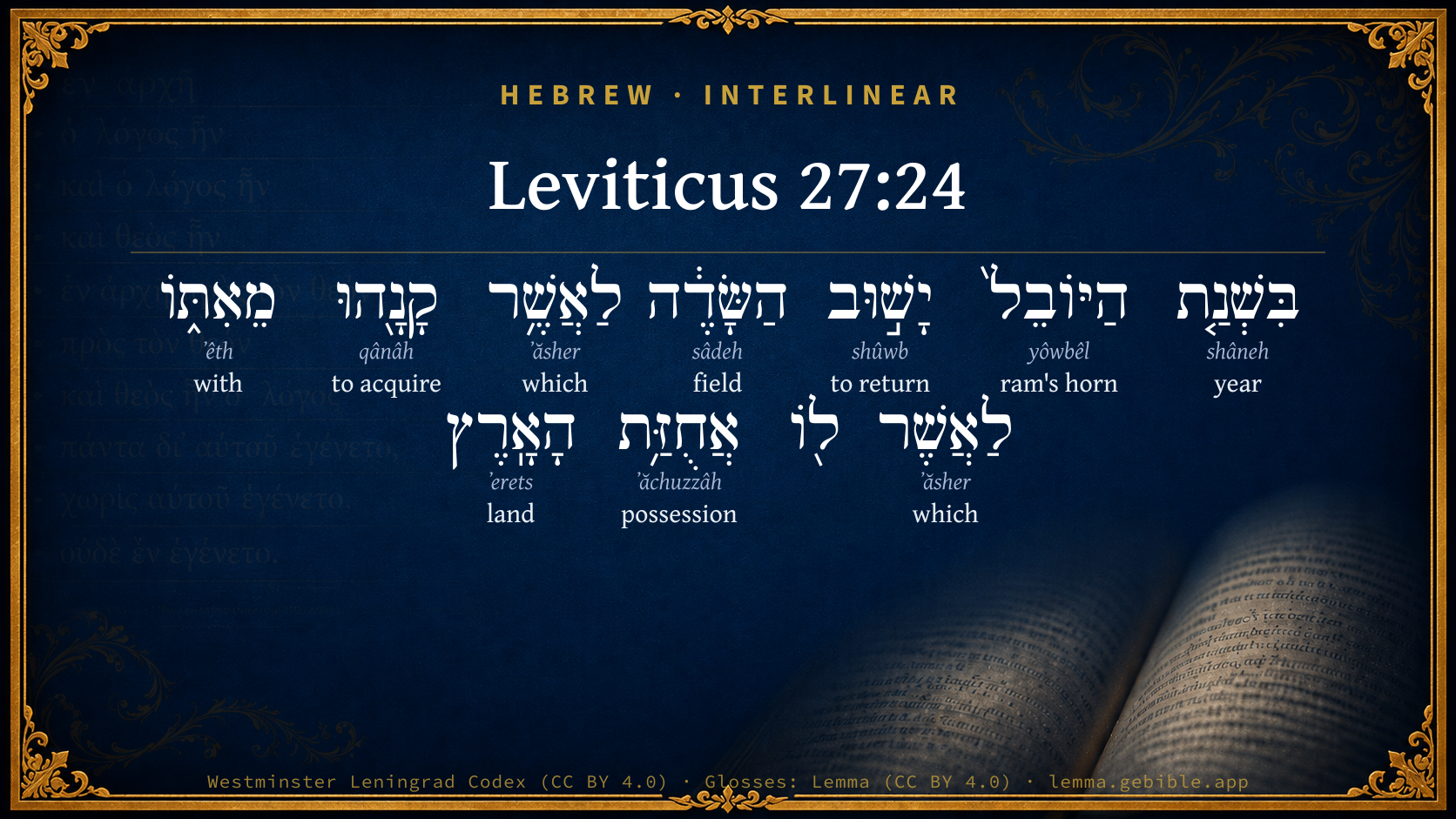
Leviticus 27:24

Hebrew (Westminster Leningrad Codex) Leviticus 27:24 appears in the Hebrew Old Testament. The text above is from the Westminster Leningrad Codex. Each word links to its Strong’s number, a concise gloss, and parsing drawn from the Open Scriptures Hebrew Bible morphology. Click any word for its full Brown-Driver-Briggs (BDB) entry.
Download image
Cite this verse

Leviticus 27:24 (World English Bible). Public Domain. Lemma interlinear Bible study tool, https://lemma.gebible.app/v/leviticus/27/24.

Show BibTeX & RIS
BibTeX
RIS
English Translation
In the Year of Jubilee the field shall return to him from whom it was bought, even to him to whom the possession of the land belongs.
World English Bible · Public Domain
Download a study sheet

One document with this verse’s original text, its word-by-word gloss line, the meaning frame, cross-references with their text, attributed commentary, and full source and license credits — printable, and it pastes into notes with its structure intact.

This verse Autodidact and up

Study sheet (.html) Plain text (.txt)

A passage Seminary Student

Up to 50 verses in one chapter. A passage sheet keeps up to 6 commentary sources and 12 cross-references per verse, in the order this page ranks them, and says so on the sheet whenever that leaves anything out. Ask for a single verse and you get the Autodidact verse sheet above.

Everything on this page stays free to read, with no account — the sheet is a download of what is already on screen, not access to it.

Want to remove ads? Support Godless Engineer
Compare translations 3

The same verse in 3 English versions, stacked beneath the original-language interlinear above. Click any original word for its lexicon entry.

Each is an independent rendering of the whole verse — the interlinear is not word-aligned to these translations.

Highlighted words mark where these versions differ — a whole-verse word diff, not a word-by-word alignment.

  • World English Bible Public Domain
    In the Year of Jubilee the field shall return to him from whom it was bought, even to him to whom the possession of the land belongs.
  • King James Version Public Domain
    In the year of the jubilee the field shall return unto him of whom it was bought, even to him to whom the possession of the land did belong.
  • unfoldingWord Literal Text CC BY-SA 4.0
    In the year of the jubilee the field will return to him from whom he bought it, to whom to him the possession of the land.

unfoldingWord Literal Text — © unfoldingWord, licensed CC BY-SA 4.0. Word-aligned USFM3 via Door43 (git.door43.org/unfoldingWord/en_ult).

Versions to compare (up to 4)

3 of 4 selected

Show all 18 translations

Every available English version of this verse, each an independent rendering of the whole verse.

  • World English Bible Public Domain
    In the Year of Jubilee the field shall return to him from whom it was bought, even to him to whom the possession of the land belongs.
  • Berean Standard Bible Public Domain
    In the Year of Jubilee the field shall return to the one from whom it was bought—the original owner of the land.
  • Majority Standard Bible Public Domain
    In the Year of Jubilee the field shall return to the one from whom it was bought—the original owner of the land.
  • King James Version Public Domain
    In the year of the jubilee the field shall return unto him of whom it was bought, even to him to whom the possession of the land did belong.
  • American Standard Version (1901) Public Domain
    In the year of jubilee the field shall return unto him of whom it was bought, even to him to whom the possession of the land belongeth.
  • Revised Version (1885) Public Domain
    In the year of jubile the field shall return unto him of whom it was bought, even to him to whom the possession of the land belongeth.
  • Geneva Bible (1599) Public Domain
    But in the yeere of Iubile, the fielde shall returne vnto him, of whome it was bought: to him, I say, whose inheritance the land was.
  • Douay-Rheims (1899) Public Domain
    But in the jubilee, it shall return to the former owner, who had sold it, and had it in the lot of his possession.
  • Young's Literal Translation Public Domain
    in the year of the jubilee the field returneth to him from whom he bought it, to him whose `is' the possession of the land.
  • Literal Standard Version CC BY-SA 4.0
    in the Year of the Jubilee the field returns to him from whom he bought it, to him who [has] the possession of the land.
  • Unlocked Literal Bible CC BY-SA 4.0
    In the year of Jubilee, the field will return to the man from whom it was bought, to the land's owner.
  • unfoldingWord Literal Text CC BY-SA 4.0
    In the year of the jubilee the field will return to him from whom he bought it, to whom to him the possession of the land.
  • Darby Bible Public Domain
    In the year of the jubilee the field shall return unto him of whom it was bought -- to him to whom the land belonged.
  • World Messianic Bible Public Domain
    In the Year of Jubilee the field shall return to him from whom it was bought, even to him to whom the possession of the land belongs.
  • Webster's Bible Public Domain
    In the year of the jubilee, the field shall return to him of whom it was bought, even to him to whom the possession of the land belonged.
  • Free Bible Version CC BY-SA 4.0
    In the Jubilee Year, ownership of the field shall revert back to the person you bought it from—to the original owner of the land.
  • Bible in Basic English Public Domain
    In the year of Jubilee the field will go back to him from whom he got it, that is, to him whose heritage it was.
  • JPS Tanakh (1917) Public Domain
    In the year of jubilee the field shall return unto him of whom it was bought, even to him to whom the possession of the land belongeth.

Literal Standard Version (2020), Covenant Press — licensed CC BY-SA 4.0. Text via the HelloAO Bible API (eBible.org). Unlocked Literal Bible (unfoldingWord) — licensed CC BY-SA 4.0. Text via the HelloAO Bible API (eBible.org). unfoldingWord Literal Text — © unfoldingWord, licensed CC BY-SA 4.0. Word-aligned USFM3 via Door43 (git.door43.org/unfoldingWord/en_ult). Free Bible Version, Dr. Jonathan Gallagher — licensed CC BY-SA 4.0. Text via the HelloAO Bible API (eBible.org).

Word by word

More ways to search: Search by grammar → Find every occurrence → Compare this word →

Practice this passage: Drill this verse → Learn its vocabulary →

הַיּוֹבֵל֙
yôwbêl
H3104
“the · ram's horn”
Particle, Definite Article + Noun, Common, Masculine, Singular, Absolute
Part of Speech
Particle + Noun
Type
Common
Gender
Masculine
Number
Singular
State
Absolute
Full BDB Definition

Origin: apparently from H2986

TWOT: 835e

ram, ram's horn, trumpet, cornet - ram (only in combination) - ram's horn, trumpet - jubilee year (marked by the blowing of cornets) (metonymy)
  1. בִּשְׁנַ֤ת shâneh H8141 “in/at · year of” Preposition + Noun, Common, Feminine, Singular, Construct
  2. יָשׁ֣וּב shûwb H7725 “to return” Verb, Qal, Imperfect, 3rd Person, Masculine, Singular
  3. הַשָּׂדֶ֔ה sâdeh H7704 “the · field” Particle, Definite Article + Noun, Common, Masculine, Singular, Absolute
  4. לַאֲשֶׁ֥ר ʼăsher H834 “to/for · which” Preposition + Particle, Relative
  5. קָנָ֖הוּ qânâh H7069 “to acquire · him” Verb, Qal, Perfect, 3rd Person, Masculine, Singular + Suffix, Personal, 3rd Person, Masculine, Singular
  6. מֵאִתּ֑וֹ ʼêth H854 “from · with · him” Preposition + Preposition + Suffix, Personal, 3rd Person, Masculine, Singular
  7. לַאֲשֶׁר ʼăsher H834 “to/for · which” Preposition + Particle, Relative
  8. אֲחֻזַּ֥ת ʼăchuzzâh H272 “possession of” Noun, Common, Feminine, Singular, Construct
  9. הָאָֽרֶץ ʼerets H776 “the · land” Particle, Definite Article + Noun, Common, Both, Singular, Absolute

About this verse

These counts appear in no published source. They are computed here, from the morphology-tagged text and Lemma’s own curated glosses. What Lemma adds →

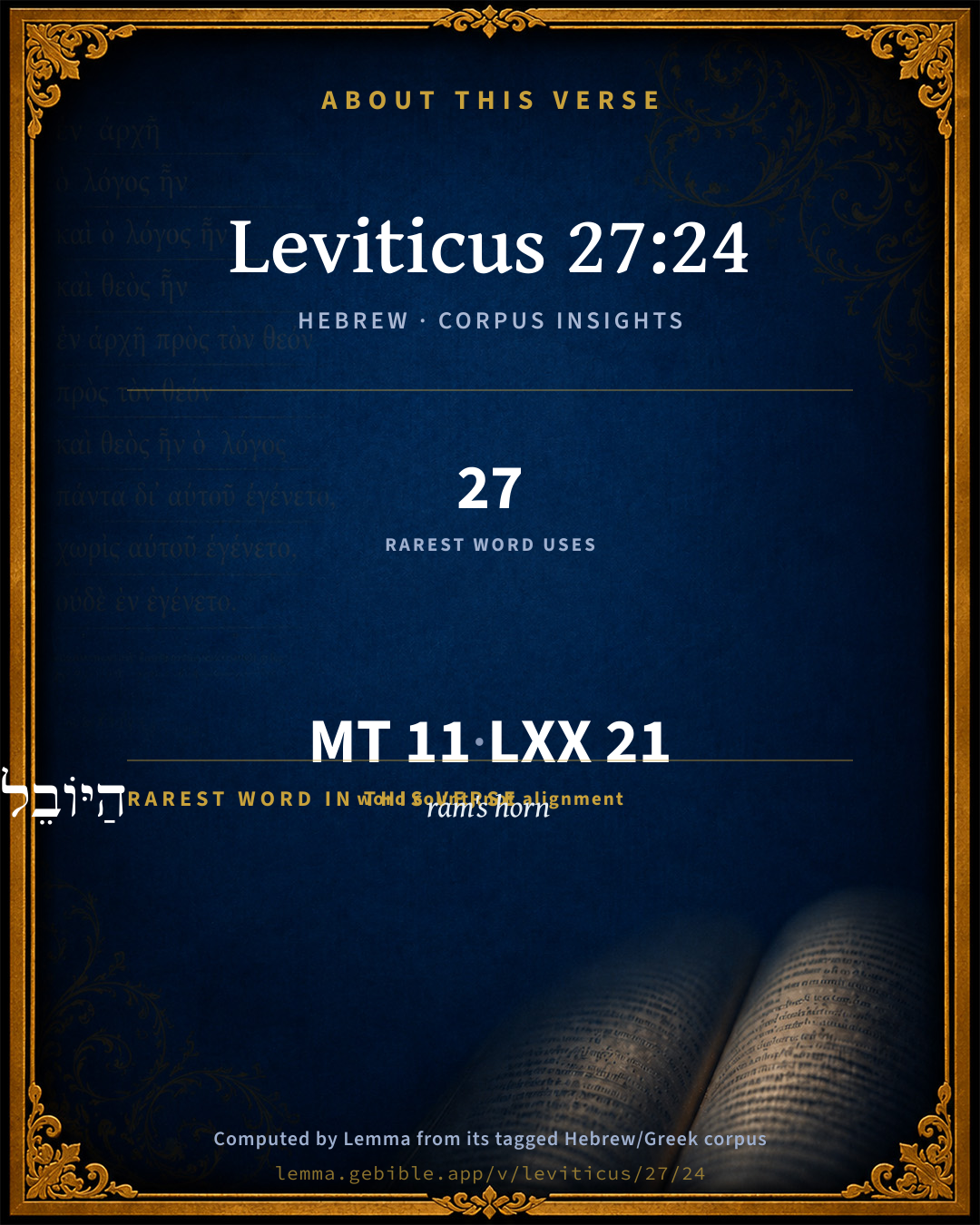
11
words
9
distinct lemmas
Pentateuch
section

Shared distinctive vocabulary

הַיּוֹבֵל֙ ram's horn H3104 occurs in 25 verses of the Hebrew Bible. Also found in:

Grammatical profile

  • 2 verbs
  • 5 nouns
  • 2 prepositions
  • 2 particles

Verb forms

  • יָשׁ֣וּב Qal · Imperfect
  • קָנָ֖הוּ Qal · Perfect

Repetition

A word recurs within this verse — often emphatic in Hebrew:

  • לַאֲשֶׁ֥ר which H834 ×2

Hebrew & Septuagint length

In English translation the verse runs 27 words from the Hebrew and 27 from the Septuagint (LXX English) — the same length.

A rough comparison of the two English renderings, which tokenize alike — not a word-level alignment.

Word counts can differ between the Hebrew and the Greek without any difference in meaning — e.g. the Hebrew direct-object marker אֵת has no separate Greek word, and Greek often adds the article ὁ.

In the original languages it is 11 Hebrew tokens and 21 Greek tokens — but the two are counted differently (Hebrew bundles its prefixes and suffixes into one token; the Greek is in lemma form), so that isn’t a like-for-like length.

Cross-references

2

Topical passages linked to Leviticus 27:24 in the Treasury of Scripture Knowledge — connected by theme and wording, ordered by reader-vote popularity; previews shown in the World English Bible.

  • Leviticus 25:28 But if he isn't able to get it back for himself, then what he has sold shall remain in the hand of him who has bought it until the Year of Jubilee: and in the Jubilee it shall be released, and he shall return to his propery.
  • Leviticus 27:20 If he will not redeem the field, or if he has sold the field to another man, it shall not be redeemed any more;

Cross-references courtesy of OpenBible.info (CC BY 4.0).

Hebrew and Greek witnesses Masoretic Hebrew ↔ Greek Septuagint

The same verse in the two great witnesses to the Old Testament, shown verse-for-verse.

These are two independent witnesses, not word-aligned to each other, and the Septuagint is shown in lemma (dictionary) form.

Hebrew Leviticus 27:24 Masoretic · Westminster Leningrad Codex

בִּשְׁנַ֤ת הַיּוֹבֵל֙ יָשׁ֣וּב הַשָּׂדֶ֔ה לַאֲשֶׁ֥ר קָנָ֖הוּ מֵאִתּ֑וֹ לַאֲשֶׁר ל֖וֹ אֲחֻזַּ֥ת הָאָֽרֶץ

In the Year of Jubilee the field shall return to him from whom it was bought, even to him to whom the possession of the land belongs.

World English Bible · Public Domain

Greek LXX Leviticus 27:24 Septuagint · lemma form

καί ἐν ὁ ἐνιαυτός ὁ ἄφεσις ἀποδίδωμι ὁ ἀγρός ὁ ἄνθρωπος παρά ὅς κτάομαι αὐτός ὅς εἰμί ὁ κατάσχεσις ὁ γῆ

And in the year of release the land shall be restored to the man of whom the other bought it, whose the possession of the land was.

LXX2012 (modern English Septuagint) · Public Domain

Hebrew: Westminster Leningrad Codex (CC BY 4.0). Greek: Septuagint (public domain); English from LXX2012 (modern English Septuagint) (Public Domain). How the Septuagint differs from the Hebrew →

Targum (Aramaic paraphrase)

2

The Targum is the ancient Jewish Aramaic paraphrase of the Hebrew Scriptures — an interpretive translation, not the Hebrew text itself. Onkelos (literal) and Pseudo-Jonathan (expansive) render the Torah, and Jonathan the Prophets. Coverage is partial: where no permissively-licensed English translation exists for a verse, only the Aramaic is shown. This is verse-level text, not a word-by-word alignment to the Hebrew.

  1. Targum Onkelos Torah (Genesis–Deuteronomy)
    בְּשַׁתָּא דְיוֹבֵלָא יְתוּב חַקְלָא לִדְזַבְנֵהּ מִנֵהּ לִדְדִילֵהּ אַחֲסָנַת אַרְעָא

    (no public-domain English translation for this verse)

    Targum Onkelos — Aramaic: “Onkelos Genesis” (public domain); “Onkelos Exodus” (public domain); “Onkelos Leviticus” (public domain); “Onkelos Numbers” (public domain); “Onkelos Deuteronomy” (public domain). English: “Sefaria Community Translation” (CC0 1.0 (public-domain dedication)); “J.W. Etheridge. The Targums of Onkelos and Jonathan Ben Uzziel on the Pentateuch. London: Longmans, Green, 1862” (public domain). Text via Sefaria.

  2. Targum Pseudo-Jonathan Torah (Genesis–Deuteronomy)
    בְּשַׁתָּא דְיוֹבְלָא יְתוּב חַקְלָא לְמַן דְזַבְּנֵיהּ מִנֵיהּ לְמַן דִילֵיהּ אַחֲסָנַת אַרְעָא

    In the year of Jubela the field shall return to him from whom he bought it, to him who had the inheritance of the land.

    Targum Pseudo-Jonathan — Aramaic: “Targum Jonathan on Genesis” (public domain); “Targum Jonathan on Exodus” (public domain); “Targum Jonathan on Leviticus” (public domain); “Targum Jonathan on Numbers” (public domain); “Targum Jonathan on Deuteronomy” (public domain). English: “The Targum of Jonathan ben Uzziel, trans. J. W. Etheridge, London, 1862” (public domain). Text via Sefaria.

Commentary

Notes on Leviticus 27:24 from classic Christian and Jewish commentators (each source and its license shown beneath its notes). The classic Christian expositions comment on the surrounding passage and are grouped to its opening verse, so a note may address several verses; the Jewish commentaries on the Tanakh (Rashi and others) are per-verse, so they appear only where the commentator wrote on this verse.

Lemma curates 59 commentaries, every one of them public domain or Creative Commons licensed, each selected and text-cleaned for this edition rather than reprinted as found. About our sources →

Ellicott's Commentary for English Readers

(24) The field shall return unto him of whom it was bought.—In accordance with the law laid down in Lev_25:23-28, the field thus vowed did not return to the purchaser in the year of jubile, but to the, hereditary owner, of whom the person who had vowed it to the Lord had bought it.

A Bible Commentary for English Readers, edited by Charles John Ellicott (1878–1897) — public domain. Text from a community e-Sword module.

John Gill's Exposition

And all thy estimation shall be according to the shekel of the sanctuary,.... The shekel kept in the sanctuary, which was the standard of all shekels; not that there was a shekel in the sanctuary different from the common one; for every shekel ought to have been as that, of the full weight and worth of it; and the estimation was to be according to such a shekel, and the money paid in such, even in full weight:

twenty gerahs shall be the shekel; which the Targum of Jonathan calls "meahs" or "oboli", one of which was about three halfpence of our money, scarce so much, and weighed near eleven grains, as Bishop Cumberland (i) has calculated: see Eze 45:12.

(i) Of Scripture Weights and Measures, ch. 4. p. 111.

John Gill's Exposition of the Whole Bible (1746–1763) — public domain (CC PDM 1.0). Text via the HelloAO Bible API.

Matthew Poole's English Annotations

By original right, which no other person by vow or otherwise could give away from him.

Matthew Poole's English Annotations on the Holy Bible (1683–1685) — public domain. Text from a community e-Sword/MySword module.

unfoldingWord translationNotes

Door43 World Missions Community

the man from whom it was bought ... the land's owner

These two phases refer to the same person. Normally the land would be bought from its owner.

the man from whom it was bought

This can be stated in active form. AT: "the man who sold it" (See: Active or Passive)

All the valuations must be set

This can be stated in active form. AT: "The priests must determine the estimated values" (See: Active or Passive)

by the weight of the sanctuary shekel

There were shekels of different weights. This is the one that people had to use in the sanctuary of the sacred tent. (See: Biblical Weight)

Twenty gerahs must be the equivalent of one shekel

The purpose of this sentence is to tell how much the sanctuary shekel weighs. The gerah was the smallest unit of weight that the Israelites used. AT: "One shekel must equal twenty gerahs" (See: Biblical Weight)

Twenty gerahs must be the equivalent of one shekel

If it is necessary to use modern weight units, here is a way to do it. AT: "One shekel must weigh ten grams" (See: Numbers and Biblical Weight)

translationWords

sanctuary

unfoldingWord translationNotes — © Distant Shores Media and the Door43 World Missions Community, licensed CC BY-SA 4.0. Source: git.door43.org/Door43/en_tn.

Lesson kit

Teaching starters — assembled from the data on this page, not authored interpretation. Every prompt links to the verse data it draws on. Edit before teaching.

Leviticus, in the Pentateuch, opens this verse with 11 words (9 distinct Hebrew lemmas). Its most distinctive word is yôwbêl (“ram's horn”). A historical commentator’s framing appears above. Read the whole chapter for the surrounding context.

Discussion questions

  1. What does “ram's horn” (yôwbêl) contribute to the verse as a whole?
  2. How does Exodus 19:13, which shares the word «ram's horn», read alongside this verse?
  3. What does the repetition of “which” (2× in this one verse) do in this verse?
  4. The translations on this page render this verse differently — a whole-verse word diff, not a word-by-word alignment. What might account for the different wordings?
  5. «יָשׁ֣וּב» is a Qal Imperfect verb. How does that grammatical form shape the action described?
  6. Compare how Ellicott's Commentary for English Readers and John Gill's Exposition read this verse. Where do they agree or differ?

Things to notice

Reading settings

Reading text

Shown beneath each verse's original-language words.

Old Testament
Old Testament edition

Read the OT as the Masoretic Hebrew (MT) or the Greek Septuagint (LXX).

English shown for the Greek Septuagint (in the Hebrew ↔ Greek comparison).

Comparing translations? Open the Compare panel on any verse page to stack up to four side by side.